Charoset’s many variations

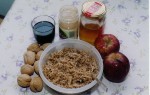
Ashkenazi-style charoset: apples, walnuts, cinnamon and red wine. (photo by Yoninah via commons.wikimedia.org)

What Passover seder symbol is common to all communities but is not mentioned in the biblical passage that enjoins us to eat the paschal offering, matza and bitter herbs? Charoset.

Charoset is loosely defined as a paste of fruit, spices and wine, symbolic of the mortar used by the Hebrews when they were slaves in Egypt.

The word is of unknown origin but may be from the word heres, meaning clay, because of its color. The custom of eating charoset is thought to have come from the time of the Babylonians, who dipped food in relishes or sauces to add flavor.

Some years ago, I surprised all my seder guests by serving both the traditional Ashkenazi version and a Sephardi version of charoset, which everyone loved and wanted in future years.

The New York Times Passover Cookbook, edited by Linda Amster, says that the Iraqi version of charoset is one of the oldest and most time-consuming recipes, dating back to the Babylonian exile of 579 BCE. Made into a jam from dates, grapes, pomegranate and honey, it was a sweetener in the ancient world and is still used by Iraqi, Burmese, Syrian and Indian Jews.

The Talmud says charoset must be sharp in taste and similar to clay in substance and color. Differing geographies is one of the reasons there are differing charoset recipes.

Ashkenazim tend to use apples, chopped almonds, cinnamon, red wine and perhaps even matza meal; sometimes walnuts or other nuts are used. Sephardi and Mizrahi Jews tend to use fruits that grew in Eretz Israel in biblical times, such as grapes, figs, dates, almonds and pomegranates. Israelis often turn charoset into a dessert by adding bananas, dates, orange juice and/or sugar.

Abraham Chill, author of The Minhagim (The Customs), writes that each ingredient symbolizes something different from the Egypt experience. The mixture as a whole stands for the mortar used by the Jews in making bricks, and the cinnamon resembles the color of the bricks they made. Wine represents the blood of the Jewish infants thrown into the Nile. Almonds are used because the Hebrew word for almond, shaked, is also a word that means to accelerate, as G-d accelerated the end of slavery. Apples are used because it was said that Jewish women during that time gave birth to their babies under apple trees in order to avoid detection by the Egyptians.

In her book The Jewish Holiday Kitchen, Joan Nathan states that charoset is “one of the most popular and discussed ritual foods served at the seder.” She says the fruits and nuts refer to verses in the Song of Songs, which mention an apple tree and the garden of nuts; the red wine recalls the Red Sea.

Because the maror or bitter herb is so strong, some say that the real purpose of charoset is to allay the bitterness. As part of the seder, the charoset and maror are placed between matzot to make a sandwich, which is said to have been invented by the first century CE Rabbi Hillel, hence, its name, the “Hillel sandwich.”

There are as many variations on the ingredients of charoset as there are Jewish communities.

Jews from the island of Rhodes use dates, walnuts, ginger and sweet wine. Jews of Salonika, Greece, add raisins. Other Greek Jews use walnuts, almonds, pine nuts, raisins, cinnamon, cloves and red wine and spread it thickly on matza. Turkish Jews include orange.

A Moroccan friend told me she used some of the seven species from the Bible in her charoset: dates, almonds, nuts, pomegranate seeds, figs, wine and cinnamon. Jewish Daily Forward Food Maven columnist Matthew Goodman once wrote in the Forward that Moroccan Jews sometimes make charoset paste and roll it into balls. He says this is a legacy from Jews of medieval Spain, who made the balls of apples, dried fruit, almonds, cooked chestnuts, sugar and cinnamon (but no wine) and then drizzled the balls with white vinegar before serving.

Jews of Venice use chestnut paste, dates, figs, poppy seeds, walnuts, pine nuts, orange peel, dried apricots, raisins, brandy and honey, while Jews of Bukharia use nuts, almonds, dates, raisins, apples and wine. Egyptian charoset contains dates, nuts, banana, apples, wine, cinnamon and pomegranate seeds.

An Iraqi woman told me that instead of a paste type of charoset, they would buy a special date honey and sprinkle chopped nuts on top. Goodman, again in the Forward, explained that its foundation is a syrup, halek, made by boiling dates, straining the liquid and then reducing it over a low flame until thick. Halek is one of the earliest of all sweeteners and may be the source of the reference in “land flowing with milk and honey.” Chopped walnuts or almonds are then added to the syrup. Jews of Calcutta also follow this custom.

A Dutch woman told me that she makes a chunky mixture with more apples and only a few nuts, plus cinnamon, sugar, raisins and sweet wine. Jews from Surinam in Dutch Guiana use seven fruits and coconut.

Following the injunction to have a sharp taste, Persian Jews use dates, pistachios, almonds, raisins, apples, orange, bananas, pomegranate seeds, sweet wine, cloves, cardamom, cinnamon, vinegar and black pepper. Likewise, Yemenite Jews use dates, raisins, almonds, nuts, figs, dates, sesame seeds, apples, pomegranate seeds, grape juice, ginger, cinnamon, cardamom, cloves and black pepper. Jews from Afghanistan pound charoset in a mortar with a pestle and use walnuts, hazelnuts, almonds, apples, sweet wine, pomegranate seeds, dates and black pepper.

One exception I have found to Ashkenazim following the strictly sweet version was a friend whose father’s family came from Galicia. He recalled that their charoset was made from apples, nuts, wine, cinnamon and horseradish.

Here are but a few recipes.

CLASSIC ASHKENAZI CHAROSET

6 chopped apples
1/3 cup chopped nuts
1/4 cup raisins
1 tsp cinnamon
2 tbsp sugar
1/4 cup red sweet wine

Combine apples, nuts and raisins. Add cinnamon, sugar and wine. Depending on your preference, this can also be made in a food processor.

DATE CHAROSET

1/2 cup seeded, finely chopped dates
1/2 apple, grated
1/2 cup chopped almonds
1/8 cup red wine
1/2 tsp cinnamon
1/4 tsp ginger

Combine dates and apple. Add nuts, wine, cinnamon and ginger.

SEPHARDI CHAROSET

1/2 cup chopped dates
1/2 cup chopped raisins
1 cup chopped walnuts
1/4 cup chopped almonds
1/4 cup red wine
2 tbsp lemon juice
1/8 tsp cinnamon

Combine dates and raisins. Add walnuts, almonds, wine, lemon juice and cinnamon. Form into balls.

SPICY CHAROSET

12 figs
1 1/2 cups pitted dates
2/3 cup raisins
2 seeded oranges
2/3 cup almonds
1/2 cup dry red wine
1/4 tsp cayenne pepper
1 tsp cinnamon

In a food processor, coarsely chop figs, dates, raisins, oranges and almonds. Try to keep the fruit chunky unless you prefer it pureéd. Pour into a bowl. Add wine, cayenne, cinnamon and blend.

Sybil Kaplan is a journalist, foreign correspondent, lecturer, food writer and book reviewer who lives in Jerusalem. She also does the restaurant features for janglo.net and leads weekly shuk walks in English in Jerusalem’s Jewish food market.
Chicken for Pesach midweek

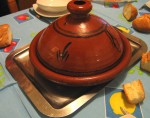
A tagine is a North African, slow-cooked savory stew, named after the earthenware clay pot in which it is cooked. (photo by Iron Bishop via commons.wikimedia.org)

After the sedarim, by midweek, you may be looking for some creative ideas for Passover dinners. Here are three dishes I frequently serve.

A mina is a traditional Sephardi savory layered pie, which is a great way to use up leftover chicken. In Spain and Turkey, it is called mina; in Egypt, maiena or mayena; in Algeria, meguena; and, in Italy, scacchi. The pie is also popular among Jews from the island of Rhodes and Yugoslavia.

A tagine is a North African, slow-cooked savory stew, named after the earthenware clay cooking pot, whose base is flat and circular with low sides. The cover is cone or dome shaped, which traps the steam and returns the condensed liquid to the pot, thus requiring very little liquid when cooking. In a chicken tagine, vegetables or dried fruit, nuts and spices are added.

Finally, leek patties known as kyeftes de prasa in Ladino, kifte in Turkish, keftas or keftes in Greek, are popular among Mediterranean Jews for Passover. I like to add chicken to mine.

CHICKEN MINA
6-8 servings

2 cups cooked, shredded chicken
1/2 cup chopped scallions
1/2 cup chopped Italian parsley
1/4 cup chopped mint
1/4 cup chopped dill
5 eggs
6 matzot
chicken soup
olive oil
1/2 cup tomato sauce
1/4 tsp nutmeg

  1. Preheat oven to 350˚F. Grease a rectangular or oval baking dish.
  2. In a bowl, combine chicken, scallions, parsley, mint and dill. Add two eggs and blend.
  3. In another bowl, combine three eggs, tomato sauce and nutmeg.
  4. Place matzot in bottom of a deep dish. Pour enough chicken soup to soften, about three minutes.
  5. Place two matzot in greased baking dish. Brush with olive oil. Spread half the chicken filling on top. Add two more matzot, brush with oil and spread rest of chicken filling on top. Top with remaining two matzot.
  6. Pour tomato sauce on top. Bake for 45 minutes. Cut into squares to serve.

CHICKEN TAGINE
8 servings

1 cup matza meal
8 pieces of chicken
4 cups chopped onions
2 cups chicken soup
1 1/2 – 3 cups prunes, apricots or other dried fruit
2 tsp cinnamon
1 tsp ginger
1/4 cup lemon juice
2 tsp lemon peel
1 cup slivered almonds
oil

  1. Place matza meal in a shallow dish. Dip chicken pieces in the meal.
  2. Heat oil in a soup pot. Add chicken and brown. Add onions, chicken soup and dried fruit and simmer until chicken is cooked.
  3. Add cinnamon, ginger, lemon juice, lemon peel, and almonds. Simmer another 20 minutes.

CHICKEN-LEEK PATTIES
6-8 servings

3 leeks
1 cup chopped onions
2 cups chopped cooked chicken
2 eggs
1 cup mashed potatoes
1/2 cup matza meal, plus extra
salt and pepper to taste
1 beaten egg
oil

  1. Place cut-up leeks and onions in a saucepan with water, bring to a boil, reduce heat and simmer 30 minutes.
  2. Drain and chop. Add chicken, eggs, 1/2 cup matza meal, mashed potato, salt and pepper and blend.
  3. Place egg in one shallow bowl and additional matza meal in the second bowl. Take chicken mixture and make into patties. Dip into beaten egg then in matza meal for coating.
  4. Refrigerate for awhile at this point if serving later. Before serving, heat oil in a frying pan and fry until patties are brown on both sides. Drain on paper towels.

Sybil Kaplan is a journalist, foreign correspondent, lecturer, food writer and book reviewer who lives in Jerusalem. She also does the restaurant features for janglo.net and leads weekly shuk walks in English in Jerusalem’s Jewish food market.
Add culinary flair to Pesach

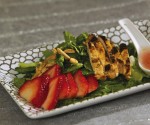
Grilled salad with chicken is one of the many tempting dishes in A Taste of Passover.

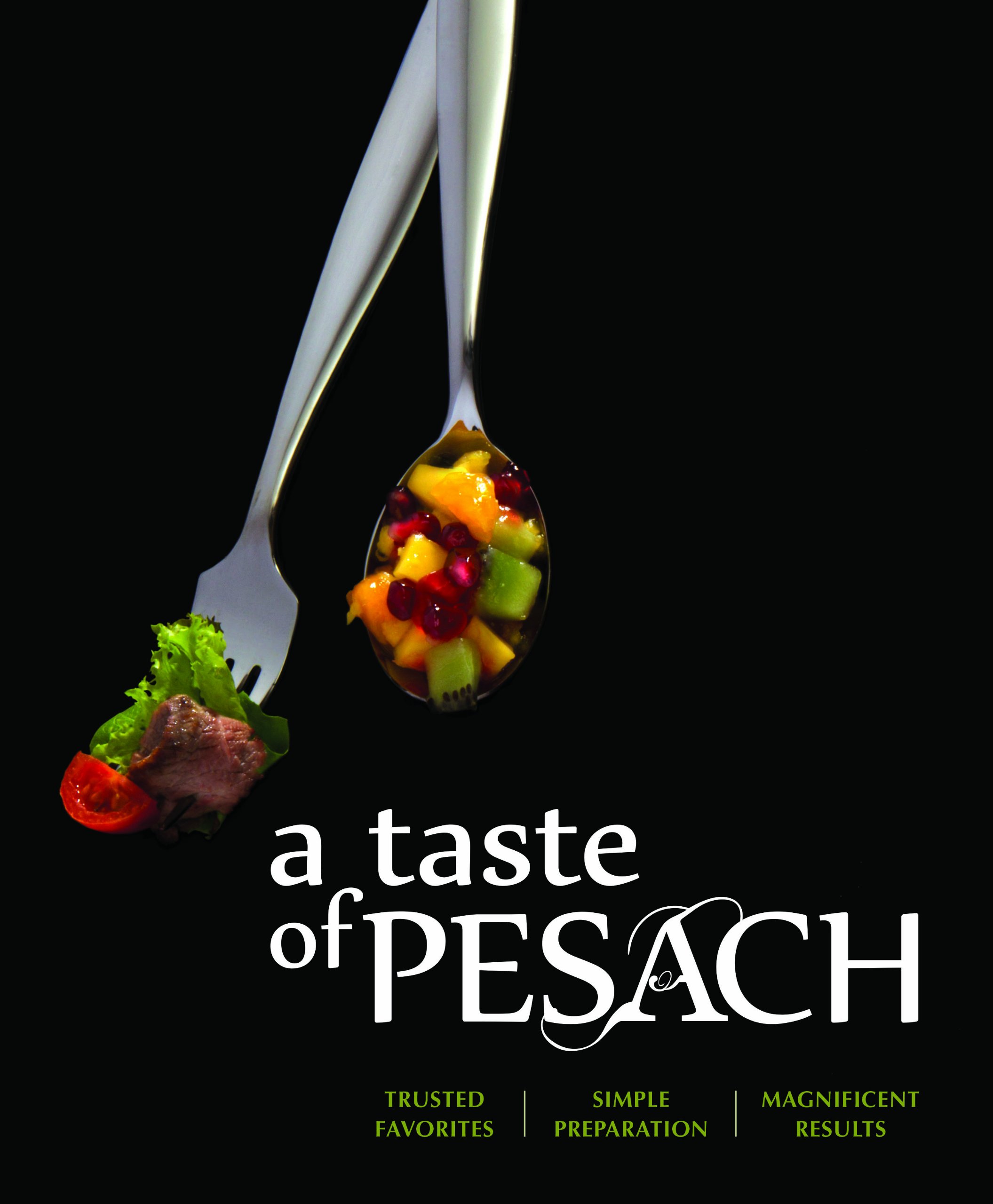
Every now and then, there’s a new recipe book that blows you away with innovative, easy-to-make dishes combined with tantalizing photographs that render you hungry within a couple minutes of flipping through the glossy pages. A Taste of Pesach (ArtScroll, 2014), a project of Yeshiva Me’on Hatorah (in Roosevelt, N.J.), is one such book. It promises to reinvent your Passover menu and inspire you with creative culinary twists and turns during this hungry time of year.

image - A Taste of Pesach  coverMany schools and communities have tried the same technique of compiling a recipe book and selling it as a fundraiser, and that’s how this one had its genesis seven years ago. But while most of those fundraiser books have a short lifespan before they’re recycled or mislaid, A Taste of Pesach is unlikely to follow the same trajectory. For one, it’s a gorgeous book you can’t wait to page through and one you’d be proud to hand over as a gift to a newlywed child or close friend. For another, it’s chock full of irresistible culinary eye candy, with recipes that are for the most part easy, calling on ingredients that are readily available. Look through the book and you find yourself murmuring, “Hmm…. I can do this.”

The mothers who volunteered the 150-plus recipes for A Taste of Pesach are a diverse group but they all want the same things at the end of the day, write the editors in the book’s introduction. “Food that will get rave reviews, user-friendly, visually attractive recipes with accurate cooking times and yields and recipes that have broad appeal and that work. We’re just like you,” they write.

Most of the recipes don’t require a huge spirit of adventure in the kitchen, but rather call for a minor stretch in their use of different ingredients than you might typically incorporate. The sweet potato crisps salad, for example, is a lettuce-based green salad to which strips of fried sweet potato are added as a garnish just prior to serving. The image of this dish is so tempting, it makes you want to reach in and steal a piece of crisp off the topping. This is true for the majority of the recipes, each one prefaced with a photograph and categorized by chapter into appies, soups, salads, fish, poultry, meat, sides, dessert, cake and cookies, and gebrokts. The recipes are accompanied by handy tips on how to make their preparation easier and faster, or how to plate it most attractively. There are traditional old favorites like gefilte fish, chremslach and kugels, and more modern twists or reinvented dishes like unstuffed cabbage, pastrami and spinach-stuffed chicken and cashew-butter muffins.

Extra eye candy is offered in the chapter headers, which display images of seder plates reflecting different times, styles and tastes. Passover is not a time of year that usually excites Jewish taste buds, but A Taste of Pesach promises to add flair, creativity and innovation to your table – without stretching your culinary skills to their limits.

Lauren Kramer, an award-winning writer and editor, lives in Richmond, B.C. To read her work online, visit laurenkramer.net. This article originally appeared in Canadian Jewish News.

A friend on our long journey

The close relationship humans share with yeast is truly ancient, and predates humanity itself. (photo by Lilly M via commons.wikimedia.org)

During the holiday of Passover, we are told not to eat leavened bread (chametz). The leavening of bread is caused by yeast, a single-celled fungus. The yeast induce a chemical reaction called fermentation, which converts water and sugar into alcohol and carbon dioxide. The bubbles of carbon dioxide gas produced during this reaction cause the bread to rise and become porous, ultimately resulting in delicious fluffy bread. The close relationship humans share with yeast is truly ancient, and predates humanity itself.

Since fungi lack mobility, it had often been assumed that they were more plant-like than animal-like. But genetic studies in the 1990s revealed that fungi are actually more closely related to animals than to plants. The common ancestor that animals and fungi share would have probably been single-celled, and resembled in many ways our friend the yeast. So we can consider them very distant cousins (not invited to the Passover seder).

Fruit are an important part of the diet of all apes, including humans and their ancestors. A ripe sweet juicy fruit is full of sugar and water, the key ingredients for fermentation. There are many different varieties of yeast that are found commonly all over the world, on the human body, in the soil, and often on the skin of fruits. Fermentation of ripe fruits due to the presence of such yeast is common in nature, and would have inevitably been eaten by the ancestors of humanity for millions of years. Primatologists have observed various species of monkeys getting drunk off such naturally fermented fruit. To explain this puzzling phenomenon, biologist Robert Dudley at University of California-Berkley formulated the “drunken monkey” hypothesis. Fruit evolved as a means for plants to use animals as a method of seed dispersal; however, if the fruit rots before it gets eaten, the seed doesn’t get dispersed. Alcohol is a volatile molecule, which means it floats around the air very easily. If a fruit begins to ferment, the alcohol molecules spread much further and faster than the smell of the fruit would on its own. Animals, such as monkeys and apes, can, therefore, smell from a greater distance that there is delicious fruit, helping them find and eat the fruits, and thus helping to disperse the seeds of the plant. It is an evolutionary relationship that benefits the plant, the yeast and the animal, a win-win-win scenario.

Moderate consumption of alcohol is in fact healthy and nutritional. Alcohol contains more calories than either carbohydrates (sugar) or proteins. Let us remember that calories were integral to survival before the obesity epidemic of the modern age. Alcohol can also protect against many diseases, especially cardiovascular diseases. Studies have even shown that people who consume alcohol in moderation live longer than those who don’t. Despite the many dangers associated with excessive alcohol consumption, the low doses normally consumed in nature ultimately may have provided a survival advantage to the ancestors of humanity.

The first civilizations arose in part due to intensive cereal agriculture. These cereals were used to make bread and beer. In Mesoamerica, they made a beer from corn, in China with rice and, in Mesopotamia and Egypt, they used barley and wheat to make beer and bread. These innovations that played an integral role in the building of civilization were thanks to yeast. The first writing system ever developed was Cuneiform, in Mesopotamia during the third millennium BCE. Among the first written records in history are references to the production, distribution and consumption of beer. Some scholars suspect that the Jews acquired this beer brewing knowledge during their exile in Babylon. The Hebrew word for drunk, shikur, is thought to be derived from the Babylonian word for beer, shikaru. However, if the story of Passover is to be believed, then perhaps the ancient Israelites brought the knowledge for beer making from Egypt.

Wine, an essential component of any decent Passover seder, also has an ancient history. The earliest evidence for intensive wine production can be found at the archeological site of Hajji Firuz Tepe in modern-day Iran, which has been dated to sometime around 5400 BCE. Genetic analysis corroborates that strains of wine yeast originated in Mesopotamia, but put the date back 10,000 years ago. Some archeologists have speculated that the strains of yeast used for making bread and beer originated from wine yeasts, however the evidence for this remains contentious. Wine and beer were both produced in Egypt, and were important culturally, religiously and medicinally, and Egyptians would bury jars of wine in the tombs of the pharaohs. Analysis of DNA found inside ancient Egyptian wine jars from the tomb of a pharaoh from 3000 BCE identified the same species of yeast used to make wine today: Saccharomyces cerevisiae.

If there were indeed Jewish slaves in Egypt, they would have eaten bread and drank beer and wine, leavened and fermented by the same fungus that we use to leaven bread and ferment wine today; a little old friend that has joined us on our long journey through the vast deserts of time. L’chayim.

Ben Leyland is an Israeli-Canadian writer, and resident of Vancouver.

Matza: a symbol of humility

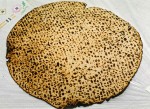
Matza and chametz are both composed of the same letters, except that matza is spelled with a hey and chametz with a chet. The only difference between a hey and a chet is that the chet is completely closed from three sides, while the hey has an opening on top. (photo by Yoninah via commons.wikimedia.org)

On Pesach, we are only allowed to eat matza, not chametz. What is the difference between chametz (leavened bread) and matza? How do they differ?

Matza differs from chametz in two respects:

1) With chametz, the dough rises, while for matza, the dough remains as is. In spiritual terms this means that chametz signifies arrogance, while matza signifies modesty and humility.

Matza is essentially lechem oni, the bread of poverty, of affliction (Deuteronomy 16:3 and Rashi’s commentary on this verse). Matza signifies humility, which manifests itself especially in lechem oni. The mitzva (obligation) to eat matza can only be observed with humility. The matza that the Israelites ate in Egypt was lechem oni.

2) The words matza and chametz are both composed of the same letters, except that matza is spelled with a hey and chametz with a chet.

The hey is similar to the chet. Both consist of three lines and are open from below. The only difference between them is that the chet is completely closed on the top, while the hey has an opening on the upper left side.

image - chet and het
The Hebrew letters chet and het.

The open side below (which chet and hey share) symbolizes that “sin crouches at the entrance.” (Genesis 4:7) The closure on both sides in the letter chet indicates that there is no escape from that fact, i.e., that sin crouches at the entrance. The opening on top, in the hey, indicates that notwithstanding this fact there is an opening above, indicating the possibility to leave one’s condition behind and to become a better person.

It is indeed no more than a small opening, but our sages teach us that G-d says: “‘Open for Me as little as the eye of the needle, and I will open for you like the entrance to a hall.’ For a single thought of self-improvement can change one instantaneously from an altogether wicked person into an altogether righteous person.” (Talmud Kidushin 49b)

These two differences between matza and chametz are interdependent. Where there is conceit and grandiose self-esteem, one doesn’t think of improvement. If there is humility, then, even if one may have stumbled, they will think of improvement. Where there is humility, there is no attempt at self-justification. Rather, one takes honest stock of oneself and, when finding improprieties within oneself, he or she will try to improve. With haughtiness, however, one will always find rationalizations to justify and excuse all doings.

Here’s a story to illustrate this point. When seeing a pauper, the one who seeks to avoid the mitzva of tzedaka will use the argument of Turnus Rufus (Baba Batra 10a), who asked of Rabbi Akiva: “If your G-d loves the poor, why does He not support them?” In other words, for reasons of haughtiness, if one accepts one’s wealth as one’s due and, in fact, feels that they deserve even more than what they already have, why then should they give away any of it? Arrogance doesn’t allow for the reality of another and, therefore, one may take it for granted that the other is not his or her equal. To this person, therefore, it is obvious that the other is poor simply because they don’t deserve any better. As it is surely the Divine Will that the other be poor, why then should one give him anything?

The humble one, possessed of humility, reasons differently.

a) He examines and judges himself whether he is essentially better than the other, and his self-examination leads him to give charity. It is written in Psalms 99:4, “You have done justice and tzedaka in Jacob.” That is, the justice, i.e. the self-judgment, leads him to tzedaka.

b) The humble one contemplates this possibility, but also notes that he himself has been blessed generously in spite of his own deficient status and condition. Thus, he is moved to conclude that we are as children of G-d. As these conditions relate to the mitzva of tzedaka, so, too, they apply to all good deeds.

This year, when we come to celebrate Passover at the festival seders, especially when we eat the matza, and when we are surrounded by our children, grandchildren and guests, we celebrate our people’s freedom from Egypt. Take time to contemplate the spiritual nature of matza, to be humble and feel the needs of our less fortunate friends, family and community members. We are celebrating, as well, the freedom of being able to go from haughtiness to kindness, from our limitations to our freedom. When we celebrate Passover this way, we will naturally feel happy that we are able to help provide what others need.

May this Passover prove to be an inclusive festival, where everyone will be able to rejoice and feel for one another. Wishing you a kosher and happy Passover.

Esther Tauby is a local educator, writer and counselor.

We all were once strangers

A boat of new immigrants arrives in pre-state Israel on Oct. 2, 1947. (photo from the Palmach Archive via PikiWiki Israel)

The Passover seder begins by welcoming anyone who is hungry, an idea that comes straight from the Book of Exodus (23:9), which states, “You shall not oppress a stranger, since you yourselves know the feelings of a stranger, for you also were strangers in the land of Egypt.”

Later in the Torah, Leviticus 19:33 says, “When a stranger resides with you in your land, you shall not do him wrong.” Leviticus 19:34 repeats this refrain, “The stranger who resides with you shall be to you as the native among you, and you shall love him as yourself, for you were aliens in the land of Egypt; I am the Lord your God.”

Over the generations, the Jewish people have been “aliens” more than once. Well-known examples of Jews leaving their perceived homeland include the Jewish exile to Babylonia after the destruction for the first Temple, those who were fortunate enough to escape Nazi persecution for Israel or the United States, expelled Middle Eastern Jews who were moved to Israel after its founding, or residents of the former Soviet Union who left a life of religious oppression.

The immigrant experience is different for everyone, said Aaron Gershowitz, senior director for U.S. programs at the Hebrew Immigrant Aid Society (HIAS). He told this reporter that the challenges of an individual’s journey often depend on the environment they are leaving and the community to which they are relocating.

Take Inge “Irene” Brenner. She escaped from Nazi Germany on Dec. 28, 1938, for Havana, Cuba. From there, she traveled to the United States, arriving to join her husband in April 1939 at age 19. She immediately took up work at a small factory where she steamed hat plumes. Her employer provided her with the required documentation to book passage for her mother, father and sister to the United States. Due to a lack of funds, the family all lived together in a tiny apartment in New York.

“When I left Berlin, I was 19 and completely single-minded, [telling myself] ‘I must get out and save myself and my parents,’” Brenner said. “We just couldn’t have existed anymore. That is what happened to the rest of my family that didn’t get out – all of them were murdered in the gas chambers. There was nothing else I could do but make it. You just had to make it.”

Gershowitz said that “the economics of surviving” often mark the first several years (or longer) of the immigrant experience. It is only after that period that immigrants become more like others – more focused on family life, a career and a future for their children.

Over time, this was the case for Brenner. Once she and her husband could afford to leave the rest of the family and live on their own, they had two daughters who they raised to be American Jews, as opposed to Jewish Americans. Brenner said she wanted to leave her horrible past behind for a new life, which she feels she received “by the grace of God.”

“She was always proud to be Jewish, but it was always extremely hard for her to talk about how she got here,” said Benjamin Kopelman, Brenner’s grandson.

photo - Lev Golinkin
Lev Golinkin (photo by Diana P. Lang)

Lev Golinkin, author of a memoir on the immigrant experience titled A Backpack, a Bear and Eight Crates of Vodka, noted the irony that Soviet Jews came to the United States in search of religious freedom, yet many of them choose not to practise Jewish traditions, his family included.

“As soon as we could, we got away from the synagogue and Jewish organizations and melded into the secular American world,” he said.

Golinkin, who arrived in the United States from eastern Ukraine in 1989 at the age of 9, surmised that people turned away from religious observance because it was precisely the Jewish faith that made them targets for persecution in the former Soviet Union. Before escaping, Golinkin was being homeschooled because he had been regularly teased and beaten for his Judaism. Religion, therefore, was nothing to celebrate for him.

“I wanted nothing to do with that. I saw being a Jew as a stigma, a disability,” said Golinkin.

But as he grew up, Golinkin’s opinion changed.

“I think it is interesting that the Israelites stayed in the desert and didn’t start over until that generation had passed away. They needed a clean slate, they needed people whose memories are formed in the new land with the new traditions,” he said.

Read more at jns.org.

Maayan Jaffe is an Overland Park-based freelance writer. Reach her at jaffemaayan@gmail.com or follow her on Twitter, @MaayanJaffe.

Ancient message of Jewish unity

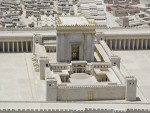
A model of King Herod I’s renovated version of the Second Temple in Jerusalem. (photo from Ariely via Wikimedia Commons)

Between 19 BCE and 4 BCE, King Herod I renovated the Jewish Temple in Jerusalem, enlarging and beautifying it. It is during this same period that we first learn of the Jewish pilgrimages to Jerusalem on what are known as the shalosh regalim, the three pilgrimage festivals.

All of the festivals – Passover, Shavuot and Sukkot – centre around the story of the Exodus in some way. But Passover is the first and foremost of the bunch.

Jerusalem always held a special place in the hearts of the Jewish people, but as the Romans built roads and as Herod expanded the Temple, the pilgrimage to Jerusalem became commonplace and served as a message of unity – “one Temple, one God, one Passover” – for all Jews, said Prof. Jonathan Klawans of Boston University’s department of religion.

Yet, detailed writings about what the pilgrimage festivals may have looked like during Temple times don’t exist. According to talmudic scholar Dr. Joshua Kulp, author of Schechter Haggadah: Art, History and Commentary, most knowledge on the subject comes from the works of the ancient historian Josephus. While later writings (such as the New Testament) describe what it was like in Jerusalem during the Second Temple era, those works were written at a much later time and some scholars doubt their accuracy.

It isn’t known where people stayed or slept when they were in Jerusalem, or how many people showed up (though most assume a large number), or what people felt at that time. What is known, Klawans explained, is that the pilgrimages were a social experience that pulled the Jewish people together.

It’s also clear that, for Passover, pilgrimage participants ate in Jerusalem as family units. A representative from each family would take an animal, bring it up to the Temple, and have it slaughtered. Then, the representative would bring the animal back, and the family would cook and eat the sacrificial meat. During this festive meal, families also drank wine, but not a specific number of glasses. They sang songs – specifically, the Hallel prayers, which is also part of the modern Passover seder.

Read more at jns.org.

Maayan Jaffe is an Overland Park-based freelance writer. Reach her at jaffemaayan@gmail.com or follow her on Twitter, @MaayanJaffe.

Elijah in New York City

(photo from PikiWiki Israel)

Her name was Rachel, his was Nathan. And even though separated by two bar stools, they struggled through 20 minutes of awkward conversation before their last names were spoken. Greenberg went with Rachel; Cohen with Nathan.

“Hey, you must be Jewish,” blurted out Nathan, a lonely bachelor whose only other date was Channel 15 on a cold, rainy night in April.

“I bet you’re Jewish, too,”she responded.

Well, things were looking up. Nathan now sat beside her and she responded with a smile at his aggressive move. He’s Jewish, no stranger, she thought.

“What a night for two Jewish buckaroos to be sitting in a western bar in the middle of Manhattan,” said Rachel. “It’s the first night of Passover, you know.”

“Yeah. I’m afraid I’ve neglected ‘my heritage,’ as my father puts it. He lives here in the city – only a few blocks down 57th. My family has a seder every year. They sit around the table – sing childish songs – stuff themselves on a five-course meal and wait for Elijah, the heavenly visitor to drop by. I go to a bar. Usually the one over on 52nd and 8th. This year, my mood took me here. Don’t know why. It’s a heck of a coincidence that I’m sitting next to you.”

“Well, I’m alone in the city. My family is back home in Louisville, Kentucky. Like yours, about now they’re sitting down to a huge meal with a week’s supply of calories and cholesterol. Kosher, but still deadly. And I’m sure they’re singing silly songs, as you put it. Wish I was there.”

“How seriously do they play out the Elijah game? You know the legend. His visit to every Jewish home on seder night. I remember my old man. He’d put down his wine glass, get all serious and open the front door. ‘Hey Pop,’ the 8-year-old who was then me, would shout, ‘If Elijah can pop up at 10 million Jewish homes in a single night, he can get through that wood-paneled front door without your help. A decent burglar can do it in a few minutes. Why not challenge the prophet?’ My old man hated it.”

An old gentleman at the end of the bar looked up with a pained expression.

“I guess so,” remarked Rachel. “Sure I know the Elijah story – our rabbi calls it a midrash – a rabbinic parable – which elevates it a level or two above a legend. It’s one of those unifying articles of faith that every Jew – even the lost ones – enjoys believing. A sweet story, you know. In fact, my rabbi believes that besides visiting many millions of seders on the first night of Pesach, he’s there – on Passover night – wherever two or more Jews are together.”

She had been a little loud. She noticed the old gentleman at the end of the bar had looked up from his drink, a dark purple wine in an ornate silver wine glass. Wonder what they called that drink? Wonder if you got to keep the glass?

Nathan, his arms folded loosely across his chest, had fixed his eyes on her as she talked. She’s got some spirit, he reflected. How his father’s eyes would gleam with passion to hear her declarations of faith.

Rachel brushed her hair back from her face. “Sorry, I got a little carried away – didn’t mean to preach to you. Let’s talk about something else.”

“No, no, I understand. That first night of Pesach is magic, my old man used to say. Makes you remember who you are. Every Jew, he used to say, had a progenitor – an ancestor – in his direct line who walked dry shod on the bed of the Red Sea. If he had perished under Egyptian whips or drowned beneath the waves, I, for example, wouldn’t be sitting at this glitzy bar in 21st-century America talking to a young Jewish lady who believes in a resuscitated prophet who makes a million house calls on one spring night.”

“You know what?” she said suddenly. “I’d love to go to a seder tonight. And there’s no lamb shank, charoset, parsley or bitter herb at your place or mine – but there is at your father’s place. Why don’t we surprise him? We’ll be just in time to greet Elijah.”

Nathan blinked, and nodded. With her, he had a chance. So, linking his arm in hers, he set out on the longest journey any man can undertake. A journey home.

And, at the end of the bar, the dignified but poorly dressed patron held up his wine goblet. “There are no coincidences,” he whispered to the goblet. He glanced hurriedly at his watch and left. He had many calls to make.

Ted Roberts is a freelance writer and humorist living in Huntsville, Ala.

About the 2015 Passover cover

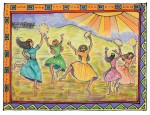
The illustration on this year’s Passover cover, “Miriam Dances,” was created by artist Carol Racklin-Siegel for the book Let My People Go (EKS Publishing, 2011). In this hand-painted silk art, Racklin-Siegel depicts the joy of Miriam the Prophetess leading the women in song and dance after reaching dry land: “Miriam the prophetess, the sister of Aaron, took her drum in her hand and all the women went forth after her with drums and with dances.” (Exodus 15:20)

Racklin-Siegel is an award-winning textile artist and illustrator focusing on custom hand-painted textiles, Judaic textiles, paintings and illustrations. She expresses the spirituality of Judaism by incorporating her textile designs and fabric painting techniques to Judaic and biblical themes. She has illustrated a series of books for children, based on the stories in Genesis, for EKS Publishing Co. in Oakland, Calif. She resides with her family in Israel. Her work can be viewed at pomegranatestudios.com.

A secret Pesach gift awaits

Daffodils herald the springtime – and the approach of Passover. (photo from commons.wikimedia.org)

I had not seen him check into the inn. And I did not see him that night as we travelers exchanged vodka toasts to Pesach – only 10 days away. But here he was this morning, awaiting the same coach that would take me to my daughter’s seder table. I like to get there early and remind her that her papa – who gave her life, in

cooperation with her mama – loves being in her home, made gefilte fish and is more than willing to evaluate her Pesach culinary efforts.

Anyhow, awaiting the carriage, we clustered together – exulting in a glorious spring day under the giant willow that shaded the station showing off her spring-new leaves as though she was competing with her neighbor, an old, mottled-bark sycamore. Aged, but still capable of spring whimsy. She seemed even showier when the newcomer leaned against her and I could swear the light green of her new leaves gleamed even greener by contrast.

The mysterious stranger glanced at me. I checked him out, too. A stern face, whose only laughter was in his eyes. He was dressed like the rest of us, except he had a jonquil in his lapel. We seated ourselves opposite each other in the coach.

He was the first to speak. “How do you do?” he said, “My name, I’m sure you know, is Elijah. And, I’m sure you know, I’m beginning my Passover planning.”

I involuntarily rose from my seat like I was sitting on a hot, pot-bellied stove and banged my head on the top of the coach. Elijah, Grand Master of the Prophetic Fraternity, sitting with an undistinguished shtetle Jew – me!

“Can you imagine,” he said, “I visit every seder from Chicago to Katmandu. Roughly,” he continued, “we’re talking millions of homes. And on the same night. The same night,” he repeated. “And nobody says, ‘Ellie (that’s what my friends upstairs call me), good job! Great job, Ellie.’ They’re all too busy being impressed with that watery miracle. They’ve talked for 3,300 years now about a breeze that allowed you Israelites to wade across the Red Sea. And they think it’s a miracle that the Master caused a bunch of birds to fall out of the sky to feed you guys. I’ve tasted ’em. Oily, tough, need a ton of spices to get ’em down. Big deal! And that manna. Ever tasted it? Like raw oatmeal. And me? The showpiece of Pesach? I’m hustling to a few million seders. And you think I can drop in – say hello and run next door? No way. I gotta have a shot of wine – a few million sips of wine. You wouldn’t believe my headache the next day.”

I listened. Shocked. Even the Prophetic Master, semi-human/ semi-angel, had the ego of our coach driver, who prided himself in making the run to Minsk in under six hours.

But Elijah wasn’t through. “And that’s not all. Unknown to a cold and frigid world, there’s a precious little secret that only the angels know. On Pesach – if the year has been a sweet one wherein mankind has controlled his hybrid heart – I beckon to springtime, which is waiting in the wings of winter for my call. It’s the great gift the Master has bestowed upon me. It’s my dividend, as you say down here, for my Pesach duties. I call, and nature, everywhere, listens. Springs into action. (I never could resist a good pun.) Timing? It depends on those 36 Tzadiks – God’s spies we call them – who roam the world and annually report. Mankind behaving? Following Torah? I beckon – spring does her thing. It all hangs on human behavior. Sometimes the earth is only gilded with a pale reflection of a bountiful spring.”

He stopped, turned his head to stare at the passing parade of dreary woodlands and grey vales and brown meadows. But I could see red and yellow tulips dancing in his eyes.

By the time I reached Minsk and burst into a living room full of expectantly waiting kids and grandkids – over their hugs and kisses, I could see the daffodils blooming through the living room windows. We must have behaved.

Ted Roberts is a freelance writer and humorist living in Huntsville, Ala.