
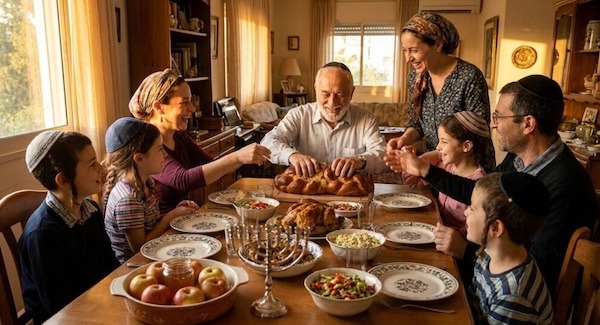

(photo from levhaolam.com)
Summer this year brought me an unusual experience. My twins went to stay with grandparents in Virginia and work as CITs (counselors in training) at a Jewish day camp. My husband dropped them off and then attended a conference. After a flurry of paperwork, packing and arranging, my family had left. Suddenly, I was alone with the dog. I’d made no solid plans while I’d spent so long getting everyone else ready. I settled into household chores, dog walks and routines that still needed to be done, even though there was no one else home.
Eating by myself for 10 days felt daunting. Previously, I’d spent a lot of time procuring healthy food and cooking for teenagers who eat a lot. I hadn’t been alone for this long since before having kids 15 years ago. I started off strong, cooking myself eggplant for salads, potato gnocchi and apple crumble. I prioritized things I like that other family members don’t. After awhile though, I was relieved to get two invitations for dinner and one helpful ride to pick up my car, which had been in the shop.
One dinner invitation was from neighbourhood friends. The other was from synagogue friends. In both cases, the people inviting me were Jewish retired professionals, and at least my parents’ ages. There were many differences – one intermarried, one person who chose Judaism long ago, one secular and some deeply committed to Jewish religious life. Yet, part of the conversation at both meals and during the car ride was “Jewish food.” What was Jewish food? What did I want to eat? Also, there were discussions on how beloved relatives’ and friends’ North American recipes shaped our cooking and eating.
All my hosts discussed North American versions of Eastern European Jewish food in detail. They had specifics: a long-lost recipe for kasha, a brisket, a “New York” cheesecake, homemade pickled beets, cucumber pickles and horseradish. In each conversation, they seemed surprised that my understanding of Jewish food didn’t mean exactly what they thought it meant.
I tried to explain childhood foods I ate at home in Virginia: Southern (American) cooking, mixed with both Eastern and Western European foods, occasional New York Jewish deli items, plus other influences like Israeli, Middle Eastern and Asian foods. This, too, was Jewish food. The foods my friends called Jewish were also Eastern European, often shared by our non-Jewish Ukrainian, Polish or Russian Winnipegger neighbours. We’re a product of family and ethnic ancestry and our environment. Winnipeg’s colder climate means that those with Eastern European backgrounds have every reason to eat the ways their ancestors did: hearty meals with root veggies and long cooking times.
Comparing this life experience with what I’ve been studying lately in Daf Yomi (a page of Talmud a day) has been interesting. While kashrut evolved over time and has precise requirements, it also has many differences from one household or community to the next.
I was taught as a kid to appreciate whatever was served to me, eat it, and say thank you. Not much was different with these recent meals. None was kosher. All were carefully prepared for me, with affection. I ate with gratitude. I appreciated being fed and included at the table. This contrasts significantly with the detailed analysis of kosher slaughter that I’m reading about in the Babylonian talmudic tractate Chullin, but it’s not as different as one might assume.
When discussing the kosher slaughter details, the rabbis are concerned with proper health and safety, as they understand it. Today, we’re lucky to have laws around food security and safety and home kitchen hygiene. In a sense, these laws do some of the same work, as the concepts were understood 1,500-2,000 years ago.
Due to wider travel and modern communication, we now recognize a diversity of eating habits and cultural traditions. What’s considered a normal diet or food consumption varies significantly. So, too, things differed throughout the Jewish world, according to the Babylonian Talmud.
There’s an understanding among the rabbis that people were keeping kosher differently, according to different rabbis’ rulings. That is part of what’s discussed in Tractate Chullin. On page 59A, Rav and Shmuel debate the kashrut and safety of a deer that had its back legs cut off. Their concern and care for each other means that, even if they debate many rabbinic rulings, they want to protect each other. (Rabbi) Shmuel worries that they might be poisoned by bad meat, because the deer might have been bitten by a poisonous snake. The two decide to cook the meat in a particular way. They will be able to tell if the meat is poisonous by whether it falls off the bone when roasted. They discover through this experiment that the meat is unsafe. They don’t endanger themselves by eating it.
There’s a lot to unpack here. Scholars, leaders and others can disagree on many things in a civil manner and care deeply about one another’s wellbeing. Our heartfelt discussions about food, recipes and preparations are how we nurture each other, show affection and protect each other from harm, whether it’s poisonous venom or loneliness. Further, Jewish traditions teach us that, while we may be absorbed in the details – Is it kosher? Is it safe? Is it your favourite? Is it vegan, vegetarian, non-allergic, gluten-free? – it’s not what we eat that matters, but rather how we show our care for others as we feed them that counts.
When I contemplated being alone, friends asked what my favourites were – and, to be honest, I couldn’t even tell them. After cooking meals for others for so long, I just appreciated the invitations, conversations and any food that was different than what was on my table. If pressed, I’d say that I love salatim (Israeli salads), fruit, cheese and dessert. In the end, brisket and turkey meatloaf were just as good. I understand that being included at someone’s Shabbat table and being part of a community is the important part.
If you’re Jewish, and you’re thinking about food carefully, with gratitude and care towards others, it’s all Jewish food, no matter what you put on the table. So, please extend that invitation. Welcome guests!
As a guest, remember to say thank you for the opportunity to share someone’s companionship, no matter what they feed you. It’s the (Jewish) thought that counts.
Joanne Seiff has written regularly for the Winnipeg Free Press and various Jewish publications. She is the author of three books, including From the Outside In: Jewish Post Columns 2015-2016, a collection of essays available for digital download or as a paperback from Amazon. Check her out on Instagram @yrnspinner or at joanneseiff.blogspot.com.



