
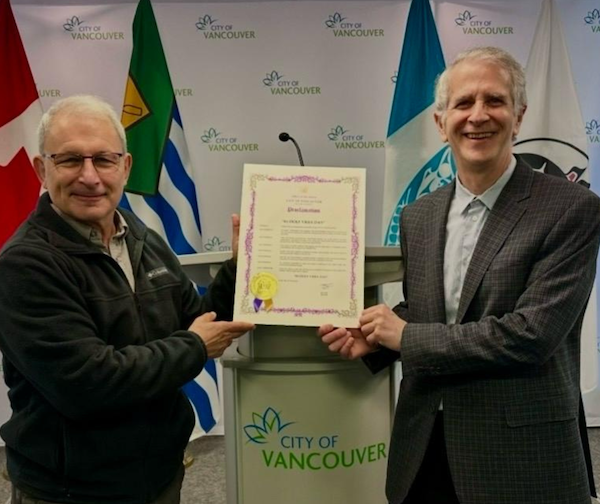

Geoffrey Druker, left, and Glen Steinman hold the City of Vancouver proclamation of April 7, 2026, as Rudolf Vrba Day. (photo from Vrba Projects / VHEC)
The Vancouver Holocaust Education Centre (VHEC) welcomes the City of Vancouver’s Proclamation designating April 7, 2026, as “Rudolf Vrba Day.”
In the proclamation, Mayor Ken Sim notes that Rudolf Vrba, who was deported to Auschwitz at age 17, escaped from the camp on April 7, 1944, and risked his life to expose the reality of Nazi atrocities. His actions helped bring forward one of the earliest and most authoritative eyewitness accounts of the Holocaust. Vrba later made Vancouver his home, where he lived and worked for nearly four decades as a distinguished professor at the University of British Columbia.
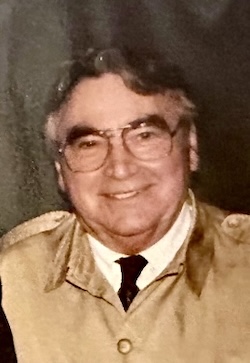
The proclamation further recognizes that the report produced by Vrba and co-escapee Alfred Wetzler – now known as the Vrba-Wetzler Report – is widely credited with helping halt the deportation of Hungarian Jews and contributing to the saving of more than 100,000 lives.
The VHEC recognizes this proclamation as honouring the historic legacy of Vrba and his continued relevance today as a man who devoted his life to the power of the individual to seek justice. Remembering Vrba is not only an act of historical necessity – it is a reminder of the moral courage ordinary individuals must summon, and of our shared responsibility to value and present the truth on behalf of humanity.
The VHEC is grateful to the City of Vancouver and Sim for making this proclamation. The centre also acknowledges the contributions of Vrba’s friends and supporters in Vancouver, including those who established a memorial monument to Vrba in Schara Tzedeck Cemetery. The proclamation was further supported by the efforts of Vrba Projects, a local group of volunteers – led by Geoffrey Druker, John Gruetzner and Glen Steinman – working to promote local, national and global recognition of Vrba. VHEC also thanks Robin Vrba, the widow of Vrba.
Vrba believed that history must be told without euphemism, distortion or sentimentality. He was a moral witness and a warrior for truth, guided by a strong internal code and a profound sense of personal responsibility. His memoir, I Escaped from Auschwitz, was first published in 1964 and remains one of the most important survivor accounts of the Holocaust.
In recent years, there has been renewed international recognition of Vrba’s legacy, including the publication of two major biographies: The Escape Artist: The Man Who Broke Out of Auschwitz to Warn the World by Jonathan Freedland, and Holocaust Hero: The Life and Times of Rudolf Vrba by Vancouver author and journalist Alan Twigg, who also curates the website rudolfvrba.com. (For more, also see jewishindependent.ca/new-bio-gives-vrba-his-due and jewishindependent.ca/vrba-monument-is-unveiled.)
The first English translations of the Vrba-Wetzler report, received by the US government in October 1944, are now preserved in the Records of the War Refugee Board at the Franklin D. Roosevelt Presidential Library.
– Courtesy Vancouver Holocaust Education Centre



