Money for the sciences

At the Weizmann Canada gala in Montreal on May 26, guests heard from Weizmann Institute professors Asaph Aharoni, left, and Ron Milo. Former CBC broadcaster Heather Hiscox hosted the event. (photo from Weizmann Canada)

On May 26, Weizmann Canada held a sold-out national gala in Montreal that raised $9 million net of expenses for scientific research on environmental sustainability. 

Seeding Hope: The National Gala to Empower a Sustainable Tomorrow, presented by the Dr. Joseph Lebovic and Dr. Wolf Lebovic foundations, brought more than 300 Weizmann Canada supporters together from across the country. Held at Windsor Station, it was a celebration of research focused on climate change, alternative energy, food security and nutrition.

Speaking at the gala, Weizmann Canada chief executive officer Susan Stern expressed gratitude for the science and those who support it. This fundraising effort comes at a time when the climate crisis is accelerating, from extreme weather and biodiversity loss, to rising pollution and global food insecurity. The Weizmann Institute of Science has made environmental sustainability one of its priority areas of research.

The focus on environmental science at Weizmann began through the leadership of Canadians. Decades ago, Canadians funded early solar energy research that has now expanded into a multidisciplinary powerhouse of more than 60 labs dedicated to sustainability.

At the gala, guests were treated to an immersive, multi-sensory event in which the science took centre stage. They heard from professors Asaph Aharoni and Ron Milo.

In his lab, Milo has been able to genetically engineer bacteria that feed off carbon dioxide rather than sugar. He described how he is now developing new ways to use solar energy to fuel the fermentation process that pulls carbon dioxide out of the air, with the goal of improving the efficiency of food and fuel production.

Aharoni is focused on engineering plants and microbes to fight world hunger and malnutrition. His work looks for ways to improve crop nutrition and resistance to disease, drought and other harsh conditions. His discoveries have also led to environmentally sustainable alternatives to the harmful chemicals in food, textiles and other materials.

“This is just the tip of the iceberg,” said Aharoni. “We are doing all kinds of stuff that will make our world more sustainable, healthy and environmentally friendly.”

Former CBC broadcaster Heather Hiscox hosted the event and recognized Canadian visionaries whose generosity has had a global impact. There was a special tribute to the legacy of Tom and Mary Beck and their early support of environmental research at the Weizmann Institute.

Other honourees were Nathalie and Laurent Amar; Rochelle Rubinstein, representing the families of H&R; Darlene Switzer-Foster and Bill Foster, honouring the memory of Sam Switzer; and Linda Cherry Soudack, honouring the legacy of Sigmund (Siggy) Soudack. Danielle Bitton received the Marvelle Koffler Award for Women of Distinction in recognition of her exceptional dedication to community leadership and philanthropy.

Several West Coasters were in attendance, including Weizmann Canada’s Vancouver chapter president Moira Stillwell; Telus chief executive officer Victor Dodig; and former Vancouverites Cheryl Brownstein and Rick Schweiber. 

– Courtesy Weizmann Canada
What “Jewish food” means

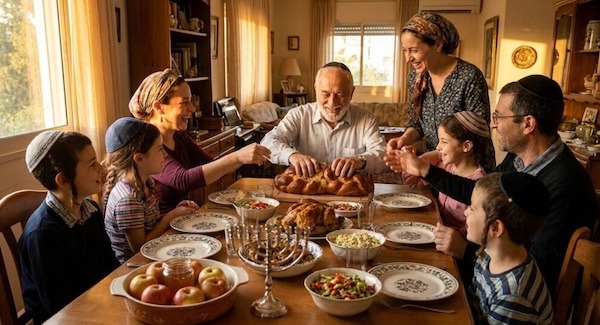
(photo from levhaolam.com)

Summer this year brought me an unusual experience. My twins went to stay with grandparents in Virginia and work as CITs (counselors in training) at a Jewish day camp. My husband dropped them off and then attended a conference. After a flurry of paperwork, packing and arranging, my family had left. Suddenly, I was alone with the dog. I’d made no solid plans while I’d spent so long getting everyone else ready. I settled into household chores, dog walks and routines that still needed to be done, even though there was no one else home.

Eating by myself for 10 days felt daunting. Previously, I’d spent a lot of time procuring healthy food and cooking for teenagers who eat a lot. I hadn’t been alone for this long since before having kids 15 years ago. I started off strong, cooking myself eggplant for salads, potato gnocchi and apple crumble. I prioritized things I like that other family members don’t. After awhile though, I was relieved to get two invitations for dinner and one helpful ride to pick up my car, which had been in the shop.

One dinner invitation was from neighbourhood friends. The other was from synagogue friends. In both cases, the people inviting me were Jewish retired professionals, and at least my parents’ ages. There were many differences – one intermarried, one person who chose Judaism long ago, one secular and some deeply committed to Jewish religious life. Yet, part of the conversation at both meals and during the car ride was “Jewish food.” What was Jewish food? What did I want to eat? Also, there were discussions on how beloved relatives’ and friends’ North American recipes shaped our cooking and eating.

All my hosts discussed North American versions of Eastern European Jewish food in detail. They had specifics: a long-lost recipe for kasha, a brisket, a “New York” cheesecake, homemade pickled beets, cucumber pickles and horseradish. In each conversation, they seemed surprised that my understanding of Jewish food didn’t mean exactly what they thought it meant. 

I tried to explain childhood foods I ate at home in Virginia: Southern (American) cooking, mixed with both Eastern and Western European foods, occasional New York Jewish deli items, plus other influences like Israeli, Middle Eastern and Asian foods. This, too, was Jewish food. The foods my friends called Jewish were also Eastern European, often shared by our non-Jewish Ukrainian, Polish or Russian Winnipegger neighbours. We’re a product of family and ethnic ancestry and our environment. Winnipeg’s colder climate means that those with Eastern European backgrounds have every reason to eat the ways their ancestors did: hearty meals with root veggies and long cooking times.

Comparing this life experience with what I’ve been studying lately in Daf Yomi (a page of Talmud a day) has been interesting. While kashrut evolved over time and has precise requirements, it also has many differences from one household or community to the next.

I was taught as a kid to appreciate whatever was served to me, eat it, and say thank you. Not much was different with these recent meals. None was kosher. All were carefully prepared for me, with affection. I ate with gratitude. I appreciated being fed and included at the table. This contrasts significantly with the detailed analysis of kosher slaughter that I’m reading about in the Babylonian talmudic tractate Chullin, but it’s not as different as one might assume.

When discussing the kosher slaughter details, the rabbis are concerned with proper health and safety, as they understand it. Today, we’re lucky to have laws around food security and safety and home kitchen hygiene. In a sense, these laws do some of the same work, as the concepts were understood 1,500-2,000 years ago. 

Due to wider travel and modern communication, we now recognize a diversity of eating habits and cultural traditions. What’s considered a normal diet or food consumption varies significantly. So, too, things differed throughout the Jewish world, according to the Babylonian Talmud. 

There’s an understanding among the rabbis that people were keeping kosher differently, according to different rabbis’ rulings. That is part of what’s discussed in Tractate Chullin. On page 59A, Rav and Shmuel debate the kashrut and safety of a deer that had its back legs cut off. Their concern and care for each other means that, even if they debate many rabbinic rulings, they want to protect each other. (Rabbi) Shmuel worries that they might be poisoned by bad meat, because the deer might have been bitten by a poisonous snake. The two decide to cook the meat in a particular way. They will be able to tell if the meat is poisonous by whether it falls off the bone when roasted. They discover through this experiment that the meat is unsafe. They don’t endanger themselves by eating it.

There’s a lot to unpack here. Scholars, leaders and others can disagree on many things in a civil manner and care deeply about one another’s wellbeing. Our heartfelt discussions about food, recipes and preparations are how we nurture each other, show affection and protect each other from harm, whether it’s poisonous venom or loneliness. Further, Jewish traditions teach us that, while we may be absorbed in the details – Is it kosher? Is it safe? Is it your favourite? Is it vegan, vegetarian, non-allergic, gluten-free? – it’s not what we eat that matters, but rather how we show our care for others as we feed them that counts.

When I contemplated being alone, friends asked what my favourites were – and, to be honest, I couldn’t even tell them. After cooking meals for others for so long, I just appreciated the invitations, conversations and any food that was different than what was on my table. If pressed, I’d say that I love salatim (Israeli salads), fruit, cheese and dessert. In the end, brisket and turkey meatloaf were just as good. I understand that being included at someone’s Shabbat table and being part of a community is the important part.

If you’re Jewish, and you’re thinking about food carefully, with gratitude and care towards others, it’s all Jewish food, no matter what you put on the table. So, please extend that invitation. Welcome guests! 

As a guest, remember to say thank you for the opportunity to share someone’s companionship, no matter what they feed you. It’s the (Jewish) thought that counts. 

Joanne Seiff has written regularly for the Winnipeg Free Press and various Jewish publications. She is the author of three books, including From the Outside In: Jewish Post Columns 2015-2016, a collection of essays available for digital download or as a paperback from Amazon. Check her out on Instagram @yrnspinner or at joanneseiff.blogspot.com.

Have a cookie, schnitzel too

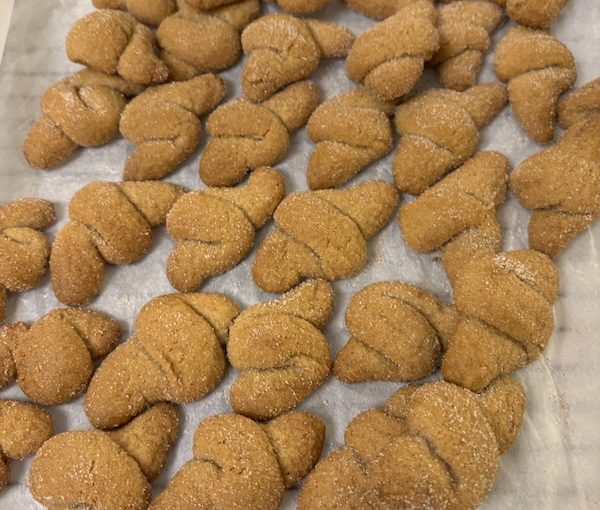
If you want cinnamon twists and schnitzel for dinner – yes, in that order – go for it. Life’s short. (photo by Shelley Civkin)

Nothing screams Jewish baking quite like kichel (aka nothings), kuffles and rugelach. Unless it’s cinnamon twists. My friend Debbie graciously brought over a fabulous selection of her pastries one day and I immediately fell in love with her Bubby Florence’s Twists (aka cinnamon twists). Begging for the recipe, Debbie offered to show me firsthand how to make them. Naturally, I jumped at the chance. 

We had a bake-a-palooza date, banished our hubbies (they went out for brunch), donned our Donna Reed aprons and got to work. We made two different kinds of cookies that day: cinnamon twists and shortbread. Both über-yummy. Full disclosure: no calories were spared in the making of these treats.

I’m still getting used to my new induction stove and convection oven, so there continues to be some trial-and-error involved. I know that my oven underheats by 10 to 15 degrees, so I cranked up the temp. The cookies turned out a bit darker than Debbie said they should be, but they were perfect for me. I’ll let you decide what to set your oven at, but the recipe calls for 350˚ F.

CINNAMON TWISTS 

1 cup brown sugar
3/4 cup canola oil
3 eggs
2 tsp baking powder
1/2 tsp baking soda
3 cups flour
1/2 cup white sugar (approx.)
2 tbsp cinnamon

Mix the brown sugar, oil and eggs in a large bowl, and mix the baking powder, baking soda and flour in another bowl. Add the dry ingredients to the wet ingredients and then put the mixture into the fridge for about one hour. (This is just a rough guideline.) After it’s chilled, form the batter into little “logs,” about the size of your baby finger, but slightly longer.

On a flat plate, mix the white sugar with the cinnamon. Roll the “logs” in the cinnamon and sugar until they’re well coated, then twist them into little twisties.

Bake at 350˚ F on a parchment-lined cookie sheet till the cookies are golden brown, approximately 20 minutes. Remove them onto a wire rack to cool – pour yourself a glass of milk and stuff your face until you feel like you’re going to explode. Wait an hour, then repeat. The recipe makes approximately 58 cinnamon twists. They freeze beautifully and they’re super-delicious with all that cinnamon sugar adorning them. Dipping in milk, coffee or tea is also recommended.

DEBBIE’S SHORTBREAD COOKIES

1 cup butter or margarine (I used vegan)
1/2 cup icing sugar
1/2 tsp vanilla
2 tbsp cornstarch
2 cups flour

Cream together butter or margarine and icing sugar. Add vanilla, cornstarch and flour, mixing for three to five minutes. (You can refrigerate the dough at this point if you want to make the cookies the next day. Up to you, but not necessary.)

When ready, spoon out half tablespoons of the dough and roll them into small balls. Place on a parchment-lined cookie sheet and flatten with a fork.

Bake at 350˚ F until golden brown on top, 15 to 20 minutes. Cool on a wire rack.

Could it get any easier?

After our bake-a-palooza was over, we sat down with a big glass of milk for me and a strong cup of coffee for Debbie, and gorged ourselves silly. Soon after, our hubbies got home from their male-bonding experience over panini and lattes. Laying their eyes on the bounty before them, they forgot they were stuffed from lunch. Need I state the obvious? Within seconds, each of the guys had wolfed down at least four of each cookie. And, once again, said they were stuffed. That lasted for 15 minutes. Our 100 cookies soon became dozens fewer. My friend’s suggestion for how to ensure that our husbands don’t eat the rest of the cookies in the future is to put them in a white container in the freezer and label it “Calf’s liver.” Pretty clever, don’t you think? 

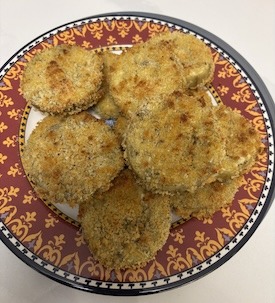
My next act was to make a recipe I found on Instagram by Shanie Amir, called Crispy Oven-Baked Eggplant Schnitzel. Simple, scrumptious and sort of healthy. Not.

CRISPY OVEN-BAKED EGGPLANT SCHNITZEL

1 eggplant
2 eggs
1 tbsp mayonnaise
1 1/2 cups golden breadcrumbs (or Panko)
salt & pepper

In a bowl, whisk the eggs and mayonnaise together. 

Slice the eggplant into half-inch rounds and peel it so stripes of the skin show.  Season lightly with salt and pepper.

photo - Eggplant schnitzel
Eggplant schnitzel (photo by Shelley Civkin)

Dip each slice of eggplant into the egg mixture, then coat them well in the breadcrumbs. Put the pieces on a parchment-lined baking sheet, spraying both sides with avocado oil.

Bake for 25 to 30 minutes at 400˚ F, flipping halfway, until golden and crispy. Make a dip to go with it. I like Ranch dressing, but a tahini dip would be delish. You’re welcome.

On a completely different note … I turned 70 years old awhile ago, and I’ve finally reached the stage of life where I’m gaining some perspective. I grew up with a mother who always told me to “Save it for good,” which translated to “Save it for when you go out somewhere fancy” or “Save it for when you have a nice dinner party” or “Save it for when you lose some weight.”

“Save it” was an exhortation to be careful, be cautious, be thrifty and, most of all, be scared of living in the moment, be scared of having too much fun, of throwing caution to the wind. As a result, I have fancy clothes in my closet that I’ve never worn, because I’ve been “saving them for good.” 

I finally have realized that “good” means now. I don’t have to wait to go somewhere fancy just so I can wear my new dress. If I want to, I can wear it out grocery shopping. Turning 70 means not waiting for a better day. Today is the best day – for anything and everything. 

I think I’m going to wear my fancy white blazer tonight. Because I can. And, if I feel like eating cookies, and eggplant schnitzel with dip for dinner, I will. Turning 70 has its advantages. My advice to you is this: have fun now – this is not a dress rehearsal! 

Shelley Civkin, aka the Accidental Balabusta, is a happily retired librarian and communications officer. For 17 years, she wrote a weekly book review column for the Richmond Review. She’s currently a freelance writer and volunteer.