Recent studies are again pointing to the potential of weekly intermittent fasting, where one greatly reduces or eliminates calories on a set number of weekdays, to fight disease and prolong life. Jewish tradition has long advocated weekly intermittent fasting, though the practice has become rare today. Maybe it’s time to bring it back.
“Periodic fasting shows the most promise in getting rid of bad cells and making good ones for regeneration and can be applied to all kinds of diseases,” Valter Longo, director of the Longevity Institute at University of Southern California, told the Washington Post.
Variations of periodic fasting have become popular, such as the 5:2 diet, which advocates five days of normal eating and two days of restricting calories by 75%. Studies suggest that such fasting may be beneficial for treating autoimmune diseases, asthma, rheumatoid arthritis, metabolic syndrome, and even cancer.
The 5:2 diet is associated with Mark Mosley, a BBC journalist who popularized it in the United Kingdom. In the United States, a more restrictive version of the diet, known as the “every other day diet,” which advocates restricting normal calorie intake by 75% every other day, has been studied and championed by Dr. Krista Varady at the University of Illinois at Chicago. Though she cautions that the 5:2 diet will only work if one does not binge on the other five days, an effect she says is avoided more easily on the “every other day” fast for reasons still being studied.
All of this reminds me of the ancient Jewish practice known as the Behab fast. Behab is formed of the Hebrew letters bet-hey-bet, numerically two-five-two, which refers to the second day of the week (Monday), the fifth (Thursday) and again the second (Monday). Without the repetition of the Mondays, the name of the diet is basically the 2:5 diet (5:2 read from left to right, ahem), though there is no known connection between Moses and Mosley.
Despite there being other fast days during the Jewish year, growing up, I had never heard of any fasts outside of the dreaded Yom Kippur deprivation, and my family’s idea of intermittent fasting was restricting oneself to little noshes between fresses. On family vacations, the favorite topic around the restaurant table was where we were going to go for the next meal. If the Behab is correctly thought of as an Ashkenazi custom, my family had long forgotten it.
For centuries, the Behab fast was used in the Ashkenazi world for repenting for inadvertent sins throughout the week – “advertent” sins would get their own specific fasts. The choice of days corresponds to the days the Torah is read, not counting Shabbat, of course, when fasting is not done. The custom of reading Torah Monday and Thursday refers to the belief that those are the days of the week Moses ascended Mount Sinai and descended again, respectively.
Despite the association with Ashkenazi custom, the Behab fast goes back earlier than Jewish settlement in Europe and is probably the fasting mentioned in the New Testament, which Jesus criticized as an attention grab. The early Christian Didache, a manual of discipline that almost made it into the Christian Bible, admonishes its readers not to do as the hypocrites (read “Pharisees”) do and fast Monday and Thursday, but rather to fast Wednesday and Friday! Among Jews, the fast was eventually restricted to periods following Pesach and Sukkot and, in recent centuries, has become obscure.
The original purpose of the Behab fast was not weight loss, of course, but repentance and spiritual purification. Regardless of where one falls on the spectrum of Jewish belief, it’s easy to envision fasting a couple of days a week as an act of repentance in our (culinary) consumer culture, and one of walking more lightly on the burdened earth – and it just might add a few years to our lives.
Matthew Gindinis a Vancouver freelance writer and journalist. He blogs on spirituality and social justice at seeking her voice (hashkata.com) and has been published in the Forward, Tikkun, Elephant Journal and elsewhere.
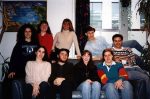
Hillel House, University of British Columbia, circa 1990. (photo from JWB fonds, JMABC L.11126)
These photos were taken at Hillel House, University of British Columbia, circa 1990. (photo from JWB fonds, JMABC L.11122)
If you know someone in these photos, please help the JI fill the gaps of its predecessor’s (the Jewish Western Bulletin’s) collection at the Jewish Museum and Archives of B.C. by contacting archives@jewishmuseum.ca or 604-257-5199. To find out who has been identified in the photos, visit jewishmuseum.ca/blog.
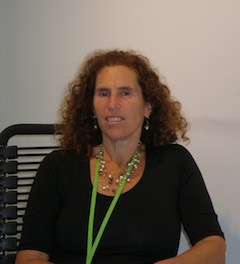
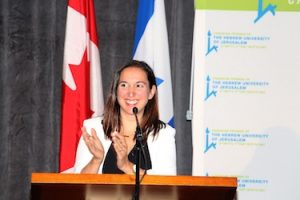
גלית ברעם אמדור נכנסה בראשית החודש לתפקידה החדש כקונסול הכללי של ישראל בטורונטו ומערב קנדה. (צילום: twitter.com/galibaram)
גלית ברעם אמדור נכנסה לתפקידה כקונסול הכללי של ישראל בטורונטו ומערב קנדה
גלית ברעם אמדור נכנסה בראשית החודש לתפקידה החדש כקונסול הכללי של ישראל בטורונטו ומערב קנדה. ממשלת ישראל אישרה בחודש ינואר השנה את מינויה של ברעם אמדור לתפקיד, עם שורה של מינויים בכירים נוספים בשירות החוץ. ברעם אמדור החליפה את די. ג’יי שניוויס, ששימש בתפקיד הקונסול של טורונטו ומערב קנדה מאז 2012.
ברעם אמדור תדבר על האירועים האחרונים בישראל והתוכניות שלה לגבי טורונטו ומערב קנדה, בשיחת ועידה טלפונית לחברי הקהילה היהודית ובעיקר לישראלים, ביום שישי הקרוב (26 בחודש), בשעה 9 בבוקר לפי שעון מחוז בריטיש קולומביה.
לברעם אמדור (שדוברת גם אנגלית ורוסית) ניסיון רב ועשיר במשרד החוץ והיא החזיקה בשורה של תפקידים בכירים בישראל ומחוצה לה. בין היתר: שימשה כמנהלת המחלקה של התחום הפלסטיני ושיתוף הפעולה האזורי במשרד החוץ (במשך כשנתיים וחצי). לפני כן שימשה בתפקיד הקונסול של ישראל ברוסיה, אוקראינה ובלארוס (משך כשנה וחצי), הקונסול של ישראל בשגרירות ישראל בוושינגטון (במשך כשלוש שנים), הקונסול של ישראל בשגרירות ישראל בקהיר (במשך כשלוש שנים), סגן מנהל תחום מרכז אסיה במשרד החוץ (במשך כשלוש שנים), ומזכיר ראשון בשגרירות ישראל במוסקבה (במשך כחמש שנים).
חתונה הפכה לסיוט: צעירה שנערכה להתחתן עם אהובה גילתה שהוא נשוי ויש לו שני ילדים
זוג צעיר בגילאי השלושים מאזור ונקובר נערך למסד את מערכת היחסים ביניהם, ולהתחתן החודש בריצ’מונד. הצעירה הוציאה למעלה מעשרים אלף דולר על מתנות, תכשיטים וכל מה שצריך לחתונה, והזמנות לאירוע נשלחו לאורחים. אך 11 יום לפני החתונה הכלה המיועדת גילתה שבעלה לעתיד הוא בעצם גבר נשוי ויש לו אף שני ילדים.
הזוג הכיר לפני שנתיים באמצעות אתר אינטרנט להכרויות. הם בילו הרבה ביחד ובספטמבר לפני שנה בעת טיול ליפאן, הצעיר הפתיע את אהובתו והציע לה להתחתן והעניק לה טבעת. מאותו רגע החלו השניים לתכנן החתונה במרץ. לאט לאט החלו לצוץ בעיות שונות מצדו של הגבר, אך אשתו לעתיד לא חשבה שיש לכך משמעות. פעם אחת הוא סיפר לה שהוריו שגרים בהודו לא מאושרים כל כך מהחתונה, כיוון שמשפחתה לא מספיק עשירה. לאחר מכן הוא סיפר כי אמו חלתה במחלה חשוכה והמשפחה במצב נפשי קשה. למרות כל הבעל לעתיד ביקש מאשתו לעתיד שלא להפסיק בהכנות לחתונה אלה להמשיכן כמתוכנן.
האמת על מצבו התגלתה לאחר שפגישה מתוכננת בין משפחות שני הצדדים שבועות ספורים לפני החתונה לא יצאה אל הפועל. משפחת הכלה הבינה שמשהו מוזר קורה והחליטה לנקוט מעשה. הוריה, אחיה והיא עצמה נסעו לאבוטספורד לראות את קרוביו של חתנה. את דלת בית המשפחה פתחה אישה שהציגה עצמה כשאשתו של החתן, מזה 13 שנה. הכלה המיועדת שהייתה בשוק ביקשה מאשתו להציג לה תמונות מהחתונה שלהם. פתאם הופיעו בסלון שני ילדיו הקטנים של הבעל (בגילאי 4 ו-10) שכל כך דומים לו, כך שלא היה צריך בהוכחות נוספות להוכחת המירמה. לאחר מספר דקות הגיע הגבר הנשוי שהוא גם החתן המיועד ונאלץ להתמודד עם התקפות הזעם מצד שתי הנשים בחייו. הוא לא הפסיק להתנצל וכמעט כרע על ברכיו, וטען להגנתו שהמניע להתנהגותו נובע מהעובדה שהוא לקה במחלת נפש.
הכלה נערכת בימים אלה להגשת תביעה כספית נגד אהובה הרמאי, בהיקף כ-53 אלף דולר, לכסות את כל ההוצאות הגבוהות שנגרמו לה עקב החתונה שלא יצאה אל הפועל.
The upcoming show at the Sidney and Gertrude Zack Gallery, which features 45 community artists who have donated their work, is a fundraiser for the gallery.
“The idea for the show belongs to Shirley Barnett,” said gallery director Linda Lando in an interview with the Independent. “We wanted to showcase the works of the people who do art for the joy of it, not professional artists. Shirley also made a donation towards the show.”
Lando explained the process leading to the exhibit, which opens Aug. 31.
“I purchased 45 11-by-14-inch wood panels and sent a group email to the gallery email list. The artists got the panels for free and, if their art sells, they will get a tax receipt. The price for every piece is the same, $125, and the proceeds of all sales will go to the gallery. The theme of this art show is ‘Renewal.’ It’s a very broad theme that allows for many interpretations.”
Linda Lando, director of the Sidney and Gertrude Zack Gallery. (photo by Olga Livshin)
Lando doesn’t think that the universal size and shape of the panels limits artists’ creativity. “Just the opposite: it’s a challenge.”
The response to the email was overwhelming. Lando had to turn away people who wanted to participate. The demographics of the show’s contributors are broad.
“A lot of word of mouth helped spread the news about the show,” she said. “Among our participants are people who are involved with the gallery, some who exhibited with us before, while others haven’t. There are several poets from the Pandora Collective, members and non-members of the JCC and some mother-daughter duos. Most of them are not professional artists, but the works that have already started to arrive are amazing and very diverse. I hope we sell most of them.”
The Independent spoke with a few of the exhibit’s artists.
“I have always been interested in arts: painting, poetry, etc.,” said Carl Rothschild, a child psychiatrist with more than 40 years of experience, who is about to retire. “I published two books of my poetry and visual arts.”
Rothschild considers himself an amateur artist but he has already participated in several shows at the Jewish Community Centre of Greater Vancouver and sold a few paintings. When Lando asked him to participate in the fundraiser, he was thrilled. His piece is already at the gallery.
“I decided to participate in this show because I am always painting and because Linda asked me,” he said. “My small piece is called ‘The Backyard Garden in a Box.’ I am endlessly fascinated by the little landscapes around me. My small garden, with crocosmia flowers, attracts a hummingbird each summer. Sometimes, the bird comes with his mate and, on this occasion, as I stood motionless and watched, he came over and hovered for a few seconds about a foot from my head before passing me as safe.”
Another participant, Liz Koerner, retired a few years ago from working in a law office. “I am a professional artist in the sense that I get paid for some of my work, but I started down this path as a hobby,” she said. “Over the past 15 years, I have done dozens of commissions.”
Like the other contributors, Koerner learned about the show from Lando’s email. “I met Linda years ago, when I would take my mother into her gallery, and they always had lively discussions about the paintings and the artists. My mother has since passed on and, at her request, we gave Linda a number of art books from her collection.”
When Koerner decided to participate in Renewal, she chose the theme of spring. “Spring is a wonderful time of renewal and rebirth in nature,” she explained. “My painting is almost done. I needed to leave it while I complete a rush commission, then I will get back to it and finish it soon.”
Sandi Bojm’s piece is also a work in progress. She works part-time as a speech language pathologist and as a therapist, which allows her the time to explore her other interests, including art and writing. “I don’t consider myself an amateur artist; nor am I a professional,” she said. “Perhaps chronically ‘emerging.’”
Over the years, Bojm has taken art classes at Langara College and with private mentors. She met Lando through the Zack Gallery.
“I support the gallery and participated in last year’s community show/fundraiser,” she said. “Linda and I have shared ideas this past year for the next upcoming show, regarding community engagement and participation, and, at the same time, offering a fundraising opportunity for the gallery. It is exciting that it is now coming to fruition.”
Her own piece will be an amalgam of abstract and landscape. “I have just completed an intensive painting workshop on abstraction of the landscape and decided to expand on that,” said Bojm. “I have been intrigued in the past, in my walks through the woods, with the presence of logs and stumps that have nurtured new growth; nursing logs, I believe they are called. This is the image I am exploring in its relationship to renewal.”
A show as a gallery fundraiser is not a new concept. The Federation of Canadian Artists, for example, holds their fundraiser, Paintings by Numbers, annually, but their event is much more expensive for art lovers, and they feature well-known and established artists in their galas.
“Giving the local community artists the opportunity to shine, and making all the paintings affordable to everyone might be unique in Canada,” said Lando. “The idea was not only to engage the community artists but to bring in their families and friends to the gallery, to show them that it is their gallery, too.”
Renewal will run to Sept. 11. There is a free reception at the Zack, with the artists in attendance, on Sept. 8, starting at 7 p.m.
Olga Livshinis a Vancouver freelance writer. She can be reached at olgagodim@gmail.com.
Left to right, reciting the Four Questions at the Okanagan Jewish community’s Passover celebration: Adarah Challmie, Ben Levitan, Jordan Spevakow, David Spevakow, Samara Levitan, and Kate Spevakow. (photo by Misty Smith)
Kelowna’s Jewish community may be small, but it’s poised for growth. The latest development: an expansion of its Hebrew school’s curriculum.
Led by the family of David and Natalie Spevakow, who moved to Kelowna from Calgary some 13 years ago, Hebrew classes were first provided last year. Now, more Jewish content will be added to the lessons, as well.
At the moment, the Spevakows are spearheading this task. Parents lead classes every Monday after school, with kindergarten to Grade 3 first, followed by grades 4-to-7. The parents rotate each week, teaching the kids about Jewish traditions and the Hebrew language, prayers and blessings. Currently, there are 14 students in total (two of whom are Spevakows).
“Trying to have a Jewish life in a small community can be a challenge,” said Natalie Spevakow. “I would say our congregation at the Okanagan Jewish Community Centre is about 100 members, but only 25 to 30 are active members.
“We have a visiting rabbi who comes once a month, Rabbi [Shaul] Osadchey from Beth Tzedec congregation in Calgary. We set this up to bridge the gap with our communities, and that’s been wonderful. With us having young families, we’ve all decided that it’s important that we get together, and we wanted to build a Jewish community for ourselves and our kids.”
The Spevakows are looking to hire a part-time teacher to start in September and work through June. They are searching for a creative, energetic person knowledgeable in Hebrew and the Jewish traditions to teach children ages 4 to 14. The position involves two hours of teaching a week, plus preparation time, and the teaching material is provided. In addition to an hourly wage, the teacher would receive a free annual family membership to the Okanagan JCC. (Interested readers should call Anne at the OJCC, 250-862-2305.)
“All of our parents just want our kids to be with other Jewish children and get a sense of what it is to be Jewish,” said Spevakow.
“We also try to get together with our Hebrew school every few months for a potluck,” she added. “When we have the visiting rabbi come, we do a potluck with the rabbi and do services with our children and our families as well. We make that a time to get together and bring the community together.”
Dressed for Purim, left to right: in the front row, Bria Tizel, Anderson Parnes, Kate Spevakow, Ryder Golbey, Skyla Golbey and Chase Golbey; in the back, Jordan Spevakow, Abbey Parnes and a friend, and Adarah Challmie. (photo by Natalie Spevakow)
As of now, all the children involved in the school are Canadian-born, but there are Israeli-born children who will be joining classes when they come of age. The class curriculum is a combination of programs that the Spevakows sourced online with guidance from Osadchey. Parents are encouraged to take material home to practise during the week.
“The learning works better if they do take stuff home,” said Natalie Spevakow. “I know, for the little guys, they’re just learning the Hebrew letters and can repeat the words they learned…. We try to make it hands-on and more fun for them.”
Looking ahead, Spevakow feels that the Jewish community is growing, anticipating that one day it will be big enough to warrant more frequent visits from Osadchey.
“But, right now, with our smaller numbers, it’s very difficult for us to finance having a rabbi here all the time,” she said. “As is, we’re making it work, getting our kids educated and getting the resources we can.”
The older students are learning to lead Friday night services, with the goal of having them lead a service by May 2017, and then again, have them lead a service with Osadchey.
“We’re not on our own, trying to make things up on our own,” she said. “It’s just a matter of people making time for their kids, so the program works. I think all the parents recognize they want this for our kids and are willing to put in their time.
“We used to do it on weekends, but, with so many of us really big into skiing, it wasn’t working out. So, weekdays are definitely working better for us.”
They also recognize there may be some older members of the community who may be interested in helping with classes, so they hope to bridge the gap and find ways to bring them in, too.
“There’s something to be said about a small community, in that you really get to know all your members,” said Spevakow. “They truly do become an extension of your family. You realize that anything you’d like to see happen, things that, in a larger community you might have taken for granted because it’s available, in a small community may not exist yet…. Connecting on a deeper level with the people in our community, figuring out the assets that each can bring to the table, has really benefited our community. Knowing everyone’s faces really helps.”
Gwyneth Paltrow, left, and Zooey Deschanel at the Sage Summit in July. (photo by Dave Gordon)
Some 15,000 entrepreneurs gathered in Chicago July 26-29 for the Sage Summit, to hear keynote speakers, network and browse the exhibitors’ stations, which spanned the length of 10 football fields, according to Sage chief executive officer Stephen Kelly, who oversees the accounting software giant.
Celebrity speakers included entrepreneurs and actors Gwyneth Paltrow, Zooey Deschanel and Ashton Kutcher, all of whom have Jewish connections.
Paltrow, most known lately for her role as Pepper Potts in the Iron Man film series, was also the head of Goop, which touts itself as a “weekly lifestyle publication.” (She left the publication days after the Summit.)
Some 15,000 entrepreneurs gathered in Chicago July 26-29 for the Sage Summit. (photo by Dave Gordon)
“The more you create a vision of where you’re going, the more you can create a vertical. Where do you want it to be, where do you imagine it to be, and ask people ‘where do you want it to go?’ – that’s how you form an execution strategy,” she advised entrepreneurs at the Chicago gathering.
She also offered a morale boost for budding entrepreneurs.
“Unwavering self-belief is everything. Everyone’s going to tell you why you can’t do it, and you have to know in your bones that you can do it … and take disappointments with as much grace as you can,” said the actress, whose late father, film director Bruce Paltrow, was Jewish.
Paltrow’s co-panelist, Deschanel of television’s New Girl, is founder of the website Hello Giggles, an online magazine for young women launched five years ago and acquired by Time Inc. in 2015. She has also invested in a hydroponics company that grows sustainable and eco-friendly organic food.
“Trust your gut and be yourself – and watch your bottom line. Customers will thank you for that,” said Deschanel, who converted to Judaism last November.
Chiming in about knowing one’s limits – and about social media engagement – was Kutcher, who has invested in high-tech ventures including Skype, FourSquare and Airbnb.
“I learned by sitting in the rooms being the dumbest person in there and asking a lot of questions,” he said.
Kutcher last year married Jewish actress Mila Kunis. He has been a student of kabbalah and has visited Israel several times.
“I was aggressively into social media early on,” he said at the summit. “From a business perspective, I think it’s valuable from a customer service, customer relations perspective. Building a social media environment for their feedback in a dramatic and visible way creates transparency and delivers a high-quality product and service. From a marketing perspective, if used right, it can be beneficial.”
But, he noted, there’s a critical caveat regarding marketers.
Aston Kutcher with Yancey Strickler of Kickstarter (photo by Dave Gordon)
“They come up with these elaborate social media marketing plans, which inevitably fail along the way,” he said, “because marketers tend to forget it’s a conversation, and they don’t account for feedback.”
Kutcher cautioned against having fingers in several social media platforms, noting it’s more about quality than quantity.
“I feel a lot of people aggressively chase the latest in social media marketing and waste a lot of time in it. It’s this sort of race to be on the cutting edge, but, in another sense, it’s time on inefficient platforms. It’s like in acting – the fans don’t go to the actor, the actor should go to where the fans are.”
Twitter, Instagram and Facebook already have “huge swaths of people and have really great tools for targeting,” he added.
Co-panelist Yancey Strickler, one of the three founders of Kickstarter, which he described as “the world’s largest funding platform for creative projects,” has also been the crowdfunding site’s CEO for the past three years.
Despite Kickstarter’s online base, Strickler had his own warning about social media.
“I think social media is bad for our brains, and it’s hard to have introspection on these platforms.… I wouldn’t doubt, in 20 years, if they found what social media does to our brains is what smoking does to our lungs.”
“I’m worried about my brain now,” Kutcher retorted.
Dave Gordonis a Toronto-based freelance writer whose work has appeared in more than a hundred publications around the world. He is the managing editor of landmarkreport.com.
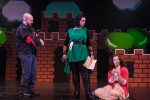
Left to right: Kazz Leskard (Iago), Claire Rice (Desdemona) and Courtney Shields (Constance) in Awkward Productions’ Goodnight Desdemona, Good Morning Juliet. (photo by Derek Fu)
Have you ever wished you could change the course of a play, making the plot … well … just a little bit different?
What would have happened if someone had told Othello that Iago was tricking him? What if Romeo and Juliet hadn’t died? Would the plays have been successful as comedies and not tragedies?
These are the questions taken on in Awkward Productions’ Goodnight Desdemona, Good Morning Juliet, part of the first annual Fakespeare Festival.
Written by the award-winning Ann-Marie MacDonald, Goodnight Desdemona is an outlandish and hilarious romp that follows associate professor Constance Ledbelly (Courtney Shields), who is trying to prove a peculiar notion.
Doing her PhD in Shakespearean literature, her thesis revolves around a made-up tome written in code, called the Gustav Manuscript. She believes the work proves that Othello and Romeo and Juliet were originally written by an author who had included a wise fool and that the plays were supposed to be comedies. Shakespeare, she posits, got rid of the fool, turning them into tragedies. If she can only decipher the code, she can find out the identity of the fool and that will lead her to the original playwright.
The theory is laughed at by her colleagues, including a professor for whom she works (and with whom she is in love), who takes advantage of her desire to please him by having her write all his papers. Her work garners him a post at Oxford, which she believes she deserved, and, to top it off, he is running off with another woman, leaving her alone and out of a job.
Disgusted with herself, feeling hurt and betrayed, she begins to trash her office and finds herself transported into the world of Shakespeare, first landing in Othello, when Iago is about to trick Othello into thinking Desdemona has been unfaithful, and next in Romeo and Juliet, as Tybalt is about to kill Mercutio.
Like Alice in Wonderland, Constance is at first bewildered by her surroundings, but, as she is an expert in Shakespeare, she easily comes up with a backstory and picks up the language of the time. She impresses everyone with her knowledge and is accepted as a contemporary, allowing her to proceed on her quest to find the fool that Shakespeare had eliminated and, from there, find the real author.
But, her presence changes the course of events, and the two tragedies become comedies. This is where the play really takes off.
While in Venice, she reveals Iago’s trickery and befriends Desdemona, who, in turn, helps Constance find her own confidence, but also encourages her to revel in killing, which turns Constance’s stomach (being a vegetarian) and causes her to question her usefulness.
“Next to Desdemona, I’m roadkill,” a dejected Constance laments.
In Verona, the turn of events leads to a squabbling marriage between Romeo and Juliet, both of whom fall in love with Constance, leading Romeo to dress in drag, thinking Constance is a lesbian. The thought excites Juliet, who revels in the idea of a girl-on-girl tryst.
The hilarity of these ludicrous set-ups is enhanced by the dazzling wordplay that infuses MacDonald’s script. A “creep” becomes a “base annoysome knave,” for example. Calling herself an academic from Queens, Desdemona believes that Constance is referring to the queen of the Amazons and treats her as one. When Constance appears in Verona, she’s wearing pants and is mistaken for a boy, with uproarious results.
In the end, Constance finds her fool in an unexpected place (alas), and returns home with the confidence to finish her paper, academic derision be damned.
Though the dialogue is lightning-fast and the one-liners are nonstop, Shields carries the weight of the wordy script brilliantly. Jewish community member Zach Wolfman as Mercutio (as well as numerous other characters) calls upon his Shakespeare training to add his own comedic nuance to the production.
It’s not surprising that MacDonald has won several awards for this literary tour de force, including a Governor General’s Award and Canadian Authors Association Award. It is definitely one not to miss.
The Fakespeare Festival features Goodnight Desdemona, as well as Titus Andronicus: The Light and Delightful Musical Comedy of Titus Andronicus. Both plays run at York Theatre, 639 Commercial Dr., until Aug. 28. Tickets are available from tickets.thecultch.com or 604-251-1363.
Baila Lazarus is a freelance writer and media trainer in Vancouver. Her consulting work can be seen at phase2coaching.com.
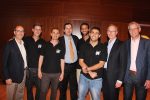
From left to right: Murray Palay, Canadian Friends of the Hebrew University national chair; Israel Defence Forces Unit 669 reserve combat soldiers Leehou Porat and Gai Ben Dor; Prof. Yaacov Nahmias, director of the Alexander Grass Centre for Bioengineering at Hebrew U; 669 reserve combat soldiers Bar Reuven and Dotan Braun; CFHU Vancouver chapter president Randy Milner; and CFHU national vice-chair Phil Switzer. (photo from CFHU Vancouver)
Dina Wachtel, executive director of Canadian Friends of the Hebrew University’s Western region, describes the recent fundraising event that attracted more than 300 people to Congregation Beth Israel on July 17 as “a wonderful success.”
The sold-out event raised scholarship funds for outstanding student-soldiers. These individuals are pursuing degrees at the Hebrew University of Jerusalem, as well as performing their miluim, or reserve duty, in the Israel Defence Forces’ elite airborne rescue and evacuation unit known as “669.” The Vancouver event drew a diverse and engaged crowd from the community and included academics and members of local search and rescue groups.
Prof. Yaakov Nahmias, director of the Alexander Grass Centre for Bioengineering at the Hebrew University, kicked off the formal part of the evening’s program with an overview of Hebrew U’s history and accomplishments. Founded in 1918 – 30 years before the establishment of the state of Israel – by illustrious historical figures, such as Albert Einstein, Sigmund Freud and Chaim Weizmann, Hebrew U ranks as one of the world’s leading universities and boasts seven Nobel Prize laureates. According to Nahmias, “when Hebrew U calls, you answer!”
The Grass Centre was established in 2010. Nahmias, who was at Harvard University before returning to Israel, has won several academic awards for his work in liver research and he is particularly proud of the centre’s successes in “educat[ing] a new generation of multidisciplinary innovators and entrepreneurs at the cutting edge of biotechnology and medical science.” He noted that the centre’s 44 affiliated faculty members undertake research that winds up in the world’s leading scientific journals; interest-catching pursuits such as building a liver outside of a body, predicting in vitro fertilization pregnancy rates, and determining “idiosyncratic drug toxicity” (hitherto unexpected adverse reactions to drugs).
Nahmias also outlined the “startup” element of the centre’s work – an aspect that appeals to students with academic ambitions, as well as giving them market experience and engendering an entrepreneurial spirit. The Israeli government has invested $20 million US in BioJerusalem, or “Silicon Wadi,” to support technological innovation. The outcome? Israel is a global leader in medical devices and pharmaceuticals, he said, and this attracts intellectually curious science students who are also seeking opportunities in business, medicine and engineering. The biodesign program feeds directly into Israel’s economic success and reputation as a technological powerhouse. Remarkable and revolutionary projects to date, he said, include the creation of a specialized infrared gun to facilitate intravenous insertions; digitally made dentures that are inexpensive and quick to produce; and a new 60-second life-saving procedure that improves stabbing victims’ chances of survival by preventing suffocation caused by collapsed lungs.
Nahmias concluded his presentation by highlighting bioengineering as “one of the most fascinating areas, especially for the future of Jerusalem as a city and Hebrew University as the leading university in Israel.” He announced that plans are underway to build a large, new institute on the Givat Ram campus to house the biodesign program.
Event emcee and Hebrew University alumna Nava Rosenberg. (photo from CFHU Vancouver)
The evening’s lecture was punctuated with a musical interlude from Vancouver-based Israeli composer and guitarist Itamar Erez. Recipient of the Landau Prize in 2014, as well as the ACUM Prize for special achievement in jazz, Erez’s musical talents blend jazz, flamenco and the sounds of the Middle East.
Following Erez’s performance, four extraordinary young Israelis took centre stage. They detailed their personal experiences serving in the IDF’s 669 and how the service has impacted their lives.
The unit, which accepts only 50 recruits each year out of 10,000 applicants, was established in 1974 following the Yom Kippur War. It is referred to as the “guardian angel of the Jewish people” because it rescues soldiers and civilians alike, both within and beyond Israel’s borders. The unit’s motto is, “Thou didst call in trouble and I rescued thee” and, in the last 40 years, the unit has rescued more than 10,000 injured and saved thousands of lives. Rescue operations are generally extremely difficult and dangerous.
Bar Reuven, Leehou Porat, Dotan Braun and Gai Ben Dor impressed upon the crowd the unique and challenging lifestyle of a Unit 669 reservist, who is “on-call 24/7” and serves an average of 30 to 45 days a year “in peacetime.” When summoned, a civilian university student is instantly transformed into an elite reservist on a mission that can be anywhere in the world. All personal commitments are immediately set aside.
According to Reuven, 27, who served as an officer in 669 and founded an alumni association designed to provide much-needed support to discharged soldiers from 669 transitioning to civilian life, you “can go from eating shakshuka [in Tel Aviv] to Gaza in 30 minutes.”
Thirty-year-old Braun, a fifth-year medical student at Hebrew U and a reserve combat soldier and paramedic in 669, recounted walking to class in July 2012, when he received a command to present himself on base within the next 30 minutes. He soon learned that he would be traveling to Burgas, Bulgaria, to treat and evacuate some 42 Israeli tourists who had been targeted in a bus bombing. (Tragically, five Israelis and a Bulgarian bus driver were murdered in that terror attack.)
Serving in the 669 instils Braun with a profound sense of pride in Israel, as “there is no other country that cares about the security of all its citizens and at all times,” he said. He – like others in 669 – is also called upon to come to the aid of non-citizens in life-threatening situations, including rescuing sailors in the Mediterranean or treating casualties of natural disasters in far-flung corners of the world.
Braun emphasized that life for 669 reservists, in particular, “is never routine.” Porat, 28, who is both a reserve combat soldier in Unit 669 and a student at Hebrew U, underscored this fact by recounting – with the aid of select video footage – a harrowing evening of back-to-back rescue missions that included evacuating an Israeli soldier from Gaza who had been gravely wounded in an axe attack; responding to a serious car accident that caused seven fatalities; assisting a pregnant Bedouin woman in the advanced stages of labor and whose house had just been washed away by floods; and rescuing a number of individuals trapped in or on cars swirling in raging floodwaters and high winds.
Despite the challenges of balancing the responsibilities of school, work, family, volunteerism and reserve duty, Reuven, Porat, Braun and Ben Dor were all steadfast in their commitment to their unit, and to serving their country and fellow citizens in times of crisis.
It was evident that these four speakers have indeed internalized the core values of the unit, described by Reuven as assisting those in need, social responsibility, and helping make Israel and her people stronger. He engages these values to guide him in managing his Cat 669 Alumni Association, a group that provides emotional, psychological and financial guidance, career mentoring and other material support to fellow unit members transitioning – sometimes with great difficulty – to civilian life. This group also draws upon its superior skill set to “pay it forward” in local communities by, for example, teaching emergency first aid.
Thirty-two-year-old Ben Dor is an accountant and lawyer at KPMG in Israel. As part of 669, he is another example of the positive contributions that 669 reservists make to Israeli society. An avid long-distance runner in his teens, Ben Dor responded to an online ad seeking “a runner with soul.” Beza, a blind Ethiopian immigrant wanted to take up running, and Ben Dor (and his father, also a runner) coached Beza over the next several years. Beza competed in a number of international marathons, and ultimately qualified to compete at the Beijing Paralympics, representingIsrael. Ben Dor, his father and Beza have since climbed to Everest Base Camp together and Ben Dor has established an Israeli not-for-profit organization called 180 Degrees, which hosts running groups for people with physical or cognitive disabilities.
Listening to these four young Israelis who are serving their country in truly meaningful ways and learning about the cutting-edge research taking place at the Hebrew University, it is not surprising that the evening’s fundraising event – to support the reserve soldiers in Unit 669 studying at Hebrew U by relieving them of financial worries – was a “wonderful success.”
Vancouver Hebrew Academy head of school Rabbi Don Pacht, right, presents Joseph and Rosalie Segal with a Stanley Cup-inspired Kiddush cup. (photo by Jocelyne Hallé)
Vancouver Hebrew Academy has outgrown its current facility and is looking to build a new school. It’s in the early stages of a capital campaign to raise $18 million, of which almost 15% has been pledged to date. Its annual Summer Garden Party added to those funds – and it also celebrated the school’s impact, the broader community, and Joseph and Rosalie Segal for their “lifetime of commitment to our Jewish future.”
The party was held on July 21 at the home of Lorne and Mélita Segal. The other event ambassadors were their siblings: Norman and Sandra Miller, Dr. Mark and Tracey Schonfeld, and Gary and Nanci Segal. The night was emceed by Howard Blank and catered by Chef Menachem.
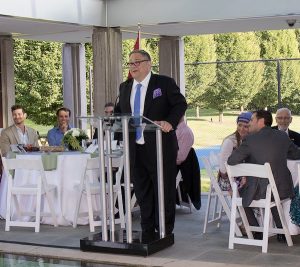
Emcee Howard Blank in action. (photo by Jocelyne Hallé)
The evening’s program noted that VHA’s facility, which it rents from the Vancouver School Board, “doesn’t provide the space and the tools for modern education,” and doesn’t allow for growth. “The main building was built in the 1940s. Three portables have been added. The current 12,000-square-foot space is insufficient and well below the area standards recommended by the Ministry of Education for elementary schools.” VHA’s vision? “A new home for Torah education.”
Starting off the formal portion of the evening, Elizabeth Nider, co-chair of the VHA board of directors, thanked Joe and Rosalie Segal, “not just for being our honorees, but for providing an inspiration and example to our community of what it means to give.” She said this is a value that the teachers and staff of VHA are effectively imparting to students.
By way of example, Nider related the story of what happened three years ago, when her father-in-law, Marvin Nider, was diagnosed with pancreatic cancer. Her son, Yosef, who was 6 at the time, asked her and her husband what he could do to help. Over the course of a few weeks, Yosef planned and held a violin concert, raising more than $10,000 for the B.C. Cancer Foundation, “knowing that this money might not help his grandfather, but would maybe help others with cancer in the future.”
The most meaningful part for the family, she said, was that her father-in-law could watch the concert on Facetime from his hospital bed. “To us, giving back means giving and not expecting anything back. It means giving because you know it’s the right thing to do. And I thank Vancouver Hebrew Academy for teaching our children the importance of giving, and I also thank Joe and Rosalie for leading by example.”
In his dvar Torah, Rabbi Don Pacht, VHA head of school, gave a brief lesson on the mitzvah of charity, “the commandment to give and to offer assistance.” One of the most known lessons is that of the half-shekel, he said. “Everyone in the community was invited to participate and the funds raised would be incorporated into the treasury of the Temple and would benefit the entire community equally.”
“Charity is a two-way street,” he added, talking not only about those who give – making special mention of the evening’s honorees – but the receivers. “For those of us who do receive, it creates an obligation, wherever possible, for us to give back. And that is the value we try to impart at the Hebrew Academy for our families, for our students.”
VHA class of 2008 alumna Kira Smordin said, “VHA gave me the values and the skills of a Torah education, a love for my Jewish heritage, the ability to navigate across the broad spectrum of the Jewish world and the tools to engage and thrive in the secular one.”
Smordin spoke of a couple of teachers in particular who inspired and encouraged her to become a teacher herself.
“This past April,” she said, “I finished my second year of a five-year dual degree arts and education program at Queen’s University in Kingston, Ont.”
As part of the curriculum, she has to do an annual teaching practicum and, this year, she chose VHA. “My teaching practicum was the perfect opportunity for me to give back to a school and a community that has given so much to me,” she said, adding that the most important lessons she learned at VHA were about chesed (compassion) and tzedakah (charity), and that the Segals “are those lessons come to life for me…. You demonstrate by example what it means to give back. You set the bar high and challenge all of us to reach for it.”
Judy Boxer-Zack, VHA class of 1996, added her reflections.
She compared a community to an orchestra, in which everyone has a part to play. She then shared why VHA is close to her heart, and a bit about Chimp (Charitable Impact), the organization for which she works.
At VHA, she said, students were taught to treat everyone with respect, dignity and a sense of inclusiveness. “What naturally flowed from this for us was a distinctive sense that we had a responsibility for our local and broader communities. This was one of the many ways that VHA was setting the stage to inspire the next generation of Jewish leaders.”
And it specifically inspired Boxer-Zack in her career path. She has worked for a variety of nonprofits, leading up to her job at Chimp, and she was visibly proud to introduce Ariel Lewinski, vice-president of Chimp, who was the next speaker.
Recently, Lewinski and his wife, Rachael, had met with Joe Segal, learning a bit about Segal’s life and business endeavors. “What struck me,” said Lewinski, “is how Mr. Segal was so proud to mention that his children and grandchildren have carried on in this tradition of giving back, and thus creating a family legacy of giving.”
Lewinski noted, “We are all here tonight, in some capacity, because we value the importance of Torah education and recognize that, regardless of how each of us chooses to raise our children, a Torah education and an institution that serves that purpose is at the foundation of any vibrant and diverse Jewish community.”
Lewinski’s wife is a VHA alumna and currently sits on the executive board; his mother-in-law, Ruth Erlichman, was the board’s first president and currently sits on the board of governors; and his son, Yaakov, will be starting school at VHA in September. He said that he and his family are such strong supporters of VHA because not only does it provide a strong Torah education but also an excellent secular education.
Lewinski spoke about Chimp, and its objective of reversing the trend of declining charitable giving in Canada by creating and nurturing “a culture of giving by making charity accessible and an everyday part of life.” Everyone at the garden party was given a $100 gift from Chimp to give to any charity, or charities. During the proceedings that followed, Hodi Kahn challenged attendees to give to VHA, saying that the Kahn Family Foundation would match all donations, up to $10,000. As of Tuesday, with 15 days left in the fundraiser, more than $17,000 of the $20,000 goal had been donated.
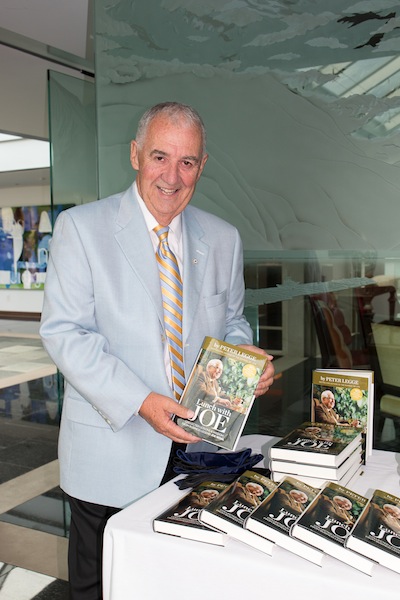
Dr. Peter Legge and his wife, Kay, provided a copy to every family in attendance of his book Lunch with Joe. (photo by Jocelyne Hallé)
Another type of donation was also presented during the evening, with Dr. Peter Legge and his wife, Kay, providing a copy to every family in attendance of his book Lunch with Joe, which features a biography of Joe Segal, shares some of Segal’s philosophies on business and life, and includes the stories of more than 90 people who have had the chance to lunch with Segal at the Four Seasons Vancouver.
Addressing the honorees, Erlichman said she has had many meetings with Joe Segal over the last 18 or so years. “I always came away not only with material support, but practical suggestions to move the needs of our school forward,” she said. “You and Rosalie have been and continue to be incredible mentors – so many of us have benefited from your leadership and generosity of spirit.”
Pacht then presented the Segals with a Stanley Cup-shaped Kiddush cup. Just as the blessing over the wine helps us transition into Shabbat, said the rabbi, “you have also taught us how to take the mundane and to elevate it to the spiritual. The way that your family supports the community is exceptional in every way. It’s inspiring for every one of us here, and countless generations of children and families at the Vancouver Hebrew Academy have felt and will always feel the impact of your family.”
The inscription on the cup recognizes the Segals’ “lifetime of commitment to our Jewish future.”
When Joe Segal spoke, he acknowledged that, while he and his wife had received many accolades during the night, they were not the only ones deserving. “Everybody in this room, I’m sure, has had a special affinity,” he said, “something that was important to them [to support]…. The important thing in life is to do what you can. And the measurement is not how you do it or how big you do it, but doing it the right way.”
Segal described VHA as a “very worthy institution” because it is a “nurturing breeding ground of understanding and of belonging and of responsibility.”
He added – sharing part of a conversation from earlier that day – that Jews comprise such a small percentage of the world’s population. And so, he said, holding back emotion, “This is directed to you, Rabbi Pacht, because what you’re doing is so important – you’re planting the seeds for the evolution and the continuation of the race. Thank you.”
Mitzvah Tools 2.0 aims to make every aspect of bar and bat mitzvah preparation easier for everyone involved. The app schedules meetings, keeps track of progress, enables long-distance learning, organizes essential information like the Torah portions and honors at the ceremony, and makes resources for studying available to the student. The architect of the app is Rabbi Dan Moskovitz of Temple Sholom, who is founder and chief executive officer of Mitzvah Tools.
Moskovitz’s interest in digital Torah education tools goes way back. He has been a computer geek since his own bar mitzvah, which took place in the days of the Atari 400. In rabbinical school, he developed software to help him with the Jewish calendar and, while working in a Los Angeles synagogue in 1998, he created a database to track the progress of children studying for their b’nai mitzvah. In 2003, he developed Mitzvah Tools 1.0, a much more limited version of the current platform.
Mitzvah Tools 2.0, which was released in June, was developed with the help of Cantor Mark Britowich, director of sales and operations at Mitzvah Tools, who has more than 20 years of experience in b’nai mitzvah education. Vancouver’s Mark Fromson was the project manager and Australia-based Salim Jordan led an international team of programmers.
Mitzvah Tools was completely updated to help synagogues prepare their b’nai mitzvah students. According to the app’s website, “the original was locked in the rigidity of fixed browser widths and ’90s graphics. We kicked some new life into this trusty tool with a fresh identity and comprehensive design system to define its look and feel.”
The entire b’nai mitzvah educational team can interact using Mitzvah Tools to manage the study process together. Each student’s resources and their assignments can be accessed, and the student can attach recordings and send them to their tutor to review. Tutors and other team members can work from any location, and Mitzvah Tools enables video chats between tutor and student.
The app’s multimedia resource bank includes the chanting of every Torah and Haftorah portion. Recordings of prayers, various Torah commentaries and pages of the Tikkun (a book of the text as it appears in the Torah scroll) can all be stored and shared, as well as any other relevant files. All members of the team can communicate with each other, and students and parents can communicate with their team members, as well, with privacy settings available to restrict who can access different conversations.
Since its release in June, Mitzvah Tools is already in some 30 congregations. For more information, visit mitzvahtools.com.
Matthew Gindinis a Vancouver freelance writer and journalist. He blogs on spirituality and social justice at seeking her voice (hashkata.com) and has been published in the Forward, Tikkun, Elephant Journal and elsewhere.










 Mitzvah Tools 2.0, which was released in June, was developed with the help of Cantor Mark Britowich, director of sales and operations at Mitzvah Tools, who has more than 20 years of experience in b’nai mitzvah education. Vancouver’s Mark Fromson was the project manager and Australia-based Salim Jordan led an international team of programmers.