New Western awards

The Western Canada Jewish Book Awards are a new initiative of the Cherie Smith JCC Jewish Book Festival. The initiative is designed to celebrate excellence in writing on Jewish themes and showcase the achievements of authors residing west of the Ontario-Manitoba border. The awards aim to recognize the contribution to Jewish culture by these writers, and prizes will be awarded in several categories.

In the inaugural year of the awards (2016), books published in 2014 and 2015 will be accepted. A jury comprised of distinguished members of the literary community will examine the eligible submissions, which will be accepted until Feb. 29, 2016.

It is possible to submit to more than one category. The categories are the Diamond Foundation Prize for fiction, the Pinsky Family Prize for non-fiction, the Betty Averbach Foundation Prize for poetry, the Jonathan and Heather Berkowitz Prize for children and youth books, and the Marsid Foundation Prize for writing on the Holocaust.

Currently, there are two other Jewish book awards in Canada. One is in Montreal, dedicated to writing in Yiddish, and one in Toronto. Although the book awards in Toronto are national, it is the JCC Jewish Book Festival’s hope that Western Canada-based awards will encourage more authors to enter books into competition. By being geographically based, one goal is to enhance the literary scene in Western Canada, which, for the intentions of this award, is considered as being from west of the Manitoba-Ontario border, including the northern regions, to the B.C. coast.

The submitting author must have lived in Western Canada for the past 12 months or have lived in Western Canada for at least three of the past five years. A book written by a non-Jewish author is eligible if in accordance with the following criteria. Eligible books contain significant Jewish content or theme; they are written by an eligible author (see above); they are written in English or are available in English; they are published in English or in English translation between Jan. 1 and Dec. 31 of the year of the award and the year previous to it; they have a 13-digit ISBN, including eBooks; and graphic books are eligible.

The books submitted will be judged by independent industry professionals. The jury will be comprised of five judges, including a chair, to be drawn from a larger pool including judges from all Western provinces. The winners will be announced by mid-April. An awards soirée and event will take place at a later date in the spring. There will be a monetary award of $2,000 for each winning author.

To submit a book for the award, download the form via jewishbookfestival.ca. Mail or deliver in person the following items for each book submitted: a completed entry form, five copies of the book and the $36 entry fee per prize category. Send the package to JCC Jewish Book Festival, attn: Dana Camil Hewitt, at 950 West 41st Ave., Vancouver, B.C., V5Z 2N7.

Contact Camil Hewitt, JBF director, at 604-257-5156 or jbf@jccgv.bc.ca, with any questions.
Canada’s 1936 Olympic decision

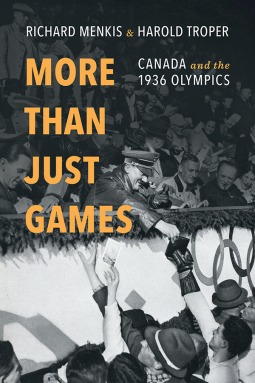
Rarely has a book worked me up as much as More Than Just Games: Canada and the 1936 Olympics by professors Richard Menkis (University of British Columbia) and Harold Troper (University of Toronto).

book cover - More Than Just Games: Canada and the 1936 OlympicsMore Than Just Games was published by U of T Press in the spring. I got my copy from Menkis, who, biases known, I consider a friend. Even so, it took me months to open. The cover image is of members of Canada’s 1936 Olympic team vying for Adolf Hitler’s autograph. Other than some high-quality archival images grouped in the centre of the book, the text is academic, looking almost as imposing as the topic itself. So I was surprised that, when I finally did start reading, I pretty much couldn’t stop. In just over a week, I had read the 230ish-page book, not counting the notes, bibliography and index.

That the scholarship of academics with the credentials of Menkis and Troper would be impeccable I had no doubt. What I hadn’t anticipated was the immediacy they could evoke with their writing. The amount of detail they provide, though on rare occasion overwhelming, serves to bring readers into the period leading up to Canada’s decision to send athletes to the Olympic Games in Berlin in 1936, when there could be no doubt as to the Nazis’ actions and intentions.

Through ample use of citations from letters, articles and speeches of the pro- and anti-Olympic forces, readers witness almost firsthand the debates that took place prior to the Games, they get a glimpse of the almost dizzying number of internal conflicts within the boycott movement, and they get an idea of the amount of propaganda that was being disseminated by Germany in Canada (and other countries). They even learn of some of the differences of opinion between the German Olympic Committee and the Nazi party as to the value of hosting the Games, when the event’s ideal – no discrimination on “grounds of race, religion, politics, gender or otherwise” – ran contrary to the Nazis’ belief in the superiority of the Aryan race, and their efforts to annihilate those they considered inferior.

There were a few outspoken people who tried to waken Canadians to the reality of the Nazi regime – notably journalist Matthew Halton and Rabbi Maurice Eisendrath – but their voices couldn’t rise above the Games’ advocates nor break through the apathy of most of the population. Canada, we are reminded, had closed the doors to Jewish immigration in 1923 – “In distinguishing Jews from non-Jews of the same citizenship, Canada predated Nazi regulations denying Jews and non-Jews equal status under the law by more than 10 years,” write Menkis and Troper.

This is one of the principal reminders of this book, which came out of an exhibit that the professors put together at the behest of the Vancouver Holocaust Education Centre, and which opened several months before the 2010 Winter Olympics were held in the city. Canada might have become a model of multiculturalism, but it was not always so.

Another reminder that stands out is that it doesn’t necessarily take evil people for bad things to happen. Many of the supporters – including athletes – of sending Canadians to the 1936 Games sincerely believed in their position on the importance of sport above all, and seem to have been genuinely confused as to why anyone would disagree. Canada’s position was that of a good colony, following the lead of Britain, which saw no reason not to send competitors. It’s not even obvious in hindsight as to whether Canada’s absence at those Games would have made a difference to the Nazis’ progression of violence to war, to genocide.

Sensibly, Menkis and Troper don’t try to examine the issues with the benefit of hindsight. They present numerous viewpoints and historical facts, mostly without judgment. Their opinions, however, pop out here and there via their choice of adjective or use of sarcasm. I found this comforting because they generally reflected my mood at those points in the book. I would be getting all worked up about what was being said at the time and their jibe would make me smile, and not feel like the crazy one. Because that’s what it felt like reading about it – I can only imagine how people like Halton and Eisendrath felt, actually being there, trying to fight against such ignorance, selfishness, pettiness, narrow-mindedness, greed and indifference.

More Than Just Games is an important contribution to Canadian history, and it is not only a must-read but a very good read.

Continuing the legacy

It’s a wonder any of us are alive. And it’s even more a wonder that we are each the result of generations (not to mention stardust). Not only do genes past and present influence who we are, but the actions of our ancestors, both distant and recent, brought us to where we are today. And we are but a moment in time, a link to future generations.

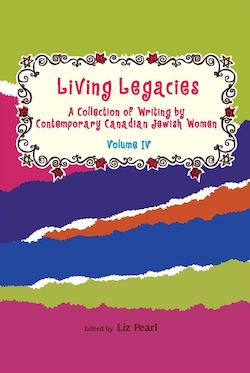
It’s hard not to get sentimental and contemplative reading Living Legacies: A Collection of Writing by Contemporary Canadian Jewish Women (PK Press, 2014). In this instance, Volume 4 that Toronto-based editor Liz Pearl has brought to life; though the previous editions are equally thought-inspiring. Volume 5 is already well in the works.

dec 04 books.04.Living Legacies 4 coverAmong the more than 20 contributors to Volume 4 is Pearl with an essay on her name, Lisbeth Anne Ahuva Pearl Katz, though she has been known as Liz since 1990 and rarely uses her husband’s surname. “I have always liked the name Pearl – a rare and precious gem, and have never considered it just my maiden name,” she writes. “Pearl is a central piece of my name and core identity.” As is her namesake, her maternal great-grandmother Liba Sherashevsky Gitkin, z”l. Born in Lithuania, Liba and her family all died in the Holocaust; her grandmother, Sonia bat Liba, “managed to emigrate in 1935 [to Canada], following a brief courtship and quick marriage” – “the sole surviving member of her family-of-origin.”

About to volunteer as a chaperone on a March of the Living trip, Pearl reflects on the “strong values of Zionism, Yiddishkeit, tzedakah and Jewish education that were central” to her grandmother’s life, which she gained from her mother and others of that generation, and which she passed on to her children, grandchildren, great-grandchildren, and counting. “My namesake and maternal lineage are firmly embedded with history, heritage and wisdom, and form the roots of my solid Canadian Jewish identity.”

Other contributors echo these types of thoughts and feelings. Local author Lillian Boraks-Nemetz, a child survivor of the Holocaust, dedicates her essay, called “Sacrifice,” to her “beloved grandmother, Kazimira Solomon Boraks (1878-1949).” Describing a moment in Russia in the summer of 2010, she writes, “I stand on the shore of the city of the Bronze Horseman, searching the horizon, scanning it for clues to a woman who was born here long before the city became Leningrad, who spent her life in exile, and who died in exile, away from her homeland and her family. A woman who saved my life – my babushka, grandmother in Russian.”

Boraks-Nemetz briefly recounts some of her memories of her years in hiding, the physical and emotional effects of what she experienced and witnessed, her grandfather’s death in the ghetto, and her father’s death only weeks before her grandmother’s in 1948. She notes some of the similarities in their lives – hers and her grandmother’s – and she explains the sacrifices her grandmother made to keep her alive. It is a loving and moving tribute.

Each essay in Living Legacies has something to recommend it. Not all are as deeply serious but all are personal, yet universal. Gratitude is one of the words that comes to mind after reading this collection. Looking at life in the context of the generations before and still to come is both humbling and empowering.

How about a meowukiyah?

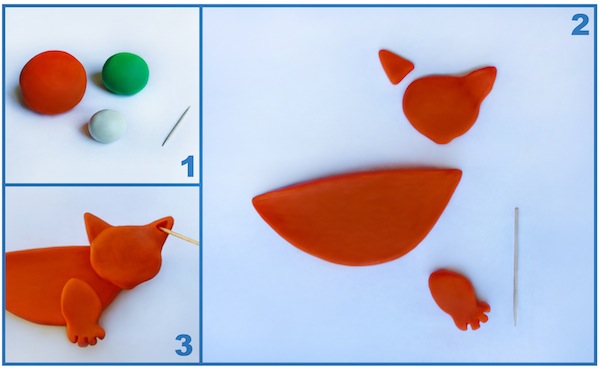
During the Festival of Lights, Chanukah, we light up candles in a special candleholder called a chanukiyah. Chanukiyot come in all kinds of designs, shapes and colors. That is why we will make our own unique version. To be more specific, it is going to be a meowukiyah, since our chanukiyah will take a shape of a cat.

  1. To start, have ready a few basic colors of modeling clay: orange, green, black and white, and a little bit of pink. You will also need a toothpick.
  2. Take the orange modeling clay, make and set aside the body parts of the cat: a head, two ears, the trunk in a shape of a watermelon slice, and four legs.
  3. Attach the ears to the head, the head to the trunk and then attach all four legs to the body. Using the toothpick, carefully trace triangles inside the ears.
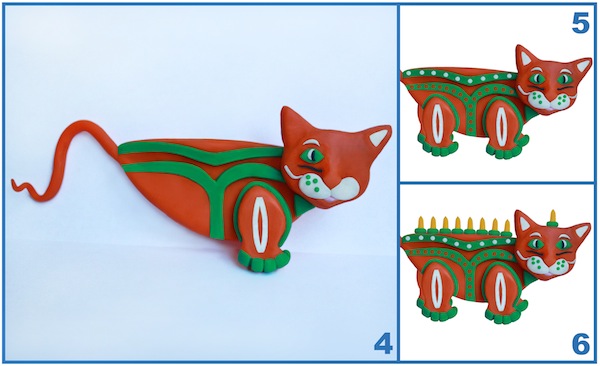
  4. image - meowukiyah steps 1-3Using white, green and black modeling clay, give your cat a face: make the eyes, the eyebrows, cheeks with whiskers – and don’t forget the pink mouth. Make green paw pads and decorate the pads just like the picture shows or the way you like it. After that, make a few green stripes and attach them to the top of the trunk. Give your cat a tail.
  5. Make few little balls from white and orange modeling clay. Using a little force, flatten them into the trunk of your cat. Alternatively, you can try your own design. Don’t be afraid to use your imagination!
  6. The only remaining task is to make the candles. The body of the cat can hold eight yellow candles in green candleholders, and the head can have the shamash, the candle that is used to light up all other candles.

meowukiyah steps 4-6Our meowukiyah is ready! You can play with it, just like you play with your toys, or you can use it to decorate your home. If you take a picture of your creation and print it out, it would make a wonderful Chanukah postcard. Send the pictures of your artwork to curlyorli@gmail.com and win prizes from Curly Orli.

Have a Happy Chanukah, dear Jewish Independent readers!

Lana Lagoonca is a graphic designer, author and illustrator (lunart.ca). At curlyorli.com, there are more free lessons, along with information about Curly Orli merchandise.


Cooking for all the seasons

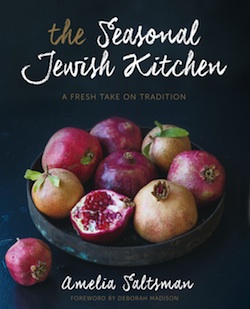
Amelia Saltsman’s background makes for an interesting source for her cookbook The Seasonal Jewish Kitchen (Sterling Epicure, 2015). Her mother is Romanian and her father is Iraqi; they met in the Israeli army and then immigrated to Los Angeles, where Saltsman was born and grew up. She and her family live in Santa Monica.

Saltsman is a regular contributor on food in the media. One day, while cooking and sharing her ideas on various social media and her blog, the responses were so overwhelming, she realized “that a new generation of cooks was looking for a fresh approach to Jewish food.” Thinking about her heritage led her to explore her family’s culinary roots more deeply.

book cover - The Seasonal Kitchen cover

When she divided the year into two-month microseasons, she saw how foods meshed with the holidays occurring during those times. The result is 146 recipes plus 135 beautiful, enticing color photographs. Within each two-month section is the description of a holiday, the background image for which is a piece of Arab embroidery. And each two-month section contains recipes connected to the holiday, from starters, salads and soups, to side dishes, main courses and desserts.

There are essays on what comprises Jewish food, as well as explanations for how to use the cookbook, ingredient essentials, kitchen fundamentals, helpful kitchen tools and seven basic recipes. There are two special indexes – recipes by course and by kosher category – a bibliography, information on the holidays, a resource guide, acknowledgments, more about the author and a regular index.

Saltsman said in an interview with KQED Food, “We often overlook today … the innate seasonality of Jewish food, from the late-summer/early-fall pomegranates, apples and quince of Rosh Hashanah and the etrog (citron fruit) of Sukkot, to the spring lamb and herbs of Passover. That Jewish food can be reframed through the lighter, brighter lens of how we eat today while still being true to its traditional roots.”

This is not a kosher cookbook, but the recipes are labeled as meat, dairy, pareve (neutral) and fish, as well as vegan or gluten-free. “The food philosophy is that you should use well-raised, whole, real foods,” she said. “There are no artificial ingredients used in any recipes.”

Weights are given in imperial and metric measures. One of my favorite aspects of a cookbook is anecdotes on each recipe, which Saltsman includes, and which make for a very warm and personal read. One of my other favorite features is numbering of instructions, which is not used in this cookbook.

Recipes are from Tunisia, Morocco, Germany, Syria, Yemen, Persia, Bulgaria, Hungary, Eastern Europe and, of course, Romania and Israel. Some of the recipes I found particularly interesting include autumn slaw with beets, carrots and kohlrabi; Syrian lemon chicken fricasse; braised beef with semolina dumplings; apples in nightgowns; rustic almond-orange macaroons; rice with almonds and raisins; bulgarian cheese puffs; and whole fish with preserved lemons and herbs.

For Chanukah, here are two of her recipes.

BEST POTATO LATKES
(makes 24; pareve or dairy)

2 pounds peeled starchy potatoes
1 small onion
2 heaping tbsp unbleached all-purpose flour or potato starch
1 tsp kosher salt
1/2 tsp baking powder
freshly ground black pepper
2 lightly beaten eggs
mild oil (grapeseed, sunflower or avocado)
sea salt

Using the large holes of a box grater or a food processor fitted with the grating disk, grate the potatoes (about five cups).

Grate the onion on the large holes of the box grater or use a food processor.

In a large bowl, stir together potatoes, onion, flour, salt, baking powder and a few grinds of pepper. Stir in eggs.

Line two or three sheet pans with paper towels. Place the prepared pans, the latke batter, a large spoon and a spatula near the stove.

Heat one or two large skillets over medium heat. Do not use more than 1/4-inch oil. When the oil is shimmering and a tiny bit of batter sizzles on contact, start spooning in the latke batter, making sure to add both solid and liquids Using the back of the spoon, flatten each spoonful into a circle three to four inches in diameter. Do not crowd the latkes in the pan. You will get four or five latkes in a 12-inch skillet.

Cook the latkes, flipping them once until golden on both sides, five to six minutes total.

Transfer the latkes to the prepared baking sheet. Cook the remaining batter in the same way, stirring the batter before adding more to the pan and adding oil as needed at the edge of the pan.

Arrange the latkes on a warmed platter, sprinkle with sea salt, and serve with applesauce or sour cream.

ROASTED SMASHED APPLES AND PEARS
(3 cups; pareve/vegan)

3 pounds medium-size apples and pears
a few sprigs thyme (optional)
2 to 3 tbsp water, fresh lemon juice, calvados, pear brandy or eau-de-vie, hard cider or dessert wine
ground cinnamon or nutmeg (optional)

Preheat the oven to 375˚F.

Halve the pears and apples through the stem end, then core them and place the halves, cut side down, on one or more sheet pans, spacing them one to two inches apart. If using the thyme, scatter it among the pears and apples. Cover the pan tightly with aluminum foil.

Bake the apples and pears until tender when pierced with a knife tip (30 to 40 minutes). When they are cool enough to handle, slip the fruits from the skins and back into the pan, scraping any pulp from the skins. Discard skins and thyme stems.

Mash the apples and pears with a fork, stirring in enough water or other liquid to help scrape up any brown bits from the pan bottom and lighten the texture of the fruit.

Scrape the mixture into a bowl and serve warm, at room temperature or cover and refrigerate up to a day ahead and serve cold.

This can also be made with all pears or all apples.

Sybil Kaplan is a journalist, foreign correspondent, lecturer, food writer and book reviewer who lives in Jerusalem. She also does the restaurant features for janglo.net and leads weekly walks in English in Jerusalem’s market.

From simple to spectacular

Food writers are privy to a lot of recipes, and many of them, sadly, are repeats of ones already widely familiar, with small variations in ingredients. Infrequently, though, we get access to a compilation of recipes by a skilled author with an innovative eye and a dash of culinary talent, and the result is nothing short of inspiring.

That’s Daniella Silver’s The Silver Platter (Artscroll, 2015) in a nutshell. Silver has none of the accolades of a celebrity chef – she doesn’t call herself a professional and she never spent a day in culinary school. Still, what she lacks in education she more than makes up for in passion and ingenuity in her work. Her recipes take common, easily obtained ingredients and put them together in spectacular new ways that highlight their flavor and versatility. Lay your hands on The Silver Platter and you feel an urge to get into the kitchen and start cooking.

A mother of kids with allergies, Silver is sensitive about gluten and notes whether each of her recipes is pareve, gluten-free, freezable and if substitutions could make it appropriate for Passover. She collaborated with Norene Gilletz to write this book and adds “Norene’s Notes” at the end of each recipe. That’s great because Gilletz is a no-mess, no-fuss chef who offers great tips on food storage, easy cleanup tricks, uses for leftovers and substitution possibilities.

Each recipe has a color image of the prepared dish on the facing page and all look incredibly tempting. I have a weakness for salads and vegetarian dishes, so I loved the panko-topped bok choy with edamame, the shaved corn and asparagus salad, and the kale salad with roasted sweet potatoes. Eye candy abounds and, in almost every recipe, the ingredient list adds new flavors to old staples. For example, lentil cranberry salad; mango chicken with leeks; parsnip latkes; and roasted squash with red onion and pears.

The Silver Platter is eye candy in the best sense of the word. This is a recipe book that will earn its chefs heaps of praise as they create easy dishes with ingredients that are mostly kitchen staples. That means no hunting the grocery stores for that odd ingredient you’ve never heard of before. Nutritional information for each dish is listed in the appendix and more than half of the 160 recipes, which cover fish, meat, poultry, desserts, appetizers and soups and salads, are gluten-free and Passover-friendly.

This book is a keeper on the recipe shelf. Kudos to Silver on her winning combinations in a recipe book that will inspire even long-dormant chefs to get cooking. Here is but one example, straight from The Silver Platter.

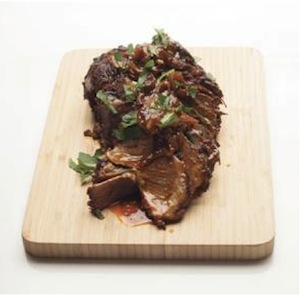
BALSAMIC-BRAISED BRISKET
(meat, Passover, gluten-free, freezes well, yields eight to 10 servings)

photo - Balsamic Braised Brisket from The Silver Platter1 beef brisket (4-5 lb /1.8-2.3 kg)
2 tsp kosher salt
1 tsp black pepper
1 tbsp onion powder
1 tbsp garlic powder
2 tbsp olive oil
3 large onions, thinly sliced
1/4 cup chopped fresh parsley
1 can (6 oz/170 g) tomato paste
2 tbsp honey
3 bay leaves
1/2 cup balsamic vinegar
3/4 cup dry red wine or water

  1. Coat a large roasting pan with nonstick cooking spray. Add brisket; sprinkle with salt, pepper, onion powder and garlic powder. Rub brisket with spices to coat on all sides.
  2. In a large nonstick skillet, heat oil over medium heat. Sauté onions for five minutes, until softened. Stir in parsley, tomato paste, honey, bay leaves, vinegar and wine. Simmer for five minutes, stirring occasionally. Let cool.
  3. Pour sauce over, around and under the brisket. Cover and marinate in the refrigerator for at least one hour or overnight, turning occasionally.
  4. Preheat oven to 325°F. Bake, covered, for three to three-and-a-half hours or until meat is fork-tender. Calculate 45 minutes per pound to determine the cooking time. Discard bay leaves. Let cool.
  5. Refrigerate several hours or overnight. Discard hardened fat from gravy. Trim excess fat from brisket. Slice against the grain to desired thickness.
  6. Reheat, covered, in pan gravy at 350°F for 25-30 minutes.

Norene’s Notes

  • Slow cooker method: season brisket and prepare sauce as above; add to slow cooker insert coated with nonstick cooking spray. Marinate overnight in the refrigerator. Place insert into slow cooker; cook on low for eight to 10 hours.
  • Ask your butcher to cut a very large brisket (8 lb/3.6 kg) in half. Total cooking time will be the same as for one 4 lb/1.8 kg brisket.
  • Brisket should be cooked “low and slow,” with lots of onions. The internal temperature should not rise above 180°F on a meat thermometer; after it reaches 200°F, the brisket will become dry.

Lauren Kramer, an award-winning writer and editor, lives in Richmond, B.C. To read her work online, visit laurenkramer.net.

Mother influences chef

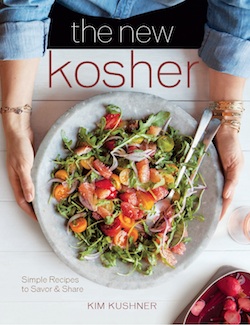
The New Kosher: Simple Recipes to Savor and Share by Kim Kushner is a beautiful cookbook with more than 100 recipes that reflect many cultural traditions. There are full-color photos aplenty (by Kate Sears), easy-to-follow instructions, and each recipe has its own brief introduction.

book cover - The New KosherKushner’s bio notes that she spent “childhood summers in Israel with her extended family,” and there “learned to cook by eating, and by participating in family feasts.” In The New Kosher, she writes: “I was raised in a modern Orthodox home in a vibrant kosher community in Montreal and first learned to cook from my mother, who was born in Morocco and grew up in Israel. My mother’s life revolves around food, and her generosity through her love of feeding other people has been the greatest influence on my cooking.”

Now living in New York with scads of education and experience behind her, including the cookbook The Modern Menu (2013), there can be no doubt that the meals, salads, appetizers and desserts in The New Kosher will make for good eating – and for good sharing with family and friends.

Since it’s almost Chanukah, here are two recipes from the book, one for latkes and one for an applesauce that would go with them quite nicely or, as Kushner recommends: “It’s delicious on its own or served alongside roasted potatoes or even sliced brisket, and both kids and adults love it.”

KIM’S QUICK LATKES
(makes about 24)

5 Yukon gold or red potatoes, about 2 lb (1 kg) total weight, peeled and cut into large chunks
1 large yellow onion, cut into large chunks
2 large eggs
1⁄3 cup (2 oz/60 g) all-purpose flour
1 tsp baking powder
kosher salt and freshly ground pepper
1⁄2 cup (4 fl oz/125 ml) rice bran
oil or canola oil

Preheat the oven to 400°F.

In a food processor, combine the potatoes, onion and eggs, and process with quick on-off pulses until the potatoes and onion are chopped into small pieces, about 30 seconds. Add the flour, baking powder, one teaspoon salt and 1⁄4 teaspoon pepper and process until the ingredients are well combined, a couple of seconds longer.

In a large frying pan, heat the oil over medium-high heat. Using an ice-cream scoop … scoop up the potato mixture, drop into the hot oil, and flatten with a spatula or fork to about 1⁄4–1⁄2 inch thick. Cook only four latkes at a time so you don’t crowd the pan. Once the edges are browned, carefully flip the latkes over and cook until the underside is crisp and golden, about two minutes per side. Transfer the latkes to paper towels to drain. Repeat with the remaining potato mixture. You can serve them right away, but Kushner likes to arrange them in a single layer on a baking sheet and put them in the oven for three to five minutes to give them a final crisping.

To freeze the latkes, let them cool completely, then freeze them in a single layer in large lock-top plastic freezer bags for up to one month. To serve, thaw in the refrigerator overnight and reheat in a 375°F oven until piping hot, eight to 10 minutes.

If you like, sprinkle the latkes with truffle salt just as they come out of the frying pan but, if you plan to do this, reduce the kosher salt to 1⁄2 teaspoon.

VANILLA BEAN APPLESAUCE
(makes 3-4 cups)

10–15 apples (any variety), 3.5–4 lb (1.75–2 kg) total weight, peeled, quartered and cored
1 vanilla bean, split lengthwise

In a large pot, combine the apples, vanilla bean and 1⁄4 cup water and bring to a boil over high heat. Reduce the heat to medium, cover and cook for 35-50 minutes without stirring. (The water will prevent the apples from scorching.) The timing will depend on how many apples you use: the more fruit, the longer the mixture will need to cook. To test for doneness, pierce the apples with a fork. They should be extremely soft and almost falling apart.

Carefully remove the vanilla bean from the pot and let it cool for a few minutes. Then, using the tip of a sharp knife, scrape the seeds into the pot and discard the pod.

Let the apple mixture cool for about five minutes longer. If you prefer a smooth applesauce, transfer the mixture, in batches, to a food processor, and pulse until smooth. If you prefer a chunky sauce, use a potato masher to mash the fruit to your desired consistency. Let cool completely, then transfer to one or more glass jars. The applesauce will keep in the fridge for up to two weeks.

The capacity for excellence

It’s a wonderful concept. A family flees from Russia in 1928. By 1933, they are running a lodge in Canada – the only place Jews can stay. Among their more known guests are the Marx brothers, in particular for the plot, Harpo. Jump to 2003 and the fourth generation, Emily Kogan runs away to her family’s lodge to escape her unraveling PhD thesis. While her academic future remains uncertain, her research brings clarity of her family’s history and of the connections that truly matter.

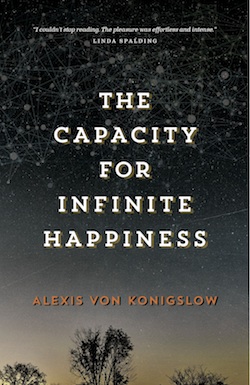
book cover - The Capacity for Infinite HappinessThe Capacity for Infinite Happiness (Buckrider Books) by Alexis von Konigslow is a solid first novel. Von Konigslow is a talented writer with a gift for language and storytelling. Straight away, she sets up the mystery and the tension, describing the scene as Emily’s great-grandmother, Ayala, prepares to flee Russia with her husband and daughter, Blima, Emily’s grandmother:

“Pay attention,” said the tall man.

He was so long that he seemed to be folded into the hallway. He was standing close to Blima’s mother, his big hands around her smaller ones, pressing papers into her palms. Blima had seen this man before, and she hadn’t liked him then either. She backed away, quietly so that they wouldn’t know she was there.

“Ayala, I need you to listen to me,” the man said again.

Ayala bowed into his chest. Blima shivered.

“I don’t want you to panic, or pretend that you’re bored. Here’s what I want you to do. When the officials ask to see your papers, I need you to pinch the little girl, pinch her hard. Don’t tell your husband that you’re going to do it. That way, she’ll be crying, you’ll both be concerned, everyone will want the scene to be over.”

Blima crouched down. She was the only little girl in the house.

“Also, make sure that your shirt is unbuttoned,” the man said, touching her mother’s blouse. “That will help.”

“I don’t want to do this,” said Ayala.

“As a plan, it’s perfectly safe. You’ll send these back by post. We’ll be together again before the end of the year.”

The questions that arise from this opening passage, notably about the man helping Ayala and her family, are central to the novel and keep you reading as it struggles to find its feet. The book’s format, which alternates between Harpo’s 1933 visit to the lodge and Emily’s 2003 visit, interrupts the flow at first and doesn’t become a tension-increasing device until about two-thirds of the way into the book. As well, while von Konigslow’s poetic writing is succinct, it is also repetitive on a few points: Harpo’s concerns about whether he’d make a good father; whether or not William, who Harpo meets in the woods on more than one occasion, is a real person or a figment of the actor’s imagination; and Emily’s ruminations about her thesis and her successive excuses for putting it off.

For almost 200 pages, The Capacity for Infinite Happiness is an OK read; its last 100-plus pages, however, as it becomes more focused and races towards “the reveals,” are excellent. A few minor edits would have made the novel a standout from start to finish. As it is, it is still worth reading for its unique premise, the quality of writing and its insights into Jewish life in the first half of the last century, the meaning of family, how we impact each other even across generations and, most important, love.

Noir-ish Toronto tale

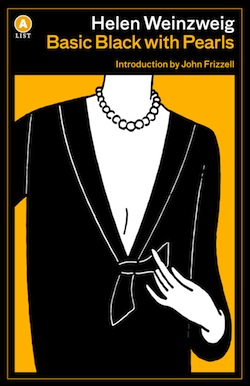
Basic Black with Pearls by Helen Weinzweig is having a second life as a 35th anniversary reissue. The novel won the 1981 Toronto Book Award and gained critical acclaim when it was first issued. Yet, it had been largely forgotten by most Canadians until recently, its revival heralded by reviewers in Canada.

book cover - Basic Black with PearlsThe Polish-born Weinzweig began writing comparatively late in life and certainly never became a household name like some of her contemporary Canadian writers. However, she cut ground with experimental writing that, in this novel, employs dreamlike progression as her character assimilates the dramatic stories of ordinary people she encounters as she moves from place to place and mood to mood.

The narrator, Shirley Kaszenbowski, travels the world under the alias Lola Montez. If the reader is not quite sure who Shirley/Lola really is at the start of the book, it is amply clear by the end that she doesn’t know precisely either.

Her dull, although far from normal, home life is bearable thanks to a secret world she inhabits, in which she travels the world meeting her lover, Coenraad. Because of Coenraad’s top-secret role in a spooky intelligence service, rendezvous locations are secretly conveyed through numerical codes hidden in the latest issue of National Geographic, leading her to dramatic forays into remote parts of the world.

The theatrical, noir-ish story (the title marquees basic black, after all) unfolds through furtive, whispered conversations, overheard snippets, recollected traumas and sexual fantasies … or are they real encounters? It is often dark, sometimes dismal and lonely, yet the writing is brisk. Emotions and events transpire and are left behind in quick succession as the story – and Lola’s adventures – speed along. Much is packed into the novel of little more than 100 pages.

And while the book is fiction, it captures a real sense of a Toronto gone by: the original Shopsy’s backing onto the Yiddish theatre, and passing mentions of landmarks, familiar and less familiar, as she trudges the city’s streets like a lost soul.

Some reviewers have viewed this novel as a feminist tome. If so, it is in the sense of illustrating how some women’s lives are dictated and proscribed by the men in their lives. Or, figuratively or literally, not in their lives.

Despite critical acclaim, Weinzweig never joined the famous names of Canadian literature, or even the smaller shelf that is Jewish Canadian literature, and she was well aware of this before she died in 2010.

She wrote to the Globe and Mail once: “Canadians hate success … Basic Black with Pearls has had rave reviews and has been bought by William Morrow Company in New York. Success and 60 cents will get me a ride on the subway. No one can find a copy of my novel in the bookstores.”

The iconic Canadian literary publisher House of Anansi recognized something in this work that deserved to be shared with another generation. Weinzweig would be pleased. If only bookstores were still a thing. Basic Black with Pearls is also available as a digital book.

Tales of courage and sacrifice

Serious topics are at the fore of the books for younger readers reviewed by the Jewish Independent this Chanukah. From the story of a Russian dancer whose life is cut short by pneumonia to Canadian teenagers who must work 13-hour days for little pay to young Danes who take on the Nazis, these recent publications respect the intelligence of their audience and, through the combination of entertaining narratives and compelling images, broaden their understanding and knowledge of the world.

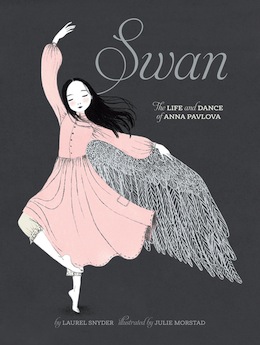
Swan: The Life and Dance of Anna Pavlova (Chronicle Books) is intended for readers ages 6-8. It is truly a work of art that writer Laurel Snyder and illustrator Julie Morstad (who happens to live in Vancouver) have created. The illustrations are stunning and the placement of the text is also artistically done.

book cover - SwanAs Snyder explains at the end of the book, Anna Pavlova was born in 1881. Her mother was a laundress, “and Russia under the czars was generally a world where the poor stayed poor. Anna’s life should have been dismal.” But then her mother took her to the ballet. Onstage, “A sleeping beauty opens her eyes … and so does Anna. Her feet wake up! Her skin prickles. There is a song, suddenly, inside her. Now Anna cannot sleep. Or sit still ever. She can only say, dip and spin….”

The story follows Anna as she practises and practises, until finally accepted into ballet school. After which, more practising, “Until one night she takes the stage … Anna becomes a glimmer, a grace.” She becomes world famous, traveling the globe, though never forgetting her humble beginnings, and becomes a ballet teacher when she can no longer perform. “Until a chill finds Anna, hunts her down alone, without her boots and mittens. A wind. A cough beside a stopped train. A rattle she can’t shake.” In the book, as she apparently did in real life, Anna asks for her swan dress from her sick bed. One last performance, if only in her mind. She died in 1931.

For readers interested in knowing more about Anna Pavlova, Swan includes a nine-book bibliography.

* * *

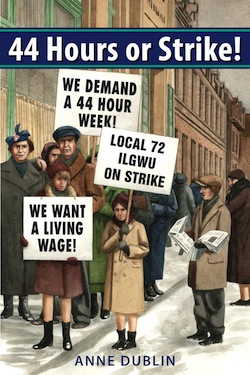
While change may take awhile in coming, it can be achieved. Take, for instance, working conditions in Canada. The title of Anne Dublin’s 44 Hours or Strike! (Second Story Press) comes from one of the unmet demands that led to the Toronto Dressmakers’ Strike of 1931: a 44-hour work week.

book cover - 44 Hours oor Strike!After their father is laid off, Rose must leave school to work in a dress factory. When their father dies from tuberculosis and their mother becomes ill from an unknown ailment (at least at first), 14-year-old Sophie must join her 16-year-old sister at the factory. The working conditions are appalling and they include a lecherous foreman.

When the workers go on strike, there is little empathy. Immigrants (especially Jews) are resented and not trusted, and the Depression has left many people in dire poverty. In an altercation 10 days into the strike, Rose – who did nothing wrong – is arrested with some other strikers and, without due process, is sentenced “to 30 days at the Mercer Reformatory for Women or a $100 fine – as if she had ever seen that much money in her life!”

Sophie must continue her strike duty, as well as care for her mother. She receives some comfort from the friendship of Jake, a paperboy who, unfortunately, is not Jewish.

44 Hours or Strike! – aimed at readers 10 to 14 years old – covers a lot of issues in its 124 pages. The archival photos really help put readers in 1931 Toronto, and brief biographies of some of the labor activists at the time are included at the back of the book. Dublin also lists many options for further reading on the topic.

* * *

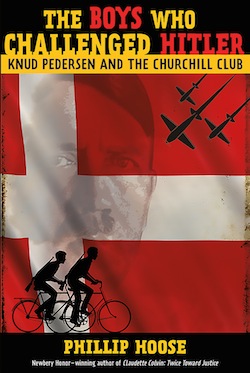
The incredible true story of a group of Danish teenagers who, during the Second World War, fought against the Nazis through acts of sabotage is told by Phillip Hoose and Knud Pedersen in The Boys Who Challenged Hitler: Knud Pedersen and the Churchill Club (Farrar, Straus and Giroux).

This book is comprised of Hoose’s narrative and excerpts from his nearly 25-hour interview with Pedersen in 2012, as well as photos, illustrations, scans of documents and sidebars. At times, it’s hard to know where to look on a page and what to read first. But that shouldn’t be a problem for the 12-to-18-year-olds for whom the book is written.

book cover - The Boys Who Challenged HitlerPedersen was in Grade 8 when, on April 9, 1940, Germany attacked both Norway and Denmark. The Norwegians put up a valiant, if short-lived, resistance. “Jens [Pederson’s brother] and I, and our closest friends, were totally ashamed of our government,” Pedersen says. “At least the Norwegian victims had gone down in a country they could be proud of. Our small army had surrendered to the German forces within a few hours on April 9…. One thing had become very clear: now any resistance in Denmark would have to come from ordinary citizens, not from trained soldiers.”

The brothers with a few others started their rebellion in Odense, where they were living. They called themselves the RAF Club, after the British air force. They would do things like change or damage road signs and cut telephone lines.

When their father was posted to Jutland and the family moved, the brothers organized the Churchill Club; named, of course, after Winston Churchill. They continued their acts of resistance, which came to include blowing up train cars full of material the Nazis needed. Eventually, after about a year, all of the Churchill Club boys were discovered and sent to jail in 1942. The brothers spent two years in prison. Hoose lets readers know what happened to them and their co-saboteurs. There is a selected bibliography and author’s notes on each chapter. This book would be great as the basis of a school project.