Skip to content

  • Home
  • Subscribe / donate
  • Events calendar
  • News
    • Local
    • National
    • Israel
    • World
    • עניין בחדשות
      A roundup of news in Canada and further afield, in Hebrew.
  • Opinion
    • From the JI
    • Op-Ed
  • Arts & Culture
    • Performing Arts
    • Music
    • Books
    • Visual Arts
    • TV & Film
  • Life
    • Celebrating the Holidays
    • Travel
    • The Daily Snooze
      Cartoons by Jacob Samuel
    • Mystery Photo
      Help the JI and JMABC fill in the gaps in our archives.
  • Community Links
    • Organizations, Etc.
    • Other News Sources & Blogs
    • Business Directory
  • FAQ
  • JI Chai Celebration
  • JI@88! video
image - Weizmann Canada Physics Tournament 2025
image - The CJN - Visit Us Banner - 300x600 - 101625

Recent Posts

  • היהירות היא אחד האויבים הגדולים ביותר של ישראל
  • Vrba monument is unveiled
  • Music to build bridges
  • A better future possible
  • Anne Frank exhibit on now
  • Human rights in sport
  • Telling the story of an icon
  • Crawl bigger than ever
  • JCC Maccabi in Toronto
  • A way to meet fellow Jews
  • Time to include
  • Add Jewish joy to the mix
  • Reminder of humanity’s light
  • From the archives … editorials
  • Year-round holiday recipes
  • מדוע עזבתי את ישראל ואינני חושב לחזור ארצה
  • OJC hosts Oct. 7 memorial
  • A journey beyond self
  • Antisemitism a problem
  • Young man is missed
  • Orr action sparks complaint
  • Prison sentence for hate
  • Etgar Keret comes to Vancouver
  • New fall lecture series
  • Series explores music
  • Doc on Zapiro screens Nov. 6
  • Joy of shared existence
  • Community milestones … October 2025
  • MAID vs Jewish values
  • Cheshvan a great month, too
  • Bull, bear or bubble?
  • From the archives … a coin, etc.
  • מדוע האנטישמיות הולכת וגואה בעולם
  • New bio gives Vrba his due
  • Joy brighter than ever
  • When approaches differ

Archives

Follow @JewishIndie

Tag: Zack Gallery

Robin Atlas’ Lashon Hara exhibit at the Zack offers artistic midrash

Robin Atlas’ Lashon Hara exhibit at the Zack offers artistic midrash

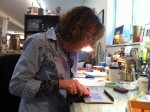
Artist Robin Atlas in studio. (photo from Robin Atlas)

Midrash has been an integral part of Jewish culture for centuries, mainly in literary form. It also branches into the visual arts, however, and there exists a vibrant, international alliance of artists investigating the sacred texts through their paintings and sculpture, fibre art and theatre. Robin Atlas, a Seattle-based mixed-media artist, is part of the movement, and she considers it a personal challenge to raise the awareness of visual midrash in the Jewish community and beyond.

Atlas has been exploring visual midrash for the past four years. Her new show at the Zack Gallery, Lashon Hara, A Narrative on the Consequences of Evil Speech, highlights some of the results of her exploration.

“I turned to this theme after I suffered from an evil tongue myself,” she shared in an interview with the Independent. “Someone gossiped about me. She said very unpleasant things behind my back and then to my face. I was very upset. I talked to my rabbi’s wife, and she sensed my disquiet. She asked me what happened. When I told her, she said, ‘What lashon hara!’ I asked her what that meant, and she told me. It means ‘evil speech’ or ‘evil tongue.’ I started thinking about it. I felt it was a powerful subject to explore through art. Lashon hara creates pain and darkness. How do we turn this darkness into light? What could I, as an artist, say about it? Our community needed such a conversation.”

The exhibition is Atlas’ contemplation on the topic, its different approaches and consequences. Through the use of textile art, she examines how lashon hara impacts the spiritual realm and the physical world. The show consists of 20 small, framed canvas squares decorated with various materials: beads, appliqués, strings, paint and so on. Each piece is imbued with its own symbolism, and the artist’s explanations of her vision are handwritten on the attached labels.

“I started this project by researching the subject for several months,” she said. “I began with seven titles and then created the pieces to match them. But I felt that seven wasn’t enough, so I thought of 13 more titles and the related art pieces.”

One piece in particular, “Feather Pillow,” encompasses the idea behind the show. It might be seen as an illustration to a story. “It’s a Jewish folk story. I heard it first when I was a young girl,” Atlas recalled. “I did something bad, gossiped about someone, and my grandmother told me that story. When I started investigating lashon hara, I remembered the story again, and it became the foundation for one of the pieces.”

A small panel with the full text of that story hangs next to the artwork. The story compares gossip to a feather. Once on the air, flying away, it can’t be caught and retracted, and those who spread the gossip commit three murders: they kill the souls of the speaker, the listener and the one about whom they gossip. “Three Murders,” another piece in the show, illustrates the point.

Several pieces reflect the artist’s personal way of dealing with gossip, converting its darkness into light. One is called “Bomb,” but Atlas’ depiction is not a weapon: the beautiful, sparkling-with-golden-beads image depicts an unusual bomb, a bomb of kindness. “It’s a retaliation of love,” Atlas said. “We have to stop the circle of evil speech. It’s about that woman who spoke evil of me.”

Although she used the vehicle of the Torah to convey her introspections, lashon hara is not confined to the Torah or the Jewish community, of course. There are examples of “evil tongue” everywhere, in our personal and work lives, in the public sphere. In this respect, the show is both timely and timeless, resonating with everyone of every nation or culture, and age.

The show also has an interactive aspect. “We invite the public to write down small notes: how lashon hara affected them, whether it was something they said or something said about them. The notes are anonymous,” Atlas explained. “Anyone can pin his or her note about their experience of lashon hara to a special board. We provide the papers, the pencils and the pins. At the end of the show, we’ll collect all the notes, shred them and turn them into mulch, to be used for a plant at the JCC. We will, this way, symbolically turn the darkness of lashon hara into light.”

During the opening reception on May 29, Rabbi Carey Brown of Temple Sholom joined Atlas for the Artist’s Beit Midrash, a discussion of lashon hara. The exhibit runs until June 22.

Olga Livshin is a Vancouver freelance writer. She can be reached at [email protected].

Format ImagePosted on June 6, 2014June 6, 2014Author Olga LivshinCategories Visual ArtsTags lashon hara, Robin Atlas, Zack Gallery
Reenvisioning women at the Zack

Reenvisioning women at the Zack

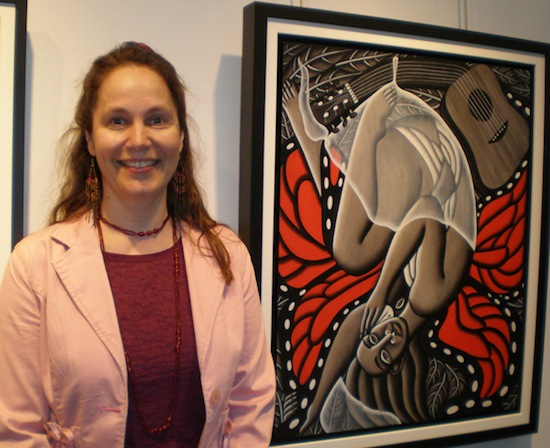
The centrepieces of the show, two large paintings by Jazmin Sasky, are both based on Anita Diamant’s novel The Red Tent. (photo by Olga Livshin)

Across centuries, artists in different countries have depicted women in their multiple incarnations – among them, mother, muse, beloved, temptress. The new show at the Sidney and Gertrude Zack Gallery, called Envisioning Women, brings a new slant to the theme: how 21st-century Canadian artists see women.

The centrepieces of the show, two large paintings by Jazmin Sasky, are both based on Anita Diamant’s novel The Red Tent and, therefore, on the Torah. The women in the paintings could be just as easily from biblical or contemporary times, friends going on a camping trip or visiting a spa. The paintings’ festive red palette with its multiple nuances communicates the women’s contentment at being together, sharing the space. While the red tent in the novel refers to a place reserved for the females of the tribe, a place where they find mutual support and encouragement, in the paintings, the space alludes to a wider interpretation.

“I explored the sisterhood of women,” said Sasky. “It’s as relevant today as it was then, although in the biblical times, they all lived together. No secrets were possible, unlike us. We are much more private, but it was interesting to imagine those women, their lives.”

Her women don’t belong exclusively to the ancient tribe. They also live in the here and now, share our workspace and our holidays, walk along the same streets and into the same buildings. They are not afraid of change, of bursting out of the artificial confines of the “red tent” and into life.

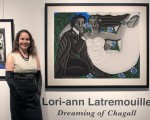
photo - In Lori-Ann Latremouille’s “Emerging,” a woman transforms out of her restrictive silken shroud into wings and the world
In Lori-Ann Latremouille’s “Emerging,” a woman transforms out of her restrictive silken shroud into wings and the world. (photo by Olga Livshin)

This courage and strength resonates in many other works in the show. The women in them assert their place in history and are willing to rebel, if necessary.

Nancy Henderson’s painting with the title “Sk8r grrl one” is one example of such a rebellion. It depicts a young female hockey player in a ridiculous costume of the beginning of the 20th century. The artist’s fiery words about her work read as a tribute to every Canadian woman: “I salute women of every generation who have defied everything from societal disapproval to outright bullying in order to get into every game, including the great frozen one.”

Carly Belzberg’s “Eve” doesn’t look like a traditional Eve of old either. This Eve participates; she gets into games. In her shorts and a tank top, sitting in a meditation pose, perhaps doing yoga, she is not afraid of the world unfolding around her, and her quiet courage transmits to everyone who comes into the gallery.

Life is changing, and we’re changing with it, coming out of our traditional cocoon of domesticity, where women were confined (by choice and not) for generations – that seems to be the message of the show.

Lori-Ann Latremouille’s painting “Emerging” embodies this idea. Her woman is transforming out of her restrictive silken shroud into wings and the world. She will fly and sing, and the guitar incorporated into the image signifies the connection between music and freedom. “Rebirth after dormancy,” commented the artist. Not surprisingly, she is a professional musician herself, and her painting is a story of metamorphosis. “It’s a new painting technique for me, too. I used to do drawings,” she said.

photo - In her photography, Kathryn Gibson O’Regan tries to “find what unites women of all times and cultures”
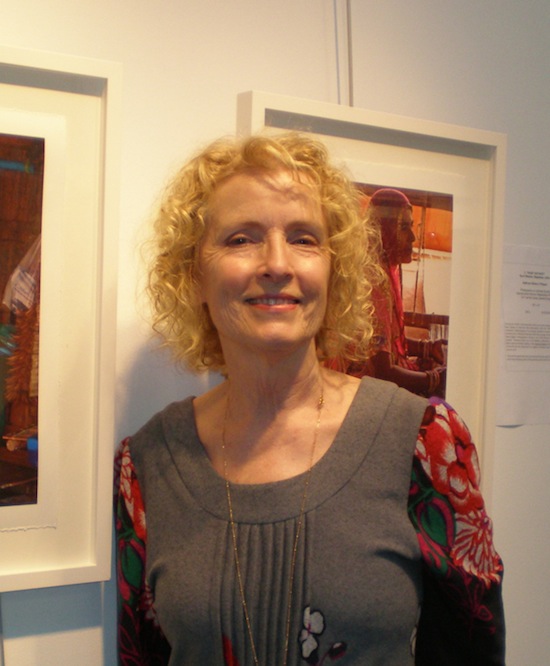
In her photography, Kathryn Gibson O’Regan tries to “find what unites women of all times and cultures.” (photo by Olga Livshin)

The line of timelessness, of connectivity, continues in Kathryn Gibson O’Regan’s serene photographs. “I travel a lot and always try to find what unites women of all times and cultures. Creativity is common: weaving and spinning and making textiles, from the Bible to our times. I visited villages in many countries in Asia.” Her photos of the weavers in India and Thailand emanate peacefulness, their deep colors soft and bright simultaneously.

In contrast, there is little that is peaceful in Linda Lewis’ display of pottery cups. Each one has a face painted on it, or rather a hint of a face, the eyes. They are called collectively “Hints.” About two dozen of the cups are arranged in two glass cases in the middle of the gallery, similar in shape and size, but varied in their facial expression. Some cups stand in groups, like friends gossiping. Others are alone, in pain or pleasure. Still others resemble family clans, with love and antipathy intermixed. The whimsical complexity of women’s lives in pottery is fresh and unexpected.

It’s impossible in a short article to tell about each of the 15 artists participating in the exhibit – all of them add their unique perspective to the image of “contemporary woman,” and readers are encouraged to visit the gallery. Unfortunately, they won’t be able to experience one aspect of the show – the JCC Shalom Dancers. As the exhibit is in collaboration with Festival Ha’Rikud, its opening night featured a group of young dancers, led by Marla Simcoff and Jessica Bradbury, who presented a short but beautiful routine, a teaser of their full-length performance. Six young women in long black dresses, trimmed with red and yellow, with large red fans, danced in the atrium of the community centre, bringing dramatic energy and gladness to gallery patrons. They were the real-life embodiment of the paintings, women of the 21st century.

Envisioning Women will be on display until May 25.

Olga Livshin is a Vancouver freelance writer. She can be reached at [email protected].


Format ImagePosted on May 16, 2014May 14, 2014Author Olga LivshinCategories Visual ArtsTags Carly Belzberg, Envisioning Women, Festival Ha’Rikud, Jazmin Sasky, JCC Shalom Dancers, Jessica Bradbury, Kathryn Gibson O’Regan, Lori-Ann Latremouille, Marla Simcoff, Nancy Henderson, Zack Gallery
Rothschild’s watercolors at Zack Gallery

Rothschild’s watercolors at Zack Gallery

Dr. Carl Rothschild has always had artistic inclinations but he could never choose one creative medium over the others. In the end, like a Renaissance man, he chose them all. He plays violin and viola. He’s made sculptures and wood carvings. He studied theatre. He has been writing poetry since high school, and painting and drawing even longer. He’s an artist through and through, unable to exist without making art in one form or another, even though his chosen profession is child psychiatry.

“I always drew pictures,” he said about his early years. “When I told my mom I wanted to be an artist, I was six at the time, she said: ‘Doctors paint.’ When I mentioned that I liked playing music, she replied: ‘There’re doctors’ orchestras.’”

She wanted him to be a doctor, and he followed her advice. He doesn’t regret his choice. “At least I’m not starving,” he said with a smile. But he continued his involvement with the arts as a hobby, albeit a serious one. His first solo show of paintings, Stained Glass in Watercolor, opened on March 20 at the Sidney and Gertrude Zack Gallery.

Every painting in the show resembles a stained-glass panel; every shape is delineated by a dark outline. Inside the outlines, color rules. Yellow torches of the autumn trees stand along a street like soldiers on parade. Red tulips glow like candles above the grey flagstones of a backyard. Bluish sky melts into the pearly sea at the horizon, while the dramatic black borders cut across nature’s immensity, bringing it closer to humans and to the boulders on the beach.

Stained-glass technique is Rothschild’s latest creative mode. He is exploring its possibilities and shares his discoveries with viewers. “When our eye looks at two objects side by side,” he explained, “it sees a black separation line between them. When I insert the black lines myself, I can contain the shapes. I have control over them, and each object is discrete. I place them wherever I want in the picture.”

His images are never photographic. Whether the inspiration for a painting comes from a photo or a scene he has witnessed, or from his own poems, the end result is invariably his impressions of the objects that attracted his interest. “I saw those red trees and I wanted to paint them. I placed them in the painting, but they couldn’t be alone, they needed a street, a house, so I painted them, too.”

Besides shapes and lines, the stained-glass technique also fascinates Rothschild because of the texture and color variations in every glass fragment, he said. He tries to replicate the effect in his paintings, so his colors are muted, fluctuating inside the shapes he has imposed. “I like rounded lines; they’re easier on the eye,” he admitted. “It’s like the lines are dancing.”

His creative process implies a deep knowledge of the subject, but he is mostly self-taught. “I only started taking regular art lessons three years ago,” he said. “I was unsure whether I should continue painting. I visited a friend and talked to him about it. He had some watercolors by Susan Pearson on his walls. I liked them, and he said he knows the artist, why don’t I talk to her. So I did. I took my sketchbooks to this [artist] and I said I wanted to know where I was in my art. Am I an artist? Should I continue? She said: ‘Yes, of course, you’re an artist.’ Since then, I’ve been taking lessons with her every week.”

Those lessons contributed to another of his recent creative endeavors: in 2013, he published a book of drawings and poems, Almost Missed, on sale alongside his paintings at the gallery. “Only one painting in the book is done in the stained-glass technique, the first one I ever tried,” he said. “It was for my poem ‘In Memory of My Father’s Death.’ I liked it and started painting other pictures the same way.”

Most other illustrations in the book originated from one or another of Pearson’s lessons. They are either classic watercolor landscapes, airy and light, almost transparent, still-life pictures and abstracts based on the ideas and images of still life.

The connections between the poetry and pictures are intimate and allusive, and are woven together throughout the book. “Art is a synthetic process,” he said. “It comes out in whatever you do: poetry, visual art, furniture making. I always made art. Once, my family moved into a new home, and the previous owners left a stack of wooden kitchen cabinet doors in the basement. I started carving those doors. I don’t know what happened to them when we moved again. I also tried sculpture. When I was at university, my friend needed help in making dental samples. I helped him, and then used the same material for small sculptures. I also made a chess set for a friend.”

The modest Rothschild said he regards his constant creative output as relatively insignificant, but his sensitivity and artistry is unmistakable. Despite a medical degree and a psychiatric practice, in his heart, Rothschild is definitely an artist.

Stained Glass in Watercolor is on exhibit at Zack Gallery until April 27.

Olga Livshin is a Vancouver freelance writer. She can be reached at [email protected].

Format ImagePosted on March 28, 2014May 5, 2014Author Olga LivshinCategories Visual ArtsTags Almost Missed, Carl Rothschild, Stained Glass in Watercolor, Susan Pearson, Zack Gallery

Art space gets new director – Linda Lando

“I was in the right place at the right time with the right preparation,” said Linda Lando about her new position: director of the Sidney and Gertrude Zack Gallery.

photo - Linda Lando
Linda Lando (photo from Linda Lando)

Lando has unique qualifications for the job, having been an art dealer, with her own gallery, for 30 years. Now, she wants to share her knowledge of the arts with the Jewish Community Centre of Greater Vancouver and its gallery.

Lando didn’t dream of becoming a gallery owner when she was young. “It just happened,” she told the Independent. “After getting my degree in art history from UBC, I did some work for the UBC art gallery and worked for a local auction house. When Alex Fraser Gallery had an opening, I applied and got the job. I liked gallery work so much that I ended up buying the gallery. It was unintentional. It was never a goal of mine to run a gallery, but I loved it.”

Although her gallery has changed its name twice since – it is now Granville Fine Art on the corner of Granville and Broadway – Lando remains the owner. She intends to retain her client and artist lists, both of which she’s established over the years, but she is eager to explore the new venue, to dedicate half of her time to the Zack.

“I can’t see myself doing anything else but running a gallery, but I’m ready for something new, for community-minded work, away from the commercial art world…. Sometimes we have to rise above the monetary values and do something for the community.”

She had been searching for a new direction for awhile when she received a phone call from Reisa Smiley Schneider, the gallery’s recently retired gallery director. Schneider told the Independent: “We started talking about the recent changes in our lives, and she said she wasn’t sure what she was going to be doing in the next while and had to make some decisions about her gallery. We chatted for awhile, and then she said someone had suggested she apply for my position. I asked her how she responded to them, and she sounded like it was something she might consider. I proceeded to tell her how much I had loved my job over the 15 years I had worked there. I included some of the things that frustrated me as well, just to be realistic, but basically I encouraged her to apply and to do so soon, as the deadline for applications was in two days. I was delighted to hear that she was interested in the position, as it seemed a ‘win-win-win’ for everyone and every organization involved. What a gift to me to have Linda, a gallery owner for 30 years, take over as gallery director! I am excited to see how the gallery will soar under her direction.”

Lando elaborated, “I’ve known Reisa for some time, and she was always happy here at the Zack. She had a connection with people. When I learned about her retirement, I decided to apply for this job. Sitting all day at my commercial gallery could get lonely. Nobody comes there just to chat. But here, interacting is easy. Children come to the gallery. Someone offered me a chocolate. Nobody’s offered me chocolate at my gallery. Here, Reisa had created a warm, friendly place, and I’ll try to keep it [that way].”

She is already keeping that promise, maintaining a link between the past and the future of the gallery. Whoever comes through the door – an art lover to look at the current exhibition, a toddler to play hide and seek or a senior on the way from a class – Lando engages everyone with a smile and a friendly word.

“Running a gallery requires huge people skills,” she noted about her approach. “I have to keep my artists happy. The best part of the job is phoning the artists and saying that their painting is sold. I love it. It could be very disheartening, when you put up a beautiful show, and it doesn’t sell. But it’s not only about selling.” Her job is also about educating people, she said. She considers the educational aspect essential, both for a commercial gallery and for the Zack.

Keeping her clients happy is also paramount. “Anybody walking into the gallery with the intention to buy is in a good space with me. I have to build on that. Sometimes, people start by liking art and then they become collectors, passionate and knowledgeable about the art they collect. I have to keep up my research to be worthy of their trust. It’s all about trust. For the clients to trust my taste and my artists, I have to know what’s going on in the marketplace, what is a good investment, especially in regards to historical works. Before [the] internet, I often went to auctions and shows in Toronto. Now it’s easier – everything is online.”

Unlike sales of historical masterpieces, where the dealer’s personal taste counts for much less than marketplace demands and cultural traditions, in the modern arts, the dealer’s taste is utterly important.

“That’s why I like the Zack,” Lando added. “It’s not exactly a commercial gallery, no pressure to sell. But, of course, if paintings sell, it’s good for everyone, for the artists and for the JCC. I see it as my biggest challenge: finding good, quality art and making sure a certain calibre of artists wants to exhibit here. Plus, attracting serious buyers. Now, when collectors want to buy a painting, the Zack is not on their usual route. I’d like to change that, so they would consider the Zack when they are ready to make a purchase.”

Olga Livshin is a Vancouver freelance writer. She can be reached at [email protected].

Format ImagePosted on March 7, 2014May 5, 2014Author Olga LivshinCategories Visual ArtsTags JCC, JCCGV, Jewish Community Centre, Linda Lando, Reisa Smiley Schneider, Zack Gallery
Michael Abelman art bright, optimistic

Michael Abelman art bright, optimistic

Michael Abelman’s show runs at the Zack until Feb. 16. (photo by Olga Livshin)

A day before Michael Abelman’s art show opened, someone wandered into the Sidney and Gertrude Zack Gallery, looked around, and exclaimed: “How nice. Spring has arrived!” This random comment could serve as a description of the entire show. Bright optimistic flowers bloom on the gallery walls, defying the winter rain outside, encompassing all seasons. It’s hard to believe that the artist only started painting 10 years ago.

“I always loved art,” Abelman told the Independent about his start, “loved visiting museums and galleries. There are wonderful paintings in galleries along Granville Street, but I could never afford them, so I thought I would paint what I like myself.”

His vague wish to create beauty resulted in the birth of an artist, although from his background, one might never guess the exuberance of his floral canvases. By education, Abelman is an accountant; by profession, a salesperson. He grew up in South Africa and immigrated to Canada 20 years ago, together with his partner. He never painted in his native country, but Canada inspired him to start.

“In the beginning, I was really bad for a long time,” he admitted with a smile. “But I never gave up. I learned: studied with Lori Goldberg, took classes at Emily Carr, read textbooks and went to galleries.” And, of course, he painted.

“Studying art was a long, slow progression for me,” he recalled. “Each year, I would get better – maybe one percent. Then, three years ago, I had a big jump in quality. I joined Artists in Our Midst that spring and opened my house to the public.”

He sold several paintings that first year, which seemed like an acknowledgement of his skill, although sales don’t really matter to him. “I enjoy painting. That’s why I do it. If my paintings sell, all the better, but I would do it anyway. I don’t think I’ll ever stop.”

Abelman finds inspiration in the gardens around Vancouver. “I like painting what I see close to home. It’s beautiful here,” he said. “I’ve traveled to Europe, South America and Australia, but I don’t want to paint what I see there. I don’t want to paint Mexico. I want to paint local gardens. My partner, Leon, is a gardener. His garden is wonderful. I painted it one whole year. It motivated me. Leon grows some interesting tropical trees, plants from South Africa. He has a banana tree.”

Several paintings in the exhibition reflect the artist’s vision of his partner’s garden. One of them he even named after the gardener: “Leon’s Garden.”

Verdant greenery and the profusion of flowers of all varieties dominate Abelman’s pictures. Pink roses and red poppies, gorgeous dahlias and coquettish impatiens, slender blush-tinged mallows and exotic orange pokers beckon the viewers to enter the paintings, smell the fragrance, hear the leaves whisper.

All this multicolored magnificence has been painted indoors, in the artist’s basement turned studio, from photographs and picture books. “It’s often cold and rainy outside,” he lamented. “And I try to paint every day, at least one hour a day.”

He uses his own photographs and those of others as a motif, a starting point for his unique compositions, which are imbued with polychromatic light. He never copies a photo. To breathe life into his paintings, he changes the layout, applies his own impressions to the image or introduces a little mystery.

One of the paintings in the show, “Reflections Through My Window,” resonates with enigmatic undertones. Furniture and living stems, glass panes and a bouquet in a glass vase intertwine in the image, creating something new, discordant and harmonious simultaneously. It’s hard to discern what is reflection and what is reality, what is inside the glass and what is outside. “Mystery is good,” Abelman said with satisfaction when he talked about this painting.

“When I look at photos to find a new idea for a painting, color is more important to me than content,” he explained about his creative process. He constantly searches for that elusive quality that only reveals itself to true artists. “I’m always pushing the limits of beauty, but my esthetics change with years, evolve…. It’s all about that final lost layer of paint that makes all the difference.”

Sometimes, that final touch is a shadow or a few stray wavelets in a pond, or a lone petal falling into a stream. Water – be it a tiny rivulet in a garden, a pond in Giverny or the somnolent Burrard Inlet – features prominently in many of his paintings. “I love painting water,” he said.

Always on the lookout for new imagery, Abelman visited the library of Van Dusen Botanical Garden a few months ago for some flower books. When the librarian saw his paintings, she offered him a show at the library, and that show was mounted in the fall of 2013. His impressionistic flowers did very well alongside the real thing. “I was invited to speak to the Richmond Art Guild later this spring, because they saw my paintings at the Van Dusen. They have 60 members.”

He sounded amazed at his own luck, despite his rapidly improving skills and the attending commercial success, as if he can’t take himself too seriously. Even when he disclosed his secret ambition, he laughed, as if sharing a joke: “I want my paintings to be so good that it would hurt you to walk out of the galley without them.”

In Full Bloom is at the Zack Gallery until Feb. 16.

Olga Livshin is a Vancouver freelance writer. She can be reached at [email protected].

Format ImagePosted on January 24, 2014May 5, 2014Author Olga LivshinCategories Visual ArtsTags In Full Bloom, Michael Abelman, Zack Gallery

Posts pagination

Previous page Page 1 … Page 10 Page 11
Proudly powered by WordPress