Skip to content
  • Home
  • Subscribe / donate
  • Events calendar
  • Business Directory
  • FAQ
  • News
    • Local
    • National
    • Israel
    • World
    • עניין בחדשות
      A roundup of news in Canada and further afield, in Hebrew.
  • Opinion
    • From the JI
    • Op-Ed
  • Arts & Culture
    • Performing Arts
    • Music
    • Books
    • Visual Arts
    • TV & Film
  • Life
    • Celebrating the Holidays
    • Travel
    • The Daily Snooze
      Cartoons by Jacob Samuel
    • Mystery Photo
      Help the JI and JMABC fill in the gaps in our archives.
  • Community Links
    • Organizations, Etc.
    • Other News Sources & Blogs
  • JI Chai Celebration
  • JI@88! video

Recent Posts

  • Or Shalom reopens its doors
  • JFS from past to future
  • Need holistic approach
  • Sharing stories, advice
  • Journalist shares fears
  • Skills to live together
  • Road to independence
  • Cutting grass with scissors
  • Zionism as a solution
  • Deceit, desire & the divine
  • Reclaiming sacredness
  • Creative project ideas
  • Summer squares and cobbler
  • Thou shalt … summer commandments
  • Legal help for students
  • Revisiting myth of Lilith
  • Wrong person rebuked
  • Canada’s mixed messages
  • Questions for museum
  • Symposium on antizionism
  • Making soccer political
  • CJPAC lauds Pulver’s impact
  • City recognizes Vrba’s legacy  
  • Organ donation saves lives
  • Theodore’s March premiere
  • A healing Shabbaton
  • Supplying healthy food
  • A chime of metal tags
  • Yellowknife seder a first
  • Ishai energizes, unifies
  • A Lag b’Omer to remember
  • Expanding the healing
  • Hannah Senesh – a unique hero
  • Community milestones … May 2026
  • Sharing her testimony
  • Fall fight takes leap forward

Archives

Follow @JewishIndie
image - The CJN - Visit Us Banner - 300x600 - 101625

Tag: WSCCS

Sharing stories, advice

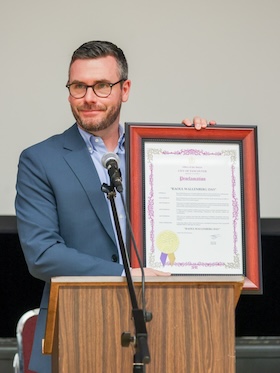
photo - Vancouver City Councilor and Deputy Mayor Peter Meiszner holds the city’s proclamation of April 19 as Raoul Wallenberg Day
Vancouver City Councilor and Deputy Mayor Peter Meiszner holds the city’s proclamation of April 19 as Raoul Wallenberg Day. (photo by Masumi Kikuchi)

The Wallenberg-Sugihara Civil Courage Society (WSCCS) hosted its 21st annual Raoul Wallenberg Day event on April 19. Held at the Peretz Centre for Secular Jewish Culture this year, its theme was “Confronting Hate Speech and Scapegoating.”

Alan Le Fevre, the society’s current president, opened the proceedings with a brief history of the organization and the annual event.

“Our name is taken from Raoul Wallenberg and Chiune Sugihara, who were two outstanding diplomats who, at great personal risk, saved thousands of Jews in World War II,” he explained. “Our aim is to recognize and remember those who have acted with similar civil courage in the present day.”

Vancouver City Councilor and Deputy Mayor Peter Meiszner read the city’s annual proclamation of April 19 as Raoul Wallenberg Day. He thanked the society “for their leadership in establishing and sustaining this important event and their dedication to recognizing those who act in defence of human dignity.” He spoke of the need for such leadership, when, “across Canada and around the world, we are witnessing the consequences of hate speech, including acts of violence that undermine the safety of our communities.”

WSCCS board member Gene Homel introduced the three speakers, starting with Kim Reclama-Clutesi (Oqwilowgwa), who has served as the elected chief of Kwakwaka’wakw (Qualicum First Nation), and is a Kwakwaka’wakw and Pentlatch knowledge holder and an ethnobiologist.
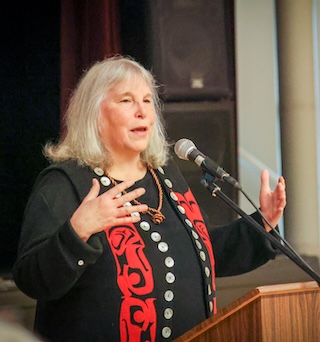
photo - Kim Reclama-Clutesi (Oqwilowgwa) speaks at this year’s Wallenberg-Sugihara Civil Courage Society Raoul Wallenburg Day event April 19
Kim Reclama-Clutesi (Oqwilowgwa) speaks at this year’s Wallenberg-Sugihara Civil Courage Society Raoul Wallenburg Day event April 19. (photo by Masumi Kikuchi)

She shared various experiences with hate and injustice, along with examples of resilience, including work that her father did to protect children in residential schools, and his family. She spoke of how she is always seeking connections. “Even if it’s a thin thread, we have to honour those connections…. A lot of what people are doing today is trying to remove those connections and putting us into different places and categories,” especially regarding treaty and land claims issues, she said.

“You have to remember that this began over 500 years ago, with the Doctrine of Discovery and the papal bull that was issued in the late 1400s,” said Reclama-Clutesi. “It gave permission for European colonizers to ‘discover’ lands if they assumed that the people were ‘not organized’ or were in need of ‘spiritual healing’ – I’m paraphrasing dramatically.” 

Prior to colonization, she explained, there was food security through traditional land and water stewardship, there were cultural practices that promoted spiritual growth and community cohesion. 

Reclama-Clutesi spoke of the need for compassion. “We share this land with many,” she said.

“The bottom line is education,” she concluded. “Not just education as in taking cultural competency courses. It’s about getting to know each other. It’s about going into each other’s sacred places and understanding them. It’s about looking at things with a different lens.” It’s also about calling out those who spread hate and deny injustices that have happened, she said.

The second speaker was Hasan Alam, a human rights and labour lawyer, president of the BC Civil Liberties Association and co-founder of the Islamophobia Legal Assistance Hotline. He addressed the fact that the relationship between the Muslim and Jewish communities has not always been easy, saying it is important to hold onto “our shared histories and our shared experiences.”

He described the power of words to engender hate, to scapegoat and to “other,” as well as the dangers of silence. As a youth in the post-9/11 era, he experienced and witnessed the increased suspicion of Muslims, including instances of detention without due process “not because of anything they had done, but because of their names and what they believed.”

This not only influenced Alam’s decision to become a lawyer, it also taught him a lesson: “Words are not neutral. They carry weight. They shape how we see each other, how institutions treat us and, when weaponized, they can strip people of their dignity, their safety and, in the worst moments in history, their lives.”

Alam discussed the Charter of Rights and Freedoms, as well as the Criminal Code. He gave the R v. Keegstra case as an example of an appropriate and successful prosecution of someone promoting hatred. His focus, however, was the injustices that occur within lawful boundaries. He noted that “the framework, as it operates in practice, too often assumes an equal playing field” between those spreading hatred and the targeted community. Yet, those with the widest platforms, such as politicians and the media, through apparent credibility and through repetition, can generate broad acceptance of their ideas, to the detriment of the “othered,” he said.
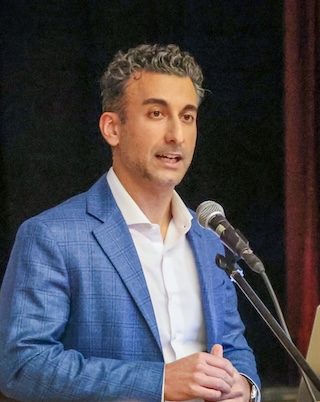
photo - Hasan Alam
Hasan Alam (photo by Masumi Kikuchi)

Alam warned that the state is not a “neutral arbiter of free expression.” Those in power can select who gets heard, “punishing certain voices while giving others a free pass,” he said, highlighting Canada’s genocide of Indigenous culture, and the internment of Japanese-Canadians during the Second World War.

The public’s “moral panic” can lead to political rhetoric that eventually results in laws or selective application of laws that target specific communities, said Alam. This can have a “chilling effect,” so that people self-censor – “freedom of expression doesn’t have to be formally taken away to be lost,” he said.

“I think real dialogue works,” he added. “The research on prejudice reduction consistently shows that when people who hold mistaken assumptions driven by fearmongering, driven by misinformation, driven by othering, or maybe just limited exposure, when they actually engage with the community they fear, those views do change.”

Making space for good-faith dialogue, where someone can admit they don’t understand something, might be uncomfortable, said Alam, but “that discomfort, when it’s honestly expressed and when honestly engaged, is often the beginning of understanding, and that’s where change lives … when the person in front of you becomes real.”

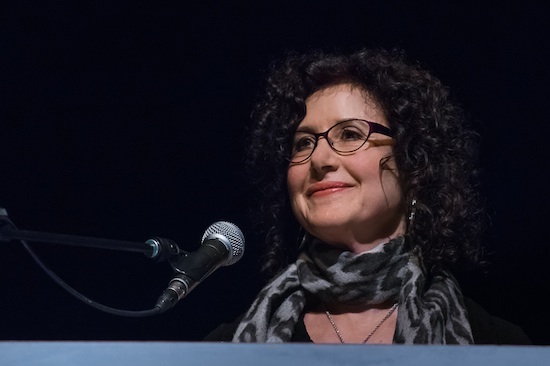
Marsha Lederman – a Globe and Mail columnist and author of two books  – spoke about how Sugihara saved some 6,000 Jews by issuing them transit visas.

Referring to a statue of Sugihara in Los Angeles that was defaced earlier this year with red paint, she asked, “How, in any way, is this statue, is this man, an appropriate target?” It’s understandable to disagree with the actions and policies of the current Israeli government, she said. “It’s quite another thing to self-righteously target a historical figure whose heroic act was saving Jewish lives.”
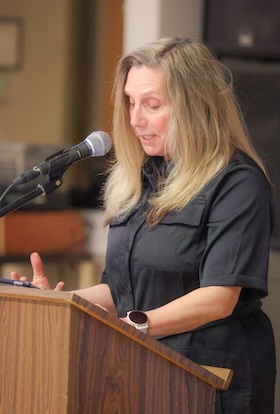
photo - Marsha Lederman
Marsha Lederman (photo by Masumi Kikuchi)

Since the Oct. 7, 2023, terror attacks on Israel, there has been increased hostility toward Jews and a greater acceptance of speech that is hateful, if not the legal definition of hate speech, she noted.

Acknowledging that “what is happening in Gaza is catastrophic,” Lederman does not believe it should be compared to the Holocaust. Such comparisons, she said, are being used to delegitimize the state of Israel, and she shared some of her family’s experiences and other Holocaust history as proofs of why this line of thinking is wrong.

Lederman has become a frequent target of hate speech and she read out some of the names she has been called, including “Zionist nutcase” and “blood thirsty ghoul,” and, by supporters of Israel, “traitor” and “self-hating Jew”; she has been threatened. “Both sides have accused me of weaponizing the Holocaust, which my parents survived and which my grandparents [and other family] did not,” she said.

Lederman’s strategy for dealing with hate is to continue to exercise her freedom of speech. “I refuse to stop writing about these wars, about antisemitism, about Gaza, about Oct. 7, about Iran, Lebanon, with context, nuance and, I hope, heart, always trying to come at it from the humanitarian middle,” she said.

A panel discussion and question period followed the presentations, and the program concluded with the National Film Board short For Angela, the true story of a Winnipeg mother and daughter who successfully confronted bullying aimed at their Indigenous identity. 

The April 19 event was supported by the Peretz Centre and the Vancouver Jewish Film Centre. 

Ann Daskal is an independent writer and a member of Or Shalom.
Format ImagePosted on June 12, 2026June 10, 2026Author Ann DaskalCategories LocalTags freedom of expression, Hasan Alam, hate, hate crimes, history, human rights, Kim Reclama-Clutesi, law, Marsha Lederman, resilience, Wallenberg-Sugihara Civil Courage Society, WSCCS
Dosanjh courage recognized

Dosanjh courage recognized

Ujjal Dosanjh will receive the inaugural Civil Courage Award at the 10th annual Raoul Wallenberg Day on Jan. 18. (photo by Patrick Tam)

In honor of the 10th annual Vancouver Raoul Wallenberg Day, the Wallenberg-Sugihara Civil Courage Society will present its inaugural Civil Courage Award to the Hon. Ujjal Dosanjh on Jan. 18.

WSCCS was formed by members of the Swedish and Jewish communities in 2013, with the goal of continuing the legacy of the Wallenberg Day in Vancouver and commemorating Raoul Wallenberg, Chiune Sugihara and others like them through the establishment of an award for civil courage. The award is given to an individual associated with British Columbia who has helped improve the lives of others and society while defying unjust laws, norms, conventions or unethical behaviors of the time and place. The choice of Dosanjh as a recipient was unanimous in the panel of three, which includes Thomas Berger, a Canadian politician of Swedish descent and retired Supreme Court justice, Georgia Straight publisher Dan McLeod, and Thomas Gradin, honorary Swedish consul, former hockey player and a scout for the Canucks. Dosanjh was selected as the award recipient “for his actions as a critic of sectarian violence and his advocacy for social justice, often at great risk to his personal safety. As a critic of extremism and champion of liberal democracy he has been a great benefit to Canada and an inspiration to us all.”

Dosanjh is well known as Canada’s first Indo-Canadian provincial premier and for his roles as attorney general, federal health minister and a member of Parliament until 2011. Back in 1985, after the Indian army attacked the Golden Temple in the Punjab to flush out Sikh extremists, Dosanjh warned the Canadian government that sectarian violence could spill over into Canada. His warning fell on deaf ears. Four months later, on June 23, 1985, Air India Flight 182 was bombed, killing 329 people, 280 of whom were Canadian. In the wake of this tragedy, Dosanjh consistently and publicly denounced violence as a means of establishing an independent Sikh homeland in India.

As a result these calls, Dosanjh has been subjected to death threats since the 1980s, he was attacked and severely beaten with a metal bar outside his law office and he had a Molotov cocktail thrown into his constituency office in 1999. He recalls a Facebook page set up in 2010 to discuss openly how to execute his murder. Despite these harrowing encounters, Dosanjh said he has always felt “safe enough” living in Canada. “Canadians are a peace-loving people who respect each other’s right to speak, no matter how distasteful one’s remarks might be,” he said. The threats subsided after 2010 but by then he had learned to live with them. “You can’t let these threats beat you into fear,” he added.

In an interview with the Independent, Dosanjh said he was “totally humbled” when he learned he would be receiving the award a few weeks ago. Though he’d not heard of the WSCCS, he was familiar with the story of Raoul Wallenberg. “To be honored in his name is something I could never have imagined in my wildest dreams,” he confessed. “I’m extremely honored to be associated with Wallenberg’s name, though what he did was under much more difficult circumstances and, therefore, all the more important. Still, to be acknowledged in your own lifetime for things you stood for, that some may find disagreeable, is great because it’s good to have friends.”

Dosanjh is presently writing a memoir and said though he misses the “gut and thrust” of politics, he has no longing for the weekly commutes to Ottawa and, prior to that, to Victoria.

WSCCS will present the award at the Wosk Auditorium at the Jewish Community Centre of Greater Vancouver on Sunday, Jan. 18, 1:30 p.m. B.C. lieutenant governor, the Hon. Judith Guichon, will attend the ceremony, which will include a screening of the film The Rescuers by Michael King, which tells the story of 13 heroic diplomats who saved tens of thousands of lives during the Second World War. Admission is by donation.

Lauren Kramer, an award-winning writer and editor, lives in Richmond, B.C. To read her work online, visit laurenkramer.net.

Format ImagePosted on January 9, 2015January 8, 2015Author Lauren KramerCategories LocalTags Ujjal Dosanjh, Wallenberg-Sugihara Civil Courage Society, WSCCS
Wallenberg Day honors heroes

Wallenberg Day honors heroes

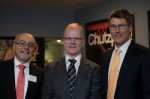
Left to right, Henry Ross-Grayman, Thomas Gradin and Mayor Gregor Robertson. (photo by Wendy Fouks)

There was a full house at the Norman and Annette Rothstein Theatre for the community’s marking of Wallenberg Day on Jan 19. Sponsored for the first time by the newly formed Wallenberg-Sugihara Civil Courage Society, the annual event was the natural outgrowth of the placement of a plaque in Queen Elizabeth Park in 1986. It was revived at the 20th anniversary in 2006 as a cooperative effort between the then honorary Swedish consul, Anders Neumuller, and the Vancouver Second Generation Group.

Each year, the event pays tribute to courageous and heroic actions inspired by the Swedish diplomat, Raoul Wallenberg, and the Japanese diplomat, Chiune Sugihara. Both men, at grave risk to themselves, their families and their future, chose to follow their own personal moral code and save the lives of large numbers of Jews during the Second World War.

Mayor of Vancouver Gregor Robertson read a proclamation naming the day “Raoul Wallenberg Day in the City of Vancouver.” He said, “There are always heroes in our midst and elevating their place in society and celebrating and having discussion … is absolutely critical in a civil society.”

This year, the heroism of Englishman Sir Nicholas Winton was highlighted in the movie Nicky’s Family. This emotionally powerful film told the story of how Winton saved the lives of more than 600 Czech children just prior to the outbreak of  the Second World War. The film documents how his actions have inspired young people to engage in direct acts of tikkun olam.

British Consul Rupert Potter honored Winton, saying, “I have never introduced a film to quite so full a house as this, which, I think, is testament to the content and the importance of the subject and what the film represents….”

There was an especially moving moment when members of the audience who owed their lives to the heroic actions of people such as Wallenberg, Sugihara and Winton were asked to stand. This action made the impact of these men clearly visible, showing that one person can make a profound difference in the world.

Naomi Taussig, the cantor of Temple Sholom Synagogue, spoke about the miracle of how her father and uncle were saved by Winton. She said, “Where would I be but for the actions of a single man who chose to do something when he could have done nothing at all? I feel a responsibility to live proudly as a Jew, honoring my grandparents, Emil and Irma. I try to live kindly, with compassion and intention. Nicholas himself says we must live ethically, and do whatever we can – no matter how small. We must take action rather than believe we are too insignificant to make a difference.”

photo - Deborah Ross-Grayman
Deborah Ross-Grayman is a Wallenberg-Sugihara Civil Courage Society committee member.
(photo by Wendy Fouks)

I, too, owe my life to the actions of a diplomat. Against the orders of his government, Sugihara gave out visas to Jews, allowing them to escape certain death and travel to Japan. My mother was a recipient of such a visa. Had she not received it, I would not be here today. Last year, I traveled to Japan and had the honor of meeting with Sugihara’s granddaughter to express my deepest gratitude for the actions of her grandfather. It was a heartfelt meeting that I will remember for the rest of my days.

We need these stories to remind us of the inherent good that lives within people. We need to educate, to pay tribute, to remember and, finally, to inspire people today, as well as future generations, to act with courage and live their values in a way that contributes to the healing of the world.

The Wallenberg-Sugihara Civil Courage Society is passionate about wanting to leave a legacy encouraging others to engage in behaviors inspired by Wallenberg, Sugihara and people like Winton. We are looking for people who, at significant personal risk, have helped improve or save the lives of others by going against unjust norms or conventions. Over the coming year, the names of suggested individuals who meet the criteria (including being associated with British Columbia, even if their actions may have taken place outside of the province) will be reviewed. Next year, at the annual Wallenberg Day event, we hope to present an award for civil courage to acknowledge heroic acts in today’s world. For more information, contact the society at [email protected].

Deborah Ross-Grayman is an artist, writer and Sugihara survivor descendant committee member of the Wallenberg-Sugihara Civil Courage Society.

Format ImagePosted on January 31, 2014April 9, 2014Author Deborah Ross-GraymanCategories LocalTags Deborah Ross-Grayman, Gregor Robertson, Henry Ross-Grayman, Thomas Gradin, Wallenberg Day, Wallenberg-Sugihara Civil Courage Society, WSCCS
Proudly powered by WordPress