
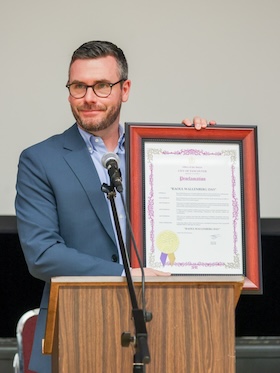
The Wallenberg-Sugihara Civil Courage Society (WSCCS) hosted its 21st annual Raoul Wallenberg Day event on April 19. Held at the Peretz Centre for Secular Jewish Culture this year, its theme was “Confronting Hate Speech and Scapegoating.”
Alan Le Fevre, the society’s current president, opened the proceedings with a brief history of the organization and the annual event.
“Our name is taken from Raoul Wallenberg and Chiune Sugihara, who were two outstanding diplomats who, at great personal risk, saved thousands of Jews in World War II,” he explained. “Our aim is to recognize and remember those who have acted with similar civil courage in the present day.”
Vancouver City Councilor and Deputy Mayor Peter Meiszner read the city’s annual proclamation of April 19 as Raoul Wallenberg Day. He thanked the society “for their leadership in establishing and sustaining this important event and their dedication to recognizing those who act in defence of human dignity.” He spoke of the need for such leadership, when, “across Canada and around the world, we are witnessing the consequences of hate speech, including acts of violence that undermine the safety of our communities.”
WSCCS board member Gene Homel introduced the three speakers, starting with Kim Reclama-Clutesi (Oqwilowgwa), who has served as the elected chief of Kwakwaka’wakw (Qualicum First Nation), and is a Kwakwaka’wakw and Pentlatch knowledge holder and an ethnobiologist.
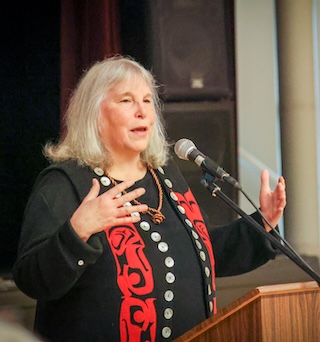
She shared various experiences with hate and injustice, along with examples of resilience, including work that her father did to protect children in residential schools, and his family. She spoke of how she is always seeking connections. “Even if it’s a thin thread, we have to honour those connections…. A lot of what people are doing today is trying to remove those connections and putting us into different places and categories,” especially regarding treaty and land claims issues, she said.
“You have to remember that this began over 500 years ago, with the Doctrine of Discovery and the papal bull that was issued in the late 1400s,” said Reclama-Clutesi. “It gave permission for European colonizers to ‘discover’ lands if they assumed that the people were ‘not organized’ or were in need of ‘spiritual healing’ – I’m paraphrasing dramatically.”
Prior to colonization, she explained, there was food security through traditional land and water stewardship, there were cultural practices that promoted spiritual growth and community cohesion.
Reclama-Clutesi spoke of the need for compassion. “We share this land with many,” she said.
“The bottom line is education,” she concluded. “Not just education as in taking cultural competency courses. It’s about getting to know each other. It’s about going into each other’s sacred places and understanding them. It’s about looking at things with a different lens.” It’s also about calling out those who spread hate and deny injustices that have happened, she said.
The second speaker was Hasan Alam, a human rights and labour lawyer, president of the BC Civil Liberties Association and co-founder of the Islamophobia Legal Assistance Hotline. He addressed the fact that the relationship between the Muslim and Jewish communities has not always been easy, saying it is important to hold onto “our shared histories and our shared experiences.”
He described the power of words to engender hate, to scapegoat and to “other,” as well as the dangers of silence. As a youth in the post-9/11 era, he experienced and witnessed the increased suspicion of Muslims, including instances of detention without due process “not because of anything they had done, but because of their names and what they believed.”
This not only influenced Alam’s decision to become a lawyer, it also taught him a lesson: “Words are not neutral. They carry weight. They shape how we see each other, how institutions treat us and, when weaponized, they can strip people of their dignity, their safety and, in the worst moments in history, their lives.”
Alam discussed the Charter of Rights and Freedoms, as well as the Criminal Code. He gave the R v. Keegstra case as an example of an appropriate and successful prosecution of someone promoting hatred. His focus, however, was the injustices that occur within lawful boundaries. He noted that “the framework, as it operates in practice, too often assumes an equal playing field” between those spreading hatred and the targeted community. Yet, those with the widest platforms, such as politicians and the media, through apparent credibility and through repetition, can generate broad acceptance of their ideas, to the detriment of the “othered,” he said.
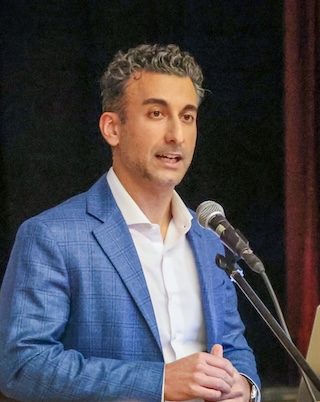
Alam warned that the state is not a “neutral arbiter of free expression.” Those in power can select who gets heard, “punishing certain voices while giving others a free pass,” he said, highlighting Canada’s genocide of Indigenous culture, and the internment of Japanese-Canadians during the Second World War.
The public’s “moral panic” can lead to political rhetoric that eventually results in laws or selective application of laws that target specific communities, said Alam. This can have a “chilling effect,” so that people self-censor – “freedom of expression doesn’t have to be formally taken away to be lost,” he said.
“I think real dialogue works,” he added. “The research on prejudice reduction consistently shows that when people who hold mistaken assumptions driven by fearmongering, driven by misinformation, driven by othering, or maybe just limited exposure, when they actually engage with the community they fear, those views do change.”
Making space for good-faith dialogue, where someone can admit they don’t understand something, might be uncomfortable, said Alam, but “that discomfort, when it’s honestly expressed and when honestly engaged, is often the beginning of understanding, and that’s where change lives … when the person in front of you becomes real.”
Marsha Lederman – a Globe and Mail columnist and author of two books – spoke about how Sugihara saved some 6,000 Jews by issuing them transit visas.
Referring to a statue of Sugihara in Los Angeles that was defaced earlier this year with red paint, she asked, “How, in any way, is this statue, is this man, an appropriate target?” It’s understandable to disagree with the actions and policies of the current Israeli government, she said. “It’s quite another thing to self-righteously target a historical figure whose heroic act was saving Jewish lives.”
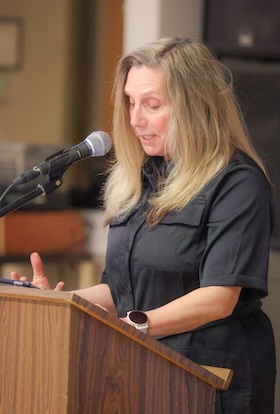
Since the Oct. 7, 2023, terror attacks on Israel, there has been increased hostility toward Jews and a greater acceptance of speech that is hateful, if not the legal definition of hate speech, she noted.
Acknowledging that “what is happening in Gaza is catastrophic,” Lederman does not believe it should be compared to the Holocaust. Such comparisons, she said, are being used to delegitimize the state of Israel, and she shared some of her family’s experiences and other Holocaust history as proofs of why this line of thinking is wrong.
Lederman has become a frequent target of hate speech and she read out some of the names she has been called, including “Zionist nutcase” and “blood thirsty ghoul,” and, by supporters of Israel, “traitor” and “self-hating Jew”; she has been threatened. “Both sides have accused me of weaponizing the Holocaust, which my parents survived and which my grandparents [and other family] did not,” she said.
Lederman’s strategy for dealing with hate is to continue to exercise her freedom of speech. “I refuse to stop writing about these wars, about antisemitism, about Gaza, about Oct. 7, about Iran, Lebanon, with context, nuance and, I hope, heart, always trying to come at it from the humanitarian middle,” she said.
A panel discussion and question period followed the presentations, and the program concluded with the National Film Board short For Angela, the true story of a Winnipeg mother and daughter who successfully confronted bullying aimed at their Indigenous identity.
The April 19 event was supported by the Peretz Centre and the Vancouver Jewish Film Centre.
Ann Daskal is an independent writer and a member of Or Shalom.