
Skip to content
  • Home
  • Subscribe / donate
  • Events calendar
  • Business Directory
  • FAQ
  • News
    • Local
    • National
    • Israel
    • World
    • עניין בחדשות
      A roundup of news in Canada and further afield, in Hebrew.
  • Opinion
    • From the JI
    • Op-Ed
  • Arts & Culture
    • Performing Arts
    • Music
    • Books
    • Visual Arts
    • TV & Film
  • Life
    • Celebrating the Holidays
    • Travel
    • The Daily Snooze
      Cartoons by Jacob Samuel
    • Mystery Photo
      Help the JI and JMABC fill in the gaps in our archives.
  • Community Links
    • Organizations, Etc.
    • Other News Sources & Blogs
  • JI Chai Celebration
  • JI@88! video

Recent Posts

  • Or Shalom reopens its doors
  • JFS from past to future
  • Need holistic approach
  • Sharing stories, advice
  • Journalist shares fears
  • Skills to live together
  • Road to independence
  • Cutting grass with scissors
  • Zionism as a solution
  • Deceit, desire & the divine
  • Reclaiming sacredness
  • Creative project ideas
  • Summer squares and cobbler
  • Thou shalt … summer commandments
  • Legal help for students
  • Revisiting myth of Lilith
  • Wrong person rebuked
  • Canada’s mixed messages
  • Questions for museum
  • Symposium on antizionism
  • Making soccer political
  • CJPAC lauds Pulver’s impact
  • City recognizes Vrba’s legacy  
  • Organ donation saves lives
  • Theodore’s March premiere
  • A healing Shabbaton
  • Supplying healthy food
  • A chime of metal tags
  • Yellowknife seder a first
  • Ishai energizes, unifies
  • A Lag b’Omer to remember
  • Expanding the healing
  • Hannah Senesh – a unique hero
  • Community milestones … May 2026
  • Sharing her testimony
  • Fall fight takes leap forward

Archives

Follow @JewishIndie
image - The CJN - Visit Us Banner - 300x600 - 101625

Tag: reporting

Journalist shares fears

Itai Anghel, one of Israel’s most recognizable documentary reporters, was with his wife and toddler son in New York City, celebrating his Emmy nomination for Last Stop Before Kyiv, in which Anghel and cameraman Eddie Gerald reported from Ukraine during the early months of Russia’s invasion.

As the glitter of the celebratory excursion dissipated, Anghel began receiving news from home. Thousands of terrorists from Gaza had flooded into Israel, in a cataclysm that was only beginning to be understood.

Israeli airspace shut down on Oct. 7, 2023, but, leaving his family in the safety of the United States, Anghel managed to return, and focus his camera on the catastrophe.
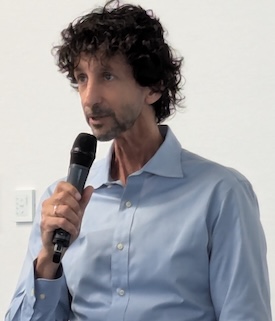
photo - Itai Anghel, in Vancouver, provides bleak assessment of the future
Itai Anghel, in Vancouver, provides bleak assessment of the future. (photo by Pat Johnson)

Anghel shared his story here in a lunchtime event for business community members May 29 and that evening at Shabbat services at Congregation Schara Tzedeck.

Anghel is the recipient of the Sokolov Award, Israel’s highest award for journalism, and is a university lecturer in history and international relations. He is a correspondent for the television news program Uvda, sometimes referred to as Israel’s 60 Minutes.

On arriving back in Israel, Anghel received a call from a stranger at Kibbutz Nir Oz, in the Gaza Envelope, urging him to get to their village immediately and record the atrocities committed there.

Anghel told the caller that, as far as he understood, Israeli military officials were preventing outsiders from entering the region. The stranger insisted Anghel come, telling him that, if the military tried to prevent his visit, they would shoot the soldiers. The government, the stranger told the reporter, would seek to cover up the reality of what happened and the failure of the Israel Defence Forces to intervene, and getting the reality on video was of utmost importance.

The suspicion of a government coverup may not have been based in reality, but what Anghel saw at Nir Oz was like nothing he had witnessed in war zones in Bosnia or the killing fields of Rwanda.

The Nir Oz survivors took Anghel from home to home, where he filmed the aftermath of some of Oct. 7’s most grisly atrocities. More than 10% of the community’s residents were murdered and 76 residents, almost 20% of the population, were taken as hostages to Gaza.

“They set on fire whole families, whole communities, the terrorists were in Nir Oz for seven hours and not one Israeli soldier confronted them,” Anghel said.

At a home where a mother and child were shot point blank, Anghel reflected on their final seconds.

“The last thing that this boy saw before he was shot to death was someone shooting his mother to death,” he recalled. And, if that didn’t happen, the mother saw her son murdered before she was killed.

Anghel asked for a break, maybe to have a bottle of water, but the people of Nir Oz wouldn’t let him stop witnessing and recording, insisting that he continue his documentation.

As he moved through the kibbutz, he did not process what he was seeing. He admits that his camera is a shield between him and the world. Often, he said, it is later that he begins to process what he sees. 

“It was only when I got back to Tel Aviv that I understood what I saw and began reflecting,” he said. “For the first time, I was crying.… The reflecting would come later, when I’m in the editing room.”

He has harsh words for people sitting in comfortable TV studios opining on places they have never visited or who practise, as he acidly calls it, “hotel journalism,” rather than “field journalism.”

The latter, in which Anghel embeds himself among ordinary people and even terrorist fighters, is how journalism used to be done, he said, before the 24-hour news cycle created demand for semi-qualified talking heads to discuss things of which they have only surface knowledge. 

Anghel has an American passport – his parents were students in the States when he was born – so he can go places his Israeli passport would not permit. 

“People are so focused on ‘everyone’s an enemy,’” he said, but when he interviewed people in Damascus, Syria, Israelis couldn’t believe their openness to good relations with Israel.

Being relatively fluent in Arabic opens doors for Anghel. 

“I tell them I’m from the US, but I’m not a soldier, I’m not from the army,” he said. “They are in a state of shock because they have never heard an American speak Arabic.”

He tells them he studied the language so he could communicate with people like them and, from there, he almost always finds a willingness to open up.

Anghel took special aim at the New York Times columnist Nicholas Kristof, who last month published an at least partially fictionalized account of IDF atrocities, including attack dogs allegedly trained to rape Palestinians.

“It is so radical and parts so far-fetched,” said Anghel, noting that the organization Kristof cited as the source for some of his most incendiary allegations is Euro-Med Human Rights Monitor, which Anghel and Israel’s diaspora affairs ministry characterize as a Hamas front organization in Europe.

“Anyone with very basic knowledge knows that Euro-Med is an affiliation of Hamas,” he said. “If you get information from there, at least be honest and say so.”

That the Kristof piece could pass the standards of the New York Times is, Anghel said, symptomatic of a decline in basic journalistic rigour, in which terms like “apartheid” and “genocide” are applied without qualification. 

“They know already, they’ve decided already and there is no openness to hear anything else,” he said.

On the other hand, Anghel admits to getting criticism from all sides. Some Israeli viewers condemn him for platforming anti-Israel terrorists. Israel’s government is no fan of Anghel or Uvda, either.

Anghel is blunt in his assessment of Israeli cabinet minister Itamar Ben-Gvir.

“He’s a fanatic, a criminal, in charge of law enforcement in Israel,” Anghel said.

Anghel and his TV program have also been condemnatory toward what he calls Israel’s abandonment of the Kurdish people.

“We knew that jihadists in Syria would like to crush them and we did nothing,” he said.

The relations are complicated, he admitted, but Israel prevailed upon the new Syrian regime to protect the Druze people in the south of Syria, because Israel has a special relationship with the community because of the Druze population in Israel. The Kurds, in northern Syria, who Israel has allied with at times, were left to their own devices, Anghel said.

Of all the threats to Israel’s future, Anghel said, his greatest fear is internal strife.

“Israel is divided like it has never been,” he said. “The situation is awful. You cannot make it look nicer. It is awful.”

While some Canadian Jews are thinking about leaving, he noted, in the past two or three years, 10,000 Israelis came to live in Canada. 

The schism between ultra-Orthodox, who generally do not serve in the military, and the majority of Israelis, who have been carrying the burden of service, is a particular point of division. At the same time, the birth rate among ultra-Orthodox portends a country that is demographically shifting toward that group.

Many Israelis are concluding that the current government does not care about people like them.

“You make the calculation and you realize maybe it is not the place for you to live,” said Anghel.

“I’m not afraid of Hezbollah, I’m not afraid of Syria, I’m not afraid of Iraq, I’m not afraid of Yemen’s Houthis, I’m not afraid of nuclear weapons from Iran,” Anghel said. “I’m afraid of ourselves.”

Schara Tzedeck’s Rabbi Andrew Rosenblatt thanked the Diamond family for sponsoring the event in memory of the late Charles Diamond. Josh Pekarsky interviewed Anghel. 

Posted on June 12, 2026June 10, 2026Author Pat JohnsonCategories Israel, LocalTags field journalism, Israel, Itai Anghel, Oct. 7, politics, reporting, witnessing

Flying camels still don’t exist

We’ve been getting a lot of weird phone calls lately. The caller ID says it is from our credit card company or the bank. Yet, the person on the phone seems a little off. What we realize, before giving away any important information, is that it’s likely some new kind of scam. The person calling knows our names, or knows where we shop or bank. Maybe that person has seen our mail. Maybe they work at the store and noticed our info when we ordered online. Maybe the information has been sold to them. No matter, it becomes clear it’s a scam. We hang up. Later, we might log on and check our accounts. Is everything fine? Is someone stealing money or information? 

This is well worth asking because, sometimes, there is theft happening. If you read the news, there are often articles saying “Caution! Look out! There’s a new scam out there, beware!” Like everything we read, it’s helpful to think critically about this. Criminals are always upping their game to catch new victims. This isn’t a new phenomenon.

I’ve just started studying a new tractate of the Babylonian Talmud, Makkot. So far, it’s mostly about how a court of law rules and doles out punishment. I’ve learned about “conspiring witnesses.” That is, witnesses who arrange in advance to lie about something to the court. For instance, imagine there was a crime in Saskatoon and there were witnesses to it. The conspiring witnesses might swear that, in fact, the criminal was in Winnipeg that day, and not in Saskatoon. It’s clear to the court that the conspiring witnesses were lying, due to the testimony of others. How should the court punish those conspiring witnesses? How are they held accountable for lying?

This topic continues for awhile, but my absolute favourite moment happens on Makkot 5a. The situation is as follows, in summary:

Rava says: If two witnesses came and said, So-and-so killed a person in Sura on Sunday morning and two other witnesses came to court and said to the first witnesses, on Sunday evening, you were with us in Nehardea – if one can travel from Sura to Nehardea from the morning and arrive by the evening, fine, nobody is misleading us. If not? They are “conspiring witnesses.”

The Gemara (later commentators) say: This is obvious. Don’t be concerned that these witnesses traveled via “flying camel” – that is, using a magical or impossible way to travel with great speed. You don’t have to take that kind of thinking into account.

In practical terms, Sura and Nehardea were both places in Babylon with Jewish academies of learning, but they were far apart. Nehardea was destroyed in 259 CE. More than 1,766 years ago, the Mishnah described this. Later rabbis advised students not to be taken in by somebody lying outright in court. After all, these lying witnesses didn’t travel by “flying camels.”

It often feels like that we’re struggling with ever new and complicated scams. The pace and amount of information via the internet and social media is astounding. Yet, I sometimes hear the most interesting things close to home, in the old-fashioned way people have always communicated. When is that? Well, when I’m visiting with friends, having a cup of coffee after lunch on Shabbat, or at synagogue. 

Both world news and “true accounts” are only as good as the people who tell them and how much trust we have in those sources. If those sources rely on witnesses who like to offer bald-faced lies, well, that’s not a good source. If we have trouble with the veracity of someone’s account, we must ask: What flying camel did you ride in on?! How were you in two places at once, that you witnessed both these things?

Jewish tradition is amazing. We have these ancient sources to remind us that “there’s nothing new under the sun.” The bigger point is a modern one: we must get out of our usual news bubbles or coffee klatches. We are so easily lulled into believing some versions of the “truth” when we trust our sources without question. For example, some Canadian news outlets suggest that Israel is targeting specific Gazan locations with a vengeance. Yet these same outlets fail to mention the Hamas rocket fire that came from that location just before the Israeli response. So, if the story conveniently fails to mention why the Israeli army is firing at a specific location, the news article may not be an objective source of war coverage.

In the Winnipeg Free Press newspaper, I read about a new lecture series created by professors supposedly concerned about freedom of expression. Their invited speaker, a professor from York University, brought up the suspension of her colleague, who had been charged with “vandalism of a bookstore.”  Notably, the article did not mention which bookstore. My household strongly suspected it had been the incidents targeting Indigo, when Jews and Israelis were targeted by protesters. Further, the article didn’t mention that freedom of expression doesn’t mean freedom to commit crimes against businesses. 

The article’s tone was matter of fact. A person could read such an article and feel that the professors were rightfully concerned about the loss of freedom of expression. To me, it seemed like the example given before, of the distance between Sura and Nehardea. If you don’t know the particulars, such as the distance between these two locations, you can miss the absurdity of the situation. In the guise of defending free speech, the professors wanted readers to bemoan the suspension of a professor who was charged with vandalism – a crime.

Sometimes, when someone presents a news story or a court defence that seems so smooth and practised as to be suspicious, well, perhaps that’s because it is. Likewise, the tidbits we gain at Kiddush lunch after services may also vary in their reliability. We may have faster transportation and cellphone connections today, but, sometimes, things still aren’t as they seem. As much as things change, much is still the same. Yes, a juicy bit of news is an interesting truth to ponder, but a lie is still a lie. We still have conspiring witnesses to contend with and, even now, we still don’t have flying camels. 

Joanne Seiff has written regularly for the Winnipeg Free Press and various Jewish publications. She is the author of three books, including From the Outside In: Jewish Post Columns 2015-2016, a collection of essays available for digital download or as a paperback from Amazon. Check her out on Instagram @yrnspinner or at joanneseiff.blogspot.com.

Posted on April 25, 2025April 24, 2025Author Joanne SeiffCategories Op-EdTags courts, Gemara, law, newspapers, reporting, Talmud
Proudly powered by WordPress