Skip to content
  • Home
  • Subscribe / donate
  • Events calendar
  • News
    • Local
    • National
    • Israel
    • World
    • עניין בחדשות
      A roundup of news in Canada and further afield, in Hebrew.
  • Opinion
    • From the JI
    • Op-Ed
  • Arts & Culture
    • Performing Arts
    • Music
    • Books
    • Visual Arts
    • TV & Film
  • Life
    • Celebrating the Holidays
    • Travel
    • The Daily Snooze
      Cartoons by Jacob Samuel
    • Mystery Photo
      Help the JI and JMABC fill in the gaps in our archives.
  • Community Links
    • Organizations, Etc.
    • Other News Sources & Blogs
    • Business Directory
  • FAQ
  • JI Chai Celebration
  • JI@88! video

Recent Posts

  • BGU fosters startup culture
  • Photography and glass
  • Is it the end of an era?
  • Taking life a step at a time
  • Nakba exhibit biased
  • Film festival starts next week
  • Musical with heart and soul
  • Rabbi marks 13 years
  • Keeper of VTT’s history
  • Gala fêtes Infeld’s 20th
  • Building JWest together
  • Challah Mom comes to Vancouver
  • What to do about media bias
  • Education offers hope
  • Remembrance – a moral act
  • What makes us human
  • המלחמות של נתניהו וטראמפ
  • Zionism wins big in Vegas
  • Different but connected
  • Survival not passive
  • Musical celebration of Israel
  • Shoppe celebrates 25 years
  • Human “book” event
  • Reclaiming Jewish stories
  • Bema presents Perseverance
  • CSS honours Bellas z”l
  • Sheba Promise here May 7
  • Reflections from Be’eri
  • New law a desecration
  • Resilient joy in tough times
  • Rescue dog brings joy
  • Art chosen for new museum
  • Reminder of hope, resilience
  • The national food of Israel?
  • Story of Israel’s north
  • Sheltering in train stations

Archives

Follow @JewishIndie
image - The CJN - Visit Us Banner - 300x600 - 101625

Tag: musical theatre

One of best TUTS seasons

One of best TUTS seasons

Man in Chair (Shawn Macdonald) with the cast of The Drowsy Chaperone. (photo by Tim Matheson)

“Look, I know it’s not a perfect show: the spit-take scene is lame and the monkey motif is laboured. But none of that matters. It does what a musical is supposed to do: it takes you to another world, and it gives you a little tune to carry with you in your head. A little something to help you escape from the dreary horrors of the real world. A little something for when you’re feeling blue. You know?”

The irony of Man in Chair’s comments is that the spit-take scene and the monkey motif are hilarious in The Drowsy Chaperone and, for the lover of musicals, this parody is perfect. Or, as Mary Poppins would say, “practically perfect.”

Theatre Under the Stars is presenting both The Drowsy Chaperone and Mary Poppins this summer and, without a doubt, this is one of the best TUTS seasons yet. Both shows are excellent – the scripts, the acting, the sets, the music, the choreography, the directing, the costumes, the lighting, etc., etc. Both shows will take you to another world, escaping the real one for a few hours.

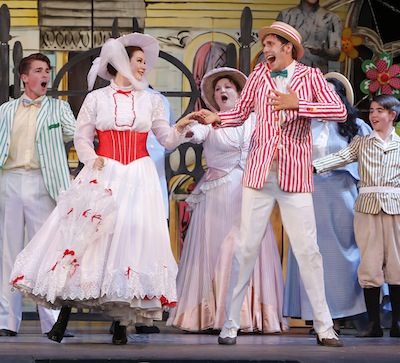
photo - Ranae Miller as Mary Poppins and Victor Hunter as Bert have a magical song and dance in the park
Ranae Miller as Mary Poppins and Victor Hunter as Bert have a magical song and dance in the park. (photo by Tim Matheson)

The season opened with Mary Poppins on July 11. I saw it a couple of days later and, while there were still some sound issues to be sorted out with individual actors’ microphones, the performance was spot on. Led by Victor Hunter as Bert the chimney sweep (artist, lamplighter and an assortment of other jobs) and Ranae Miller as the magical, stern-yet-loving nanny with great posture who puts all other nannies (and caregivers) to shame, the TUTS production is in more than capable hands. Both of these performers are fantastic actors and singers, and the rest of the cast matches their talent and energy.

Lola Marshall, 11, and Nolen Dubuc, 9, deserve a shout-out for their portrayals of Jane and Michael Banks, the two unruly children Mary Poppins ostensibly comes to help. But Mary arrives at their house on Cherry Tree Lane as much for their parents – their mother, a former actress who is having trouble adapting to life in high society, and their father, a banker whose work consumes him, neither of whom has time for their kids.

As The Drowsy Chaperone’s Man in Chair notes – he’s a wealth of pithy and astute observations – “Everything always works out in musicals,” and Mary Poppins is no exception. However, a lot of effort goes into making everything work out onstage and the TUTS team really added their own unique touch to both musicals.

For Mary Poppins, the Cherry Tree Lane house that Brian Ball built is like a huge Fisher Price toy that opens and closes to reveal the kids and Mary’s bedrooms on one side and the kitchen and dining room on the other, plus various hidden compartments. The other sets – that take the audience to the park and its statues that come alive, to a kitchen in which a broken table and shelves can fix themselves, and to the rooftops of London – invite the audience into Mary’s world. The starry nights and Mary’s flights elicit awe, not to mention the flying kites.

The choreography is also inspired, with the problem of how to have dancing penguins join Bert in “Jolly Holiday” smartly solved, with the crowd-pleasing flag-less semaphore in “Supercalifragilisticexpialidocious” that reaches a feverish pitch and the raucous rooftop tap-dancing in “Step in Time.” It was sometimes a wonder how music director and conductor Wendy Bross Stuart kept the cast and orchestra in sync, but she did.

While the energy slowed a bit as the musical neared its end – the child behind me wondered, with about two songs remaining, “How long is this musical?” – for the most part, director Shel Piercy has done a masterful job of pacing. He takes the audience on an emotional journey, with many laughs but also many touching moments. No one will be unmoved by Cecilia Smith’s performance (as Bird Woman) of “Feed the Birds” – the lessons of compassion and seeing beyond appearances that Mary teaches the Banks children are lessons we cannot learn often enough.

Joining Bross Stuart in this production are fellow Jewish community members Kat Palmer, as part of the talented and enthusiastic ensemble, and Andrea Minden in the orchestra. In The Drowsy Chaperone, community member Stefan Winfield plays Broadway producer Feldzieg, while his and wife (choreographer) Shelley Stewart Hunt’s 5-year-old son Wesley plays a couple of adorable, if superfluous, parts near the musical’s end in an over-the-top number that pokes fun at the extravagant finales of many musicals, not just Man in Chair’s favourite, The Drowsy Chaperone.

Having just come home to his rundown apartment, this lonely bachelor – played extremely well by Shawn Macdonald, as if the role was written for him – announces, “I hate theatre,” and proceeds to tell us why. It’s really current works that he dislikes; once upon a time, “you knew that when the show began you would be taken to another world, a world full of colour and music and glamour.”

“Remember?” he asks the audience of the (fictitious) “musical within a comedy,” as The Drowsy Chaperone is described. “Music by Julie Gable, lyrics by Sidney Stein. It’s a two-record set, re-mastered from the original recording made in 1928. It’s the full show with the original cast including Beatrice as the Chaperone. Isn’t she elegant? And this is a full 15 years before she became Dame Beatrice Stockwell. Can you believe it? Let me read to you what it says on the back – it says, ‘Mix-ups, mayhem and a gay wedding!’ Of course, the phrase gay wedding has a different meaning now, but back then it just meant fun. And that’s just what the show is – fun. Would you … would you indulge me? Would you let me play the record for you now? I was hoping you would say yes.”

And, with that, Man in Chair puts the record he has just unsleeved onto the player and, as the static sounds, he introduces us not only to his beloved musical but its actors and the era. Throughout the show, which he imagines (and that we can see) taking place in his apartment, he gives a running commentary, sharing a little about his life, factoids about the actors in the play and explanatory notes about certain scenes. He both extols the virtues of the musicals of the 1920s and exposes their weaknesses, including some poor writing – the aforementioned spit-take scene and monkey motif, as examples – and some not-so-subtle racism. An example of the latter is the incomparable first scene of Act 2 – Oriental Palace, Day – which the TUTS cast performs superbly.

Man in Chair’s dialogue is absolutely brilliant and Macdonald delivers it with such excitement, as if he – and not just his character – so wants you to love the musical as much as he does, despite its flaws. He seems to barely contain his joy when certain songs come up and when he just can’t stay in his chair and joins the dancing, it is almost contagious. (Though the incredible closeness of the rows at this year’s TUTS barely allows you to reach your seat, let alone get up and dance.)

As with Mary Poppins, there isn’t a weak link in The Drowsy Chaperone. The entire cast – leads and ensemble – bring everything they have to the stage, and it shows.

Ball’s set design once again amazes, as people pop in and out of almost anywhere, and Stewart Hunt’s dance numbers use every inch of the apartment’s kitchen and living room space. Music director and conductor Kevin Michael Cripps does double duty as the Chaperone’s bartender and director Gillian Barber delivers a fast-paced, larger-than-life contemporary musical that would even please Man in Chair.

Chris Sinosich was the costume designer for both The Drowsy Chaperone – which seems to have countless costume changes – and Mary Poppins. She is to be commended for the period dress in both, evoking the late-1920s and silliness of the former and the Edwardian period of the latter; as well as the stark contrasts, with Man in Chair obviously of a different era than his favourite musical and Mary Poppins’ colour-rich realm standing out from the darker, more sombre tones of the bankers’ reality.

While the Chaperone may stumble along, martini glass in hand, there is no stumbling in either TUTS production this year. See both if you can. They alternate nights, with Mary Poppins closing Aug. 18 and The Drowsy Chaperone Aug. 19. For tickets and more information, visit tuts.ca.

Format ImagePosted on July 21, 2017July 19, 2017Author Cynthia RamsayCategories Performing ArtsTags Drowsy Chaperone, Mary Poppins, musical theatre, Theatre Under the Stars, TUTS
Bittergirl is seriously funny

Bittergirl is seriously funny

In Bittergirl, Cailin Stadnyk, Katrina Reynolds and Lauren Bowler play women who have just been dumped by their boyfriends – maybe they can get back their men if they lose some weight? (photo by Emily Cooper)

Have you ever taken part in an aerobics class and wondered how many of the women in it were trying to lose weight to get a boyfriend back? The sad truth is, there are probably many, eagerly trying anything to return to the way things were, even if the way things were wasn’t all that great.

Bittergirl: The Musical takes aim at countless breakup truisms from the perspectives of three different women, reminiscent of the sharp wit in Mom’s the Word and the relationship charades of Sex in the City. Their varied responses to being dumped are hilariously insightful.

The progress of the play loosely follows the five stages of death: denial, anger, bargaining, depression and acceptance. The stages of the breakups are denial (he made a mistake), second-guessing (I could have done something differently), manipulation (I’m going to make him love me), reflection (I should have seen the warning signs) and acceptance (I’m over him, I’ve moved on).

The three women – played by Lauren Bowler, Katrina Reynolds and Cailin Stadnyk – are known only as A, B and C, as though these trials and tribulations are those that belong to every woman, not a specific person. Jewish community member Josh Epstein plays D, all three of the dumpers – the husband who wants to join the RCMP, the live-in partner who just “has to go” and the boyfriend who’s lost his “magic.”

Epstein delivers the stereotypical reasons why he needs to get out of each relationship: “I feel trapped,” “I can’t give you what you want” and the ridiculous “We’ve got to be birds flying higher.”

The lame rationales elicit howls of laughter at the familiarity, especially when one of the women initially thinks that the “talk” her boyfriend wants to have will lead to a proposal.

Not surprisingly, the women stand there, stunned into silence, not demanding further explanation, but meekly mumbling things like, “I understand,” even though they don’t – another conventional reaction it is sadly not surprising to see depicted.

After their men leave, the women think about what they might have done differently to save their relationships – “Maybe if I wore plum eyeshadow,” “Maybe if I didn’t talk to my mother so much” and “Maybe if I worked out more.” This last statement segues into an hysterical scene of the three women working out with various gizmos and in different types of classes in a desperate bid to get in shape and win back their men.

photo - Katrina Reynolds and Josh Epstein in Bittergirl, at the Arts Club Granville Island Stage until July 29
Katrina Reynolds and Josh Epstein in Bittergirl, at the Arts Club Granville Island Stage until July 29. (photo by Emily Cooper)

The women also reflect on the warnings signs they missed. He wears socks with sandals. He cries at Celine Dion songs. He growls during sex.

Especially comical is a scene where the women run into friends and they are forced to admit they were dumped. The standard, “You’re better off without him” or “If you guys couldn’t make it work, what chance do the rest of us have?” hit the mark on how insensitive people can be, much to the enjoyment of the audience. The rapid-fire delivery of the lines, the women playing off each other brilliantly, is a sight to see and hear.

As the musical progresses, classic girl-group songs of the 1960s and ’70s complement the dialogue. Thinking about their first dates leads into “And Then He Kissed Me.” The initial breakups prompt a rendition of “Mama Said There’d Be Days Like This.” When the women hope they’ll have a chance to renew the relationship, they sing “When Will I See You Again?” And who hasn’t felt the difficulty of moving on because there’s “Always Something There to Remind Me”?

The strength of the play is in how the writing spotlights those moments we all know so well and that sound so absurd when depicted one after the other. Being reminded of one’s own failed relationships, watching the play is like watching a good comedian – often funny and, despite being cringeworthy at times, you want to stay to the finale.

As with the different stages of death, the women finally accept their situations and move on with their lives, singing such lyrics as “you don’t really love me; you just keep me hanging on,” there are “too many fish in the sea” and “I will survive.”

Bittergirl is actually an autobiographical play written by three Toronto actresses who had, indeed, just gotten dumped by a husband, live-in boyfriend and short-term partner. The positive reaction to the play led to the 2005 book Bittergirl: Getting Over Getting Dumped. After that, the writers added the songs, accompanied by an all-female band onstage, and the musical was born.

Besides the sharp, insightful writing, these women (and Epstein) can all belt out a tune, making the performance a hit from the beginning to the (not so) bitter end.

Bittergirl runs at the Arts Club Granville Island Stage until July 29. For tickets and more information, visit artsclub.com.

Baila Lazarus is Vancouver-based writer and principal media strategist at phase2coaching.com.

Format ImagePosted on July 7, 2017July 5, 2017Author Baila LazarusCategories Performing ArtsTags Arts Club, Bittergirl, comedy, Josh Epstein, musical theatre, relationships
A little music … a few trysts

A little music … a few trysts

Katey Wright and Warren Kimmel co-star in A Little Night Music, which opens at Anvil Centre Theatre on May 13. (photo by David Cooper)

“The end of Act One may just be the most brilliant piece of musical theatre writing ever,” actor Warren Kimmel told the Independent when asked about Stephen Sondheim’s A Little Night Music, which will have a limited run at the Anvil Centre Theatre, starting next week.

And Jewish community member Kimmel knows of what he speaks when it comes to musical theatre. To name only some of the super-well-known musicals he’s been in – Billy Elliot, Fiddler on the Roof, Les Misérables, My Fair Lady, Mary Poppins, Sound of Music, Beauty and the Beast.

In A Little Night Music, which takes place around the turn of the last century, Kimmel plays Fredrik Egerman, who has just married 18-year-old Anne, many years his junior. One problem is that Fredrik’s son also loves Anne. Two other problems are that Anne is reluctant to give herself to Fredrik and Fredrik hasn’t quite doused the fire that exists between him and Desiree, a former girlfriend. Then there’s Desiree’s jealous (and married) lover. “All of these trysts and twists come to a head,” reads the promotional material, “when Desiree convinces her mother to host Fredrik and his family for a weekend on her lavish estate – where the count [Desiree’s lover], with his wife … crash the party.”

“Apart from its sheer entertainment value – the incredible music and genius lyrics of Stephen Sondheim – A Little Night Music is based on a film by Ingmar Bergman – Smiles of a Summer Night – so the themes are eternal,” said Kimmel. “How do you find love? How do you find the right person to love? How do you love the person you are with? How do you get the person you are with to love you? How do you remain faithful? Should you remain faithful? Like all great works of art, it doesn’t so much speak to a modern audience as whisper and shout!”

“I don’t know if I can adequately state the importance of Stephen Sondheim and his work,” director Peter Jorgensen told the Independent. “No other single artist has thought more deeply about composition as a tool for telling stories. No other lyricist gives characters such distinctive, rich language. As a musical dramatist, he has set the gold standard for artistry and craftsmanship.”

“Sondheim has a special place in the heart of all singer/actors,” agreed Kimmel. “His material is, without doubt, the most challenging and also the most satisfying to perform of anyone in the musical theatre canon. It’s really hard to get right but thrilling every time you do. Fredrik has some particularly complicated and expressive songs, and that’s the best and worst thing about this role.”

The Broadway musical – with music and lyrics by Sondheim and book by Hugh Wheeler – won six Tony Awards, a Golden Globe and a Grammy. In the local Patrick Street Productions mounting of the show, Kimmel co-stars with Katey Wright, who plays Desiree.

Real-life husband-wife team Wright and Jorgensen founded Patrick Street Productions in 2007. Their mandate: “to offer great productions of great plays and musicals for Metro Vancouver, with an emphasis on contemporary musicals that have not yet been professionally produced in the region.”

“For Patrick Street Productions,” said Jorgensen, “it is important for us to program musicals that challenge conceptions of what a musical is and what a musical can do. That aspiration is never better matched than with a Sondheim musical.

“As to why A Little Night Music,” he continued, “in many ways it is similar to why Hal Prince (the show’s original director) and Sondheim chose to create the show: we wanted to program something romantic and light that had a broad appeal, but that was still sharp and biting. Hal Prince described the show as ‘whipped cream and knives.’ There is no better statement that sums up the show’s appeal than that.”

Kimmel added, “Apart from ‘Send in the Clowns,’ which is perhaps Sondheim’s best known song, A Little Night Music is not as well-known as some of his other stuff, and certainly not as well known as Phantom of the Opera or something like that, but this piece is a real gem. The end of Act One may just be the most brilliant piece of musical theatre writing ever. The brilliance of the material forces you to really step up – and everyone has. From the costumes to the lighting, from the orchestrations to the casting, the level of work and attention to detail in this production are quite wonderful. It’s just worth seeing on every level.”

A Little Night Music opens at Anvil Centre Theatre in New Westminster on May 13, 8 p.m., with previews on the nights of May 11 and 12. Show times are Wednesday through Saturday, 8 p.m., with 2 p.m. matinées May 14, 20-21. Tickets are $25.50 for the previews and range from $25.50 to $39.50 for the run; they can be purchased at ticketsnw.ca or 604-521-5050.

Format ImagePosted on May 5, 2017May 3, 2017Author Cynthia RamsayCategories Performing ArtsTags musical theatre, Peter Jorgensen, Sondheim, Warren Kimmel
Joni Mitchell for millennials

Joni Mitchell for millennials

Left to right, Andrew Cohen, Sara Vickruck, David Z. Cohen and Anna Kuman are among the cast of Circle Game: Reimagining the Music of Joni Mitchell. (photo by Tyler Branston)

Andrew Cohen and Anna Kuman, a Vancouver-based husband-and-wife team who are both composers and choreographers, will debut Circle Game: Reimagining the Music of Joni Mitchell this month at the Firehall Arts Centre.

The genesis was Mitchell’s 70th birthday in 2013, Cohen told the Jewish Independent.

“There was a lot of press that caught our attention,” said Cohen. “After that, it seemed like her music started following us around, popping up everywhere. We started researching her – her music, her lyrics, her impact on Canadian art and culture. We opened that can of worms and very much found a spark of something. We decided to see if we could take her poignant and meaningful and topical lyrics and reimagine them.”

The pieces Cohen and Kuman came up with are diverse re-arrangements of Mitchell’s material.

“We sat down on the piano to dissect and distil her songs,” said Cohen. “We threw in some harmony or a different drum beat. We came up with 20 different arrangements. Some are mash-ups, some are whole but more acoustic and unplugged, some are indie rock sounding or Latin.”

“We made a conscious effort to make the songs sound as if they were released today,” explained Kuman. “It’s the music of our parents’ generation, but we realized how poignant it still is for us. The social and political issues are repeating themselves. We wanted to change the sound so people could leave their preconceptions about the music of baby boomers behind.”

Kuman points to “Fiddle and the Drum” as a song that really resonates with today’s news cycle. “In that song, the line, ‘once again, America my friend,’ resonates powerfully,” she said.

The song lyrics include the following lines: “And so once again / America my friend / And so once again / You are fighting us all / And when we ask you why / You raise your sticks and cry and we fall / Oh, my friend / How did you come / To trade the fiddle for the drum? / But we can remember / All the good things you are / And so we ask you please / Can we help you find the peace and the star?”

While working on the project, both had songs they found personally meaningful. A song that sticks out for Cohen is “A Case of You.”

“The way we do it is very unique and will be unlike anything you’ve seen or heard before,” he said.

For Kuman, it was “Down to You,” which she described as “a story song.” In the lyrics, Mitchell “really painted a picture, a specific narrative. The way that we staged it in the workshop is that movement really evokes the emotion of the song. The arrangement that Andrew came up with is totally a cappella, yet really full.”

Cohen and Kuman are both in their 20s and are “proud East Vancouverites.” Cohen grew up going to Congregation Beth Tikvah in Richmond, and his parents were longtime members of the Beth Tikvah choir. Both he and his brother were in Perry Ehrlich’s ShowStoppers.

“We grew up at the JCC,” Cohen said, referring to the Jewish Community Centre of Greater Vancouver. “Anna taught tap at the Dena Wosk School [of Performing Arts], and we both taught there for years at Gotta Song! Gotta Dance!”

Both Cohen and Kuman are members of Temple Sholom, where they were married by Rabbi Dan Moskovitz.

When Cohen and Kuman started the process of composition, they were dating and not yet married. They did a workshop together, pitched it to Capilano University and were given a three-week residency and the time and space to experiment. This is their first foray as co-directors and co-collaborators.

“We got great feedback from the musicians and did a workshop presentation and invited people in the industry that we respect and we wanted to hear what they thought,” said Cohen. “The feedback was overwhelming and amazing. We knew we definitely had something – the spirit of our generation with the words of Joni Mitchell. There was some constructive criticism that we took and incorporated, too. It was great to have the roses and the thorns of a feedback session.”

“We will be the first to tell you how lucky we feel to be able to work with this calibre of talent,” said Kuman, referring to the musicians they are working with. “They are all multi-instruments who wail like nobody’s business and will sing to break your heart. We had a fairly extensive audition across the country, a ton of incredible talent came out for the show, but we settled for this six because they have the right skills and the right mix.”

The ensemble features Rowen Kahn (Superman: Man of Steel), Scott Perrie (Godspell), Adriana Ravalli (Rock of Ages), Kimmy Choi (Avenue Q), Sara Vickruck (Love Bomb) and David Z. Cohen (Heathers: The Musical). Together, they will play 18 instruments.

“We’d both like to encourage everyone to come out and see the show, whether you’re a Joni fan or not, or whether your mom is a Joni fan or not!” said Kuman. “We think it will be a great way to bridge the generation gap. What we hope we’ve accomplished is making the hits of 30 or 40 years ago sound like the hits that you’d hear on the radio.”

Circle Game runs April 29 to May 20. For tickets and showtimes, visit firehallartscentre.ca.

Matthew Gindin is a freelance journalist, writer and lecturer. He writes regularly for the Forward and All That Is Interesting, and has been published in Religion Dispatches, Situate Magazine, Tikkun and elsewhere. He can be found on Medium and Twitter.

Format ImagePosted on April 21, 2017April 20, 2017Author Matthew GindinCategories Performing ArtsTags Andrew Co, Anna Kuman, Firehall Arts Centre, Joni Mitchell, musical theatre
Don’t miss this Parade

Don’t miss this Parade

Left to right are Kaila Kask (Mary Phagan), Emily Smith, Rachel Garnet and Alina Quarin with Riley Sandbeck (Leo Frank). (photo by Allyson Fournier)

On Aug. 17, 1915, 31-year-old Leo Frank was kidnapped from the Georgia State Penitentiary in Milledgeville by a Ku Klux Klan lynch mob and hanged by his neck until he was dead. His alleged crime: the rape and murder of 13-year-old factory worker Mary Phagan. His real crime: being Jewish, successful and a northerner in an impoverished Deep South still reeling from the humiliation of the Civil War and looking for retribution against its perceived oppressors.

The case has been the subject of novels, plays, movies and even a mini-series. But who would have thought that you could make a musical out of such a tragedy. Author Alfred Uhry (Driving Miss Daisy) and Broadway producer Hal Prince (Cabaret) did. Thus Parade was born, with music and lyrics by Jason Robert Brown. It opened on Broadway in 1998, won two Tonys and went on to be produced across America to much acclaim.

Now, Fighting Chance Productions, a local amateur theatre company, is bringing this compelling story to Vancouver audiences for its Western Canadian première at the Rothstein Theatre April 14-29. Director Ryan Mooney and lead actor Advah Soudack (Lucille) spoke with the Jewish Independent about the upcoming production. But first, more background, because it is an incredible story.

Frank was a slight man – five feet, six inches tall, 120 pounds – with a nervous temperament. Born in Texas and raised in Brooklyn, he graduated from Cornell University with a degree in mechanical engineering and was enticed to move to Atlanta in 1908 to run the factory owned by his uncle. There, he met and married Lucille, a 21-year-old woman from a prominent Jewish family. The newlyweds lived a life of privilege and wealth in a posh Atlanta neighbourhood, Frank became the president of the local B’nai B’rith chapter. However, having been brought up in the vibrant Yiddish milieu of New York, he always felt like an outsider amid the assimilated Southern Jewish community.

The journey to his tragic demise started the morning of Saturday, April 26, 1913, when little Mary put on her best clothes to attend the Confederate Memorial Day Parade in downtown Atlanta. On the way, she stopped at the National Pencil Factory, where Frank was the superintendent, to pick up her weekly pay packet from his office. That was the last time she was seen alive. Her body, half-naked and bloodied, was found in the basement of the factory later that day. Shortly after, Frank was arrested by the police and charged with the crime along with the African-American janitor, Jim Conley.

The trial was a media circus fueled by a zealous district attorney, Hugh Dorsey, who was looking for a conviction in a high-profile case to popularize his bid for the governorship of Georgia, and Tom Watson, a right-wing newspaper publisher who wrote virulent, racist editorials against Frank, casting him as a diabolical criminal and calling for a revival of the Klan “to do justice.” Frank was convicted by an all-white jury on the testimony of Conley – who had turned state’s evidence in exchange for immunity – and sentenced to death in a trial that can only be characterized as a miscarriage of justice replete with a botched police investigation, the withholding of crucial evidence, witness tampering and perjured testimony. This was America’s Dreyfus trial and Frank was the scapegoat.

The conviction appalled right-thinking people and mobilized Jewish communities across America into action. William Randolph Hearst and New York Times publisher Adolph Ochs campaigned on Frank’s behalf. The conviction and sentence were appealed. Georgia governor John Slaton was lobbied to review the case. For two years, Frank sat in jail not knowing his fate until, one day, he heard that Slaton had commuted his death sentence to life in prison. In response, frenzied mobs rioted in the streets and stormed the governor’s mansion. A state of martial law was declared and the National Guard called out to protect the city. Against this backdrop, Frank was transferred into protective custody at the state penitentiary but that did not stop the lynch mob, some of whom had been jurors at the trial.

It wasn’t until 1986 that Frank was (posthumously) pardoned by the Georgia State Board of Pardons and Paroles.

Jewish Independent: What attracted you to this play?

Ryan Mooney: Parade has been a favourite musical of mine for as long as I can remember. I was drawn to it because it is such a fascinating story, it speaks so much to its time and continues to speak to us. When people see it, they will want to know more. It has beautiful soaring music, is very emotional, but also it is real, so relatable. It will take you on a journey that will touch you in many ways.

Advah Soudack: The songs, the music. When I was going through the script and getting used to the music, I could not get through some of the songs without choking up, it was so emotional, beautiful and real.

JI: How would you classify it as a theatrical piece?

photo - J.P. McLean (Britt Craig) and Advah Soudack (Lucille Frank) are part of the 25-person cast of Parade, which will have its Western Canadian première at the Rothstein Theatre April 14-29
J.P. McLean (Britt Craig) and Advah Soudack (Lucille Frank) are part of the 25-person cast of Parade, which will have its Western Canadian première at the Rothstein Theatre April 14-29. (photo by Allyson Fournier)

RM: It is, in essence, a love story about a young man and a woman who learn through tragic circumstances to have a deeper love for each other and to appreciate each other’s kind of love.

AS: Leo sees love as a service, being a provider, while Lucille looks for love in spending quality time together and physical intimacy. Over time, their two loves unite.

JI: This isn’t your typical musical. It has a very dark side. It covers the kind of subject matter usually covered in narrative plays. Do you think people want to see this kind of musical theatre?

RM: Our company, as our name states, takes chances and we are taking a chance on this, but I think the risk is worthwhile and that audiences will appreciate the story. It seems to do very well wherever it plays – Broadway, London. We thought the Rothstein Theatre would be the perfect venue and we hope that the Jewish community will support us.

JI: Is this strictly a Jewish story?

RM: It is not necessarily just a Jewish story, it could be about anybody, anywhere. It is a fascinating look at a historic event through a musical lens. I don’t think Prince was trying to make a political statement when he produced the show but rather to educate people about the event. At the time of its first production, 1998, shows like Ragtime and Showboat were on Broadway alongside Parade. It seemed to be a time for examining how mainstream America treated those people it considered lesser citizens.

JI: What was it like to cast?

RM: The production requires a large cast: 25. I needed people who could sing and act. Lots of people auditioned and we ended up with a great cast, with the members spanning the ages of 18 to 60. What makes this show very relevant is that we have actors playing roles for their real ages, not trying to be someone younger or older, and that makes the production more realistic. I wanted at least one of the leads to be Jewish and Avdah was perfect for the role of Lucille.

AS: When I heard about this show, I jumped at the chance to apply. I had been out of theatre for about 10 years and I really wanted to get back into it. I was lucky enough to get a callback after my first audition and felt very proud of my performance the second time around. I was thrilled when I got the role.

JI: What is it like to deal with a true event as opposed to a fictional account?

RM: Because it is a real life story, there is so much more research you can do to make sure you get it right. I read Steve Oney’s And the Dead Shall Rise: The Murder of Mary Phagan and the Lynching of Leo Frank and gave it to members of the cast to read to get a feel for the characters and some background information. There is some material that did not make it into the musical but the play does essentially honour the accuracy of the event.

AS: I am reading the book right now and it is so fascinating to get the story behind the character and be able to use that as an actor.

JI: How are Leo and Lucille portrayed in the script?

RM: He is not portrayed that sympathetically. At the trial, he is really cold and does not look repentant but, ultimately, we see him break. If he were just shown as a martyr and everyone else a villain, that would not be interesting for the audience. Instead, the audience sees his flawed human character and that is why it is a great story to tell – [he’s] a person with faults that anyone can relate to.

AS: She is a Southern woman and a product of the American melting pot, more assimilated than Jewish, and that is how she survives. America wants you to become American first and everything else second. People like her thought like that and assimilated. Then, she is thrust into this case, where horrific things are being said against her husband on a daily basis in the newspapers and she has to deal with that. Yet, she stands by him and is one of his biggest supporters. She even went to the governor’s mansion to personally lobby him to intervene in the case. For a young Southern Jewish woman, that was a big step. So, you see her grow into this strong, independent woman.

She comes across very strong in the play, perhaps stronger than she really was in real life, but she was so committed to Leo’s cause and to him. She came every day to jail to visit him and bring him food. The circumstances of the tragedy allowed her the opportunity to become a heroine.

JI: What will the staging be like?

RM: The set is a long wall with platforms set at different levels. The lights will move through the different levels from scene to scene to create more of a cinematic flow, more like a movie than live theatre. We did not want the story’s flow to be interrupted by the audience clapping after every song. Of course, we do hope the audience will give a standing ovation at the end of the show.

JI: What do you expect audiences to take away from the musical?

RM: I want them to walk out with questions and want to look up more information about the case, but I also want them to leave with the understanding that all good art finds the grey in life and that everything is not black and white. One of the biggest issues in America today is the mentality that you are either with us or you are against us. The world is going in that direction and it is a hard place to be. You have to be able to see issues from all angles if you want to see any positive growth. There are some ambiguities in the show but there are also strong life lessons about the dangers of prejudice and ignorance.

For tickets to Parade, visit fightingchanceproductions.ca.

Tova Kornfeld is a Vancouver freelance writer and lawyer.

Format ImagePosted on March 31, 2017March 31, 2017Author Tova KornfeldCategories Performing ArtsTags Advah Soudack, antisemitism, history, Leo Frank, musical theatre, racism, Ryan Mooney
Khalifa joins the circus

Khalifa joins the circus

Jared Khalifa toured with Cirque de Soleil this year. (photo from Jared Khalifa)

Last November, Jared Khalifa’s career was at a low point. He had just come back from Denmark, where injuries in both ankles and one knee had limited his performance representing Canada at an international competition for tumbling, a high-intensity form of gymnastics where, after a running start, one tumbles, cartwheels and twirls at high speed down a course before coming to an artful landing at the end of the track. He was having a hard time getting motivated to get back up on his feet when he was contacted by a talent scout who had first spoken to him months before – a scout for the internationally renowned Cirque de Soleil.

Montreal-based Cirque de Soleil, famous for its innovative blend of music, narrative, dance and acrobatics, is now the largest theatrical producer in the world. The scout had expressed interest in Khalifa after seeing him perform previously but had told Khalifa, then 17, that he was too young. But, at 18, only weeks after his time in Denmark, Cirque wanted Khalifa to submit a demo.

Khalifa submitted a mixed demo reflecting his broad mix of skills – singing, dancing, martial arts and gymnastics – and was told he had made it into the final selection for singers. He would be invited to make a live audition when the circus was next in town.

photo - Jared Khalifa did a two-month tour with Cirque de Soleil
Jared Khalifa’s two-month tour with Cirque de Soleil tool him from Louisiana to New York. (photo from Jared Khalifa)

A month later, he was contacted by another branch of Cirque’s talent scouts who were unaware of his possible selection as a singer – they were interested in offering him a training contract doing teeterboard. Teeterboard is a circus mainstay, where two performers collaborate on different ends of a giant teeter-totter, propelling each other into the sky to twirl and tumble in the air. The circus was coming for Khalifa from multiple angles, and soon he was signed to do a show. He joined Cirque de Soleil for a two-month American tour, traveling from Louisiana to New York. With between five and eight shows a week, he did around 50 shows in those eight weeks.

Khalifa said he has had “a thrilling year,” which is surely putting it mildly. He said he learned a tremendous amount on the road with the troupe of perhaps 40 performers and 100 support staff.

“The troupe became very close,” said Khalifa, who is still friends with many of the performers he met. “Despite the exhaustion, I was exhilarated every day.”

How did Khalifa – who went to Vancouver Talmud Torah and King David High School – get to Cirque de Soleil?

He began studying capoeira, the Brazilian martial art that integrates acrobatic and dance elements, at 3 years old. That led to an interest in gymnastics and dance and, when he was 8, he also began studying musical theatre. He attended the summer musical theatre program at the Jewish Community Centre of Greater Vancouver, Gotta Sing! Gotta Dance! And, by his teen years, he was training in competitive tumbling. “It’s all about the elegance you bring to it,” said Khalifa, whose Instagram feed is a study in bending the laws of physics.

Since his return to Vancouver, Khalifa has signed with a film and television acting agency. He is part of the local troupe ShowStoppers and has also started studying hip-hop and urban street-style dancing. Khalifa – whose skills, as has been mentioned, include capoeira, musical theatre, dancing, singing, gymnastics, tumbling and circus performance – said, without a hint of irony, that his focus now is to become “more well-rounded,” an athlete and artist.

Matthew Gindin is a Vancouver freelance writer and journalist. He blogs on spirituality and social justice at seeking her voice (hashkata.com) and has been published in the Forward, Tikkun, Elephant Journal and elsewhere.

Format ImagePosted on September 9, 2016September 7, 2016Author Matthew GindinCategories Performing ArtsTags capoeira, circus, Cirque de Soleil, gymnastics, Khalifa, musical theatre, tumbling
Mazal tov, Golde

Mazal tov, Golde

August’s Gotta Sing! Gotta Dance! crew. (photos by Hannes Photography)

photo - This August’s Gotta Sing! Gotta Dance! crew 1This August’s Gotta Sing! Gotta Dance! crew did a wonderful job of bringing Perry Ehrlich’s Break a Leg! to the Rothstein stage, as did the July graduates, no doubt. Ehrlich outdid himself on the script, which had more witty lines than groaners, with humor on so many items currently in the news; notably, the presidential race. In Ehrlich’s musical, Fiddler on the Roof’s Tevye actually does break a leg and Golde, who knows all his lines, steps in to take the lead role. She becomes the star, flipping traditions on their head as she rises beyond the theatre and into the political spotlight. Every one of the 76 young performers seemed to have a blast performing the show, and there were many, many talented singers, dancers and actors. The full-house audience certainly enjoyed themselves. The entire Gotta Sing! Gotta Dance! faculty is to be commended.

photo - This August’s Gotta Sing! Gotta Dance! crew 2


Format ImagePosted on September 9, 2016September 7, 2016Author Cynthia RamsayCategories Performing ArtsTags Gotta Sing! Gotta Dance!, JCC, musical theatre, Perry Ehrlich

Posts pagination

Previous page Page 1 Page 2 Page 3
Proudly powered by WordPress