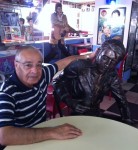
Uri Yoeli, left, at the Elvis Inn, his restaurant/convenience store/gas station in Neve Ilan. (photo by Deborah Fineblum Schabb)
To appreciate how much Israelis love Elvis Presley, you just have to hear three generations of the Mizrachi family of Rehovot crooning, “Wise men say only fools rush in … but I can’t help falling in love with you.”
The Mizrachis – mom Aliza, sons Asaf and Yehoram, and granddaughter Kahila – had just downed some American-style burgers at the Elvis Inn, a restaurant, convenience store and gas station that proudly claims to be the only Israeli institution devoted to “the King.” And they were busy inspecting the impressive Elvis memorabilia and tchotchke collection on the premises.
Drivers passing through this corner of the hills surrounding Jerusalem often do a double take from the car window when they spot not one, but two way-more-than-life-sized statues of Elvis. Unless, of course, they’re among those who, like the Mizrachis, make a special pilgrimage to the Elvis Inn, located in the small hillside town of Neve Ilan.
Elvis-themed bottles of wine on sale at the Elvis Inn. (photo by Deborah Fineblum Schabb)
Where else can Israelis hear all Elvis, all the time, piped into a 1950s-style diner while they feast on burgers and fries? Where else can they purchase an Elvis mini-alarm clock, a platter-sized “Elvis in Jerusalem” plate, or a postcard with Elvis wearing tefillin in front of the Western Wall? (The latter souvenir comes thanks to Photoshop, since the King was never in Israel – the closest he got was Germany, and there is no evidence that he ever wore tefillin.) Better yet, buy a cup of coffee for 15 shekels (about $5 Cdn) and you get the ceramic Elvis mug to take home as a souvenir.
But nothing of this Elvis sanctuary was in the picture when Uri Yoeli was a 12-year-old growing up in Jerusalem, the seventh generation of his family to do so. The year was 1958 and the Israeli preteen had a girlfriend who was a hardcore fan.
“She gave me a picture of a man and said it was someone named Elvis,” he recalled. “The next week she gave me a small record – One Night with You.” Back then, his family owned one of just a handful of gramophones in all of Jerusalem, and being willing to repeatedly play the Elvis record instantly made Yoeli one of the most popular kids in the neighborhood.
“I didn’t understand one word of English but I knew this was great music,” he said nearly six decades later. So began a lifelong devotion to the King, punctuated with trips to Graceland (Elvis’ Memphis shrine) and an impressive collection of Elvis memorabilia, much of it now on display at Yoeli’s Elvis Inn.
Even during his years of Israel Defence Forces service, Yoeli’s Elvis fascination continued; he bought whatever posters and records he could get his hands on. In 1974, when he had the chance to open a gas station in Neve Ilan, he put a few of the Elvis pictures on the wall behind the cash register.
“That’s when I saw people’s reaction: ‘Wow, Elvis!’” he said. Thus, the Elvis Inn was born.
Over the years, the venue has grown, adding the two oversized statues – the brass one is a towering 16 feet high – and attracting not only Israelis, but plenty of Americans on vacation looking for some old-fashioned home cooking. (Note: any Elvis fans who keep kosher will have to pass on the food at the inn.)
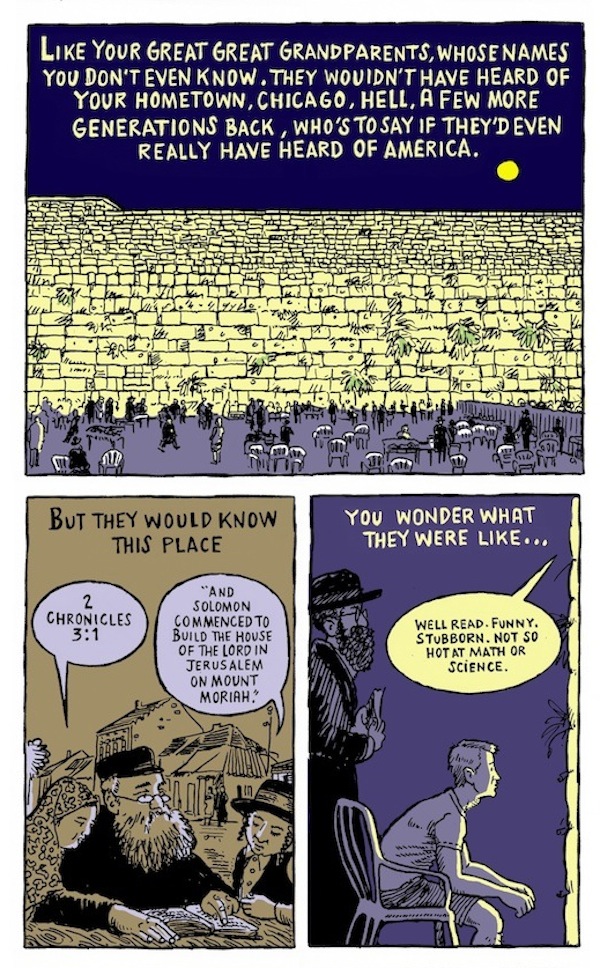
From The Completely Unfabulous Social Life of Ethan Green, by Eric Orner.
It was never on Eric Orner’s agenda to go to Israel. He resisted his mother’s entreaties to join a young people’s synagogue trip to the Jewish state. A relatively secular upbringing and a tendency to play hookey rather than attend Saturday morning religious classes meant he emerged into adulthood without a sense of strong connection to Israel or Zionism.
As a young adult, he was busy with a dual career that had him working days in the office of Barney Frank, the iconic, gay, Jewish congressman, and spending his nights drawing an iconic gay, Jewish comic strip that, at its height, was running in about 100 alternative and LGBTQ newspapers across North America.
It was circumstance, not Zionist fervor, that eventually took Orner to Israel, and among the results of his three years there is a series of comic strips that are, in turns, disturbing, thought-provoking and moving.
***
Starting in 1989, Orner drew the self-syndicated cartoon strip The Mostly Unfabulous Social Life of Ethan Green. For 15 years, it was a cult favorite that followed a cast of sharp-tongued characters across a dramatic time in the evolution of the AIDS epidemic, the gay rights movement and politics in general, while capturing the spirit of the time in ways that perhaps only the medium of a comic strip can. The cartoon is cut through with Yiddishisms and sometimes unmistakably Jewish humor and sensibilities. Orner acknowledges that Ethan Green is, like him, a short, culturally Jewish, gay man, but the strip is not about Orner’s life.
“There’s 15 years of episodes of things happening to him and those things didn’t happen to me,” he said. “It was about somebody who had characteristics like me but it wasn’t about my life.”
For those who missed the strip in its serial incarnation, or who want to catch up, a compilation has recently been released, titled The Completely Unfabulous Social Life of Ethan Green.
When The Mostly Unfabulous Social Life of Ethan Green was turned into a film, in 2005, Orner figured that was a good time to wind up the strip and make a change. He had spent a decade working in the Boston and Washington offices of Frank, the recently retired longtime congressman whose name is synonymous with Wall Street reform, consumer protection and pithy lines. Frank had met Orner around Boston, where the Chicago-born Orner was studying at Tufts University.
“I forget who first raised the question that he would work for me,” Frank told the Independent. “He’s very smart, he’s very thorough. The fact that he was doing the cartoons made him more interesting. It wasn’t relevant to his work one way or the other.”
But while Frank is noted for humorous quips, Orner apparently saves his best for the page.
“What I found in Eric is that his wit and humor comes out more in his writing,” Frank said. “He was not shy, but not nearly as outgoing as the cartoons.”
Frank said Orner has one of the hardest work ethics he’s encountered, which may help explain how he held down an intensive job as an aide to one of the country’s leading politicians while also pumping out a bi-weekly comic strip and distributing it, in the days before the internet, by stuffing it into envelopes. To top it off, during this time, Orner also studied law and was called to the bar.
Frank, who introduced the first gay rights bill in Massachusetts, in 1972, is a central figure in the movement for sexual orientation equality, which experienced its most dramatic achievement when the U.S. Supreme Court ordered marriage equality for gay and lesbian couples, just days before Frank spoke with the Independent.
“No social movement in America, that I can think of, has moved remotely as quickly as this one,” Frank said. While the congressman was fighting legislatively, he credits Orner for playing no small part in the movement as well.
“This was not always an easy fight for people and there is also this tendency for people in movements to be grim and to talk about all the negative stuff,” he said. “But having someone who saw the humor in it was affirming in a way.”
***
Orner left the congressman’s staff to follow his dream to draw full-time. He moved to California and got a job as an animator with Disney.
“Most cartoonists I know aren’t lucky enough to do it full-time,” Orner said. “The only time I’ve had that experience was the time when I was working in animation and really they both involve drawing but they’re very different.”
It was not everything he had imagined. Orner acknowledges he is a good animator, but maybe not as good as some at Disney, who accused his Tinkerbell of flitting across the screen like a Black Hawk helicopter. Even this was not the main problem.
“That was not about my creativity, that was about Uncle Walt,” he said. “Animation is, in some sense, factory work.”
Like a lot of factory work, much of it was moving overseas. His boss got a job as head of a project in Jerusalem, which was at the time competing with Tel Aviv to become a media industry hub.
“So they built a beautiful animation facility and a bunch of Californians, including myself, went over there to work on a film.” The project never saw light, which is common enough in animation, he said. But, again, he was moonlighting with his own projects.
“Suddenly there I was in Israel,” he said. “It changed my life in many, many ways. I didn’t want to go and I wasn’t very happy about it, but that all changed and I fell in love with it and now I worry about it every day of my life. I disagree with a lot of things that are happening over there and yet I have dear, dear friends.”
From Avi & Jihad, by Eric Orner.
The strips he wrote in Israel are part of a to-be-published volume called Avi & Jihad. One strip, called “Kotel 3 a.m.,” is a powerful short story of a midnight stroll to the Western Wall, where a skeptical American Jew finds resonance and a connection to the millennia of history there. When he tells his colleagues at the office about his stroll, it evokes stories of “nutcase Americans” who arrive from Great Neck or Savannah or Palo Alto and start speaking in tongues. Another is about the unadvisable idea of not taking seriously the El Al security agents. In one deeply dark strip, a love story between a Jewish man and a Palestinian Arab man turns into violent carnage that Orner said is not specifically about a single incident, but clearly evokes the murderous attack on a gay youth centre in 2009, and which has added resonance after the stabbings at this summer’s Pride parade in Jerusalem.
Orner’s politics were on his sleeve – or, rather, on the page – when he was writing Ethan. Some of his Israeli comics are less overt and more slice-of-life, but he pulls no punches when speaking about Israeli policies and the positions of American Zionists.
“I think that if it’s fair game to be critical of the Likud in Tel Aviv, then it should be fair game to be critical of it in Washington, D.C.,” Orner said. “I think we’re a little afraid to be critical. This is not the Israel of Golda Meir and Moshe Dayan and David Ben-Gurion.”
Orner said that if you can love America and not love George W. Bush, you can love Israel and be critical of its leadership.
“Sometimes, dialogue is unpleasant and uncomfortable and harsh,” he said. “I think we’re tough enough to handle that. I think we’re strong enough to have this conversation without going to pieces, thinking, oh God, our campuses are full of antisemites.”
Orner was in Israel from 2007 to 2009, which was the aftermath of the Second Intifada, the tensions of which are depicted in his pieces from those years.
“They are constantly under threat,” he said of Israelis. “Do I understand why people would then go to the polls and vote for Netanyahu? I do. Because you might disagree with him but, in the end, you think he’s a tough guy and that’s what we need.”
But Orner thinks there is an element in Israeli politics that doesn’t want a resolution to the conflict.
“I’m a Zionist, but I think the settlements, settlement activity, has been counterproductive from the beginning and I think there’s a lot of people that promote the settlement activity particularly because it is counter-productive to peace.”
Orner recognizes that his opinions may not be a consensus viewpoint, even in his own circles.
“I make a lot of people mad,” Orner said. “I’m not sure my old boss agrees. I know my stepfather disagrees. I know my best friend disagrees. But, having lived there for three years, that’s what I saw. I saw settlements over the [Green] Line and, if I were a Palestinian, that would enrage me also. I don’t know what the answer is, but my guess is building more settlements over the line quicker isn’t the answer.”
After the global recession hit and he lost his job in Jerusalem, Orner returned to Frank’s office and remained there until the congressman retired in 2013. Orner is now a speechwriter in New York. He is looking for a publisher for his Israeli cartoons and is working on another book depicting his time in California.
He has no regrets about his three years in Israel. It piqued his interest in Jewish history and changed him.
“I became far much more appreciative of my connections to Jews from other parts of the world, not just Israel, but France, Italy, Morocco, Iraq,” he said. “I looked out my window – I had this apartment that I could see the gold dome of the Al-Aqsa Mosque from my window – I lived in a hilltop neighborhood called Abu Tor and I looked right down on the Old City walls. You can’t live there without being more interested.”
The Conservatives, Liberals and NDP have all expressed strong support for the Jewish state. Is there any difference between them?
Line up the platforms of the three main political parties and, despite the rhetoric, they are all solid allies of Israel.
The federal Conservatives, Liberals and NDP all profess support for Israel’s right to exist, for the nation’s right to defend itself and for a two-state solution. All three leaders have visited Israel, with Prime Minister Stephen Harper being the most recent to visit, in January 2014.
Indeed, Canadian political support for Israel has been consistent since the establishment of the Jewish state in 1948, said McGill sociology professor Morton Weinfeld.
It is rooted in a strong and shared Judeo-Christian tradition but has gotten a boost recently, as Canada and the West confront groups such as the Islamic State and other forms of militant Islam, he said.
The perception, especially among Jewish voters, however, is different.
Stephen Harper (photo from sv.wikipedia.org)
“I think the perception is that Stephen Harper and the Conservatives are the most committed to Israel’s security,” Weinfeld said. “They [voters] would probably say the NDP would be less committed to Israel, not because of [NDP leader Thomas] Mulcair, but because of elements in the party. I would think the perception that the Liberals under [leader Justin] Trudeau would be in the middle.”
That perception is based in reality, since the Harper government has made clear and forceful statements about support for Israel, Weinfeld said.
However, Liberal MP and foreign affairs critic Marc Garneau pointed out that it is simply because Harper occupies the highest office in the country that his decisions have greater visibility than statements by other parties.
“There are no differences [between the Conservatives and the Liberals] in terms of a lot of the positions [on Israel], and I try to get the message across. I don’t get to do it in the public way that you do when you’re the prime minister and the government of Canada.”
Meanwhile, in what is shaping up to be a close three-way race, foreign policy, once only of interest to wonks and Ottawa insiders, is coming under closer scrutiny by voters.
The amplified attention being paid to foreign policy is being driven by a more sophisticated and diverse electorate that is more globally connected, said Chad Rogers, a partner in public affairs agency Crestview Strategy.
But it would be wrong to assume that the Tories’ especially vocal support of Israel is a ploy to woo Jewish voters. The electoral math, with Jews concentrated in a handful of ridings, doesn’t add up, said Rogers, who has worked on several Conservative campaigns.
Rather, the Tories’ support is part of a consistent worldview that is reflected in its defence of Ukraine and on issues such as opposing the persecution of gays in Iran or protecting Syrian refugees, he said.
“The mistake is to look at this and say it’s a political issue and it’s about Jews and Israel,” he said. “It’s a worldview that says we will side with democracies over countries that are not democracies.”
While Harper is portrayed as being in lock step with Israeli Prime Minister Binyamin Netanyahu, that’s not accurate, Rogers said. Harper “has been very frank” with the Israeli government on its policy on settlements.
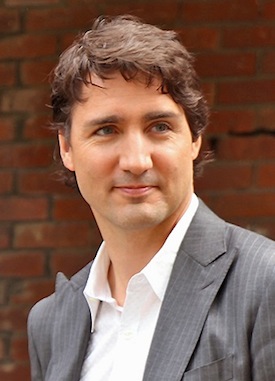
Justin Trudeau (photo from en.wikipedia.org)
For the Liberals, the greatest challenge is a political platform that’s identical to the Tories’ on support for Israel, but is perceived by some voters as weaker.
Trudeau “won’t make the issue of Israel a wedge issue. He believes Canada should support Israel because it is the right thing to do,” said Irwin Cotler, Liberal MP for Mount Royal and a former minister of justice and attorney general, who is not running for reelection.
“I welcome Harper’s support for Israel, but when Harper says if you care about Israel, you must vote Conservative, then he politicizes it,” Cotler said. “When you do that, it undercuts support for Israel.”
In previous elections, brochures were distributed to Jewish voters in his riding and others alleging that Cotler and the Liberals had not been forceful enough in countering antisemitism and terrorism and in supporting Israel. Cotler believes this type of negative campaign cost the Liberals seats in heavily Jewish ridings, partly because the allegations seemed so absurd that the candidates did not mount a strong defence, but he believes it won’t be successful this time around.
In recent weeks, guests invited to a Toronto fundraiser for the Liberals, hosted by pharmaceutical magnate Barry Sherman, received an email from a Jewish Conservative supporter charging that Trudeau was less than the staunch ally of Israel he professes to be.
Sherman countered with another email which, like the original exchange, has been distributed beyond the initial circle of invited guests. Cotler said this is the tack that Liberals need to take.
“What Sherman did was to fight back with the facts and the truth, rather than letting those allegations take hold,” said Cotler.
While elections are usually fought on domestic issues, Cotler believes foreign affairs concerns “have come to the fore” in this election, spurred by the instability in the Middle East.
Many Jews are not single-issue voters, but the threat posed by Iran and the deteriorating situation in Syria “create a heightened concern in general, and among Canadian Jews in particular,” he added.
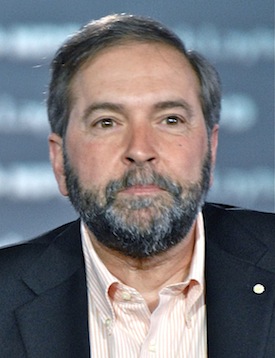
Thomas Mulcair (photo by Asclepias via commons.wikimedia.org)
The NDP’s support for Israel puts it at odds with other leftist parties in Europe, which have taken a much harsher tone with Israel, but places it alongside other Canadian political parties, said Judy Wasylycia-Leis, a former NDP MP for Winnipeg North.
“The position is unique in social democratic parties because of Canada’s role as a peacekeeper and mediator generally in the world,” she said.
The NDP, especially under Mulcair, has shown unwavering support for Israel, she said.
Voters got a good look at how Mulcair would handle a crisis in the Middle East during the war in Gaza last summer. The NDP leader acknowledged that Hamas was a terrorist group and that Israel had a right to defend itself, while simultaneously lamenting the deaths of innocent civilians and calling for a ceasefire.
The intensified attention to foreign policy has left the parties competing for the title of who is Israel’s best ally.
While the Conservatives have painted themselves as “a strong friend” of Israel, Wasylycia-Leis disagrees. “I don’t think a good friend of Israel would use this as a wedge issue,” she said. The Tories’ uncritical support for Israel has made it a polarizing issue for Canadians instead. “I think the NDP has been criticized for offering a more nuanced, balanced approach.”
Meanwhile, Mulcair’s pro-Israel direction has also generated tension within the party itself. Last summer, a Montreal-area MP quit the party, citing Mulcair’s policy on Israel. A Nova Scotia NDP candidate for this year’s election resigned recently after making critical comments about Israel, while two other NDP candidates are facing close scrutiny for previous remarks.
As foreign policy concerns play a greater role in the election, the question is to what degree this drives voters. In the Jewish community, it certainly plays a pivotal role for many voters, strategists say.
While “bread-and-butter issues,” – the economy, jobs and health care – have traditionally been the chief concerns for voters, Wasylycia-Leis, who’s been through 14 elections, said foreign affairs have taken on a new significance for Canadians because of the Tories’ handling of such issues as Bill C-51, which addresses terrorism, and domestic controversies, such as the legality of wearing the niqab at citizenship ceremonies. But, for Jewish voters, the issue takes on even greater importance, she said.
“Positioning on the Middle East conflict is very important for Jewish voters. I’m not so sure they appreciate the Conservative approach,” she said. “I think they also understand that approach doesn’t bring help in terms of a long-term solution that everyone wants.”
Weinfeld agrees that Jewish voters tend to show special interest in Israeli affairs, but especially in this election, when the Conservatives have positioned themselves as Israel’s strongest ally.
“The community is probably split at this point,” he said. “Those for whom Israel’s security is the Number 1 concern, and think things like the Iran deal are disastrous, would tend to lean toward Harper.” But “many would think that Harper’s position’s is too one-sided or that there are other domestic issues, which might lead them away from support from Harper.”
In the longstanding debate over whether collective narratives should be transmitted as capital-T truth, or whether they should be challenged and problematized, there is a flurry of activity around rethinking Israel education for the next generation. As if they were speaking to each other (they weren’t – neither creative team knew of the other), a short documentary film and a new curriculum have emerged to address an apparent gap in critical thinking around Israel.
The director of the short film Between the Lines, Ali Kriegsman, was frustrated with the kind of Israel-right-or-wrong messaging she received growing up in Jewish day school. In the film, she interviews students, rabbis, Jewish educators and professors who each suggest that it’s time to allow the light of critical thought into our community’s classrooms when it comes to Israel.
As a professor who teaches Israeli-Palestinian relations, I am well aware that the kind of one-dimensional Israel education that some students receive does not make them well placed to take in the more intellectual, critical-thinking approach that is the hallmark of higher education. But where the film makes its most counter-intuitive suggestion is in the area of Israel advocacy on campus.
The film suggests that even for those who want to create effective Israel advocates, the current tone of Israel education falls short. Kriegsman, who says she “wants to see improvement and justice in Israel,” believes that “antisemitism still exists in the world” and is troubled by the fact that the Palestinians “are marginalized and mistreated and settlements continue to expand,” puts it this way. She believes that a student who has been force-fed a simplistic view of Israel and arrives on campus where the discourse is almost inevitably contentious and polarized will do one of three things.
In one scenario, the student will become embarrassed by the actions of the country they were taught to idealize and thus choose to detach entirely. In another scenario, the student will draw on the “AIPAC”-style advocacy “bubble” they lived inside during Jewish day school and will become completely closed to any alternative narratives. In this scenario, the hypothetical student might become an “exaggerated version of a day school student” – discriminatory and racist. In a third scenario, the hypothetical student may feel “duped or betrayed” by her Jewish day school education and burn her emotional connection to Israel entirely.
Having premièred at a SoHo loft in New York City, the documentary – which received seed money from the Bronfman fellows alumni fund – is slated for a West Coast première in October sponsored by a Los Angeles synagogue.
Unbeknown to Kriegsman, as the film was being made, a rabbi in Madison, Wis., was creating a new curriculum that appears to address the conceptual gaps that Between the Lines identifies. Called Reframing Israel, the curriculum is meant to address what Rabbi Laurie Zimmerman saw as a major deficiency in Israel education at the elementary and high school level: “There was virtually no published material that asks students to think critically about the conflict.”
The rabbi wants kids to think in more complex terms, to be inspired to look at Jewish texts.
How do you cultivate compassion for both Israelis and Palestinians? How do you understand Palestinian stories?
Rather than emphasize a “love” for Israel, Zimmerman uses the term “connection.” As she puts it, “We pick one of the following: Eretz Yisrael (the Land of Israel), Medinat Israel (the State of Israel) and Am Yisrael (the Nation of Israel). We ask, What does it mean to be connected to each of these?”
She has been piloting parts of the program over the last couple of years. Last year, two 13-year-olds created a debate with each other on the question of the one-state versus two-state solution to the Israeli-Palestinian conflict. “It didn’t matter what they believed,” she said. Rather, the act of articulating the critiques was really valuable.
Some critics of this open-minded approach will claim that, to be agnostic about whether Israel remains a Jewish state (given that a one-state solution, in its democratic form, would basically spell the end of Israel as we know it) is itself a betrayal. Zimmerman, however, “trust[s] kids enough to draw conclusions that are sound and solid.”
As for what kind of Jewish student she hopes to send to campus once they have graduated from religious school, Zimmerman wants to send kids who are “inquisitive; have open minds, can evaluate an argument, apply their knowledge; research a position and make an informed choice. I guess that makes me radical since I’m not trying to send kids to campus to defend Israel. I care mostly that they go to campus and think deeply about being Jewish, about their connection to Israel, about Palestinian perspectives. The role of education is to create people who are actively engaged in their communities.”
Mira Sucharovis an associate professor of political science at Carleton University. She blogs at Haaretz and the Jewish Daily Forward. A version of this article was originally published on haartez.com.
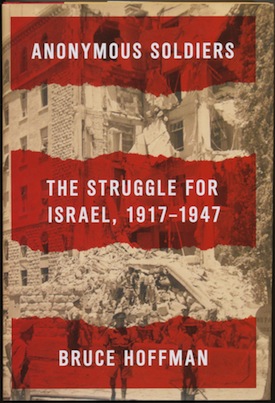
Does terrorism work? This is the question that opens Anonymous Soldiers: The Struggle for Israel, 1917-1947 (Alfred A. Knopf, 2015). Western leaders insist that the work of terrorists will never lead to the ends they seek, but one of the lessons from this book is that this may well be wishful thinking.
Anonymous Soldiers – the title is from the anthem of the Irgun, the Zionist paramilitary force led by Menachem Begin – is the latest book by Bruce Hoffman, an expert on terrorism.
In the aftermath of the First World War and the collapse of the Ottoman Empire, Britain came to control the region known as Palestine, a victory that would prove confounding and tragic. Hoffman’s book is a story of endless miscalculations, under-preparedness and overreactions on the part of the British military and police.
The Balfour Declaration of 1917 was a statement of intent by the British government to create a Jewish national homeland in Palestine and the Jewish people there and elsewhere saw this as a sign that Britain would be their fiercest ally. However, almost from the moment the British Mandate began, until the forces of the empire departed with their tails between their legs three decades later, Palestine was riven with not only violent clashes between its Arab and Jewish residents, but by both those parties against the British and, as brutally detailed by Hoffman, fraternal conflict between Jewish militias.
The Haganah was the “establishment” militia, associated with the Jewish Agency and intended as a self-defence organization after the British proved incapable of or unwilling to protect the Jews of Palestine. In 1929, Arab riots led to mass killings of Jews and, while British police killed almost as many Arabs as the Arabs killed Jews, the balance demonstrated an inability of the British police and military to control the area. The diplomatic response was to attempt to appease the Arabs, which appears to be the first example in the book to prove that terrorism works.
The riots led to an investigative commission, a white paper and another British obfuscation on Zionism. The white paper blamed Arab violence on “excessive” Jewish immigration to the area in the mid-1920s and the purchases of land by Jews. This led some Zionists – notably those of Ze’ev Jabotinsky’s Revisionist party – toward the idea that Britain may not be a reliable ally. In 1931, Revisionists defected from the Haganah and formed Haganah-bet (later the Irgun), which did not see itself solely as a self-defence force but opened the door to “sabotage, bomb making and hit-and-run attacks – in other words, the core tactics of terrorism.”
From 1936 to 1939, Palestine was in a state of near civil war in the form of an uprising by the Arab populations against the British and the potential of more Jewish migration. At precisely this time, the fate of Jews in Europe was being sealed and countries, including Canada, were slamming shut the gates.
Clouds of war in Europe were accompanied by fear of Muslim uprisings in the vast British Empire. The priority, in the words of foreign secretary Lord Halifax, was to avoid “arousing antagonism with the Arabs.” Neville Chamberlain, the prime minister at the time, said it was “of immense importance to have the Muslims with us. If we must offend one side, let us offend the Jews rather than the Arabs.”
This, too, was a miscalculation that did not take into account the determination of the Irgun. British caving in the face of Arab violence was taken by the Irgun as proof that terrorism works.
And a third group, which had broken away from the Irgun – Lehi, also known as the Stern Group (or the Stern Gang by the British) – went further. They attempted an alliance with the Axis, viewing Hitler as “just another antisemite” and proposing a mutually beneficial partnership based, the author writes, “on the fatally erroneous assumption that for Hitler the crux of the Jewish problem in Europe could be solved by evacuation, not annihilation.”
Meanwhile, as terror was rocking the Middle East, Chaim Weizmann, the Zionist leader who was plugged into the British establishment, was mending fences in London and urging the Haganah to crack down on the Irgun and Lehi.
Weizmann was warned by then prime minister Winston Churchill that if the violence didn’t end, “we might well lose interest in Jewish welfare.”
Of course, the Irgun did not expect to defeat the British Empire militarily. “History and our observation,” Begin later said, “persuaded us that if we could succeed in destroying the government’s prestige in Eretz Israel, the removal of its rule would follow automatically.”
Weizmann’s diplomacy and the cooperation of the Haganah with the British forces in Palestine regained the trust of Churchill, but that was of limited value after the war leader lost the 1945 election and the Labor party came to power at Westminster.
The new prime minister, Clement Atlee, inherited a paralyzed Palestine, in which there seemed to be no winning position. At a 1947 conference, the British tried to share the mess with the United States, but that failed and they eventually dumped the problem at the podium of the new United Nations.
So, does terrorism work? In the Palestine example, Hoffman demonstrates that the Arab riots of 1921 resulted in restrictions on Jewish immigration to Palestine and the 1929 riots resulted in Britain backpedalling from its commitment to Zionism. The Arab Rebellion, from 1936 to 1939, resulted in a huge reconsideration of Britain’s policy in Palestine and, though the author doesn’t make this explicit, possibly the deaths of millions of European Jews.
On the Jewish side, violence seems to have had its intended effect, as well. “By September 1947, the Irgun had achieved its objective,” Hoffman writes. “Each successive terrorist outrage illuminated the government’s inability to curb, much less defeat, the terrorists. Already sapped by World War II, Britain’s limited economic resources were further strained by the cost of deploying so large a military force to Palestine to cope with the tide of violence submerging the country.”
The author sees the Irgun’s campaign as critical to understanding the evolution and development of terrorism in the second half of the 20th century and the already bloody 21st century. “Indeed, when U.S. military forces invaded Afghanistan in 2001, they found a copy of Begin’s seminal work, The Revolt, along with other books about the Jewish terrorist struggle, in the well-stocked library that al-Qaeda maintained at one of its training facilities in that country.”
Roger Sherman’s Florentine Films crew chows down at El Babor restaurant in the Haifa area. (photo from Florentine Films)
It might seem absurd that an American filmmaker, who, until five years ago, thought that falafel and hummus were the only ingredients of Israeli cuisine, would introduce the world to the Israeli food and culture scene. But documentarian Roger Sherman – who has won an Emmy, a Peabody and two Academy Award nominations – seems to be the right guy to whet the world’s appetite for Israel’s diverse and innovative dishes.
“The reason I’m doing the film is because I found a food culture that no one in the world knows about. This is the best-kept secret,” Sherman told Israel21C during a quick interview in the lobby of a Tel Aviv hotel before setting out to film final pickup shots for his documentary, The Search for Israeli Cuisine.
Sherman discovered Israeli cuisine five years ago when he made an introductory visit to the country he’d heard so much about in the news.
“I was knocked out by what I saw, what I ate and how gorgeous the country is. Who knew that there was a gorgeous beach that runs the whole length of the country? Israel has incredible mountains and desert,” said Sherman, who finally came for a visit at the behest of a foodie tour-guide friend.
Sherman, married to the founder of influential gourmet food and wine magazine Saveur, said the country’s culinary revolution is unknown to many because most foreigners only associate Israel with “political drama and biblical history.”
“They don’t realize it’s so much more,” he said. “Israel has a food scene that I had no clue about, a restaurant scene that rivals New York, London and Paris. I think people are going to be shocked, surprised and very pleased with what they learn from watching this film.”
The two-hour PBS special is to be completed by October. Sherman admitted that he has enough material for a six-hour miniseries but prefers to pack the choice shots into 120 minutes, leaving the remaining 150 hours of footage on the editing floor.
Private backers as well as a successful Kickstarter campaign have helped support Sherman in the two-year researching and filming process. He interacts with interested would-be viewers via Facebook, Twitter, a blog and Instagram almost daily.
“The primary audience is American public television but it will be shown around the world. American public television is a fairly high demographic of people who like to travel, and a lot of people that like to travel like to eat, and they like to see new things and explore the world,” said Sherman. “It’s also for people who like to open their minds even if they don’t travel or are interested in surreptitiously going on adventures. And I think this is going to be an adventure.”
The Florentine Films documentary tries to answer the question “What is Israeli cuisine?” To do this, Sherman’s team crisscrossed the country, filming at more than 100 locations.
While the question is simple enough, the answer is not clear cut.
The film introduces audiences to the country’s leading chefs, innovative farmers, home cooks, boutique winemakers, craft beer brewers, world-class chocolatiers, cheese artisans, restaurateurs, food journalists, street foodies and traditional bakers. Some of them believe Israeli cuisine can be defined as a hodgepodge of traditions, while others say it’s too early to brand the delicious concoctions being created at local eateries.
“What we have here is confusion food. It’s all mixed together beautifully: traditional spices, techniques, dishes that intermingle with all the influences. After [service in] the army, we Israelis go to study abroad or [travel] to the Far East, India or South America. We get to know Thai and Vietnamese food, Mexican flavors. Some [return] and open restaurants. It all becomes Israeli food,” chef/baker Erez Komarovsky says in the documentary.
Chef Maoz Alonim of HaBasta restaurant is one of those against labeling Israeli cuisine as such.
“So, what is Israeli food? Domestic food. We have our inspirations from ingredients that used to be cooked here for hundreds, thousands of years. I really do not think that I serve Israeli food,” Alonim says. “I serve domestic food again and again and again. And what makes it Israeli? Sure, I take fresh ingredients from Israel and I can import the fresh oysters from France, but does this make it Israeli? No, that just makes it oysters that I really like.”
For Sherman, the American looking in, there is definitely a “something” that makes gastronomy in Israel different from elsewhere.
He shows Israeli-American chef Michael Solomonov, a James Beard Award winner and guide for the film, stopping at a Yemenite grill in Tel Aviv, where he is served 17 salads as an appetizer. The salads are an international sampling of Arab, Iraqi, Arabian, Moroccan, Russian, Eastern European, Italian, Turkish, Moroccan and Greek dishes – obviously, all made in Israel.
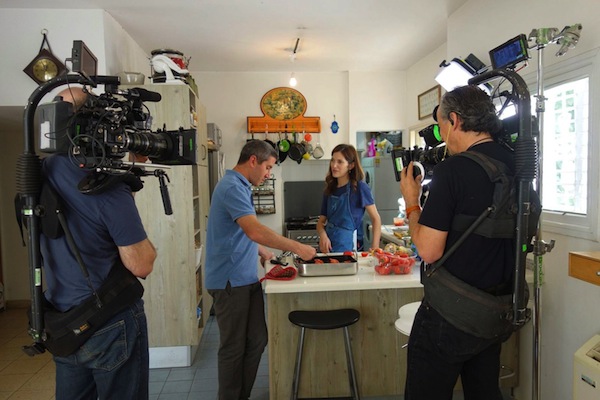
Michael Solomonov being filmed in the kitchen of Krav Sakinim (Israel’s Iron Chef) judge Ruthie Rousso. (photo from Florentine Films)
“In America, it’s identifiable. But here, people say it’s too soon to have a cuisine. There are people that love the idea of a melting pot, everybody coming together. But there are also people who do not like this idea; they want to keep cultures separate,” Sherman said.
“Israeli cuisine is the amalgamation of dozens of cultures that are taking remarkable local ingredients and either trying to stay true as much as they can to their traditions or updating and upgrading.”
Sherman contends that Israeli cuisine only came into existence in the 1980s. “You have a country that began with no kitchens in private homes because, if you lived on a kibbutz, and many people did, you ate communally. And, if you talked about enjoying food, people would slap you. ‘We’re here to survive, we’re trying to create a country,’ they’d say,” Sherman explained. “Until at least the mid- to late-’80s, ‘cuisine’ was a four-letter word. You didn’t mention it.”
Today, of course, Israeli cuisine is simmering in pots around the country – and even beyond. He pointed out that three of the best new U.S. restaurants as chosen by Bon Appétit magazine are dedicated to Israeli cuisine. “Israeli cuisine is now proliferating, accelerating … in the past year, Israeli cuisine places have opened all over the world. Israeli cuisine is a force,” he said.
The Search for Israeli Cuisine is not only focused on the kitchens of Israel. Sherman spotlights Israeli agri-tech and how Israeli farmers and engineers are changing the way the world eats.
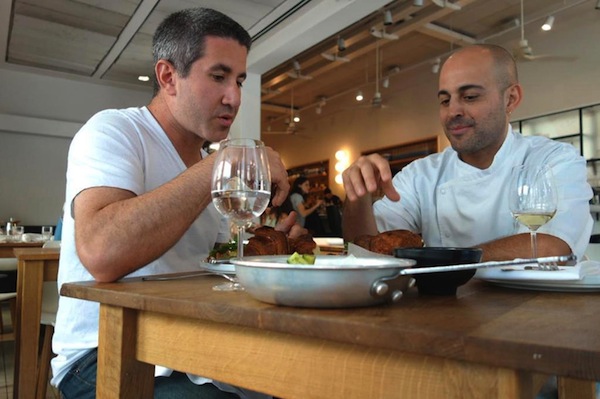
Michael Solomonov dines with Israeli celebrity chef Meir Adoni in Tel Aviv. (photo from Florentine Films)
“This is another reason I’m doing the film. If you go back, Israel was a Third World country for most of its existence. Now, it’s not just a First World country, but it is leading the world in many ways,” he said. “I don’t think many people know that Israel’s high-tech agriculture has changed the way the world eats, beginning with drip-irrigation methods and going to seedless watermelons, cherry tomatoes, soon-to-be seedless lemons. Israelis know all this stuff but people around the world don’t.”
Sherman said viewers will be flabbergasted to hear that “farm to table” and “locally sourced” are standard practice in Israel. “People will think that’s fantastic because it’s such a big deal in the U.S. right now, what is your carbon footprint,” he explained. “Here, the whole country is accessible in two hours.”
Eating is a sensory experience, and a food-focused documentary has to instil the enjoyment of cuisine through the big screen. “People who watch our teaser, which is five minutes long, say, ‘Oh my God, that made me so hungry,’” Sherman said. “So, if I can do that in five minutes, imagine what I can do in two hours. We’re telling really interesting stories about people who are passionate about what they do. The people I have found have been wonderful in sharing their passion to the world.”
Israeli-American chef Solomonov takes viewers into the lives of everyone – Jews, Christians, Arabs, Druze and Bedouins – changing the food landscape of Israel.
“Israeli cuisine reflects humanity at its best. People need to know that, regardless of what they see on TV, regardless of their political stance, the best way to relate to Israel is through its food and culture,” Solomonov says in the film.
Sherman admitted that, prior to his visit, he realized that he’d “never thought much about the Israeli people. It became clear that most people I meet don’t know much about the Israeli people either, and they’re surprised at what I reveal.”
And that’s why he doesn’t see The Search for Israeli Cuisine as simply a foodie movie.
“I’m calling this a portrait of the Israeli people told through food,” said the same filmmaker who profiled preeminent restaurant owner Danny Meyer in The Restaurateur. “It’s not a cooking show, it’s not recipes; the food is at the heart of it but it’s really about these amazing people doing these dynamic things.”
Israel21C is a nonprofit educational foundation with a mission to focus media and public attention on the 21st-century Israel that exists beyond the conflict. For more, or to donate, visit israel21c.org.
Atomic Falafel poster. (photo from Atomic Falafel PR via israel21c.org)
While world headlines focused on the landmark Iranian nuclear deal, an enormous billboard outside a Tel Aviv building announcing the upcoming opening of an Iranian embassy in Israel in August had the local social media community wondering whether it was an art installation, an anonymous peace group’s campaign or someone’s idea of a joke.
The billboard announcement that had Tel Avivians talking. (photo from Atomic Falafel PR via israel21c.org)
The Hebrew billboard included pictures of the two countries’ flags, a local phone number and the text: “Opening here soon – embassy of Iran in Israel.” It was erected at Rabin Square, the favored site for political peace rallies.
The mystery was solved in the last days of August by the people behind the sign. It was a public-relations stunt to drum up publicity for the new Israeli comedy Atomic Falafel, a madcap film about a nuclear conflict between Israel and Iran.
“A satirical comedy mocking ultra-militarism” is how producer Avraham Pirchi explained the film, which was scheduled to open in Israel on Sept. 10.
Atomic Falafel is the latest from director Dror Shaul, winner of the 2007 Sundance World Cinema Jury Prize for his semi-autobiographical film Sweet Mud. It tells the story of two girls – one in Israel, one in Iran – who spill their countries’ most valuable secrets on Facebook to prevent a nuclear crisis. The movie pits a wifi-connected younger generation against old-school warmongers in an effort to stop a preemptive Israeli attack on Iran’s nuclear facilities.
“Teenagers around the world today are much more similar than different to each other. They dress the same, listen to the same music and are not really interested in wars. I hope that the sane, logical side of Israel and the world will overcome the irresponsible one, and that my little boy born just two weeks after the end of shooting will be rewarded with a safe future,” said Shaul.
“When we started to make Atomic Falafel, we didn’t know we would be releasing the film when Iran’s nuclear power would be so relevant. But that’s what’s happened,” Pirchi told variety.com, adding that the film is “pro-peace and optimistic.”
The film is co-produced by New Zealand’s General Film Corp. and Germany’s Arden Film, Getaway Pictures and Jooyaa Film. It stars Israeli actors including Shai Avivi, Mali Levy, Yossi Marshak and Zohar Strauss, as well as Germany’s Alexander Fehling (Inglourious Basterds).
Tara Melter, a German actress of Iranian descent who plays a supporting role in the film, raps the soundtrack’s title track, “Hitchki.” (screenshot)
Tara Melter, a German actress of Iranian descent who plays a supporting role in Atomic Falafel, raps the soundtrack’s title track, “Hitchki.” The song, composed by Bahar Henschel, is addictive.
Production company United Channel Movies (UCM) announced on Facebook that Atomic Falafel has all the makings of a hit, citing that the movie’s trailer (in Hebrew only) racked up more than 100,000 views in its first two hours online. UCM says it is in talks with international agents to secure wide distribution of the movie following its Israel release.
Israel21Cis a nonprofit educational foundation with a mission to focus media and public attention on the 21st-century Israel that exists beyond the conflict. For more, or to donate, visit israel21c.org.
Salomon Centre for American Jewish Thought fellow Eliana Rudee, left, and senior editor Joanie Berger enjoy lunch in Chicago. (photo by Paul Miller)
As I sit on a bench at the First Station in Jerusalem, just about to leave Israel for a weeklong conference in the United States, I watch the people around me on the most perfect Thursday. A bodybuilder-looking man feeds his young daughter and smiles at her as he leads the spoon of food into her mouth. Friends laugh and chat over ice cream, and couples walk hand in hand alongside the train tracks.
Suddenly, a sadness cascades over me as I get a too-familiar feeling of intense sadness that I experience every time I leave this amazing country. Some people call it the “Israel bug” and others call it “post-Israel depression.” Whatever it is, it feels like you’re about to leave something fulfilling and head towards a more robotic, mundane life. It means leaving behind the “Shabbat shaloms” heard from storekeepers on Thursdays and Fridays, and heading towards the “Merry Christmases” from storekeepers throughout December. It’s leaving behind the transcendent resonance of the shofar and heading towards elevator music while you’re on hold with the credit card company for the umpteenth time. It’s leaving the buzz of the people crowded into the shuk and heading towards the metronomic beeping as items are scanned at the grocery store. It feels like I am headed in the wrong direction.
But then I remember – I live here. I live in Israel. I am coming back in less than a week, and even though I am still sitting at the First Station in Jerusalem, I already cannot wait to come back. This is the epitome of my feelings for Israel, the land with which I am completely obsessed and the land that I am so very thankful to call home.
It was at this moment that I realized yet again that I have made the right decision by making aliya. This place truly fulfils me and fills my life with a sense of meaning that I have found only in my happiest moments elsewhere – an intimate gathering with my extended family, the moment I realized I had fallen in love, a birthday party that brought together all of my friends from the many parts of my life, and the feeling of learning something in college that changed my perspective on life.
As I write, I realize that these feelings are quite mushy-gushy, which (honestly!) is not usually how I am. So, in true rational form, I have concluded many times that I may be idealizing Israel, as my previous trips to Israel had been spent vacationing with family or new friends. But then, I think, how could I not idealize as I sit in the Jerusalem sun as the weekend hits, feeling so happy and sad at the same time? I honestly feel like a changed person in Israel.
My mom tells me that even before I was born, my personality was the same as it is today: I know what I want, I work hard to get it, I am rooted in facts and reality and I am a perpetual list-maker. I do things a little differently than most, and I like to lead others and pass along my passions. I am impatient and, because I feel so strongly about what I believe, my passion and confidence can often come off as inflexibility and stubbornness.
In Israel, much of my personality is unchanged. But I have found new parts of my personality finding expression and I think it is more a reflection of Israel than of myself. In Israel, I am quite able to express my emotions about this place, something that I would have found difficult and somewhat silly before. A new friend actually called me “artistic” the other day, something that I have not been called since I was very little.
After talking about Myers-Briggs with friends over the weekend, we decided to retake the test. After years and years of getting the same results, my personality profile shifted from “sensing” to “intuition.” This means that before I came to Israel, I paid more attention to the information absorbed through my five senses, but now I pay more attention to the information I receive through intuition. It also means that perhaps I am now a little more interested in the bigger picture than the details, the meaning behind the events, and new possibilities.
But I digress. Why I think this is worth mentioning is because I believe that something about being in Israel has changed this in me and has the power to change everyone who visits. When people have asked me why I chose to make aliya, I resort to talking about my feelings rather than rationality. (After all, I am not sure that someone who is purely rational would make this decision to move here!) I usually find myself saying something like this: “Well, there are a number of reasons why I moved here. One is because when I first came I fell in love with this place. I came back a number of times in the next several years, but it was never enough! I feel a fulfilment here that I missed when I lived in the U.S.” And then, when people look as if they want a more practical reason, I explain that my boyfriend and I were both thinking about living here before, so we chose to come together. It’s also a great place professionally, as a writer, because I write about Israel all the time. Rationally, it makes sense to be living in Israel if I am writing about Israel.
Previously, in explaining my decision to others, I would begin with the rational and move on to the emotional only if pressed to do so. But something about this place makes me tap into my emotions and intuitions. My theory about why this occurs is this: being in Israel inspires self-reflection in a way no other place does for me.
Israel’s history, culture, language and religion all relate to my past, present and future because of my identity as a Jew and my values of self-determination and freedom. My ancestors longed for the actualization of these values, died for the actualization of these values and survived for the actualization of these values. And now, I am helping to actualize these values by being in the Jewish state. This automatically triggers a cheshbon hanefesh – introspective monitoring about how well I am continuing to actualize the values that I find to be more important than my own being. I am, therefore, prompted every day here to integrate the values into my life, my actions, my choices.
As I am headed to the United States for the first time since making aliya, I reflect on the fact that even my choice to come for this week was based on these values. I believe to my core that creating the conditions for every person to find meaning in their lives should be a goal of humanity. For many Jews, finding their identity within the context of their culture, family and traditions means finding their identity within the context of Judaism. Israel is the place to find that identity, as nowhere else in the world do Jews come together like this to honor our past, present and future, actualize our values and traditions, and return to the only land that is inextricably tied to our identity as a people.
I came to the United States this week in order to be trained as a Birthright leader, someone who leads a group trip of young Jews to Israel, often for their first time, and guides them in learning about their own identity as a Jew. Birthright Israel and I share the same mission of creating the conditions for Jews to find their identity and meaning. I hope that, in this next week, I will learn to most effectively carry out this mission. And I think there is no better reason than this to leave my precious Israel, even for a week.
Eliana Rudeeis a fellow with the Salomon Centre for American Jewish Thought and the author of the new “Aliya Annotated” column for jns.org. She is a graduate of Scripps College, where she studied international relations and Jewish studies. She was published in USA Today and Forbes after writing about her experiences in Israel last summer. Follow her aliya column on jns.org, facebook.com/aliyaannotated and instagram.com/israelgirl48.
Among the events that began the Jewish year of 5775 (2014/15), Israeli Prime Minister Binyamin Netanyahu traveled to the United States, where he addressed the United Nations to warn of the danger of a nuclear-armed Iran, and met with U.S. President Barak Obama at the White House.
Prior to that visit, in September 2014, Israel received from Germany another state-of–the-art submarine, the INS Tanin. In October, United Nations Secretary-General Ban Ki-Moon was taken by the Israel Defence Forces to see a Hamas-built tunnel on the Gaza border, used for the purpose of terrorism.
In November, there was an attack on the Jerusalem light rail in which one person died after a terrorist drove his light van into a crowd of people waiting at a train station, and also injured more than a dozen others. The same month saw two terrorists enter Kehilat Ya’acov Synagogue in Jerusalem and attack worshippers at morning prayers with knives, axes and guns, killing four people and injuring a further eight.
In December, Labor party leader Isaac Herzog and Hatnua party leader and former justice minister Tzipi Livni announced that the two parties would join, with Herzog becoming party leader. Another new face was that of Lt.-Gen. Gadi Eizenkot, who became the new chief of staff of the IDF in February.
The year was a reality check for some public figures, as their misconduct caught up with them. In February, former chief rabbi Yona Metzger, who had been subject to an investigation for accepting bribes, was indicted. In March, former prime minister Ehud Olmert was found guilty of fraud and sentenced to a prison term.
With respect to the environment and public space, the Tel Hiriya waste dump outside Tel Aviv was closed down and a development started for the foundation of a huge urban park in its place.
In March, Netanyahu won the general election, but was only able to form a majority government with a coalition. Later that month, seven siblings, aged 5 to 16, from Brooklyn were buried in Jerusalem after they died in a fire in their home.
During the year, several incidents brought into focus the complaint, particularly by Jews of Ethiopian descent, of discrimination by the police. In one, an Israeli Ethiopian IDF soldier, Damas Pakada, was attacked by a policeman, after which Pakada was invited to the Prime Minister’s Office to receive an apology.
In April, Israel was one of the first countries to respond to the earthquake in Nepal. Within a day or two, a field hospital was set up by the IDF in Katmandu.
In May, there was another attack on the light rail system in Jerusalem. This time, the terrorist was shot in the legs, then apprehended, by a security guard.
In July, the United States announced that it would release Jonathan Pollard in November. Pollard will have served 30 years in prison for spying for Israel. He will not be allowed to leave the United States for five years after his release.
In August, Yishai Shissel, who had recently been released from prison for stabbing participants in Jerusalem’s Pride parade 10 years earlier, once again attacked marchers in the annual parade. He stabbed six people at random, and a 16-year-old died of her injuries. Once again, Israel was faced with problems relating to discrimination and violence.
As the year closed, the government concluded a deal with the companies that will be responsible for mining the huge quantities of natural gas found off Israel’s coast.
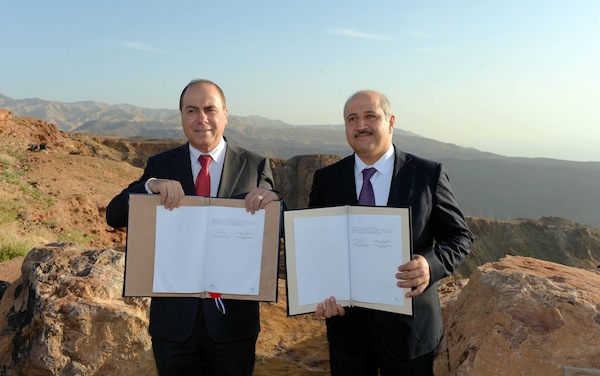
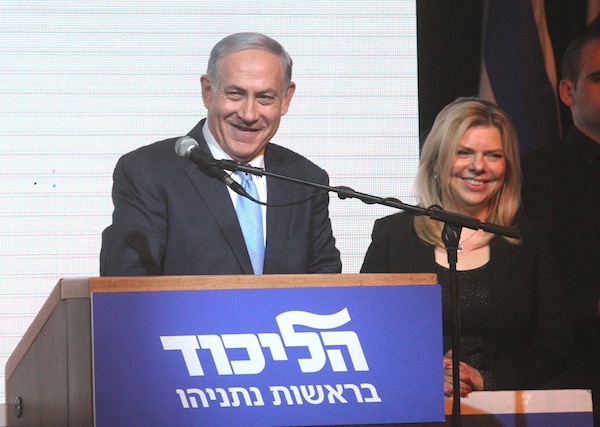
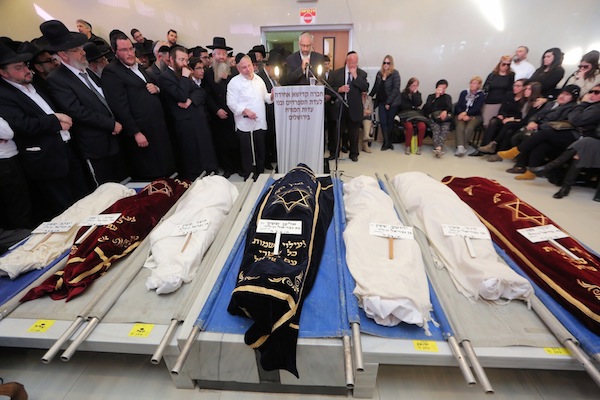
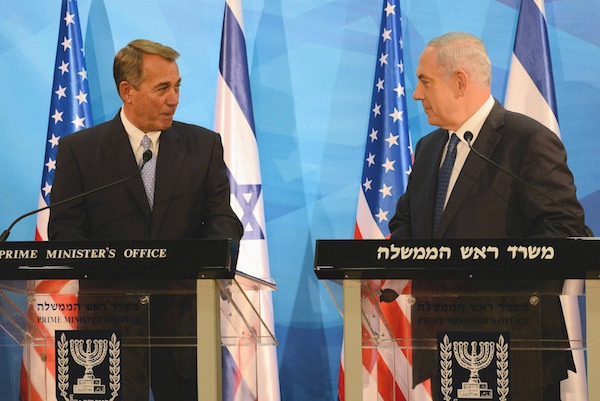
A border policeman walks past the covered body of a victim of the terror attack near the Jerusalem light rail in November 2014. (all photos from Ashernet)Near the end of February 2015, Israel and Jordan sign an agreement to revitalize the Dead Sea by building an $800 million pipeline from the Red Sea. The measures will not only slow down the evaporation of the Dead Sea, but also supply electricity to both countries when completed.In March 2015, Likud wins the general election.On March 22, Gabriel Sassoon from New York eulogizes in Jerusalem his seven children who were killed in a house fire the previous Shabbat in Brooklyn.The Tel Hirya reclamation project and urban park, April 2015.In April, Senator John Boehner visits Israel to show his solidarity over the rejection of the deal with Iran.Israel Defence Forces medical personnel treat injured Nepalese at the IDF field hospital in Katmandu, May 2015.Ethiopian Jews and their supporters protest outside the Ministry of Defence headquarters in central Tel Aviv, June 2015.Prime Minister Binyamin Netanyahu receives Esther Pollard in his office on July 29, 2015, following the news that her husband Jonathan Pollard is to be freed from prison in the United States in November.In August 2015, Jerusalemites take to the streets in a rally against violence and hate crimes. Thousands also take part in the demonstration in Tel Aviv.
Ala Buzreba, the 21-year-old Liberal candidate in Calgary Nose Hill, has withdrawn from the federal election campaign after vicious tweets attacking readers were revealed.
Buzreba apologized on Aug. 18 for the tweets, saying they were “made a long time ago, as a teenager, but that is no excuse.”
“They do not reflect my views, who I am as a person or my deep respect for all communities in our country,” she stated on her Twitter page.
The University of Calgary student announced her withdrawal later that evening, on the same day she tweeted how proud she was to be part of Liberal Leader Justin Trudeau’s team promoting real change.
“After the unfolding of today’s events, I have decided to step down as the Liberal candidate for Calgary Nose Hill,” she stated.
Speaking during a campaign appearance in Sault Ste. Marie, Ont., Trudeau said, “When someone makes a mistake, it’s important that they own up to it and they apologize.
“Ala has unreservedly apologized for her comments and I think it’s important to point out that she was a teenager and that we all make mistakes.”
The tweets that prompted Buzreba’s apology and withdrawal employ vicious language to attack a variety of targets. One is a supporter of Israel, who in a 2011 tweet is told his mother should have used a coat hanger for an abortion. Another insults gay women, when Buzreba said her new haircut made her look like “a flipping lesbian.” And, in a third, she wrote, “Go blow your brains out you waste of sperm.”
Responding to critics, Buzreba tweeted that “young people, myself included, have learned a lot of lessons about social media. Those 2009-2012 tweets reflect a much younger person.”
Ironically, earlier this month Buzreba retweeted a tweet from Jerome James, Liberal candidate for Calgary Shepard, who spoke at an anti-bullying rally. It is, he stated, “An important cause to support.”
– For more national Jewish news, visit cjnews.com.