

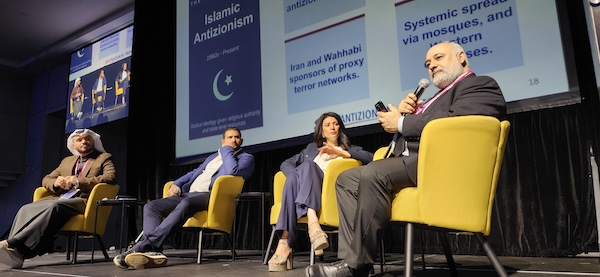
At the first World Symposium Against Antizionism, left to right: Jacob Smith, Eyal Jacoby, Nick Matau and Anastasia Zorchinsky. (photo by Dave Gordon)
The first World Symposium Against Antizionism took place on May 17 in Toronto, with some 30 speakers, from educators and lawyers to influencers and politicians and other activists in the pro-Israel space.
Ben Shapiro, an American pundit and broadcaster, told the thousand people gathered that “antizionism is evil, it is wrong, it is predicated on lies, and it requires violence to achieve the ends it seeks.”
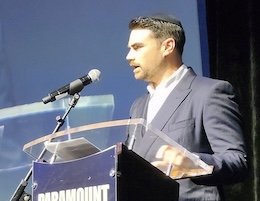
He said, “Antizionism argues that the Jewish state of Israel, a thing that … exists in the world today and has 10 million citizens, some two million of them Muslim, another 200,000 Christians, should be destroyed; that Israel ought to be treated unlike any other country, because Israel is somehow uniquely evil.
“Now, in order to make that case, antizionists must lie…. The antizionists must claim that Israel is an apartheid state, despite the citizenship of two million Arab Israelis…. The antizionist must lie that Israel discriminates against Christians and Muslims, despite it being the only state in the Middle East that provides the highest level of rights to both.”
He added: “the people who argue that Israel ought to be eliminated are antisemitic, for whatever that’s worth. They believe that Israel ought to be destroyed and, to accomplish that purpose, they lie incessantly, and then they spread the biggest lie of all – that global Jewry has bamboozled the population, taken over the institutions and used its magic mind lasers to control the world.”
The symposium was produced by Tafsik Organization and Stop Antizionism.
Syrian-born Rawan Osman, who has a large following with her online advocacy, shared the stage with fellow Arabs United Arab Emirates-based Loay Alshareef and Damascus-born Abraham Hamra, who lives in New York.
Years ago, before befriending Jews in France, she said she was “one of Hezbollah’s biggest fans,” someone who “hated the Israelis, the Zionists and the Jews, and I repeat the three terms because, in the Arab world, we do not make a distinction between the three.”
Growing up in Lebanon, Osman saw the “bombardment” of indoctrination against Jews. That same hatred has been spread in the West, she told the Independent. Her “red line” for engagement is anyone who “justifies or denies Oct. 7.”
“Because they are so deeply indoctrinated that they cannot summon any sympathy for the Israelis, including children … I will not go that close, and I’ll let others fight them,” she explained. “I would rather focus on something else. The same way I think many Jews would not have a conversation with someone who denies the Holocaust, especially if they are descendants of Holocaust survivors.”
She drew a sharp contrast with Abraham Accord countries, like UAE, where their culture has “taught children to tolerate others, to be accepting. You, as a Jew, are safer wearing a kippah walking in Dubai and Abu Dhabi than you are in Paris and in London,” she said.
Lebanon-born Gad Saad, a former professor at Concordia University and author of Parasitic Mind and Suicidal Empathy, argued that antisemitism “in a sinister way, is akin to the immune system, and that it so evolves into new variants of Jew-hatred.” In modernity, that means Jews are blamed for open borders that let in rapists, profiting from the COVID vaccine, and even poisoning the minds of sharks, he said.
Toronto lawyer Leora Shemesh shared the stage with American law experts Matthew Schweber, Rona Kaufman and Mark Goldfeder (via Zoom). Shemesh noted that certain small groups in the country have been attempting to mainstream antizionism. “We have an entire political party, the NDP, that ran on a platform of being antizionist,” said Shemesh. “A Jewish guy, Avi Lewis, ran on that platform, and he joined forces with Independent Jewish Voices of Canada, and they have attempted, and have been somewhat successful, to intervene in certain cases.”
Montreal-based Anastasia Zorchinsky, a Concordia Student Union councilor and co-founder of StartUp Nation Montreal, an Israeli organization at Concordia and McGill universities, moderated the panel called NXT GEN: Future Advocates.
“We really try to do lots of events that collaborate between different cultures, so I think the first step is really to take that step to reach out to those other communities,” she told the JI of her organization’s educational initiatives. “If we just approach people with the thought, with the optimism, that, yes, they will accept us or, maybe, they don’t have to agree, but we can still talk, then maybe that’s something that we should keep in mind.”
Dave Gordon is a Toronto-based freelance writer whose work has appeared in more than 100 publications around the world. His website is davegordonwrites.com.