Skip to content
  • Home
  • Subscribe / donate
  • Events calendar
  • News
    • Local
    • National
    • Israel
    • World
    • עניין בחדשות
      A roundup of news in Canada and further afield, in Hebrew.
  • Opinion
    • From the JI
    • Op-Ed
  • Arts & Culture
    • Performing Arts
    • Music
    • Books
    • Visual Arts
    • TV & Film
  • Life
    • Celebrating the Holidays
    • Travel
    • The Daily Snooze
      Cartoons by Jacob Samuel
    • Mystery Photo
      Help the JI and JMABC fill in the gaps in our archives.
  • Community Links
    • Organizations, Etc.
    • Other News Sources & Blogs
    • Business Directory
  • FAQ
  • JI Chai Celebration
  • JI@88! video

Recent Posts

  • Zionism wins big in Vegas
  • Different but connected
  • Survival not passive
  • Musical celebration of Israel
  • Shoppe celebrates 25 years
  • Human “book” event
  • Reclaiming Jewish stories
  • Bema presents Perseverance
  • CSS honours Bellas z”l
  • Sheba Promise here May 7
  • Reflections from Be’eri
  • New law a desecration
  • Resilient joy in tough times
  • Rescue dog brings joy
  • Art chosen for new museum
  • Reminder of hope, resilience
  • The national food of Israel?
  • Story of Israel’s north
  • Sheltering in train stations
  • Teach critical thinking
  • Learning to bridge divides
  • Supporting Iranian community
  • Art dismantles systems
  • Beth Tikvah celebrates 50th
  • What is Jewish music?
  • Celebrate joy of music
  • Women share experiences 
  • Raising funds for Survivors
  • Call for digital literacy
  • The hidden hand of hate
  • Tarot as spiritual ritual
  • Students create fancy meal
  • Encouraging young voices
  • Rose’s Angels delivers
  • Living life to its fullest
  • Drawing on his roots

Archives

Follow @JewishIndie
image - The CJN - Visit Us Banner - 300x600 - 101625

Keys to healthy marriage

Last month marked my 15th wedding anniversary. Every year has felt significant, but 15 has a somewhat mystical overlay. The Hebrew equivalent for 15 would normally contain two of the four letters of the tetragram spelling God’s name (yud and heh), so there is a different customary formulation: “tet vav” or tu, for short. Sprinkle in some multilingual word play, tu being “you” in French, and “to” in English connoting a mutual connection, and 15 is rife with meaning.

This anniversary has also prompted me to consider what goes into a lasting marriage. I began my mental search by polling those of my Facebook friends who’ve surpassed the 15-year mark. Trust. Communication. Acceptance. Humor. Generosity. Patience. Commitment. Common values. Mutual respect for one another’s journey through life. One friend offered the idea of love, as measured by actually enjoying listening to what the other person has to say. Curiously, no one mentioned sex.

There is an inherent catch here, of course. How can we know which of these many laudable qualities are signs of a healthy marriage, and which are prescriptions? In other words, can a troubled marriage be saved by adopting these practices, or do these practices simply flow, automatically, from a solid union?

Some friends did offer some potential advice. Date nights, even if it involves watching a movie on the sofa with take-out after the kids are in bed, one friend said. Another emphasized how important it is not to “keep score.” Where sometimes partners fall into the trap of believing that “reciprocity has to be quantitatively balanced over a short period of time,” she said, it’s better to think of the “partnership as rooted in generosity and mutual caring.” She added that it’s important for the couple to shed external expectations, whether they come from televised images, societal norms or embedded ideals with which one was raised. That imaginary third party’s judgmental voice can intrude on a couple’s relationship in unhealthy ways. At a dinner party I attended, one woman emphasized kindness. Her husband said it’s important to park one’s ego.

And what do the experts say?

A recent article in The Atlantic by Emily Esfahani Smith profiled a team of researchers who study lasting partnerships. Noting how partners engage in moment-to-moment “bids” for attention, the research team – led by John Gottman – stressed that how the partner responds to these bids is key to the marriage’s success. As Smith describes it, “People who turned toward their partners in the study responded by engaging the bidder, showing interest and support in the bid. Those who didn’t – those who turned away – would not respond or respond minimally and continue doing whatever they were doing, like watching TV or reading the paper.”

This “turn toward” philosophy can also fall into the causality trap. Is “turning toward” a function of a healthy marriage, or a prescription for one? The answer is probably both. But that doesn’t mean that a virtual cycle can’t be consciously created. Over the past several weeks, I’ve been practising “turn toward” and discussing it with whoever will listen, my husband included. My husband and I are now in the habit of “turning toward” more than we sometimes have been in the past.

We even joke about it as we’re doing it, a subtle way of reinforcing the mental links between intention and action.

As for our anniversary, we did something we never get to do anymore: catch a film after work. We saw Boyhood, the tour de force of Richard Linklater, who spent 12 years filming using the same actors. Over the course of two and a half hours, we witnessed the on-screen children developing into adults, and parents struggling to find their way. On the subject of marriage, the film was more bitter than sweet, but we enjoyed it, admiring the director’s fortitude and creativity, and privately reflecting. When we returned home, we discussed the film over a glass of wine, and concluded the evening by “turning toward” one another as one shared with the other some newly discovered National Public Radio podcasts, episodes devoted to love, loss and longing.

Mira Sucharov is an associate professor of political science at Carleton University. She blogs at Haaretz and the Jewish Daily Forward. This article was originally published in the Ottawa Jewish Bulletin.

Posted on September 5, 2014September 3, 2014Author Mira SucharovCategories Op-EdTags John Gottman, marriage, Richard Linklater
This week’s cartoon … Sept. 5/14

This week’s cartoon … Sept. 5/14

For more cartoons, visit thedailysnooze.com.

Format ImagePosted on September 5, 2014September 3, 2014Author Jacob SamuelCategories The Daily SnoozeTags cookie monster, thedailysnooze.com
Fill your (ice) bucket!

Fill your (ice) bucket!

I recently returned from Detroit, Mich., where I was the Team Vancouver-Galil Delegation Head at the JCC Maccabi Games (shameless plug: www.jccmaccabigames.org).

While there with my 22 teen athletes and artist, the ALS Ice Bucket Challenge was growing momentum faster than a rumored Robert Downey Jr. sighting at Comic Con.

To clarify for those living in the dark ages, the ALS Ice Bucket Challenge asks nominees to chose between donating $100 to ALS research or dump a bucket of ice water over their head. Each participant then nominates someone(people) else to accept the same challenge – with 24 hours to act.

The more dumping I saw around Maccabi Land – and the more I saw posted online – the more criticism I began to hear that challenged the validity and purpose of dumping ice on one’s head in the name of a good deed.

I admit, when I first came across the challenge on Facebook I commented, “It is great to see exactly what lengths folks will go to avoid donating money to charity.”

However, as I saw it pop up again and again, growing in epidemic numbers, I started to see the value in the endeavor. Awareness was growing and ALSA.org was receiving more donations in a week than they had previously collected in a year.

By the time the JCC Maccabi Games came along it was rampant. Everyone and their dog (literally) was being challenged and the kitchen at the JCC in West Bloomfield was struggling to make ice fast enough.

By the time I returned home Facebook became flooded with articles like THIS ONE by Scott Gilmore in Maclean’s Magazine suggesting that the cute marketing gimmick (which actually didn’t get initiated for that purpose) was a “horrible reason to donate.”

Gilmore presents a several valid points about ALS research not meeting the top standards of the three factors one should consider when choosing where to send their limited charitable dollars. It is argued ALS doesn’t present the largest need – it is classified a rare disease, ALS research wont offer your dollars the greatest influence and ALS is hardly the most urgent problem in the world today.

Another post on iflscience.com provides an info-graphic on which diseases cause the most deaths in the USA vs where Americans focus their donations. These posts are no-doubt littered with wise words and offer a valid sense of awareness on their own.

However, this is nothing new. iflscience.com‘s info-graphic is not based on facts that have come out just since the Ice Bucket Challenge kicked off.  For various reasons – the largest of which is simply due to marketing successes and failures – rare and unique diseases have pulled in a larger piece of the philanthropic pie than the actual leading causes of death, like heart disease or diabetes.

What frustrated me with the timing of these articles is that, at least in the case of the ALS Ice Bucket Challenge, it is about much more than just targeting American donor dollars. Watching people all over the world connect, bond, laugh and share in the name of something good was a blessing that, quite frankly, we don’t see enough of. Watching my kids – and all of my friends’ kids – get in on the action felt like humanity took a deep breath of fresh air amid a time in which the globe has been filled with muck and tragedy.

Maybe ALS research got lucky that a clever gimmick came along and helped their cause. And maybe ALS isn’t the charity most in need today. But in the ALS Ice Bucket Challenge humanity got a win! Stop finding ways to take that away from us.

Format ImagePosted on September 2, 2014September 3, 2014Author Kyle BergerCategories It's Berger Time!
Israel trip inspires choreographer

Israel trip inspires choreographer

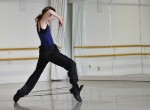
Crystal Wills in rehearsal for The Way They Walked Through the World. The work includes the use of more than 300 pairs of army boots. (photo by Christie Wood)

The female experience of war. This part of the description of choreographer Caitlin Griffin’s The Way They Walked Through the World – a contemporary dance piece set to première at the Scotiabank Dance Centre’s open house on Sept. 13 – particularly intrigues me.

Despite the number of conflicts taking place around the world, images of women are few and far between, except for the odd photo, in which the subject(s) is either screaming out in anguish or quietly wiping tears in mourning. Other images come to mind with more thought, but not many, and words also have fallen short in helping me understand my feelings about the violence in general, but my concern and sadness over the situation in Israel specifically. Perhaps a dance performance, its physicality, its abstract nature, will allow me to process some of the emotions that have, to this point, eluded identification, expression.

I have known Griffin for several years. I don’t know her well, but well enough to know that she is a very talented dancer and teacher – and a mensch. When she told me that she was applying to a program at Kibbutz Contemporary Dance Company, I was thrilled. When she came back from five months in Israel with a new work in progress, one inspired by her time there, I knew I would want to see it once it was ready to be shared publicly. Fortunately, while I missed an earlier version that was performed at the Firehall Arts Centre’s BC Buds showcase in May, a good friend attended. She was impressed, not only with the performance, but with Griffin; so much so that she connected me to Griffin, not knowing that I already knew her. When I asked Griffin to send me some information on The Way They Walked, she included the following:

“The preliminary movement vocabulary [for the work] was created there [in Israel], as a personal answer to the questions I began to ask myself after seeing armed conflict in a new immediate perspective. I was inspired by the maturity of the young Israelis preparing to serve, and by the strength of Israeli mothers whose realities included the conscription of their children. I was struck by the intense beauty of life framed by conflict.”

It was only weeks later that Israel and Hamas went to war.

“The current conflict has definitely hit close to home for me, as I still have several friends living in Israel who send updates regularly,” shared Griffin in a recent interview with the Independent. “The changes that have happened within the work aren’t at all to do with the content … or message of the work, but a general change in tone – almost a sadness, a level of more raw exposure. I think the work has lost a bit of its naivety.”

photo - Kibbutz Ga’aton, where KCDC’s International Dance Village is located
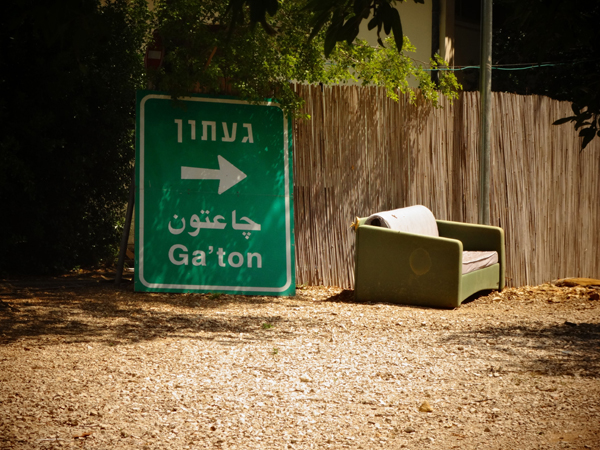
Kibbutz Ga’aton, where Kibbutz Contemporary Dance Company’s International Dance Village is located. (photo by Caitlin Griffin)

The Way They Walked has been an ongoing project since Griffin was in Israel in the first part of 2013.

“Some of the solos that are featured in the show in its current form were created from single images that came to me while living on the kibbutz,” she said, referring to Kibbutz Ga’aton, where KCDC’s International Dance Village is located. “Most of the imagery in the work was born in the studios after long days of rehearsals, while processing the overwhelming stimuli of my new surroundings. It has taken many months to explore those images and find out what was so intriguing to me about them. It’s been a process of uncovering what happens before and after these images in the dance, and how to frame them to resonate with an audience.”

Griffin, who is not Jewish, discovered KCDC online, and applied to its Dance Journey (Masa) program, which, explains the website, offers dancers 18-35 years old from around the world the “opportunity for professional development while dancing side by side with KCDC dancers [and] learning from one of the leading dance companies in the world.”

“I learned about the long-term immersive environment available to young performers and decided it was something that fit what I was looking for creatively and personally,” she explained. “I began writing grants and researching ways to make it a possibility. It took just over a year to gather the necessary resources, and to heal a broken foot I had sustained in the meantime. In 2012, I was awarded a professional development grant to attend the program from the British Columbia Arts Council. I successfully wrapped up a crowd-funding campaign that brought over 65 individuals and in-kind corporate sponsors together and, a few short months later, I was on a plane to Tel Aviv.

“I attended the program from February 2013 to June 2013, along with 24 other young artists from across the globe. The experience of living in the Galilee Dance Village, surrounded by other equally passionate and determined artists has changed everything for me. The friends I made continue to support me personally and professionally. In fact, much of the rehearsal footage from The Way They Walked has made its way to these friends – in Mexico, in Italy, in the U.S., who have all informed the direction of this work and inspired pieces of it along the way.”

Performing in The Way They Walked are Delphine Leroux, Crystal Wills and Heather Dotto. Griffin first worked closely with them in 2011, when MOVE: the company performed in the 13th International Festival of Dance and Music in Bangkok, in celebration of 50 years of Thai-Canadian relations.

Leroux, Wills and Dotto “have been absolutely integral” to The Way They Walked, said Griffin. “These are some of the most supportive and lovely artists I have had the pleasure of sharing a studio with. To date, my professional choreographic experience has been exclusively creating on myself, which is an entirely different process than directing three dancers of world-class calibre. Each of them has contributed not only their artistic expertise to the process, but has shared ideas about the work that have informed its direction. They have breathed life into something that at one time was an idea and some simple movements and pictures in my head.”

The Way They Walked has undergone several phases of development so far.

“We are currently working under Restless Production’s Project CPR5, which is a choreographic research opportunity run by Claire French, providing rehearsal space and guidance to emerging choreographers,” said Griffin, describing French as “an invaluable mentor during this process, and it is with her whom we have been working the most closely.”

In addition to the show at the Firehall, the group also had rehearsals in May and June through the Dance Centre’s 12 Minutes Max program.

Griffin said the piece will continue to evolve, as long as she feels there’s something to say with it. “I am thrilled to have the opportunity to showcase the work at this phase and will be welcoming audience feedback from the Dance Centre open house event in September to take on into the next, yet-to-be-determined developmental phase,” she said. “My hopes are that audience members can find something to relate to, coming from inside the work. Whether it’s reacting directly to a dancer’s actions, an image we create, a sound, a relationship between the dancers. To give people a chance to escape even for a moment into an atmosphere that we created would be a big success.”

Griffin, who was born in Toronto, grew up in Oakville, Ont. Dancing since the age of 4, she said she “realized it was a career option around 13 years of age.” Her family was “extraordinarily supportive … instilling in me the ideals of equality, family, hard work and creativity.”

“I have given some consideration to returning to a more traditional academic path, but honestly have never been fulfilled in the same way with any of my brief explorations into other fields. My passionate curiosity lies within the processes of performing, creating and teaching dance.”

“I had considered alternate careers and educational opportunities,” she admitted. “After graduating from high school with outstanding academic excellence, I deferred my acceptances from the science programs at Queen’s University and a scholarship from Guelph University to pursue my continued dance training with the Goh Ballet Academy in Vancouver. I have given some consideration to returning to a more traditional academic path, but honestly have never been fulfilled in the same way with any of my brief explorations into other fields. My passionate curiosity lies within the processes of performing, creating and teaching dance.”

Griffin was among the performers at the opening ceremonies of the 2010 Olympic Games. In rehearsal, she said, “Witnessing k.d. lang’s ‘Hallelujah’ to a near empty stadium in the days leading up to the event was hauntingly beautiful, and is one of my most treasured memories.” Another is teaching a ballet class to her peers in the Masa program, “with several of the KCDC company members in attendance. This is a teaching highlight for sure, though I have many highlights from my teaching career that are simply moments of understanding lighting the faces of my students. When I can teach someone that dance and well-being can go hand in hand, that’s a highlight.”

As to the future? Following the performance at the Dance Centre open house, Griffin said, “I will be headed to Montreal to dance with Les Grands Ballets Canadiens de Montréal’s annual production of Casse-Nosisette. In December, I will be accompanying Team Canada West to Poland for the International Dance Organization’s World Dance Championships. I’m not sure what’s in store after this, but I’m excited to find out!”

***

The Way They Walked Through the World premières as part of the Restless Productions CPR5 showcase at the Scotiabank Dance Centre’s open house on Sept.13, at 4 p.m., in conjunction with other performances. Updates on the work can be found at facebook.com/caitlingriffincpr5.

Format ImagePosted on August 29, 2014August 28, 2014Author Cynthia RamsayCategories Performing ArtsTags Caitlin Griffin, Israel, Kibbutz Contemporary Dance Company3 Comments on Israel trip inspires choreographer
Jewish flare at Fringe Festival

Jewish flare at Fringe Festival

Naomi Steinberg debuts Goosefeather. (photo from Naomi Steinberg)

The Vancouver Fringe Festival starts next Thursday, Sept. 4, and runs until Sept. 14. There are many shows from which to choose and five of which, at least, include members of the Jewish community. In order of first appearance, here are the highlights of those five shows, garnered from their press material:

photo - Beverley Elliott premières … didn’t see that coming
Beverley Elliott premières … didn’t see that coming. (photo from the production)

HappyGoodThings presents the première of … didn’t see that coming, Beverley Elliott’s funny and moving collection of autobiographical stories that take the audience on a romp from small-town Ontario to Vancouver’s gay bars and red carpets. Directed by Elliott’s friend and colleague of 30 years, Jessie Award-winner Kerry Sandomirsky, who has been close by holding the tissue for many of these life-changing events, musical direction is by Bill Costin.

Inspired by her live performances at the Flame, her writing group Wet Ink Collective and years of entertaining crowds gigging in various bands in a parade of bars, … didn’t see that coming reveals unexpected blessings and uncomfortable epiphanies. These range from catching a bouquet, being called Smelly Elliott, attending a Guess Who concert, growing up with Presbyterian morals, a generous Greek admirer and a yellow dress, the highs and lows of singing at weddings and funerals, relationships with straight men going nowhere and relationships with gay men going to the grave – all held together with the galvanizing salve of songs, the lifeboat of music.

… didn’t see that coming takes place at Performance Works on Granville Island, 1218 Cartwright St., with the first show (of six) on Sept. 5 at 6:45 p.m. For more information on Elliott, visit beverleyelliott.net.

***

Naomi Steinberg’s debut performance of Goosefeather will be at the Fringe, after which she will set off to go around the planet with no airplane, carrying the story in which she weaves together traditional storytelling with movement and clowning to tell you about the time her grandfather sent her on a wild goose chase in the south of France.

Steinberg is an accomplished performer, storyteller and site-specific installation artist. With more than 13 years experience, she knows how to seduce audiences through a provocative mix of political thought and artistic content, telling her stories in a unique voice, with an evocative gestural language.

Past highlights of her work include storytelling events in Jerusalem, Ramallah, Paris and Zurich, among others. Steinberg was the artistic director of the Vancouver Society of Storytelling from 2009-2014, steering large-scale community engagement initiatives and producing three international festivals. Grants awarded include from the City of Vancouver, B.C. Arts Council and Canada Council for the Arts.

Goosefeather begins its nine-show run at the Toast Collective, 648 Kingsway Ave., near Fraser and 16th, on Sept. 5, 8:30 p.m.

Following the Fringe performances, Steinberg heads down the West Coast to board a cargo ship in Los Angeles. She will arrive in Melbourne, Australia, near the end of December, completing the first leg of her journey around the planet. See goosefeather.ca for more information about the project.

***

photo - Charlie Varon’s new solo show is Feisty Old Jew
Charlie Varon’s new solo show is Feisty Old Jew. (photo from Tangeret via Charlie Varon)

Charlie Varon brings his new solo show, Feisty Old Jew, to the Vancouver Fringe. Feisty Old Jew is a fictional comic monologue about a 20th-century man in a 21st-century city. At age 83, here’s what Bernie hates: yoga studios, tattoo parlors, boutiques of all kinds, $6 cups of coffee, young techies and what they’re doing to San Francisco.

The story takes place entirely on one hot October day. Bernie gets tired of waiting for a cab, sticks out his thumb and is picked up by three 20-somethings in a Tesla with a cappuccino maker in the dashboard and two surfboards strapped to the roof. By the time they get to the beach, Bernie has convinced the kids to let him surf for the first time in his life, and bet them $400,000 that he’ll ride a wave.

Varon has been making theatre for 23 years at San Francisco’s Marsh Theatre, in collaboration with director David Ford. In addition to Feisty Old Jew, his other shows include Rush Limbaugh in Night School (1994), The People’s Violin (2000) and Rabbi Sam (2009). Of Feisty Old Jew, Varon says: “This is a show about a city in flux. When I moved to San Francisco in 1978, my rent was $70 a month. Now people pay $70 a month just for lattes.”

The Fringe presents six performances of Feisty Old Jew, beginning Sept. 5, 8:45 p.m., at Performance Works. To read a Q & A with Varon about the show, visit goo.gl/doYJ7h; more information at charlievaron.com.

***

photo - Lynna Goldhar Smith directs Dirty Old Woman
Lynna Goldhar Smith directs Dirty Old Woman. (photo from Loretta Seto)

As part of the Vancouver Fringe, Dirty Old Woman Artists Collective presents Dirty Old Woman, a new play by Loretta Seto, directed by Lynna Goldhar Smith.

After her divorce, Nina, a 50-something-year old, decides to venture back into the world of romance. But when she meets Gerry, 20 years her junior, the sparks fly in more ways than one. Judgments, double standards and comedy ensue, as Nina tries to navigate the dangerous world of dating a younger man.

Dirty Old Woman stars Jessie Award-winning actors Susinn McFarlen, Robert Salvador, Emmelia Gordon and Alison Kelly; with lighting design by Michael Schaldemose, sound design by Dylan McNulty. It will have six shows at Studio 16 (1555 West 7th Ave., between Fir and Granville), starting Sept. 6, 6:15 p.m. For more information about the show, visit dirtyoldwomanplay.wordpress.com.

***

From the twisted mind that spawned South Park and Book of Mormon, Trey Parker’s Cannibal! The Musical comes to the Vancouver Fringe Festival.

Cannibal! The Musical is the true story of the only person convicted of cannibalism in America – Alferd Packer. The sole survivor of an ill-fated trip through the Rockies, he tells his side of the harrowing tale to news reporter Polly Pry as he awaits his execution. While searching for gold and love, he and his companions lost their way and resorted to unthinkable horrors … with music!

It’s unique every time. Originating as a film, the licence includes no script, only a guide, so each production really is a new show. Care is taken to preserve those fundamental elements to please the cult following, but the rest is up for grabs. The blended offering in this year’s Fringe includes a human campfire, a tribe of Amazon war princesses, a multi-media format with animation, a giant Cyclops, a lesbian biker gang of fur trappers, puppets, a massive saloon fight, some cross-dressing and sexual confusion, the classic “Shpadoinkle” and “Hang the Bastard” musical numbers, offensive language, a human horse and, of course, a healthy helping of gore and cheese.

For this, its fifth year in a row at the Vancouver Fringe, Awkward Stage Productions presents another all youth cast, crew and band of emerging stars aged 14 to 25 who are eating up these roles! There will be eight shows, the first being on Sept. 6, 7:15 p.m., at the Firehall Arts Centre, 280 East Cordova St.

***

For the full Vancouver Fringe schedule, ticket and other information, visit vancouverfringe.com or head down to the box office at 1398 Cartwright St. (after Sept. 1).

Format ImagePosted on August 29, 2014May 5, 2025Author Vancouver Fringe Festival press materialCategories Performing ArtsTags Beverley Elliott, Charlie Varon, Lynna Goldhar Smith, Naomi Steinberg, Vancouver Fringe Festival
Hundreds unite to stitch Torah

Hundreds unite to stitch Torah

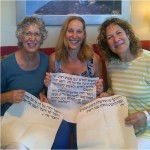
Sisters Brenda Silver, Susan Rubin and Mimi Wolch are among the hundreds who will contribute to the Torah Stitch by Stitch project. (photo by Phillip Silver)

A new Torah scroll is in the making. The brainchild of Temma Gentles, Holy Blossom Temple’s artist-in-residence in Toronto, the project originated from a chance encounter Gentles had with Marilynne Cass a year ago.

Gentles, an award-winning Judaic textile artist, is the artistic director of Torah Stitch by Stitch (TSBS), while Cass is the project’s executive coordinator.

“I fell in love with the concept and have thoroughly enjoyed seeing this dream turn into a reality,” said Cass about accepting Gentles’ invitation to join the team when the project was just beginning.

Gentles came up with the idea while on sabbatical in Israel several years ago, when seeking a way to help people engage in the words of Torah. As a textile artist, she envisioned creating a cross-stitched Torah.

“Temma chose cross-stitch because it’s a universally known craft that has been traditionally taught to young girls around the world for adorning clothing and household items,” said Cass. “It was also often the way in which girls learned their letters and numbers. While it’s a simple skill to master, it can still produce amazingly beautiful pieces of work. Using cross-stitch for TSBS has been an inspired choice, as it has allowed people from around the world to work together on a single project.”

Gentles designed a new font for Hebrew letters and divided the entire Torah into 1,463 four-verse segments for people to work on. TSBS participants range from men and women in their teens to those well into their 90s, from skilled stitchers to novices.

“There is no skill test to pass,” said Cass. “The only requirement is that each person commits to following the stitching graph correctly, complete their canvas in a timely manner and treat the work with respect.”

TSBS stitchers come from many different religions – from Judaism to Christianity, Buddhism to Islam. “Even though we’re doing the Torah (the Five Books of Moses), this isn’t an exclusively Jewish project,” said Cass.

“The Torah is the basis of three of the world’s major religions and TSBS has universal appeal,” she added, noting the project includes avowed atheists and the mother superior of a convent. “Everyone is welcome,” said Cass. “In fact, we’re actively looking for more Muslim stitchers.”

While many TSBS stitchers are from the Toronto area, the project has spread throughout Canada.

“I found out about this project from my sister, Brenda Silver, who met the artist through her synagogue in Toronto,” said Susan Rubin, chief financial officer of a downtown Vancouver junior mining company, who resides on the North Shore. “Both of my sisters volunteered to do panels, so I decided to sign up for a panel, too.”

Rubin paid $18 to cover the kit cost and received the template for the verses, the fabric and the embroidery threads in the mail. “At first, it was difficult to figure out how to start, but soon I got the hang of it,” she said. “I hadn’t done any cross-stitching for about 40 years, but it’s not that difficult. I worked on the cross-stitching at night, doing an hour here and an hour there. After about six months, it was done. It was very satisfying work and fun to do.”

Gentles asked Rubin to be more involved in the project and asked whether she would like to be a coach. “I was pleased to take a position,” said Rubin. “I’m one of many volunteers assisting Temma. Some volunteers are helping people with the stitching, while others are helping to compile the finished panels.”

image - The display for the Torah scroll has been designed by Phillip Silver
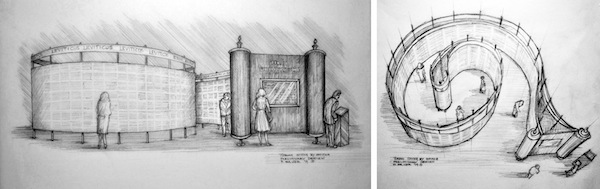
The display for the Torah scroll has been designed by Phillip Silver. (illustration by Phillip Silver)

Rubin is helping keep track of the 700 stitchers. “I assign each stitcher a coach, so they have someone to contact if they run into trouble,” she said. “I also follow up with the stitchers who’ve had their panel for over six months and haven’t yet completed it. If someone cannot complete their panel, we try and find out why and offer help or, if need be, find a volunteer to adopt the panel. It’s important that all panels are complete, so the finished project is the entire Torah.

“It’s been interesting to hear feedback and personal stories from the volunteers. Even though this is a folk art project, there is a spiritual overtone and the stitchers receive great satisfaction in working with the words of the Torah.”

TSBS now has nearly 900 participants in 13 countries, with more applications coming in each week.

“Our ultimate goal is to have all 1,463 panels completed,” said Cass. “We’re more than halfway there.” The books of Genesis and Exodus have been finished, and stitchers are now working on Leviticus.

“We expect it to take another year before all the remaining canvases have been assigned,” she added. “Meanwhile, we’re working on the final details for the display format.”

The display has been designed by Phillip Silver, one of Canada’s foremost stage designers. It will be about 2.5 metres high and nearly 100 metres long. “The finished work will be museum quality and we hope it will be exhibited in several museums,” said Cass. “The goal is to allow people to feel as if they’re wrapped in the Torah.”

The project’s registration form, more information and helpful tips are available at torahstitchbystitch.temmagentles.com.

Rebeca Kuropatwa is a Winnipeg freelance writer.

Format ImagePosted on August 29, 2014August 28, 2014Author Rebeca KuropatwaCategories Visual ArtsTags Brenda Silver, Marilynne Cass, Mimi Wolch, Phillip Silver, Susan Rubin, Temma Gentles, Torah Stitch by Stitch, TSBS

Talking about Israel

In British Columbia, this summer has been among the finest in living memory. Yet, for Jewish British Columbians and for all those watching events around the world right now, the summer has brought a very dark cloud.

It has not only been the terrible violence between Israel and Gaza, but violence elsewhere in the Middle East that is claiming exponentially more lives and causing horrific hardship and inhumanity.

The advance of the so-called Islamic caliphate from Iraq into parts of Syria opens the potential for additional Western military involvement in the region. The horrors that are taking place under the extremist ISIS dictatorship are almost beyond human imagination. In Syria, meanwhile, the death toll from the now two-year-old civil war has reached 190,000.

Despite all this, global attention remains focused on Israel. At the United Nations, Israel is singled out for condemnation, while Hamas is given a pass. Marches in the streets around the world declare Israel a pariah. Violence against Jews and attacks on Jewish institutions worldwide are legitimately striking fear that a generation or more of Diaspora Jews have never experienced.

There really is no silver lining. But, if there were, perhaps it would be that several fictions have been debunked.

Time was, even Zionists accepted the position that “anti-Zionism does not equal antisemitism.” This has been almost a required disclaimer at the beginning of any conversation on the subject for at least the last 15 years. This needs to be revised, however, to recognize that anti-Zionism at least sometimes equals antisemitism. As we have seen in recent weeks, there are those in the anti-Zionist movement who are motivated by anti-Jewish animus, and then there are those who refuse to condemn them. When it comes down to it, the moral difference between the two groups is minimal.

There is also the position that, by definition, anti-Zionism should legitimately be considered a form of antisemitism. After all, Zionism is simply the national representation of the Jewish people. If one is opposed to that, especially while supporting self-determination for every other national identity in the world, it must stem from some intellectual or emotional process that views Jews differently from other people.

There are certainly reasons why a conflict in a place that is holy to several religions should draw an outsized interest from people around the world. Yet, when the global reaction is so extraordinarily imbalanced, something is clearly beyond reason.

We know what motivates at least a significant part of the anti-Israel movement. More words have been spilled on this subject in the past two months than perhaps ever in human history, given the ability of everybody to broadcast their positions via social media. We have been able to see in greater detail the narrative subscribed to by many of Israel’s critics, from well-known commentators to elected officials to ordinary Facebook friends. Overwhelmingly, it is a simple one: Israel is just plain evil and, because its legitimacy and right to exist are explicitly or implicitly denied, its right to defend itself is likewise repudiated.

These are not words that generally come out of the mouths of anti-Israel activists, because they are not palatable to those who would otherwise consider themselves progressive, well-intentioned people. But push has come to shove and, all over the internet and in face-to-face conversations – yes, those still take place sometimes – we have been able to learn more about what a lot of “ordinary” people think about Israel. It has been painful. The conversations have been difficult. Many of us have lost friends.

But it is always better to know than to proceed in ignorance. We have a new understanding of what we are up against. We also have discovered many new friends, and new ways of engaging with those who don’t share our views.

Others in our community have no doubt had similar experiences. Many of us have felt challenged to present our positions with clear heads and hearts, and we invite all readers to contribute to the discussion by sharing their suggestions for continuing this dialogue constructively.

Posted on August 29, 2014August 28, 2014Author The Editorial BoardCategories From the JITags dialogue, Diaspora, Israel
Abargil makes Brave Miss World worth seeing

Abargil makes Brave Miss World worth seeing

Cecilia Peck, left, and Linor Abargil in Princeton, N.J. (photo by Motty Reif)

Former Israeli beauty queen and international cover girl Linor Abargil is a sharply intelligent woman with a cause: survivors of rape. Empathetic yet unsentimental, highly visible but also private, Abargil is a uniquely complicated individual.

Those who have been directly or indirectly affected by rape will have a visceral, positive reaction to Abargil’s story, as depicted in the feature-length documentary Brave Miss World, which is now streaming on Netflix. While Cecilia Peck’s film suffers from a meandering structure, Abargil’s toughness and tenacity provide a steady source of inspiration.

Shortly after she was anointed Miss Israel in 1998, the 18-year-old Abargil went to Milan for some modeling jobs. Preparing to leave Italy and return home a few months later, she was raped by an Israeli travel agent who’d been recommended by her modeling agency.

Abargil escaped with her life by promising the assailant that she would never tell anyone, but quickly reported the crime to Italian and Israeli authorities. When he returned to Israel, he was arrested, tried, convicted and sentenced. (The film marshals allegations that the perpetrator – an Egyptian Christian married to an Israeli woman – was a serial rapist and an ongoing danger to society.)

The film picks up Abargil’s saga many years later, after she’s begun a website (now based at bravemissworld.com/speak-out/share-your-story) for rape survivors to confide their experiences, as well as the ongoing effects of their trauma.

Brave Miss World follows the peripatetic Netanya native from Tel Aviv to Cleveland, Johannesburg, New York, Princeton, UC Santa Barbara and Beverly Hills, where she meets with rape survivors and speaks at charity luncheons. Supplying solace and strength as needed, Abargil offers in-person proof that it’s possible to heal from a sexual attack and lead a satisfying life of unapologetic self-expression.

It’s not always a smooth ride, of course, particularly when Abargil’s rapist is up for parole and she has to confront past events and ongoing fears. Her determination, along with her belief that the failure to prosecute more rapists is an injustice that contributes to the ongoing suffering of survivors, is truly inspiring.

Abargil is a strong-willed, self-confident woman, and it’s always interesting watching her interact with strangers. But the documentary lacks her courage, tiptoeing around anything that might make her less sympathetic and saddling her with dull voice-over narration devoid of the bite of her personality. The omission of any discussion of how young women are objectified in advertising and fashion photography is an especially curious oversight given both Abargil’s extensive career as a model and her outspoken nature.

Brave Miss World was shot over a period of time that encompasses Abargil’s enrolment in law school as well as her abrupt transition from secular to religious Jew, which flummoxes her ever-loyal parents and may unsettle some viewers.

Ultimately, Brave Miss World does a clumsy job of blending a character study with a social-issue documentary. It’s soft-centred, unlike its subject, and largely content to proffer good intentions and a parade of hugs instead of exploring the tangle of issues surrounding rape.

Abargil, however, is a pretty remarkable person who never stops pushing herself beyond the familiar and comfortable. She’s well worth getting to know.

Michael Fox is a San Francisco film critic and journalist.

Format ImagePosted on August 29, 2014August 31, 2014Author Michael FoxCategories TV & FilmTags Brave Miss World, Cecilia Peck, Linor Abargil
Journey across water, time

Journey across water, time

Members of the Gitxaala Nation at the 2014 Qatuwas Festival. (photo by Kris Krug)

Vancouver, Erev Tisha b’Av (Aug. 4): As Jews across North America are preparing themselves for the sombre, mournful fast commemorating the destruction of the holy temples in Jerusalem, Jews in Israel and across much of the world have already begun fasting. We fast to mark the calamities that befell our people on the ninth of Av throughout history, and to acknowledge that we are still living in exile, awaiting the building of the third Beit Hamikdash.

For a moment, imagine that we are in Yerushalayim while the Temple stands and hearing news of a siege of the city. Food is growing scarce and we realize that the walls will soon be breached, and destruction leveled upon us and upon our holiest of places. Invasion, murder and desecration are almost certain. If we survive, we will almost certainly be forced into exile, and our city would be burned along with the centre of life for all Jews, the Holy Temple.

As I sit, I reflect upon our history, my history. I reflect upon 2,000 years of exile, upon the Holocaust, upon the war in Gaza. I wonder what may come tomorrow. Exactly three weeks earlier, I was away from the city, visiting my mother on Denny Island, B.C. I went there to spend time with her, to go fishing with my stepfather and to eat Mom’s cooking. I hadn’t planned on meeting people from other nations that have faced destruction, assimilation and exile also, or to learn from their resolve.

Waglisla, Heiltsuk territory, three weeks earlier (July 15): I stand in the grass under the blazing sun, straw hat on, squinting at the dancers. They wear traditional garb: robes, cedar hats, blankets and paint; they sing. Today is the 17th of Tammuz and I haven’t eaten since the night before. I am at the 2014 Qatuwas Festival, an annual gathering of the First Nations of North America’s West Coast – from Alaska to Oregon, where the nations have traveled by glwa (gil-wah, an ocean-going canoe), some for more than 30 days to reach their destination. Qatuwas, the Heiltsuk word for “people gathering together,” has its roots in 1985 in Waglisla (Bella Bella), when a group of local residents built a glwa to paddle 500 kilometres to Vancouver for Expo ’86. They now make a journey each year to a different nation to build connections, morale, identity and community. Nearly 30 years after Qatuwas began, there are hundreds gathered on the grass field in Heiltsuk territory.

My mother moved to Denny Island about two years ago and I’ve taken the 10-minute ferry to Bella Bella to see Qatuwas for myself. I sit in the shade with Jessica Brown, a beaming, bright young woman from Heiltsuk Nation, who is part of the host committee for Qatuwas. She smiles while she speaks about the festival:

“It’s pretty amazing. Last summer, we left Bella Bella and paddled for 32 days on the water, and stopped at every first nation – for a day in the life of each nation. You can be there for a funeral, or you can be there for a lahal tournament or a powwow. It’s a journey of healing, drug and alcohol free, and it’s supposed to be about resurgence, revitalization.

“Young people on the canoe say that the water is a healing process, from the effects of colonization, continuing and ongoing.”

As I contemplate my physical hunger, my fatigue, I feel connected to my spiritual hunger, our collective desire as Jews to return to the Holy Land, a holy time. At least some of my emotions are shared by the nations celebrating at the Qatuwas Festival. Like us, they have suffered innumerable losses. Spirit, though, as it is with knowledge, faith and hope, can never be taken away from one person by another. They can only be given up.

I leave Qatuwas in peace. The days are long here on the central coast in summer, but the sun is slowly burning towards the horizon. Spirits are high on the ferry back to Denny Island.

Vancouver, Erev Tisha b’Av (Aug. 4): The hour of the fast is nearly upon us. Soon I will get into my car and drive to shul to sit and pray on the floor like in a house of mourning, and mark the beginning of the fast of Tisha b’Av. I have a flash from three weeks prior, when I asked Jessica about the land we stood on at Qatuwas.

“We’re not treaty people,” she said, “and that means that we’ve never given up access to our land. We basically consider ourselves the Heiltsuk Nation, a sovereign nation.”

“Am I in Canada?” I asked with an intrigued grin.

“No, you’re in Heiltsuk territory.”

As Jews across Israel and the Diaspora prepare to mourn on Tisha b’Av, I’m inspired by the strength of our people and by that of the First Peoples of Canada.

Despite the destruction, chaos, hatred and exile, we still hope to be free peoples in our own land. For us, the land of Zion, Yerushalayim. Am Yisroel chai.

Benjamin Groberman is a born and raised Vancouverite. He is a freelance writer, and is pursuing a bachelor of education degree, with aspirations to teach in a Jewish high school. He is a resident of Vancouver’s Moishe House.

Format ImagePosted on August 29, 2014August 28, 2014Author Benjamin GrobermanCategories TravelTags Qatuwas Festival, Tisha b'Av

Importance of prayer

The holy month of Elul has begun, the sixth month in the Hebrew calendar. There is a rabbinic allusion that the month was named from the initial letters of “Ani le dodi v’dodi li” (“I am my beloved’s and my beloved is mine”), describing the relationship between G-d and His people. In the Aggadah, we read that Elul has special significance because of Moses’ 40-day stay on Mount Sinai (Exodus 34:28), which was calculated to have begun on the first of Elul and ended on the 10th of Tishrei (Yom Kippur).

Every weekday morning, the shofar is sounded and Psalm 27 recited. Sephardim have already begun saying Selichot, but Ashkenazim recite this only in the last days of the month. The word selichah means forgiveness – it is a plea for forgiveness for sins and, as we approach the time when we know that we will be judged, we practise a kind of spiritual stocktaking. We look inward, trying to assess what happened to last year’s dreams/goals, asking pardon for wrongs committed and hoping, with repentance, charity and prayers, to be written into the Book of Life for another year.

Rav Nachman of Bratslav expressed it beautifully: “Every word of your prayer is like a rose which you pick from its bush. You continue until you have formed a bouquet of blessings, until you have pleated a wreath of glory for the Lord.”

Prayer takes on special meaning in Elul, as we move toward Rosh Hashanah, which celebrates the birth of the world. Then, we will recite the special prayer called Unetenah Tokef (“Let us proclaim the sacred power of this day…”) when we are reminded of our mortality. The translation for part of it reads: “Humanity’s origin is dust, and dust is our end. Each of us is a shattered pot, grass that must wither, a flower that will fade, a shadow moving on, a cloud passing by, a particle of dust on the wind, a dream soon forgotten…. But You are the Ruler, the everlasting G-d.” Legend has it that this prayer was written some 10 centuries ago by Rabbi Amnon of Mainz. Ordered to convert to Christianity by the local bishop, Rabbi Amnon refused. His limbs were amputated and, as his mutilated body lay before the ark as he was dying, he said these words, which are also part of the Yom Kippur liturgy.

When mystics pray, they believe there is an ascent of the soul to upper worlds. Prayers of thanksgiving and praise are deemed worthier than petitionary prayers (when we are asking for things), because they are selfless. Some people believe that the highest form of worship is silence. The Bible tells us that Abraham was the first to utter a true prayer – for his fellow man.

In these times, when we are at war, agonizing over our losses and the many families who have lost loved ones, we in Israel need to have faith more than ever. We pray for all Jews to have a good, safe year. We share a common destiny – Jews in Israel and abroad – and it is this shared destiny that binds us together, no matter how different our ethnic and cultural boundaries may be.

I memorized the following poem when I was a schoolgirl. I never knew the author, and doubt that he was Jewish, but I think it is appropriate now and all the year: “I shall pass through this world but once / Any good therefore that I can do / Or any kindness I can show / To any human being / Let me do it now / Let me not defer it or neglect it / For I shall not pass this way again.”

Dvora Waysman is the author of 13 books, which are available through Amazon, or from the author at [email protected]. Her website is dvorawaysman.com.


Posted on August 29, 2014August 28, 2014Author Dvora WaysmanCategories Celebrating the HolidaysTags Elul, High Holidays, prayer, Rosh Hashanah

Posts pagination

Previous page Page 1 … Page 632 Page 633 Page 634 … Page 664 Next page
Proudly powered by WordPress