Skip to content
  • Home
  • Subscribe / donate
  • Events calendar
  • News
    • Local
    • National
    • Israel
    • World
    • עניין בחדשות
      A roundup of news in Canada and further afield, in Hebrew.
  • Opinion
    • From the JI
    • Op-Ed
  • Arts & Culture
    • Performing Arts
    • Music
    • Books
    • Visual Arts
    • TV & Film
  • Life
    • Celebrating the Holidays
    • Travel
    • The Daily Snooze
      Cartoons by Jacob Samuel
    • Mystery Photo
      Help the JI and JMABC fill in the gaps in our archives.
  • Community Links
    • Organizations, Etc.
    • Other News Sources & Blogs
    • Business Directory
  • FAQ
  • JI Chai Celebration
  • JI@88! video

Recent Posts

  • Eby touts government record
  • Keep lighting candles
  • Facing a complex situation
  • Unique interview show a hit
  • See Annie at Gateway
  • Explorations of light
  • Help with the legal aspects
  • Stories create impact
  • Different faiths gather
  • Advocating for girls’ rights
  • An oral song tradition
  • Genealogy tools and tips
  • Jew-hatred is centuries old
  • Aiding medical research
  • Connecting Jews to Judaism
  • Beacon of light in heart of city
  • Drag & Dreidel: A Queer Jewish Hanukkah Celebration
  • An emotional reunion
  • Post-tumble, lights still shine
  • Visit to cradle of Ashkenaz
  • Unique, memorable travels
  • Family memoir a work of art
  • A little holiday romance
  • The Maccabees, old and new
  • My Hanukkah miracle
  • After the rededication … a Hanukkah cartoon
  • Improving the holiday table
  • Vive la différence!
  • Fresh, healthy comfort foods
  • From the archives … Hanukkah
  • תגובתי לכתבה על ישראלים שרצו להגר לקנדה ולא קיבלו אותם עם שטיח אדום
  • Lessons in Mamdani’s win
  • West Van Story at the York
  • Words hold much power
  • Plenty of hopefulness
  • Lessons from past for today

Archives

Follow @JewishIndie
image - The CJN - Visit Us Banner - 300x600 - 101625

Creating artistic storm

Creating artistic storm

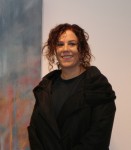
Shevy Levy’s Storm Brewing is at Zack Gallery until Dec. 6. (photo by Olga Livshin)

This month, Zack Gallery is dedicated to abstract art. The exhibition Storm Brewing introduces gallery patrons to an unusual artist, Shevy Levy. Nobody looking at her daring, color-splashed paintings, throbbing with élan, could guess that Levy is an amateur artist. In her professional life, she is the owner of a software company, Lambda Solutions.

“I don’t have a formal art education,” Levy said in an interview with the Independent. “I always liked art and design, painted at school, and my mother encouraged my interest in art. She urged me to take classes, to study, but I was drawn to science, too. When the time came to choose between art and science as a career, I chose science and got a math degree. Much more practical,” she laughed. “But art was always in my life. You could say it is in my blood. I heard that math and creativity originate in the same part of the brain.”

Levy has taken classes with many famous artists, first in Israel, where she was born, and then here, in Vancouver, after her family immigrated. “I’m still learning, still enrolling in art courses. It’s a lifelong study,” she said, “an ongoing journey to learn new techniques and skills, develop them. The better your skills, the wider their range, the more they allow you to express yourself.”

Levy’s visual language consists mostly of colorful abstract compositions. Colors flow and clash, tinkle and thrum like an orchestra, twirl like dance strains and float like snowflakes. “I like nature and colors, not so much shapes,” she explained. “When I paint, I don’t plan. I just want to express myself. What color would fit here? What color should be there? It’s all intuitive. I want tons of energy on my canvases and I pour it out through colors.”

Light and darkness interlink in her paintings as they do in our lives, and in her own life, which hasn’t been easy or straightforward. “We came to Canada in 1993,” she recalled. “My husband retired from the Israeli air force and I took a sabbatical from teaching math. Our children were 10 and 15 at the time. We decided to travel for a year and came here. I did my master’s degree at SFU [Simon Fraser University]. We stayed.”

Of course, it wasn’t that simple. The life of an immigrant is never simple. It requires much time and energy to build a new home in a new country, to integrate into a new culture. There was no time for art.

“I painted a lot while in Israel, but when we came here, I stopped for awhile,” she said. “I started painting again about 10 years ago, and now I don’t see myself stopping. I’m busy with my work, I love it, but I love painting, too. I paint in the evenings and on the weekends. It’s my way to meditate, to relax, a distraction from real life.”

Levy also started taking classes again, and every new class offered a new discovery. “I always thought I had an intuition for colors, how they fit together. Then I took a class on colors at Emily Carr, and it explained so much. It was very helpful to know what the colors mean, alone or in different combinations. It is like there is a conversation of colors in my paintings.”

The sense of communication, of wordless discussion through the paintings comes from the artist’s original approach. “I always paint several pieces at the same time. I can’t do just one. I need continuity, from one painting to another. Sometimes I paint on top of older paintings. It might be beautiful, esthetic, but if there is no ‘umph,’ I have to fix it. I need to see a story in each painting, a conflict, a tension, where color clusters interact with empty space.”

For the current show, the story is all about storms – both in art and in life. “The idea for this show was not only to investigate the storms in nature but also to reflect on what storms make us feel,” said Levy. “We are facing storms all the time in our lives. There are darker clouds and lighter moments. But storms are not necessarily black. I wanted to know how a storm would look in pink. Could it be white? It was an exploration of the theme, and every painting has a title that came from music, from songs. I couldn’t live my life without music. I always put on music when I paint. I love classical music, jazz, rock.”

Like notes that build into melodies, the paintings of the exhibit create a concert of colors on the gallery walls. Some pieces are like symphonies, deep and powerful, while others look like doodles coming alive, buzzing with current and bursting with the artist’s emotions.

Levy seems to be drawn towards the darker spectrum of the palette, where happiness is tempered with concern. “Sometimes I force myself into a ‘cheerful mood’ but generally I think life is darker,” she said. “My sister is going through a serious illness now. Maybe the darkness in my paintings comes from it.”

Storm Brewing opened on Nov. 12 and will continue until Dec. 6.

Olga Livshin is a Vancouver freelance writer. She can be reached at [email protected].

Format ImagePosted on November 20, 2015November 17, 2015Author Olga LivshinCategories Visual ArtsTags Lambda Solutions, Shevy Levy, Zack Gallery
First Israel on Campus event

First Israel on Campus event

Yael Steinberg, left, and Zina Rakhamilova at Israel on Campus’ first event of the year at the University of British Columbia. (photo by Zach Sagorin)

“Often Jewish students on university campuses struggle to express any kind of pro-Israel sentiment. They are intimidated to do so and they don’t have the tools to articulate or engage in productive conversations,” said Ariella Karmel, president of Israel on Campus (IOC) at the University of British Columbia.

Karmel spoke to the Independent after the closing of the IOC’s first event of the year, called Israel Unlimited: Exploring Israel at UBC. Held on Oct. 29, its purpose was to teach effective communication skills and ways to address anti-Israel bias. It was led at Hillel BC by Zina Rakhamilova, StandWithUs Canadian campus coordinator, and Yael Steinberg, Hasbara Fellowships’ West Coast director.

“IOC is a student-run group … relating to Israeli culture, media, food, and we are also a pro-Israel group,” explained Karmel to the approximately 25 attendees. She said the club gives “a platform to engage with Israel” and is a resource for students who want to learn more about Israel.

With the exception of BDS (boycott, divestment and sanction) last year, Steinberg said anti-Israel propaganda on campus is minimal. However, she said, “When situations go down in Israel it becomes a lot more stressful on campus for those Jewish students, who somehow are held accountable for every action the state of Israel might possibly have ever done.… By virtue of Israel being the Jewish state, being a Jewish student means that you are the representative for that.”

Screened at the event was the film Crossing the Line, which, Steinberg explained, “is about when anti-Israel propaganda gets out of hand and crosses into the realm of antisemitism, which even though you may not see huge amounts of it at UBC … this can spring up in a moment’s notice.”

The short film emphasized hasbara (public relations), efforts to spread positive information about Israel, to stand up for Judaism and Israel: “A Jewish person not secure enough in their Jewish identity and [who] doesn’t know enough about Judaism, about Zionism, about Israel is going to be much more exposed, much more vulnerable.”

Rakhamilova warned, “Just because your campus climate is quiet for the most part, apathetic, doesn’t mean necessarily you shouldn’t do any sort of Israel engagement or Israel education because universities … across the country are dealing with BDS and are dealing with anti-Israel activity…. You are not immune to that kind of stuff…. It means you need to find a way to showcase a positive association with Israel.”

Rakhamilova suggested holding events on topics such as Magen David Adom or Israeli humanitarian aid, as a means of “nipping” anti-Israel activity “in the bud before it hits campus,” and “not only being reactive.”

“There are situations when people are allowed to be legitimately critical about Israel,” she stressed, “but there is a distinction between being fair about Israel and when it becomes antisemitic.”

The line between the two can be measured, she said, by the three Ds: demonization, delegitimization and double standard. “That’s how you can pinpoint when this is no longer legitimate criticism of Israel.”

As an example, Rakhamilova offered a chant from the Students for Justice in Palestine: “From the river to the sea, Palestine will be free” – this is delegitimization, she explained, as it is “indicating from the Jordan River to the Mediterranean Sea, so that entire land is Palestine and not Israel.

So, claiming [that] the Jewish people, unique among all national or ethnic groups, have no claim to sovereignty.”

Rakhamilova described the BDS movement as encompassing all three Ds, noting particularly its emphasis only on Israel, and ignoring any other body bringing harm to the Palestinians, as well as ignoring all of the contextual information. “And a lot of the imagery can be looked at to be demonizing towards Israel,” she said.

“What are the real issues? Occupation, excessive force, racism?” Steinberg asked. In addressing any of these issues, she said, “Each anti-Israel message has a corollary pro-Israel message.” Regarding excessive force, for example, “the Israeli government sent the IDF in with foot soldiers to Gaza to eradicate different terrorist cells when they could have sent the air force and turned Gaza into a parking lot because Israel values human life so much and they were trying to protect civilian casualties.”

Rakhamilova gave another example: the assertion that Israel is an apartheid state. “Apartheid is a system of racial subjugation to benefit one race over the other,” she said. “Does that happen in Israel? Do Arab Israelis have the same human rights as Jews in Israel? … Arab Israelis have equal rights in Israel.” She recommended including the message: “Until the Palestinians can accept the right for a Jewish state to exist, peace will be elusive. Peace can only come through mutual recognition and respect.”

In response to a question about how pro-Israel students should handle Jewish students who support BDS in the name of social justice and human rights, Rakhamilova said, “Just because you are Jewish doesn’t mean what you are saying is any less antisemitic,” and whether the criticisms are antisemitic or not can be gauged using the three Ds.

A member of the Jewish Defence League (JDL) asked how to respond to an event such as the one held by the Progressive Jewish Alliance, who hosted Israeli conscientious objector Yonatan Shapira on campus on Nov. 3. Some 125 people attended that event, including about eight protesters.

Rakhamilova began to respond, “When you come in and you look like you are demonstrating against someone’s right to speak….”

“We are demonstrating against their spreading antisemitism and anti-Israel propaganda on campus,” interrupted the JDL member, adding, “We are just giving a positive message.”

Steinberg suggested “not giving the event more publicity,” to which the JDL member countered, “We need to address it.”

Steinberg responded, “When we spoke about going rogue against the Jewish community….” The JDL member interrupted again, saying, “Ignoring it will not make it go away.”

Steinberg said, “By virtue of being a minority, one represents the whole and that’s unfortunate, and it sucks, and that’s racist, and it’s awful, but that’s the way this works. We have no choice but to work together … to figure out the best way to handle anti-Israel activity on campus.”

When asked for alternatives to demonstration, Steinberg suggested writing an op-ed after the fact, “so you can control the messaging,” working with the administration, or sending students to take notes of what has been said to use in the future.

Rakhamilova noted that Hillel or the IOC could take action. “They never do,” contended the JDL member.

The event wrapped up soon afterward. Karmel described it as having been “really productive” and “helpful in improving” the ability of students to effectively communicate pro-Israel sentiments.

Zach Sagorin is a Vancouver freelance writer.

Format ImagePosted on November 20, 2015November 17, 2015Author Zach SagorinCategories LocalTags Ariella Karmel, Hasbara Fellowships, IOC, Israel on Campus, StandWithUs, Yael Steinberg, Zina Rakhamilova
Six Jewish MPs part of Parliament

Six Jewish MPs part of Parliament

New Canadian MPs, clockwise from top left: Jim Carr, Michael Levitt, Karina Gould, Anthony Housefather, Julie Dabrusin and David Graham. (photos from cjnews.com)

The Liberal tide that swept away the Conservative government of Stephen Harper brought in what is believed to be a record six MPs of Jewish lineage – one of whom was appointed to cabinet.

Winnipeg South Centre MP Jim Carr was named minister of natural resources and will have responsibility for overseeing hot-button issues such as the Keystone XL pipeline, as well as Northern Gateway, which the Liberals opposed prior to the election, and Energy East.

Carr, 64, is a former provincial politician in Manitoba and served as president of the Business Council of Manitoba. He was also a founding board member of the Canada West Foundation, a public policy and research nongovernmental organization.

Of the incoming MPs, two hail from Quebec, three reside in and around Toronto, while Carr is the sole Westerner.

At the same time, a handful of prominent Jewish MPs departed the scene. Longtime Mount Royal Liberal MP Irwin Cotler, who served as justice minister and attorney general in earlier Liberal governments, announced his retirement prior to the election. He was first elected in the Montreal riding in 1999.

Conservative MP Joe Oliver, who served as finance minister in the outgoing government – the first Jew to ever hold the position – was defeated in Eglinton-Lawrence, while his Tory colleague, Mark Adler, was similarly ousted in York Centre. Both ridings run along Toronto’s Bathurst Street corridor and are home to thousands of Jewish voters.

In interviews with the CJN, the incoming MPs described their background, their ties to the Jewish community and how their Jewish heritage and being the children or grandchildren of immigrants helped inform their political views.

***

Jim Carr is well aware of the immigrant experience. His family’s experience in Canada dates back to czarist times. Carr is the grandson of immigrants who fled Russian pogroms in 1906.

“They came with nothing – no skills, no money – just a thirst for freedom for their children and grandchildren,” he said in an interview prior to being selected to cabinet.

Carr grew up in a middle-class household in the River Heights neighborhood of Winnipeg. He had his bar mitzvah in 1964 at Congregation Shaarey Zedek.

“I’ve been part of the community all my life,” he said.

He’s also had a rather eclectic career, playing oboe in the Winnipeg Symphony Orchestra, working as a journalist for the Winnipeg Free Press and the CBC, and he was the founding chief executive officer of the Business Council of Manitoba. He also served in the provincial legislature as a critic in the areas of energy, education, urban affairs and constitutional matters.

Outside of politics, he was a founding member of Arab-Jewish Dialogue of Winnipeg, and he calls himself, “a passionate supporter of the state of Israel, which I have visited many times.”

Those life experiences shaped the values that he will bring to Ottawa.

“I can’t separate my values and political views from my identity as a Canadian and as a member of the Jewish community,” he said.

***

Michael Levitt had a traditional Jewish upbringing, just not in a traditional Jewish setting. The incoming MP for York Centre, Levitt attended synagogue and participated in youth groups in his native Scotland, where the Jewish community was small, tight-knit and traditional. It wasn’t until his family moved to Canada when he was a teenager that he was able to partake in the full array of communal activities.

And partake he did. His resumé listing his involvement in things Jewish is extensive. Among the most impactful was his participation in a leadership training program under the auspices of the United Jewish Appeal. “I found it absolutely fascinating,” he said.

He went on to serve as chair of the young adult division of the United Jewish Appeal and assisted in the UJA fundraising campaign, which raises money for a variety of Jewish agencies and for Israel.

He is a founding member of the Canadian Jewish Political Affairs Committee and he co-chaired Liberal Friends of Israel.

For Levitt, a partner and vice-president of business development for the Benjamin Group in Toronto, his Jewish heritage “absolutely” shaped the values he brings with him to Ottawa. Imbued with the spirit of tikkun olam, or repairing the world, he has particular empathy for seniors on fixed incomes, refugees and young people looking for jobs.

Levitt has visited Israel three times in recent years and expects his knowledge of the country will put him in a good position to inform his caucus colleagues about the challenges it faces.

***

Karina Gould calls herself “a fresh voice for Burlington,” her hometown. Although she is “not an active practitioner of Judaism,” she maintains her heritage through the celebration of Chanukah, Purim and Yom Kippur.

Gould is Jewish on her father’s side. Her paternal grandparents were Holocaust survivors from Czechoslovakia. Her grandfather was deported to Theresienstadt, then to Dachau and Auschwitz. Though separated during the war, her paternal grandparents were reunited afterward.

Her father met her mother, who is from Germany, while both were in Israel volunteering on Kibbutz Naot, where the sandals are made. While in Israel, her father visited her grandfather’s lifelong friend, a man who had been left for dead in a pile of corpses, but who had been rescued by her grandfather.

Gould visited Israel on a Birthright trip and stayed longer for a personal visit. Although she doesn’t consider herself a Zionist – “it’s not something that I thought about” – Gould admires the Jewish state.

“Israel is a beautiful country. It’s unique in the world. It has difficult challenges.” She particularly admires the country’s diversity and hopes for a solution that will allow it to peacefully coexist with its neighbors.

Gould believes her family heritage plays a big role in shaping her political values. “My family was accepted and welcomed into Canada after a difficult experience,” she said. “Canadian values of tolerance and diversity were not just important for my family, but for others. Canada provided the opportunity to grow and to thrive.”

***

Before incoming Jewish MPs can play Jewish geography with their colleague David Graham, they might well be better off studying the science of geography, as in maps and charts. That way they’ll be able to find the riding the Quebec MP represents. Graham was elected to represent Laurentides-Labelle, northwest of Montreal in the middle of cottage country and en route to the skiing venue Mont-Tremblant.

His family has lived in small-town Quebec for many years, he said, and his grandmother was an Olympic-level skier in her day. His great-grandfather, Hersh Wolofsky (Wolowski), was founder of Keneder Adler, a Yiddish-language newspaper that served the largely Jewish immigrant population of Montreal in the early 1900s.

Graham, 34, attended weekend Hebrew school as a young boy and today considers himself “a Reconstructionist Jew … culturally very Jewish.”

“I happen to be a Jew who happens to be in politics,” he said. “Jewish culture is a very community-oriented culture by nature. It had an enormous impact on my values,” he said, with the feeling that “community comes first.”

That has led him to champion a number of community initiatives, from promoting free software and calling for better public transportation.

Advocating for his community will be job one when he gets to Ottawa, he said. “My priority is my community.”

Laurentides-Labelle is “a poor riding” with an older population that lacks internet and cellphone connectivity, he said. Getting government to provide infrastructure support is necessary for the future of the area. “How are you going to keep youth if they can’t get the internet?” Graham asked.

As for the Middle East, he said, “I absolutely believe in Israel’s right to exist,” adding that the region is a very complicated place and he would defer to the government leadership in crafting policy in the area. “I have great faith that [Prime Minister] Justin Trudeau knows who to turn to for the best advice.”

***

Julie Dabrusin grew up in Montreal, but moved to Toronto to attend law school. She met a guy, got married and never moved back. Today, she lives in the Danforth area of Toronto and will represent Toronto-Danforth in Parliament.

Growing up, she attended Hebrew school regularly and remembers it as “an important part of my week.”

Her Jewish identity is an important part of her life, as is her feeling of being part of a larger multicultural community.

“What I take from my Jewish background is a lot of study and learning, debate and advocacy,” she said. “That ties into being involved in politics.”

Dabrusin has visited Israel twice, first as part of a CEGEP (a publicly funded post-secondary, pre-university college) program that included volunteer work on a kibbutz and, later, while attending McGill University, on an archeological dig that unearthed a Byzantine church.

“Israel is a beautiful country with a strong and resilient population…. As a mother [of two], I understand Israelis wanting to be safe and secure,” she said.

***

The origins of the family name Housefather are lost in the mists of time but, according to family lore, there was probably an innkeeper or someone who ran an orphanage somewhere in Bukovina, Romania, who adopted the name, or at least the pre-anglicized version of it. But that connection to the Austro-Hungarian Empire is way in the past – all of Anthony Housefather’s grandparents were born in Montreal, as was he. Housefather, who has served as mayor of Cote-St.-Luc since 2005, was recently elected MP in the Liberal bastion of Mount Royal, the seat vacated by Irwin Cotler. The riding has a higher proportion of Jews than any in Canada, he said.

Like his predecessor, Housefather has substantial links to the Jewish community. He attended Herzliah High School and is fluent in Hebrew. He served on the executive of Canadian Jewish Congress’ Quebec region and was part of a group tasked with finding ways to retain young Jewish Montrealers who were leaving for greener pastures.

He also has longstanding ties to the Maccabi movement, with his first exposure to the Jewish sports organization as a teenager attending youth games in Memphis. At the 2013 Maccabiah Games in Israel, he won seven medals, two silver and five bronze, in a variety of masters swimming events.

“Being involved in the community, Jewish and non-Jewish, is an important part of our [family] values,” he said.

Given his role in local government, he sees himself as an advocate for municipal interests at the federal level.

He also considers himself as someone who will speak up for the Jewish community and reflect their concerns over the well-being of the state of Israel.

“I’m passionate about the state of Israel, and I certainly [understand] the security issues [it] faces, given its borders and the narrowness of the country…. I’m pretty well attuned to the policy issues on Israel. We committed in the election that we’d have Israel’s back, and support for Israel is a Canadian value,” he said.

– For more national Jewish news, visit cjnews.com.

Format ImagePosted on November 20, 2015November 17, 2015Author Paul Lungen CJNCategories NationalTags Anthony Housefather, David Graham, Jim Carr, Julie Dabrusin, Karina Gould, Liberals, Michael Levitt
Panelists talk about BDS movement

Panelists talk about BDS movement

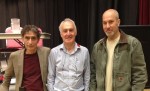
Left to right, panelists Gabor Maté, Michael Barkusky and Yonatan Shapira. (photo by Zach Sagorin)

Independent Jewish Voices-Vancouver hosted A Conversation About BDS (boycott, divestment and sanction) on Nov. 8. IJV’s Martha Roth, moderator of the event, told the Jewish Independent, “The Israeli government propaganda has been so strongly anti-BDS and people are terrified of it.… We wanted to make a safe space for discussion.”

In order of presentation, the four panelists were columnist Dr. Mira Sucharov, an associate professor of political science at Carleton University, who joined the discussion via FaceTime; Yonatan Shapira, a former Israeli rescue helicopter pilot who has become a Palestinian solidarity activist; Michael Barkusky of the Pacific Institute for Ecological Economics, who was born in South Africa and was an anti-apartheid activist during university; and author and speaker Dr. Gabor Maté, a former Zionist youth leader.

The BDS movement (bdsmovement.net) calls for Israel to end “its occupation and colonization of all Arab lands occupied in June 1967 and dismantl[e] the [security] wall”; recognize “the fundamental rights of the Arab-Palestinian citizens of Israel to full equality”; and support “the rights of Palestinian refugees to return to their homes and properties as stipulated in UN Resolution 194.”

Shapira told the crowd: “The BDS movement is a human rights-based initiative calling for equality … end of occupation, end of apartheid situation and to promote the right of return. It is not saying that Israel is the most devilish thing in the world. It doesn’t say what is happening in Syria is better.… It is just a nonviolent practical tool to change the power balance in the situation.”

Maté based his view on the actions carried out in 1947/48, which, he said, “involved massacres … expulsions of large numbers of people from their homeland … demolition of hundreds of villages, the bulldozing of gravestones. Going to Palestine-Israel today is like going to Europe today and looking for a trace of Jewish life.”

He continued, “On top of that now, you have this occupation, this totally illegal occupation… Even if you assume Israel has a right to conquer those lands in 1967…. They never had the right under international law to enter these demographic changes, that’s against the law. To build businesses and economy, that’s against the law. It’s not even controversial.”

The only panelist against BDS, Sucharov said, “I have spoken out, mostly through writing, against BDS … for the reason, I think the end-game is confused.”

While portions of Sucharov’s arguments were inaudible due to technical difficulties, she did make her main points heard. She referenced Prof. Rex Brynen of McGill University, in saying, about the right of return, “repatriation in that case would refer to Palestinians who are still stateless being able and encouraged to return to a Palestinian state, but, in order for that to happen, a Palestinian state needs to come about. So the question is, How to change this tired and bloody status quo that we see right now in order to see a Palestinian state?”

She added, “Instead of boycott, I call for wrestling, grappling and engagement. Instead of shunning, I call for dialogue. Both sides want, if you want to use the binary construct of sides, to play their own game of boycott and shunning and narrowing of the discourse…. The most egregious expression of that has been the academic boycott that has been used to cut off the kind of debate and dialogue we are having today.”

She said, for example, that philosopher and law professor Moshe Halbertal was blocked from speaking at the University of Minnesota on Nov. 3 for 30 minutes by BDS supporters, and that she has witnessed the same shunning of dialogue “within the mainstream Jewish community.”

Shapira later responded to the notion of academic boycott: “Only if the professor is connected and representing an official institution in Israel, then it’s a target for the boycott.… All Israeli universities are connected to the occupation … therefore, if someone is representing them, it’s a target for the boycott.”

About the debate over SodaStream, which was located in the West Bank and employed 500 Palestinians, Sucharov said, “One could certainly view that as a way of propping up the settler project, and we know the settlements are illegal under international law. What was key and what the boycott movement got wrong [is], the owner had stated that if and when there would be a Palestinian state, tomorrow he would seek to keep the plant there and simply pay taxes to the new Palestinian state.” She later added, “This is an example of direct investment that will be essential to help the Palestinian economy in its sovereign incarnation.”

Maté countered, “When you are taking people’s lands, when you build a wall that separates them from their fields, when you make life impossible, when you destroy their economy, when you practise environmental degradation on their whole country, guess what, they are going to be desperate for jobs.” He said SodaStream’s “giving 500 jobs to the Palestinians” was “not an argument against boycott, not an argument against economic pressure.”

Sucharov argued that BDS works against a two-state solution: “Scores of Palestinian, Israeli and joint Palestinian-Israeli NGOs are doing work in the West Bank and Israel. There are many groups seeking to engage the situation. With boycott, one has cut off one’s ability to connect with those activists who seek to engage, to visit Israel, visit the West Bank and try to change status quo.”

Shapira said, “Wake up from this old dream of a two-state solution…. We are intertwined together with the Palestinians whether we want it or not. We have to move on from a conflict between two sides … an occupier force and an occupied, an oppressor and oppressed, a colonizer and native. This is the context and we have to change the mindset.

“It is not, let’s go for a dialogue meeting with Israeli and Palestinian kids. I am not saying I am against dialogue,” but dialogue “will not be what brings the solution … the solution will come when we change the power dynamic.” He said, looking at the audience, that they “were probably a part of struggle to end apartheid…. If you supported boycott back then, you should support boycott now.”

About the use of BDS to end apartheid, Barkusky said, “About 25% of South African civil society wanted the end of apartheid … and my worry is that I don’t think that 25% of Jewish Israelis today are ready for a two-state solution, or certainly not a one-state solution.” Barkusky warned that “any BDS strategy, to be effective, needs to avoid sweeping the centrist majority in Israel into the hands of the right-wing.”

Barkusky was “ambiguous” about BDS. “There are certain, obviously attractive features of BDS. It is accessible when other strategies seem futile and it appears to be nonviolent,” he said. However, he added, BDS “is a collective punishment strategy,” akin to an aerial bombing: “hard to target and collateral damage.” BDS can be “damaging and [destroy] people’s livelihoods,” he said, and it “is not exactly nonviolent: it can crush peoples’ hopes, it can lead to suicide, it can lead to domestic violence.”

Maté said it is a “pipedream to shift Israeli policy by being really nice about it.” When it came to boycott specificities, he said, “If you are only willing to boycott stuff from the occupied territories, boycott stuff from the occupied territories. If you want to boycott everything, boycott everything…. If you want to boycott academia as well, go ahead, I don’t care. Because it doesn’t matter what small, little arguments or details we want to engage in because the overall reality for everybody who has been there … is so horrible and is getting daily more horrible that the insanity is out of control now and only external pressure will do anything about it.”

Shapira said, “You cannot live in peace and security if you are superior over other people in that country. You cannot have the oxymoron of a Jewish democracy. We have to give up this idea, it is not possible.”

Around 80 people attended the event, which was held at the Peretz Centre for Secular Jewish Culture, including professor Rabbi Dr. Laura Duhan Kaplan, interim director of Iona Pacific Inter-Religious Centre at the Vancouver School of Theology. She told the Independent, “There was a significant amount of agreement in the audience and so the questions were not as provocative as they would have been if … most people weren’t left-leaning.”

Zach Sagorin is a Vancouver freelance writer.

Format ImagePosted on November 20, 2015November 17, 2015Author Zach SagorinCategories LocalTags BDS, boycott, Gabor Maté, IJV, Independent Jewish Voices, Israeli-Palestinian conflict, Michael Barkusky, Mira Sucharov, Yonatan Shapira

We stand …. together

There has been an outpouring of grief and solidarity since the terror attacks in Paris a week ago. At some point, though, people began to ask why there was not a parallel response to the terror attack the previous day in Beirut, or the sadly frequent but remarkably similar incidents in various flashpoints in Asia and Africa recently. And what about the ongoing knifings and vehicular attacks against Israelis? Are some victims more important than others? Are some acts of violence more justifiable?

For comfortable people in Western societies, the Paris attacks remind us that violence can come to where we live – even though we don’t live in a place normally associated with such mass killings. Yet losing a loved one is no less painful because you live in a war zone. We should not allow ourselves to become numb to murder simply because of where the victims live, the color of their skin, their religion or nationality.

But current events have become far more fraught because of the perpetrators in Paris. Early reports suggest at least one of the murderers entered Europe amid the throngs of legitimate refugees streaming in recently. This will have damning consequences for the millions of persons displaced by war in Syria, Iraq and elsewhere in the region.

And the violence has reverberated to Canada. A mosque in Peterborough, Ont., was set ablaze, almost certainly an act motivated by a disordered response to events in Paris.

We should stand with victims of violence everywhere, whether in Peterborough, Paris, Lebanon or Jerusalem.

Posted on November 20, 2015November 17, 2015Author The Editorial BoardCategories From the JITags immigration, Paris, terrorism

Limits to free speech

Last week, a Quesnel man was found guilty of criminal hate speech for anti-Jewish postings to his website.

Arthur Topham’s RadicalPress website is packed with the kind of “commentary” you have to read to disbelieve. Many of us imagine we know the sorts of slanders being purveyed in the dusty corners of the internet. You can’t imagine.

In addition to his own material, Topham has made it his side-business to repatriate from the crevices of discarded ideas and republish some of history’s forgotten anti-Jewish hate literature.

Topham was found guilty by a jury under Section 319 (2) of the Criminal Code, which pertains to “Every one who, by communicating statements, other than in private conversation, wilfully promotes hatred against any identifiable group.…” He will be sentenced next year.

The law does not go so far as to demand proof of incitement to injure or kill. Yet, among other gems, Topham’s postings call for “the extermination of Israel and all Jews.” In his defence, Topham’s lawyer insisted his client does not actually hate individual Jews. Indeed, he told court, Topham’s wife is Jewish.

Canada’s hate laws are controversial. Where to draw the line between fair comment in a free society and that which is to be criminalized is a very difficult balance. Generally, it is best to confront hateful ideas in the marketplace of ideas and to give them enough air that we can know they exist, and not drive them underground where they can corrode into even worse words and deeds.

This case was addressed under criminal law and not by the quasi-judicial human right apparatus, which is a far more dubious medium. Limitations on free expression should be limited to the most extreme and egregious offences. Indeed, this is the first criminal conviction for hate speech in British Columbia since 2006, so it is a rebuke that is reserved for the most heinous offences.

A democratic society expresses its values in its laws. Incidents like this, which meet the standard of intolerable expressions of hate, are a message from and to our society about what is fair comment and what is not.

On the whole, however, we prefer that our society express its commitment to equal treatment and cross-cultural respect in the context of our civil discourse – in our education system, in the free exploration of contentious issues, in the vocal condemnation by the many of any egregious offences by the hateful few. And that is what we do. In the most extreme instances, our society has agreed to a legal proscription.

Topham’s case will send a message, although it is already being rejected by his advocates as the demolition of free speech in Canada and as the manifestation of Jewish power.

As a society, we should accept the court’s verdict, but also rededicate ourselves to the promotion of intercultural respect. Comments under the story in the local Quesnel newspaper, almost unanimously of the “Jews control the world” variety, suggest we still have a long way to go.

Posted on November 20, 2015November 17, 2015Author The Editorial BoardCategories From the JITags antisemitism, Arthur Topham, free speech, hate laws, RadicalPress

Remain open to discussion

As hot as things have become in Israel and the West Bank over the last many weeks with escalating violence, here in North America a chill is palpable. It comes in the form of silencing within and across communities – in private homes, on university campuses and in community institutions. It’s coming from both sides: those who call themselves “pro-Palestinian” and those who call themselves “pro-Israel.” While the Palestinian solidarity side uses boycott and silencing, the Jewish community has its own internal conversation watchdogs.

Recently, a speaker at the University of Minnesota was shouted down, his talk delayed by 30 minutes. The invited scholar was Moshe Halbertal, a philosopher at the Hebrew University of Jerusalem and a professor of law at New York University. It was a scholarly talk: the Dewey Lecture in the Philosophy of Law, sponsored by the university’s law school. Halbertal is also a noted military ethicist who helped draft a code of ethics for the Israel Defence Forces. The Minnesota Anti-War Committee took credit for the stunt; Students for Justice in Palestine endorsed it.

If you’re concerned by the extent to which civilians have born the brunt of violence and destruction in the Israeli-Palestinian context, Habertal is someone you’d want to speak with, especially in an academic context, where the point is the free exchange of ideas. But it’s hard to pose tough questions if you’re trying to silence the person.

This blocking of Halbertal’s speech is a trend that gets its fire from the academic and cultural boycott of Israel organized by the BDS (boycott, divestment and sanctions) movement, along with the more general push against what many Palestine solidarity activists call “normalization,” meaning ordinary engagement with Jews and Israelis and their ideas. Activists argue that the target is institutions, not individuals. But the effects on individuals and open speech, as they were at the University of Minnesota, are clear.

Continuing in this vein, producers of Dégradé, a film about Gaza told from the perspective of clients at a hair salon, pulled it from the Other Israel Film Festival sponsored by the JCC Manhattan because it’s a “Jewish” festival. While it seems that the producers’ decision was their own, it suggests a dangerous precedent: fortifying the silos between acceptable audiences and unacceptable ones in the world of art, ideas and culture.

Meanwhile, while the Jewish community doesn’t talk in terms of boycott and anti-normalization, it has its own troubling rules of engagement.

There are the narrow speaker guidelines for those with whom campus Jewish groups allow their members to publicly engage in dialogue. The guidelines for Hillel International, the world’s largest Jewish student organization, exclude anyone who “delegitimize[s], demonize[s] or appl[ies] a double standard to Israel, or supports the boycott, divestment and sanction movement.” While it’s natural that Israel supporters would bristle at those things, the rules effectively preclude Hillel students from inviting for debate and dialogue any Palestinian solidarity activists, almost all of whom, unfortunately, have jumped on the BDS bandwagon.

When my seven-year-long columnist post was cut from my local Jewish community paper last summer, I was told that it was to “make room for new voices.” Since then, it’s become clear that the publisher wanted only one angle on Israel. The columnist who focuses almost exclusively on the failings of Israel’s adversaries remained in place, while my replacement is steering clear of Israel altogether.

And then there are the corners of quiet shunning. I recently organized a Jewish community youth project involving rotating hosts. One of the participants pulled out, citing the fact that her husband “didn’t want me in his home.” He was appalled by my last Globe and Mail piece. When it comes to “support for Israel,” they said, “there is only one side.”

But some – young Jews in particular – are pushing back against this narrowing of discourse. First there was Open Hillel, a grassroots organization devoted to opposing the speaker guidelines mentioned above. (Disclosure: I am on the group’s academic advisory council.) And now there’s the Jewish People’s Assembly, which has launched in Washington. The group is demanding that Jewish federations – the main funding body of local Jewish communities – “not condition support for Jewish institutions and organizations on these institutions’ adherence to red lines around Israel.”

One might fantasize about casting all the silencers into a room where they can sit in silence with each other to their heart’s content. Meanwhile, the rest of us can continue to try to talk, to write and to publicly grapple with the dilemmas of the day, trying to search for bits of common ground wherever they might be.

Mira Sucharov is an associate professor of political science at Carleton University. She blogs at Haaretz and the Jewish Daily Forward. A version of this article was originally published by the Globe and Mail.

Posted on November 20, 2015November 17, 2015Author Mira SucharovCategories Op-EdTags BDS, boycott, Dégradé, free speech, Israel, Moshe Halbertal, Palestinians
Kids in the classroom

Kids in the classroom

Maria LeRose, left, speaks with Dr. Kimberly Schonert-Reichl. (photo from Janusz Korczak Association of Canada)

The second lecture of the “How to Love a Child” series, co-sponsored by the Janusz Korczak Association of Canada and the University of British Columbia faculty of education, took place at the Robert H. Lee Alumni Centre on Oct. 29. The topic was Janusz Korczak and the Importance of Listening to Children’s Voices in Education: Theory, Research and Practical Strategies.

Keynote speaker Dr. Kimberly A. Schonert-Reichl spoke at length on being mindful and caring towards children, very much in the spirit of Korczak’s own theories on how to love a child. Her best example was the classroom as the microcosmic world of children, where teachers’ attitudes towards their students play an integral role in their development.

Schonert-Reichl is a professor in the Human Development, Learning and Culture program at UBC and the interim director of the Human Early Learning Partnership. She has authored more than 100 articles and several books, and her focus is on the social and emotional development and the well-being of children and adolescents.

In her address, she talked about her own education and how she was seduced by the idea of giving children a voice in the classroom. So, she engaged them in decorating the classroom according to their own taste, and let them express their ideas. When the students saw that their opinion mattered, they became engaged. Schonert-Reichl realized that she was learning from her students by listening to them, hearing and heeding their voices, and this increased her pleasure in teaching them. She discussed further how teachers need to have compassion for the children and to never shame them.

Following the keynote lecture, moderator Maria LeRose, program consultant for the Dalai Lama Centre for Peace and Education and adjunct professor at UBC in the faculty of medicine, coordinated a panel consisting of Robin Kaebe, Salma Rafi and Alexander Corless, Grade 6 students at Lord Roberts Elementary School, who answered questions from the audience. They spoke of how a teacher’s attitude matters; how children need to be heard and seen. Even a hello in the school corridor gives a child a sense of being and recognition.

One student said that the classroom becomes like a second family and that very important relationships are formed at school. Another appreciated school’s climate of comfort and safety. Another defined a teacher as “somebody who asks us what we want to do.” Also appreciated was the presence of suggestion boxes as a medium through which the children could express their thoughts and feelings.

Both Schonert-Reichel and LeRose addressed the fact that teachers also need care and understanding, as being a teacher is an often-demanding job that can cause burnout.

The panel discussion closed on the importance of parent-teacher communication, as that gives the child more confidence, acknowledgment and feeling of security.

Jerry Nussbaum, the president of the Janusz Korczak Association of Canada, opened the evening with remarks about Korczak and his various activities in the field of children’s rights and welfare, and he quoted Korczak: “Children are people whose souls contain the seeds of all those thoughts and emotions that we possess. As these seeds develop, their growth must be gently directed.”

Nussbaum mentioned the famous Korczak democratic court, held in his orphanage for the children by the children. Nussbaum concluded his address by thanking all the donors, speakers and volunteers.

The next and third lecture of the six-part series takes place in the alumni centre on Nov. 25, with Anne Cools, senator for Toronto Centre-York, and moderator Dr. Edward Kruk, associate professor of social work at UBC. The discussion will focus on current challenges in the implementation of the “best interests of the child” standard in Canadian jurisprudence, social policy and professional practice. To register, visit jklectures.educ.ubc.ca.

Lillian Boraks-Nemetz is a Vancouver-based author and a board member of the Janusz Korczak Association of Canada.

Format ImagePosted on November 20, 2015November 17, 2015Author Lillian Boraks-NemetzCategories LocalTags children's rights, Janusz Korczak, JKAC, Maria LeRose, Schonert-Reichl, UBC
Remember the Weston Girls

Remember the Weston Girls

Weston Girls Estelle Sures, 17, centre, with Yvonne Harris, left, and Toni MacDonell before they set sail in 1953. (Photo from Estelle Sures)

The Weston Girls were named after the man who sent them from Canada to Great Britain – W. Garfield Weston, a Toronto businessman and philanthropist who came from Britain to Canada to open up a biscuit factory.

The young women who comprised the Weston Girls were sent from Canada to attend the coronation of Queen Elizabeth II in 1953 and to get a greater view of the British Empire.

A total of 50 17-year-olds from across Canada were chosen to make the six-week trip that included the coronation and a few historic and cultural sites in Britain, France and the rest of the British Isles – all paid for by Weston.

Estelle Sures (née Flesher) was the only Jewish member chosen. At that time, she was living in Ottawa. Now retired, following a successful career in public relations, Sures lives in Winnipeg. While she spent most of her career and life in Winnipeg, Sures did have a five-year stint in Vancouver, where she was director of public relations at St Paul’s Hospital from 1980 to 1985.

“Prior to our tour, he [Weston] had had a couple of boys tours to the British Isles, but, in the coronation year, he decided to send a group of 50 young women to foster a better understanding of Great Britain and foster closer ties. At the same time, he also sent 50 young women from Great Britain to tour Canada,” Sures told the Independent.

“The young women who were selected for the tour [to England] were from all across Canada, from the Yukon to Newfoundland, and there were four young women from B.C. One came from Prince George, one from 150 Mile House (a First Nations young woman), one from Dawson Creek, and one from Kimberley. One of the things he [Weston] was trying to do was choose young women, not just from cities, but who could represent all parts of the country.”

The selection was based on principals’ nominations of students from their schools and then, in conjunction with departments of education across the country, they made a selection of 50 young women to go on the trip.

“Those were the days when ocean liners were the way to travel,” said Sures. “It was also a way for the young women to bond. None of us knew each other before the trip. We took an ocean liner together there and back.”

The trip was well organized, said Sures, with two of Weston’s daughters, who were only a few years older than the other participants, leading the way.

As was the case with the other participants, Sures was selected during her high school graduating year.

“The trip had a big impact on all of us,” said Sures. “It was life-changing. It gave me a greater worldview and certainly inspired me to go on to higher education. After that, I received a scholarship from the National Council of Jewish Women to attend the University of Toronto.

“I think we all … wanted to give back afterwards and try to accomplish something, give back to the community and in terms of our careers.”

Sures was married in 1957. She and her husband Richard spent a year traveling overseas, later returning to Winnipeg (where he is from).

While the Weston Girls have kept in contact to a certain extent over the years, it was not until 2003 that they decided to hold their first reunion. “The first reunion was quite significant, because it was 50 years after the Queen’s coronation,” said Sures. “As you can appreciate, we had all moved on, changed cities, most of us had gotten married.

“When a few of the women, including myself, decided we wanted to have a reunion, there was a lot of detective work involved trying to find where people were. At the first reunion in Ottawa, we succeeded in having 38 of the original group attend.

“That first reunion sort of cemented our friendship and our desire to meet again. We had subsequent reunions in St. John’s, Nfld.; Victoria, B.C.; Burlington, Ont.; and St. Andrews by-the-Sea,” which is in New Brunswick.

Sures felt that this year, 2015, was time for another reunion, particularly with the establishment of the Canadian Museum for Human Rights (CMHR) in Winnipeg. She saw it as an opportune moment in history.

“I was quite thrilled, on a personal level, that 19 of the original group were able to come to Winnipeg,” said Sures.

photo - Weston Girl Estelle Sures, left, presents a memory book of the Weston Girls tour to Manitoba Lieutenant Governor Janice Filmon
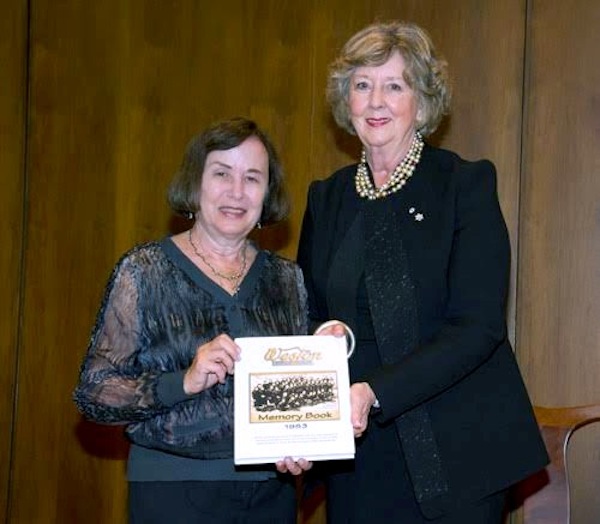
Weston Girl Estelle Sures, left, presents a memory book of the Weston Girls tour to Manitoba Lieutenant Governor Janice Filmon. (photo from Estelle Sures)

The reunion lasted for four days, beginning with Sures hosting the women to a luncheon at her home, followed by a tour of the legislative buildings, and capped off by a dinner reception hosted by the lieutenant governor of Manitoba, Janice Filmon. The dinner reception, said Sures, “was very elegant and we all enjoyed it.”

On the Saturday of the reunion, participants visited CMHR and toured the Forks area, a popular local meeting place with historical significance. On Sunday, they spent the day at Assiniboine Park, touring the English Garden and Leo Mol Sculpture Garden.

“We also had a picnic in the park that day,” said Sures. “So, it was a lovely weekend, where we spent a lot of time together, but also had the chance to see the best of Winnipeg.”

Given that all of the participants are now about 80 years old, it is getting more challenging for many of them to travel. While Sures will continue to get together with some of the women in smaller groups, the next large reunion is not yet planned.

“When I go to Vancouver, which I do once a year or so, because I have children and grandchildren living there, I usually meet the women who now live on the West Coast and a couple of the women in Calgary usually fly in to get together,” said Sures. “Similarly, with people in the east – there is a group that meets in Montreal.”

Of the original group trip, Sures reflected, “I think it was just coincidental, but I was the only Jewish girl in the entire group. There were a lot of Francophone women, because of the large representation from Quebec. It gave me an opportunity to meet women from across the country, which ended up being lasting friendships.

“A lot of these friendships, as we got older, we saw each other in a different context, and some of us who maybe didn’t know each other that well on the trip became even closer friends later on.”

Rebeca Kuropatwa is a Winnipeg freelance writer.

Format ImagePosted on November 20, 2015March 16, 2023Author Rebeca KuropatwaCategories NationalTags coronation, Estelle Sures, Queen Elizabeth II, Weston Girls
Sacred for three faiths

Sacred for three faiths

The Hellenistic/Hasmonean excavation at Nebi Samwil. (photo by Anthony Bale)

Just over 10 kilometres north of the Temple Mount, the Old City and east Jerusalem, where terrorist attacks continue, Muslims and Jews both go up to Nebi Samwil, to what they consider to be the holy burial place of Samuel the Prophet.

On the Thursday between Yom Kippur and Sukkot and the first day of Eid al-Adha, the Muslim Feast of Sacrifice, I visited this archeology site located in the West Bank. It was quite a scene.

A young Muslim family in Western holiday dress entered the Muslim part of the joint prayer site. They were followed by a young ultra-Orthodox couple who climbed to the roof for photo-taking. Close on their heels, a group of young adult Chassidic males piled out of a mini-van.

Walking by the Muslim cemetery, along the northern perimeter of the archeology site in the direction of the spring, I nearly bumped into a glitzy-dressed bridegroom, clad from head (kippah) to toe (pointy shoes) in silvery white. Continuing on my way, I glimpsed Bratslav Chassidim scurrying into the trees on their way to hitbodedut or seclusion. At the edge of the spring named after the Prophet Samuel’s mother, Chana, North American yeshivah students were drying off following immersion in this natural mikvah, ritual bath. (If you visit, consider equipping yourself with a bullhorn or whistle to announce your upcoming presence to anyone who might be in this open mikvah.)

Special religious experiences are not new to the site. For example, some 500 years earlier, Christians were having mystical experiences at Nebi Samwil. In 1413, Margery Kempe, an English mystic, traveled from the coastal plain toward Jerusalem. When she passed Nebi Samwil, she was so overjoyed by the view and by her reported heavenly contact, she nearly fell from her donkey. Two German pilgrims broke her fall. “One of them was a priest, and he put spices in her mouth to comfort her, believing her to have been ill. And so they helped her onwards to Jerusalem.” (The Book of Margery Kempe)

And, speaking of “joy,” earlier on when the Crusaders first looked south to Jerusalem from this point, they were so enthralled that they named the area Mount of Joy or, in French, Mont de Joie. In between combating those they considered pagan, heretical or politically inexpedient, the Crusaders happily settled in at Mont de Joie. They established a cistern, church, monastery (apparently commemorating Samuel the Prophet), pilgrims hostel, stable, quarry (drinking troughs and hewn stones are clearly visible today) and a fort. Before they began construction, they razed the area upon which they built. Crusader joy was relatively short-lived, however, as a generation later, in 1187, Salah ad-Din pushed them out and ushered in the Mamelukes. Curiously, the remains of one Mameluke building have an arch displaying a Star of David. While it looks like a Magen David, back then it was not a Jewish symbol.

Like the earlier Umayyads and Abbasids (638-1099), the Mamelukes went into pottery production. Archeologists have uncovered the large kilns they used, as well as pottery with place-identifying Arabic seals. Oddly enough, during this same period, the site became a holy place for Jews from Egypt, Syria, Mesopotamia and elsewhere. In 1730, however, Jerusalem’s Mufti Sheikh Muhammad al-Khalili called a halt to Jewish pilgrimage, by what Yitzhak Magen terms “appropriating the tomb from the Jews” and forbidding Jews to pray there. The mufti erected a mosque at the site.

Some Jewish sources have identified Nebi Samwil as the biblical Rama, the burial place of Samuel. Others have identified it with Mitzpah, a site connected to Samuel, and later to the Hasmoneans.

Speaking of the Hasmoneans, the well-built structures from the Hellenistic period were not destroyed by natural disaster or by fighting. It appears that the community was simply abandoned. One theory maintains that the Hasmoneans did not want competing places of worship, as there apparently was a tradition of worship at both Mitzpah and neighboring Givon (see Maccabees I: 3,46 and Kings I: 3,4). That is, they wanted to centralize worship and power in Jerusalem.

In being at the site, you see how people have protected their holdings. One way has been to build a fortress, equipping it with soldiers and weaponry. Another way has been to declare a place a holy site. While we cannot actually prove that Samuel the Prophet was buried at this site, neither can we totally disprove it. So the tradition stands for Jews, Muslims and Christians. Today, the site houses both a Wakf-run mosque with its tomb of the Prophet Samuel and an Orthodox synagogue with its separate tomb for the Prophet Samuel.

***

If you visit Nebi Samwil, don’t be fooled into thinking that you are going to the original citadel and mosque. The British destroyed it while fighting to take Jerusalem from the Ottoman Turks. During the Mandate, however, they rebuilt the structures.

The visiting hours for the archeology site are 8 a.m.-4 p.m. (winter) and 8 a.m.-5 p.m. (summer). Visiting hours for the prayer sites are Sunday-Wednesday continuously, with the exception of two hours between 2-4 a.m.; and Thursday-Friday, from 4 a.m. until an hour before Shabbat begins. More on the site, including a map, can be found at parks.org.il/sigalit/DAFDAFOT/nabi-samuel_eng.pdf.

At the time of my visit, there was no checkpoint, and apparently only one guard on the premises. Originally located among the archeology ruins, Israeli authorities moved the village called Nebi Samwil to its current setting in 1971, with some controversy. (For example, see alt-arch.org/en/nabi-samuel-national-park.)

Nebi Samwil is partially accessible to wheelchair users. If readers wish to get further details on the subject, they can contact the park curator, Avivit Gara, at 972-2-586-3281.

Deborah Rubin Fields is an Israel-based features writer. She is also the author of Take a Peek Inside: A Child’s Guide to Radiology Exams, published in English, Hebrew and Arabic.

Format ImagePosted on November 20, 2015November 17, 2015Author Deborah Rubin FieldsCategories IsraelTags archeology, Israel, Nebi Samwil, Samuel the Prophet

Posts pagination

Previous page Page 1 … Page 530 Page 531 Page 532 … Page 650 Next page
Proudly powered by WordPress