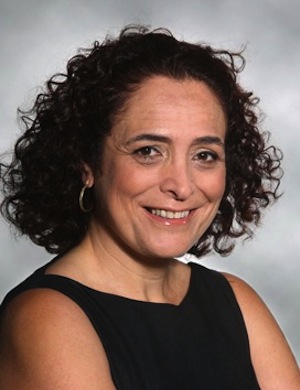
Prof. Idit Shachar, an expert on inflammation from the Weizmann Institute in Rehovot, Israel, spoke to a group of almost 70 people at VanDusen Botanical Garden on March 25.
Shachar discussed why issues arise in the body when there is a breakdown in the cooperation, communication and mobility of the immune system. Highlights of her presentation included discussion of the dual role of the immune system, and how it is critical for defence against pathogens and critical for body homeostasis. She also spoke of how inflammation is a double-edged sword, as it is both a key weapon in host defence against infections, but also has the potential to cause severe collateral damage in tissues, causing it to be labeled “the silent killer.”
The evening was hosted and sponsored by Drs. Alisa Lipson and Charles Krieger, and the audience was a mix of academics and lay people, resulting in a dynamic question and answer session.
For more information on Shachar’s research or about the Weizmann Canada chapter in Vancouver, contact Kathryn Berkson, [email protected] or 1-877-734-5948.
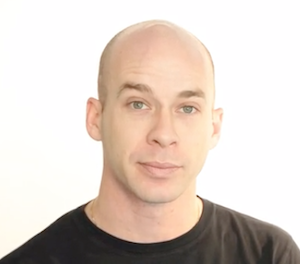
Aryeh Altman, inventor of the game Kujamma, has launched a Kickstarter campaign to crowdfund $25,000 to manufacture an initial run of Kujamma for retail.
Kujamma inventor Aryeh Altman. (screenshot)
The game’s concept revolves around collecting and accumulating, which is exactly what kujamma means in Estonian. The game involves opponents strategically throwing different-valued magnet pieces, called slappers, onto a metallic game board. Points are awarded by overlapping or stacking the slappers and claiming them with a special magnet called a point marker. The first player to reach 30 points wins.
Altman, a Toronto native, played the game as a child with fridge magnets that he found in the house. He and his siblings created a point-based game by trying to stack as many magnets as they could on the refrigerator. He taught the game to friends while in college, as well as to his nieces and nephews. Over the years, he has refined and developed it and is ready to take it into the production phase.
Although luck has a lot to do with the indoor and outdoor game, Kujamma also incorporates elements of skill and can bring out the competitiveness in people of all ages. Kujamma can also be used as a learning tool to teach children basic arithmetic and hand-eye coordination, and keep adults’ basic math and motor skills sharp.
אמזון מבצעת ניסויים סודיים במזל”טים בקנדה. (צילום: amazon.com)
הונאת הפונזי הגדולה של קנדה: 3,000 משקיעים איבדו קרוב ל-300 מיליון דולר
פרטי פרשת הונאת הפונזי הגדולה ביותר בתולדות קנדה נחשפים בימים אלה, במהלך משפט פלילי נגד שני אזרחים מקלגרי. גרי סורנסון (71) ומילו ברוסט (61), נאשמים שהונו כ-3,000 משקיעים בסכום שנאמד בקרוב ל-400 מיליון דולר. מקורות הכספים של המשקיעים באו מחסכונותיהם, כספים שהקציבו לטובת הפנסיה ואף מהון עצמי של בתיהם.
המשפט שנחשב לאחד מהארוכים בהיסטוריה הפלילית של העיר הקלגרי, נפתח ב-2009, וכאמור הוא עדיין מתנהל בימים אלה. בבית המשפט הוצגו למעלה ממאה אלף של דפים של מסמכים וקלטות שמע. לאחרונה אחד עשר חברי המושבעים הרשיעו את סורנסון וברוסט, בשלושה סעיפי אישום. הם הואשמו בשני סעיפים אישום של זיוף וסעיף אחד של הלבנת כספים. התביעה מבקשת להטיל על השנים את העונש המירבי שנקבע בחוק, שעומד של 14 שנים בכלא. פסק דינם של שני הנוכלים צפוי להתפרסם בקרוב.
סורנסון וברוסט שיכנעו את המשקיעים שרובם מצפון אמריקה (בעיקר אמריקנים וקנדים), בשנים 1999 ועד 2008, לרכוש מניות של שלוש חברות השקעות לכריית זהב שבשליטתם. פעילות החברות התמקדה כביכול בהונדורס, ונצואלה, אקוודור, פרו, קנדה וארצות הברית.
את הכספים השקיעו השניים בחברות קש חסרות ערך עם שמות נוצצים. ובעיקר הם לקחו את הכספים ובזבזו אותם על חיי ראווה ונוחות, שכללו בין היתר: טיסות במטוסים פרטיים, מגורים בווילות מפוארות וארוחות יקרות. סורנסון וברוסט טוענים שהם נשארו חסרי כל, והמשטרה לא בדיוק מאמינה להם. בשלב זה חוקרי המשטרה מנסים לאתר לפחות חלק מהכסף שנעלם על ידי שני הנאשמים.
זה לא חלום אלה מציאות: אמזון מבצעת ניסויים סודיים במזל”טים בקנדה
ענקית המסחר האלקטרוני האמריקנית אמזון, מבצעת בימים אלה ניסויים עם מטוסים זעירים ללא טייסים (מזל”טים) להעברת חבילות, במחוז בריטיש קולומביה, קרוב לגבול עם מדינת וושינגטון בארצות הברית. מטה החברה של אמזון ממוקם בעיר סיאטל שבוושינגטון. באמזון מסרבים לחשוף את מיקומו המדויק של אתר הניסויים כדי למנוע מעקב מצד המתחרות הקשות, בהן גוגל ופדקס. גורמים שונים בקנדה ששמעו על דבר הניסויים של אמזון, הגיבו בספק וחשבו שמדובר בדבר בדיחה. אך באמזון השיבו בתגובה שמדובר בדבר אמיתי. הניסויים באתר הסודי כוללים הטסת מזל”טים בגובה של עד 150 מטר, ובמהירות של עד 80 קמ”ש. ניסויים סודיים דומים עם מזל”טים מתבצעים ע”י אמזון באחת מהמדינות של מערב אירופה.
אמזון המתינה למעלה משמונה חודשים לקבל את אישור רשות התעופה האמריקנית, לביצוע ניסויים עם מזל”טים בתוך ארה”ב. לאחר שהתייאשה מהאמריקנים החברה פנתה לרשות המקבילה הקנדית. ולהפתעה (או לא) קיבלה את אישור המיוחל בתוך שלושה שבועות, לביצוע ניסויים עם מזל”טים במשך שנה. קנדה נחשבת למדינה ידידותית להפעלת מזל”טים לשימושים מסחריים שונים. בשנה שעברה קנדה הנפיקה אישורים ל-1,672 מזל”טים מסחריים. ולעומת זאת ארה”ב הנפיקה אישורים רק 48 מזל”טים.
שרת התעופה של הממשלה הפדרלית של קנדה, ליסה רייט, אומרת שקנדה היא המובילה בעולם כיום בטכנולוגיית מזל”טים. היא מקווה שגופים דומים כמו אמזון ילכו בעיקבותיה ויפנו לקבל אישור לניסויים, בהם רשות הדואר הקנדית – קנדה פוסט.
אמזון הכריזה בסוף שנת 2013 על פרוייקט ‘פריים אייר’ להפעלת מזל”טים, שישלחו ללקוחות שלה בתוך כחצי שעה, חבילות במשקל של עד 2.3 ק”ג. אמזון מחפשת עתה בין היתר מהנדסים ישראלים שיעבדו בפרוייקט המעניין. עם מפרסום ‘פריים אייר’ לא מעט גורמים טענו שמדובר בפרויקט מסוכן, שיגרום לנזקים ברכוש ובנפש.
Rabbi Rick Jacobs, president of United Reform Judaism. (photo by Ian Spanier)
Temple Sholom is celebrating its 50th anniversary this year. As part of its continuing celebrations of this milestone, Rabbi Richard Jacobs, president of United Reform Judaism, and Paul Leszner, head of the Canadian Council for Reform Judaism, joined Rabbi Dan Moskovitz and the Vancouver congregation last Shabbat.
Rabbi Rick, as he is fondly known, is entering his third year as president of URJ. Throughout his rabbinate, he has been a social justice activist, whether setting up a homeless shelter in his hometown of New York City, or joining an international humanitarian mission to the Chad-Darfur border. Vibrant, welcoming and warm are some of the words that he uses to describe the movement, and it was not difficult to sense the enthusiasm as he discussed with the Independent his leadership philosophy, as well as the goals of Vision 2020, a URJ campaign to reach and inspire the 900 or so Reform communities across North America.
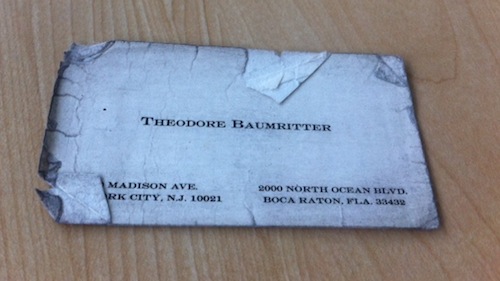
Rabbi Rick Jacobs carries with him a business card of his grandfather, Theodore Baumritter: “He taught me as much about life and Judaism as anyone I ever met.”
JI: I read about your personal mission and the fact that you carry around a business card of your grandfather, Theodore Baumritter. What does that say to you?
RJ: My grandfather was a person with such integrity and such goodwill that everywhere he went, people came to know and love him, people he met through business and through Jewish life. He taught me as much about life and Judaism as anyone I have ever met. Generational bonds are very important. To know where you come from and the people that helped you become who you are, they shape one’s character and aspirations.
My other grandmother emigrated from Eastern Europe when she was a teen. She was a seamstress on the Lower East Side and didn’t have the privilege of going to high school until she was a senior citizen. She went back and got her degree. She raised five children.
I feel very blessed to have the grandparents and parents I had, and hope that when we talk about ancestors they are not just vague theoretical people.
JI: What would you like readers, and Jews generally, to know about Reform Judaism?
RJ: Reform Judaism is large, passionate strong, dynamic, welcoming and truly inspirational. It can speak to lifetime congregation members and to those who haven’t tasted any of the rituals of the Jewish traditions. There may be people who at one point lived somewhere in a Jewish community and are open to finding a place for themselves.
JI: What are the specific goals of Vision 2020 and how do you propose to carry them out?
RJ: With guidance and help from rabbis and leaders across the U.S. and Canada, UJR envisions three major strategic priorities.
The first is to strengthen congregations, even congregations that are thriving and growing…. The world in which we live and the Jewish communities in which we find ourselves are having to change at an extraordinary rate. Congregations have to learn about how to engage in learning, spirituality and worship to nourish the soul. How do we ensure the synagogue is not frozen in one moment even though we have been growing steadily? How do we express chesed (loving kindness) in the congregation?
The second priority is called “audacious hospitality.” Audacious hospitality reaches beyond politeness…. Anyone who shows an interest in Judaism should not be turned away. If someone walks into the synagogue for the first time, it’s a very tentative moment. “Will I feel at home? Will I want to explore and get to know people?” Particularly a family with children. We want and need everyone to feel a genuine connection, rather than institutional – seniors, disabled, interfaith families; someone who has no knowledge of their Jewish faith; a traditional person who is now seeking something more contemporary. It’s about inclusion with no barriers. What’s important is building the bridges outside the walls and at the same time paying very close attention to those inside our walls.
JI: Low-income people or families may not have the means to afford membership or event costs. How do you propose to remove that barrier?
RJ: One of the barriers that keeps people outside the synagogue can be a financial barrier. Sometimes it’s a barrier or a priority they choose to avoid. Either way, we want to lower those because it’s not the finances that bind us together. We are bound together because we are part of a people, and we want to reduce ways in which you have to formally affiliate. Although, supporting something you care deeply about is a deeply held Jewish value. But, if someone wants to participate, it cannot be a barrier. Whether it’s participation in summer camp or Jewish day school, we have to remove those barriers.
JI: The third pillar of Vision 2020 is tikkun olam. Could you give me some examples?
RJ: Tikkun olam [perfecting the world] is a very large category to express a fundamental Jewish commitment. In the past 20 years, every study of the Jewish community [asks] … “What is the most compelling way you express your Judaism?” Pew Research [results] said: One, remembering the Holocaust. Two, standing up for equality and social justice. We use [tikkun olam] to actually express a fundamental Jewish commitment. When we pray or celebrate holidays, it is not instead of doing community work for people who have no home or food – tikkun olam is becoming a partner with G-d and making the world as God intended it to be. It’s primary. It is the pillar of Jewish life.
For us, tikkun olam also involves core Jewish values on a local and national level. It’s about helping immigrants, making sure that gun violence is not to the point that it inhibits our society. It also means making sure that public policy is responsible to [people’s] needs, whether it’s health care or caring for seniors. We don’t separate public policy and say, “That’s the government’s job.” We care about them. On a local and a national level, these are core Jewish values.
So, how do we lead and support the things that our Jewish tradition commands us to do? Young people tell us (whether they are involved or not) that, for them, the way that tikkun olam is practised is a serious, ongoing discipline, a way of life and a top priority.
JI: Is that where all the passion is to be found? What happens to the ritual and liturgy? Can these inspire people in these high-tech times?
RJ: Not only can we, but it’s happening. I recently attended a convention in Atlanta, Ga., where 1,000 of our own youth leaders attended, but also youth professionals who lead prayers, study. They [made] sure that we learned about the history of civil rights. Atlanta is where Martin Luther King preached. I use the example of young people because they have the fire burning in them. They speak Hebrew, they know how to pray, chant Torah and they have attended Birthrights. It is one thing to hear it from rabbis and educators. It is another thing to hear it from youth leaders.
We have 15 summer camps. Young people will talk about their expressions of Jewish commitment, such as meditating, praying and singing. They will stand up for Israel in their schools. This is the kind of Jewish engagement we are seeing. But this is also the time to be thinking about the young people who aren’t engaged.
JI: How do you reach them?
RJ: One method, which we can now use, is technology. We have, for instance, a website, reformjudaism.org. Last year, there were two million users on the website looking for Jewish learning and connection. Technology can be a connector but can’t have the same experience as a face-to-face real community, only virtual.
JI: What really excites you about your job?
RJ: I love traveling and getting to know Jewish communities all across North America. From a small little community in Mississippi or a large congregation in Arizona. Or, this weekend, Vancouver, Calgary and Edmonton. It’s a privilege getting to know the different communities and bringing a sense that we are part of something larger.
Jenny Wright is a writer, music therapist, children’s musician and recording artist.
Dr. Neil Pollock hands out some of the awards, as Larry Barzelai and student participants look on. (photo by Cynthia Ramsay)
Based on the numbers alone, the 27th Annual Public Speaking Contest on March 19 at the Jewish Community Centre of Greater Vancouver was a success. Participants: 120. Prizes: 30. Volunteer judges and moderators: 30.
Founded by Larry Barzelai in memory of his father, the event was co-sponsored by Jewish Federation of Greater Vancouver and State of Israel Bonds, with additional support from the J and the Isaac Waldman Jewish Public Library. As one of the volunteer judges, I witnessed a well-organized event that thrived on controlled chaos – almost all of those 120 student participants were accompanied by family and/or friends, and in the crowd were potential future speakers and their parents sussing out what participating next year might be like.
“My father, Morris Black, alav ha’shalom, would be very pleased to see the legacy he created,” Barzelai told the Independent.
Indeed, he would. Speakers were from grades 4 through 7, and they had their choice of topic from a list of 10, one of which was to choose their own. The most popular choices in the Grade 4 class I co-judged were to create a day to mark an event from Jewish history that is not currently being celebrated or commemorated; to describe an app that would enhance Jewish studies at your school; to explain why recycling is a Jewish concept; and to explain what you think is/are the best innovation(s) to have come out of Israel in recent years.
The enthusiasm of the competitions taking place in rooms around the J was corralled in the Wosk Auditorium afterward, and Alex Konvyes entertained the excited students and their guests while the results were being tallied. As each winner was announced, huge cheers went up. As some winners read their speeches, the auditorium came to a hush.
“Several parents in attendance this year had previously been public speaking contestants in their youth, so the legacy continues,” Barzelai noted.
While pleased that “the contest continues to be healthy” and that it is strongly supported by the principals and teachers of the three day schools – Vancouver Talmud Torah, Vancouver Hebrew Academy and Richmond Jewish Day School – Barzelai expressed concern about “the inability to attract students from Jewish supplementary schools and students that are not affiliated with Jewish schools. In former years, the contest had a wider cross section of students,” he said.
Barzelai credited Lissa Weinberger, JFGV manager of Jewish education and identity initiatives, for doing “all the work, with only occasional input from me. Her organizational skills are great. A few prospective judges dropped out close to the event, and she was able to recruit new ones at Shabbat services. Beware, synagogue attendees!”
2015 winners
In order of first, second and third, this year’s Public Speaking Contest winners in each contest were:
Hebrew: Omer Murad (Grade 4, VTT), Ofek Avitan (Grade 5, VHA), Yael David (Grade 4, VTT).
It was election week in Israel when I had the chance to speak with Ruth Westheimer. Though the noted sex therapist and celebrity Manhattanite served in the Haganah pre-state militia and is planning a trip to Israel in May, she didn’t want to talk politics. “It’s OK,” I told her on the phone, “just know that, as a political scientist, I don’t typically write about sex.”
She giggled in her contagious way, through her thick German accent – which, she told me, she’s lucky to have, since radio listeners always knew when Dr. Ruth was speaking.
Westheimer doesn’t like to talk politics, but in many parts of the world – and even in corners of North America – her topic of choice is a highly politicized issue. While completing her PhD in education and before training as a sex therapist, she worked at Planned Parenthood, an organization positioned on the front lines in the reproductive-choice wars in America.
Indeed, she had just returned from addressing a Planned Parenthood convention in Las Vegas when we spoke a few weeks ago. She said she was adamant that kids need to talk more about menstruation – especially since the onset of puberty is coming earlier for some – and nocturnal emissions. (Side note for the parents out there: My own personal introduction to the topics of periods and wet dreams was through Judy Blume’s excellent books.)
Talking is, of course, key to Westheimer’s trade – and she sees talking about sex as essential to overall sexual literacy. We’ve made great strides, she told me. In the United States and Israel, for example, there are now fewer women who are left unsatisfied due to not being able or willing to communicate their sexual needs to their partner. And, for men, premature ejaculation is also on the decline. Did she want to share advice for readers on that particular problem? It’s in her books, she told me. For those who are interested, I poked around (no pun intended) and found this entry on Dr. Ruth’s online encyclopedia of sex. Hint: It has to do with getting intimate with one’s “moment of inevitability.”
She had some strong words for the founder of psychoanalysis, Sigmund Freud, a favorite punching bag for postmodern intellectuals. “Freud said that any woman who doesn’t have an orgasm during intercourse is an immature woman,” said Westheimer. “He did not know that the clitoris needs to be stimulated in order to have an orgasm.” Instead, she added, “Freud should have taken a class with me.”
As she prepared to give a talk at the Israel Bar Association convention in Eilat, she said she was keeping in mind a talmudic adage: “A lesson taught with humor is a lesson retained.” She was pleased that after the seriousness of discussing legal matters, the conference delegates will be able to have some fun. But she “probably will not tell them to have good sex that night,” because “I don’t think they are there with their partners. I am old-fashioned and a square, and I’ve remained that way.”
Her squareness extends to trends like casual sex, which, she argues is not in people’s best interest, pointing to the increased risk of contracting HIV and other sexually transmitted diseases: “It’s dangerous.”
Yet, there is one area in which critics might call her politically incorrect: the hot-button issue of seeking overt consent before engaging in sexual activity.
“I do not believe that when partners are naked they can say at any time ‘I changed my mind,’” Westheimer planned to tell the lawyers at the convention. “In the Talmud, they say, when that part of the male anatomy is aroused, the brain flies out of the head.” In other words, she added: “It’s nonsense to suddenly, at the height of sexual arousal, say ‘I changed my mind.’ It will lead to many more problems. The idea of consent is nonsense – except consent before they are naked in bed.”
I didn’t press her on this point, except to ensure I’d heard correctly. But I did pause to mull over the current wave of youthful activism on this topic in my own province of Ontario, where a couple of teen spokespeople have been pushing the premier – with an apparently positive response so far – to add issues of consent to the new sex-ed curriculum.
Approaching 87, Dr. Ruth wants the world to know that she “feels great.” She has three new books coming out and she continues to teach courses at Columbia University, following a stint at Princeton.
What is her proudest accomplishment?
I ask. Her four grandchildren, she tells me. “Hitler lost, and I won.”
Mira Sucharovis an associate professor of political science at Carleton University. She blogs at Haaretz and the Jewish Daily Forward. A version of this article was originally published on haartez.com.
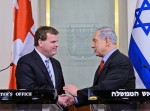
שר החוץ הקנדי לשעבר ג’ון בירד, עת ביקר את ראש הממשלה בנימין נתניהו, בירושלים ב-20 בינואר השנה. בירד הוא אורח כבוד ‘בנגב דינר’ של קק”ל בוונקובר ב-7 ביוני. (צילום: Kobi Gideon-GPO via Ashernet)
מחלוקת בין ידידים: הרפר שוב תומך בהקמת מדינה פלסטינית בניגוד לנתניהו
ראש ממשלת קנדה, סטיבן הרפר, שנחשב לידיד הקרוב ביותר של ראש ממשלת ישראל, בנימין נתניהו, מקרב מנהיגי העולם, חלוק עימו בסוגיה מאוד משמעותית. בשיחה שהתקיימה בין השניים ביום ראשון שעבר, חזר והדגיש הרפר בפני נתניהו, כי הוא תומך בפתרון שתי המדינות והקמת מדינה פלסטינית לצידה של ישראל. הדברים נאמרו לאור הכרזת נתניהו ערב הבחירות בישראל, כי הוא מתנגד להקמת מדינה הפלסטינית וכי ימשיך את הבנייה בשטחים.
הרפר שוחח עם נתניהו לראשונה בטלפון לאחר ניצחונו בבחירות שהתקיימו לפני שבועיים, בזמן שהוא נערך להקמת הממשלה החדשה. מייד עם פרסום תוצאות הבחירות, שלח ראש ממשלת קנדה ברכות חמות לראש ממשלת ישראל היוצא והנכנס, והוסיף שהוא מצפה לעבוד ביחד עם הממשלה החדשה בישראל, וכי לישראל אין ידידה קרובה יותר מאשר קנדה. בשיחת הטלפון שוב בירך הרפר את נתניהו, וכן הבטיח כי קנדה תמשיך לעמוד במחוייבותה לדאוג לביטחונה של ישראל. וציין כאמור שהוא תומך בפתרון שתי המדינות.
אפשר לסכם את הפרק הזה ביחסי קנדה וישראל באמירה, כי הרפר מאז נבחר לרשות ממשלת קנדה (2006), ממשיך לעמוד לצידה של ישראל ומדיניותה בכל עניין. למעט שתי סוגיות עקרוניות משמעותיות: תמיכה בהקמת המדינה הפלסטינית והתנגדות להמשך בניית ההתנחלויות בשטחים.
הערכה לידיד: אורח הכבוד בערב הגאלה של קק”ל הוא שר החוץ לשעבר בירד
סניף ונקובר של אגודת ידידי קרן קיימת לישראל (קק”ל) בקנדה בראשות אילן פילו, יקיים ערב גאלה מיוחד, בהשתתפות אורח הכבוד שר החוץ של קנדה לשעבר, ג’ון בירד. האירוע מתקיים לכבודו של בירד שנחשב לידיד קרוב מאוד של ישראל, וכמו ראש הממשלה סטיבן הרפר, עמד לצידה לכל אורך הדרך. בירד ביקר בישראל מספר פעמים וזכה לאירוח לבבי. האירוע במסגרת ‘נגב דינר 2015’ יערך ב-7 ביוני (יום ראשון) במלון ארבע עונות בדאון טאון ונקובר, ומחיר כרטיס 270 דולר.
קק”ל ונקובר תגייס תרומות לטובת הקמת פרוייקט בישראל שיקרא על שמו של בירד, ובשלב זה אין פרטים נוספים. כדי לקבל הכרה בפרויקט ע”י בירד יש לתרום לפחות 6,000 דולר.
קק”ל בקנדה יסדה את ‘נגב דינר’ עם הקמת מדינת ישראל ב-1948. האירוע מתקיים בכל רחבי קנדה מדי שנה להבליט את העשייה החשובה של קק”ל, לגייס כספים לטובת פרוייקטים בישראל, ולהעניק אות כבוד למי שעוזר ותומך בישראל.
בירד (45) פרש בראשית פברואר מתפקידו כשר החוץ בממשלת הרפר. בימים אלה הוא הצטרף לקואורפוריישן ‘בריק גולד’ (חברת כריית הזהב הגדולה בעולם), בתפקיד יועץ בינלאומי. הוא עבד בשירות הציבורי במשך כעשרים שנים, ושימש שר החוץ מאז 2011. קודם לכן החזיק בתפקידים בכירים שונים (בהם שר התחבורה ושר האנרגיה) בממשלות הרפר. ברד הוזכר לא פעם כמועמד להחליף את הרפר ביחד עם השר ההגנה, ג’ייסון קני, שגם הוא תומך גדול בישראל.
קק”ל שחוגגת השנה 114 שנים להיווסדה מקיימת שורה של אירועים בישראל. במסגרת זו אגודות ידידי קק”ל בעולם מארגנות מסע לישראל בן שמונה ימים, בחודש מאי (12-20). המשתתפים ישהו במלון מצודת דוד בירושלים. המסע יכלול מפגשים עם מספר אישים ובהם: נשיא המדינה, ראובן ריבלין וראש עיריית ירושלים, ניר ברקת. הסיורים יכללו בין היתר: ביקור בבסיס חיל האוויר, השתתפות באירועי יום ירושלים (ב-17 במאי), ביקור בתחנת הטלוויזיה של ערוץ החדשות באנגלית ’24 ניוז’, סיור ביקב, ביקור בשוק של יפו העתיקה, ביקור בבאר שבע ובנגב.
Masha Shumatskaya’s visit here was part of an American Jewish Joint Distribution Committee tour of North American cities. (photo from Jewish Federation of Greater Vancouver)
All Masha Shumatskaya wants is for the fighting to stop so she can go home. The 24-year-old Jewish Ukrainian English teacher was living and working happily in the city of Donetsk until April 2014, when pro-Russian separatists arrived two hours north of her hometown and declared their intention to form a people’s republic.
Until that moment, her life had been quite ordinary. Shumatskaya, a slender beauty with gentle eyes, was one of some 15,000 Jews in Donetsk, a city that boasts a Jewish community centre, a Chabad-run synagogue, a kosher café and various Jewish youth and cultural groups. “I never once experienced antisemitism growing up there,” she said. “I was never afraid to say I was a Jew.”
By May 2014, the pro-Russian separatists had moved into Donetsk and were threatening the safety of civilians. They bombed the Donetsk airport and the violence forced the closure of many schools and business offices in the city. Shumatskaya and her friends began making plans to move to other cities in Ukraine, such as Kiev, Odessa and Kharkov. She chose Kharkov, five hours’ drive from Donetsk, leaving her parents behind.
But Shumatskaya is one of the lucky ones. There are some 7,000 Jews still living in the war zone in Ukraine, many of them elderly. They’re dependent on the Joint Distribution Committee’s aid for food, medical support, rental subsidies and basic necessities.
Shumatskaya was in Vancouver recently as a guest of JDC, where she met with Jewish Federation of Greater Vancouver representatives and media to tell her story. With her was Michael Novick, executive director of the American Jewish JDC in Bellevue, Wash. “The situation in Ukraine has become a high priority for the JDC,” he said. “It’s not just the Jews, mostly elderly, still living in the conflict zone, but also the 2,500 Jews who’ve fled and need assistance, and another 60,000 Jews we’ve been helping all along with basic humanitarian supplies.” The JDC estimates the cost of its monthly relief for these Jews to be more than $387,000 US.
The political unrest has had widespread effect. The Ukrainian economy has plummeted, the purchasing power of the Ukrainian currency, the hryvnia, has dropped more than 50 percent and inflation is between 25 and 30 percent. “A year ago, the average pension of an elderly person we were assisting was equivalent to $150 US. Today, that same pension is only worth $50 US,” Novick said. “People have lost their jobs, their businesses, and Jews who could previously take care of their own families are now coming to the JDC’s Hesed welfare centres.”
The JDC has 32 Hesed welfare centres in Ukraine, and 160 of them across the former Soviet Union. Among those Jews requiring their services in Ukraine, Novick said they represent “the poorest Jews on earth, living in really dire conditions. For them, the lifeline provided by Hesed in terms of supplemental, basic humanitarian assistance, is vital.”
He added that the emergency funds being supplied by JDC are not part of its budget. “But the situation in Ukraine is so dire that we’re not waiting – we’re simply spending money and hoping that individuals, federations and foundations that meet Masha and hear about this story will come to our assistance.”
Shumatskaya’s 10-day visit to North America included stops in Seattle, Vancouver, Los Angeles, Philadelphia and New York. Last year, JFGV made a $25,000 grant to JDC for its various programs.
As she looked to the future, Shumatskaya was uncertain what it would hold for her. “I feel attached to Ukraine and I feel some responsibility to help with what’s going on there,” she said. “If I had to leave Kharkov I don’t know where I’d go. But I know that I don’t want to become a war refugee again. Once in my life was quite enough.”
Her message to Vancouver’s Jewish community is twofold: a reminder that Jews are responsible for each other, and one of gratitude for the support she and her fellow Ukrainian Jews have all ready received.
“Without that support we literally would not have survived,” she said. “I wish we could finish this need for assistance fast, but it’s out of our hands. We’re praying every day that we can live in a peaceful country without the assistance provided by the JDC.”
Lauren Kramer, an award-winning writer and editor, lives in Richmond, B.C. To read her work online, visit laurenkramer.net.
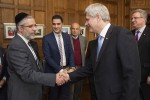
Rabbi Ilan Acoca, left, shakes hands with Prime Minister Stephen Harper on Parliament Hill. (courtesy of Prime Minister’s Office)
Last month, a Jewish delegation paid a visit to Parliament Hill with two main items on the agenda – educating the Canadian government about Sephardi Jewry in Canada and discussing Iran’s aim to obtain nuclear weapons.
The delegation included Sephardi community leaders, activists, philanthropists and spiritual leaders from across Canada. They met with the prime minister, various ambassadors and other dignitaries. The delegation was led by Yehuda Azoulay and Vancouver’s Rabbi Ilan Acoca of Congregation Beth Hamidrash, the only Sephardi synagogue west of Toronto.
A scholar, educator, author, activist and entrepreneur, Azoulay established the Sephardic Legacy Series: Institute for Preserving Sephardic Heritage. He envisioned the series as helping ensure future Sephardi publications, articles, lecture series, documentary films and research on Sephardi topics, and other works geared toward the benefit of Sephardi communities worldwide. It was the lack of general knowledge concerning Sephardi history, culture, Jewish law and other facets of Sephardi Judaism that prompted him to establish the organization. To date, Azoulay has authored five books and published more than 30 articles on various topics. In November 2013, he initiated a tribute luncheon to honor the contributions of Sephardi Jewry in America for members of the U.S. Congress.
The recent Parliament Hill delegation had as its primary goal to “create more awareness about Sephardic Jews in Canada by educating them about our history and our contributions to Canadian society,” Acoca told the Independent. “There are currently 55,000 Sephardic Jews in Canada and the number is growing. This is something that we related to the government.”
Acoca was born in Israel to parents of Moroccan descent. “I grew up in a typical, traditional Sephardic home,” he said. “Sephardic Judaism was an integral part of my upbringing.”
When Acoca was 13 years old, his family moved to Montreal, where he attended a Jewish high school. Growing up in Montreal’s Sephardi community, Acoca said, “helped me deepen my appreciation for my rich Sephardic ancestry.” Acoca eventually become a rabbi, fulfilling his grandfather’s wish that one of his descendants follow in his footsteps to the rabbinate, he said. In November 1999, Acoca and his wife Dina took on the roles of rabbi and rabbanit at Beth Hamidrash.
“Getting this responsibility made me more aware and passionate about my ancestry,” said Acoca. “My job enabled me to learn more about various Sephardic traditions and communities.”
Over the years, Acoca has added other aspects to his rabbinical role, teaching online, writing a monthly column in the Canadian Jewish News, heading the Rabbinical Council Sephardic Affinity Group, being an official Sephardi representative in Western Canada, and being the region’s Sephardi halachic authority.
Canadian human rights lawyer David Matas joined the group in Ottawa. Acoca described the importance of having Matas present in front of the House of Commons SubCommittee on International Human Rights about Iran’s intent to develop nuclear capability. During the presentation, Matas and Azoulay also conveyed some of the hardships that Iranian Jews “have faced and continue to endure.” (The full hearing is available at cpac.ca/en/programs/in-committee-house-of-commons/episodes/37646919.)
Matas gave six recommendations to the committee, which he shared with the Jewish Independent:
1. Expand the exceptions to sovereign immunity to catch Iranian human rights violations in a larger net. It should be possible for victims of the Iranian regime to sue in Canadian courts for the harm that the regime has done to them.
2. Ask for the extradition of Hassan el-Hajj Hassan, a Canadian citizen implicated in a Bulgarian bombing, from Lebanon to Canada. Under the Criminal Code, Canada has jurisdiction to prosecute him because he is a Canadian citizen, explained Matas. Canada does not have an extradition treaty with Lebanon, but the Extradition Act allows for extradition, even without a treaty, on a case-by-case basis by agreement with the state where the accused is found.
3. Support the suggestion that any arms agreement between Iran and foreign states include a human rights component parallel to that of the Helsinki Accord. “A regime hell bent on the destruction of Israel and the Jews should be kept as far away from weapons of mass destruction as possible,” said Matas. “A nuclear weapons agreement with Iran, if one can be reached, should not just prevent nuclear weapons capability. It should have a place for human rights.”
4. The European Union in July 2013 added the military wing of Hezbollah to its list of terrorist entities. Canada should urge the EU to list Hezbollah in its entirety, not just the military wing, as a terrorist entity.
5. As the lead sponsor to the United Nations General Assembly, Canada should strengthen the language of the resolution, even if it that means fewer votes. “While we would not suggest language so strong that the resolution would be lost, Canada today has some room for manoeuvre,” said Matas.
6. Encourage the Government of Canada to take into account all refugee populations as part of any just and comprehensive resolution to the Israeli-Palestinian and Arab-Israeli conflicts. “That, of course, includes 55,000 Jewish refugees from Iran, driven out of Iran by the regime of the mullahs,” said Matas.
It is also important to confront the myth that Israel is a Western, imperial, colonial enterprise – a myth that holds particular sway with the mullahs of Iran, Matas said. The reality is that Israel is in large measure composed of Jews from the Middle East, including Iran. “Unless the Palestinians themselves accept the reality of dual victimization, a meaningful peace becomes impossible,” he said.
The delegation met with MPs Tim Uppal, Denis Lebel, Jason Kenney, Peter Kent, John Carmichael, Mark Adler, Joyce Bateman and Irwin Cotler. Other members of the delegation, including Acoca, met privately with Prime Minister Stephen Harper.
“The government officials were extremely supportive and promised they will assist,” said Acoca. “We were ecstatic, definitely.”
Acoca is eager to create more awareness of Sephardi Jewry, the community’s needs and cultural differences, and to promote understanding. He is also looking forward to following up on the event and meetings, and hopes this delegation will become an annual occurrence. “I would like the Sephardic way and philosophy to be preserved and am working hard, together with my colleagues, to ensure a thriving future,” said Acoca.
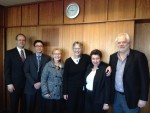
Left to right: Glen Hodges, manager, Mountain View Cemetery; Damian Koo, City of Vancouver legal services; Francie Connell, director, City of Vancouver legal services; Dr. Penny Ballem, city manager; Shirley Barnett, chair, MVJCRP committee; and Herb Silber, Schara Tzedeck Cemetery board. (photo from Mountain View Jewish Cemetery Restoration Project)
“Sometimes it takes awhile,” said Shirley Barnett, chair of the Mountain View Jewish Cemetery Restoration Project. But generally not 124 years! In 1891, Vancouver mayor David Oppenheimer, member of a prominent pioneer Jewish family, was approached by the growing Vancouver Jewish community to reserve a section within the city-owned Mountain View Cemetery to be consecrated and used exclusively for Jewish burials. At the time, when a Jewish person died, they were sent to Victoria, where the community had already established a cemetery.
Oppenheimer knew the small Jewish community of Vancouver well. The Gintzburgers, Weavers, Fleishmans, Golds and Goldblooms traveled in the same circles as the Oppenheimers. They had all emigrated from Western Europe, some via the United States, around the same time and all had prospered. Perhaps, as Barnett speculates, “they had even helped to get Mayor Oppenheimer elected.”
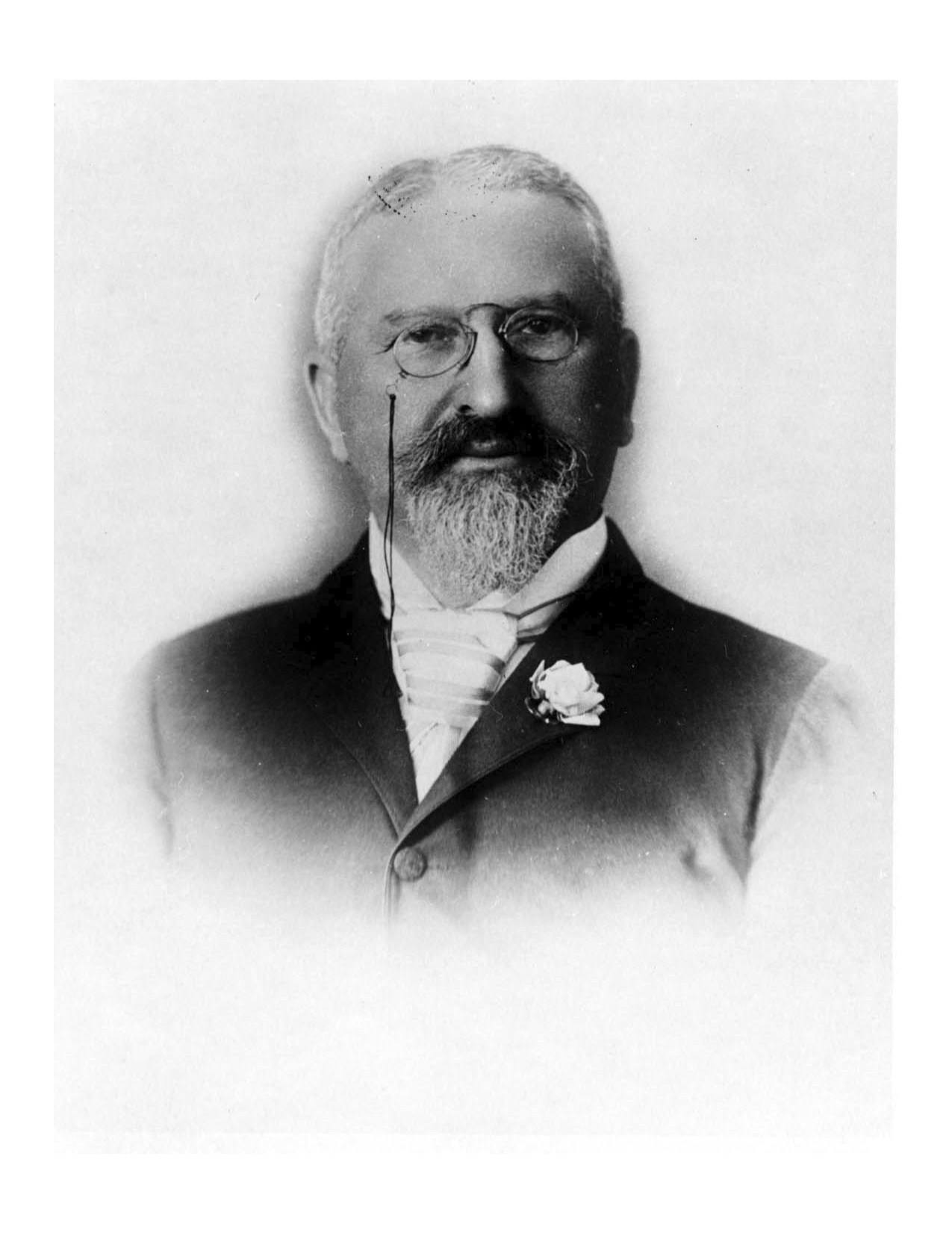
David Oppenheimer, circa 1891. (photo from Jewish Museum and Archives of British Columbia, L.00179)
Oppenheimer was born in Germany in 1834, one of 10 children. He emigrated to New Orleans in 1848 with his sister and four of his brothers. Becoming a bookkeeper, and later a trader in the California gold rush, the Oppenheimers relocated to Sacramento, where David invested in real estate, and married his first wife Sara in 1857. After the gold rush, the Oppenheimer brothers moved to Victoria, establishing stores throughout British Columbia, catering to prospectors and settlers. Also building a real estate portfolio, they expanded their interests in Vancouver.
Although Malcolm MacLean was the first mayor of Vancouver, it was Oppenheimer who is remembered as the “Father of Vancouver.” In his four terms as mayor, from 1888-1891, he implemented many basic civic services: fire department, streetcars, water supply, utilities, schools and parks. He was also a philanthropist, a founding member of the YMCA, Vancouver Board of Trade, Vancouver Club and many charities.
Establishing a Jewish cemetery at Mountain View in 1892 was one of his many accomplishments. Without minutes of meetings or other documentation, however, the only evidence of this was a number of articles published over the years, and the records of burials.
In 2015, 124 years later, the City of Vancouver recognized the historical establishment of the Jewish section at Mountain View and, based on this, an oversight agreement with Schara Tzedeck Cemetery board was signed. The agreement confirms that the cemetery board has the right to oversee all interment and funeral services within that Jewish section.
Although Oppenheimer himself was buried in New York, many of his colleagues were laid to rest at Mountain View. Over the past two years, a restoration of this old cemetery been undertaken. Now complete, the rededication will take place on Sunday, May 3, at 1:15 p.m.