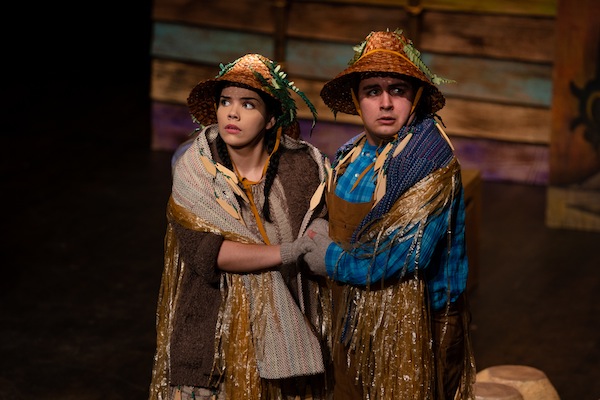
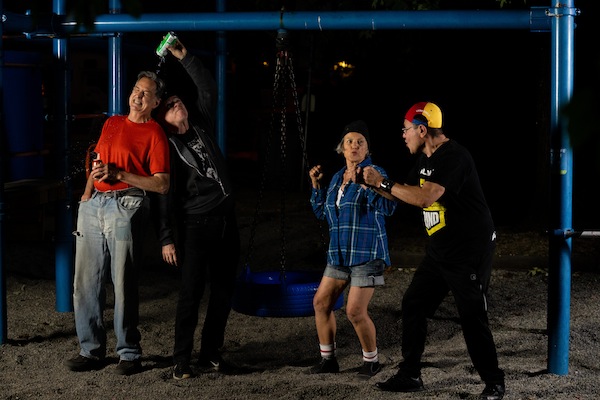
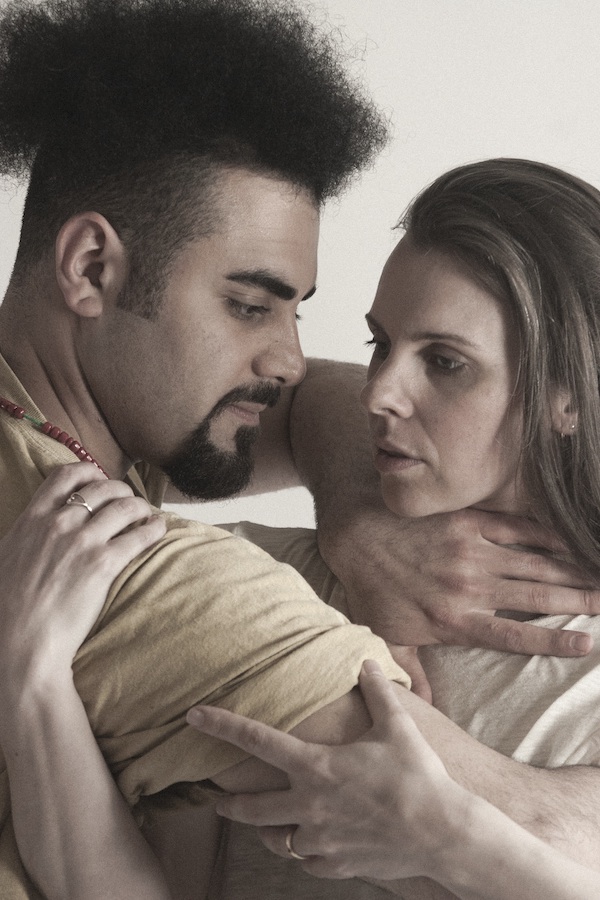
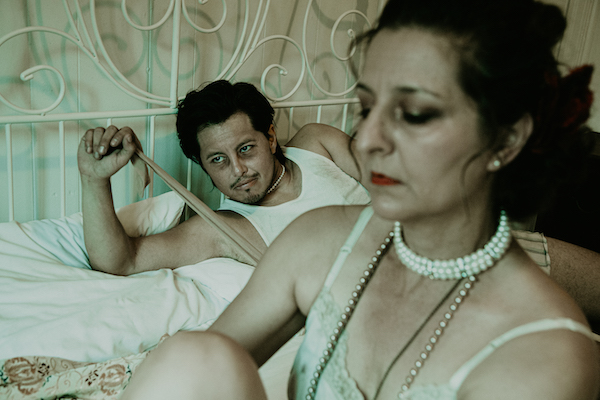
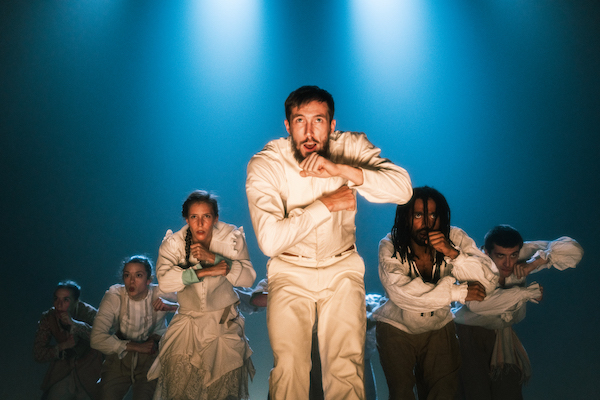
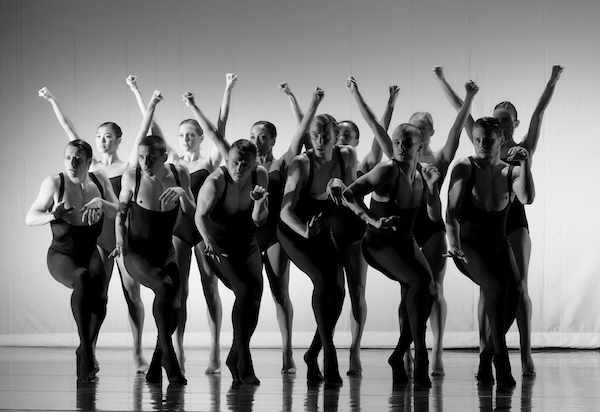
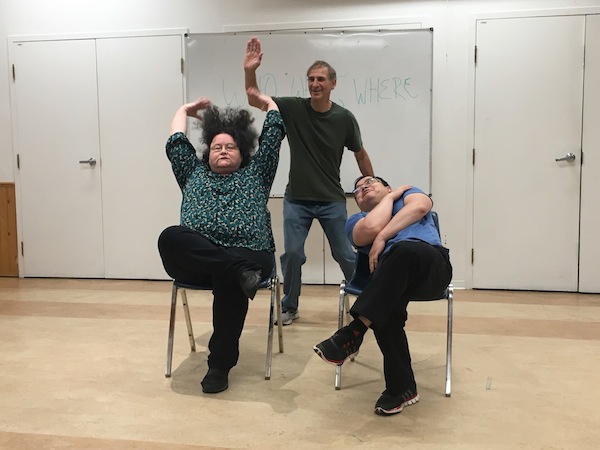
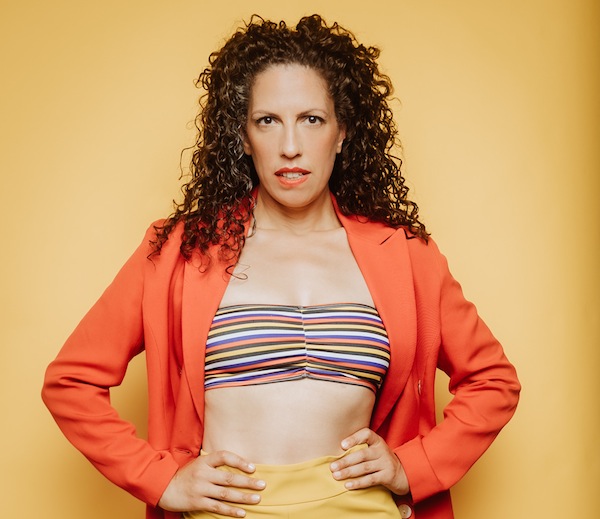
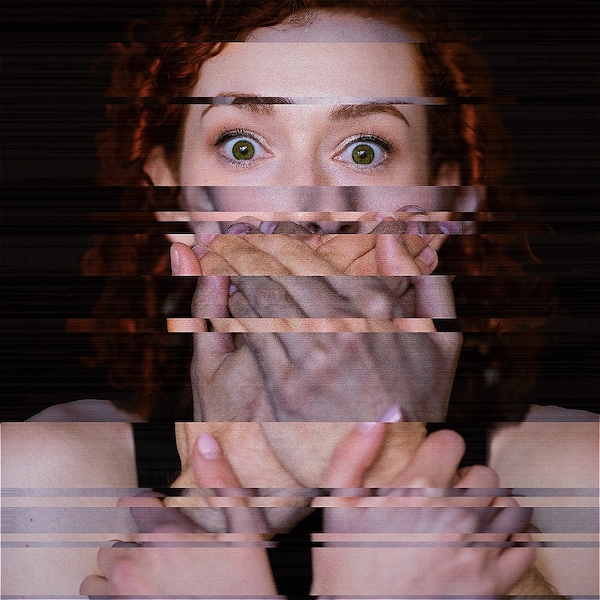
After an acclaimed run at the Vancouver Fringe Festival in 2021 and the Edmonton and Montreal Fringes this year, Everybody Knows returns to its creator’s hometown and the Vancouver Fringe Festival. In this semiautobiographical, one-woman musical set to nine covers of Leonard Cohen songs, Rita Sheena creates a spiraling narrative using contemporary dance, post-modern quirk and the haunting melodies of First Aid Kit.
* * *
Jem Rolls (PR photo)
In 2015, Jem Rolls brought his one-man show about Hungarian Jewish physicist Leo Szilard, The Inventor of All Things, to the Vancouver Fringe Festival. This year, he’s back with another show about a forgotten Jewish nuclear physicist – Lise Meitner. The Walk in the Snow: The True Story of Lise Meitner explores how a shy Austrian, who only graduated high school at 23, opened so many doors and achieved so much; how she pushed against age-old sexism and murderous antisemitism; how she was the first or second woman through a whole series of doors; and how she was one of the very few physicists to refuse work on the bomb.
* * *
ira cooper (photo from spectheatre.com)
Vancouver-born, Jewish writer and performer ira cooper of Spec Theatre stars in the one-man show mr.coffeehead, which is arriving at the Vancouver Fringe Festival after a series of successful premières at the Winnipeg, Victoria, Edmonton and Montreal Fringes. In Montreal, the “foot-fueled, slapstick tragedy about bikepacking, dreaming big and giving up in your 30s,” which was written by cooper, was nominated for Outstanding Clown Show.
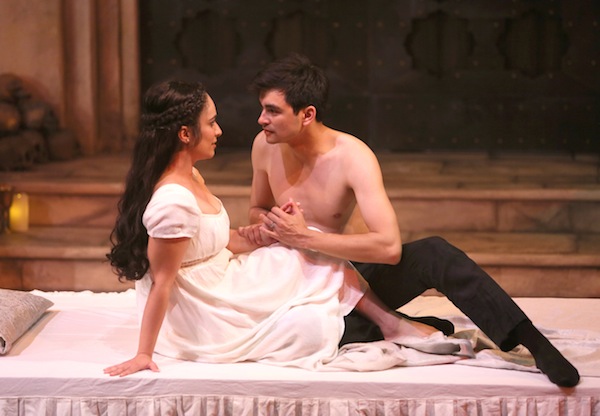
Ghazal Azarbad and Daniel Fong in Bard on the Beach’s Romeo and Juliet, which runs to Sept. 24. (photo by Tim Matheson)
William Shakespeare’s tragic love story, Romeo and Juliet, about teenaged lovers who come together despite the objections of their families, resonates with contemporary audiences as much as it did with the Elizabethan crowd.
Since it was written in 1595, ˆ has spawned countless adaptations, including the musical West Side Story, the animated feature Gnomeo and Juliet, and even a Palestinian girl meets Israeli boy version. So how do you present this well-known tale from a different angle? You do what director Anita Rochon did for this year’s Bard on the Beach production – start at the end, when Juliet wakes up in the family crypt next to dead Romeo, and flash back to the beginning. As well, tell the story from Juliet’s perspective, as she grapples with the question of how this situation came to be.
Rochon has taken some creative liberties with Shakespeare’s text, nipping and tucking here and there, and leaving out the characters of Lord Capulet and the Montague parents. Purists may not appreciate that surgery but will like that the play is set in its proper era. However, if you don’t know the story, the time line is a bit confusing, as the scenes jump around a bit, unlike the linear unfolding of the original text, so you should read the program summary beforehand.
From the minute you walk into the small tent and are met with the sight of the set, you know you’re in for a treat. Front and centre is an elevated marble-like tomb surrounded by 300 skulls strategically stacked around the macabre crypt, all bathed in flickering candlelight. The crypt’s massive iron doors open and close on an ever-changing backdrop as actors make their entries and exits. The tomb disappears into the ground on scene changes while a balustrade rises from the ground for the iconic balcony scene. Kudos to set designer Pam Johnson for a job well done.
The acting in this production is also first rate. Each and every one of the nine actors gets the job done. Daniel Fong as Romeo, Ghazal Azarbad as Juliet and Jennifer Lines as Lady Capulet are particularly strong in their roles. Fong nicely portrays the naïve confusion of the young swain while Azarbad shows strength of character and resolve not normally seen in depictions of teenage girls. The chemistry between the eponymous duo is palpable.
But it is Lines – morphing from gracious and charming party host to ferocious tiger mother when she gives Juliet the disinheritance ultimatum – who captures the essence of the play’s unspoken dilemma: Do we marry who our parents/families pick for us or do we marry who we love, no matter the consequences.
In a nod to role reversal, which seems to be the flavour of the season for Bard, Andrew McNee plays Juliet’s nurse, Sara Vickruck does double duty as the doomed Mercutio and the Apothecary and Anita Wittenberg plays Friar Laurence. McNee is one of the best comedic actors this city has, and his antics on the boards inject much-needed comic relief into an otherwise dark script.
Raising the production to sublime are the costumes (richly coloured, textured gowns for the ladies and sexy doublets and britches for the men), the dramatic lighting and the trio of choreographed sword fights – all backgrounded by the haunting tones of handheld bells that herald scene changes.
As Rochon points out in the program notes: “We know how their story ends and, in a way, we know how all our stories will end. The way we get there is where the mystery begins.”
You don’t have to be a hopeless romantic to appreciate the beauty of this production, which runs to Sept. 24 on the Howard Family Stage at Vanier Park. For tickets, visit bardonthebeach.org or call 604-739-0559.
Tova Kornfeld is a Vancouver freelance writer and lawyer.
Katherine Matlashewski is creator, performer and co-producer of Disclosure, which “explores the struggles of a survivor searching for pathways toward healing in an adversarial medical system.” (photo from Disclosure Productions)
“Disclosure was inspired by a true story that focuses on the process of healing,” explained Katherine Matlashewski, creator, performer and co-producer of the production that will see several performances during the Vancouver Fringe Festival, Sept. 8-18.
“The way in which trauma affects the mind and body is complex and unique to each individual,” Matlashewski told the Independent. “Through movement, spoken word, soundscape and humour, Disclosure explores the struggles of a survivor searching for pathways toward healing in an adversarial medical system.”
An interdisciplinary artist, Matlashewski is a graduate of Studio 58. She has trained with Arts Umbrella and the Arts Club, and has performed with several companies, including Theatre Replacement, Metro Theatre, Stage 43 and Royal City Musical Theatre. The award-winning theatre artist is an instructor at Carousel Theatre for Young People and Arts Umbrella.
“Prior to attending Studio 58,” she said, “my training was based in movement and musical theatre. In musical theatre, when a character does not have the words to express themselves, they sing. When singing is not enough, they dance. I do not always have the words to describe how I am feeling, so I naturally turn to creating interdisciplinary works. While I was developing Disclosure, I realized that combining multiple disciplines could be utilized to convey what could not be communicated through text.”
Every Fringe performance of Disclosure will include a 10-minute post-show discussion facilitated by a representative from WAVAW Rape Crisis Centre.
The first iteration of the one-person show was presented at Studio 58 as part of Matlashewski’s graduation solo performance this past spring. “With the hopes of expanding Disclosure to a wider audience,” she said, “I applied for the 2022 Vancouver Fringe Festival. After my performance at Studio 58, I was approached by director Jane Heyman about developing my show further. After being selected as a Vancouver Fringe Festival lottery finalist, I reached out to Jane about directing the show for the Fringe and I was overjoyed when she accepted! I then began building a creative team of local emerging and early career artists.”
Heyman is also a member of the Jewish community, and she was already attached to the production when creative producer Natasha Zacher came on board.
“Katherine and I connected in May 2022, after Disclosure was accepted into the Vancouver Fringe Festival,” said Zacher. “However, we have known each other for a few years, since working alongside each other on a (very!) different Vancouver Fringe Festival show in 2015. Katherine reached my way as she knew a good deal about my professional journey, integrating work as an independent theatre-maker and a mental health clinician. We reconnected quickly on the premise and hopes for the production, and I was very glad to join the team.”
As a producer, Zacher said, “My primary focuses are on seeking funding for the show (grants, sponsorships, donations), creating and managing our budget, coordinating timelines for marketing and promotions initiatives for the show … contracting artists, liaising with the Vancouver Fringe team regarding production needs and, recently, developing and facilitating COVID-19 safety plans.”
Given the nature of the production, there are additional safety plans.
“It is important to take the time to create a safe, inclusive and accessible rehearsal and performance space,” said Matlashewski. “Part of my artistic practice is to create a ‘room agreement.’ This is a living document, written by the artists involved in the production. In our room agreement, we include boundaries and guidelines about how we will communicate and conduct ourselves in the rehearsal process. Something I value is taking the time to include a check in and out at the beginning and end of each rehearsal day.
“In addition,” she said, “to promote self-care, the artistic team has decided to stagger rehearsals, and also observe Shabbat by not rehearsing on Fridays.”
The seriousness of the material does not mean Disclosure is devoid of lighter moments.
“There are many ways to heal from trauma. Humour is one of them!” Matlashewski said. “Having witnessed and experienced generational trauma, I have come to understand that humour can help create distance from a difficult incident. In addition, sometimes humour is more palatable for an audience. For me, the journey to healing is like a rollercoaster. It is not linear in any way. Even in the most challenging of times, humour can facilitate healing.”
Disclosure will be presented at the NEST on Granville Island during the Fringe Festival. For anyone wanting to support the show, there is a GoFundMe campaign. “Funds raised will go directly to production costs and compensating the artists involved for their time, energy and expertise,” said Matlashewski.
“I am looking forward to seeing how the audience responds to the performance,” said Zacher. “I don’t have any expectations, and want to walk into the experience of getting the show on stage as an open book. I hope the audience feels empowered to take with them whatever supports them to feel seen and heard.”
Take This Waltz performers Ted Littlemore, left, and Daniel Okulitch. (photo by Victoria Bell)
Take This Waltz world premières at Rothstein Theatre Sept. 10-11.
“The concert as a whole tells a story, and each song finds its place within that story,” Idan Cohen told the Independent about Take This Waltz, which sees its world première as a Chutzpah! Plus event Sept. 10-11 at the Rothstein Theatre.
Cohen is the artistic director of Ne. Sans Opera and Dance, so it might seem odd that he’s staging a show celebrating the music of Leonard Cohen. But he’s a fan of the Canadian icon, who died in 2016, and this production piqued his interest.
“I’ve admired Cohen’s lyrics and music for years,” said Cohen, who is not related to the singer-songwriter. “So, when Daniel Okulitch, one of Canada’s most appreciated operatic baritones reached out to me to directly to produce Take This Waltz, I immediately said yes. Daniel’s vision was to look at Cohen’s music through the classical tradition of the Song Cycles (Lieds). I thought that it was a really interesting way to look at Cohen’s music through a fresh, exciting lens.”
Okulitch contacted Cohen after having created a successful online concert that included some of Leonard Cohen’s work, as well as that of other singer-songwriters, which took place via Pacific Opera Victoria in winter 2020. Okulitch wanted to add dance to the concert.
“I knew that, if I was to take this on, I would want to focus on Cohen’s body of work and say something meaningful about the times we live in,” said Idan Cohen. “Ne. Sans’ mandate is to follow the operatic tradition in the full sense of it – to create work that integrates all the classical arts of theatre, music, dance, set and costume design. It is challenging to do in this economy, but I strongly believe in this type of offering.
“It took us some time to fundraise so that we can present this work as I believe it should be presented,” he noted. “We have an ensemble of cello, violin and accordion, with stunning arrangements by Adrian Dolan, and Daniel’s voice is so rich and sensitive, that it speaks straight to the heart. Amir Ofek is designing the set, Itai Erdal creating the light design and Christine Reimer the costumes. Alongside Daniel is the dancer/musician Ted Littlemore, with whom I’ve been collaborating for almost five years, who’s such a wonderful artist. I am truly blessed, and I hope that we’ll not just do justice to Cohen’s legacy, but help audiences experience it in a different, new way.”
About that legacy, Cohen added, “I had coffee with the wonderful Vancouver-based composer Rodney Sharman the other day, to discuss a future project that we’re working on, and Rodney said something that I found to be really relevant to Take This Waltz. He said that he thinks that my body of work is a variation of two core elements: love and death. And I thought to myself, that’s life, right? Cohen got it. His wisdom is so profound that it sometimes seems as if he knew the secrets of the human soul. I think it’s because he was brutally honest, a thing that we don’t see a lot in our contemporary culture. There’s so much pain and often bitterness and anger in his work, that are then composed in such generosity and love. What a beautiful combination. My work is to honour that.”
About his collaborators on Take This Waltz, Cohen said the production started at Pacific Opera Victoria, “as an intimate, beautiful concert of various music that included just a few of Cohen’s songs, and Vancouver Opera decided to support its development and creation. Jessica Gutteridge, a wonderful human and the artistic director of Chutzpah!, has given us a very generous creative residency at the Norman and Annette Rothstein Theatre in Vancouver’s JCC [to further develop the work]. It’s all live, no film or projections. I felt that Cohen’s work needs to be honest and direct. Having said that, there are quite a few surprises in the show – you’ll just have to come and see!”
Take This Waltz is being presented with Pacific Opera Victoria and Vancouver Opera, and Chutzpah!’s live music programming is supported by a grant from AmplifyBC. The Sept. 10-11 shows are also being supported by the Bierbrier family, in memory of Len Bierbrier, who was a dear friend of Chutzpah! board chair Lloyd Baron, said Gutteridge. Bierbrier was also a friend of Leonard Cohen, she said.
While most people cannot claim that level of connection to the legendary musician, many people do feel connected to him in some way. When asked to confirm that, indeed, he was not related to the singer-songwriter, Idan Cohen said, “We are all related, aren’t we? I first heard Cohen’s music through my dad and, in many ways, always felt that he is a father figure to me. So many of us feel that way about him and his music and poetry. I love him like family. Does that count?”
Montreal guitarist and member of the Jewish community Henry Garf takes part in this year’s Vancouver International Flamenco Festival. Presented by Flamenco Rosario, the festival features live performances, with both ticketed and free events.
Garf performs at the Waterfront Theatre Sept. 23, as part of Kara Miranda’s company. Sombras/Shadows is a live music and dance presentation with projections reflecting personal experience both visually and thematically. Shadows are explored as interplay between light and dark, through the lens of Swiss psychiatrist Carl Jung’s theories of the Shadow Self. A parallel search is for intangible shadows of the past, Miranda’s ancestral roots, living in the shadow of the flamenco greats that came before and the masters that reign today and finally accepting and actualizing her shadow side.
Garf also teaches a master class at the Scotiabank Dance Centre Sept. 24, with Alvaro Echanove, called Theory and Practice: Exploring the Skills of Improvisation, Dynamics and Active Listening through Palmas. Palmas is a style of handclapping that accompanies flamenco dance.
Other master classes take place Sept. 17 and 18, with Mucha Muchacha, and on Sept. 24, with Albert Hernandez. Other ticketed shows include Mucha Muchacha at the Rothstein Theatre Sept. 16. Their eponymous show started as theoretical and practical research about women artists from the “Generation of the 27th,” known as Las Sinsombrero, and evolved into a contemporary dance project focused on the ideas of empowerment, determination, voice, participation, freedom and cooperation. The performance is developed from force-driven movement, effort, celebration and physical exhaustion. They put “at risk” traditional Spanish dance’s corporeality in a confrontation with contemporary dancing.
The two other shows at the Waterfront Theatre are Anastassiia Alexander on Sept. 22, performing The Machination of Memories Suppressed, based on the poem “Maquina de Olvido,” which Alexander wrote, and the performance contains elements of spoken word with dance; and Flamenco Rosario on Sept. 24, with Nuevo III, a collection of new choreographies by Ballet Nacional de España choreographer Albert Hernandez, Granada’s Sara Jimenez and Rosario Ancer.
On the afternoons of Sept. 3 and 4, free performances take place on the Picnic Pavilion stage at Granville Island. The Saturday features Mozaico Flamenco, A.J. Simmons and company, Bonnie Stewart, Jhoely Triana, and Michelle Harding and Calle Verde. Performers on the Sunday are Mozaico Flamenco, Kara Wiebe, Harding and Verde, Linda Hayes, and Stewart. There is also a free 20-minute workshop on Sept. 4 for children at noon, and a 30-minute one for adults at 12:20 p.m.
Much of the humour in Something Rotten! comes from Nostradamus (Jyla Robinson), right, leading Nick (Kamyar Pazandeh) astray with incorrect visions of the future. (photo by Emily Cooper)
Theatre Under the Stars is a fun, relaxing way to ease yourself back into theatre after the COVID hiatus. Its two productions, Something Rotten! and We Will Rock You, are happy fare that alternate nights through Aug. 27, outdoors at Stanley Park’s Malkin Bowl.
The Independent saw Something Rotten! on opening night, hoping to see Jewish community member Daniel Cardoso, who plays Jewish moneylender Shylock in the TUTS productions. However, it was understudy Simon Abraham who took on the role of the moneylender that night. He and the entire cast put on a great show.
In this comedy, set in 1595, Shakespeare is monopolizing the theatre industry and playwright siblings Nick and Nigel Bottom are trying to write a hit. They face several challenges, including being in debt to Shylock, who is willing to forgive that debt if they permit him to produce their new production. However, they initially refuse because he and they could be put to death, as Jews at the time were permitted few professions, one of which was moneylender.
Something Rotten! takes on – in very light manner – antisemitism, the treatment of the poor and the place of women in Shakespeare’s time. It also takes on these issues as they are depicted in Shakespeare’s plays and poetry.
“Shylock has been a very interesting character to explore and I extremely grateful to our director, Rachel Peake, for giving me the chance to do so,” Cardoso told the Independent in an interview before the show opened. “In researching for this part, I certainly took a cursory look at Merchant of Venice, but only so I could have an idea of who Shakespeare’s Shylock is. Because of how much Something Rotten! subverts the audience’s expectations of these well-known Shakespearean characters, there are only a few similarities between what I’m doing and what we see in Merchant of Venice. I don’t think that antisemitism is a central theme of this show, but we certainly get a view of it through Shylock.
“I also dove into what antisemitism looked like during the time of the Renaissance,” he continued, noting that Jews were “expelled from England in the late 13th century and only officially allowed to return in the mid-17th. However, it does appear that there were indeed Jewish people living in England during Shakespeare’s time and that some even fled to England from Spain and Portugal, due to the Inquisition.”
Cardoso sees parallels between Shakespeare’s time and today’s undocumented immigrants in both Canada and the United States and the refugee crises around the world. “In trying to find a way into the Shylock ofSomething Rotten!,” he said, “I found myself drawing on these modern-day examples, as well as trying to imagine what it must have been like for Jewish people in the time of the Renaissance or various other points in history. I found that, given my own connection to the community, this hit quite close to home for me. At the end of the day, he’s a smart guy who works hard and, despite the obstacles in front of him, he is able to be an equal and a friend to many of the characters in the show.”
Not such a smart guy is Nick Bottom (Kamyar Pazandeh) who, in trying to skip the hard work and best Shakespeare (Daniel Curalli), seeks out a soothsayer, Nostradamus (Jyla Robinson), who tells him that musicals are the popular theatre of the future. Nick sinks the last pennies he and his wife Bea (Katie-Rose Connors) have into a musical production with a reluctant Nigel (Vicente Sandoval), who has Shakespeare’s talent but lives in his brother’s shadow. It is only after Nigel meets Portia (Cassandra Consiglio), the daughter of Puritans, that he becomes to his own self true.
The homage to and satire of both musicals and Shakespeare makes for a lot of laughs and reference guessing – is that line or musical snippet from Annie, Evita, Rent, A Chorus Line, or more than a dozen other shows? Standout songs are “God, I Hate Shakespeare,” with the Bottom brothers’ differing views of their main competitor; “The Black Death,” a cheery ditty about the plague, the Bottoms’ first musical attempt; “Will Power,” Shakespeare enjoying his rockstar status, amid fawning, crying, screaming, fainting fans; and “Make an Omelette,” the title song of the Bottoms’ new musical. Foreseeing Omelette instead of Hamlet as Shakespeare’s best-ever play is only one of the soothsayer’s many slightly incorrect visions.
“It’s been a privilege to get to work on Something Rotten!” said Cardoso, who has been in four other TUTS productions. “It’s an extremely funny show and, if you’re a fan of either musical theatre or Shakespeare, then you’ll have a fun time at this show. And, if you like both, even better!”
For tickets to either of this season’s productions, visit tuts.ca.
Congregation Emanu-El Synagogue (photo from Bema Productions)
Bema Productions, directed by Zelda Dean, is bringing the play Peace Talks to the Victoria Fringe Festival, Aug. 25-Sept. 4. Performances will take place at Congregation Emanu-El Synagogue’s Black Box Theatre, 1461 Blanshard St., pictured above.
Written and performed by Izzy Salant and Ryan Dunn, this run will be a world première of the work that saw a virtual staged reading in early 2021. Since that time, the playwrights continued to develop their play and raise the necessary funds to meet their goal of touring the show to university and college campuses in both Canada and the United States.
Peace Talks addresses the Israeli/Palestinian conflict. Noam watches helplessly as his best friend Andrew dies in an explosion right in front of him in a hookah bar in Israel. Noam believes he was responsible. After the catastrophe, Andrew’s bereaved American brother James sets out on a revenge plot against Israel and against Noam, as he also believes Noam is responsible for Andrew’s death. He puts his plan into action, actively sabotaging Israeli advocacy and promoting anti-Zionism to anyone who will listen, ultimately attempting to attain his true goal: to kill Noam.
James and Noam find themselves in a bitter internal and external struggle with Israel, Zionism, death, human rights, and Andrew’s memory. As they clash, they both discover some harsh realities of the Israeli/Palestinian conflict and that it is a world that isn’t as clear-cut as they thought.
The company of Bard on Beach’s production of Midsummer Night’s Dream. (photo by Tim Matheson)
The thespian delights of Shakespeare set against the glorious backdrop of mountains, sea and sky have been missed. But now, after a COVID-induced two-year hiatus, Bard on the Beach at Vanier Park is back with a bang, based on the audience buzz on opening night.
The comedy A Midsummer Night’s Dream, a perennial crowd pleaser, will occupy the BMO Mainstage all season. Harlem Duet, a tale of Black life spanning three periods in American history, runs until mid-July on the smaller Howard Family Stage, with Romeo and Juliet taking over that stage in August through to September.
This is the seventh time Bard has produced A Midsummer Night’s Dream, and this rendition has “hit” written all over it. It is one cheeky dream.
Set against the backdrop of the upcoming marriage of Athenian Duke Theseus (Ian Butcher) to foreign Queen Hippolyta (Melissa Oei), three stories weave their way through a mélange of mistaken identities, unrequited love, feuding fairy royalty and would-be actors, riotously intersecting in the enchanted wood outside of Athens.
Four young lovers, Hermia (Heidi Damayo), Lysander (Olivia Hutt), Helena (Emily Dallas) and Demetrius (Christopher Allen) dash through the woods in a mad, “looking for love romp” replete with a WWE-worthy cat fight and zingy insults.
Meanwhile, in the sylvan wonderland, Fairy King Oberon (Billy Marchenski) and his queen, Titania (Kate Besworth), are in the midst of a custody battle. Oberon sends his trusty servant, the mischievous Puck (Sarah Roa), to exact revenge on his queen with a potion meant to make her fall in love with the first thing she sees when she awakes.
Finally, we meet a troupe of bumbling tradesmen who seek refuge in the forest to rehearse Pyramus and Thisbe, the play they have written in honour of the duke’s pending nuptials. It is during this rehearsal, that one of them, Bottom (Carly Street), morphs into an ass, both literally and figuratively, and becomes the love interest of Titania.
In a nod to diversity and gender fluidity, director Scott Bellis (who knows this play from top to bottom, having performed in five of Bard’s previous Midsummer productions) has cast lovers Hermia and Lysander as a lesbian couple, while two of the tradesmen, Bottom and Snug (Jewish community member Advah Soudack), are played as females.
Bellis has also incorporated some interesting staging devices. Oberon arrives on stage on stilts, towering over his subjects. Bottom makes numerous asides to the audience and takes forays up the aisles. And the Mechanicals characters, at one point, move in a shuffling turntable motion around the stage.
Street steals the show as Bottom, the know-it-all of the working class group. Although given the lead of Pyramus, she wants to play all of the parts, thinking she can act better than the others. In her quest to prove this, she gives whole new meaning to the concept of emoting. It generally works and the audience loves it, although she often upstages her castmates.
Roa provides a refreshing spin on her impish character and Soudack, although in a minor role, is hilarious as the timid lion in Pyramus and Thisbe, as is Flute (Munish Sharma) as Thisbe, the reluctant object of Pyramus’s affection. Many of the actors are making their Bard debut and it is good to see new blood in the Vancouver theatre scene.
Jewish community members are prominent behind the scenes in this production. Amir Ofek’s set, backed by two leaded glass windows framing the view of the North Shore, easily transitions from the staid royal Athenian court to the warehouse of the tradesmen to the whimsy of the Oberon realm. Mishelle Cuttler, as sound designer/composer, provides original music that complements Tara Cheyenne Friedenberg’s ethereal choreography, as performed by students from the Simon Fraser University School of Contemporary Dance. You don’t usually get to see Shakespeare with so many dance elements, which adds an interesting layer to the mix.
Christine Reimer’s costumes are a delight – earth-toned, tailored day suits and cloche hats for the women, a white bejeweled gown for Titania, frothy candy-coloured tutus for the fairies and silky evening frocks for the final scene. Gerald King’s lighting – the greens, the purples, the reds – all work in harmony with the sun as it sets behind the stage.
To escape into the Bard’s fantasy world and enjoy the dream, visit bardonthebeach.org.
Tova Kornfeld is a Vancouver freelance writer and lawyer.
Jewish artists participating in Dancing on the Edge July 7-16 include Tara Cheyenne Friedenberg in Pants. (photo by Wendy D Photography)
Several Jewish community artists are part of the 34th annual Dancing on the Edge lineup, which includes more than 30 productions July 7-16.
Tara Cheyenne Friedenberg will share part of a new solo called Pants, which is a work-in-progress. Tasha Faye Evans will perform in the première of Raven Spirit Dance’s Confluence and Vanessa Goodman’s Core/Us will see its local debut. Rebecca Margolick will bring the now-complete solo Bunker + Vault to the festival, whose home base is the Firehall Arts Centre.
Of Pants, Cheyenne Friedenberg said, “The full-length show will premiere at the Firehall in the ’23/24 season and centres around my experience as a ‘mostly’ female-identifying person who has been questioning the gender binary in private and in my art practice all my life. The younger generation, including my child, is inspiring the challenging of the gender binary in ways my generation never had the language for. Pants uses personal narrative comedy/stand-up and dance to trace how gender stereotypes and expectations affect a life, an identity, and how poking holes in all of it can bring healing and catharsis.”
She noted, “The piece is being created with consultation, interviews and collaboration from a variety of artists working outside the gender binary.”
Cheyenne Friedenberg created Pants in collaboration with choreographer Kate Franklin, theatre artist Cameron Mackenzie (ZeeZee Theatre) and dramaturge Joanna Garfinkel (who is also a member of the Jewish community).
Evans is a theatre and dance artist, writer and festival producer, with Coast Salish, Welsh, and European Jewish heritage. She described Raven Spirit Dance’s Confluence as “a beautiful weaving of Indigenous women from across these lands. The piece is about the things we carry as women, how we hold each other and how the land holds all of us.
“The piece,” she said, “was shared two years ago at the Talking Stick Festival and, days later, we all went into lockdown and our worlds changed.”
Tasha Faye Evans in Raven Spirit Dance’s Confluence. (photo by Erik Zennström)
When theatres began to reopen, Confluence was the first piece that brought Raven Spirit together again – they performed an excerpt of it at Dancing on the Edge. “This year,” said Evans, “we are delighted to be brought together again, premièring the work and being able to take a deep breath together as life continues to unfold in these unprecedented times.”
Goodman’s Core/Us is a new group work that she has been in the process of creating on and off since the fall of 2019. During the piece, which runs about 70 minutes, Goodman said “four dancers transverse our perception of how we hear movement and see sound, with mesmerizing results. The live movement and sound score sculpt an ever-evolving atmosphere that builds gravity for the body. Patiently shifting states and layers of momentum define this piece, marked by its immersive world-building. The work asks for both tenderness and strength from the performing artists.”
Vanessa Goodman’s Core/Us. (photo by David Cooper)
Core/Us will be performed by Anya Saugstad, Eowynn Enquist, Ted Littlemore and Adrian de Leeuw with lighting by James Proudfoot. Shion Skye Carter and Sarah Formosa have also been a part of the creative process, said Goodman.
The group has worked closely with artist Brady Marks on the piece. “Her incredible knowledge of sonic composition has made a deep impact on our process together,” said Goodman. “We are looking forward to sharing the work in Seattle with On the Boards and Velocity just before DOTE, then we are excited to première it here in July.”
Rebecca Margolick in Bunker + Vault. (photo by Maxx Berkowitz)
Margolick has performed the first 10 minutes of the solo Bunker + Vault in Vancouver previously and said she is excited to be bringing the full show to DOTE.
“It’s now a finished 35-minute solo,” she said. “I showed 20 minutes in Montreal, and I showed the full piece in Carcassonne, France, and in San José, Costa Rica, once in November 2021 and just recently in May 2022.
“The work is very much based on personal experience,” she continued. “In it, there is a lot of imagery steeped in memory, women, mothers, womb and resilience. Some inspiration and imagery in the solo came from reading through the archives at the 92nd St Y in New York City detailing the lives of immigrant Jewish women, from 1890 to 1950, residing at the Clara de Hirsch Home for Working Girls, and where and how my experience has overlapped with theirs.”
Dancing on the Edge takes place at Firehall Arts Centre, Scotiabank Dance Centre and various other locations. It also features online performances, as well as dance films and discussions. Tickets are pay-what-you-wish from $15 to $35, and offsite outdoor performances are free. For tickets and more information, visit dancingontheedge.org.
Back row, left to right: Jocelyne Hallé, Debbie Cossever, Nassa Selwyn, Susan Goldstein, Arnold Selwyn, Karon Shear and Marshall Berger. Middle row, left to right: Beryl Israel, Maurice Moses, Daniella Givon, Muriel Morris, Dawn Hurwitz and Rona Black. In front: Sara Bernstein, left, and Tamar Glaser. (photo by Jocelyne Hallé)
Shortly after she arrived in Vancouver from South Africa, in 2002, Beryl Israel founded Showtime, a seniors’ singing and dancing group. In the decades since, Showtime participants have performed 230 concerts. After a hiatus forced by the global pandemic, Showtimers are back to rehearsals, hoping to have their first public performance in September or October.
“It’s old-time, happy favourites, from the movies and from Broadway shows,” Israel said of the Showtime repertoire.
For most of the group’s history, rehearsals took place at the Jewish Community Centre of Greater Vancouver, but, as rehearsals return, they will be meeting at Kerrisdale Community Centre. Concerts are performed wherever they can bring happiness and good memories – community centres, church groups and Jewish venues like the Richmond Kehila Seniors, the Louis Brier Home and Hospital and the Weinberg Residence.
From the start, 20 years ago, the group – which usually consists of about 16 performers, many of whom are Jewish – has done a concert every three or four weeks. That came to an abrupt halt with the arrival of COVID. Now, as the group plans the first post-pandemic activity, Showtimers are reflecting on what the group – and Israel in particular – has meant to them. In a series of testimonials collected by participant Karon Shear, members spoke of the impact of their participation in general and of their friendship with Israel. The testimonials were compiled “behind my back!” Israel noted, and were shared in Senior Line, the publication of the Jewish Seniors Alliance of Greater Vancouver.
Muriel Morris, who has just retired as the group’s pianist, said the Showtime experience was important at a pivotal time in her life.
“Beryl came into my life shortly after Ben, my husband, died,” said the musician. “Meeting her was so fortunate for me. Showtime filled a great void in my life, as pianist of the group, giving pleasure to all our audiences and giving myself a true feeling of well-being and fulfilment.”
With Morris’s departure, the group will sing to music recorded by North Shore musician Bob York.
Beryl Israel founded Showtime shortly after she arrived in Vancouver from South Africa, in 2002. (photo by Jennifer Friezen)
“We’re very privileged and lucky that he’s done this for us,” Israel said.
While Showtime includes a cadre of singers and dancers, Israel alone fills many roles.
“I’m the everything,” she said with a laugh. “I’m the director, producer, choreographer, I make the costumes, I do the arrangements, I do the bookings. I ended up doing it all.”
Most of the performers are north of 70.
“I don’t know what’s happened with the 60-to-70 age group,” she said. “They sort of disappeared.”
A number of the most active participants are in their 90s – and maybe singing and dancing keeps them young.
“It’s very rewarding, both for participants and for the audience,” Israel said, a theme reflected in the many testimonials collected by Shear.
“I love the costumes, the rehearsals, being on the stage, singing and dancing and entertaining folks,” said singer Debbie Cossever. “Beryl gave me the opportunity to use my talents bringing joy to the lives of seniors. I have been with her troupe for 17 years
because I love it! I am so proud I am a Showtimer.”
“Beryl has enhanced my life and my dreams have been fulfilled,” said singer and dancer Sara Bernstein. “It has been an honour over the 17 years being part of Showtime. I witnessed how people sprung up from wheelchairs in elation of the dance, costumes and musical joy Beryl produced. I shall never forget seeing stroke victims joyfully tapping a finger or toe in unrestrained elation. Caregivers and staff mentioned that the residual energy of the shows carried on for days.”
“Although my stage presence in acting and singing goes back over 75 years,” Arnold Selwyn added, “the last 16 years, performing with Beryl’s Showtime group, has given me, without a doubt, the most satisfaction and pleasure. Her professionalism, choice of content and skill of program arranging, makes each show run smoothly and [be] enjoyable for the varied audiences. It is a joy to work with her and watching her dance is a delight.”
“Thank you for giving me the opportunity to do a mitzvah (again and again) while I do some of the things I love most – singing and dancing,” said Daniella Givon. “It is a pleasure to bring light and colour, music and movement to those who are wheelchair-bound, who cannot live on their own and who need special care. Every time I see our audience smile, nod their head, clap their hands and sing with us, I know this mitzvah counts.”