Pied Piper in music, dance

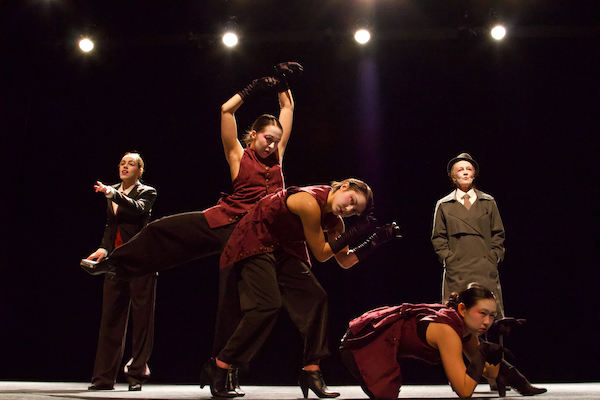
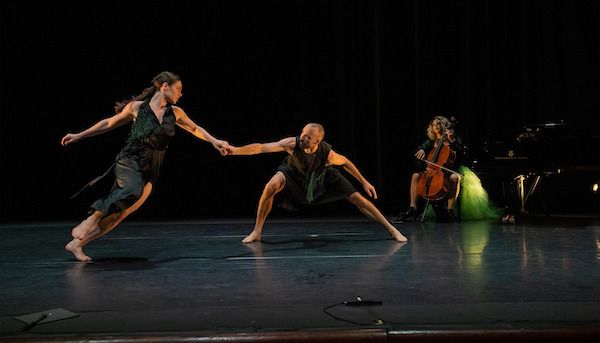
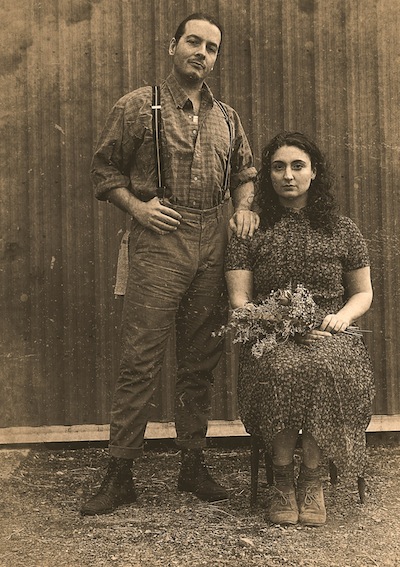
Into the Little Hill is a multi-disciplinary re-telling of the classic Pied Piper tale. Performances take place May 19 and 20 at SFU Goldcorp Centre for the Arts, Fei and Milton Wong Experimental Theatre. (photo by Flick Harrison)

In partnership with Simon Fraser University’s Woodward’s Cultural Programs, Astrolabe Musik Theatre presents the Canadian première of the chamber opera Into the Little Hill, a contemporary re-telling of the Pied Piper tale, with direction and choreography by Idan Cohen of Ne.Sans Opera and Dance, and musical direction by conductor Leslie Dala. Performances take place May 19 and 20, 7:30 p.m., at SFU Goldcorp Centre for the Arts, Fei and Milton Wong Experimental Theatre.

Into the Little Hill – by composer and classical musician George Benjamin with libretto by playwright and theatre translator Martin Crimp – is an unflinching look at our response to the “Other.” A mysterious stranger rids a town of its rats, only to also make its children disappear when his promised payment is withheld. The story evokes many questions. Who do we deem as “rats” in our society? Who gets to decide? What are we willing to do to get rid of them? And what are the consequences when we refuse to “pay the piper,” i.e. refuse to accept responsibility for the outcomes of our actions?

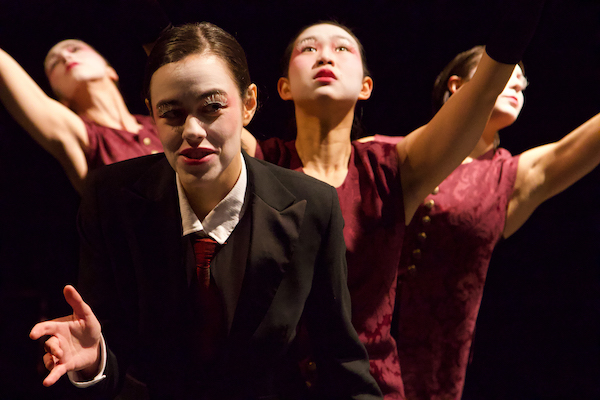
All six characters (the Crowd, the Stranger, the Narrator, the Minister, the Minister’s Wife and the Minister’s Child) are sung by mezzo-soprano Emma Parkinson and soprano Heather Pawsey. The orchestration for this production includes bass flute, basset horns, mandolin and banjo. And, in a multi-disciplinary staging, Astrolabe’s production incorporates dancers Juolin Lee, Daria Mikhalyluk and Hana Rutka.

“It has always been my vision to have dancers as part of this intensely dramatic opera,” said Pawsey, Astrolabe’s artistic director.

Lighting design for the production is by Victoria Bell; the costume design, by Elena Razlog.

Ne.Sans Opera and Dance’s Cohen was born and raised in Israel, on Kibbutz Mizra. After being trained as a classical pianist, he studied theatre and fine arts at the Art Colony, in Israel. At the age of 20, he participated in a video-dance project by Batsheva dance company dancer Lara Bersak before joining, in 1998, the Kibbutz Contemporary Dance Company, where he danced for seven seasons. Since 2005, Cohen has been creating, performing and teaching.

For tickets to Into the Little Hill, go to eventbrite.ca/e/into-the-little-hill-tickets-609025460547.

– Courtesy Astrolabe Musik Theatre

Who decides what culture is?

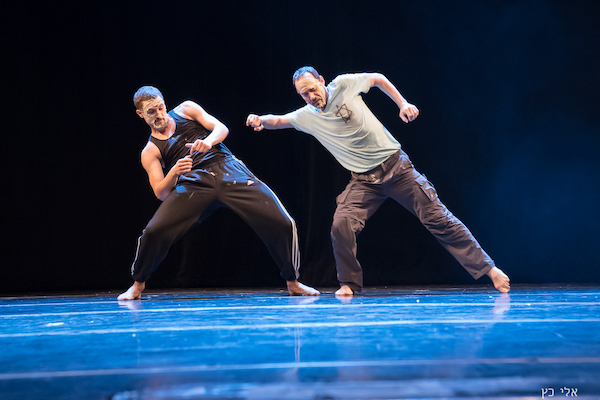
Mourad Bouayad, left, and Hillel Kogan in We Love Arabs, which is at the Dance Centre April 13-15. (photo by Eli Katz)

“I don’t have answers so I can only ask questions,” Israeli choreographer Hillel Kogan told the Jewish Independent. “If this is changing people’s political views, I doubt it, but at least what I’m trying to do is to put the questions on the table and make people, audiences, and myself see that art is not a separate sphere, that art is part of politics and social and cultural systems … and this is what I’m trying to expose in my pieces.”

The JI interviewed Kogan in advance of the Vancouver run of We Love Arabs, which is being presented at the Scotiabank Dance Centre by the Dance Centre and Théâtre la Seizième April 13-15. There will be both English- and French-language performances of this work, which also has Hebrew and Spanish versions. Kogan will dance the duet here with Mourad Bouayad.

We Love Arabs premièred at the 2013 Intimadance Festival in Tel Aviv. The brief outline for the piece, which Kogan has on his website, begins: “I address the audience, my name is Hillel Kogan. Some say that I do political art. I want to show you today how dance has the power to promote coexistence between Arabs and Jews in Israel. I invited an Arab dancer here….” The video teaser offers a glimpse of Kogan’s physicality, humour, tenderness, intelligence.

Born in Tel Aviv, Kogan has performed with and created for companies and choreographers around the world. At Batsheva Dance Company, he is director of educational programs. He is pursuing a master’s degree in cultural studies.

We Love Arabs garnered awards, and it has traveled to more than a dozen countries. The Vancouver show was postponed twice, said Mirna Zagar, executive director of the Dance Centre. First due to a scheduling conflict and then due to COVID. “However, I believe the work is just as relevant now as it was when we started,” she said. “It is an exceptional work that continues to engage audiences internationally.”

The Dance Centre often partners with other arts organizations, as a means of pooling resources and amplifying opportunities to show international artists. “This collaboration is along these lines,” she said. “I have known Esther Duquette, the now-outgoing artistic director at Théâtre la Seizième, for some years and the nature of this piece – multilingual and straddling theatre as well as dance – made it a perfect opportunity for our organizations to work together.”

The April 14 performance and talkback will be in French; the other two shows and the April 15 talkback in English. Kogan speaks six languages: Hebrew and Russian because his parents were born in the Soviet Union and he was born in Israel; he studied English in school; he learned French from working two years in Switzerland, and Portuguese and Spanish from working in Portugal for seven years. He doesn’t speak Arabic.

“This is interesting,” he said, “because this piece, We Love Arabs, is an autocritical peace that asks exactly this. Why am I facing the languages and cultures of the West and not the languages of my neighbours and of my co-citizens in Israel? Why don’t I read the books of Arabic writers? Why doesn’t Arab culture interest me, and why do I identify myself as ‘Western,’ which is a bit strange?”

It is both a geographic question, he said, living as he does in Israel, and a social, historical, cultural and political question. “And the piece deals with this question: who decides what the general culture is, and why I am – and why the Israeli art field, at least as I see it, is – so orientalist, which means looking at the Orient, at the Arab as inferior and wanting to impose on it the Western culture.”

The different versions of We Love Arabs resulted from Kogan’s wanting to perform the piece abroad, in the language the audience speaks. “I think it brings more this idea of relevance to the space,” he explained. “If I did the piece in Hebrew with subtitles, it would be more like a piece from Israel … and be framed as something local and in my perspective. The universality of the piece is one of the ideas – I want people to identify with it and, by choosing their own language, I feel there is more chance to make them sense that they are part of it as well.”

Kogan had no idea of how much impact We Love Arabs would have. “It was created for a small niche festival in Israel,” he said, and “for a specific audience who is already convinced in the political opinions that I hold. So, I didn’t imagine it ‘big.’… As I performed the piece out of Israel, I understood that the question of Jews and Arabs in Israel is just a microcosm of a more universal question: of the situation of power between minority and majority, and the way we see ‘the other’ – who is the master of the culture in any nation?”

In looking at the question, Kogan asks: “Who is invited to participate in creating a national identity, what is Israeli or what is Arab Israeli? It is not very different than the question of, I don’t know, for example, in Canada: who is invited, what is Canadian? Is it French? Is it American? Is it English? I don’t know the minority situation in Canada, but I know there is a history with Native Canadians. So, are they also invited to take part in culture? How much are they participating in mainstream dance, literature, music? How do we define what is high art and what is popular art? What is folk and folklore? And what is universal art?”

Initially dancing the duet with Kogan was Adi Boutrous, an Israeli Arab dancer who is also a choreographer and so not always available. Bouayad, who is French, danced in Israel in the Batsheva junior company. “This is how we met, so I invited him to perform with me,” said Kogan. “And, of course, it’s very different for an Israeli Arab to play the role of an Israeli Arab than for a French half-Arab person, because to be an Arab in France is different than to be an Arab in Israel.”

Not wanting to speak for Bouayad, Kogan noted that, while Bouayad may define “himself first as French, and his relationship with his Arab origins are just an extra part of his being,” for Israeli Arabs, he said, “I’m not sure that they are first Israeli and then Arab because of their own perception of themselves – but also the way the majority looks at them, the state looks at them, society looks at them, Jewish society looks at them.

“We often make the mistake even in the language, and we forget to say that Arabs are Israeli as well. We say Israelis and Arabs – even when we refer to Arabs who are citizens of Israel and who hold an Israeli passport, we call them Arabs, and we call ourselves, the Jews, Israelis…. We are both Israeli and the difference between us in definition is our religion. In a country like France, where it’s a republic and religion has at least formally not such an important role in the definition of citizenship and of nationality, then, of course, the change of cast is also changing the relationship.”

Kogan has no illusions that art can change the world. Elected politicians “are the ones who should change the world,” he said. For him, art is there to reflect, to inspire. “Art, for me, is a place for the imagination, for the possibility of not necessarily escaping reality, but giving an alternative to reality…. If art can feed the imagination and then, as an outcome of this feeding of imagination, can change the reality, OK, that’s great. But I think that … when artists try to change the world by their art – in history, at least as far as I see, it ends in political propaganda and just serves the hands of politicians.”

As many funny moments as there are in We Love Arabs, they have a profound purpose.

“I have anger towards some of the cultural systems, and the questions that I’m asking are involved with hard emotions. I feel that humour allows me to take some distance from the aggression and from being so emotionally involved,” said Kogan. “It allows me to laugh about myself as well. It allows me to invite people to laugh about a question without making it not serious. The laughing, I feel, is a tool to invite people to enter a conversation, to agree to criticize, to agree to ask questions … to see the bias, to be aware of the stereotypes, to be aware of the prejudgments that we have…. The laughter is just a means in order to speak about something very serious.”

For tickets to We Love Arabs, call 604-736-2616 or visit thedancecentre.ca.

Moscovitch play about life in Canada pre-legalized birth control

(photo by Matt Reznek – Reznek Creative)

Excavation Theatre presents What a Young Wife Ought to Know by Jewish-Canadian playwright Hannah Moscovitch, at Performance Works on Granville Island March 24-April 1.

It’s Ottawa in the 1920s, pre-legalized birth control. Sophie (Bronwyn Henderson), a young working-class girl, falls madly in love with and marries a stable-hand named Jonny (Michael Briganti). After two difficult childbirths, doctors tell Sophie she shouldn’t have any more children, but don’t tell her how to prevent it. When Sophie inevitably becomes pregnant again, she faces a grim dilemma. Inspired by real stories of mothers during the Canadian birth-control movement of the early 20th century, playwright Moscovitch vividly recreates a couple’s struggles with reproduction.

The Excavation Theatre production will be playing in the final weeks of Women’s History Month, exactly 100 years after Canada’s first birth-control advocacy group was formed in Vancouver, and fresh off the landmark announcement that birth control prescriptions will be free in British Columbia starting April 1. For tickets, visit excavationtheatre.com.

– Courtesy Excavation Theatre

Just for Laughs returns

Phil Rosenthal of Somebody Feed Phil takes part in Just for Laughs Vancouver on Feb. 19. (photo from JFL Vancouver)

Just for Laughs Vancouver returns for another year’s festival, presented in association with SiriusXM Feb. 16-25. It welcomes back Best of the West, highlighting local talent, and reintroduces the Creator’s Series, with the first guest confirmed surely to be an entertaining afternoon: Phil Rosenthal. Listed below are some of the Jewish community members participating in the festival.

A Conversation with Phil Rosenthal /  Feb. 19, 5 p.m., at Vogue Theatre

Rosenthal is the award-winning creator, executive producer and host of Netflix’s hit Somebody Feed Phil, as well as a New York Times best-selling author. The Emmy-nominated unscripted documentary series combines Rosenthal’s love of food and travel with his unique brand of humour and he recently won a 2022 Critics Choice Real TV Award for Best Travel/Adventure Show on behalf of the series and garnered a 2022 James Beard Award nomination. He also recently released Somebody Feed Phil: The Book, which instantly landed on the New York Times bestseller list.

Sarah Silverman: Grow Some Lips / Feb. 23, 7 p.m., at Queen Elizabeth Theatre

Silverman is a two-time Emmy Award-winning comedian, actress, writer and producer. She currently hosts her weekly podcast, available on iTunes and wherever podcasts are available. She can next be seen as the host of TBS’s Stupid Pet Tricks, an expansion of the David Letterman late-night segment. She recently wrapped production on Netflix’s Maestro, a biopic on the life of composer Leonard Bernstein, where she will star opposite Bradley Cooper.

Ari Shaffir / Feb. 25, 9:30 p.m., at Vogue Theatre

Shaffir is best known for the storytelling show he created and hosted on Comedy Central called This Is Not Happening. His last Netflix special, Double Negative, won a Grammy for best comedy special before the award committee realized it was too filthy and didn’t represent the high standards that the Grammys has long stood for so the honour was stripped from him. Shaffir has had numerous appearances on the Joe Rogan Experience podcast, as well as WTF with Marc Maron, The Adam Carolla Show and Your Mom’s House. His own podcast, Ari Shaffir’s Skeptic Tank, is a chart topper that comes out every week.

Sarah Sherman / Feb. 16, 9:30 p.m., and Feb. 17, 7 p.m., at Biltmore Cabaret

Sherman aka Sarah Squirm is currently a featured player on Saturday Night Live. Outside of the show, she is known for her unconventional and popular live show, Helltrap Nightmare. She was chosen as one of the 2021 Just for Laughs’ Montreal’s New Faces of Comedy.

Jared Freid / Feb. 22, 9:30 p.m., and Feb. 23, 7 p.m., at Rio Theatre

Freid is a stand-up comedian based out of New York City, with a strong focus on dating and relationships. His comedy is current and reflects the ordinary daily thoughts of everyone you know, especially if you know a lot of millennials who are obsessing over dating apps, trying to be real adults, and worrying about their bodies. He co-hosts the podcast U Up? with Jordana Abraham, where they discuss their takes on modern dating, and recently launched a new show, Dating Makeover, a podcast presented by Spotify.

An Intimate Evening with Adam Pally / Feb. 17, 7 p.m, at Rio Theatre

Songs, stories and jokes come together just like Momma used to make it. Enjoy the stories, sing along to the songs, hopefully think the jokes are in fact jokes and the price of the ticket and commute and being around a bunch of strangers was worth it. I, uh, I mean whoever is writing this, definitely not Adam Pally, is so thankful for the opportunity to entertain you.

Hannah Berner / Feb. 18, 9:30 p.m., at Rio Theatre

Berner was born in Brooklyn, N.Y., and played competitive tennis for the University of Wisconsin. She emerged on the comedy scene by directing, editing and acting in videos on Instagram and writing viral tweets. She has two podcasts, Giggly Squad and Berning In Hell. Berner is an advocate for mental health, animals and napping.

* * *

For the full Just for Laughs Vancouver lineup and show tickets, visit JFLVancouver.com. 

– Courtesy JFL Vancouver

The Moaning Yoni returns

In this scene from their solo physical comedy The Moaning Yoni, Joylyn Secunda is playing the vulva character, Yoni, who is based on the archetype of the Jewish mother (inspired by their own grandmother) – Yoni is strangling the Disembodied Voice of the Patriarchy with a tampon string. (photo by Eric Zennstrom)

Joylyn Secunda is an actor, dancer and puppeteer. In The Moaning Yoni, Secunda brings to life more than a dozen characters to tell the story of a young college student named Zoë who is just trying to fit in, until one day she applies an elixir, and her vulva starts to talk. From Tinder to Tantra, The Moaning Yoni explores the intersection of gender, sexuality and spirituality.

Secunda has performed The Moaning Yoni some 50 times in cities across Canada. Other recent credits include Scrooge in A Wonderheads Christmas Carol (the Wonderheads), Zephyr in Crisis on Planet Z (Monster Theatre), Seek in Pop Pop (Presentation House) and puppeteer in The Breathing Hole (National Arts Centre).

The Moaning Yoni contains mature language and sexual themes. The Feb. 3, 7:30 p.m., show at the NEST on Granville Island will be hosted by drag artist Continental Breakfast. Tickets are $25 and can be purchased from eventbrite.com.

Controversy welcome

Soldiers of Tomorrow, about Itai Erdal’s experiences in the Israeli army, is at the Roundhouse Feb. 3-5. (photo from the Elbow Theatre)

“I know that this play will piss off a lot of people on both sides of the conflict, but I welcome the controversy. I am taking some strong stances and talking about some explosive subject matters (pun intended) so, if it wasn’t going to piss people off, then I probably didn’t do my job properly,” Itai Erdal told the Independent. “I think it’s good to challenge people and I welcome the discussion that this play will generate.”

Erdal was talking about Soldiers of Tomorrow, which he wrote with Colleen Murphy. The play is part of this year’s PuSh International Performing Arts Festival, and sees its world première Feb. 3-5 at Roundhouse Performance Centre.

Presented by the Elbow Theatre and PuSh, Soldiers of Tomorrow is directed by Anita Rochon and performed by Erdal with Syrian musician Emad Armoush.

“When I was a kid growing up in Israel, peace seemed inevitable – it was just a matter of time, there were countless songs about the day peace will arrive. The adults would always say, ‘By the time you grow up, we won’t need an army anymore.’ No one says that today,” writes Erdal on his website. “Most Israelis accept that their children will be soldiers. One day, when my nephew was 8, he came home from school with an empty box to fill with stuff to send to soldiers on the front line. Inside the box his teacher had written: ‘To the soldiers of today from the soldiers of tomorrow.’”

This experience inspired the play. While fictional, it is about real events that happened to Erdal during his time in the Israel Defence Forces in the early 1990s.

“I served in the army for three years and as a combatant soldier,” said Erdal. “I would have had to be in the reserves until the age of 45, which I didn’t want to do. I was in Jerusalem during all the suicide bombings in the ’90s and my reluctance to continue to be a soldier and my exhaustion of the political situation definitely contributed to my decision to immigrate to Vancouver.”

Erdal has made his mark here in many ways, including as an award-winning playwright, performer and lighting designer. He created the Elbow Theatre in 2012 “to confront urgent social and political issues.” Soldiers of Tomorrow is its sixth production. The PR blurb notes that, in it, Erdal “relates his actions in the army, exploring his personal culpability in the face of complex geopolitical forces in his former country – a place that he loves ‘with a broken heart.’”

“I pitched the idea for this play to Colleen Murphy in 2018 when we were working together in Stratford,” Erdal told the Independent. “We met a few times that year, but it really took off when the pandemic started. For almost two years, Colleen and I would meet on Zoom every Monday and Thursday for two hours. It was really great to have a project during the lockdown, it kept me sane.”

Although it is a one-man play, Armoush will also be on stage with Erdal, performing the music live. As to how he connected with Armoush, Erdal said, “I was looking for a Palestinian musician but there aren’t many of them in Vancouver and Emad was highly recommended by my Israeli musician friends.”

About the timing, Erdal explained, “During my lifetime, the situation for Palestinians has only gotten worse, it never gets better. Israel recently formed the most extreme right-wing government in its history, with several openly racist and homophobic ministers. Many Israelis and Palestinians are bracing themselves for the worst. Unfortunately, this play is more relevant than ever.”

He is not concerned about how Jews in general or Israelis specifically will be perceived by non-Jewish people who see the play.

“I am a very proud Jew and, even though I criticize the state of Israel, I do so because I love it, and I think that love is clear in the play,” said Erdal, who shared the following quote from the play: “I am aware that this is a topic that intimidates many Canadians. I’ve seen the glazed look in your eyes. I’ve had many people ask me to explain the conflict to them and, after one minute, they are searching for the exit. I’ve also seen many people twist themselves into pretzels in order not to take sides because they were concerned about appearing antisemitic. I hope by the time you leave here, you’ll be able to criticize Israel without worrying about appearing antisemitic.”

Soldiers of Tomorrow is at the Roundhouse Feb. 3-4, 7:30 p.m., and Feb. 5, 2 p.m., with a post-show talkback after the Feb. 4 performance. The show is 75 minutes long, with no intermission. Tickets ($34) can be purchased at pushfestival.ca.

The PuSh International Performing Arts Festival runs Jan. 19-Feb. 5. It features 20 original works – theatre, dance, music, multimedia and circus – from 12 countries and includes six world premières, one North American debut, six Canadian and two Western Canadian openings and one Vancouver première. Single tickets start at $34 in-person, $25 online, plus there are pay-what-you-can and free events; passes, which offer a discount and other perks, are available for both in-person and digital shows. Visit pushfestival.ca or call 604-449-6000.

Sacre premières here

Circa’s Sacre is an exploration of humanity’s interconnectivity, our inherent sexual desire and our complex relationship with divinity. (photo by Pedro Greig)

DanceHouse and the Cultch present the Canadian première of Circa’s acrobatic Sacre, on stage Jan. 17-21, 8 p.m., at the Vancouver Playhouse. Directed by Jewish community member Yaron Lifschitz, artistic director and chief executive officer of Circa, Sacre is an exploration of humanity’s interconnectivity, our inherent sexual desire and our complex relationship with divinity. Inspired by Igor Stravinsky’s seminal production The Rite of Spring, the full-length work from Australia’s leading contemporary circus company is a blend of balletic lines and athletic feats, infused with pulsating and dissonant elements of a reimagined Stravinsky score.

“This is a work of powerful juxtapositions, blending the sacred with the profane; the ethereal with the visceral. On one level, Sacre is a work of mesmerizing beauty, drawing on the lyrical movement of contemporary dance and the intense physicality of the circus arts,” said Jim Smith, artistic and executive director of DanceHouse. “At the same time, the work offers a raw and bracing social commentary, drawing upon the ancient pagan traditions referenced within Stravinsky’s transgressive work – in which a virginal young woman dances herself to death. This offers an intriguing and gritty contrast to the pure spectacle of the performance, and invites reflection on the nature of humanity’s responsibility toward one another in a world on the brink of disaster.”

Stravinsky’s The Rite of Spring was so scandalous that it incited a riot at its Parisian première in 1913. Despite – and partly because of – this incendiary start, the work is now considered one of the most impactful compositions of the 20th century. Circa’s new interpretation of the haunting work premièred in January 2021 at the Illawarra Performing Arts Centre in Wollongong, Australia. Sacre features 10 acrobats interwoven in ceaseless motion, as they deftly move in and out of technically complex grouping structures, lifts, tumbles and leaps.

Set to a pounding musical score by Philippe Bachman, full of fast-paced tempo and mood changes, and echoed by a lighting design by Veronique Benett that moves through intense flashes of light and darkness to dim lighting that slowly brightens, the work methodically builds into a crescendo with heart-pumping intensity.

Circa’s Lifschitz is a graduate of the University of New South Wales, University of Queensland and National Institute of Dramatic Arts (NIDA), where he was the youngest director ever accepted into its graduate director’s course. Since graduating, Lifschitz has directed more than 60 productions throughout his career, including opera, theatre, physical theatre and circus. He was founding artistic director of the Australian Museum’s theatre unit and head tutor in directing at Australian Theatre for Young People, and has been a regular guest tutor in directing at NIDA. He was creative director of Festival 2018: the arts and cultural program of the 21st Commonwealth Games.

Lifschitz has served as artistic director and CEO of Circa, based in Brisbane, since 2004. The company has performed in more than 40 countries across six continents to more than 1.5 million people. Circa has presented at major festivals and venues around the world, including Brooklyn Academy of Music, the Barbican Centre, les Nuits de Fourvière and Chamäleon Theatre Berlin.

For tickets and further information about Sacre, visit dancehouse.ca.

Courtesy DanceHouse and the Cultch

Go see Courage Now

Left to right, Katherine Matlashewski (as Shayna Schneider), Advah Soudack (as Margaret Grant) and Amitai Marmorstein (as Jankl Schneider) in Courage Now, playing at the Firehall Arts Centre until Dec. 4. (photo by Youn Park)

One does not often get a chance to see a world première of a play in Vancouver. After writing my preview article on Courage Now in the last edition of the Independent, I was looking forward with great anticipation to seeing the final product. I was not disappointed.

It is a difficult story to tell but it is done with such sensitivity and style that I highly recommend seeing it. As a child of a Holocaust survivor, any story of courage and heroism arising out of that era resonates with me – this one in particular had me in tears.

From the moment you walk into the intimate Firehall Arts Centre theatre, you know you are about to see something special. The set is austere – a desk, a bench, a lattice-like trellis, an empty wall-mounted picture frame – with a pagoda-style roof and an archway backlit with vibrant colours. (Kudos to set designer Kimira Reddy and lighting designer Itai Erdal.)

To summarize the backstory, Chiune Sugihara, the Japanese consul in Kaunas, Lithuania, in 1940, against the instructions of his government, issued more than 2,300 handwritten visas in a 30-day period to save Jews trying to leave Poland and Lithuania. He was supported in his decision by his wife, Yukiko, who knew the price the family would pay for going against the government edicts. And a price was paid: career loss, humiliation and Sugihara’s self-imposed postwar exile to Russia for 16 years.

The play follows what appear to be two separate narratives that intersect in an unexpected way in the final scene. In 1986, Yukiko (playwright Manami Hara) is forced to revisit wartime when a visitor from Vancouver, Margaret Grant, born Shayna Schneider (Advah Soudack), comes for answers from Sugihara as to what happened to her father after he put her on a train out of Kaunas when she was 13 years old. She has resented her father through the years, feeling abandoned and betrayed by his sending her off alone; she is also coping with a difficult divorce and her own daughter’s hatred. Sugihara has recently died, however, and Margaret must turn to Yukiko for answers instead.

The play opens with Yukiko waking from a dream where she is visited by the ghost of her husband. Then Margaret enters her garden. She tells Yukiko, “I am a Sugihara Jew, Sempo saved my life.” The play then moves through a series of memory flashbacks, as the audience is transported back and forth between 1940 Kaunas and 1986 Japan.

Katherine Matlashewski plays the teenage Shayna and Amitai Marmorstein plays her father, Jankl. Jankl visits Sugihara (Ryota Kaneko) to plead for visas on behalf of the thousands of Jews who have been lining up every day outside the consul’s office. In a touching and poignant scene, something as simple as a shared cup of coffee gives you a sense of the integrity and honour of these two men as they strive to do the right thing. Kaneko plays Sugihara with a quiet intensity and Marmorstein portrays Jankl with dignity. The scene where he sees Shayna off at the train station is heartbreaking – he watches his only child (his “little mouse,” as he calls her) walk away from him, tattered suitcase in hand, in a fog of smoke and the eerie sound of a train whistle in the distance.

photo - Ryota Kaneko plays Chiune Sugihara and Courage Now playwright Manami Hara takes on the role of Yukiko Sugihara
Ryota Kaneko plays Chiune Sugihara and Courage Now playwright Manami Hara takes on the role of Yukiko Sugihara. (photo by Youn Park)

In many ways, the journeys of the two women are love stories. Yukiko grapples with the grief of losing her husband, moving through the stages towards acceptance, and Margaret comes to the realization that it was her father’s love that put her on that train in 1940. Both characters become conduits for the other’s catharsis. When Yukiko shares her husband’s journal from that time, Margaret says, “My father lives in that journal.”

All five of the actors do credit to their roles in this ensemble piece but Hara and Soudack’s performances are sublime. The play is particularly effective when all five actors are on stage at the same time in the memory flashback vignettes.

My one criticism is that there is quite a bit of Japanese dialogue between Kaneko and Hara and it would have been helpful to have either a reader board translating or a program insert with translations.

Hara has penned a lovely tribute to Sugihara and I, for one, am grateful to her for her work.

Courage Now is at the Firehall until Dec. 4. For tickets, visit firehallartscentre.ca.

Tova Kornfeld is a Vancouver freelance writer and lawyer.

Old Stock returns by popular demand

Ben Caplan stars in Old Stock: A Refugee Love Story, which opens at SFU Goldcorp Centre for the Arts Dec. 1. (Stoo Metz Photography)

Ben Caplan is narrator and co-creator (with Christian Barry and Hannah Moscovitch) of Old Stock: A Refugee Love Story, which opens at SFU Goldcorp Centre for the Arts Dec. 1. It is a fantastic show, well worth seeing, which was last in Vancouver for the 2020 PuSh Festival.

“The show hasn’t changed all that much,” said Barry, artistic director of Halifax’s 2b theatre company. “We have a brilliant new drummer and keyboardist working on the show and, on top of that, the team has more skill and experience just by virtue of having had more opportunities to refine our show through repetition. But, ultimately, the reason we are bringing [it] back to Vancouver is all about access. In January 2020, we were only able to perform six times at UBC as part of the PuSh Festival. It was a lovely run with full houses and boisterous responses, but we think there were many people who just didn’t have the chance to see the show. We were thrilled to receive an invitation from SFU to bring the show back, and to perform in downtown Vancouver.”

To read more about the music-theatre performance, visit jewishindependent.ca/searching-for-a-safe-harbour. For tickets, go to eventbrite.com.

Reimagining together

A scene from Site: Yizkor as it was performed in Sichów Duży, Poland, this past June. (photo from Chutzpah!)

Site: Yizkor is both an intensely personal work and a powerful, universally meaningful work. It is ever-changing and spans the past, present and future.

“For me, this project is a gesture of healing,” co-creator Maya Ciarrocchi told the Independent. “My goal for audiences and participants is that, through the process of shared commemoration, we may put aside our differences and look towards a reimagined future.”

Part of this year’s Chutzpah! Festival, Site: Yizkor is a collaboration between Canadian multimedia artist Ciarrocchi and American composer Andrew Conklin. It is an evolving “interdisciplinary project [that] explores the physical and emotional manifestation of loss through text, video and music.” It is an installation (of video, prints and drawings) and a performance, and includes workshops “where participants are invited to create their own Yizkor pages as a way to mourn and commemorate lost people and places.”

“Yizkor books are documents written by Holocaust survivors to commemorate the villages they lived in before the Second World War,” explained Ciarrocchi. “They capture the spirit of these places by describing the day-to-day life of their Jewish citizens. They include lists of the Jewish residents, the structure of political systems and where the best shopping could be found. They also include photographs and maps of the villages drawn from memory. They document a time and place that no longer exist but the traces of which are visible in the contemporary landscape.”

In introducing the project to workshop participants, Ciarrocchi said, “I tell them that, while Site: Yizkorexamines displacement through the lens of Yizkor, which is an inherently Jewish framework, the project is not limited to the Jewish experience. Site: Yizkor is centred on creating a space for shared commemoration and the universal experience of loss.”

photo - Maya Ciarrocchi
Maya Ciarrocchi (photo © Joanna Eldredge Morrissey)

For the local presentation, Conklin works with a local string quartet for the performance, while Ciarrocchi creates “video projections for the performance that include references to the known and erased histories of Vancouver,” and installs the exhibit in the gallery. She leads the workshops, which include both Jewish and non-Jewish community groups, and participants “are invited to read their text as part of the performances or share them as written documents or drawings as part of the exhibition.”

Site: Yizkor has been presented in New York City and in San Francisco. In June of this year, it was presented in Poland, from where Ciarrocchi’s maternal grandfather immigrated to Canada; Ciarrocchi was born in Winnipeg.

The project began in 2018, when Ciarrocchi was a fellow in the Laboratory for Jewish Culture program in New York City. “At the time,” she said, “I was working on a series of drawings depicting former Polish and Lithuanian wooden synagogues layered with memory maps sourced from Yizkor books. As part of the project, I gave a performance lecture where I read passages from Yizkor books, accompanied by projections of my drawings, maps and photographs from Yizkor books. I concluded the performance by prompting the audience to ‘describe a vanished place of personal importance.’ I collected these texts, and they were incorporated into future performances.”

photo - Andrew Conklin
Andrew Conklin (photo from Chutzpah!)

She met Conklin around when she was in residency at Millay Arts in upstate New York. “He expressed interest in using my drawings of maps as a musical score,” she said. “We then started working on a sound/video project comprising his compositions and my animated maps and drawings.”

In 2019, Ciarrocchi was invited to attend an international meeting of interdisciplinary artists in Poland.

“The group gathered in Sichów Duży, a rural area not far from Staszów, a small town that was once an important centre of Jewish life,” said Ciarrocchi. “The site once belonged to an aristocratic family who lost their lands and titles during the Second World War. The buildings had been restored except for one and, one evening, I projected the video on its surface and played Andrew’s music from speakers inside. It was then I knew that I needed to return to this place and present the work live with musicians inside the structure. In June 2022, after three years, a pandemic and a war, I returned to Sichów with a team of musicians from the U.S., Germany and Poland. We presented Site: Yizkor inside the ruin to an audience comprised of Ukrainian refugees who were being housed on the site. The following week, we presented Site: Yizkor in another ruined manor home outside of Kraków. That iteration included dancers as well as musicians.”

It was an emotional experience.

“Gratitude and relief,” said Ciarrocchi about what she felt afterward. “Gratitude to Andrew and the incredible team of performers we assembled and to the funders who supported the work. Relief after all the planning and delays that we were finally able to bring the work to Poland. It was also exciting to see the project come together so beautifully. In many ways, my first research trip in 2019 was where I felt all the sadness and grief. This year, I was too busy to let myself go into the dark crevasses of my emotions. In 2019, though, I spent most of the three weeks I was there crying. I visited my grandmother’s shtetl, which was incredibly powerful. While sitting on the ground in the old Jewish cemetery there, I released all my grief. Poland is filled with ghosts. One does not help but feel their presence.”

It is in this context that the question asking workshop participants to “describe their dreams of the future” was added to the project.

“I added this part of the prompt in Poland,” said Ciarrocchi. “I realized that, understandably, so much of the Jewish experience there is about memory and the past. I’m two generations removed from the Holocaust and, while its effects are written into the code of my body, I am also interested in how we create something new from the residue of this loss. This also comes from these past years of the pandemic, when there has been such a huge loss of life. We’ve had to reimagine how we live now and in the future.”

The performance and exhibition of Site: Yizkor in Vancouver is the Canadian première of the work.

For a recent grant proposal, Ciarrocchi wrote about the première, “This event will also be a coming home. Site: Yizkor is rooted in research into the land and architecture of a place in relation to the known and mythological histories of my ancestors who fled Poland and Lithuania before the Second World War. My ancestors emigrated to Canada to form a new life for themselves and their descendants. On the surface, their story is one of success. My great-grandfather was a seminal figure in Winnipeg’s garment industry, and my family still benefits from his accomplishments. This story belies how the effects of trauma and displacement have persisted from their origins in Eastern Europe so many decades ago. Forming cross-cultural connections through Site: Yizkor’s performance and workshop model, first in Poland and now in Canada, irrigates ancient inherited wounds.”

Site: Yizkor is co-presented with the Zack Gallery and in partnership with the Vancouver Holocaust Education Centre, with the support of the Jewish Community Foundation. The performance takes place Nov. 19, 8 p.m., at the Rothstein Theatre, and it will livestreamed and available on demand; it will include a facilitated talkback and a reception with the artists. The exhibition and workshops take place Nov. 12-19 in the gallery. For tickets and more information, visit chutzpahfestival.com.