Honouring ancestors’ stories

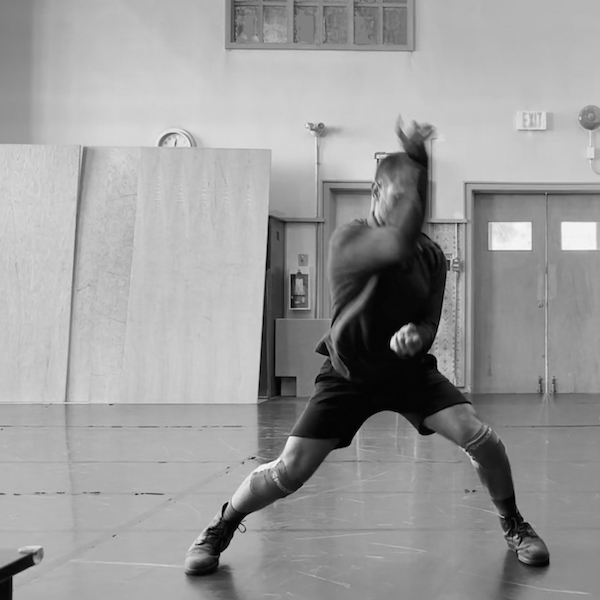
Juan Villegas rehearsing Edictum, choreographed by Vanessa Goodman, which is about Villegas’s Sephardi ancestry. The work is part of Dancing on the Edge’s EDGE One July 6 and 8 at the Firehall Arts Centre. (video still from Vanessa Goodman)

“I am very happy to be able to share my work and talk about Sephardic Jews, as I am doing a lot of research and I am discovering a lot about my own culture and where it comes from,” Juan Villegas told the Independent about Edictum, a new work with Vanessa Goodman about his family heritage, an excerpt of which he will perform at this year’s Dancing on the Edge July 6 and 8. “Throughout history, the Jewish community has suffered a lot and I am very happy to be able to pay respect, honour, shed some light and help tell the story of my ancestors,” he said.

Villegas and Goodman had already started their collaboration when Villegas found out that his ancestors were Spanish Jews who, following the Alhambra Edict of Expulsion in 1492 and the persecution of Jews by the Spanish Inquisition, sought refuge in Colombia.

In 2015, Spain passed legislation to offer citizenship to members of the Sephardi diaspora, but the window of opportunity to apply was only a handful of years and Villegas’s family missed it. However, they did apply to Portugal, which passed a similar law, also in 2015. Given the number of applicants, it could be several years before the family finds out. For the application, certified records were needed, so Villegas’s siblings hired a genealogist.

“They did both of my parents’ family trees and both ended up having the same ancestor – Luis Zapata de Cardenas, who came to Antioquia, Colombia, from Spain in 1578 and whose family had converted to Catholicism in Spain,” he said. “What is unclear to me is whether Luis Zapata de Cardenas was a practising Jew and was hiding it or if his family back in Spain became Catholic and raised him Catholic. I find it very hard to believe that people fully converted to Catholicism, as religion is so embedded in one’s culture and must be very difficult to switch by obligation. So, this is probably when they started disguising some Jewish rituals as Catholic, which happened a lot in Colombia.”

Villegas left Colombia in 2003, at the age of 18, concealing from his family his real reasons for leaving.

“I told them that I was going to only be in Canada for eight months to study English and then come back to Colombia,” he shared, “but deep inside I knew that I wanted to find a way to stay in Canada. I am gay and had a hard time growing up in Colombia – without realizing it, I was also escaping from a traumatic childhood, as I had been sexually abused and bullied at school. I was lucky enough that my parents helped pay for ESL studies in Canada and then I was able to do my university studies in Vancouver at Emily Carr University.”

After getting a bachelor’s degree in design from Emily Carr, Villegas worked at a design studio but was let go when the economy collapsed in 2008. He took about a year to figure out what he wanted to do next.

“I had a lot of unresolved trauma and I think it was a combination of having the time and (unconsciously) wanting to be healed from trauma that I started taking yoga and dance classes,” he said. “I met a dance artist named Desireé Dunbar, who had a community dance company called START Dance and she invited me to join her company. Vanessa [Goodman] had just graduated from the dance program at SFU and she was in the company also, this was back in 2009. Then, in 2010, I joined the dance program at SFU and Vanessa came to choreograph for us a couple of times. I always loved working with her and I felt like I connected with her.”

Graduating from SFU with a diploma in dance, Villegas moved to Toronto, where he danced for a few years. When he returned to Vancouver in 2017, he started following Goodman’s work. Intrigued, he asked if she would choreograph something for him and she agreed.

“And that piece that we created was about family,” he said, “but we left it at that, because I did not get the grants I needed to continue the work. So, when I discovered about my Sephardic Jewish ancestry, I pitched the idea to her and she agreed (without me knowing that she also has a Jewish background).”

video still - Juan Villegas rehearsing Edictum
Juan Villegas rehearsing Edictum. (video still from Vanessa Goodman)

Everything fell into place, he said, including some funding, so they took up work again this year on Edictum, which is Latin for order or command. The project was always intended to be a solo for Villegas, and they had started by “diving into his family history and the names of his ancestors to build movement language,” said Goodman.

“Since his family found that they have Jewish ancestry and were a part of the diaspora from Spain and Portugal in the 1400s, we found it very relevant to revisit the starting material and expand on this history inside the work,” she said. “I was raised Jewish culturally and we found, through conversations about our family rituals in relation to culture, food and celebration, there were some very interesting links between his family’s expressions of their identity and mine. We have woven these small rituals into the piece and have found a very touching cross-section of how this can be shared through our dance practice in his new solo.”

Goodman is also part of plastic orchid factory’s Ghost, an installation version of Digital Folk, which will be free to visit at Left of Main July 13-15. It is described on plastic orchid factory’s website as “a video game + costume party + music and dance performance + installation built around the desire to revisit how communities gather to play music, dance and tell stories.”

“I began working with plastic orchid factory on Digital Folk in the very early days of its inception,” said Goodman. “James [Gnam] and Natalie [Purschwitz] began researching the work in 2014 at Progress Lab, and I was a part of that initial research for the piece. Since then, the work has been developed over a long period of time with residency creation periods at the Cultch, at Boca del Lupo, at the Shadbolt, at SFU Woodward’s, and it has toured Calgary and northern B.C. This work lives in several iterations, but the Ghost project is a beautiful way for the work to live in a new way one more time. The cast got together at Left of Main in December of 2022 and filmed the piece for this upcoming iteration…. It is exciting to see a work have such a rich life with so many incredible artists who have been a part of this project.”

Dancing on the Edge runs July 6-15. It includes paid ticket performances at the Firehall Arts Centre, where Edictum will be part of EDGE One, and offsite free presentations, such as Ghost. For the full lineup, visit dancingontheedge.org.

Get ready to laugh it up

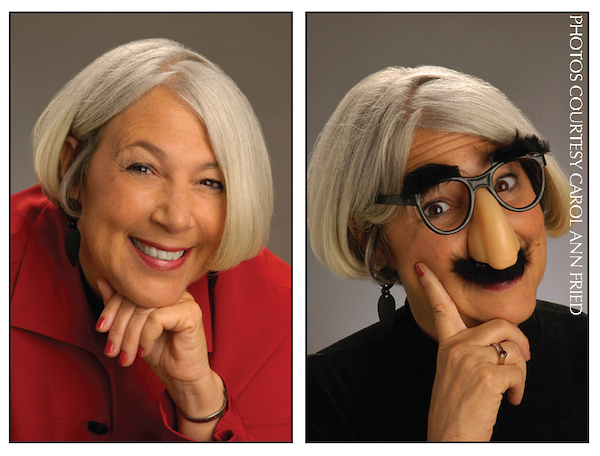
Carol Ann Fried as herself, and as Groucho Marx. Fried presents the program Laughing Matters at the May 28 Jewish Seniors Alliance Spring Forum. (photos from Carol Ann Fried)

Carol Ann Fried helps people find their “joy spot.” When she brings her interactive presentation to the Jewish Seniors Alliance Spring Forum May 28, she promises: “My goal is it’s going to be the most fun meeting they’ve ever attended.”

Fried is a Halifax-raised, Montreal-educated, Vancouver woman whose Friedom Training and Coaching Services include keynote speeches, workshops and meeting facilitation. She is also chief executive officer of Playfair Canada, which offers noncompetitive adult play experiences, especially to first-year students on Canadian campuses.

The joy spot is found in many ways, but it always involves connecting people with one another, she told the Independent.

“I do it by getting people to interact in creative and fun ways, toward some kind of end, if it’s a theme or team-building or fun at work or fun at home,” she said. “This can happen in various ways, but the way I do it is to get people up moving, usually, interacting with each other, talking with each other, doing some kind of activity.”

Typically, she does this with businesses, organizations and teams. In her program with the Jewish Seniors Alliance, laughter will be a core objective.

While members of the JSA may be longtime friends or acquaintances, Fried promises that, by attending her program, “They are going to get to know each other in new ways. They are going to make new connections, they are going to laugh. There will be laughter.”

After growing up in Halifax and studying at Dalhousie University, Fried got a master’s degree in counseling at McGill University in Montreal and eventually made her way west. She has served on the board of Or Shalom synagogue and is currently the chair of the membership committee.

If she has one piece of advice for people – attending her program or not – it is “Be courageous.”

That can mean something as simple as being willing to play.

“In our world, people somehow have the idea that play is for children and that we have to get serious when we get taller,” Fried said. “The idea of it is pooh-poohed by a lot of people. But my work is about getting them to do it before I tell them what they’re going to do.”

In corporate settings, she calls this “Managing to have fun.”

“I love jazzing up meetings,” she said.

Fried also has an affinity for doing programs with food.

“You can do a lot of things around food – Jewish people and food,” she said. “You can have a bag and in the bag are a variety of implements that are anything but cutlery. One of them could be the egg beater, the carrot peeler, a salt spoon, the things that you find in that drawer where you throw everything. People pull a ribbon and they have to eat their whole meal with that one thing. There are no forks, knives or spoons in there. It’s super-fun and it would be great for one of these family meals where you’re worried about how people are going to get along.”

Another idea is a “backwards meal” – spoiler alert: it’s eating dessert first.

“I really believe that shared laughter and play are essential to a healthy lifestyle,” said Fried. “When we are playful, all sorts of good things happen in our body, all those horrible hormones decrease and all the good ones increase. It affects morale, it affects creativity, all very positively. They’re going to experience each other in different ways than they otherwise would or that they are used to or that they have at other times.”

JSA’s Spring Forum takes place May 28, 2 p.m., at the Peretz Centre. Fried’s program is titled Laughing Matters. Call 604-732-1555 or email office@jsalliance.org for more information.

KDHS hits all the right notes

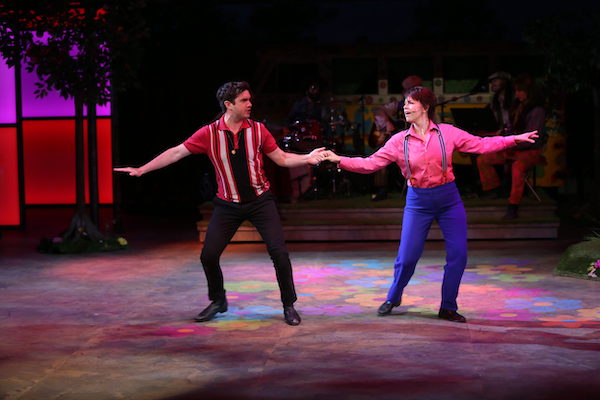
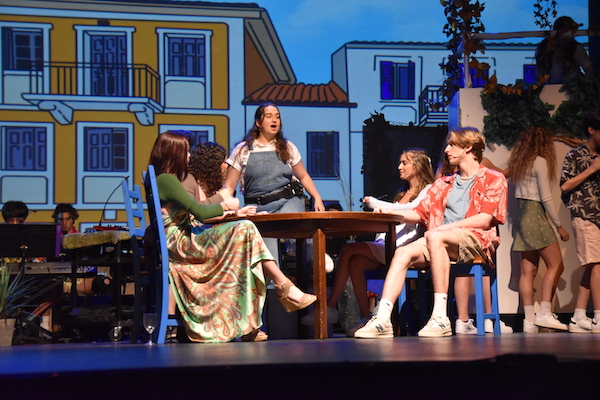
Rachel Gerber, playing Donna Sheridan, performing “Money, Money, Money” in King David High School’s production of Mamma Mia! (photo from KDHS)

High school theatre programs have the power to unite a student body. At King David High School, community values are inseparable from the student experience, and their recent production of Mamma Mia! May 3-4 was a captivating demonstration of exactly that.

Mamma Mia! follows a young bride’s search for her birth father, leading her to invite three of her mother’s former lovers to her wedding. It is a tale of love, friendship and family, told through the beloved hits of the iconic ABBA. I was lucky enough to see the King David High School production of the show on its sold-out closing night May 4. The audience was brought to its feet by the final song, “Waterloo.”

Staging a musical such as Mamma Mia! requires teamwork and camaraderie. The show largely relies on its ensemble and King David’s ensemble and principal actors seamlessly collaborated in their singing, dancing and acting. Several of the actors agreed that the most meaningful part of the process was the cast coming together over the course of rehearsals and the performances.

The cast featured students from grades 8 to 12. The on-stage band, led by Johnny Seguin, was professional and impressive, providing a soulful and steady backbone for the actors. With an electric musical score, a heart-warming plot and countless laughs, any theatre’s take on Mamma Mia! is sure to delight its audience, and this production was no exception.

The graduating seniors of King David claimed the stage in roles that showcased their respective talents. The curtains rose as Kailey Bressler, playing Sophie Sheridan, enchanted the audience with an angelic rendition of “I Have a Dream.” Bressler – who, full disclosure, is my sister – portrayed Sophie with a balance of sweetness and confidence, accompanied by her breathtaking voice. While I did not see Mhairi Hemingson’s portrayal of Sophie the day before, she earned herself rave reviews – I heard she gave a genuine and graceful performance.

The introduction of Sophie’s mother, Donna Sheridan, and the Dynamos sent laughter and excitement throughout the audience. Nikki Wiseman brought energy and humour to the character of Rosie, skilfully counterbalanced by Kiera Katz’s poised and classy portrayal of Tanya. Both Wiseman and Katz said that a memorable part of the rehearsal period was developing the dynamic between their characters, and their efforts paid off, eliciting roaring laughter with each interaction. Completing the trio was Rachel Gerber’s portrayal of the matriarch, Donna. Gerber’s performance emanated confidence, energy and depth, bringing some to tears with her rendition of “The Winner Takes It All.”

The leading male characters of the show – Sophie’s three possible dads – also delivered heartfelt and vibrant performances. Shai Rubin’s Sam was dignified and upbeat. Ori Haber, who played Harry, shared that his favourite part of rehearsals was crafting the intricate interactions among the dads, who happen to be his real-life best friends. The actors’ friendship translated on stage, especially with the masterful comedic timing of Yair Cohen, playing Bill. Another standout was Jesse Millman’s exuberant stage presence as Sophie’s fiancé, Sky.

As King David prepares to send off its graduating class, Mamma Mia! proved to be the ideal narrative for its seniors. The story captures the journey of navigating unique paths while having the comfort of community to fall back on. It is about growing up and self-acceptance in an ever-changing world. Gerber and Bressler’s rendition of “Slipping Through My Fingers” perfectly captured the emotional core of the story – it was an emotional moment for the families of the graduating class, as well.

With their talent and joy, this remarkable cast and crew made Mamma Mia! a pleasure to watch, and a beautiful testament to the strength of King David’s community.

Alisa Bressler is a fourth-year student at Queen’s University in Kingston, Ont. She is an avid reader and writer, and the online director of the arts and culture publication MUSE Magazine. Bressler is a member of the Vancouver Jewish community, and the inaugural Baila Lazarus Jewish Journalism Intern.

Teapacks brings happiness

Israeli music pioneers Teapacks perform at the Queen Elizabeth Theatre May 14 (photo from Teapacks)

“We will bring a lot of Mediterranean happiness, with a lot of Jewish chutzpah,” Israeli singer-songwriter Kobi Oz told the Independent about Teapacks’ upcoming concert here on May 14. The event at Queen Elizabeth Theatre is the culmination of the community’s many Israel @ 75 celebrations.

Teapacks will sing about 30 of their hits, spanning their more than 30 years of composing and performing. Plus, said Oz, there will be many “duets with our fabulous female lead vocalist Shani Yizhari, one Arik Einstein cover, one Moroccan song and our version of Hatikvah.”

Teapacks was established some 35 years ago. Named after the correction fluid Tipp-Ex, Oz has explained the choice to be related to the band’s aim to “erase boundaries between people,” but the English transliteration of the name was changed relatively early on to Teapacks to avoid infringing on the trademark. (The Hebrew remains the same.)

Oz and Gal Peremen (bass) are founding members, and Rami Yosifov (guitar) is basically one, too. The rest of the band is Yizhari (vocals), Motty Joseph (drums), Shahar Yampolsky (accordion and synthesizer) and Adam Mader (violin, mandolin, flute and trumpet).

“We are good friends,” Oz told the Independent. “Playing in a band like ours is like riding a bike – you cannot unlearn it. We are like a mobile circus, very different from each other but something funny and worth dancing is always happening when we start making music together.”

photo - Teapacks members are good friends
Teapacks members are good friends. (photo from Teapacks)

Teapacks is credited by many as having led the way in making Middle Eastern music popular in Israel.

“Teapacks is basically a get-together of three kibbutz members from the northern Negev, with me from Sderot, a small town populated with Israelis who made aliyah from Morocco,” Oz explained. “From the start, we tried to make music that would go with each other’s taste – I brought the rai [Algerian folk] music influence and they came with rock and Israeli folk. Mizrahi Oriental music was ‘underground music’ and wasn’t played on the radio as often as it should be. Teapacks offered a sound that was suited to ’90s playlists, with refreshing ethnic lines and sound – Teapacks opened the door to [Israeli singer] Sarit Hadad with two smash hit duets.”

Oz said the band “started as a funny electronic pop band. With time, we became more acoustic, with social awareness messages, incorporating an elegance – accordions with oud and rock beats.

“We were pioneers in Israeli hip-hop from 1992, but our 1999 Disco Menayak album was filled with sampled tracks from old Israeli vinyl [recordings],” he said. “Our last three albums are all about blending these styles and creating the right balance between electronic and acoustic instruments, hip-hop and Israeli and North African folklore.”

About performing in the Diaspora for Yom Ha’atzmaut, Oz said, “I believe the Jewish people is one big cultural fabric, in Israel and all over the world. We know that music is a great way to celebrate this deep connection. For us, it’s like singing for our families. A lot of politicians are trying to tear us apart, inside and outside Israel. We believe that our music is the right dance floor for a lot of people longing to be together.”

The concert event at the Queen Elizabeth Theatre on May 14 starts at 6:30 p.m. The program will include the national anthems of Canada and Israel and a prayer for Israel by the Jewish day schools (Vancouver Hebrew Academy, Vancouver Talmud Torah and Richmond Jewish Day School). Local Israeli dance groups will perform, there will be a few speeches, a surprise video and Teapacks. The night’s emcees are honorary co-chairs Jonathan and Heather Berkowitz.

For tickets ($18 plus fees; children under 5 are free), go to jewishvancouver.com/israel75.

Flamenco of contrasts

Lili Flamenco / Liat Har Lev performs two solos in the Dance Centre’s Open Stage Edition #3 on May 6, 8 p.m. (photo from Lili Flamenco)

The Scotiabank Dance Centre’s Open Stage Edition #3 on May 6 includes two solos choreographed and performed by Lili Flamenco / Liat Har Lev: We Shall Not Forget, dedicated to the six million Jews killed in the Holocaust, and Lemons, in the flamenco style Alegrias, which means “happiness” in Spanish.

“Although my family was not directly affected by the Holocaust, growing up in a Jewish family I heard and learned about it…. I created this piece with the hope that I and the audience will connect to the experience of the victims and survivors on a deeper level and remember what they endured just because they were Jewish,” Har Lev told the Independent.

In contrast, she said, “Lemons has an uplifting, joyful mood and a vibrant rhythm, harmony and pulse. It has more of a traditional flamenco flavour and will be performed with a guitarist [Peter Mole] and singer [Pat Keith]. It is inspired by my personal artistic journey and celebrates optimism and grit. I chose to perform it in conjunction with We Shall Not Forget because it has a lighter mood … and is completely different stylistically.”

Har Lev performed We Shall Not Forget last year as part of the Dance Centre’s International Dance Day events. (See jewishindependent.ca/a-celebration-of-dance.)

“I started developing We Shall Not Forget in 2020 during the pandemic with the support of the 12 Minutes Max program. I had access to support and feedback from facilitators, I received subsidized studio space at Scotiabank Dance Centre, and had the opportunity to participate in an informal public showing which, unfortunately, had to be featured on Zoom because of the pandemic. I never actually performed We Shall Not Forget to a live audience.”

In addition to Har Lev, Open Stage Edition #3 features dance works by Kiruthika Rathanaswami and Malavika Santhosh (in the classical Indian dance style of bharata natyam), Lili Shilpa Shankar (bharata natyam) and Voirelia Dance Hub (contemporary dance). For tickets, visit thedancecentre.ca.

Har Lev will also be performing at the Festival of Israeli Culture at the Jewish Community Centre of Greater Vancouver on May 14.

Learn klezmer dancing

Kol Halev Performance Society in action. (photo from Kol Halev)

On May 7 at White Rock South Surrey Jewish Community Centre, Kol Halev Performance Society is holding a two-hour klezmer dance workshop, which is open to kids 8 and up, adults and seniors. And you don’t have to be Jewish to enjoy klezmer – this workshop is open to all!

In the workshop, participants will learn traditional and contemporary klezmer dances (traditional dances of Jewish celebrations originating in Eastern Europe) and read excerpts from The Kugel Valley Klezmer Band by children’s book author Joan Stuchner, in a joyous celebration of music, dance and storytelling. The instructors are Hadas Klinger (dance) and Tom Kavadias (theatre).

Klinger currently teaches recreational Israeli dance to adults at Richmond’s Congregation Beth Tikvah and at the Louis Brier Home, as well as jazz and Israeli dance instruction and choreography to K-6 kids and preteens. She has led Israeli dance workshops and drama workshops at a variety of youth summer camps, and has performed in Miami representing the Jewish Community Centre of Greater Vancouver as part of Maccabi Artsfest.

Kavadias has been involved in community theatre since 1985 as an actor and director, and he has worked with adults, teens and children. He has acted with Metro Theatre, Stage Eiren, Theatre North Van, and United Players.

There is no charge for the workshop, which takes place from 3 to 5 p.m., but registration is required by emailing info@wrssjcc.org or via wrssjcc.org.

White Rock South Surrey Jewish Community Centre is located at 3033 King George Blvd. For questions about the dance program, call Sue Cohene at 604-889-4337. For other questions, call the WRSSJCC at 604-541-9995.

– Courtesy Kol Halev

Celebration of Israeli culture

Mark your calendars for May 14. The Festival of Israeli Culture, a one-day free series of events at the Jewish Community Centre of Greater Vancouver, is a multicultural celebration of music, dance, art, sports, food and drink.

photo - Kids enjoying last year's Festival of Israeli Culture
Kids enjoying last year’s Festival of Israeli Culture. (photo by Galit Lewinski)

Get ready for community drumming by the Drum Café, Israeli dance, Mediterranean belly dancing, flamenco and the Israeli Choir, followed by a sing-along with well-known Israeli musician Elad Shtamer. And that’s not all! Join Maccabi-Mania with gym-based activities for all ages, the sassy sesame cooking workshop, intuitive painting, and calligraphy workshops.

photo - Dancers at last year's festival
Dancers at last year’s festival. (photo by Galit Lewinski)

For adults, there is a range of 19+ programs, including an Israeli wine tasting and cocktail party to sample some arak-based cocktails (arak is an alcoholic drink made primarily with aniseed and grapes) followed by an exhibition of video art from Bezalel Academy of Art and Design in Israel.

photo - Music is a part of the celebrations
Music is a part of the celebrations. (photo by Galit Lewinski)

In addition to the performances and activities, the festival will have a market featuring a variety of eats from local vendors and food trucks, along with hand-poured candles, jewelry, clothing, arts and crafts, Judaica, and more.

The Festival of Israeli Culture on May 14 runs from 11 a.m. to 5 p.m. at the JCC. While all events are free of charge, food donations to the Jewish Food Bank are encouraged. For more information, visit israelifestival.com.

– Courtesy Jewish Community Centre of Greater Vancouver

Powerfully against othering

Into the Little Hill runs May 19 and 20 at SFU Goldcorp Centre for the Arts, Fei and Milton Wong Experimental Theatre. (photo by Flick Harrison)

Into the Little Hill is a powerfully emotional opera,” soprano Heather Pawsey told the Independent.

Pawsey is the artistic director of Astrolabe Musik Theatre, which, with Simon Fraser University Woodward’s Cultural Programs, is presenting the opera’s Canadian première May 19-20. A multidisciplinary, modern take on the medieval story of the Pied Piper of Hamelin, Into the Hill features two singers, three dancers and live music. Written by English composer George Benjamin with libretto by Martin Crimp, Jewish community member Idan Cohen of Ne.Sans Opera and Dance is the local production’s director and choreographer.

“From the moment I first heard Into the Little Hill, I knew I had to have dancers in the production,” said Pawsey. “My company, Astrolabe Musik Theatre, has been experimenting with dance and movement in classical music, in varying degrees, for over 10 years now. Dance and movement are such normal, natural, innately human ways of expression, yet we see it so rarely in opera and classical music.”

When she heard Into the Little Hill, she said, “I literally saw the dancers in my mind … and knew that this was the perfect opera to intentionally incorporate them as amplifications of the characters, as commentators on the story, and as true partners with the singers (who are also precisely choreographed).”

After that, she was just “waiting for the perfect person with whom to work.” And she found that person in Cohen – his company, Ne.Sans, exists to reimagine and reconnect opera and dance.

“When Idan and I met in Amsterdam in 2018 on an opera I was singing and he was directing, I knew at the first rehearsal that he was the person I’d been waiting for: someone who knows music, who knows dance, who can work with professional dance artists and with singers who may have little or no dance training, and whose knowledge and experience come together in a profound understanding of the possibilities of singing and dance.”

“We’ve connected on so many levels,” said Cohen of Pawsey, who introduced him to Into the Little Hill. “Since then,” he said, “we’ve enjoyed many long conversations about this wonderful opera that is so close to both our hearts. I am so excited to finally be able to share our version of this brilliant work.”

“As far as I know,” said Pawsey, “l’Opéra de Montréal is the only other company in Canada to have produced one of George Benjamin’s operas (Written on Skin, his second). In 2014, I watched Written on Skin on MediciTV and literally got goosebumps. Singing contemporary music is a huge part of my career, yet I had never heard of this composer nor heard music anything like his: crystalline, precise, profound, spare, yet filled with emotion, colour, shadow, passion and power. I looked him up immediately and discovered that Into the Little Hill was (at that time) the only other opera he’d written…. I knew then that I had to produce (and sing!) it; that it would have dancers; and, voilà! A decade later, here we are. This opera speaks so profoundly against ‘othering.’ I know that people will come away having experienced something powerful, intense and beautiful.”

Pawsey and mezzo-soprano Emma Parkinson sing all six of the opera’s characters.

“One of the things I love the most about Into the Little Hill is its exquisite precision,” said Pawsey. “Vocally, orchestrally, dramatically, dramaturgically there are no extraneous notes, no extraneous words, and the power of this concentration is intensified by having only two singers portray all the roles. We aren’t distracted by multiple singers coming on and off the stage, nor by the differing ranges and timbres of their voices – we have focus.

“We also have gender-neutrality, something that is difficult to achieve in traditional opera, where characters’ genders have historically been determined by voice-type (ie. tenor, soprano, etc.). Having only two singers sing all the roles makes gender, sexual orientation or how one presents to the world irrelevant, and leaves the make-up of the characters to each individual audience member’s imagination. As an artist, it frees me from having to imagine or recreate assumptions about how ‘men’ or ‘women’ move, behave and speak (sing), and allows me to enter fully into what that character is actually expressing. My hope is that this also helps audiences to identify more freely with the characters.”

The opera speaks to Cohen on many levels.

“As a queer artist, a descendant of Holocaust survivors, coming to Canada from Israel/Palestine, I have always valued the importance of raising voices of underserved communities and to acknowledge our troubled past, learn from it, and aspire to do better,” he said. “I chose to leave my country in search of a better future and, as I arrived in Canada in 2017, I was amazed to find how relevant the history of Canada is to my own, from multiple angles, both as the oppressed and the oppressor, often against my will.

“My work is embedded in this life experience and perspective, and I am passionate in telling classical stories through alternative lens,” he continued. “Into the Little Hill is such a powerful opera that speaks of the human condition in a very creative way. There are different ways to speak of the tragic history of Western culture, and one of the reasons I chose to be an artist is because I see the importance of speaking of the violence and hurt, and to fight against discrimination.

“This opera is such a great, complex example of the fact that there is no one source of harm, and not one source of knowledge and perspective,” he said.

Critics have generally lauded Into the Little Hill, though some have expressed concern over the way in which the story is told.

“The narrative style of this opera imposes a certain detachment or distancing,” Pawsey said. “Traditionally, opera is all about emotion – big, huge, dare I say OPERATIC emotion! Here, Martin Crimp’s libretto uses Brechtian techniques (such as the Narrator directly addressing the audience, breaking the fourth wall, etc.) to discourage the audience from becoming too emotionally involved. Brecht used these techniques to encourage a deeper focus on the socially significant aspects of the story. This is particularly relevant in this opera’s tale of ‘who are we labeling as the “rats” in our society, what are we willing to do to get rid of them and what happens when we refuse to “pay the piper,” ie. take responsibility for the consequences of our actions?’

“Detachment, distancing – this is what we, as humans, do when we label, when we ‘other,’ when we divide into ‘us’ and ‘them.’ It’s a part of the de-humanizing process, which allows us to plan or to undertake horrific acts. But this is not to say that audiences will feel emotionless at the end of Into the Little Hill,” she stressed. “Fascinatingly, the muting of emotion evoked for individual characters and their stories makes us feel even more deeply and keenly the emotion of the story overall and how its outcome affects all the characters – and, by extension, us.”

Into the Little Hill takes place at SFU Goldcorp Centre for the Arts, Fei and Milton Wong Experimental Theatre. Conductor Leslie Dala is music director for the production, whose orchestration includes bass flute, basset horns, mandolin and banjo. Lighting design is by Victoria Bell, with costume design by Elena Razlog. The dancers are Juolin Lee, Daria Mikhalyluk and Hana Rutka.

For tickets and more information, visit littlehill.eventbrite.ca.

Part of New Wave’s Season 3

Laura Leibow is one of the 14 comics featured on The New Wave of Standup, now streaming on CBC Gem. (photo by Emily Cooper)

The whole thing was a highlight really! I still kind of had that post-COVID ‘I can’t believe I get to take the stage again’ sense of wonder in me at that time,” comedian Laura Leibow told the Independent. “Combine that with getting to see comics I respect and love do their thing made the whole experience very cool. Plus, I love staying in hotels.”

Leibow was speaking about the taping of the latest season of The New Wave of Standup, a Just For Laughs Vancouver and CBC original series, which is now streaming on CBC Gem. Leibow and fellow Jewish community member Jacob Balshin are two of the 14 comics featured on the show.

“I try really hard to approach taped sets in the same way I’d approach ones that are not being taped because, ultimately, it’s just about that live experience between you and the crowd and, hopefully, the tape will capture that,” said Leibow. “The only major difference is I mind the subject matter I cover a little more when I’m being filmed, so my mommy and daddy don’t get mad at me!”

Balshin went into the New Wave set having worked out more of what he was going to say than he usually does. “I love writing and try and work every day on my comedy. I do not like repeating the same set over and over again though,” he said. “It can make me depressed. Leading into the taping, I only ran the set a few times. I was just getting back into comedy after the last COVID lockdown in Ontario and did not want to take a break from having fun to repeat the same jokes over and over. I try not to overthink things. Comedy is the easy part of my life. The rest is the struggle.

“After I got off stage that night, I went to another show,” he said. “It was next door to where we were shooting and was actually part of a tour I was on…. I was able to make it in time to do my spot. I bombed trying new stuff. No one in the audience knew I had just filmed for TV 20 minutes earlier. Both sets held the same weight to me – I just want to make people laugh, and get better. I do not think any one set matters that much. And, if it does, I will be prepared because I know I have put in the work.”

It took Balshin time to find his comedic voice. “I did not know my own voice when I started comedy, so I would speak like other people who I was a fan of,” he said. “Now, it is not something I think about. Everything I do is naturally me. And that feels like a really good place to be – and something I always wanted. To me, the goal is to be yourself. Anyone can be funny, but only you can be yourself. So, over the years, it has been more about actually living a life and less about what happens on stage.”

While Leibow seems to have experienced a less drastic evolution, she, too, has reached the point where, she said, “I’m far less concerned now with trying to impress certain people than I am with just talking about what I think is funny.”

Leibow said, “My comedic voice is driven largely by my ADHD [attention-deficit / hyperactivity disorder], friendship, laughter, feminism, silliness, clay, and Jews. No, I don’t know if I can really nail down my comedic voice other than saying that it really is largely driven by my scattered brain and throwing spaghetti at the wall. If something really tickles me, and it seems to be making other people laugh, then that’s great!”

Both Leibow and Balshin have topics they won’t cover in their acts.

“I won’t tell a joke that denigrates or harms a marginalized group and I prefer to stay in my lane when it comes to certain issues,” said Leibow. “I’m not going to boldly speak out of turn on a topic about which I’m not well informed. I also try not to violate the privacy of my family members. Unless I think of a good joke that would require me to do so.”

Balshin only writes material that is about him. “I only have my own story to tell,” he said. “I hope my comedy makes you feel good when you watch it. And I always feel bad when someone has a bad night. If any joke I ever tell hurts someone, I am interested to know why and am willing to listen.”

On stage, Balshin interacts with the audience quite a lot.

“It is a part of my comedy that naturally developed from doing comedy in rooms in Toronto, where the audience … [wants] you to feel present and talk to them,” he said. “I struggle with social anxiety off stage and rarely talk to people. It is pretty fun to have a space where that seems to not exist for me at all. And I love when the audience opens up to me. It feels like the reward I get for being so open with them. And to know they trust me sometimes is really special.”

photo - Jacob Balshin
Jacob Balshin (photo by Emily Cooper)

Balshin tours the country regularly. “I’ve performed in places with populations in the hundreds many times in my career. For many, I am the first Jewish person they have ever met,” he said. “From my own experience, I would say there is a big difference between hate and ignorance. I would say the vast majority of what I have encountered firsthand is ignorance. Most people though do not care that I am Jewish. We are all just people.

“I hope to be funny and genuine enough on stage so that anyone who came in with any misconceptions or hate towards Jewish people can recognize someone who has nothing but love to give. Even though we are different, we can all relate to the weird experience that is living.”

In addition to being part of The New Wave of Standup, Balshin’s debut standup comedy special will be airing on his YouTube channel in the next few months. “It’s called 30 and Breathing Funny,” he said. “It was recorded on my 30th birthday and it would mean a lot if you gave it a watch. It better showcases my style of comedy and includes some material about being Jewish that is not in the CBC taping.”

Balshin moved to Vancouver last year, after a breakup. “When I arrived at the airport, friends Bobby Warrener and Malik Ellassal [also on New Wave this season] picked me up and immediately helped the move feel far less lonely. Getting to do my first TV taping with both them a few months later helped relieve me of that same feeling of loneliness,” he said. “And getting to watch them both kill, knowing how hard they both work and how much they deserve it, was definitely a highlight. Go watch their episodes! They are two of the funniest young comics in Canada.”

Rounding out The New Wave of Standup lineup are Brendan D’Souza, Travis Lindsay, Rachel Schaefer, Courtney Gilmour, Charles Haycock, Seán Devlin, Dino Archie, Heidi Brander, Jackie Pirico and Mike Green. To watch, go to gem.cbc.ca/the-new-wave-of-standup.

Destruction and rebirth

Grass is Green is at the Rothstein Theatre on April 25. (photo from Una Productions)

B.C. Movement Arts and Chutzpah!PLUS present the Canadian première of Grass is Green in Vancouver and several other B.C. locations, starting April 25.

Grass is Green is an evening-length work from San Francisco- and New York City-based UNA Productions. Performed by six dancers and drag queen/cellist/pianist Rose Nylons, Grass is Green considers cycles of destruction and renewal both within humanity and the land of which humanity is a part. The highly physical and exuberant work embodies a cycle of rebirth, representations of queer intimacy, and moments of communal joy, grief and connectivity.

The choreographer of Grass is Green is Chuck Wilt, in collaboration with the performers, who are Wilt, Nylons, Kira Fargas, Dominica Greene, Dasol Kim, Rebecca Margolick and Hadassah Perry. The music is by Nylons, Donna Summer, Sylvester, DJ Koze and Nils Frahm, Julia Wolfe and Matthew Welch, and Michael Nyman.

Grass is Green is the first partnership of B.C. Movement Arts (BCMA) and the Chutzpah! Festival. BCMA was founded by artistic and executive director Mary-Louise Albert, the former director of Chutzpah!, which is now led by artistic managing director Jessica Gutteridge, who has been at the helm since 2020.

Grass is Green takes place at the Rothstein Theatre on April 25, 7:30 p.m. For tickets, go to chutzpahfestival.com or call 604-257-5117.

It moves on to Sointula April 27-28, Alert Bay April 29, Port Hardy April 30 and Campbell River May 2. For more details on and tickets for these shows, visit bcmovementarts.com or call 604-970-3206.

– Courtesy B.C. Movement Arts