Mixing global music, dance

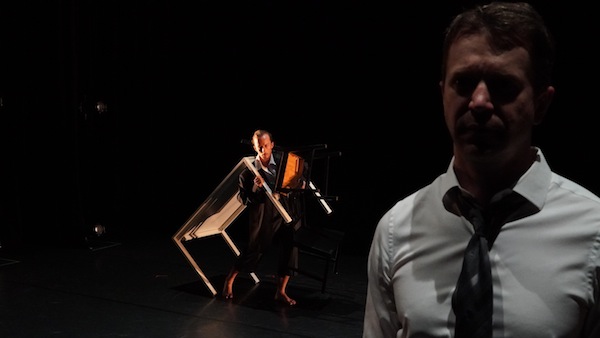
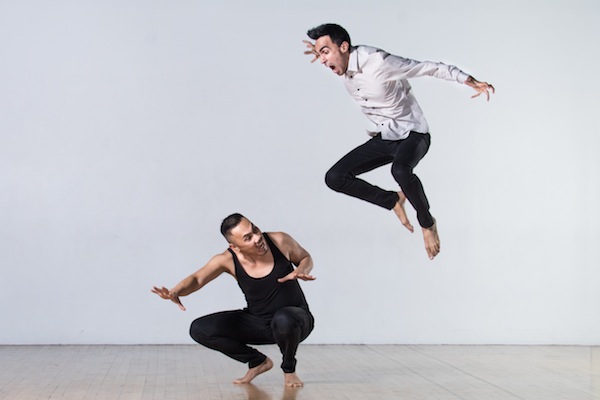
Dancers Alvin Erasga Tolentino, left, and Gabriel Dharmoo in Passages of Rhythms, in which Jonathan Bernard (below) is a percussionist. (photo by Yasuhiro Okada)

“Passages of Rhythms is inspired by a shared fascination with interculturalism, interdisciplinary activity, flamenco and collaborations between cultures,” percussionist Jonathan Bernard told the Independent about the Co.ERASGA production, which is being remounted May 19 and 20 at PAL Studio Theatre, in recognition of Asian Heritage Month. May is also Jewish Heritage Month.

“Canada is becoming well-known as an international centre of intercultural arts,” said Bernard, a member of the Jewish community. “I very much look forward to the remount and a bright future for the show on Canadian and international stages.”

In Passages of Rhythms, Co.ERASGA’s Alvin Erasga Tolentino highlights flamenco, Bharatanatyam and voices for the body, in a collaboration with local Chinese-Canadian flamenco artist Kasandra “La China,” Indo-Canadian Bharatanatyam dancer Sujit Vaidya and Montreal voice artist Gabriel Dharmoo. Ronald Stelting joins Bernard on the percussion music, and Jonathan Kim provides the lighting.

Bernard was in the original production, which took place at the Firehall Theatre as part of the Dancing on the Edge festival in 2018.

“The creation process of Passages was very smooth, full of joy and dedication, and the result brought a standing ovation from an enthusiastic audience,” he said. “Alvin is a director with a warm heart, an open mind, and is a passionate artist, so I’m overjoyed to be part of the remount.

“This is a dream gig for me,” he continued, “as I caught the flamenco bug back around 2005, I’ve traveled to the birthplace of flamenco in southern Spain to study and I’ve happily spent countless hours collaborating with flamenco dancers at local flamenco venues and on the concert stage. Kasandra was my first flamenco teacher, and we have had an artistic relationship going back to the mid-2000s. One of our groups, Orchid Ensemble, collaborated with Kasandra’s and Oscar Nieto’s Al Mozaico Flamenco Theatre to create a show named after the famous Café de Chinitas in Malaga, where Frederico Garcia Lorca penned some of his most famous works.”

photo - Passages of Rhythms is percussionist Jonathan Bernard’s “dream gig”
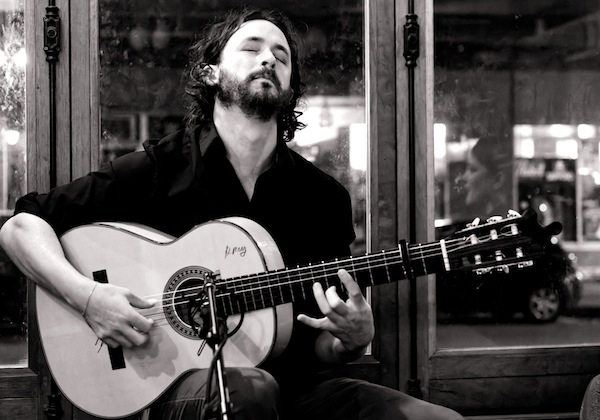
Passages of Rhythms is percussionist Jonathan Bernard’s “dream gig.” (photo from Jonathan Bernard)

Another reason this is a dream gig for Bernard, he said, “is that I have the pleasure of surrounding myself with many of my favourite instruments, collected from 25 years of travel and study around the world, scouring through ancient temple and traditional markets for the best sounding instruments. For example, you will see/hear temple bells and opera cymbals from Beijing and Sichuan province; tuned gongs found in Thailand, Cambodia and Laos; the riqq (Arabic frame drum), handmade in Cairo’s old city; bells from India; and, of course, the cajon, a box drum adapted into the flamenco tradition in the 1960s.

“My compositional ideas that form the soundscape for Passages are not only inspired by the dancers’ movement,” he said, “but by the instruments themselves and the ancient styles traditions they represent. Further, as most often I am busy interpreting the work of composers, Passages gave me a chance to compose my own original music.”

Since the mid-1990s, Bernard and his wife and artistic partner Lan Tung have been creating intercultural ensembles, mixing instruments and instrumentalists from traditions ranging from Chinese, South Asian, Persian, Arabic, North African and Western traditions, creating original Canadian music, and touring internationally. “We looked to ancient centres of interculturalism such as the Silk Road and El Andalus for inspiration, and as reflections of our own unique cultural environment,” he said. “Andalusia was a golden age of interculturalism, where Jews, Muslims and Christians lived in relative peace and shared knowledge and cultural traditions, from architecture to music to the culinary arts.

“Since the birthplace of flamenco – approximately one hour by train to the ancient Mediterranean port city of Cadiz – was located in the heart of Andalusia, I believe flamenco was certainly shaped by the liberal sharing and mixing of traditions,” he said. “For example, the 12-beat time cycles that are of central importance to West and North African traditions are also deeply embedded in flamenco forms; the castanets and palmas (interlocking handclaps) can be found in the carcabas and rhythms of the Gnawa and Berber people of Africa; the Ashkenazi cantorial traditions must have influenced the passionate flamenco vocal style. It might be said that flamenco borrowed rhythmic elements from North Africa, melodic elements from the pre-inquisition Ashkenazi Ladino song, and with simple harmonic structures and the guitar from Europe.”

Passages of Rhythms’ May 19 and 20 performances start at 8 p.m. Tickets are $30 ($20 for students and seniors) and can be purchased at eventbrite.ca.

Our relationship to objects

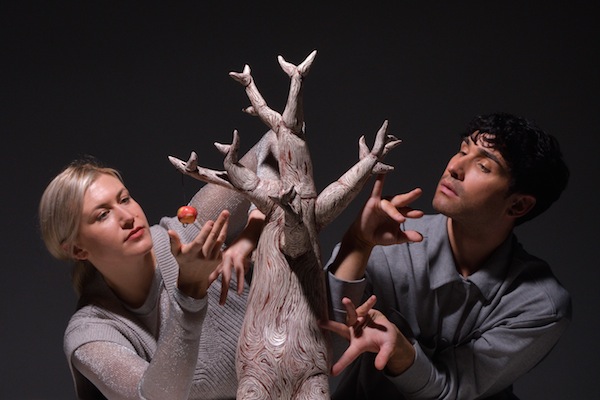
In DANCE:CRAFT, dancers Heather Dotto and Joey Matt interact with and reinterpret five elements – glass, metal, wood, fibre and ceramics – created by B.C. crafts artists. (photo by Michael Slobodian)

After years of development, DANCE:CRAFT will see its world première May 20-22, 7 p.m., at the SFU Goldcorp Centre for the Arts, Fei and Milton Wong Experimental Theatre. Among the craftspeople who contributed their creativity to the show is Hope Forstenzer, a glassworks artist, who also happens to be the director of the Gertrude and Sidney Zack Gallery.

“I was asked to be part of the project in October of 2016 and, at the time, the thinking was that it would take about two years to develop,” Forstenzer told the Independent. “It wound up taking longer than that for lots of reasons – I think one of the primary dancers went on maternity leave and, then, right as the project was about to begin rehearsals, COVID shut everything down.

“Initially, Joe [Laughlin] and I had all kinds of discussions and brainstorming sessions about ways to incorporate pieces into the dance. We rethought quite a bit of it when we started up again, and we wound up with some very interesting stuff that was quite different in some ways than we originally imagined. I think it’s going to be quite a bit different than any of us originally thought – the world isn’t what it was in October 2016.”

DANCE:CRAFT is described as “an exploration of two dancers interacting with numerous craft objects in a reconfigured theatre setting. It’s craft seen through the lens of dance and remixed, a look at our relationship to objects, creating and interacting with them.”

Presented by Joe Ink – which is led by Laughlin – and SFU Woodward’s Cultural Programs, DANCE:CRAFT also features five virtual reality films that give viewers a look into the artists’ studios.

“I’ve made six large blown glass rock-like pieces with lights inside of them, a large acrylic box full of glass balls, and 12 hanging cylinders in various sizes,” said Forstenzer.

photo - Hope Forstenzer has created 12 hanging cylinders for the performance
Hope Forstenzer has created 12 hanging cylinders for the performance. (photo by Hope Forstenzer)

The whole creative endeavour began as a research project focusing on dance and art. Laughlin conceived of the concept and the dancers are Heather Dotto and Joey Matt. They worked with five B.C. artists, facilitated by the Craft Council of British Columbia, curators of the show. In addition to Forstenzer, Stefanie Dueck (metal), Patrick Christie (wood), Deborah Dumka (fibre) and Debra E. Sloan (ceramics) provide the five elements that the dancers and Laughlin reinterpret.

“I have been thinking about the earth, the environment, the elements, evolution, geography, migration and humans,” says Laughlin in the press release. “The tactile sensation of handmade objects juxtaposed with the ephemeral quality of the dancing body triggers a memory experience. Being immersed in an environment and watching the body respond to texture and colour is what anchors us in time and space. We are looking for connections between communities and the natural world, geography and the human family.”

Laughlin added, “The process for creating a dancer incorporates fibre, sinew, muscle, bone, water, pressure, agitation and repetition. Craft is a transformative process that incorporates stone, fibre, wood, metal, water, pressure, agitation and repetition.”

DANCE:CRAFT asks audiences to consider, “How do objects further extend the language of the body and its narrative possibilities?”

photo - Glassworks artist Hope Forstenzer
Glassworks artist Hope Forstenzer (photo from Hope Forstenzer)

“I come from a theatre background and have done a great deal of work with dancers and actors,” said Forstenzer in contemplating this question. “Objects – props, costumes, sets, and all things like them – become part of a performance completely. A knife becomes part of an arm, to use for harmless or harmful purposes; a table becomes a second stage if someone stands on it; a mask hides a face. The best performances use performers, environments and objects to tell a story fully. I think what we’ll see with DANCE:CRAFT is a full storytelling collaboration, in which the artists have given works to Joe, and he has created a story to tell with them.

“This has been a fun project to work on,” she continued. “It’s not that often you get to do a collaboration like this. I’m really excited to be part of it.”

Tickets for the performance are $30 ($25 for students and seniors) and they can be purchased at eventbrite.ca.

Orcas inspire creative music

The creation of Songs for a Lost Pod helped singer/songwriter Leah Abramson explore her family’s Holocaust history. (photo by Angela Fama)

The world première of Leah Abramson’s Songs for a Lost Pod was supposed to be part of this year’s PuSh Festival three months ago. Delayed because of COVID restrictions at the time, it now will debut May 28-29, 7:30 p.m., at Studio T, SFU Goldcorp Centre for the Arts.

Songs for a Lost Pod is a “nine-song cycle [that] makes spectacular use of orca vocalizations, transforming them into rhythmic beats in a musical exploration of historical trauma, environmental crisis and communication between species.” The theatrical production is the most recent development in a process that includes an album by the same name, released in 2017.

“It was just an outward spiral, really. The project started with dreams I had about whales, which turned into researching whales for fun, which then turned into a master of fine arts thesis, an album, a comic book, and now a stage show!” said Abramson when the Independent interviewed her in anticipation of the PuSh festival. “When I made the album, I knew there was so much research and information behind the lyrics and music of each song, and I felt like I wanted people to understand that context, so I made the comic book to highlight some of the research and stories. Then, as I was arranging the music to be performed live, I realized that I wanted people to have that context, too, so I’ve turned the research and background into a script. Then we decided that adding visuals would really help immerse the audience in the material. The project has just been expanding from the beginning.”

Abramson, who grew up in Burnaby, said she has been interested in music from a young age. “My grandma sang in her synagogue’s choir and my dad played the piano, so they tell me it runs in the family,” she said. “But I was also told that music was only for fun, and not a real career, unless you were a concert pianist or something like that. So, I tried to do other things, but I was miserable unless I was making music.

“Over the years, I’ve done lots of touring and playing in bands and teaching, but writing and composing has always been what I love the most. I have pretty varied interests – I’m fascinated by marine biology and I love learning about the environment, as well as human history. The great thing about writing songs is that you can research anything and put it into your work. Right now, I’m really excited about writing music for the stage, as well as choral music.”

Along with her MFA in creative writing (with a focus on lyrics) from the University of British Columbia, Abramson studied classical music at Capilano University, and also has studied traditional Appalachian balladry.

In addition to the song-cycle, Songs for a Lost Pod features the narrative script that Abramson mentioned, which “juxtaposes the whale histories with Leah’s own family and their experience surviving the Holocaust and its aftermath,” according to the program description. “Mind of a Snail’s handmade projections create an impressionistic and largely non-representational visual world to support the songs and narration, guiding the audience into a space of contemplation.”

“When I first started looking into whale histories, the parallels presented themselves pretty quickly,” Abramson told the Independent. “It was not my intention to delve into my family’s past, but, while learning about captures and commercial whaling practices, it was hard not to look at the bigger picture of human behaviour throughout history – aspects of cruelty and destruction that manifest in heartbreaking ways. But also, whales are similar to humans – whale intelligence is extremely high, and whale families are extremely tight knit.”

It was difficult for Abramson to explore her family’s Holocaust history – “the loss and pain are pretty overwhelming,” she said, “and it’s not always easy to find a way forward when that intensity is present. Whale families became a mirror for me, a way to understand and experience intergenerational trauma at a greater distance. The project allowed me to deal with my feelings in a more manageable way, through empathy for another species. And it provided a space for my grief, but also helped me find a way through it. Trauma is so common in families of all different backgrounds. Our ancestors may have lived through wars or other calamities and there are so many people living through these things right now. I think learning others’ stories can help people start to process their own family’s pain, even if the details are different. I felt like whale stories did that for me.”

Credit for Songs of a Lost Pod’s music and lyrics go to Abramson in collaboration with Antoine Bédard, J.J. Ipsen, Andrew Lee (Holy Hum), Aidan O’Rourke (Lau), Sandro Perri, Arliss Renwick and Marten Timan. The program notes that credit also could be given to the A5 whale pod, as the musicians “were given selected A5 pod orca vocalizations, along with Abramson’s other field recordings, to turn into beats and tracks, which formed the backbone of Abramson’s songwriting process, and the rhythms behind much of the music.”

Fellow Jewish community member Barbara Adler also has contributed to the project, and is the show’s narrator.

“Barbara and I have known each other for so long that we can’t remember when or how we officially met,” said Abramson. “It’s like that with people in creative community sometimes – you grow up making art alongside each other. We have shared some special experiences and projects over the years, and continue to work together and in parallel. We have some shared Czech-Jewish roots, which makes Barbara a really good fit for this project in particular. She’s working on a lot of interesting projects of her own, and I’m also happy to be one of her composer-collaborators for Mermaid Spring, which is a musical she’s making with Kyla Gardiner (who also happens to be our lighting designer).

“Barbara has been sending me song lyrics over the last few years, which I have been setting to music. I love working with the characters she has created, and it has truly been a joy to work on those songs. I also really admire Barbara’s artistic process. When she writes, she really digs into all the nuances of a situation or character. She welcomes complexity and the messy underside of creation. I think Barbara balances my impulsivity, and helps me step out from the shadows in my shyest moments. She’s also a great performer!”

Co-presented by Music on Main and SFU School for the Contemporary Arts, tickets for Songs for a Lost Pod ($15) can be purchased from musiconmain.ca/event/songs-for-a-lost-pod.

A celebration of dance

Liat Har Lev premières a new work at the Dance Centre on April 29, as part of the centre’s celebration of International Dance Day. (photo by Chris Randle)

International Dance Day is April 29. To celebrate the occasion, the Dance Centre is presenting a day of free events, including a performance and workshop by choreographer Liat Har Lev.

Born in Ashkelon, Israel, to Ashkenazi parents from Romania, Har Lev said her parents decided to immigrate to Canada in 1982 because they wanted a safer haven for their children.

While dancing has always been a part of her life, flamenco came later.

“I remember my first jazz dance class at the age of 10,” she said. “Moving in space and creating shapes to the sound of music was natural. I felt alive and so vibrant.”

She first encountered flamenco at the Kino Café, which used to be on Cambie Street in Vancouver.

“I was mesmerized by the force, strength and intensity of the dancers and musicians,” she said. “It was a projection of who I am, an instant connection. Flamenco is a challenging art form in terms of rhythm, physicality and expression. I never stop learning and evolving. It challenges my mind and body and allows me to express deep sorrows and great joys.”

photo - Liat Har Lev
Liat Har Lev (photo by Catalina Torres)

One of the highlights in her dance journey, she said, “was the first time I stepped on stage to perform my first flamenco solo. It boosted my confidence and opened the door for opportunities.”

On the Dance Centre’s website is a profile of Har Lev. In an interview with the centre, she says, “I believe that dance performance exists to communicate and teach. It is an embodied language that has different forms, shapes and expression. As an expressive dancer, the source of the inspiration for my choreographies and performances comes from the need to express a story, to invite people to move and think deeply. My work is inspired by the human condition and personal experiences. I take pride in collaborating with local dance artists and musicians and I strive to create new works.”

The Dance Centre profile includes a video of Har Lev’s We Shall Not Forget, which she began choreographing with the support of the centre’s 12 Minutes Max program. It is a powerful commemoration, dedicated to the victims of the Holocaust.

We Shall Not Forget was inspired by my ancestors that perished in such a horrific way,” she told the Independent. “It was a calling for me to honour and remember them; a message from them through me. This tragedy left a big scar and a lesson to humankind.”

On International Dance Day, Har Lev will première a new work, Tientos. The program description says it “explores themes of personal integrity, internal conflict and the freedom of resolution, expressed through the flamenco dance forms of tientos and tangos.”

A work-in-progress, it features live music and singing. It is a collaboration between Har Lev, who choreographed and dances the piece, singer Maria Avila, guitarist Peter Mole, drummer Matteo Bebbo Sampaolo and choreography facilitator and dramaturg Carmen Romero. The performance will be followed by a brief introduction to flamenco workshop, led by Har Lev.

At the presentation, the artists will be collecting non-perishable food items for the Greater Vancouver Food Bank. So, if you’re heading downtown to see the show or attend the workshop, try and remember to bring an item to donate.

International Dance Day was started by UNESCO in 1982, with the date commemorating the birthday of Jean-Georges Noverre (1727-1810), who is considered the founder of modern ballet.

For the full local International Dance Day lineup, visit thedancecentre.ca.

Presenting Mixed Repertoire

A Million Voices, choreographed by Matthew Neenan, is described as a “lighthearted and whimsical ode to Peggy Lee’s iconic jazz standards.” (photo by Rob LatourRob Latour)

Los Angeles-based BODYTRAFFIC returns to Vancouver for their DanceHouse debut, May 5-6, at the Vancouver Playhouse. The company, which is led by artistic director Tina Finkelman Berkett, will present Mixed Repertoire – A Million Voices, The One to Stay With, SNAP and PACOPEPEPLUTO.

“It is an immense privilege to present BODYTRAFFIC’s DanceHouse debut this spring, which also represents the company’s return to Vancouver since 2015,” said Jim Smith, artistic and executive director of DanceHouse, in a press release. “This is a masterful program of short works that effortlessly showcases BODYTRAFFIC’s singular ability to take on any dance genre, moving from hip hop to ballet to jazz and back again. Beautiful, virtuosic, political, and with a dash of much-needed lightness, this evening of dance will leave audiences breathless and wanting more.”

photo - Tina Finkelman Berkett
Tina Finkelman Berkett (photo by Guzman Rosado)

“We love coming to Vancouver,” Berkett told the Independent. “The audiences are always so welcoming and so curious. There always feels like a supportive energy for the work we are sharing. I loved that program that we offered back in 2015 [at the Chutzpah! Festival]. Typical to BODYTRAFFIC programming, it was packed full of works by choreographers who I believe in wholeheartedly.”

As for the May program, Berkett said, “The works the company will offer on May 5 and 6 showcase the versatility and virtuosity of our dancers. The program offers singular choreographic voices, some emerging and some established. Baye & Asa and Micaela Taylor are newer voices in our industry and are certainly taking the dance world by storm; I’m so excited to share their works. As always, the program will offer the audiences a chance to enjoy and be entertained.”

According to the press release, the 90-minute show will open with A Million Voices, from Matthew Neenan, which premièred in 2018. “A lighthearted and whimsical ode to Peggy Lee’s iconic jazz standards, this infectious piece featuring seven dancers reminds us that, even during our toughest moments, life is always worth enjoying.”

The One to Stay With by choreographers Baye & Asa was commissioned by BODYTRAFFIC and premièred only just last month. “Inspired by Patrick Radden Keefe’s 2021 book The Empire of Pain, about the Sackler family’s role in ‘Big Pharma’ and the current opioid epidemic,” The One to Stay With is a work for eight dancers. It “tackles ideas of power, greed and deceit, punctuated by a lively score of Russian waltzes and Romanian folk songs.”

SNAP, from Micaela Taylor, which BODYTRAFFIC premièred in 2019, features six dancers in a “hip hop-infused choreography [that] urges audiences to ‘snap out of’ pressures to conform, encouraging us to embrace the individuality of our own selves as well as those around us.”

The final piece, PACOPEPEPLUTO, by Alejandro Cerrudo, which premièred in 2011, features three male dancers, “who each perform an athletically charged solo set to a Dean Martin classic.”

BODYTRAFFIC was co-founded in 2007 by Berkett and Lillian Rose Barbeito. It is now under the sole artistic direction of Berkett, who started her career at Aszure Barton & Artists, with which she became a feature dancer, as well as Barton’s assistant and an instructor.

“I never dreamt of having a dance company,” Berkett told the Independent. “When I was a young dancer, I had a very different idea of what my future would be. I thought I’d join a repertory company – not start one! But life led me to Los Angeles and eventually to launching BODYTRAFFIC to fulfil my dreams as a dancer.”

Before moving to Los Angeles from New York and co-founding BODYTRAFFIC, Berkett was a founding member of Mikhail Baryshnikov’s Hell’s Kitchen Dance.

“Jewish values are a part of everything I do,” Berkett said when asked how her being Jewish influences her outlook and choices. “Family, community, charity, honour, respect, curiosity and a commitment to learning are also central to who I am and the work I do.”

BODYTRAFFIC’s May 5 and 6 shows at the Playhouse start at 8 p.m. Tickets (from $35) can be purchased at dancehouse.ca.

Celebrating Israel together

Israel’s Gilat Rapaport and the InJoy Band headline this year’s Yom Ha’atzmaut celebration on May 4 at the Vogue Theatre. (photo from injoyprod.com)

This year’s Yom Ha’atzmaut celebration on May 4 at the Vogue Theatre, headlined by Israel’s Gilat Rapaport and the InJoy Band, marks 20 years since the first large-scale community-wide event to celebrate Israel’s Independence Day was organized by the Jewish Federation of Greater Vancouver.

“Growing up in Vancouver, the community had occasional large Yom Ha’atzmaut events with Israeli performers and I have wonderful memories of attending them,” said Stephen Gaerber, who co-chaired that first major gathering. “I was incredibly impressed by a large event held to celebrate Israel’s 50th in 1998 at the Orpheum [which was chaired by Judy Mandleman]. It was 2001, the Second Intifada was raging, Camp David had resulted in failure and Israel was, as usual, being disparaged in the press. My friend, Rick Schreiber, had become the chair of the Federation’s Israel department, and I told him that I thought the community should be having large-scale events every year to celebrate Yom Ha’atzmaut and all that is wonderful about Israel. His response was, ‘OK, you chair it.’ That’s how I became chair for the 2002 Yom Ha’atzmaut celebration, first co-chairing with my wife, Shari, and then, starting in 2003, with my brother Allen.”

Of course, local groups celebrated Israel’s birthday in various ways prior to 2002, notably the now-defunct Canadian Zionist Federation (CZF). Bernard Pinsky was CZF chair in the late 1980s.

“In the 1980s,” said Pinsky, “CZF brought in big names from Israel for a Yom Ha’atzmaut concert, including top artists like Nomi Shemer, Chava Alberstein, and Haparvarim. The concert was held at the JCC and wasn’t always right on Yom Ha’atzmaut, it was when the artists were available. The venue meant that we could only sell about 400 tickets, and CZF did a lot of fundraising to cover costs.”

Geoffrey Druker, who still leads the community’s annual Yom Hazikaron (Israel’s Memorial Day) ceremony, said he was recruited by Pinsky to become involved in CZF and it was from Pinsky that Druker took over the role of local CZF chair in the early 1990s.

“We ran most Israel-related community programs,” said Druker, including Yom Ha’atzmaut, Yom Hazikaron, Walk with Israel (which took place on Jerusalem Day), the student public-speaking contest and other programs. When CZF closed nationally, Druker said he gathered past local leaders of the group to decide “whether to become an independent local organization or join Federation.”

The choice was to join the Israel desk at Federation, and Druker continued to chair many of the events, with most of the Yom Ha’atzmaut activities being held at the Jewish Community Centre of Greater Vancouver, he said.

“Federation didn’t have the funds for a large Yom Ha’atzmaut, and we couldn’t risk having a large celebration … while keeping the event tickets affordable to all,” said Druker. “So we ran smaller celebrations and with less-known artists.”

Affordability remained key when Federation, led by a committee put together by Stephen and Shari Gaerber, took over the event.

“Our goal wasn’t to just make it a concert, but a real community celebration,” said Stephen Gaerber. “We kept ticket prices very low so that everyone could afford to attend – and if they couldn’t afford even that, we made free tickets available through JFS [Jewish Family Services]. We invited all Jewish organizations in the city to add their names as Community Partners, and dozens did. We had children from Hebrew Academy, Talmud Torah and RJDS performing in addition to Israeli singer Danny Maseng.

image - The ad promoting the 2002 Yom Ha’atzmaut celebration
The ad promoting the 2002 Yom Ha’atzmaut celebration.

“We were given no budget (other than staff time) for the event from the Federation and I didn’t want one. I was determined that the Federation not take anything away from what they were allocating to local community agencies in order to make this event happen. We believed that the community would support the event and we were right. We raised the funds from generous donors, rented the Chan Centre and signed a contract with the performer. We put tickets on sale and we sold out all 1,200 seats very quickly. The event itself is a bit of a blur, but my most vivid memory is the joy people expressed to us at its conclusion.”

With that success behind them, the goal was to involve even more individuals and organizations in the celebrations.

“For years,” said Gaerber, “Jonathan and Heather Berkowitz wrote a piece for young community members to perform and we were fortunate to have Wendy Bross Stuart direct them. We later added the JCC’s children’s Israeli dance troupes to the program, sometimes joined with dancers from our partnership region in the Upper Galilee.

“Pam Wolfman took over chairing the event in 2014 and continued to tweak things to make sure everything is new and fresh and even better each year, including involving the entire community in the community song,” he said. “What hasn’t changed is the support from the community. To this day, other than staff time, the Federation has not had to give any funding at all towards putting on the event. The group of donors has grown over the years and that allows the event to continue to stay true to our initial vision – tickets are still affordable and many are available at no cost to those who need them – and the events continue to sell out.”

The annual celebration brings Israeli performers – from veteran musicians to up-and-coming singers and musical groups – to Vancouver on Yom Ha’atzmaut.

“For many,” said Gaerber, “it was their first time performing outside of Israel on Yom Ha’atzmaut, as they hesitate to leave the country for this important day. Without exception, they have all expressed how incredibly meaningful it was for them to experience the warmth of our community and its love for Israel. A number of our performers who would not have otherwise considered coming to Vancouver for Yom Ha’atzmaut have only done so because they have heard from other performers about their experience and our Jewish community.

“Despite our Jewish community’s relatively small size,” he said, “we have been told by Israeli diplomats that Vancouver’s Yom Ha’atzmaut celebration, always occurring actually on erev Yom Ha’atzmaut, is one of the largest celebrations of its kind taking place on that day outside of Israel.”

For tickets to this year’s event and a sneak peak at the program guide, go to jewishvancouver.com/yh2022.

Opening of hearts

In this Vancouver Playback Theatre screenshot are, top row, left to right, Peter Abrams, Diandra Lee and Laen Hershler; middle row from left, Ingrid Broussillon, Joel Bronstein and Louise Lemieux; and Carol Ann Fried.

If you want to see tikkun olam in action, see the next performance of Vancouver Playback Theatre (VPT). For the last 23 years, the ensemble has been retelling audience participants’ life stories with sensitivity and compassion.

At VPT’s March 6 show, brightly coloured scarves, banners, dance, piano music and improvisation “played back” individual audience experiences of and the accompanying emotions caused by antisemitic events and other forms of discrimination.

“We really want audience members to feel seen, understood, and learn from the playback experience,” VPT’s Peter Abrams told the Jewish Independent.

Fellow Jewish community and troupe member Joel Bronstein added, “Our work takes audience members out of their heads and into their hearts … when people share their feelings and life experiences in a safe and supportive environment, there is a collective opening of our hearts, even when it is light and funny.”

Playback Theatre was created in New York 47 years ago with the intention of returning theatre to its storytelling and community-building roots. With troupes now established worldwide, Playback Theatre directly engages participants in sharing experiences and ideas related to themes of importance to them individually, and as groups, organizations and communities.

Abrams, Bronstein and Carol Ann Fried, who is also a member of the Jewish community, have all been part of the ensemble for more than two decades. Fried’s most memorable audience story involved a father talking about the love he had for his son.

“As he was speaking,” she said, “I wanted to sing a song about his love. I knew there was a Cat Stevens song called ‘Father and Son’ but I couldn’t remember the words or the melody. The only song I could think of was ‘You are the Wind Beneath My Wings,’ and I sang a few lines.”

After the show, the father told Fried that he had made a video of his son when his son was younger and the sound track was “You are the Wind Beneath My Wings.”

“That’s the magic of Playback,” said Fried. “It’s Hashem in action.”

Abrams remembers a story about a woman who found herself attracted to two men who were both interested in her, and she was wondering what to do about her pleasant dilemma.

“In the playback, myself and another male actor represented the two suitors in an old-fashioned duel that was a slow-motion dance, also using fabrics,” said Abrams. “We ended in a draw, appealing to the teller [audience participant] to decide. The teller and the audience loved it, and the teller realized she didn’t need to rush any decision, and decided just to enjoy the experience.”

There seems to be no limit as to what can be expressed in performances with VPT and what insights can be gained.

Fried said she has particularly enjoyed playing “non-literal parts.” For example, she has played a table at which two people fell in love, she has played the feelings of love and has even played internal organs. She said she has learned to trust that her creativity will emerge when invited.

Bronstein remembers when he had to play back a story about a violent character. “Although I symbolically represented the violence, when the story was finished my body was shaking intensely,” he said.

It’s not surprising that VPT works with organizations that help others, such as the Kitsilano-Fairview Mental Health team and Oxfam Canada.

“When we do a workshop for an organization or a community group, we often start with a short performance on an issue, and follow this with breakout groups where participants can dialogue on what they’ve learned and where to go from here on the issue,” Abrams said. “The groups we work with are focused on progressive social issues, so we contribute to forward movement on these issues through our workshops.”

VPT offers a variety of services, including public and conference performances, workplace conflict resolution workshops, peace-building in schools, community engagement projects, and Playback skills training, in person (when possible) and virtually (via Zoom).

Fried said she has learned a lot about the human condition through working with culturally diverse audiences. “Although our lives, cultures, religions and life experiences are different, we all value and care about the same things,” she said. “We all have the same variety of feelings. I feel connected on an internal level with each teller.”

When they aren’t together storytelling, Fried runs her own company and is a keynote speaker, workshop leader and coach; Bronstein is the executive director of Little Mountain Neighbourhood House; and Abrams runs his own organizational development consulting business.

The other members of the ensemble are Diandra Lee, Laen Hershler, Ingrid Brousillon, Louise Lemieux, Laurie Damer and Matthew Spears.

The troupe’s website is vancouverplaybacktheatre.com. Their next online public performance will be on June 26 in honour of World Refugee Day, which is June 20.

Cassandra Freeman writes stories with the support and love of her husband, Irwin Levin.

Bar mitzvah reveals tensions

Nicholas Guerriero, left, Lorene Cammiade and Rudy Smith rehearse a scene from Bema Productions’ staging of Men Overboard, which will be at Emanu-El Synagogue’s Black Box Theatre May 5-15. Guerriero plays Jay Silver, a Buddhist monk and the youngest son of Zaida Ernie, Cammiade portrays Eva Fuzesi, the bar mitzvah tutor from Hungary, and Smith plays Doug Silver, Ernie’s middle son and a psychotherapist. (photo from Bema Productions)

Next month, Victoria’s Bema Productions mounts the first full production of Men Overboard.

Winner of the Long Beach Playhouse New Play Contest and a finalist for the Woodward-Newman New Play Award, Men Overboard was written by Rich Orloff. After well-received readings and workshops in New York, Philadelphia, Long Beach and Dayton, the play comes to Victoria, where the première will be directed by Kevin McKendrick.

photo - Things get rough in Men Overboard: Rudy Smith puts a (fake) stranglehold on Nicholas Guerriero
Things get rough in Men Overboard: Rudy Smith puts a (fake) stranglehold on Nicholas Guerriero. (photo from Bema Productions)

The play focuses on a bar mitzvah for a boy, Abraham, who doubts he’s ready to become a man. The event brings together Abraham’s politician father and the father’s two brothers, a therapist and a Buddhist monk. Add their fading but forceful father and Abraham’s bar mitzvah tutor, a woman who loves Abraham and possibly one of his uncles, and it’s easy to see that Abraham is torn between obedience and defiance of his father. Tensions grow, affecting everyone in the family, until anger becomes abuse and it becomes clear that the family’s status quo is no longer an option. Men Overboard asks “What makes a man?” as it explores the responsibility each of us has to protect the souls of those we love.

The Bema production stars Lorene Cammiade, Nicholas Guerriero, Asa O’Connor-Jaeckel, Evan Roberts, Alf Small and Rudy Smith. It is produced by Alan Segal and takes place May 5-15 at Congregation Emanu-El Synagogue’s Black Box Theatre, 1461 Blanshard St. For tickets ($25) and showtimes, visit eventbrite.ca/e/295008758137. 

– Courtesy Bema Productions

Bunny at Cultch

Emma Slipp co-stars in Bunny. (photo by Emily Cooper)

Emma Slipp co-stars in Bunny, written by Jewish-Canadian playwright Hannah Moscovitch, and presented by the Search Party in the Cultch’s Vancity Culture Lab March 17-27.

In Bunny, Sorrel – a young woman raised by unconventional parents – tries to reconcile her love of Victorian literature, her intellectual Marxist-feminist upbringing, and her burgeoning sexuality. From high school, through college and into adulthood, Sorrel’s story reveals a woman who feels the weight of societal expectations, wants to make the “good” and “right” choice, while simultaneously embracing her own sexual nature.

Bunny premièred in 2016 at the Stratford Festival, and garnered rave reviews for its bold and honest portrayal of female sexuality. With this upcoming run, the Search Party presents the play for the first time in Western Canada. A relatively new theatre company, their 2019 production of Florian Zeller’s The Father won six Jessie Awards. Mindy Parfitt, artistic director of the Search Party, directs this Vancouver première, which features Slipp, Ghazal Azarbad, Kayvon Khoshkam, Jay Hindle, Nathan Kay, Pamela Carolina Martinez and Liam Stewart-Kanigan.

– Courtesy the Cultch


Ominous Sounds premières

Kerry Sandomirsky co-stars in Ominous Sounds at the River Crossing by Jason Sherman, which has its world première at Performance Works March 6-13. (photo by David Cooper)

Who is permitted to tell stories? This is the main theme of Ominous Sounds at the River Crossing; or, Another F–king Dinner Party Play, playwright Jason Sherman told the Independent.

The world première of Ominous Sounds takes place March 6-13 at Performance Works on Granville Island. Not only is Sherman a member of the Jewish community, but so are cast members Alex Poch-Goldin and Kerry Sandomirsky and lighting designer Itai Erdal. The production is being staged by Touchstone Theatre, whose artistic director is Roy Surette.

Ominous Sounds is described as “a provocative and darkly comedic piece of metatheatre that dives into hot-button issues including the ethics of representation, climate responsibility, and social power in a reality marked by colossal cultural shifts and blurring meanings.”

“In exploring the central theme,” said Sherman, “characters in the play reject a number of storytelling approaches, old and new, notably the dinner party play, of which there are many fine examples, to be sure, but which one of our characters is desperate to escape from. The play keeps returning to various versions of a dinner party play, interspersing it with attempts at other forms of storytelling, before finding a synthesis in a new story.”

photo - Playwright Jason Sherman
Playwright Jason Sherman (PR photo)

The launching point of Ominous Sounds was a planned follow-up to Sherman’s play Patience, which Surette directed some 20 years ago. Patience is “a contemporary retelling of the story of Job; the new play was to pick up with news of the death of the earlier piece’s main character,” said Sherman. “But I found myself balking at returning to the earlier story – for reasons of both form and content – and instead incorporated some of its elements into what would become Ominous Sounds.”

Erdal described some of the considerations in lighting a play like Ominous Sounds. “In a naturalistic play,” he said, “the lighting usually wants to be invisible; it should move the story forward and set the mood and the tone for the scene but it should do all that without pulling any attention to itself…. In an abstract play, the lighting doesn’t have to be justified – it can be part of the architecture and the dramaturgy of the piece. This play is about making theatre, so it moves between the two approaches – sometimes the lighting is invisible and sometimes it can be very dramatic and noticeable.

“We have a brilliant projection designer,” he added, “and many of the locations will be done with video projection, so I will have to … work closely with the projection designer to determine which scenes will be done with lighting only and which scenes with lighting and projections. We are still very early in the process so a lot of those decisions are still being made.”

When Poch-Goldin spoke with the Independent, there had been only three days of Zoom rehearsals.

“It was a bit exhausting using that format, but very enlightening,” he said. “The writer, Jason, was part of our rehearsals and he was able to clarify things for us, which was very helpful.

“I hope people will come see the show now that things are opening up. While COVID is hovering in the background, I have to be optimistic. I want to share this play with people. I want to work with other actors without masks on and I want a sense of normalcy to prevail. I’m not nervous about having restrictions loosen and a full theatre appreciate the work.”

Sandomirsky echoed this last sentiment. “We have all been inside now for two years, many of us living on a diet of Netflix and Skip the Dishes,” she said. “This play does what theatre does best – engages in the cultural conversation of the moment in a provocative, entertaining way. It’s an opportunity to see theatre that you will keep discussing post-show. It’s an opportunity to leave your bubble and safely let a group of experienced actors delight and enrage you. You don’t need to go to New York. You can hear a script that has intelligence, humour and heart right here, on Granville Island.”

Both Poch-Goldin and Sandomirsky play more than one character.

Among Sandomirsky’s roles, she said, “is a 50-something actor trying to navigate the minefield of what stories she is and is not allowed to tell. Is her voice still relevant?”

“We start as numbered entities and then we start to play other characters in little plays along the way, but always return back to our numbered entity,” explained Poch-Goldin. “My character starts vulnerable and becomes quite strident and outspoken, longing for the good old days, when theatre was something he understood. As for the other characters I play, Peter is a bit of a wisecracking dad who is trying to be a better person and facing a lot of struggles. I also play the character of Ruben, who is someone who has passed away and comes back in a flashback to talk about his struggles, and to learn to accept himself and his failings. I love all the characters, they’re profound and reflect many things I feel about the changes in society.”

Poch-Goldin has been busy since the pandemic began. He moved to Winnipeg two years ago and has been doing a lot of TV and film, he said. For example, the première of the series The Porter started on CBC Feb. 21, and Poch-Goldin is in five of the eight episodes.

“I also just finished writing a new play called The Trial of William Shakespeare,” he said. “After three years of development, we’re finally starting to share the script after several workshops. I also have a play called The Great Shadow, about the first film studio in Canada in 1919. It’s going to première this summer at 4th Line Theatre, which is an outdoor theatre in Millbrook, Ont.”

For her part, Sandomirsky continued to teach acting for film and television at Langara’s Studio 58.

“I gathered a group of friends and directed A Midsummer Night’s Dream on Galiano Island in a field,” she said. “It was an opportunity to have experienced Bard on the Beach actors mix with local islanders and create a bit of magic on a few warm August nights.”

As well, she, her son Ben (who is in Los Angeles shooting The Mysterious Benedict Society) and her mom (who lives in Saskatchewan) “started doing nightly themed Zoom sessions to amuse ourselves and stay in contact. We’d choose a theme and then give ourselves half an hour to whump up costumes and props using only what we had at hand.” They shared photos with friends and “began to take thematic requests and covered everything from Bergman to Batman to Brueghel.”

Next for her is the play Courage Now at Firehall Theatre.  Written by Manami Hara, it’s a piece about Japanese consul Chiune Sugihara, who helped thousands of Lithuanian Jews flee Europe. “The director, Jane Heyman, is herself a descendant of a family saved by Sugihara’s actions,” said Sandomirsky.

For tickets to Ominous Sounds, visit ticketscene.ca/series/926.