Novelist explores Trump era

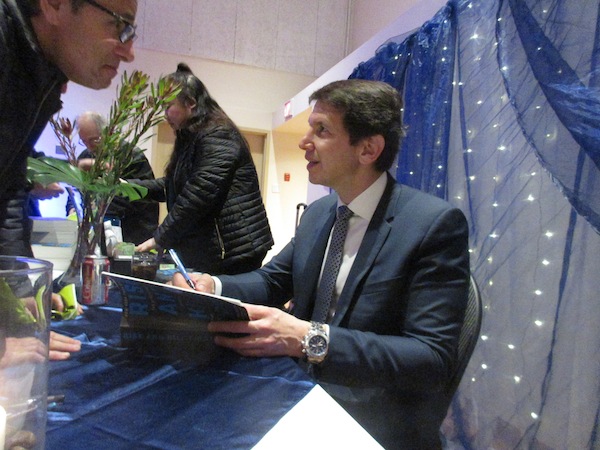
Gary Shteyngart opens the Cherie Smith JCC Jewish Book Festival on Feb. 8 at Rothstein Theatre. (photo by Brigitte Lacombe)

“You want to know the first rule of running a billion-dollar-plus hedge fund?” Lake Success protagonist Barry Cohen recalls telling the high school boys who invited him to speak to their Investors’ Club. “Don’t sweat the metrics. We’re not really about the numbers. Do you know what we are? We are a story. Hedge funds are a story about how we’re going to make money. They’re about being smart, gaining access, associating with someone great. You. You are someone smart enough to make others feel smart. You are bringing your investors something far more elusive than a metric. You’re bringing them the story of how great you’ll be together.”

Through the character of Barry Cohen, on his journey to what would be self-discovery if he were at all self-aware, author Gary Shteyngart explores the societal circumstances in the United States that led to the election of President Donald Trump – and could well do so again.

Shteyngart opens the Cherie Smith JCC Jewish Book Festival on the night of Feb. 8. In conversation with CBC’s Lisa Christiansen at Rothstein Theatre, he will no doubt talk about his latest novel, Lake Success, about a hedge-fund manager who flees his wife and young child, who has recently been diagnosed with severe autism, as well as a Securities and Exchange Commission investigation into his financial dealings.

Barry is stuck in a childlike state. He had a difficult father and his mother was killed in a car crash, a death Barry witnessed and which haunts him. Barry yearns for affection; he cannot regulate his emotions. He believes himself to be a self-made man and he is constantly coming across people he thinks would benefit from his mentorship, from fellow fund managers to a poor black youth he encounters on his travels to his first girlfriend, with whom he is trying to reconnect – hence, the bus trip. He is trying to find her, in the hopes of rekindling that relationship, and all the lost hope it encapsulated, while disregarding all the relationships – personal and business – he has left behind in New York City.

image - Lake Success book coverThe main female characters in Lake Success – Barry’s wife, Seema, and his former girlfriend, Layla – are not as well-constructed as is Barry. Despite a sympathetic portrayal, it is hard to understand what anyone would see in Barry, yet he manages to attract smart and beautiful women. The novel provides some explanation as to why Seema would marry him, including family expectations. And, after meeting him for the first time, she recalls, “she went home and Googled Barry’s net worth and found it comforting. A man that rich couldn’t be stupid. Or, Seema thought now, was that the grand fallacy of 21st-century America?” So, she thought she was connecting with an intelligent and wealthy man, but how Barry continues to be an attractive prospect to women (and men) after he cowardly runs away from his responsibilities and is nearly penniless is a bit of a mystery.

For some readers, Shteyngart might come down a little too easy on the one-percent, as exemplified by Barry, Seema and the few people we meet in their realm. When the Jewish Independent asked the author why it was important to imbue the character of Barry with humanity, Shteyngart said, “Books about inhumane characters are not fun to write. Imagine an entire novel set from Trump’s point of view. Eat burger, get angry, eat burger, get angry. It’s just not 330 pages worth of material.”

That is not to say that Shteyngart is condoning the lifestyle of the ultra-rich; in fact, quite the opposite, though he does so with seeming resignation.

“Without giving too much away for the new reader,” he said, “Barry does change. Somewhat. Slightly. But the damage that has been done to the country socially and politically by Barry-like oligarchs is not going to go away, even if the next election ends the so-called Trump Era.”

While Lake Success doesn’t offer insight into how the divisions in Trump’s United States could be repaired, Shteyngart’s acerbic wit and astute observations offer an entertaining read that will hopefully elicit readers’ introspection about our own privilege and identities, how we define and carry ourselves in the world. Both Barry and Seema have a conflicted relationship with their cultural heritage; Barry his Jewish, Seema her Tamil.

As Barry holds his three-week-old son in his arms – long before the autism has been diagnosed – “he whispered through all his agnostic lapsed-Jew bullshit, ‘Please, God, just don’t do anything to him, okay? My sins are my own.’”

Later in the novel, on the bus as it enters Louisiana, Barry overhears a conversation between two white men, one an aspiring preacher who declares hatred of “any kind of ignorance,” then goes on to explain why “they nailed Jews to the cross” and that “Muhammad was killed, because he couldn’t accept Jesus Christ as permanent.” At that moment, “Barry realized that the man was now looking at him. And also that he was a Jew. He hadn’t really thought of being Jewish since he was in grade school. But he did now.”

Even later, Barry would again look at his heritage differently, considering how it could be passed on to his son. For the most part, though, Barry is perceived as a white male throughout the novel.

“Yes, it’s very strange,” said Shteyngart about being Jewish in America. “I was being interviewed by a Jewish intellectual who was trying to convince me that we weren’t white. Which is oddly enough the talking point of the neo-fascist right. In any case, the feeling that Jews were a part of the American mainstream – think Seinfeld – has been badly shaken both by the physical attacks against Jews and by the general feeling that the country is now being run as an exclusive enclave for straight white Christian males with the occasional sprinkling of Sheldon Adelson.”

Lake Success is a provocative read with some brilliant one-liners, such as the description of neighbours in their building, whom Barry hates, as being “so featureless, they could have come with the hallway,” and, when he faces difficulty becoming a writer, Barry concludes, “He was a damaged person, but not damaged enough to make a life out of it.”

The Jewish Book Festival runs to Feb. 13 at the Jewish Community Centre of Greater Vancouver and other venues. For the full lineup, visit jewishbookfestival.ca.

Jazz that’s personal, timely

Andrea Superstein’s next local performance is at Centennial Theatre in North Vancouver on Feb. 5. Her new album is Worlds Apart. (photo from the artist)

For the last year, Andrea Superstein has been touring Canada with her new jazz album, Worlds Apart. Her next local performance will be at Centennial Theatre in North Vancouver on Feb. 5.

“I discovered my voice when I was a kid. My parents enrolled me in a musical theatre program at school and I sang in a choir,” Superstein told the Independent in a recent interview. “But my family were concerned about music as a profession for me. They thought the life of an artist was uncertain, so I went on to train as a teacher. I have been teaching theatre in several Vancouver schools since I moved here from Montreal. I still teach part-time. I taught at King David [High School] for awhile. But I always had music in my life as a hobby.”

At some point, the young teacher decided to explore if music could be more for her than a hobby. In 2009, she attended a weeklong summer swing camp, a jazz camp for adults in Sorrento, B.C. “I loved it,” she said. “It gave me access to the big names on the Vancouver jazz scene. I learned so much. I decided that, for my next birthday, I would get myself a gig. I knew I could do it and I did it.”

That performance was so successful and meant so much to her, she committed to pursuing jazz as a career. She couldn’t live without it anymore.

In 2010, Superstein released her first album, comprised of her arrangements of jazz standards. The same year, her debut performance at the Vancouver International Jazz Festival earned her a nomination for a Galaxie Rising Star award. Now, 10 years later, she is a well-known Vancouver jazz vocalist.

“I still teach theatre, while I’m still a learner in jazz,” she said with a smile. “It is good to have different outlets for my creativity.”

Her latest album, Worlds Apart, is mostly her own compositions, although it includes a few of her interpretations of other songs.

“I love jazz because it is often a reinvention of something old, something known, but the musician makes it her own, as I did with the song ‘My Favourite Things’ from The Sound of Music,” said Superstein by way of example. “I’ve seen the movie many times. I performed in the musical, in the roles of Maria and Reverend Mother.” She created her own arrangement of the song for her album.

“With Worlds Apart, I wanted to deliver something personal by examining the timely issues we all face,” she added. “We simultaneously exist in conflict and in symbiosis, and the contrast fascinates me. It is not only explored in the lyrics but also reflected in the harmonic structure and the songs’ arrangements.”

For her original compositions, Superstein writes both the music and the lyrics. She loves performing, interacting with the audience. “It gives me the biggest joy,” she said.

“I love talking to people between the songs, telling them funny stories about my music and lyrics, offering some extras. I love to hear the audience laugh or applaud. It’s like building a community, creating relationships. Not many jazz performers do that, I think, and it sets me apart. Or maybe it is my theatre background showing…. Usually, my talks are not scripted. There is always an element of impromptu. I try to be open to possibilities.”

Worlds Apart includes songs in three languages: English, French and Hebrew. “I grew up in Montreal, so I’m fluent in both English and French. When we performed this album in Montreal, people loved it when I spoke to them in French,” Superstein said.

She wrote the album’s Hebrew song years ago. “When I was 17, in 1996, I spent six months on an exchange program in Israel, on a kibbutz,” she said. “I was overwhelmed by the different life there, by the people. There were many bus bombings at that time, [Yitzhak] Rabin was recently assassinated, but people didn’t exhibit fear. Just the opposite. Everyone was passionate, on fire for life, and I wrote a song about it.”

When she started working on this latest album, she remembered that song and thought it appropriate for Worlds Apart, so she revised it and recorded it.

“This album is the first I didn’t produce myself,” said Superstein. “It’s good to have someone else to listen, to make suggestions. I invited the Montreal jazz singer Elizabeth Shepherd to be my producer. I also hired a group of Montreal musicians to record the disc. They are wonderful musicians, I enjoyed working with them, and I toured with them for the past year.”

The musicians performed in jazz concert series, in small theatres and bookstores; they also gave some house concerts.

“The life of a musician is a challenging one,” said Superstein, “but I’m fueled by my love for my art.”

For more information and other concert dates, visit andreasuperstein.com.

Olga Livshin is a Vancouver freelance writer. She can be reached at olgagodim@gmail.com.

Jewish films span the globe

Taika Waititi’s Jojo Rabbit and Roberta Grossman’s documentary Who Will Write Our History were two standouts in Jewish film last year.

Last year was a busy one, but not a great one, for Jewish-related movies. There was plenty to see, but only a couple films – Jojo Rabbit and Uncut Gems – broke through the clutter to make an impact.

While Jewish characters were front and centre in high-profile TV shows – The Marvelous Mrs. Maisel, The Kominsky Method and Broad City – in movies, they were largely relegated to glorified cameos, such as Al Pacino as old-school agent Marvin Schwars in Once Upon a Time in Hollywood and Alan Alda as menschy divorce attorney Bert Spitz in Marriage Story.

Jewish artists and celebrities were, as always, exceedingly popular among documentary makers. Sammy Davis, Jr.: I’ve Gotta Be Me, televised on PBS’s American Masters, and Ask Dr. Ruth led the parade, which included less-widely-seen portraits of singer-songwriter Leonard Cohen (Marianne and Leonard: Words of Love) and actor Anton Yelchin (Love, Antosha).

Picking a Top 10 was a bit of a challenge for 2019. Here are the films that left a mark.

Jojo Rabbit: The most ambitious and audacious film of the year was made by a Maori Jew from New Zealand. Taika Waititi, the director of Marvel’s Thor: Ragnarok, radically adapted Christine Leunens’ novel into a sharp satire of Nazi racism and groupthink that garnered the San Francisco Bay Area Film Critics Circle Award for best screenplay.

Who Will Write Our History: My only criticism of Jojo Rabbit is that it didn’t convey the depth of the Holocaust’s horror. Roberta Grossman’s artful documentary about the men and women in the Warsaw Ghetto who secretly amassed an archive of documents and diaries that would survive (if they didn’t) fills in a missing historical chapter for people of all ages. (See jewishindependent.ca/a-different-kind-of-resistance.)

Prosecuting Evil: The Extraordinary World of Ben Ferencz: The last surviving U.S. attorney from the Nuremberg trials has an impeccable memory, a spotless moral compass and enormous gravitas. This terrific doc serves as an inspiring counterpoint to Matt Tyrnauer’s slick biography of another Jewish lawyer from New York, Where’s My Roy Cohn?, who lacked an iota of integrity.

Uncut Gems: What makes Howard run? Jewelry hustler and compulsive gambler Howard Ratner (Adam Sandler, impressively manic) races around New York City to keep his increasingly angry debtors at bay. En route, Benny and Josh Safdie’s nerve-jangling drama rips the Band-Aid off black-Jewish relations.

Mike Wallace is Here: Avi Belkin examines another iconic New York Jewish character, the penetrating TV journalist who made 60 Minutes essential viewing, entirely through archival TV footage. It is one of the smartest and best documentaries of 2019.

Synonyms: Nadav Lapid’s abrasive, semi-autobiographical drama about a self-loathing young Israeli army veteran’s effort to shed his identity in Paris won the Golden Bear for best film at the Berlin International Film Festival. It is painful and revealing, with some flashes of humour.

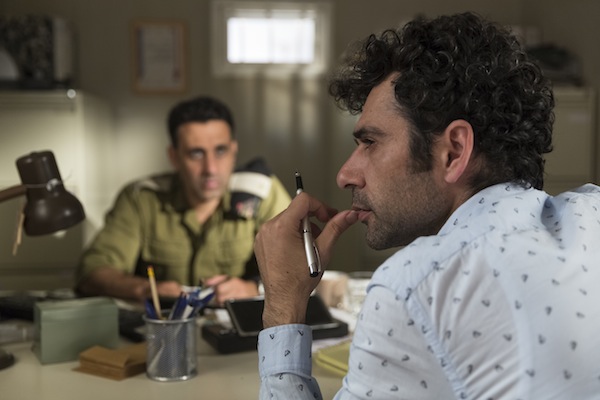
Tel Aviv on Fire: Sameh Zoabi’s clever comedy about a Palestinian soap opera writer trying to navigate the demands of his bosses and an Israeli checkpoint commander was one of nine (!) films with Jewish themes among the official submissions for the best international film Oscar.

Transit: German director Christian Petzold transposed Jewish novelist Anna Seghers’ 1944 story of refugees trying to flee France to an enigmatic time and place that has echoes of both the past and the present.

To Dust: Shawn Snyder’s debut feature explores the grief process through a Chassidic cantor (Geza Rohrig of Son of Saul) who wrangles a community college science professor (Matthew Broderick) into his obsessive investigation into how his wife’s body will return to dust. Meanwhile, his sons worry that he’s possessed by a dybbuk.

Fiddler: A Miracle of Miracles: A crowd-pleasing, by-the-numbers doc about the historical (shtetl life) and literary (Sholem Aleichem) roots, creative development and enduring cross-cultural popularity of the Broadway musical Fiddler on the Roof. Formulaic, but Jewish through and through.

Some of the best films of the year won’t open in North America until 2020. The Ophir Award-winner Incitement powerfully dramatizes the life of Yitzhak Rabin’s assassin, leading up to his irreparable act. Roman Polanski’s well-reviewed portrayal of the Dreyfus affair, An Officer and a Spy, has opened across Europe but awaits a North American distributor (a long shot given the likelihood of protests and boycotts).

Czech director Vaclav Marhoul’s harrowing adaptation of Jerzy Kosinski’s Second World War-set novel The Painted Bird is also on European screens, with a U.S. release likely now that it was shortlisted for best international film. In that eventuality, look for it during its brief run – and on next year’s Top 10 list.

Michael Fox is a writer and film critic living in San Francisco.


Opera urges “never forget”

The ship’s cabin in Pasazerka (The Passenger), as envisioned by UBC Opera’s creative team. The opera is part of a series of events at the University of British Columbia marking the 75th anniversary of the liberation of Auschwitz. (photo from UBC Opera)

UBC Opera presents the Canadian première of Mieczyslaw Weinberg’s Pasazerka (The Passenger). Opening Jan. 30 at the Chan Centre for the Performing Arts on the University of British Columbia campus, this will be the first time the work has been presented on any university stage in the world.

The Passenger opens on a luxury liner bound for Brazil. A newly married German woman, Lisa, who, earlier in life, had been an aufseherin, camp guard, at Auschwitz, thinks she recognizes a fellow passenger. The passenger is Martha, a Polish Auschwitz prisoner who was thought to have died at the camp. The effect that their meeting (either actual or imaginary – it’s never made clear) has on the two women, and on Lisa’s marriage to the German ambassador to Brazil, is the subject of this dramatic and powerful opera.

UBC Opera’s production is being created from scratch. The opera has proven so popular no sets or costumes are available for rent; consequently, new sets are being constructed and, at this writing, the students were sewing together dozens of striped prison pajamas for the Auschwitz prisoners’ chorus.

After receiving its world première in 2010 at the Bregenzer Festspiele in Austria, The Passenger has seen frequent performances in various German venues, a highly acclaimed production at the English National Opera in 2011 and, more recently, it has been performed successfully in the United States at the Houston Grand Opera and at the Lyric Opera of Chicago. In spring of last year, it was performed at the new Tel Aviv Performing Arts Centre, and it will be performed in Spain later this year.

The UBC production has received funding from various sources, including the Adam Mickiewicz Institute, which promotes Polish culture around the world, and the Consulate General of the Republic of Poland, as well as Poland’s Department of Public and Cultural Diplomacy and Ministry of Foreign Affairs.

When the president of UBC, Dr. Santa Ono, heard about the project, he committed further funding for the production. Other funding has come from UBC’s dean of arts, Gage Averill, and the David Spencer Endowment Encouragement Fund. The production also has received support from the Vancouver Holocaust Education Centre, Temple Sholom and UBC Hillel House.

“In our time, antisemitism and neo-Nazism has become shockingly prevalent again. Even our own neighbour to the south has witnessed a growing social and political climate which has encouraged disrespect for other human beings and blatant racism,” said Prof. Nancy Hermiston, head of the Voice and Opera divisions at UBC and the director of this production of The Passenger, in a recent interview with the Independent. “In my opinion,” she said, “this has, in part, been released as a result of the behaviour and actions of President Trump. His attitude has given those elements of the world’s population promoting discrimination, hatred, antisemitism and neo-Nazism, a sense that they have a licence to do so. Our opera highlights the consequences of this hatred and racism. Now is the time to remind ourselves of respect and tolerance for others and of our humanity. It is the exact time to remind ourselves of the horror of the systematic extermination of millions of innocent people. Genocides continue to plague our world. Have we learned nothing from the past?

“We can never forget the tragic deaths of those millions of innocent souls nor can we forget those who survived that crime against humanity,” she said. “We cannot let another Holocaust occur.”

The Passenger is sung in Polish, Russian, Czech, French, Yiddish, German and English, which offers a particular challenge to the young singers at UBC. Equally challenging for the singers, according to Hermiston, is the difficulty of dealing emotionally with the subject matter, which, in rehearsal, has led to periods of weeping and feelings of deep sorrow, both for the singers and “even for me,” admitted Hermiston, “especially at the end, when the chorus of prisoners comes downstage and challenges the audience to ‘never forget, never forget.’” (Hermiston has engaged a counseling team to help the singers through their own trauma as they reenact this emotional narrative.)

Performances of The Passenger are set for Jan. 30 and 31 and Feb. 1 at 7:30 pm, and Feb. 2 at 2 p.m. Tickets are available online at music.ubc.ca/opera-pasazerka-the-passenger.

The opera is part of a larger commemoration of the 75th anniversary of the liberation of Auschwitz that is being undertaken by UBC Opera; the UBC Modern European Studies program; the UBC department of Central, Eastern and Northern European studies; the UBC Witnessing Auschwitz International Seminar; and UBC Go Global. During a symposium that runs Jan. 27-30, there will be various symposia and exhibits, and school-outreach programs featuring local survivors and UBC professors and students, as well as the opera The Passenger.

Guest speakers for the symposium include Dr. Michael Berenbaum, Dr. Bozena Karwowska, Dr. Piotr Setkiewicz, Dr. Chris Friedrichs, Aleksander Laskowski, Dr. Richard Menkis, Dr. Dorota Glowacka, Dr. Rima Wilkes, Dr. Anja Nowak, Dr. Peter Suedfeld, Dr. Tricia Logan, Dr. Ilona Shulman Spaar, Janos Benisz, Amalia Boe-Fishman and David Ehrlich, among others. For more information, visit auschwitz75.arts.ubc.ca.

Graham Forst, PhD, taught literature and philosophy at Capilano University until his retirement and now teaches in the continuing education department at Simon Fraser University. From 1975 to 2010, he co-chaired the symposium committee of the Vancouver Holocaust Education Centre.

Searching for a safe harbour

Ben Caplan is narrator and co-creator of Old Stock: A Refugee Love Story, which runs Jan. 24-30 at Frederic Wood Theatre, as part of the PuSh festival. (photo by Stoo Metz Photography)

The 2020 PuSh International Performing Arts Festival opens next week. Among the highlights is Old Stock: A Refugee Love Story, which follows Chaim and Chaya from the pogroms in Romania they are fleeing, to Halifax’s Pier 21, where they meet in 1908, to Montreal, where they end up living. The show, which runs Jan. 24-30 at Frederic Wood Theatre, is narrated and co-created by Halifax-based musician and performer Ben Caplan, with whom the Jewish Independent recently spoke.

JI: How and when did you become involved in the production?

BC: It all started with a phone call from 2b Theatre Company’s artistic co-director Christian Barry in mid-2015. Christian was familiar with my work as a songwriter and performer in the music world and he wondered if I would be interested in collaborating on creating a theatrical production featuring new songs that we would write together.

To be honest, I was skeptical at first. I tend to be a very solitary writer and, though I had a lot of experience in theatre many years ago, it had been a decade since I had performed in theatre. The first few writing sessions were pleasant enough and Christian and I got along great, but we were struggling to find the story that we wanted to tell. As we were searching and exploring to find the substance of what the work would consist of, a confluence of events conspired to show us the story that would become Old Stock.

The first thing was our growing consciousness of the scale of the human tragedy emerging in Syria as a growing number of refugees started trying to find their way out of the violence. Next came Prime Minister Stephen Harper’s comments about “Old Stock Canadians” during the 2015 leadership debate. This othering of “non-Old Stock Canadians” seemed to be vile and absurd. At what point does one get to call themselves “Old Stock”? I am the great-grandson of Jewish immigrants who came to Canada fleeing violence in their own home countries. Was I supposed to think of myself as “Old Stock” or did I fit into some other category in our [then] prime minister’s logic.

Around this time, Christian’s wife, who happens to be the celebrated playwright Hannah Moscovitch, gave birth to their first child, Elijah, and came across the immigration records of her own great-grandparents who immigrated to Canada in 1908 through Pier 2 in Halifax. She realized that, if her great-grandparents hadn’t made the journey to Canada, she would not exist, let alone her infant child. It was then that Hannah asked if she could write the scenes for the show we were trying to create.

With Christian’s vision of the artistic whole, my work as composer and lyricist, and Hannah’s work as playwright, we were off to the races and we worked together to create the show. We thought that the Jewish story from 110 years ago had a striking and tragic resonance with the tragedy unfolding in our own time. I should mention that, of course, the originating cast, musical director Graham Scott, our production manager and designer Louisa Adamson, and many others played a huge role in realizing the vision and bringing the music and the play into the world.

JI: In broad strokes, could you describe how the co-writing process worked?

BC: Christian Barry created the structures and conditions that made it possible for any of these songs to be written. I was probably not always the easiest artist to work with – I tend to desire quiet and solitude when I am writing.

The way it usually worked is that Christian would book a time and a space in whatever city we were able to meet up in (we did writing in Halifax, Montreal, Stratford and Banff) and the day would start with conversations and questions. We would talk, share ideas, listen to music, read texts, Google things, etc.

Out of our conversations and questions, the idea for a song would emerge. The first one we wrote was something for their arrival at Pier 2. We didn’t have a scene or a broader context to work with but, after awhile, Christian would say something like, “We know they are going to come through Pier 2, let’s start there.” I sat at the piano and started mashing out some chords and throwing words into the air. Christian had a wonderfully delicate touch after I got rolling, and would provide helpful comments, critiques, and throw ideas into the room.

JI: What is it about the production that drew you back to performing?

BC: I had stopped performing in the theatre after I became somewhat disillusioned of the possibilities of making a career in theatre. In 2005, the year I did my last theatre performance, I was working on academic pursuits, theatre and my hobby as a singer-songwriter. My life was over-full and something had to give. My logic was something like, in theatre, you need to rely on finding a lot of talented people who are willing to work on a project that takes a lot of time and resources to complete. As a singer-songwriter, there is more room to work solo and bring other people into the project as interest and resources permit. So, that’s the path I chose to express my artistic impulses. I gave up the dream of becoming an actor to focus on the more reasonable and safe path of becoming a songwriter. Ha!

When Christian called me to ask me to make a piece of theatre with him, it was a no-brainer. Being a part of this show has been one of the great privileges of my life. Not only did I get to collaborate with a crazy good team on writing the thing, but I had the opportunity to perform on stages that I wouldn’t have dared to dream of stepping onto when I was making theatre 10 years ago. It’s been an amazing learning experience and one that is sure to influence my work as a performer for the rest of my career.

JI: In what ways does the story and/or themes of Old Stock speak to you as a Canadian in 2020?

BC: What is most meaningful for me about the story and themes of the show is the humanization of the character of the refugee. It has been disturbing to see the ways in which migrants have been portrayed by so many politicians and media outlets around the world. They are often spoken of as hordes, masses and statistics. What is lost are the individual human lives – people with hopes, dreams, fears and trauma searching for a safe harbour.

In Old Stock, we tell the story of Hannah Moscovitch’s great-grandparents coming to Canada. We see their struggles to overcome their past and to generate new and complicated identities. I think that we all, as human beings, have complicated and multi-layered identities. I think that, among other things, this show is about demonstrating layered and sometimes tragic identities with compassion and a healthy dose of humour. That’s basically the most Canadian thing I can think of.

For tickets to Old Stock: A Refugee Love Story and other PuSh shows, visit pushfestival.ca. The soundtrack to Old Stock is available on Spotify, YouTube and elsewhere.

Last Cabaret almost sold out

Joanna Garfinkel is part of the creative team behind the world première production of Berlin: The Last Cabaret, part of the PuSh festival. (photo from the artist)

The world première of Berlin: The Last Cabaret, presented at Performance Works Jan. 23-26 by City Opera Vancouver in association with Sound the Alarm: Music/Theatre, is almost sold out. Part of the PuSh International Performing Arts Festival, the only tickets that remain will be sold at the door, though writer and Jewish community member Joanna Garfinkel told the Independent, “I hope we are able to add more presentation opportunities, as well, since this is truly becoming an exciting and rich production.”

Set in Nazi Germany in 1934, a group of artists must decide whether or not to perform their new political show – which, reads the press release for Berlin, “challenges state media, calls out the Nazi classification of gay individuals as ‘degenerates’ and includes parodic inflection that women are being marginalized” under the new regime – or save themselves.

The opera takes place “two weeks after ‘the Night of Long Knives,’” said Garfinkel, “when the future had been cast, but many were not yet seeing it, including my own family. One thing that interested me a great deal is how people are forced to make compromises under oppression, and even make excuses for what’s happening around them.”

The “Night of the Long Knives” was the June 30, 1934, purge by Hitler of more than 85 members of the Sturmabteilung, the Nazi party’s initial paramilitary wing.

Rather than being a satire itself, Garfinkel explained that Berlin: The Last Cabaret “is more an unearthing of the under-heard Jewish and queer artists who flourished in the Weimar era and were crushed by the Holocaust. The humour we employ is their urgent satire, which feels fresh and relevant with all that is going in the world right now.

“My own family escaped from Berlin to Winnipeg (eventually), so I am both bound to respect and honour the history, and also privy to the dark humour we employ about it.”

City Opera Vancouver approached Garfinkel last spring, she said. They had “heard about me from my dramaturgical work with Playwrights Theatre Centre and the historically based Japanese Problem for my own company, Universal Limited. I was excited by the opportunity to work with an opera company, which would be new to me, but on something quite close to my heart, history and interest.”

The relevance of the opera was one of the reasons she joined its creative team. In regard to choosing projects in general, she said, “Right now, it feels like art must be speaking to the world and on behalf of marginalized voices. Theatre is too much work, and the world too messed up, to work on projects that don’t resonate on an activist level. I am lucky right now to get to choose to work on things that are so resonant.”

Garfinkel, who is billed as librettist for the production, clarified that categorization.

“I contributed story, structure and additional dialogue for this piece,” she said, “but it’s important to note that the songs themselves are historical, written by composers Eisler, Spoliansky, Hollaender and Weil, so I am not, technically, the librettist. However, building a story and play around preexisting songs presents its own challenges. It was of central importance to me that the Jewish/queer and other marginalized artists of the time were centred in our story.

“We were working with excellent (but unavailable!) collaborators in our composers and, together with director Alan Corbishley, music director and historian Roger Parton and choreographer Tara Cheyenne Friedenberg, tried to honour their work and build a vital story around it.”

Cheyenne Friedenberg is also a member of the Jewish community.

Berlin: The Last Cabaret stars actors with a background in music and spoken theatre, rather than traditional opera singers, and each performer, according to the press release, “was involved in the creation of their on-stage characters and storylines.” The production features a live four-person band.

For more information on PuSh, visit pushfestival.ca.

Cohen’s clay defies gravity

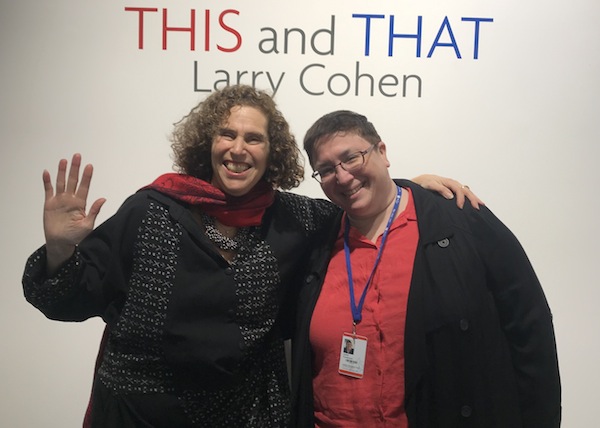
Larry Cohen’s new ceramic exhibition at the Zack Gallery runs until Jan. 25. (photo by Olga Livshin)

Larry Cohen’s new ceramic exhibition at the Zack Gallery is called This and That. The name is symbolic for the artist. His show consists of two entirely different types of pottery: whimsical woven sculptures and functional crockery. “I wanted to explore the relationship between pure art, like my sculptures, and functional things, like my bowls, vases and cups,” said Cohen in an interview with the Independent.

“There is a continuum that stretches from pure functional to pure art, and every object fits somewhere along that continuum,” he explained. “The closer to the artistic end, the less functionality the object has, except for people to look at it and think about it. On the other end, there is pure functionality: you can use a bowl for fruits or a mug for your coffee, but it also has a shape and a colour; something to look at, too.”

In his long artistic life, Cohen has worked in many different mediums, creating sculptures from metal and wood, but clay is his material of choice. “Clay is a wonderful thing to work with. It feels good in my hands,” he said. “And it could be found anywhere in the world. Here, in British Columbia, in Europe, in China, in Japan, in Latin America.”

In the past decade, Cohen has won a couple of month-long residencies as a clay master, one in China, another in Japan. “The clay is different everywhere. Its chemically different compositions provide different visual and textile effects in the objects made of it,” he said. “It could be the same colour when unfired and painted with the same glaze, but, if made from different types of clay, after firing, the resulting pottery would look and feel different.”

Cohen travels a lot and, everywhere he goes, he searches for the local potters and their art, trying to absorb as much as he can from the various traditions. “As clay is different everywhere, so the traditions are different, but, in most of the places I have visited, the history of pottery goes back thousands of years,” he said. “People made things of clay in ancient China and ancient Mexico. Not so much in Europe – it had to import the technique from China, but it is still very old. The only place in the world I know that didn’t have pottery is here, in British Columbia. The local clay is wonderful, but the indigenous people here didn’t use it. They made everything out of wood. Only in the past 200 years, since the Europeans settled in B.C., pottery has been on the rise.”

To a degree, Cohen is a local clay pioneer, like other local potters. It is important to him that everything he creates is unique, that no object repeats another. He is as much a craftsman as an artist, which makes even his utilitarian bowls and vases works of art. His woven sculptures are really one of a kind; they are akin to wicker baskets, but made of clay.

“Some of them look like vases, but there are holes,” he said with a smile. “You can’t pour water inside. No functionality except to look at and admire. It is a new technique for me. I always try something new, always think: what is another way to use clay?”

This particular technique looks like ceramic ribbons lying on top of one another, or interwoven. “Clay is forgiving,” Cohen said. “You can make all kinds of different shapes from it, but, even so, it took me awhile to develop this technique. I had to figure out how to overcome the softness of clay and how to combat gravity, so the upper layers wouldn’t squish the lower ones.”

photo - On display are works he has made using a technique that creates dynamic, ribbon-like clay structures
On display are works he has made using a technique that creates dynamic, ribbon-like clay structures. (photo by Olga Livshin)

He cuts clay in strips and then twists them in various ways to create the dynamic shapes. “Sometimes, I repeat the same shape multiple times, sometimes make them different,” he said. “I dry them before firing, so the whole sculpture doesn’t collapse under its own weight. Sometimes, I make two or three layers together. Other times, every layer is dried separately, and then they come together in the kiln, held to each other by the glaze. Once or twice, I made the full sculpture before firing, and you could see the lower layers sort of melting together.”

Unlike a painter, who sees the immediate result of his labours, a potter doesn’t see what he creates until it’s fired in the kiln. Cohen fires every piece twice, first without glaze, the second time with glaze.

“Once a piece goes into the kiln, you never know what will come out,” he said.

Cohen makes his pieces in bunches before firing them all together. “I have three large kilns in my studio on Cortes Island,” he said. “I fire them four or five times a year. One is electric, for lower temperatures. It is the first one I use. Whatever I’ve made by the time I fire the kilns goes in. Then everything has to cool down before I paint on the glaze and use the other two kilns – one for regular glaze, for the smooth surfaces, and another with salt for the special textures.”

This and That opened on Jan. 9 and continues until Jan 25.

Olga Livshin is a Vancouver freelance writer. She can be reached at olgagodim@gmail.com.

Artistic responses

Gabriolans held a candlelight vigil after antisemitic graffiti was found at Camp Miriam. An arts festival will take place Feb. 7-9. (photo from You’ve Got a Friend)

Since Camp Miriam on Gabriola Island was defaced with antisemitic graffiti in December, Gabriolans have shown support for the Jewish community, including a candlelight vigil on Jan. 2. Next month, island artists, musicians and writers will gather together to present You’ve Got a Friend: A Festival of Jewish and Gabriolish Art, Words and Music. The Feb. 7-9 festival will feature Jewish-themed visual art, music and writing, all created by residents of Gabriola, among them Juno nominees and literary prizewinners.

“When people heard about the vandalism at Camp Miriam,” said Sima Elizabeth Shefrin, one of the festival’s organizers, “many said, ‘What can I do to help? How can I show my support?’ The festival is a chance to celebrate our friendship and solidarity with each other and to move things on in a positive way. We took the title, You’ve Got a Friend, from Carole King’s old song.”

The festival program includes visual art by Shefrin, Heather Cameron and others at the Gabriola Arts and Heritage Centre. The opening reception will take place Feb. 7, 6-9 p.m., and the gallery will be open Feb. 8, 10 a.m. to 4 p.m., and Feb. 9, 10 a.m. to 1 p.m.

The concert Oy! will feature Bob Bossin, Paul Gellman, Dinah D, the Today Only Klezmer Band and others. It will take place Feb. 8, 7:30 p.m., at the Roxy Lounge and Cultural Club, with tickets available at North Road Sports. Admission is a suggested donation of $15.

Earlier on the Saturday, at 3 p.m., Amy Block will lead a celebration for Tu b’Shevat, the Jewish new year of the trees, at the arts and heritage centre.

Finally, Nu? – poetry and memoir by Janet Vickers, Naomi Wakan, Lisa Webster, Shayna Lindfield, Gloria Levi, Lawrence Feuchtwanger, George Szanto and Bossin – will be held at the arts and heritage centre Feb. 9, 1-3 p.m.

You’ve Got a Friend is supported by Camp Miriam, the Gabriola Arts Council and Anne Landry. For more information, contact Cameron at true_stitches@yahoo.ca.

Jacob Samuel records album

Jacob Samuel is at Yuk Yuk’s Vancouver Dec. 27-28 to record his debut stand-up comedy album. (photo from Jacob Samuel)

Jacob Samuel’s headlining performances at Yuk Yuk’s Vancouver Dec. 27 and 28 are special – Samuel is recording his debut stand-up comedy album live.

“I have complete freedom content-wise, and I am trying to record an album that has 45 minutes of the best jokes possible,” Samuel told the Independent. “I’ll mainly be recording jokes from the act I’ve honed over the last five to six years in venues throughout Canada. Part of my act has jokes about being Jewish and Judaism that I’m very proud of because they challenge stereotypes people may have about Jewish people as opposed to confirming them.”

The last couple of years have been productive for Samuel.

In 2017, he was part of the television taping at the Winnipeg Comedy Festival and he made his first appearance on CBC’s The Debaters. Since then, he has appeared two more times at the Winnipeg Comedy Festival and has returned to The Debaters, as well.

In 2018, he made his debut at the Just for Laughs Festival in Montreal and he was featured on JFL Northwest’s Best of the West Compilation album last year. In total, he has now taped five sets for Canadian TV and has performed even more times on CBC Radio.

“This summer,” said Samuel, “I got booked to go to the Just for Laughs Festival in Montreal for the second time, back-to-back. I went to perform on the Hasan Minhaj Gala. The galas are taped for TV in the 3,000-person theatre at Place des Arts.

“Getting on a JFL gala is the most coveted spot in Canadian comedy because those are the biggest shows at the festival. Every year, only a dozen or so Canadian comics get that opportunity.

“JFL Montreal, by the way, is the biggest comedy festival in the world – the entire comedy industry is there. So, when I was there, I was able to connect with 800 Pound Gorilla, an American Record label (based in Nashville) for comedy, and I told them I was doing a gala and wanted to record an album soon and, luckily, they were interested in signing me.”

Success entails doing harder gigs and carries the pressure to produce material at a faster pace, said Samuel, but he seems to be keeping things in perspective.

“I’m in my early 30s now, so the main thing in my life is that I enjoy getting home and going to bed earlier more than I use to. I don’t stay up late hanging out and drinking with other comics as much after shows. Not that I was ever a big partier, but it’s just nice to admit you like being in pajamas now.

“I also met my girlfriend/partner through comedy and we’ve been living together for a year-and-a-half now. So, I do a lot of writing by bouncing ideas back and forth with her. I have many more jokes now about being in a long-term relationship. My partner is not Jewish and did not know many Jewish people growing up, so it’s been interesting observing what she thinks about Jewish culture. I took her to her first Passover seder last year. On the way there, she asked me what it would be like and I said, ‘It’s hard to describe but tonight will be the most excited you’ll ever be to eat a hard-boiled egg.’”

Samuel recalled his early days in comedy.

“When I did my first open mic, I just wanted to see if I could physically do it,” he said. “I did not intend to become a comedian but, somehow, I got hooked and kept going. I’m starting to close in on 10 years and it’s weird to think about because, in some ways, comedy still feels like such a new thing. Having said that, when I look at very old videos, I cringe. I keep a hard copy of some of my earliest jokes in a drawer just to remind myself how far I’ve come (those jokes were very bad).”

When asked how his comedic content, delivery or style has changed since he began, Samuel said, “In short, it’s gotten a lot better. Part of learning how to do comedy is trying a lot of different types of jokes and seeing what works for you. So, now, I have a much better idea of what my ‘style’ is. Also, after countless professional club gigs, five TV tapings and several radio appearances, I’m a much stronger performer than I used to be. I’m able to do more complicated bits of material and I can now take ideas that used to be too abstract or subtle and make them work. I now have way fewer jokes about being single and way more jokes about things like carrot cake and moths.”

In addition to stand-up, Samuel is also a talented cartoonist, even having his work published in The New Yorker. While this aspect of his creative life has been put on the backburner for the last few years, he said, “I’m still cartooning but I’d like to put more time into it after this album.”

Other than that, he said he doesn’t have any other major projects planned at the moment.

“I’d like to do a second album in a few years, when I have more material. In the meantime,” he said, “I’ll keep trying to return to Canadian festivals and TV and radio. My partner and I would also like to do more sketch writing. Maybe I’ll submit to write for Canadian TV.”

Tickets for the live album recording shows Dec. 27 (8 and 10:30 p.m.) and Dec. 28 (7 and 9 p.m.) are on sale at yukyuks.com/vancouver.

It’s a Wonderful Life in music

Erin Palm and Nick Fontaine reprise their roles as Mary and George Bailey in Patrick Street Productions’ musical It’s a Wonderful Life. (photo by David Cooper)

So ingrained in popular culture is Frank Capra’s It’s a Wonderful Life that many Jews probably make it an annual tradition to watch the 1946 film. This year, there is also the chance to see a musical adaptation of the classic, in which the angel Clarence is assigned the job of trying to save Bailey Building and Loan owner George Bailey from committing suicide on Christmas Eve, after there is a run on the bank and George faces the possibility not only of financial ruin but of believing his life has been a waste.

Patrick Street Productions presents the musical version by Peter Jorgensen, with arrangements and orchestrations by Nico Rhodes, at the Anvil Centre Theatre in New Westminster from Dec. 19 to Jan. 5. The show is the only ticketed event of Winter Celebrations, free daily performances by professional artists, singers and musicians at the Anvil Centre until Jan. 5.

It’s a Wonderful Life features a few Jewish community members: Erin Palm as George’s wife, Mary; Andrew Cohen as Ernie, who Cohen describes as “everyone’s favourite Bedford Falls cabbie”; and Stephen Aberle playing, in his words, “the ruthless, cold-hearted capitalist Mr. Potter, as well as the Sheriff, and hero George Bailey’s father, Peter.”

“Mr. Potter is the antagonist of the piece,” explained Aberle. “He owns practically everything in the small town of Bedford Falls, other than the little Bailey Building and Loan Society that George Bailey’s father founded and that George continues. Potter hates the Building and Loan and does everything he can to crush it because it helps working people to save and buy their own homes instead of having to rent from him and live in the slums he owns.”

While Cohen and Aberle are new to the show, Palm played Mary in the 2018 Patrick Street production at the Gateway Theatre. As an aside, she said, “I also auditioned for the original production in Chemainus so many moons ago. I am so happy it all worked out the way it did. I truly believe it was the right fit for me at this time in my life. I have so much more personal growth and experience to bring to the role of Mary.”

Never wanting her acting to be a copy of someone else’s work, Palm said she has not seen the movie in its entirety. “I have seen some clips,” she said, “but not enough to develop a multifaceted character. Peter has written a great script and all I need to bring Mary to life is in the text. The musical aspect is completely different from the movie, and I think a beautiful addition.”

About her character, Palm said, “I appreciate Mary’s faith in community and her love for her family. She’s really strong and an anchor for George. When she wants something in her life, she goes after it. She’s the matriarch and heroine of the story. She comes through for her family and for her community when times are at their worst.

“I also appreciate her love of the simple life. In complex times like ours, and when I find my ambition too great, it’s people like Mary that remind me I can be happy and grateful for what I have, what I have worked so hard to create.”

One of Palm’s favourite scenes is “the moment right before we meet Clarence,” she said. “George is on the bridge and he’s deciding the fate of his own life, the same bridge where so many of his life’s highlights happen. It often makes me weep backstage. It’s difficult to think of people who carry the weight of the world with them, feeling isolated and alone, especially around the holidays, but the reality is the troubles of the world do not stop around those times and are in fact amplified for people who are struggling with depression and financial hardship. It’s a beautiful reminder how important it is to reach out to those around you, be a light in their lives. It only takes one person, one gesture to change the outcome of the lives of many.”

For her part, Palm is grateful to be working with the cast and especially Aberle, who happens to be her father-in-law. “Working on a show that has to do with family makes me long for family during the holidays and it is a gift to work with him,” she said.

Of the Christmas aspect of the show, Palm said the story is based in community and, “while we sing some Christmas carols, the heart of the piece is a very human story of how communities can overcome hardship by coming together around the holidays to help those who need it most, to support each other and to celebrate life. It touches on how faith can be a guiding light, but, ultimately, it’s in our own hands. Our daily work, prayer and decisions can change our own lives and people around us.”

While acknowledging that the story “seems to be somewhat synonymous with this season,” Cohen said it’s “the story of a stalwart man who continually puts the needs of his community members above his own. He learns that the value of life is not determined by monetary gain or ambition but rather the positive impact you have made on the lives of others. Even though we like to watch this story around Christmas time, it is not a story about any one holiday, but rather a family man who learns how to be a mensch.”

Aberle echoed his co-stars’ comments, adding more context and noting some Jewish connections.

It’s a Wonderful Life is about the importance of family, fairness, justice, courage in resistance to oppression and people sticking together in hard times,” he said. “It celebrates the human spirit and the importance of individual action and responsibility. While it’s true that the climactic scenes of the story are set at Christmas time and that our production (like perennial TV broadcasts of the film) is coming out at that time of year, I’d say (with director Frank Capra himself) that it’s not a Christmas story. To quote Capra: ‘I didn’t even think of it as a Christmas story when I first ran across it. I just liked the idea.’ In a 1946 interview, Capra described the film’s theme as ‘the individual’s belief in himself.’

“It happens that several of the writers who were involved with it were Jews, or of Jewish descent,” Aberle added. “The original short story, The Greatest Gift, was by Philip Van Doren Stern, whose father was of Bavarian Jewish extraction, and the writers who contributed to the film screenplay included Clifford Odets and Jo Swerling, both Jewish, and Dorothy Parker, whose father was a Jew.

“A heck of a lot of the music in this adaptation – like a heck of a lot of American musicals in general – is by Jewish composers and librettists, including George and Ira Gershwin, Alan Jay Lerner, Kurt Weill.”

For tickets to It’s a Wonderful Life, call 604-684-2787 or visit patrickstreetproductions.com. The show is recommended for ages 9+.