New publisher set to launch

Intergalactic Afikoman publishing house is the brainchild of children’s author and educator Brianna Caplan Sayres. (image from Intergalactic Afikoman)

A new Jewish children’s publisher is set to launch in Seattle. The brainchild of children’s author and educator Brianna Caplan Sayres, Intergalactic Afikoman will officially release its first book on Feb. 11.

Sayres is a fourth-generation Seattleite. Her bestselling series Where Do Diggers Sleep at Night has sold hundreds of thousands of copies. Illustrated by Christian Slade and published by Random House, Sayres said the series was inspired by a question from her then-2-year-old (who just celebrated his bar mitzvah) about where dump trucks sleep at night.

Her latest children’s books explore territory far from earth. Night Night, Curiosity (Charlesbridge), illustrated by Ryan O’Rourke, is about a young girl who imagines herself on board the rover Curiosity as it explores the planet Mars. Asteroid Goldberg: Passover in Outer Space, illustrated by Merrill Rainey, is one of the books to be published by Intergalactic Afikoman. In this story, a young Jewish girl gets stuck in outer space for Passover, so she plans a celestial seder.

Sayres is a graduate of Brandeis University in Massachusetts and an award-winning Jewish educator – recipient of the 2016 Grinspoon Award for Excellence in Jewish Education.

“I realized that I had a vision for what I wanted to see in Jewish children’s books,” she said about why she decided to establish the new publishing house. “One day, I sat down at my computer and a mission statement just started pouring out of me.”

Her vision includes publishing genres that are not frequently seen in the Jewish book world, including fantasy. She also wants Intergalactic Afikoman to be known for publishing humorous books – “The word zany often comes to mind,” she said.

However, the primary goal of Intergalactic Afikoman is “readability,” she said. “We are aiming to publish books that children re-read again and again.”

Of the name Intergalactic Afikoman, Sayres said it “really says a lot about our company in that it is a fun and unique name and we are a fun and unique Jewish children’s publisher.”

She added that the word “intergalactic” also “signifies the out-of-this-world quality we are going for with every one of our books – from the text to the illustrations, it all has to be absolutely stellar,” she said.

Aside from Asteroid Goldberg, Intergalactic Afikoman will be releasing Such a Library! A Yiddish Folktale Re-Imagined, written by Jill Ross Nadler and illustrated by Esther van den Berg. “Both of these books exemplify the type of fun, humorous and unique books that Intergalactic Afikoman is aiming to publish and both of them feature illustrations that are absolutely out of this world,” said Sayres.

“Make sure to look closely at Such A Library! A Yiddish Folktale Re-Imagined,” she added. “There are so many wonderful and funny details hidden in Esther’s illustrations.”

In addition to publishing these two books, Sayres said, “Intergalactic Afikoman is planning to do our own small part to help fight hunger by donating 10% of the net profits from each book sold to Northwest Harvest, Washington state’s own statewide hunger relief agency whose vision is ending hunger in Washington.” She explained that this commitment embodies the principle of feeding the hungry that is a fundamental element of the Passover seder.

Sayres, who has deep roots in Seattle, said she is “thrilled that our publishing company is based in Seattle, which is a literary hub of the Pacific Northwest, with many wonderful independent bookstores, an incredible children’s writing community and a thriving literary community.”

She said she is also “very happy to let the world know that, yes, there are Jews in Seattle.”

Sayres intends to publish just a few books a year to start and will be looking for both picture books and middle-grade novels from writers and illustrators from around the world.

“Our goal is to publish the absolutely best quality of Jewish children’s literature, so we are eager to consider all submissions,” she said, pointing out that one of Intergalactic Afikoman’s upcoming books is I Am Hava: A Song’s Story of Love, Hope and Joy by Freda Lewkowicz, who is from Quebec

“Of course, we would be thrilled to publish children’s authors from the wonderful Vancouver writing community,” she said.

Sayres also is looking forward to teaching a session at this year’s Limmud Vancouver, which takes place Feb. 29-March 1 at Congregation Beth Israel. For more on the class and the full LimmudVan schedule, visit limmudvancouver.ca.

For more information on Intergalactic Afikoman, visit intergalacticafikoman.com.

David J. Litvak is a prairie refugee from the North End of Winnipeg who is a freelance writer, former Voice of Peace and Co-op Radio broadcaster and an “accidental publicist.” His articles have been published in the Forward, Globe and Mail and Seattle Post-Intelligencer. His website is cascadiapublicity.com.

Inspiring optimism with art

Linda Frimer’s exhibit, Beckoned by the Light, runs until Feb. 23 at the Zack Gallery. (photo from Linda Frimer)

“Since I was a child, I’ve always looked for the light – in the forest near my home and in the stories of my family. All the paintings in my show were inspired by light, the light of creation,” said Linda Frimer.

The exhibit, Beckoned by the Light, opened at the Zack Gallery on Jan 30. Originally, Frimer thought that her show would open simultaneously with the launch of her upcoming book, Connecting the Dots, and this is why the gallery exhibit opened in conjunction with the Cherie Smith JCC Jewish Book Festival. But life interfered, and the book is still a work-in-progress. Nevertheless, Frimer told the Independent, “I decided to go ahead with the show.”

Frimer’s paintings are beautiful, suffused with light. They are closer to impressionism than to realism, but every piece is unmistakably and uniquely hers. Light bathes the trees and the streams. It filters among the branches. It soars on dove’s wings over brilliant abstractions and illuminates mysterious paths winding through the woods. Light bursts into explosions of gladness and swirls like dancing fairies, inviting gallery visitors to share the luminous joy, to rejoice in the rainbow of colours.

“When I paint, I want to be positive,” the artist said. “Life is hard. That’s why I want joy in my paintings.”

To express her joy, Frimer uses bright colours, including gold and silver. “Gold and silver are great for all the recurring symbols in my paintings,” she explained. “One of my favourite symbols is wings – wings of the birds, like a dove, which is a metaphor for light.”

Another symbol that appears frequently is a tree. “Trees have wings, too. Sure, they are rooted in earth, but they reach for the sky, for the light,” Frimer said.

One more symbol populates many of her paintings – a flower, specifically a sunflower, which always strives to stretch higher, to touch the sun.

And then there are paths, roads to the light. Or to a better place. Or to someone you love. “I love people,” she said. “Love being a member of a group. I’m a member of several different groups.”

One of her groups – with five artist friends – attended her opening night and brought a gift: a wooden staff adorned with symbols of her art. Each object that was attached to the staff was created by a member of the group.

“We met through a project of the Hebrew University about 15 years ago,” Frimer said. “Now, we meet regularly, support each other in life and art. Whenever one of us has a show, the rest of us always make something symbolic for her.”

The group comprises Frimer, Nomi Kaplan, Lilian Broca, Barbara Heller, Sid Akselrod and Melenie Fleischer. “We call our group Five Hens and a Rooster,” Fleischer said with a laugh, as she presented the group’s gift to Frimer.

Music also plays a big part in Frimer’s artistic life. One could almost hear notes thrumming in her imagery. “I often listen to music when I paint,” she said. “I even dance sometimes. I love classical music, pop, all kinds, really.”

Frimer always starts a painting with an idea, but then her imagination takes over. “I follow my intuition,” she said. “Painting is a spiritual act for me. It’s like meditation. I love the process, the magic of creating. It’s wonderful to be able to express all that positive energy.”

In her opinion, everyone is an artist. Not necessarily a visual artist, but we all create in our own way. “It’s about how you feel, how you express yourself,” she said. “The process is much more important than the end result. I taught art a lot and I facilitated several healing artistic projects. It is great when I can help people tell their stories through creativity.”

Her new book is about that, too. “It’s my life story through art,” she said. “There are also creative exercises there, and some essays about different aspects of creativity. It’s about the healing power of the arts.”

Many of Frimer’s canvasses are large, expensive, fit for corporate headquarters or ballrooms, but the artist wants more than to sell her paintings for profit. “I believe in art reaching the public, being accessible. That’s why I make reproductions of my own work,” she said. “I make posters and giclée prints in different sizes. While my original paintings might not be affordable to many, anyone can afford a small print or appreciate a poster.”

In the same spirit, she often makes donations of her art to hospitals and synagogues. “When a painting hangs in a hospital,” she said, “I hope it might make someone feel better, help with their healing. In a synagogue, I hope my paintings might inspire and support. I studied colours and how they could aid in healing a body or a spirit. I even wrote about it in my book.”

Frimer’s bright paintings are permeated with hope and energy. They are celebrations of possibilities, as if the artist sees everything through the lens of optimism. And she shares that optimism freely with all of us.

Beckoned by the Light runs until Feb 23. For more information on Frimer and her work, visit lindafrimer.ca.

Olga Livshin is a Vancouver freelance writer. She can be reached at olgagodim@gmail.com.

The comics rise again on Feb. 20

Kyle Berger, left, and Scotty Aceman, co-producers of Rise of the Comics. (photo from Rise of the Comics)

The outer limits of the laugh-o-meter will be tested on Feb. 20 at the Jewish Community Centre of Greater Vancouver’s Rothstein Theatre, when a group of Canada’s top funny people step on stage for A Night of Shticks & Giggles, presented by local comedy producer Rise of the Comics. This will be the third Shticks and Giggles show to raise money for the JCC Maccabi Games.

Headlining the event is Julie Kim, a two-time Canadian Comedy Award nominee for stand-up, who has performed at comedy festivals around the continent and appeared on CBC’s The Debaters and Laugh Out Loud. Her YouTube videos have amassed millions of views and, in 2018, she released her debut comedy album, Outside Voice.

Among other topics, Kim’s routine delves into modern parenting and various cultural issues, sometimes involving life seen from an Asian perspective. Yuk Yuk’s comedy club co-founder Mark Breslin called her “smart, funny, with enough self-awareness to deconstruct her life in a very sophisticated way.”

Other acts in the show, which Rise of the Comics describes as its “best line-up to date,” include Robert Peng, who bills himself as “an unemployed engineer who turned to stand-up comedy out of desperation”; New Zealander Sophia Johnson, “the one who keyed your car but probably shouldn’t have told you that”; Sean McDonnell, who Canadian comedy star Norm MacDonald has praised as “a fantastic talent”; and Brett Nikolic, a maven on Mountain Dew-flavoured weed.

Rise of the Comics is the brainchild of Vancouver stand-up comedian Scotty Aceman, who will also be on stage at Shticks & Giggles. Starting off as a weekly 30-minute program on Shaw Cable with the same name in 2015, the show has highlighted the work of many stand-up comedians who got their start on the local scene, such as Dino Archie and Ivan Decker, who has appeared on Late Night with Conan O’Brien.

Aceman, a University of British Columbia and B.C. Institute of Technology graduate, switched to comedy five years ago, after a 20-year stint in a sales job with Rogers in the corporate wireless phone department.

“Leaving the cellphone business after 20 years was a tough call,” he said. “But you have to chase your dreams. People would ask me, ‘What about my dignity and respect?’ I’d say dignity and respect went out the window the minute I had a Thursday morning bar mitzvah!”

In 2019, Aceman brought in Kyle Berger as co-producer of Rise of the Comics. Berger, sports coordinator at the JCCGV, will be the master of ceremonies for the Feb. 20 Shticks & Giggles.

Before joining the crew, Berger, in his role as JCC Maccabi Games delegation head, had hired Rise of the Comics for a fundraiser. He credits Aceman for allowing him to get his stand-up feet wet, with a debut performance at the Charqui Grill in Kitsilano in 2018.

“Stand-up was one of those things on my bucket list to do by the time I turned 40,” Berger told the Independent. “Scotty (and my then-girlfriend, now fiancée) were both big helpers in getting me up there on stage for a five-minute routine. My fiancée had had enough of me saying I was going to do it.”

Berger said, “Scotty’s reputation within the local comic community is a great asset. Nowadays, Rise of the Comics does all sorts of things, including parties in people’s living rooms. And, last year, we were hired by the Chutzpah! Festival to put on a show.”

Rise of the Comics currently works with a roster of more than 50 stand-up performers of all styles and experiences, and tailors its shows to any situation. They have created performances at such diverse venues as Hy’s Steak House, the Jericho Arts Centre and Ronald McDonald House, among others. Their gigs can cover everything from clean to dirty, social commentary to observational, but always, they say, with an emphasis on the funny.

Berger promises that he and fellow Shticks & Giggles comedians are likely to make mention, in one way or another, that their show is backed by the foundation created by Dr. Neil Pollock, a leading Vancouver male sexual health and circumcision expert, and his wife Michelle.

The show starts at 7:30 p.m. Tickets are $20 and can be purchased at m.bpt.me/event/4499277. For more information about Rise of the Comics, visit riseofthecomics.com.

Sam Margolis has written for the Globe and Mail, the National Post, UPI and MSNBC.

Israel’s early days

Gloria Levi launches her most recent memoir at the Jewish Book Festival Feb. 12. (photo from Jewish Book Festival)

When local activist and writer Gloria Levi was a teenager, she was immersed in the Labour Zionist movement and “dreamed of becoming a pioneer in Israel.” In 1950, at age 19, she spent several months there. In 1957, with then-husband Norman (whom she had met on the previous trip) and two young children, she made aliyah. Her recently published memoir, Kissing An Old Dream Goodbye, honestly and succinctly relates what took her to Israel – and what brought her back just under two years later.

Levi launches her new book at the Cherie Smith JCC Jewish Book Festival on Feb. 12, 2 p.m., in the Waldman Library. Levi, who worked as a gerontologist for 30-plus years, has written a series of booklets, Challenges of Later Life, and co-wrote Dealing with Memory Changes as You Grow Older with Kathleen Gose. A lifelong student of Jewish texts and language, she translated The Life and Times of Simcha Bunim of P’shischa from Hebrew into English. She published her first memoir, My Dance with Schechina, in 2012.

Kissing An Old Dream Goodbye starts with Levi standing on the Marseilles pier, “impatient to set sail for Israel, the land of my dreams.” It was there that Norman noticed her, and the two became close over the subsequent months.

image - Kissing An Old Dream Goodbye book coverGrowing up in Brooklyn, Levi had just finished her first year at New York University – “Emotionally, socially and culturally, I was surrounded by Jews and rarely met non-Jews,” she writes. “I was fiercely independent and a bit of a rebel, and had a stormy relationship with my mother. My father had died when I was eleven. I paid my own way through university and had recently been living independently in Greenwich Village.”

Norman, then 23, had joined the British Army in 1944 and “had been with the British troops who liberated Buchenwald concentration camp. In 1947, he was “deployed to India during the bloody time of Partition.” He was traveling to Israel in 1950, intending to settle there.

While she stayed longer than the summer, Levi did return to the United States to finish her undergraduate degree, at the University of Iowa, “renowned for its child psychology department,” and Norman eventually returned to England. When a visit to Iowa City was about to extend past the deadline of his transit visa, the two decided to get married, as Levi’s career would have been jeopardized if they lived together without being married. “So much for romantic proposals!” writes Levi.

The couple ended up getting married in Canada, for various reasons, and then moved to Toronto, to Montreal and, finally, Vancouver. There, newlywed life was challenging, as they got to know each other, struggled with money and started their family. Levi writes with openness about the good and the difficult – a recurring theme is communication troubles between Norman and her. A prime example is that, when things finally began to look good for them, with secure jobs, a reasonable income, Norman suggested they move to Israel. Initially startled, Levi admits that she, too, still wanted to make aliyah, but “didn’t want to say much.”

They arrived in Israel, kids in tow, in late September 1957, heading to Kfar Daniel, a modified kibbutz. There, they adapted to yet another completely new way of life, making friends, learning the jobs they are given – Levi’s first work is cleaning outhouses – and figuring out how to live in a place with snakes, scorpions and other dangers, including possible imprisonment if you accidentally wandered into Jordan, and military service for Norman.

While they loved so many aspects of living in Israel – “the physicality of the land,” feeling like “a link to 2,000 years of history,” connecting “with the guttural, nuanced ancient mystical language of Hebrew” and feeling “that this truly was our home” – other parts of the experience, both on the kibbutz and in Akko, where they moved in 1959, were impossible to reconcile with their beliefs and moral code. Among Levi’s doubts about staying in Israel were “certain negative societal attitudes, my children’s potential education system, political injustices, corruption in the form of ‘protexia,’ and the top-heavy bureaucracy.” It is with regret and ambivalence, as well as some shame that they couldn’t make it work, that Levi and her family returned to Vancouver.

“I never felt concerned about going public,” she told the Independent of the personal nature of the book, “because I was describing my truth.”

And part of her truth is the love for the country that remains, despite the disillusion, especially regarding social justice – how kibbutz members interacted with one another at times, how citizens were treated by the state in certain instances and how Arabs were viewed. An epilogue takes readers briefly through Levi’s views of the political situation in 1964, 1967 and 2019.

“Given today’s controversies regarding Israel-Palestine, I wanted to describe the profound needs, emotions and idealism surrounding the early days of the state,” said Levi. “I wanted to convey my own journey of love and doubt, joy and conflict, idealism and human ego – the controversies inherent in communal living and the clashes of two peoples living and loving one land.”

In writing Kissing An Old Dream Goodbye, Levi said, “I hope I’m able convey the colour and beauty of the land, the strengths and limitations of people in an authentic, compassionate way.”

And Levi continues to write. Her current project is a novel called The Hotelkeeper’s Daughter, a “story about an immigrant Jewish religious family, taking place from 1938 to 1948,” she said. “It is the most exciting writing I’ve ever undertaken.”

For the book festival schedule, visit jewishbookfestival.ca.


Loves making people laugh

Esther Povitsky performs at the Biltmore Cabaret on Feb. 22 as part of JFL NorthWest. (photo from JFL NorthWest)

Chicago-born comedian, actor and writer Esther Povitsky is one of several Jewish community members performing in the Just for Laughs NorthWest comedy festival, which takes place around Metro Vancouver Feb. 13-25. Her credits include being co-creator and star of the show Alone Together, a recurring role on Crazy Ex-Girlfriend, parts on programs such as Brooklyn 99 and Parks and Recreation, stand-up on The Late Late Show and Comedy Central, as well as host of the podcast Glowing Up. The Jewish Independent spoke with her in advance of her Feb. 22 show at the Biltmore Cabaret.

JI: When did you first start doing stand-up and what motivated you to do it?

EP: I love comedy. I love watching it, I love laughing and making people laugh. I also liked the idea of being able to do something creative where I only relied on myself.

JI: Before you started stand-up, what were you working toward education- or career-wise?

EP: I thought I was going to be a professional dancer, and majored in dance in college.

JI: What is it about performing that you most enjoy, in stand-up and in acting?

EP: Having an excuse to drink too much coffee.

JI: When did you move to Los Angeles, and was it for a specific job or more opportunity for work in general?

EP: I did not have any specific jobs lined up! I moved here to pursue stand-up and worked as a babysitter, worked at a gym, a juice bar, and other random gigs.

JI: You describe your stand-up as just being you. Being Jewish on your dad’s side, where/how/does Judaism, Jewish culture or community fit into that, or your comedy series?

EP: I feel that I was raised very culturally Jewish and it’s a big part of my personality and who I am.

JI: In an interview you talk positively about the immediacy of seeing what works and what doesn’t onstage. How do you handle the highs and lows of comedy?

EP: I try to keep busy, stay active, spend quality time with friends and family, do puzzles, watch TV. I try to really focus on doing as many “normal” things as possible.

Povitsky’s Vancouver show is 19+. For tickets and the JFL NorthWest lineup, visit jflnorthwest.com.

JFL NorthWest returns

Jessica Kirson and Big Jay Oakerson are part of the Just for Laughs NorthWest comedy festival lineup in Vancouver Feb. 13-25. (photos from JFL NorthWest)

The Just for Laughs NorthWest comedy festival takes place around Metro Vancouver Feb. 13-25. Among the performers are several members of the Jewish community, including Andy Kindler, Jessica Kirson, Big Jay Oakerson and Esther Povitsky. The Jewish Independent recently spoke with Kirson and Oakerson.

Kirson is an award-winning comedian. She has appeared on several talk and TV shows, and has her own podcast, Relatively Sane. She was a consultant, producer, writer and actor in the Robert De Niro film The Comedian and will play herself on the HBO series Crashing with Pete Holmes. As part of JFL NorthWest, she will be at the Biltmore Cabaret on Feb. 17, 9 p.m.

JI: Since the JI spoke with you in 2016 ahead of your Chutzpah! show (jewishindependent.ca/gonna-be-a-fun-night), a lot has happened in your world. Could you share some of your professional highlights over the last few years?

JK: So much has happened. I have done a ton of television and movie appearances. I’m loving traveling all over the world doing stand-up. I am executive producing a movie for FX, a documentary about female comedians; it will première this summer. I had a special come out on Comedy Central called Talking to Myself, in addition to a bunch of other projects.

JI: You’ve been in the podcast world for a long time now. What do you particularly like about the medium?

JK: I started Relatively Sane because I wanted to create a podcast that wasn’t just funny and silly. I wanted it to get real also. I wanted to talk about anxiety, depression, etc. I love it. It’s one of my favorite creative mediums now.

JI: What is the difference, if any, performance or prep-wise between working on a radio show versus a podcast?

JK: It’s very similar. I don’t do a ton of prep work with my guests. I love finding things out while I’m talking to them. It’s more real that way.

JI: Can you tell me a bit about your Comedy Central special, how it came about and what it has meant to you career-wise?

JK: I had felt like I deserved a comedy special years ago. It was the one thing I felt I deserved that I didn’t get. I got a call from Bill Burr. He told me he wanted to produce my special. He shocked me. I feel very grateful to him. When comics do things like that for other performers, it’s amazing. We should all do it for each other.

JI: Similarly, The Comedian and Robert DeNiro. How did that happen?

JK: DeNiro saw me performing at the Comedy Cellar in New York City. He was looking for comics to be in his movie. We met up that week, we connected and I became his right-hand person. I ended up being in the movie and getting a producer credit. The hardest part was showing up every day, giving my opinion and not caring what the producers and director thought. It was very intimidating but I had him by my side so it worked out.

JI: Is getting your own television show still something you’d like to achieve?

JK: Yes, I would love to have a talk show.

* * *

Oakerson has appeared on many television shows. He has recorded two specials, one for Comedy Central in 2016 and one for Netflix in 2018, as well as three albums. He was the host and creator of What’s Your F#$king Deal?! and currently co-hosts the podcasts The Legions of Skanks, The SDR Show and The Bonfire with Big Jay Oakerson and Dan Soder. For the JFL NorthWest festival, he will perform at the Biltmore Cabaret Feb. 19-20, 9:30 p.m.

JI: When did you first start doing stand-up and what motivated you to do it?

BJO: I started doing comedy in 1999 at the urging of a friend who caught up with me after high school and expressed her disappointment in me never trying it before.

JI: In what ways has your stand-up style changed since you first started?

BJO: First of all, my level of nerves is significantly down. I think I’ve evolved it into a very comfortable style of storytelling and interaction versus joke writing/telling than I started with.

JI: Did you grow up in a household where you were encouraged to form and express your own opinions?

BJO: I don’t recall anyone in my household being highly opinionated about anything.

JI: Were you a witty or mouthy child?

BJO: 30% mouthy, 70% witty.

JI: What role, if any, does being Jewish, Judaism, Jewish culture or community have in your life and/or your career?

BJO: I thought I’d get a bump in this business because I’m Jewish, and nothing. I guess I’m not that kind of Jewish.

JI: What is it about pushing the boundaries that you most enjoy, and to what purpose do you do it?

BJO: “Edgy comedy” was generally the comedy I was drawn to growing up, so it’s just sort of how my humour developed. If I can make you question things or think about a different perspective on something, great, but, ultimately, I’m just trying to make people laugh.

JI: Are there any red lines you won’t cross?

BJO: Not if I think I can make the subject more funny than offensive.

JI: What do you enjoy most about doing podcasts?

BJO: Freedom.

Both Oakerson’s and Kirson’s shows are 19+. For tickets and the full JFL NorthWest lineup, visit jflnorthwest.com.

In next week’s JI: an interview with Esther Povitsky.

Artistic visions of hope

Left to right, Three Echoes artists Sorour Abdollahi, Devora and Sidi Schaffer. Their exhibit, Hope and Transformation, is at Amelia Douglas Gallery until Feb. 29. (photo from Three Echoes)

Connected by similar values and inspirations in their creative work and in their lives more generally, Sidi Schaffer, Sorour Abdollahi and Devora are longtime friends. Their fifth exhibit together – as the informal collective Three Echoes – is called Hope and Transformation. It is at the Amelia Douglas Gallery at Douglas College in New Westminster until Feb. 29.

“Art transcends the limitations of time, space, language and cultural background,” said Devora in her written remarks, prepared for the exhibit’s opening Jan. 16, which was postponed because of the snow, and given Jan. 21. “The echoes from within spill over onto the canvases,” she said. “Together, our works create a dialogue of hope and transformation.”

Devora told the Independent that the name for the exhibit came “through talk and discussion between the three of us in reflecting on our individual and collective journeys and where we found ourselves, and the world, at that moment.”

“Today, there is a lot of anxiety about globalization and migration,” Abdollahi said. “As an immigrant artist, my art deals with connections between cultures and hybridity. Therefore, my works might help serve as a bridge and tell the immigrant story.”

Abdollahi was born and raised in Iran, where she graduated with a diploma in Persian literature from Yazd University and a bachelor’s in fine arts from the University of Art in Tehran. In Vancouver, where she settled 20 years ago, she studied at Emily Carr University of Art and Design. She writes in the exhibit catalogue that her Iranian heritage and Canadian experience “have had a tremendous influence on my works’ subject matter, dealing with the mediation between the modern and the ancient, the old and the new, the West and the East.”

The artist uses collage, a multi-layering technique and mixed media. “My works show the relationship between culture and environment and migration,” Abdollahi explained to the Independent. “Our environments are changing both internally in our mind and externally, and my works illustrate this change. My works create negotiation between different cultures and societies.”

Schaffer also started her fine arts education in her birth country, Romania. In Israel, she received a degree in art education and taught in the school system for more than a decade. When she came to Canada in 1975, she studied at the University of Alberta, where she majored in printmaking and painting. Initially focused on abstraction, her work has become “more integrated, combining abstract and figurative forms,” she writes in the catalogue. “Now I am continually exploring new possibilities with mixed media, a combination of print, drawing, painting and collage. Important for me is the visual poetry, the relationship of form, space, colour and light. Some of my works in this show are a combination of collages of different things from nature and painting; others are collages of my own imagination.”

“I am an optimist and also I am amazed about the continuous transformation in nature around me,” Schaffer told the Independent. “I combined my love and respect for the beauty of flowers and leaves, surrounding them with hope, and new imaginary landscapes. In a way, I give the dry flowers a new life, bringing them out from the pages of old books.”

As for Devora, she told the JI, “What gives me hope is my relationship with the Divine – that there is no separation, that we are all connected and made of stardust, that we are all on an unfolding journey of being together. I attempt to express that emotion onto the canvas.”

For Devora, art has the power to transform the viewer when the viewer can hear her work speak to them from their own experience. “At the opening,” she said, “the Douglas College students from two classes – one poetry class and one art history class – gathered around and engaged with all three of our works, asking questions, wanting to understand the process, the intention and how they could relate from their own lives to what they were seeing.”

Normally, only the art history students attend each artist talk. However, after Devora shared that the Zack Gallery at the Jewish Community Centre of Greater Vancouver hosts Pandora’s Collective poetry nights, where members of the collective create works inspired by the art, the Amelia Douglas Gallery invited the poetry class, as well.

Growing up in Berkeley, Calif., where she earned a master’s at California School of Professional Psychology, Deborah Ross does all of her creative work under her maternal grandmother’s name, Devora, in honour of her grandmother, who was murdered in the Holocaust. “Her spirit gives me the strength and confidence to create,” said the artist in her remarks for the exhibit.

Devora, who now lives both in Vancouver and on Salt Spring Island, came to Canada in 1993. She has studied art at Emily Carr, Langara College and elsewhere. “My artwork reflects the love I have for the creative process and exploration,” she writes in the exhibit catalogue. “I am fascinated by the inner world of emotion, dream, metaphor and story and strive to illuminate both the universal and personal by bringing them onto the canvas.

“My latest works explore the interplay and continuum between abstract and representational images of landscapes and figure, and a fascination with the surreal, in mixed media combining acrylic and collage.”

In her remarks for the exhibit opening, Devora explained, “My art reflects a search for understanding and clarity about my personal and ancestral history and the world. My experiences inform my work as I go inside and bring them onto the canvas. I endeavour to transform darkness into the light of hope. I am interested in what is hidden and how it informs what is revealed.”

She noted that she, Abdollahi and Schaffer “turned to esthetics as a way to focus and navigate our journey.” And she expanded on this concept. “Through the lens of esthetics combined with the common immigrant experience and effects of war and displacement,” she said, “the three of us have managed to bridge all other divides: language, ethnicity, culture, religion and country of origin. Our childhood environments and experiences could not have been more different on the surface and yet the foundations of connection and similarity were already being laid down, established through the development of the lens of sensitivity to beauty in the world and compassion for the human experience.

“Our ideal, of different cultures living in harmony, is reflected in our own personal experiences, in which intimate exposure to the world of ‘the other,’ unearths commonalities and gives rise to a greater depth of understanding about our own lives.”

She concluded, “In closing, I would like to quote Sorour, as Sidi and I feel that her words speak for all three of us: ‘In my friendship and collaboration with Sidi and Deborah, I see an opportunity to explore and express my own culture, but also to relate these themes to other cultural experiences – recognizing the echoes of each other in our works and our lives. My works side by side those of my friends’ works create a dialogue and negotiation which hopefully provides the viewer with a different vision of the world – one which is borderless, free and peaceful.’”

Directing a favourite musical

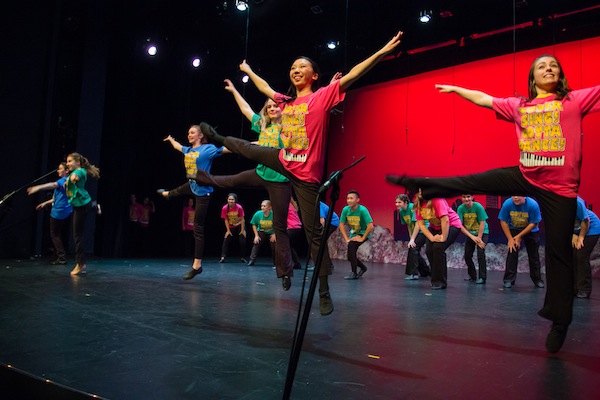
Malka Martz-Oberlander, left, and Dalia Currie are co-directing Little Shop of Horrors, which is at the Red Gate Revue Stage from Feb. 6-9. (photos from TES Theatre)

At 17, many Jewish Independent readers were probably spending most of their time hanging out with friends, maybe doing a music or art class or two, some sports activities. In addition to being a student, 17-year-old Jewish community member Malka Martz-Oberlander is a filmmaker, writer, film and theatre director, cartoonist, musical theatre actress and photographer. Her latest initiative is a production of Little Shop of Horrors, which is at the Red Gate Revue Stage on Granville Island Feb. 6-9.

Presenting the production is TES Theatre, or Transforming Education, which, explained Martz-Oberlander, was “originally the theatre program at the one-of-a-kind Windsor House School: a democratic, multi-campus, K-12 school in East Vancouver.

“When Windsor House School closed down last year,” she said, “former principal Meghan Carrico decided to start a theatre company for the students, like myself, who wanted to continue to do theatre and musical theatre together. The program that arose after the school’s devastating closure is grounded in the same democratic philosophy. Our mission is to make sure any student who wants to do any aspect of musical theatre can and will be supported by a willing cast and a professional musical theatre teacher.”

Martz-Oberlander is co-directing Little Shop of Horrors with Dalia Currie. Last June, the pair co-directed a production of Much Ado About Nothing that Currie adapted. According to Martz-Oberlander, Currie “loves Shakespeare” and has “co-directed and acted in many of the Bard’s shows,” including playing the role of Theseus in A Midsummer Night’s Dream in 2018, as part of the Carousel Theatre Teen Shakespeare Program.

Currie found musical theatre through joining Windsor House in 2018, said Martz-Oberlander. “She played Olive Ostrovsky in The 20th Annual Putnam County Spelling Bee and Gaston in Beauty vs. Beast, an original parody of the tale as old as time.”

For her part, Martz-Oberlander performed with Encore Musical Theatre (formerly Broadway Edge) for four years, then performed in two shows with Windsor House School and, this year, is a member of Arts Umbrella’s Pre-professional Musical Theatre Troupe.

illustration - Crystal, Ronette and Chiffon are the three narrators of Little Shop of Horrors. Malka Martz-Oberlander sketched this image of the trio, which was colourized by Emi Lavoie
Crystal, Ronette and Chiffon are the three narrators of Little Shop of Horrors. Malka Martz-Oberlander sketched this image of the trio, which was colourized by Emi Lavoie. (image from TES Theatre)

Martz-Oberlander said she and Currie initially pitched Little Shop of Horrors to the theatre company because they had both grown up watching it, “and we were very excited at the thought of directing our first musical together this year with the mentorship of our new musical theatre teacher, Isabella Halladay, who is a local musical theatre artist.”

The production involves around 30 people, said Martz-Oberlander, “and all but three of them are students. We held auditions for people within our theatre community,” she said. “We made sure that anyone who was interested has been involved in some way, whether it be onstage or in the tech booth. The actors range from age 14 to 19. There is no live band, we have backing tracks.”

Little Shop of Horrors, both a film and a Broadway musical from the 1980s, is now back on Broadway, said Martz-Oberlander. “It’s about an orphan boy taken in and given a job by Mr. Mushnik, a European Jewish immigrant and the owner of a run-down flower shop in the ‘bad part of town.’”

Despite the fact that both writers of the musical were Jewish – Howard Ashman (who passed away in 1991) and Alan Menken – Martz-Oberlander said that she and Currie were concerned about the portrayal of certain characters, in particular that of Mr. Mushnik.

“As a cast and individually, we have discussed when it’s good to bring out stereotypes and when it’s actually really harmful,” Martz-Oberlander told the Independent. “For example, the character Mr. Mushnik seems like a two-dimensional, money-hungry shop owner. The character embodies this Jewish stereotype throughout the whole story. My non-Jewish co-director and I have tried our best to approach this thought-provoking comedic piece with the intention of not perpetuating hurtful stereotypes. When producing a show written in a different decade, when values were different, it’s so important to come at it from an authentic, respectful and knowledgeable way.”

Martz-Oberlander had only praise for the production’s venue, the Red Gate Revue Stage. Saying that the cast and creative team were “incredibly lucky to get to rehearse and perform” there, she added, “I think a place like the Revue is vital at a time in Vancouver where things are less and less affordable – to have arts spaces and small theatres like the Revue is very important.”

As for Little Shop of Horrors, Martz-Oberlander said, “I think it’s a great opportunity to come out and support local youth-directed theatre and watch a fantastic show! This show is really a one-of-a-kind, hilarious science fiction musical that will have you humming tunes for weeks after.”

Tickets to Little Shop of Horrors ($5-$15) can be purchased at the door or online from brownpapertickets.com/event/4481952.

Magnifying emotions

Gila Green will talk about her two latest books at the Jewish Book Festival on Feb. 9. (photo from JCC Jewish Book Festival)

From the first page, White Zion reads like a memoir. Through 16 short stories, we get to know Miriam and her family, from her great-grandparents to her own children, as well as the places they are from, including Yemen, Israel at various points in its history and Canada. It is easy to wonder how much of Miriam is her creator, Israeli-based writer Gila Green, who will be at the Cherie Smith JCC Jewish Book Festival Feb. 9.

“The stories in White Zion are all about emotional truths,” Green told the Jewish Independent. “So, if that’s what’s coming across, that is some measure of success. I did not say this but Alice Munro did – I recall reading an interview with her in which she said: ‘If your audience thinks all you did was wake up and write down everything that happened to you yesterday, then you’ve succeeded.’ I would love to hear about how readers relate to these emotional truths, how they connect.”

Green will also bring her young adult novel No Entry to the festival, for which she will talk at both the Jewish Community Centre of Greater Vancouver (12:30 p.m.) and the White Rock/South Surrey Jewish Community Centre (4 p.m.) that Sunday.

The heroine of No Entry is Yael Amar, a teenager from Ottawa, which was where Green was born and has lived. Yael has traveled to South Africa to intern for a spell at a private bush camp near Kruger National Park. (Green’s husband is South African, and Green has lived in the country.) There with the intent of helping protect elephants from poachers, Yael ends up in danger herself.

Despite the connections her books may, or may not, have with her own family, Green prefers to write fiction. She described nonfiction as “limiting” for her.

“As soon as someone tells me to write a true story, I’m suffocating,” she said. “I have to start questioning what is fact, what is memory, what lacks context, what is something I’ve just convinced myself is true and on and on. I spent four years at Carleton [University in Ottawa] studying for a journalism degree, so all of that kicks in. In the end, the short story is a wrung-out sock, more like a dozen tangled wrung-out socks. No one wants to read a sock. There is no connecting with it.”

Fiction allows for the expression of emotional truths that would be impossible to express otherwise, she said.

“Writing fiction allows me to hone in on a feeling – something I want my audience to feel, which is how I start every story I write. I ask myself, ‘How do I want this story to make the reader feel?’ and I start from there – and I can hold that emotion under a magnifying glass. I can distort it, blow it sky high, cut interference to ant height or delete. I can take one characteristic of one person on a single day about a single event and I can magnify it, so that the rest of the human being is rendered invisible. These were some of my goals with White Zion. The characters are all gross distortions of one human trait or another.”

But that doesn’t mean that facts don’t enter her work.

image - White Zion book cover“I tried to be as faithful as possible to the historical period,” she said, referring to the stories in White Zion, “and I spent months researching everything, from what vegetables they could have been selling in the Jerusalem market post-1948 to how they could possibly have been heating their homes. I also used the same biographical details for two of the characters, Miriam and her father. It was important for me that Jewish fiction expand to include Yemenite voices, religious voices, gay voices, the more voices the better.”

Green also did much research for No Entry and, in addition to crafting an entertaining, at-times tense, thriller-like novel, she educates readers on the nature of elephants and the very real threat of their extinction.

“Yael is a Jewish eco-heroine,” said Green, who noted that the character’s boyfriend, David, is also Jewish. “She’s not religious but both of her parents are Jewish – she mentions in No Entry how the South African traditional dish she tastes for the first time reminds her of her mother’s chulnt on the Sabbath and, in No Fly Zone, she has an Israeli-themed dinner with her parents. None of the other characters are Jewish…. I do like exploring different kinds of Jews though. If readers want a more obvious Jewish heroine in the sequel[s], please write to me.”

Green has finished writing No Fly Zone, the next book in what might become a series. In it, she said, “Yael Amar is back with her best friend Nadine Kelly, this time protecting Kruger National Park from the skies. But she is about to learn a big lesson when it comes to moral relativity and friendship.”

image - No Entry book coverGreen added, “I set out to thread the senseless loss of human life with the equally nonsensical destruction of animals in No Entry and I continue this in the sequel. I did this not because I’m trying to make a point about the connection or status between humans and animals – that’s the wrong way to understand my motivation. Rather, I’m trying to weave together the criminals who commit these inhuman acts: they’re connected.

“Often,” she said, “the same people willing to sell illegal blood ivory are involved in terrorism, human slavery and other acts that bring nothing but grief to the planet. I wish to emphasize this linkage, to shout it from the rooftops. But, in real life, I figured an exciting, adventurous, teen novel was a more effective way to go.

“I purposely made the terrorist event [in No Entry] happen in Canada because I want to get the message across that fatal betrayal doesn’t just happen in Africa or the Middle East. That attitude might allow some of us to feel off the hook. It happens everywhere and we all have to make sure we are part of the solution or there won’t be one and that thought is too devastating to imagine. I refuse to go there and No Entry ends on a victorious note for a reason.”

Though the sequel has been written, its publication date will depend on what happens in Australia and the bushfires that continue to destroy the country. Green shared, “I am very sad to say that my publisher Stormbird Press was on Kangaroo Island and has burned to the ground. The staff was evacuated on Dec. 20th. We are all praying for their safety and that they fully recover but, for now, everything is at a standstill and there is terrible devastation.”

Green is already working on her next novel. In A Prayer Apart, her main character, for the first time, is male, she said. “He’s an Israeli-Jewish teenager living through the 2014 war with Hamas, knowing he’s next in line for the front line. By the same token, he’s had it with his parents and school and his rebellious behaviour lands him in lockdown, one step away from juvenile jail.”

She said she will let readers know on her website, gilagreenwrites.com, when the publication details are finalized.

An avid reader since childhood and now a prolific writer, with four books published since 2013 and two more on the way, Green said, “Mankind cannot live without stories. Period. We are our stories. When people are down, what they are really saying very often is they don’t feel connected. Stories connect us.”

For the Jewish Book Festival lineup and schedule, visit jewishbookfestival.ca.

Eclectic Jewish sounds

Andy Muchin with a record from his collection. (photo from Sounds Jewish)

The American South may not be the first place you would consider tuning the dial for an hour-long radio program that runs the gamut of Jewish music and many other audio facets of Yiddishkeit. That the show is assembled half the year on Vancouver Island might add another element of unexpectedness to the equation.

“I realize it might appear a bit incongruous,” Andrew Muchin told the Independent, from his Victoria home. “But, thanks to the internet age, things like this are no longer that difficult to do.”

Fifty weeks a year, Muchin goes through his collection of more than 1,000 vinyl records, scores of CDs and hour upon hour of digitized music to produce Sounds Jewish, a weekly radio program for Mississippi Public Broadcasting, based in Jackson, Miss. The show is broadcast on Sunday afternoons there and heard anytime online.

Having celebrated its ninth anniversary at the end of last September, Sounds Jewish focuses on a relevant theme, often within the Jewish and secular calendars. Avid listeners soon realize the problem for Muchin is not finding material but sifting through all the material that is out there. It takes several hours to select music for, record and produce each show, and programs often contain a range of offerings, anything from a 1960s comedy routine to Israeli hip-hop.

For American Thanksgiving in late November, Muchin spun a number of discs, including a Ladino number, “These Beautiful Tables” by the Ruth Yaakov Ensemble, and “Tish Niggun” (“Table Melody”) from the band Klezmer Plus! The show then mixed in songs of gratitude, such as a melodic rendition of Psalm 118 with Israeli singer/keyboardist Idan Raichel and Malian singer/guitarist Vieux Farka Touré and a counting of blessings from British singer Daniel Cainer – who opened the 2019 Chutzpah! Festival – in “How We’re Blessed,” from his album Jewish Chronicles.

In October, Muchin prepared a World Series show dedicated to Jews and baseball, and particularly to the home cities of the two teams involved in this year’s Fall Classic, the Houston Astros and the Washington Nationals. This show featured a country version of the prayer Modeh Ani from Houston-born country singer-songwriter Joe Buchanan; a cut from Kramer’s The Greenberg Variations, an instrumental tribute to Detroit slugger Hank Greenberg; and ballpark favourites “Take Me Out to the Ballgame” and “God Bless America” belted out in Yiddish by Mandy Patinkin.

In marking recent holidays and occasions, Muchin has taken his listeners on a musical tour of Jewish labour songs ahead of Labour Day, rhythmically reminded them of many sins to avoid during the month of Elul, leading up to the High Holidays, and melodically explored the ongoing desire for self-improvement ahead of Yom Kippur, the Day of Atonement.

“I try never to be preachy, but I like to inform my listeners of various Jewish or Jewy practices they can incorporate in their lives – or not. Mostly, though, Sounds Jewish presents the diversity of Jewish music across time and space. To my ear, Jewish music is the ultimate world music, since Jews have lived almost everywhere on earth, blending the native music with Jewish themes,” he said.

A native of Manitowoc, Wis., Muchin was raised in a traditional Jewish home, growing up versed in Hebrew and liturgical melodies. He later learned Israeli songs at a Zionist summer camp, but said he didn’t become steeped in Jewish music until long after the klezmer revival of the 1970s.

Muchin has been active in Jewish media and Jewish life since 1986, when he started as an assistant editor for the Jewish Telegraphic Agency. He moved back to his home state to serve as editor for the Wisconsin Jewish Chronicle in Milwaukee and edited and co-published (with Marge Eiseman) Jewish Heartland magazine. He also has written for the Forward, Moment, Jewish Week and numerous other publications.

In 2009, Muchin landed in Jackson, as the cultural program director of the Goldring/Woldenberg Institute of Southern Jewish Life, a nonprofit that provides a variety of educational, cultural and religious services to underserved Jewish communities throughout the South. There, he met the director of Mississippi Public Broadcasting’s radio division, Jason Klein, who also happened to be Jewish, and Sounds Jewish took flight.

In Victoria, Muchin served as director of the 2019 Victoria International Jewish Film Festival and has written and presented two Purim shpiels (plays).

As for the future of Sounds Jewish, Muchin hopes to continue adding to his Jewish music collection – he said he accepts donations of LPs – and to broaden and deepen the content of the show.

“I expect the show to have an increasingly Canadian feel as I learn more about the very creative Canadian Jewish music scene and its history,” he said.

Sounds Jewish can be heard at mpbonline.org/soundsjewish, exchange.prx.org/series/32262-sounds-jewish and radio-j.com.

Sam Margolis has written for the Globe and Mail, the National Post, UPI and MSNBC.