Be in on the joke in AI

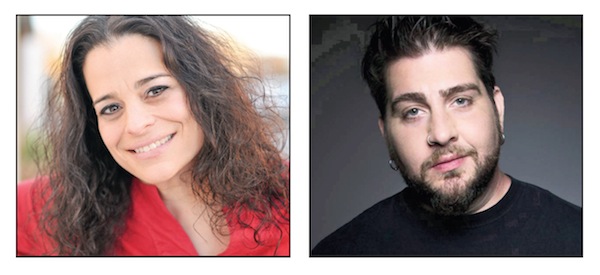
Hannah Everett, left, and Drew Carlson co-star in Artisanal Intelligence, at the Havana Theatre Jan. 14-18. (photo from Spec Theatre)

Drew Carlson and Jewish community member Hannah Everett are reprising their roles in Artisanal Intelligence, which again plays at the Havana Theatre, Jan. 14-18.

Written by Jewish community member Ira Cooper, the show had a limited two-show run this past July at the Havana; both of those performances sold out. It also traveled to a few Fringe festivals, garnering positive reviews.

Carlson plays Barry, a hipster customer-service robot who is filled with esoteric knowledge and mad skills. Everett plays Jane, the entrepreneur who created Barry.

“The content will be the same, aside from a few tweaks and tightens,” Cooper told the Independent about how the January production differs from the summer show. “One of the songs, ‘No Off-Switch for Love,’ will be fully orchestrated, as opposed to the passable version of it that I created on GarageBand with digital instrumentation, so that is exciting and new. I am hoping it will fill out the song more, give it its deserved panache, and get people dancing in and out of their seats. It’s a Boney M.-inspired funk track, so I am really happy that it will finally be given the backtrack it has always longed for.”

photo - Ira Cooper’s Artisanal Intelligence is at the Havana Theatre Jan. 14-18
Ira Cooper (photo from Spec Theatre)

The idea for Artisanal Intelligence took a couple of years to develop.

“In 2017, I went to live in China for a year to teach at a Canadian high school abroad,” said Cooper, who teaches the younger grades English and drama at King David High School. “My partner stayed in Canada and so I was there, in a new city, in a massive apartment, concocting, creating and percolating thoughts, ideas, words and scribbles to fill a void. Artisanal Intelligence was my attempt to write an accessible Fringe show…. Hipsterism just has so much great material to rib and, being that I would self-identify as a ‘hipster,’ I needn’t go too far to do my research. And robots. And AI. All are distinct and widely known, relevant, partaken in and discussed topics, so it seemed like an easy fit with my own personal playwriting aspirations this time around.

“I do not remember much about the writing process for the initial drafts. Knowing myself, it was probably over a three- or four-week period. Then drafts. Collaboration is integral to everything I and Spec Theatre do, so, early on in the process, I had people reading the script and giving me notes. Then it was sitting down with the director, Bronwen Marsden, for more edits. Then with the actors. Then with my partner, who is also the artistic designer for Spec, Ruby Arnold. The more feedback the better. The end result is a deeply heart-filled joint-effort, which we are all proud of and which we all had a part in molding, from the very words on the page outwards.”

Cooper said Artisanal Intelligence lampoons and lambasts hipster culture, as opposed to critiquing it.

“The show uses a lot of recognizable hipster motifs, tropes and allusions, but the audience is consistently in on the joke,” he said. “The show is a discussion on identity, self-perseverance, self-reliance and the impending (or not) robot apocalypse, but in a soft and humorous way.

“I think the show actually exemplifies why culture can be important, how it can bind us to something bigger than ourselves. We are constantly looking for the ‘bigger than ourselves’ entities. And so, with the culture references, the clearly identifiable razzing and fun that takes place in the 55 minutes of Artisanal Intelligence, the audience, who get what the show is alluding to, are part of each joke’s equation – that knowledge links culture, the audience and the performers.”

The performances at the Havana in January will be relaxed, said Cooper, which means “the houselights will never fully dim and people are free, if they need or want, to get up, stretch, move, go for a walk, etc. We want theatre to be accessible to everyone and we respect, acknowledge and cherish the diversity of our audiences. Also, if you’re an artist of any kind, Spec Theatre is always looking to collaborate, to make unique, experimental, new things. Reach out!”

For tickets to Artisanal Intelligence, go to spectheatre.com.

Alice’s wonder and silliness

Kat Palmer, left, and Kyra Leroux during the final dress rehearsal for Alice in Wonderland – The Panto, which opened at Metro Theatre Dec. 13 and runs to Jan. 4. (photo by Tracy-Lynn Chernaske)

“In Alice in Wonderland – The Panto, audiences will see all of their favourite characters from the original story in a new, more hilarious light,” Kyra Leroux told the Independent. The panto opened at Metro Theatre on Dec. 13 and runs to Jan. 4.

“This show is definitely a lot more silly and ridiculous than the original Alice in Wonderland story, but the difference that really strikes me the most is my character, Alice,” said Leroux, who is a member of Perry Ehrlich’s ShowStoppers and a past participant in the Gotta Sing! Gotta Dance! annual summer theatre program at the Jewish Community Centre of Greater Vancouver. “In this show, Alice has so much confidence and spunk, which is exactly what you would expect from a curious, forward-thinking young woman!

“She’s such a fun character to play because I see myself in her in so many ways. Although at first she is confused about which direction she wants to take her life, relying on others to show her the way, she soon realizes that she can make her own decisions and take charge of her own life, thereby gaining so much confidence.

“Alice loves to joke around,” added Leroux, “and, at times, even matches the absolute absurdity of characters such as the Mad Hatter, the Cheshire Cat and the Queen of Hearts. Despite feeling stuck in her confusing situation, Alice is never one to take herself too seriously, which is exactly like me in real life.”

An easy-going attitude will also help Jewish community member Kat Palmer in her role as stage manager of the production.

“Pantos definitely conjure up the phrase ‘controlled chaos.’ While there is always a certain element of surprise with live theatre,” said Palmer, “each performance of the panto is undoubtedly ever-changing, with a unique audience every night – so much of this show is determined by audience participation and the actors improvising.

“Pantos are always a family favourite,” she said, “because kids are encouraged to react loudly – they boo the Demon and cheer for the Good Fairy. As a stage manager, I might plan to call a sound or lighting cue on a certain line but, if the actor is ad-libbing or we have a particularly rowdy audience, the line may not happen when it’s supposed to. You have to be on your toes and focused all the time. Whereas musicals and plays are more set in stone, the panto will be a different show every night.”

The silliness of it all is what Leroux most enjoys.

“Throughout the process,” she said, “it has been so much fun to just let go and allow myself to be absolutely ridiculous along with my castmates. My favourite days in rehearsal are when I get to watch other actors make choices that make me laugh so hard I feel like I could explode! With that in mind, the most challenging thing about being in a panto is being so focused and in character onstage that you will never break character and laugh at what others are doing. There are so many hilarious moments in the show that even I, after seeing them over and over again, have to work hard not to laugh. That being said, I’m so excited to see how audiences will react when they see all of my favourite moments for the first time.”

For tickets to Alice in Wonderland – The Panto, call 604-266-7191 or visit tickets.metrotheatre.com.

Classes on being a DJ

Michael Fraser teaches group electronic music and DJ classes at the Jewish Community Centre of Greater Vancouver. (photo from Michael Fraser)

As a violinist, music producer and DJ, Michael Fraser’s musical talents traverse many realms. Yet, despite the proficiency and versatility he has to create his art, Fraser believes that “personal connection to music transcends skill.”

It is that personal musical connection that the 30-year-old, born-and-raised Vancouverite hopes to instil in the next generations – be they performers or devotees – in the group electronic music and DJ classes he is teaching at the Jewish Community Centre of Greater Vancouver through spring 2020.

The early stages of Fraser’s musical trajectory began in grade school as a Suzuki violin player, though numerous other styles – from classical to hip-hop – seeped into his sphere of artistic influences through various musical mentors. Among them was Vancouver-based saxophonist and flautist Tom Keenlyside, who had a tremendous impact and helped Fraser “connect with music in an abstract, rather than a theoretical, way.”

Marrying and starting a family with his partner Camille, though, has brought about a shift in Fraser’s musical focus in recent years. The sense of wonder possessed by children, and the simple way it is often expressed, led him to view things from a different perspective and to feel a sense of responsibility to teach.

Fraser began playing music for his son before his son was even born. When Isaac turned three, Fraser observed him connecting to the process of making music himself.

“After Isaac was born, I started to see that my purpose as a musician is to help young artists develop their innate creativity and coach artists to deeper levels of emotional intelligence,” said Fraser. “When my son asks to hear my music, I want to help him cultivate a relationship to music and life that goes beyond what words can express.”

Fraser’s professional musical career began in 2007, while in his late teens. Since then, he has collaborated with numerous recording artists, including the Ault Sisters, a Toronto-based vocal jazz trio; performed at the Shambhala Music Festival and the Montreal Jazz Festival, among many other venues; and opened for internationally known acts, such as Michael Bublé, Caravan Palace and Arrested Development.

His success as a live performer led him to working with Ben Affleck on the original score for Ben Affleck on the Meaning of Life, an animated short film about the actor and director’s Eastern Congo Initiative, which premièred at the 2012 Toronto International Film Festival. Fraser also appeared as a violin player in a scene of The Revenant, an Academy Award nominee for best picture in 2016 and for which Leonardo DiCaprio won the prize for best actor.

Currently, Fraser is devoting his expertise to artist development (on both the career and creative sides), as well as working with Black Octopus Sound, a company that produces samples and musical production tools.

Fraser said he has always felt “a visceral connection to Jewish music that can only be explained as being deeply embedded in my DNA. It is the main access point for a depth of emotion that can only be expressed through tones and rhythms.”

On Oct. 29, he began facilitating his first DJ course at the JCCGV for youth aged 10-16, showing them the basics of how music is composed electronically, and the ins and outs of being a DJ. This session ran until Dec. 17.

He could feel how the group connected with the music, and foresaw many new up-and-coming DJs in the Vancouver Jewish community.

“When I am in the class with students, we are focused on how the beat feels. Are there styles of music that feel good? Knowing your tastes is going to differentiate yourself from other DJs,” Fraser explained. “I will sit with a class and play various drums and figure out which one speaks to a particular student. Having that distinction brings us closer to the music – which chords carry tension and which carry release in chord progression? What does that connection to music feel like? How is it one can play the same series of notes in different order and have a different outcome feeling?”

His students take what was done in class and make musical experiments when they get home. Fraser finds that, when they open up GarageBand or Caustic, two of the more popular DJing apps, they don’t feel as though they are doing homework.

Often, he noted, students have used DJing apps before. He also pointed out that, unlike kids from earlier times, kids today don’t differentiate between DJs and music creators. Those barriers are completely gone, he said.

The courses – $180 for JCCGV members and $225 for non-members – comprise 10 lessons, run Tuesday evenings and are open to kids 10-16. Students should bring a pen and paper, a mobile device (laptop, tablet, cellphone) and headphones. For more information, visit jccgv.com/performing-arts/school-of-music.

Sam Margolis has written for the Globe and Mail, the National Post, UPI and MSNBC.

O My God at Emanu-El

Bema Productions presents the Canadian première of the comedy O My God at Congregation Emanu-El Synagogue in Victoria, Jan. 16-26. In O My God by Israeli playwright Anat Gov, God walks into a therapist’s office suffering from depression. The therapist asks, “How long have you felt this way?” God says, “Two thousand, five hundred years. Give or take.” “You’ve been depressed for 2,000 years and only now you’ve come to therapy? What were you waiting for?” asks the therapist. And God says, “I thought time would heal.”

Gov, who died of cancer at 58, was born in 1953, and was a graduate of Thelma Yellin High School of the Arts. She was briefly a student in Tel Aviv University’s theatre department – she dropped out to become a successful playwright and television writer. She also married and was a mother of three and grandmother of two.

The Bema Productions staging of O My God is directed by Zelda Dean and performed by Christine Upright (the therapist), Rosemary Jeffery (God) and Jesse Wilson, who is on the autism spectrum himself, plays the autistic son of the therapist.

Tickets ($23) can be purchased online at ticketrocket.co or at the door.

Living’s Jewish aspects

A still from the Netflix show Living With Yourself, co-starring Paul Rudd.

As the secular New Year approaches, many people make resolutions, in an effort to become a better person. What if there were a shortcut? What if, for a tidy sum, you could be transformed, virtually overnight, into the person you’ve dreamed of being?

This the conundrum posed by the Netflix show Living With Yourself, an eight-part series released in late October, starring Paul Rudd and Aisling Bea, who play spouses Miles and Kate Elliot. Rudd is also one of the executive producers.

The premise is this: Miles, a shlub discontent with and disconnected from his wife, and suffering career ennui, discovers a “spa” that offers a treatment to improve his charm and confidence. For a small fortune, they promise, a “new you.” And so, a shlemiel enters and a gentleman exits. Just one problem: [spoiler] it’s actually a cloning lab and, unbeknownst to Miles and Clone Miles, the two men exist and, later, each must contend with the other in his life.

Rudd’s 25 years of movie experience includes Ant Man, Anchorman, Knocked Up, 40-Year-Old Virgin and Clueless. On television, he played Mike Hannigan in Friends and appeared in Reno 911, among other things.

The New Jersey-born actor hasn’t been shy in publicly discussing his Jewish identity. He kibitzed a bit about his Jewishness in an interview segment of Between Two Ferns. In an episode of Finding Your Roots, he found out that his grandfather, Davis Rudnitsky, fought the Nazis, only to return home to England to face antisemitism. In 2017, Rudd played his first (overtly) Jewish character, Moe Berg, in the biopic The Catcher Was a Spy, about a baseball player who joins the Second World War effort as an undercover agent.

In Living With Yourself, there is one explicit Jewish moment, when a Holocaust survivor tells Miles an off-colour anecdote about the Shoah, involving pork. But there are also hidden Jewish themes. For example, envious of a colleague’s extraordinary success in the office, Miles is spurred by the prospect that his technological makeover could help him outperform this coworker. Though Judaism has no problem with someone being motivated to accomplish because of another’s success, the Torah warns against jealousy. The ninth commandment is one obvious caution against such sentiment: “Thou shalt not covet.” Another is Joseph’s brothers (Genesis 36), who, enraged with jealousy, sell Joseph into slavery. In a sense, Miles and Clone Miles are like brothers, and they develop petty and spiteful jealousies, wanting the best of both worlds, but not able to have it.

If only Miles initially had derived fulfilment and was grateful for what he had, he wouldn’t be in this much trouble. Ethics of Our Fathers (Pirkei Avot) (4:1) advises just that: “Who has wealth? The one who is pleased with his lot.” The meaning isn’t limited to “wealth” of materials, of course, but the wealth of blessings that are bestowed upon us, including, for most of us, our loved ones, our safety, our employment and access to the necessities of life.

Notably, though, Miles versus Clone Miles is illustrative of the yetzer hara (good inclination) and the yetzer hatov (bad inclination) at battle with each other. Interestingly, neither character is completely good nor bad, but a combination, reflecting the real, complicated, human condition, where we have both inclinations competing inside us.

Often, we are able to convince ourselves of the nobility of our decisions – that is, find a good reason for our perhaps less-than-good action; explain away the importance of a choice’s potential harm. Paradoxically, the yetzer hatov has a sneaky side. To explain this, author and radio host Dennis Prager often cites the late Rabbi Wolfe Kelman, former head of the Conservative rabbinate. He once told Prager that he had his yetzer hara under control, but his yetzer hatov “always got him into trouble.”

Rarely do ordinary people wake up each morning and strive to make another human miserable. Still, we must wrestle with our “other” selves, overcome our justifications and egos, to make principled choices. Every day is a lesson in living with ourselves.

Dave Gordon is a Toronto-based freelance writer whose work has appeared in more than 100 publications around the world.

Letting imagination fly

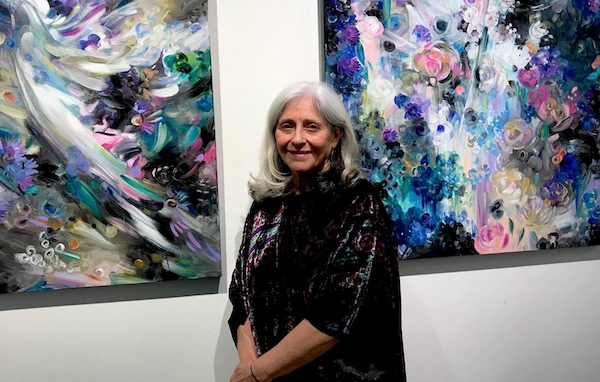
Janet Strayer at the opening of her solo exhibit, Wings of Imagination, on Nov. 28 at the Zack Gallery. (photo by Olga Livshin)

Janet Strayer first conceived the idea for her new show at the Zack Gallery, Wings of Imagination, about a year ago. “I was talking with Linda, and the bird theme came about,” she said in an interview with the Independent, referring to Linda Lando, director of the gallery.

“Birds appeared in my paintings before,” said Strayer. “They take us into the air, into a different place. Birds symbolize freedom – freedom of movement, freedom of imagination. The flight of imagination allows us to envision different possibilities, different solutions, even different ways to see familiar things. When I considered the name for this show, I thought about [Albert] Einstein and his words that knowledge is always limited, but imagination is limitless. Imagination is the most important thing for any artist.”

Wings of Imagination is all about flight and wings. Birds populate the paintings. Bright and whimsical, they flitter around birdhouses, soar towards a distant sky or interact with other creatures, real or imaginary. Some images are bright, almost cartoonish, inviting a smile, while others seem more serious, characterized by quiet intensity and misty, pastel colours. And then there are funky collages, with real 3-D birdhouses attached to the two-dimensional pictures.

“There are three distinct styles of paintings in this show,” said Strayer. “The three styles are consistent with the theme of the show. I started it conceptually, as I always do, but I couldn’t explore it in any one direction. Wings of imagination is a huge theme, and there is no one way to approach it – all the possible ways should be expressed. Freedom of expression is what it is all about; it is like several different directions of flight.”

image - “Papageno” by Janet Strayer, whose exhibit at the Zack Gallery runs until Jan. 5
“Papageno” by Janet Strayer, whose exhibit at the Zack Gallery runs until Jan. 5.

One of the styles is almost impressionism. The paintings’ blurry lines are reminiscent of Claude Monet’s foggy nights. The dream-like imagery catapults the viewers into some eldritch realms of sublime illusions with their wings and birds, sky and air.

“Another style is magic realism,” the artist explained. “I wanted to go magical. Imagination is magic. The Canada goose is flying, but his wings are magical – you can’t see such pattern on a real goose, except in your imagination. Beside the goose hangs my homage to Leonard Cohen, as he walks across the sky.”

The two paintings of “Birdwoman” seem similar in composition but entirely different in their palettes and in their emotional subtext. “The colours in ‘Birdwoman on the Roof’ are muted compared to the other one,” said Strayer. “On the roof, she is open to the sky, not as loud as the other, more of a mystery. It has space for you to come in and indulge in your own perception, while the other one is more enclosed inside its room and its brilliant colours.”

Strayer’s magic realism paintings are eccentric and capricious, with clear lines between the colours and frolicking creatures from fantasy novels, while her third style, the collages, appear at first glance as a jumble of small images punctuated by birdhouses.

“Birds need places to live in,” said the artist. “I took a risk with the collages, didn’t know what would happen, but it was such fun working with them. It took me three months to finish those two collages. They started with fragments, and then they led to other fragments. And feathers. And birdhouses. Things tell you what to do, until the entire image comes alive. It was like an adventure in my studio every day. Where would it go?”

Strayer’s playful adventure resulted in two unique art installations. “I wanted people to be surprised by these collages,” she said. “I wanted them to stop and look at all the tiny details. We don’t always stop and look. Even with art, so often, we come to a gallery, but we just glance. We don’t stop and really look.”

Strayer’s is a familiar name to Zack Gallery patrons. She had a solo show at the gallery in 2010, but the difference between the two shows is not only temporal but esthetic. While the previous show was black-and-white digital art and a poetic look at childhood, this one is bursting with colour and exuberance, and features mostly acrylic paintings.

“I enjoy creating digital art,” she said, “but I wouldn’t want it as a steady diet. I’m an explorer. I always want to try something different. I love to work on real paintings. And I’ve always loved colour.”

For Strayer, a predominantly abstract artist, the esthetics of her creations are more important than the telling of a story or the conveying of a message.

“A message should come through the esthetics,” she said. “And, if someone has a different interpretation than me, it’s fine, too. As soon as the paintings are on the gallery wall, they are not mine anymore, even though I created them. Everyone could see something different, compatible with their own memories and experience.”

Wings of Imagination opened on Nov. 28 and runs until Jan. 5. To learn more about Strayer, visit janetstrayerart.com.

Olga Livshin is a Vancouver freelance writer. She can be reached at olgagodim@gmail.com.

Sketching historic shuls

Ben and Carla Levinson (photo by Sam Margolis)

With the speed of a street-corner caricaturist yet the precision of someone who seemingly misses nothing, Ben Levinson has for decades been capturing the cityscapes of the many places to which he has traveled with his wife, Carla. No pencil, no erasing. Just a black ink pen and a small sketchbook.

“My architectural career taught me to sketch quickly and furiously, and I am able to see details that most would not see,” Levinson told the Independent in an interview earlier this fall.

During these adventures, Levinson has sketched everything of architectural interest to him: churches, cathedrals, mosques, pyramids and, of course, synagogues, while Carla would station herself at a café.

image - Synagogue at Tomar, Portugal. Sketch by Ben Levinson
Synagogue at Tomar, Portugal. Sketch by Ben Levinson.

By the time she was done with her coffee and croissant, Ben would have a complete rendering to show her. During the infrequent occasions she would finish first, incomplete drawings would be filled out when they reached their hotel.

The alacrity, accuracy and artistry of the sketches were at times the envy of those whom they encountered on their travels.

“We met artists whose wives and partners waited all too patiently and were ready to move on, whereas Ben was long done,” Carla said.

After looking through Ben’s sketchbooks one day, Carla suggested he do a show devoted to synagogues. Carla, who ran Victoria’s Gallery 1248, helped curate the selection of sketches that appeared at the Wings of Peace Gallery at Victoria’s Congregation Emanu-El from Sept. 4 through Yom Kippur. Now those sketches have been compiled into a book which is tentatively titled In Search of Identity: The Story of the Wandering Jew.

The book’s 49 sketches transport the viewer throughout the old and the new worlds. Many of the sketches are connected by the common experience of Jews moving on because of antisemitic treatment, despite centuries of coexistence in a community.

The figurative journey, which includes interiors and exteriors and is really the result of several holidays the Levinsons took over the span of two decades, sets off in Toledo, Spain, home to one of the few remaining synagogues left after the Spanish Inquisition scattered Jews throughout Europe and the Americas. Levinson’s exhibit and book spend a lot of time in Sephardi lands: a 14th-century Moorish-style synagogue in Cordoba; a tiny shul in Tomar, Portugal, the only pre-Renaissance temple in the country; larger houses of worship in Morocco, home to the largest Jewish population in the Arab world; and, finally, to the Portuguese Synagogue in Amsterdam, completed in 1675.

Poignant reminders of the once-thriving Jewish communities of Eastern Europe follow. Levinson leads the viewer through Berlin, Prague and Budapest, along with artistic reconstructions of the Terezin sleeping barracks and an ancient dig in Vienna.

image - Templo Libertad in Buenos Aires, Argentina. Sketch by Ben Levinson
Templo Libertad in Buenos Aires, Argentina. Sketch by Ben Levinson.

The voyage shifts to France, Italy and Scandinavia, with the majestic Marais synagogue in Paris, the synagogue at the Museum of Jewish Life in Trieste and the Gothenburg Synagogue, the scene of a firebomb attack in 2017.

Levinson also presents active scenes of a crowd forming outside a Venice synagogue on a sunny Shabbat morning, passersby in front of an Antwerp temple and a sea of bicycles by the Great Synagogue of Copenhagen.

The visual trip wraps up with drawings from Mexico City and the Byzantine-style building of Libertad Synagogue in Buenos Aires.

Born in Medicine Hat, Alta., in 1942, Levinson graduated from the University of Manitoba’s architectural program. In 1966, he moved to Victoria and worked for various firms before starting his 30-year private practice as president of Benjamin Bryce Levinson Architects in 1980. In addition to leading his practice, he continued sketching and showing his work at various venues, including the Architectural Institute of British Columbia and the Jewish Community Centre of Greater Vancouver.

Levinson was instrumental in restoring Congregation Emanu-El in the early 1980s. When he arrived in town, he felt an initial disappointment upon seeing the synagogue with “its pink stucco, balcony balustrade pickets, missing fence and hidden dome ceiling.” He helped the synagogue’s leadership in obtaining grants and helped steer the building and fundraising committees to get the money necessary to revitalize the region’s most historic Jewish building.

Small Town Architect, the name of his first book, documents his 40-year career in architectural design and recounts his travels and artistic endeavours. His work can be found throughout Victoria and in numerous communities throughout the province; in elementary schools, municipal halls, grocery stores and restaurants, among other buildings.

Sam Margolis has written for the Globe and Mail, the National Post, UPI and MSNBC.

A life of music, poetry

Ayelet Rose Gottlieb released two new collaborative CDs this year. (photo by Sergio Veranes)

Ayelet Rose Gottlieb released two new collaborative CDs this year: Who Has Seen the Wind? by the group Pneuma and I Carry Your Heart: A Tribute to Arnie Lawrence. Both creative endeavours will appeal to those who appreciate top-level musicianship, improvisation and meaning beyond the notes.

As she has done with other recordings, Who Has Seen the Wind?, which was released on Songlines, centres around a theme. In this case, the wind. Gottlieb and James Falzone, François Houle and Michael Winograd – clarinetists and fellow composers – have written music inspired by a range of poetry from various cultures, including Iranian and Japanese. The title of the CD comes from a poem by English poet Christina Rossetti of the same name, and Pneuma means breath, spirit or soul in ancient Greek.

I Carry Your Heart: A Tribute to Arnie Lawrence, which was released on Ride Symbol Records, also has poetry as one of its foundations, but it is, as its name says, a tribute to Arnie Lawrence and, specifically, his record Inside An Hourglass.

“Arnie’s Inside an Hourglass album has always been one of my favourite Arnie Lawrence records,” Gottlieb told the Independent. “In 1969, he went into the studio with his band and with his 8-year-old son Erik and with 5-year-old Dickie Davis Jr. (son of bassist Richard Davis). The band and children played a full record worth of improvised music together. This improvisation was released on the record label owned by the great flautist Herbie Mann.

“When I became a mother, this record started resonating with me in a new way. It reflected something of how I wanted to be a parent – in freedom, in music, in improvisation, with my kids and not in an ‘alternate reality’ that is separate from them.

“At one point,” she said, “I spoke to Arnie’s son, Erik, about the idea of revisiting the concept of that original album. Erik jumped on board and, along with my three little kids and our mutual friend and musical partner, Anat Fort, we went into pianist Chris Gestrin’s home studio in Coquitlam, B.C. My three little kids were 2 years old (twins) and 7 months old at the time of the recording. Baby Maia was with us for the full eight hours and the twins were there for about four hours. We also used some pre-recorded sounds that I edited in advance to create daily-sound tapestries for us to improvise over.

“We brought in some poetry by Arnie and E. E. Cummings and we let the day unfold as it did. The music on this album is all fully improvised – unrehearsed and unplanned. The biggest challenge was then to choose what to toss and what to keep. We loved so much of what came of this once-in-a-lifetime session.

“Our album is not a remake, but rather a revisiting of Arnie’s 1969 concept,” she stressed. “It’s a tribute to him and an extension of what he started back then, when his son was 8 years old. Fifty years later, Erik was creating this homage to his first album, now as the adult in the room, with his father’s mentee and her three children.”

Gottlieb met the elder Lawrence in Israel, where she grew up, when she was 16 years old; he had moved to Jerusalem from New York.

“He was the first to throw me into the deep waters of jazz,” she said. “My dear friend, fellow vocalist Julia Feldman, and I would go hear him play at the restaurant above the Khan Theatre. One day, someone told Arnie that the two teenagers sitting in the corner night after night are singers! At the start of the next set, somewhere around the middle of the first tune, Arnie walked up to me with a mic and commanded – ‘Sing.’ And that, I did.

“From that night on, Julia and I would frequent any restaurant, café or club he played at. In order to be able to hang with the ever-changing, always burning band, I memorized hundreds of tunes off of my father’s LPs and transcribed countless solos. After awhile, Arnie started calling me to perform with him, not as a sit-in guest, but as an equal on the bandstand. I always felt that playing alongside Arnie elevated my own playing to new levels. His trust in me allowed me to trust myself and my own musicality, at the fragile age of 17.”

Around this time, Gottlieb began composing. “I was finding my voice and my place in music,” she said. “When, at 19, I decided to go study at New England Conservatory in Boston, Arnie, who was my greatest advocate, wrote a wonderful recommendation letter, which felt like he was delivering me to my future teachers – Ran Blake, Dominique Eade, George Russell and others.

“Though my time with Arnie was spent primarily playing jazz standards, I feel that he gave me my foundations as a composer, improviser and as an educator. He taught me to work deeply with my ears, and to be present and connected. He gave me his trust, before I really did anything to deserve it. And this trust gave me the wings I still use to fly.”

Gottlieb is an avid poetry reader and collector, and has “shelves full of books and folders full of files with texts that I may or may not use some day, but they ‘feed’ me with inspiration and insight, daily. In recent years,” she said, “I’ve also been working as a poetry and prose translator from Hebrew to English.”

She sees everything, “through ‘glasses’ of music and poetry,” she said. “Music informs all of my experiences and poetry is built into my world of associations and my way of expressing myself in the world. When I compose, perform or improvise, I am the most ‘me,’ without filters. It feels like a calling, and a personal necessity. I’ve never had a time in my life in which I didn’t have music. It has been my companion and an extension of me, ever since I can remember myself. Some of my earliest memories involve music-making.

“It is also my portal into the world of spirit,” she said. “I experience inspiration in a great variety of ways. I often feel that the music I’m writing or improvising is received, rather than created. Of course, there is lots of knowledge, experience and work that goes into it, too. But this instinctual, primal connection is at the core of all of my works. This is why, when I make music, I do not think about anything other than what the music asks of me.

“I start thinking about the audience when it’s time to birth the music into a physical existence – when I’m working on packaging, releasing an album, bookings, getting the word out about it, etc.”

As an example of this transition from inner to outer focus, Gottlieb gave Pneuma, all of the members of which contributed to Who Has Seen the Wind?

“My contribution,” she said, “was a six-part song cycle based on Christina Rossetti’s poem ‘Who Has Seen the Wind?’…. This song cycle is a great example of my connection to music and poetry.

“The idea to work with clarinets was inspired by my paternal grandfather, who was an amateur clarinetist. Right from the start, this project was a way for me to communicate with him, and continue our connection and relationship beyond the limitations of the physical world. How wonderful to have such a thing as music, which bridges the gap between the earthly and the spheres beyond it!

“Christina Rossetti’s poem, which I know so well, kept surfacing in my associations as I was walking the streets of Vancouver with my babies in the stroller, in autumn 2016. From this poem, eventually emerged the form of this composition.”

When it came time to bring the music into physical form, the band members and their producer, Tony Reif, chose photographs for the CD sleeve by B.C.-based photographer Gem Salsberg, which, said Gottlieb, “pair a visual with the music, making it all the more accessible and clarifying our intensions with this set of music, inspired by the wind. We wrote liner notes, to bring our audience even further into the process of the creation and the stories behind the tunes. The album was released with a beautiful 16-page booklet, with all of the poetry printed.”

While the CD was released just this year, Pneuma’s première performance was at the Vancouver Jazz Festival in 2017.

“I love interacting with audiences,” said Gottlieb, “hearing people’s experiences with the music I make, answering questions, sharing muses, etc. The audience and their support fills my batteries as I continue on my path in music. There is always that back and forth between the internal work that is required in order to create the work and the external, open part of it – which is about sharing it generously, with as many people as possible.”

For more information on or to purchase either of these CDs, or other Gottlieb albums, visit ayeletrose.com.

The real and imaginary mix

Norman Ravvin (photo by Allen McInnis/The Gazette)

For anyone interested in the history and landmarks of Vancouver, especially, but also cities in Poland, reading Norman Ravvin’s new novel, The Girl Who Stole Everything (Linda Leith Editions, 2019), will take longer than its 310 pages would suggest. You’ll want to allot time for side trips to the internet to see what the Army & Navy building on West Cordova Street looked like in the middle of the last century, for example, or Stan Douglas’s mural at the Woodward’s complex of the 1971 Gastown riot. Stalin’s Palace of Culture and Science in Warsaw? The main square in the town of Radzanów, Poland?

While The Girl Who Stole Everything is set in real places described in detailed accuracy by Ravvin, there is still much left to the imagination. The discovery of family secrets – in one case, which were literally buried; in the other, figuratively – leads to events that bring Vancouver dulcimer musician Nadia and bookseller-café owner Simon together and, eventually, take both to Poland. Nadia’s father never told her that her uncle, who owned a pawnshop on West Cordova, was murdered in 1962, beaten to death in a robbery gone wrong, and Simon’s father told him nothing of their prewar Polish heritage. Both a little lost in life before friends drop these revelations on them, Nadia and Simon find meaning and direction as they search out the truth of their histories.

The Jewish Independent interviewed Ravvin, who lives in Montreal, about his novel, which is available for purchase most anywhere. Ravvin said he will be in Vancouver for the Cherie Smith JCC Jewish Book Festival in February, for readers who would like the chance to speak with him themselves.

Jewish Independent: I was struck by your attention to detail in the history and geography of Vancouver, and I imagine the same with Warsaw and Radzanów, though I wouldn’t know that from personal experience. Have you lived in all these places? If not, from where did you gather your local knowledge?

Norman Ravvin: I came to know Vancouver as a child, traveling from Calgary with my family to visit my mother’s mother, who lived on Willow Street. Those trips and her presence in the city contributed to my coming back to study at UBC, where my dad went for a few years in the wartime before enlisting in the Navy. I did my undergrad degree and a one-year MA in the English department.

So, I lived in the city, altogether, only about six years. I lived at UBC, then on the West Side, then in the West End, which I came to think of as “my neighbourhood.” Having left in the mid-80s, with family still there, I continued to come back and never really let go of it as “home,” or maybe a “second home.” We tend to spend two or three weeks in the city in the summer each year. My background knowledge of the city then is also connected with my mom’s youth in the city, my dad’s time there in the wartime, and my grandmother’s life in the city.

Radzanów requires a longer answer. It is my ancestral place on my mother’s side. I first visited it in 1999. I have traveled to Poland seven or eight times since then, making three follow-up trips to Radzanów. I went with different guides in each case, so some of the visits were more revealing than others. In a few cases, standing in the village square, we ended up talking to locals and, in one case, sitting for a beer in a local kufelek, or little beer hall. Going with Poles is key: you cannot access the locals or understand the scene or get a feeling for things otherwise. I met people who remembered my family. I was shown the interior of the intact synagogue building.

More recently, I was back as part of an event organized through a high school class and teacher from a larger nearby place called Mława. The students and their teacher took part in a program that Polish schools follow, called To Bring Memory Back. In their case, they held an event to “open” the synagogue – which took place in the village community centre, since the synagogue is a hollow shell – hoping to raise interest and funds to have the building renewed in some way.

As you’d expect, I added great amounts of reading and research to these visits, in order to try to understand Radzanów from a contemporary as well as historical perspective. I did not want to make up things on this front. The scenes with a film crew are imagined, but a film on the wartime was in fact filmed in the Radzanów square, a kind of lucky coincidence for me. I looked at how that film looked. And research into the Germans’ activities in the area is quite developed, since there was an SS headquarters in the nearby town of Ciechanów. I have not had the guts or the opportunity to live in Radzanów. That aspect of the book is built from all the other related work and research and visits.

JI: In a similar vein, your references to music seem from an insider’s view. What instruments, if any, do you or have you played?

NR: I play the guitar. My son is a first-rate musician, which I am not. So, music is a very established fact in our home life. I am interested in things that overlap between Jewish and Polish identity and, certainly, along with food, music was an area of shared culture and knowledge before the war. Aspects of this inhabit the realm of cliché in contemporary “world music” culture. Klezmer, as it was played before the war, and its nearness to other Polish folk music, is really a kind of untapped source of possible nearness between the two groups. So my character, Nadia, almost inadvertently stumbles into this territory. She finds her way to Eastern European music and is drawn, without her meaning it to happen, to Poland.

JI: The Night Jew, Gentle Jew, Dulcimer Girl, Typewriter Girl … could you talk a bit about these “labels” that appear in the novel? Are they to evoke an archetype, a uniqueness or something else?

NR: This is a challenging query, which goes to the matter of how this book changed over time, through different drafts, and also points to other key aspects of the book.

image - The Girl Who Stole Everything coverFor a long time it had the title The Dulcimer Girl, which is one of Nadia’s alter egos once she arrives in Poland. And the instrument itself, key to early klezmer, in its Polish guise, as a hammered instrument, was something I thought of as a talismanic object, which evoked the locale, the culture of Jews and Poles in another time.

The Typewriter Girl was also an early title that fell by the wayside, and relates to the other main female character, Ania. She is “the Typewriter Girl” by way of her work for a Polish government bureaucratic special office, which is tasked with investigating the files kept on people during the communist era. Understanding the typewriters used on each file is a way of verifying the files or revealing fraudulence.

The typewriter, like other technologies in the book – cars, books, recorded music – is evocative of a time when things worked in a way that they no longer do. So, the dulcimer and the typewriter, even hardcover books, are surely objects of nostalgic and loveable possibilities.

The Night Jew is central to the novel’s sense of Poland being haunted by the Jews murdered in the wartime. One can spend time in Poland and either look for these Night Jews or, as I sometimes feel, be one. There are plenty of real Jews in Poland today. But the Night Jew must be someone from another world altogether.

The Gentle Jew is in fact a particular nickname for a key figure in the narrative. He is an early ’60s denizen of West Cordova Street.

JI: There are many parallels in the lives of Simon and Nadia – a father’s secrets, their love of walking, etc. – and their lives do overlap, of course, but what inspired you to connect these disparate stories?

NR: Some of these parallels develop intentionally, but then others work themselves out as a book goes through drafts. Certainly, you’re right, walking is a returning motif. Nadia does seem to walk cities after the example of her father, as if she walks to be like him when she cannot know him.

The secrets of fathers: I guess, in this book, one of the premises is that ancestral stories, which go untold, can irrupt without warning. So, in the case of the younger characters in Canada, Simon and Nadia, they share this predicament, and their own lives are changed by the irruptions when they finally happen. It is satisfying when these kinds of patterns develop almost without meaning them to. This is where writing can be a bit like making music, where refrains, verse and chorus structure allow for such catchy and satisfying effects – a rhyming of sound and idea.

JI: If there is anything else you’d like to add, please do.

NR: I guess it’s important to say that I’ve returned to Vancouver in fiction for another try at it. My second novel, Lola by Night, was a Vancouver book. And, in The Girl Who Stole Everything, I felt strongly about doing things with the city that others hadn’t. I’m a walker in Vancouver, whenever I can be, so that element, which you ask about, is motivated by my own appreciation of what different parts of the city have to offer. When I walk, I do think of what’s changed since my last visit, so it may be that writing about a place can be well done from afar, as long as you keep it close enough and periodically in view. It’s interesting to have a Vancouver book come out in Montreal, where the West Coast is a kind of terra incognita.

A bleak take on our times

Bari Weiss, the New York Times columnist, grew up in Pittsburgh and so the shooting at the Tree of Life synagogue, in October 2017, hit even closer to home for her than for most Jewish North Americans. For many American Jews, she writes, it was the awakening after “a holiday from history.” It seems to have raised the question: Is the postwar reprieve from antisemitism coming to an end?

The majority of her tight, short book, How to Fight Anti-Semitism (Crown, 2019) is a litany of bleak, depressing anecdotes and statistics about the rise of antisemitic ideas and violence in North America and Europe. One imagines the title, which suggests action and optimism, being brainstormed by the publisher’s more upbeat marketing department over the alternative The Sky is Falling. But this is not to discount the value of the bleakness. It is a brief synopsis of rightful concerns around the political climate in the West in 2019.

The awakening, Weiss seems to acknowledge, was overdue. She recounts the 2006 kidnapping, weeks of torture and eventual murder of Ilan Halimi in Paris by a gang who assumed that, because Halimi was Jewish, he was also rich. As shocking as the ferocious crime, writes Weiss, was the response by the French authorities and the public, who largely chose to ignore the innately antisemitic nature of what had happened in order to retain a national self-perception that was challenged by the murder.

The consequences of what is happening, she warns, raise the stakes from the safety of Jews to the protection of the very idea of America.

“The object of our protection is not just the Jewish people. It is the health and future of a country that promised to be a New Jerusalem for all who sought it out,” she writes.

I am always disconcerted by the argument that, if we do not stand up for Jewish people when they are threatened, the enemies might eventually come for someone we actually give a damn about. But the evidence accumulates that this may be the best argument at hand.

Weiss summarizes the many antisemitisms – of left and right, of the Soviets and the fascists, of some Muslims and some African-Americans – even “Purim antisemitism” and “Chanukah antisemitism” (an interesting theory first advanced by the writer Dara Horn and it’s worth a Google). In brief, Weiss argues that the right of the spectrum considers Jews insufficiently white and not Christian, while the left contends that Jews are too white and overly privileged. Far-right antisemitism is more familiar, perhaps more clearly identifiable and is fought in partnership with what she calls Jewish people’s natural allies, liberals. Antisemitism on the left puts Jews in an especially challenging position.

She notes that the antisemitism and racism of Steve King, the far-right Republican congressman, is open to widespread criticism. “But criticize Women’s March leader Linda Sarsour for her repeated antisemitic outbursts? Criticize her and you are not just rendered racist and misogynist and an Islamophobe in league with Trump, you stand accused of putting her life at risk for trying to hold her accountable for promoting antisemitism.” (For her part, Sarsour two weeks ago declared that Weiss is “on the wrong side of history,” a statement so brazenly jaw-dropping that the publisher really should issue a revised edition of Weiss’s book just to include Sarsour’s latest.)

Weiss also walks into the lion’s den by making the equation between Muslim migration to Europe and increased antisemitic violence. And the stats she includes make challenging reading. A 2008 Pew poll indicated that 97% of respondents in Lebanon have negative view of Jews, followed by 96% in Jordan, 95% in Egypt and 76% in Turkey and Pakistan. She contrasts this with a 2015 Anti-Defamation League survey indicating that, in Germany, 56% of Muslims hold antisemitic views, compared with 16% of the general population. In France, it’s 49% to 17% and, in the United Kingdom, 54% to 12%.

When, at the end of the book, she actually gets to the nub of fighting antisemitism, Weiss outlines a number of strategies, few of which are novel but all of which are worthy.

“Resist hierarchical identity politics,” is one of her steps. “Corrupt identity politics on the right – the Olympics of Purity – tell the Jews that they can never be white or Christian enough. Corrupt identity politics on the left – the Olympics of Victimization – tell the Jews that they can never be oppressed enough.”

She calls on Jews to maintain liberalism for the sake of a healthy democracy, to support Israel, which includes demanding that Israel live up to its ideals, to “lean into Judaism” and “tell your story.”

She calls on Jews to “apply the kippah (or Magen David) test”: “If you would be uncomfortable wearing a kippah or a Magen David necklace in your neighbourhood, you should make a plan to improve your neighbourhood or make a plan to leave it.”

Most of her recommended ways to fight antisemitism presume that the reader is Jewish. This may be a fair assessment on the author’s part, but a non-Jewish person seeking to be an ally, who would find plenty of motivation in the first part of the book, will not find much actionable advice in the last short section. It should not, of course, be left only to Jews to fight antisemitism but, like the pragmatic decision to argue that the safety of Jews is a prerequisite to the safety of the entire society, it is probably a reasonable assumption at this point to accept that Jews are the most likely to do so. Which may simply underscore the problem her book is intended to confront.