Think you’re not a puzzle person? Think again. “We solve puzzles of every sort, every day. They show up in so many of our life choices – in our decision-making, in our development of human relationships, in time-management, and so on,” writes local Jewish community member Jonathan Berkowitz. “Although puzzles are usually considered to be activities of recreation, having any facility with puzzle-solving enhances other life skills. It helps you with listening, parsing, decoding, defining, lateral thinking – in short, problem-solving.”
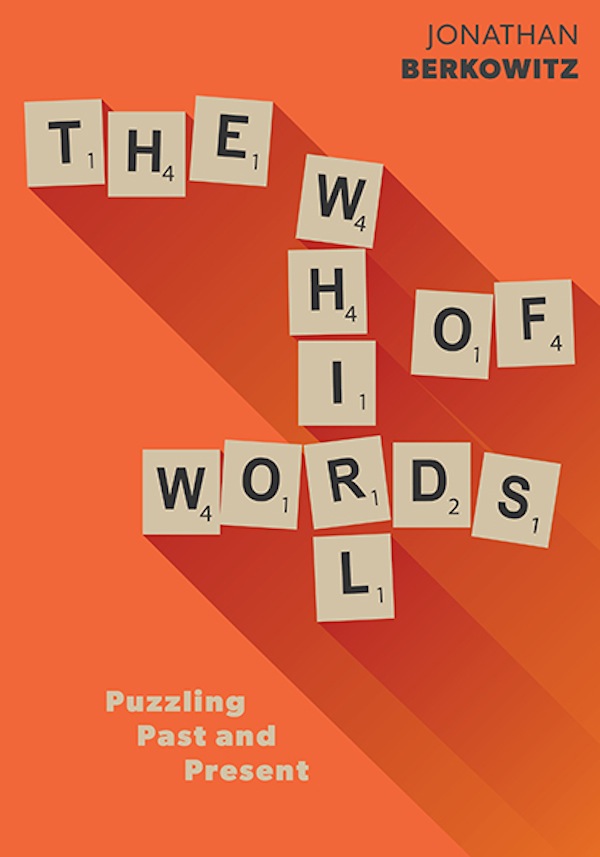
In his recently published book, The Whirl of Words: Puzzling Past and Present (FriesenPress), Berkowitz gets into the nitty gritty – history, philosophy, etymology, mechanics – of puzzle construction and solving in a conversational style that makes for good reading, even if you don’t absorb all the details on the first go. In fact, an ability to give something the once-over and then revisit it is an important aspect of puzzle-solving. It’s the second of eight steps that Berkowitz offers for solving puzzles, which would serve well for any puzzling situation.
Puns, by the way, are a part of wordplay, which, writes Berkowitz, “involves perceiving patterns where none were expected. Pattern matching is a hallmark of intelligence. It is at the root of science and art. Much of thinking is really just finding the underlying pattern.”
Berkowitz is adept at both science and art. He appears regularly on CBC Radio 1, where he is “the Word Guy” on the show North by Northwest. He creates and solves puzzles and is a member of the National Puzzlers’ League. Oh, and he’s a professor of statistics at the University of British Columbia’s Sauder School of Business.
The Whirl of Words is about all kinds of wordplay, the main types of which, Berkowitz explains, “involve letter play (wordplay involving the letters of the alphabet and their usage in words without regard to sound or sense), sound play (wordplay involving the sounds of words without regard to letters or meanings) and meaning play (wordplay involving the meanings of words without regard to letters or sounds).”
There is a chapter on numbers, both as words (one, two, three, etc.) and as mathematical concepts. There are discussions of the potential cognitive and other benefits of puzzle-solving, such as learning about a range of topics, from sports to geography to politics.
“Word puzzles improve vocabulary, grammar, spelling and communication skills, boost memory and enhance cognitive and analytical skills,” writes Berkowitz. “By improving your problem-solving skills, you may also improve your performance at work and in other areas of life. They can be a positive factor for your mental health, because focusing your attention on a puzzle can aid relaxation, ward off anxiety, and keep your emotions under control. After all, how can you think negative thoughts when you’re concentrating on a puzzle? And, doesn’t it feel fantastic when you solve a puzzle?”
Going back to his eight steps, out of context, they could be mistaken for a self-help guide:
“The puzzle is in the details. Read the instructions carefully. Then read them again.”
“Give it the once-over, twice. Assess the challenge.”
“Don’t just sit there, try something.”
“Don’t give up; persist.”
“Open your toolbox.” What approach might lead to a solution?
“Use the force wisely. Be systematic and efficient.”
“Sleep on it…. Like a train, once you are on a track, it is difficult to change tracks. Put the puzzle aside and come back to it with fresh eyes and a refreshed brain.”
“You are not alone. It is perfectly fine to seek help from resources.”
As is also true with general life circumstances, the key to getting better at something is to practise. And Berkowitz provides plenty of puzzles for readers to solve, as well as the answers to them at the end of each chapter.
The Whirl of Words includes a selected biography for those interested in further learning, and a much-needed glossary – most readers will discover many new words and terms while enjoying this book.
To read excerpts from The Whirl of Words and to purchase a copy of it for yourself or a fellow puzzle lover, visit thewhirlofwords.com.
After COVID-19 hit, The Eichmann Project – Terminal 1 evolved into a per- formance directed to a camera. (photo from Pathos-Mathos Company)
Art has many facets, forms and reasons for being. As much as it can be an escape from our daily realities, it can help us process and understand them, sometimes in vastly different ways. The Chutzpah! Festival, which opens Nov. 4 with City Opera Vancouver singers performing to the Marx brothers’ A Night at the Opera, features many examples of entertainment with multiple purposes.
On the face of it, Project InTandem’s dance double bill (Nov. 6-7) might seem to have nothing in common with the theatre work The Eichmann Project – Terminal 1 (Nov. 8). Yet both deal with, among other things, trauma and post-traumatic stress disorder, as well as our ability to change ourselves and even our circumstances.
The Eichmann trial
Lilach Dekel-Avneri and the Pathos-Mathos Company’s Terminal 1 examines the 1961 trial, in Israel, of Adolf Eichmann, one of the main perpetrators of the Holocaust. The books of attorney-general Gideon Hausner, political theorist Hannah Arendt and journalist and poet Haim Gouri, “with their testimonies on the trial, were the inspiration for the three main ‘characters’” of the theatre work, explained Dekel-Avneri. “My dramaturg, Liat Fassberg, and I, like in a Greek tragedy, positioned the two main characters with opposing worldviews, one against of the other. The words by poet Haim Gouri, who was present at the courtroom and reported daily from there, were composed and treated as a chorus. The chorus tries to advance in telling the tale of the trial while providing a dramatic lament on the happenings.
“It is actually a trial of the trial,” said Dekel-Avneri, “dotted with texts from researchers of the Holocaust and post-traumatic stress disorder, poets, philosophers, and performers’ live comments between those three main voices. The COVID-19 epidemic presents itself in the team’s testimonies and actions, erasing all plans and forcing project evolution into a digital performance to the camera.”
Dekel-Avneri refers to the Eichmann trial as “the first reality show in Israel.”
“A lot has been said about the connection between trials and performance,” she explained. “The Eichmann trial was the first trial-show recorded in front of a live audience, that actually bought tickets, and was projected live on the radio, later on television, with the full documentary show now available on the internet.”
Terminal 1 explores the concepts of collaboration and obedience, and asks, “What is our responsibility as citizens, as artists?”
“It’s an extension of Arendt’s brilliant manifest evoking the citizens to think by themselves and not to obey automatically. Not to automatically be part of horrific systems, just because they say: do this and not that,” said Dekel-Avneri. “We are thinking creatures, the least we can do is use our heart and brain, take responsibility for our actions, and not collaborate with demons.”
The show initially was created to be interactive with an audience and then remade for film because of COVID.
“During 2020, at the beginning of the outbreak, the Israel Festival, where we premièred, decided to move online, so I made my choice,” said Dekel-Avneri. “Since I do not believe in shooting a theatre show and screening it, I had to let go of my vision for the full project I was working on for six years, and re-create it as something new, made especially for the camera.
“The Eichmann Project – Terminal 1 is, for me, the first station, like its name,” she continued. “The last station may be completed in the future, or not. It will need to start almost from the beginning. We hope that one day we will find a sponsor or a theatre to collaborate with and fulfil the vision of this Via Dolorosa of 21 live scenes. The trial is not going anywhere and, unfortunately, we, by ‘we’ I mean humanity, do not learn from our past mistakes, so it looks like it will remain relevant for awhile.”
Lilach Dekel-Avneri (photo by Shachaf Dekel)
Dekel-Avneri recently premièred Crowned, which she described as “a performative portrait, broken by the encounter with time, shattered in the prism of the plague, emerging through a web of video and audio testimonies by seven women at different decades of their lives, which coalesce into a course of a lifetime. An attempt to leave a monument to the voice of femininity at the current time, femininity striving, despite everything, to see the opportunity for growth within the crisis and wonder about the intersection between life and art at a time of change. These women take responsibility of their actions, future and well-being,” she said.
“In a way,” she added, “Crowned is a post-traumatic response to what COVID did to The Eichmann Project. After being torn apart from my original vision and separated from the audience, I prepared a show for any situation – we are not afraid from lockdowns or the camera anymore. The camera became a friend, a tool and a partner, to continue creating performative works.”
Struggle, empowerment
Project InTandem – which was cofounded by Calgary-based producers and choreographers Sylvie Moquin and Meghann Michalsky in 2017 – brings two works to the Chutzpah! Festival: Deep END by Michalsky and moving through, it all amounts to something by Moquin.
“This double-bill,” explains the press material, “explores themes of female struggle and empowerment…. Michalsky investigates how movement can accumulate and evolve through set rounds and repetition. Moquin’s work is inspired by the concept of neuroplasticity and the journey of rewiring one’s patterning.”
Project InTandem – Meghann Michalsky and Sylvie Moquin – bring two works to the Chutzpah! Festival. (photo by Tim Nguyen)
The pair met for the first time when they both created short works for a production at the University of Calgary, eventually forming Project InTandem “to share workload, resources, and to create an opportunity for emerging artists to produce evening length work.”
“Having Meghann as a collaborator has always pulled me to a higher standard,” Moquin told the Independent. “I think we work together in a way that elevates us to achieve more than what might be possible on our own. It also makes the journey of being an artist less lonely.”
“Our approaches to dance can sometimes overlap because we have had similar experiences or opportunities, or trained within similar methods,” they said in their email interview with the JI. “All of our accumulated experiences as dancers and movers inform us as creators; those experiences become like an inventory of information.”
Moquin has been a dancer within Michalsky’s choreographic works since 2018, so that also informs their relationship.
“Some of our shared values include creating work with visceral physicality, creating opportunities within our city, elevating the production value of contemporary dance work, and always prioritizing integrity,” they said.
Each has her own interests, though.
“I am really interested in exploring what the body can endure in this work,” said Michalsky. “We push and we push again. As performers, we pass through movements and states and eventually surrender to things that are no longer needed. I am interested in seeing the dancer go through something tangible in real time, something that is honest and showcases risk and vulnerability. As a choreographer, I play with conflict from both internally in the body and externally in the space and I desire for both of these things to be felt by the audience.”
About her piece, moving through, Moquin said, “When creating this work, I was completely immersed with investigating partner work (the way bodies engage and interact) as well as being upside down. I used these primary desires to dig into the concept of neuroplasticity – the way we adapt, the way we can gain governance over our thinking; sometimes even the feeling of being trapped in our own mind and thoughts.
“I am a big believer that we must fail in order to succeed,” she continued. “As a choreographer, I use the sensing body to somatically approach theories I find fascinating in the world. I am especially interested in how bodies interact with one another, how they can support each other to fly, spin, and find themselves upside down effortlessly. I am keenly interested in the effects of the mind, the power of our thoughts, and the ability for change and growth. I would say that my research and choreography seeks to find a sense of hope within a world of chaos.”
The initial vision of moving through included the use of “walls.”
“I couldn’t get the idea out of my mind, and so I finally started looking into building/creating something to fulfil these ideas,” said Moquin. “The material used (a form of Plexiglass) was almost a happenstance. I became fascinated by the translucent quality. I had no way of knowing how this material would have such an impact within our world merely months after creating and premièring the work in March 2020. As I watch this work now, two years later, after a global pandemic, it is almost startling to watch the dancers engaging with these Plexiglass structures.”
The Chutzpah! Festival runs Nov. 4-24. For tickets and the full lineup, visit chutzpahfestival.com or call 604-257-5145.
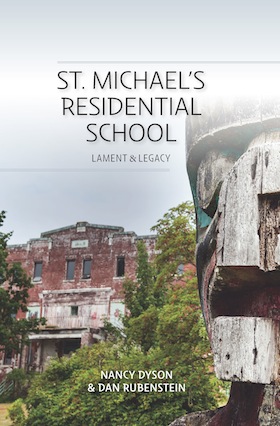
St. Michael’s Residential School in 2013, Alert Bay, B.C. (Courtesy Hans Tammemagi, from the book St. Michael’s Residential School: Lament & Legacy)
In 1970, Nancy Dyson and her husband, Dan Rubenstein, worked for a short time at the Alert Bay Student Residence, previously and most commonly known as St. Michael’s Indian Residential School. Dyson shares their experiences, with a brief section by Rubenstein, in the book St. Michael’s Residential School: Lament & Legacy (Ronsdale Press, 2021).
“This book is a must-read for all Canadians,” writes Chief Dr. Robert Joseph, ambassador for Reconciliation Canada and a survivor of St. Michael’s, in the foreword. “It is honest, fair and compelling. It is a story that screams out for human decency, justice and equality. It also calls for reconciliation and a new way forward! Two recently wed idealists arrive at Alert Bay on Canada’s Pacific central coast to work at St. Michael’s Residential School. They hire on as childcare workers. Little do Dan and Nancy in their youthful enthusiasm know they will be shaken to the core before too long.”
Yet, despite being shaken, the couple did not realize the extent of the abuse and harm being inflicted on their charges, nor that such abuse was being carried out across the country – and had been since the first schools opened in the 1800s to when the last one closed in 1996.
“In 2015, the Truth and Reconciliation Commission (TRC) Reports were released. Like many Canadians, we were shocked by the findings,” writes Dyson in the introduction. “Over a hundred-year span, thousands of Indigenous children had experienced what we had witnessed at St. Michael’s. Especially shocking were the stories of sexual abuse that had occurred along with the emotional and physical abuse we had witnessed. When we read the survivors’ statements and realized the lasting, tragic legacy of the schools, we felt compelled to share our story.”
The couple does so with the intent to bear witness to the survivors’ experience. “In adding our voices to the voices of survivors,” writes Dyson, “we hope that the history of residential schools will not be forgotten or denied.”
Dyson and Rubenstein were married in March 1970 in Rubenstein’s family home, near the campus of Vassar College, in Poughkeepsie, N.Y., from which Dyson graduated in May that year. A brief series of events landed them in Vancouver, where they decided to stay awhile, because Canada “seemed more benign and compassionate than the United States, which was then severely polarized by the Vietnam War.”
While staying with friends, they learned about openings for childcare workers at the residential school in Alert Bay. Along with one of those friends, they applied for the jobs and succeeded in getting interviews. The school administrator explained to them that St. Michael’s, which had been run by the Anglican Church, was taken over by the federal government in 1969 – this was a national change in policy, because of a Labour Relations Board of Canada ruling a few years earlier that school staff had to be paid as much as government employees doing similar jobs. The churches couldn’t afford the increased costs, so the government took over. Though, as Dyson notes – in dialogue given to the administrator – the churches still had “a strong influence.”
At the time that Dyson and Rubenstein joined St. Michael’s staff, the school wasn’t a school anymore, but a residence, with most of the kids attending public school in Alert Bay and the handful that made it to Grade 9 taking the ferry to Port McNeill for their education. Including Dyson and Rubenstein, there were seven childcare workers for 100-plus kids. Dyson was put in charge of 18 teenage girls and Rubenstein the 25 youngest boys, most of whom were 6 or 7 years old.
From the beginning, even before their interview, as they walk up the concrete steps of the residence, and notice the rusty radiators and drab hallways, they have misgivings. Their friend declined the job offer, but they accepted, thinking “it has to be better than living in the States.”
During their brief tenure at St. Michael’s, they witnessed the brutal treatment of the children, in the name of discipline, as well as the poor food, clothing, shelter and, of course, the kids weren’t allowed to learn anything about their own culture. There were suicides, some girls prostituted themselves, some students took their anger out on their peers.
Dyson and Rubenstein tried to support the kids and did indeed connect with a few of them. The couple tried to force some changes, along with other people in Alert Bay, but there was really no way they could improve the situation. Ultimately, Dyson couldn’t take it anymore and quit. Rubenstein, however, still wanted to try and change things from within, despite having been attacked with a knife by a cook who thought that the Jew among the Anglicans was the Antichrist. Rubenstein was fired from his job after he and Dyson shared their concerns about the residence with government inspectors.
The names of people in the book have been changed and the dialogue is based on memory. Dyson inserts excerpts from the TRC reports into her narrative to reinforce not only what she is saying about St. Michael’s but to show that what was happening there was, sadly and disgustingly, happening at residential schools across Canada.
Rubenstein’s story comes as an epilogue, after a section with some of his photos from 1970/71, as well as a few more recent ones, including of the reconciliation ceremony in Ottawa in 2015. Rubenstein writes about the continuing impact of the residential schools and some of his realizations. He speaks candidly of the difficulties he has in reconciling what he witnessed with the image he has of Canada “as a just and compassionate country.” As well, he admits, “I also struggle to reconcile my own sense of decency with my failure to advocate on behalf of the children after I left St. Michael’s. Like other Canadians – former childcare workers, teachers, administrators, principals, clergy and government officials – I remained silent.”
Dyson and Rubenstein have written St. Michael’s Residential School: Lament & Legacy not only to state publicly what they witnessed and did or didn’t do. They want to encourage other Canadians to join in the process of reconciliation, and offer some ideas for entry points, mainly the TRC reports. The book ends with a quote from the TRC’s final report:
“Reshaping national history is a public process, one that happens through discussion, sharing and commemoration…. Public memory is dynamic – it changes over time as new understandings, dialogues, artistic expressions and commemorations emerge.”
St. Michael’s Residential School: Lament & Legacy is available for purchase at Amazon and other booksellers. In the acknowledgements, Dyson and Rubenstein note that a portion of the royalties received for the book “will be donated to Reconciliation Canada and the Indian Residential School Survivors Society.”
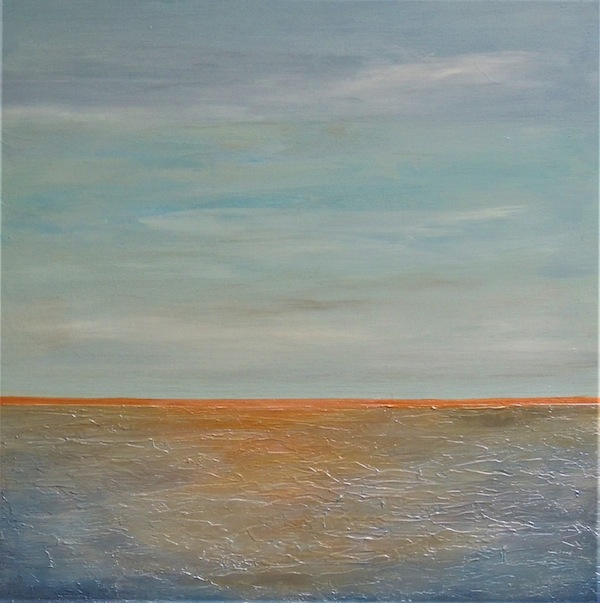
Two of artist Monica Gewurz’s paintings – “Silver Marsh” (above) and “Dawn II” – are featured in the exhibition of the Nature Trust of British Columbia’s Artist of the Year Award. “Silver Marsh” was inspired by a sunset at Addington Point Marsh, one of NTBC’s properties, which aims to conserve waterfowl and fish habitat, and “Dawn II” by a visit to Vaseux Lake in the Okanagan, an NTBC property that protects habitat for bighorn sheep and other threatened species.
Two of artist Monica Gewurz’s paintings have been selected by a jury to be included in the exhibition of the Nature Trust of British Columbia’s Artist of the Year Award. The joint show of the Federation of Canadian Artists and the Nature Trust opens on Oct. 18 at the Federation Gallery on Granville Island.
Before turning her focus to art in the past several years, Gewurz had worked in both the public and private sectors, in areas from commercial real estate to tourism to aboriginal issues. However, art was an integral part of her upbringing in Peru.
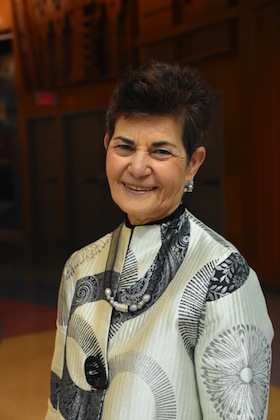
Monica Gewurz (photo from Monica Gewurz)
“For my parents, art was as important as science,” Gewurz told the Independent. “My mother was also an artist, and she exposed me to art at an early age – not just Judaica and Peruvian art but also art from different cultures. We traveled a lot. I always enjoyed visiting museums and art galleries. And I always had my camera with me, always took pictures. Landscapes and close-ups, textures and patterns always fascinated me.”
Upon graduating high school, however, she chose a different path.
“In the early 1970s, I was studying to become a veterinarian in Peru. At that time, South America went through some economic and political unrest,” she said. “Peru had a military government, and antisemitism was on the rise. My university was hit repeatedly with strikes and class closures. Getting an education was becoming difficult and dangerous. That was when I decided to move to Canada. With my parents’ financial support, I came alone to continue my studies at the University of Guelph. My parents immigrated later, in 1985.”
After university, Gewurz worked for the Canadian government, but she couldn’t abandon her art. “My photography, jewelry and painting all started as hobbies. I needed an outlet to balance my hectic and stressful full-time job…. In 2000, I started making tribal and sculptural jewelry. I was successful enough to showcase my pieces in national craft shows and then commercially in some galleries, here in Vancouver and in the U.S.”
She knew that most professional artists had formal art education, so she enrolled at Emily Carr University of Art + Design in 2011. “I could study there part-time while working,” she said. “It would also allow me the opportunity to meet other artists.”
She finished her studies at Emily Carr in 2016. Coincidentally, she couldn’t continue at her government job for much longer. “Due to a life-threatening autoimmune illness, in 2017, I had to retire,” she explained. “That gave me the opportunity to embark on a new career as a professional artist.”
Gewurz’s paintings are mostly abstracts, reflecting the landscapes of the West Coast. “The force and energy of water and its associated reflective light, the interplay of shadows and colours in a landscape, have always drawn me in as a scientist and an artist,” she said. “The endlessly changing skies and the patinas of precious minerals mesmerize me. I am fascinated with the contrasting nature of life. I paint it all to provide an escape to a dream-like place.”
Fractals in nature and stylized figures frequently populate her paintings. She doesn’t strive for photographic correctness. “Painting in abstract challenges me to represent reality in a veiled, mysterious and intriguing way,” she said. “Abstraction and the use of texture allow me the freedom to change what I see and feel into my own expression. The artistic process is, for me, one of constant discovery and conversation. The painting speaks to me, tells me what it needs, and I respond.”
Although initially she used brushes, she said, “Lately, I transitioned to using mainly a palette knife and other unconventional tools. As a result, my art became more abstracted and complex.”
She bases her paintings on her own photographs and on her memory; she never paints on location. “I paint from the heart and intuitively,” she said. “I don’t paint anything specific in a landscape and that’s what I love about it – the process of being able to use the paint any way I want. I leave out a lot of visual information. That allows the viewers to use their imagination, to see and describe every painting in their own way.”
Gewurz gifts much of her art to charities and friends. “It is exciting for me to witness the connection some of my ethereal-looking paintings elicit in viewers,” she said. “It humbles me, when people I’ve never met immerse themselves in the layers, shades and textures of my paintings and then share with me how they are seduced into a visual, tactile and emotional response. When such a connection is made, I feel that I accomplished my mission. Of course, the cherry on the cake is when somebody buys a painting and becomes a collector and, many times, a friend.”
She shared one such a case. In 2014, an interior designer from Singapore saw one of her mixed media paintings at an exhibit and contacted her for a commission. The painting was two by two feet, said Gewurz, “but she wanted a much larger one, measuring seven by four feet, for her client, a new five-star hotel in Hong Kong. That was a turning point in my career and a huge jump in scale for me. That painting still hangs in their lobby.”
Mixed media seems to be Gewurz’s preferred style. She incorporates in her pieces ancient and modern materials, such as textiles, sand, rust, aluminum foil, copper and silver. She paints in multiple layers to seduce viewers in visual and visceral encounters. But, whatever the materials, her theme remains predominantly nature.
“Dawn II” by Monica Gewurz
Gewurz’s love of nature led to her involvement with the Nature Trust of British Columbia (NTBC). “I am a donor and volunteer,” she said.
She is also an active member of the Federation of Canadian Artists (FCA).
“One of the main FCA missions is to outreach and raise awareness about conserving the environment and natural spaces,” she said. “Every year, FCA asks their membership to submit a proposal for a show that deals with social and environmental issues. I submitted the idea to have a joint show with NTBC, as they had a common vision, and also to take the opportunity to celebrate their respective anniversaries. Both director boards reviewed and accepted my proposal.”
Of course, she longed to participate in the show as well, since its underlying purpose – the conservation of British Columbia’s endangered habitats – is close to her heart.
“FCA holds several juried shows every year,” said Gewurz. “I regularly submit and often get juried in to showcase in them. This time, I applied as well. I was thrilled and honoured that two of my paintings were admitted. There was a lot of competition.”
Gewurz’s commitment to environmental issues extends beyond her participation in such shows and groups.
“I use upcycled materials in some of my mixed media art,” she explained. “There is beauty in repurposing materials because of their distinctive uniqueness and imperfect textures. Also, the fact of my using them conveys the message to the viewer about the importance of decreasing waste and minimizing our carbon footprint.”
She added, “Art can certainly open people’s eyes to how much our lifestyles imperil the planet. Art could encourage all of us to make positive changes.”
Jonas Noreika, who was executed by the Soviets in 1947, has been revered in his native Lithuania and by its expatriate community as a national hero and an anti-communist patriot.
This vaunted hero, however, has come under intense scrutiny of late, largely as a result of the findings of his own granddaughter, Silvia Foti. Her research has revealed that Noreika, whose nom de guerre was “General Storm,” was in fact a Nazi collaborator, responsible for the murder of thousands of Lithuanian Jews – sometimes, on his own initiative.
In her new book, The Nazi’s Granddaughter: How I Discovered My Grandfather Was a War Criminal (Regnery Publishing, 2021), Foti documents her path from hearing stories about his almost legendary stature to her discovery of the disturbing truth.
The book, the writing of which had been undertaken to fulfil Foti’s mother’s (Noreika’s daughter’s) dying wish, was intended as a tribute. Foti succeeded in assembling hundreds of documents related to Noreika’s life, including an antisemitic pamphlet that he authored in 1933, and KGB transcripts of his prison interrogations.
At first, Foti did not want to believe the story that was emerging from the various written sources, finding it “too scary, too painful, too shameful.” Nonetheless, as a journalist, she could not ignore the rumours that she encountered during her investigative trips to Lithuania. She pursued the matter, in the hope that an examination of her grandfather’s acts during the Second World War would exonerate him. Ultimately, she found so much evidence about his role in killing Jews that it was impossible to act as though it did not exist.
“I wanted to throw the manuscript away so many times, to just drop the whole project. I kept asking myself, Why me? Why am I the one to discover all this? I finally came to realize that, because I am the granddaughter, I would most likely get the most attention,” Foti told the Independent. “I am a practising Catholic, and I pray over this story constantly. My strength came from believing that this is the truth, and the truth needs to prevail, no matter the cost to me.”
What started out as a journey of discovery has now been the recipient of international attention. Foti’s story has been covered by the Wall Street Journal, the New York Times and the BBC, among others.
“So much seemed accidental, inadvertent. I didn’t mean to discover that my grandfather was a Holocaust perpetrator. I didn’t mean to discover that the government of Lithuania refuses to acknowledge his role in the Holocaust and, instead, has declared him a hero,” Foti said.
In 2018, when she was 18 years into her project and believing it was nearing completion, she learned of a lawsuit by Grant Gochin, who lost 100 relatives in the Holocaust, against the Genocide Research and Resistance Centre of Lithuania. They compared notes and joined forces in getting the story out to the international community.
The revelations about Noreika were, to say the least, not easy for many Lithuanians to accept.
“Today, now that the book is out, I face anger, fear and resentment from many Lithuanians who are still in denial over Lithuanians’ role in the Holocaust. I get hate email and death threats, accusations that I work for the Russians, that I’m a traitor to Lithuania, even that someone else wrote the book instead of me. So many Lithuanians think Grant wrote the book,” Foti recounted.
“Grant has an accounting degree and I have two writing degrees and yet, for Lithuanians, it’s easier for them to think Grant hypnotized me and wrote the book,” Foti added. “Lithuanians still have a lot of superstitions concerning Jews. They just can’t believe a Lithuanian would accuse her own grandfather of such horrors. In some ways though, I understand them, because I was there about 20 years ago – minus the superstitions.”
Foti believes, at present, that Lithuania has backed itself into a corner and needs to admit that the Genocide Centre, “its great arbiter” of what took place in the country during the Holocaust, has made a grave error in deeming Noreika a hero. Nevertheless, she does not think such an about-face will happen anytime soon.
“It would be a hari-kari move that would necessitate that the Genocide Centre fall on its sword. How could a mere granddaughter in Chicago uncover so much information about Jonas Noreika, and how could the nation’s legions of historians under the government’s payroll not?” she asked.
“This was Lithuania’s last graceful chance to own up to its role in the Holocaust,” she said. “It could have saved face if its legal system did its due diligence. Unfortunately, the court systems there have a reputation for being corrupt; holdovers from the Soviet era. Because Grant Gochin has exhausted all legal avenues in Lithuania, he now is able to take it to the European Union’s International Court of Human Rights.”
The Nazi’s Granddaughter was edited by Lisa Ferdman of Vancouver.
Sam Margolishas written for the Globe and Mail, the National Post, UPI and MSNBC.
The Nov. 1 online event Finding Grounds for Goodness includes the première presentation of Finding Grounds for Goodness in the Downtown Eastside, which was created during last year’s Heart of the City Festival. (photo from Jumblies Theatre)
This year’s Downtown Eastside Heart of the City Festival, which runs Oct. 27-Nov. 7, includes the screening of short videos from Jumblies Theatre and partners on the theme of “social goodness.”
Jumblies’ multi-year Grounds for Goodness project is an artful exploration of why and how people sometimes act in good ways towards each other. As it has adapted to community-engaged art-making during pandemic times, this project has generated a varied and whimsical collection of short videos with communities and artists from around Canada.
At the Nov. 1, 4 p.m., online event Finding Grounds for Goodness, hosted from Toronto by Jumblies staff, a sampling of these short films will be shared, including the première presentation of Finding Grounds for Goodness in the Downtown Eastside, which was created during last year’s Heart of the City Festival with DTES creative community members and Vancouver and Toronto artists.
Jewish community member Ruth Howard is the founder and artistic director of Jumblies Theatre, which makes art in everyday and extraordinary places with, for and about the people and stories found there. The Jumblies project was originally inspired by the history about the rescue of Albanian Jews during the Second World War by Albanian Muslim people.
Composer Martin van de Ven, an expert in klezmer and Jewish music, who has been involved in many Jumblies projects, told the Independent, in an interview last year about the DTES’s Grounds for Goodness, about besa, “an Albanian Islamic concept about hospitality and the need to help and protect guests and those in need within and beyond your community.
“In Albania,” he explained, “during the Second World War (and Italian and then Nazi occupation), this meant that almost all Jewish people living and finding refuge in Albania were sheltered and hidden, and Albania ended up with a larger Jewish population at the end of the war than at the beginning.” (See jewishindependent.ca/highlighting-goodness.)
The festival at large
The 18th Annual Downtown Eastside Heart of the City Festival is presented by Vancouver Moving Theatre in association with Carnegie Community Centre, the Association of United Ukrainian Canadians and a host of community partners. It will feature more than 100 events throughout the DTES and online.
This year’s festival theme, “Stories We Need to Hear,” resonates today as people grapple with the dramatic impact of the pandemic, ongoing displacement, the fentanyl crisis, and the reality of bigotry and systemic racism.
In the words of late DTES poet Sandy Cameron, “When we tell our stories we draw our own maps, and question the maps of the powerful. Each of us has something to tell, something to teach.”
The 12-day festival includes music, stories, poetry, theatre, ceremony, films, readings, forums, workshops, discussions, art talks, history talks and visual art exhibitions. The Art in the Streets program features surprise pop-up music and spoken word activities on sidewalks and small plazas throughout the historic district.
A few highlights of this year’s festival are We Live Here, a large-scale outdoor project projecting hyper-speed videos of Downtown Eastside artists’ artwork, produced by Radix Theatre; Honouring Our Grandmothers’ Healing Journey Launch, three days of ceremony, teachings and storytelling honouring grandmothers who traveled to the DTES (with Further We Rise Collective and Wild Salmon Caravan); and Indigenous Journeys: Solos by Three Woman, which profiles local artists Priscillia Mays Tait (Gitxsan/Wet’suwet’en), Kat Zu’comulwat Norris (Lyackson First Nation) and Gunargie O’Sullivan aka ga’axstasalas (Kwakuilth Nation).
Elder and activist Grace Eiko Thomson reads from and talks about her book Chiru Sakura (Falling Cherry Blossoms), which chronicles her and her mother’s journey through racism, and Eiko Thomson’s advocacy for the rights of Canadians of Japanese ancestry. In My Art Is Activism: Part III, DTES resident Sid Chow Tan shares videos from his archival collection that highlight Chinese Canadian social movements and direct action in Chinatown, particularly redress for Chinese head tax and exclusion. And the ensemble Illicit Projects presents Incarcerated: Truth in Shadows, three shadow plays dedicated to people who have faced unjust treatment in Canada’s incarceration system.
Other events honour various DTES performing artists and shared cultures. The festival involves professional, community, emerging and student artists, and lovers of the arts.
Philippe Tlokinski stars in Adventures of a Mathematician. (photo from Samuel Goldwyn Films)
Forgotten your calculus? Simple geometry is more than sufficient to follow the triangular saga of Polish-Jewish brainiac Stanislaw Ulam from the cloistered classrooms of Harvard to Robert Oppenheimer’s atomic-bomb “startup” in dusty New Mexico.
The third point on Ulam’s map is Lvov, Poland, where his parents, sister and niece live in tenuous safety. Until the Nazis blast across the border and blow down the doors of every Jewish home.
Adventures of a Mathematician opens in Cambridge on the eve of the Second World War, where Stan (Philippe Tlokinski) lives with his younger brother Adam. The news trickling out of Poland gets objectively worse, but going back to Europe is out of the question. So Stan Ulam embraces another way of combating the Nazis, proffered by his best friend and fellow emigré scientist, Johnny von Neumann (Fabian Kocieki) – join a bunch of other geniuses on the top-secret Manhattan Project.
Writer-director Thor Klein’s intelligent, efficient script relies on our knowledge of the war and the Holocaust (and countless movies on those subjects) to concisely convey the gravity of the situation and, importantly, avoid the familiar clichés. At the same time, Klein skilfully involves us in Ulam’s personal life – he’s a witty man with an appreciation for gambling odds, who knows a smart woman when he meets her at a party – without trivializing the larger historical events.
Klein’s other great achievement, because of its U.S.-centred subject matter, is making Adventures of a Mathematician, which he shot in Germany and Poland with local crew, European actors and German, Polish and British financing, totally look and feel like an American film. It’s a masterful trick, which requires dedication and skill at every level of the production.
Klein makes his job easier, admittedly, by depicting Ulam as an acclimated, assimilated American rather than a European fish out of water.
Where Adventures of a Mathematician (which takes its title from Ulam’s memoir) veers from traditional Hollywood filmmaking is in the dramatic conflict. It’s not the war, which is always off-screen. Tension enters Ulam’s marriage later in the film, and we care about that relationship, but that’s not the movie’s motor, either.
Instead, Klein has made a film about philosophical and existential dilemmas, internalized in the person of Ulam – a cerebral, introverted man who largely keeps his emotions to himself, even when he is debating technical solutions with his equally stubborn boss, Edward Teller (Joel Basman).
Not many Hollywood executives would back a film whose protagonist is pitched on the horns of another triangle, namely the conflicting pulls of intellectual satisfaction, personal morality and professional ambition. Stanislaw Ulam, action hero, isn’t the easiest sell to North American audiences.
But, once you get hooked by this utterly accessible film and its remarkable central character, you’re in for a rewarding and thought-provoking experience.
A likable character for much of the film, Ulam becomes more solitary as his doubts grow about devising and building a weapon of mass destruction – especially after the Nazis are defeated.
Tlokinski’s performance, which does incorporate a ridiculous (by modern measures) amount of cigarette smoking, is never less than compelling.
Adventures of a Mathematician trusts the audience enough to omit most of the melodramatic conversations and passages endemic to a Second World War-era scenario. I’m thinking specifically of Ulam’s survivor’s guilt, which is palpable without him needing a speech or a scene to convey it.
A 2020 film whose release was delayed by the pandemic and limited to a handful of festival appearances (including the Toronto and New York Jewish film festivals), Adventures of a Mathematician solves for x with nary a misstep. It can be rented via Apple TV, and possibly other platforms.
Michael Foxis a writer and film critic living in San Francisco.
A still from the feature film Charlotte, about artist Charlotte Salomon.
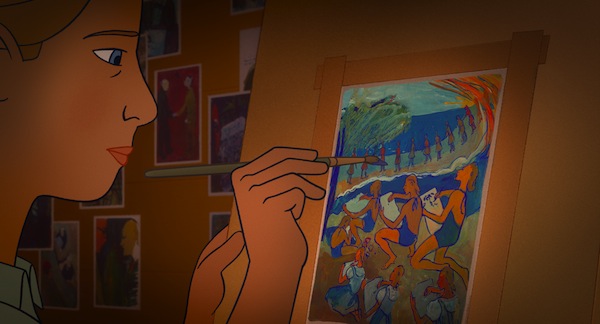
The creative drive that some people have astounds me. In about a year-and-a-half, as the Holocaust closed in on her – and her family’s history of depression became known to her – Charlotte Salomon painted hundreds of works, telling her life story in images and words, in what is considered by many, apparently, as the first graphic novel.
Somehow, despite the artist having inspired a live action film, a documentary feature, an opera, a novel, a ballet and several plays, I’d never heard of her, or of her masterpiece, Life? Or Theatre? That is, until I watched the animated feature film Charlotte, a Canada-France-Belgium collaboration that was just released. Featured at the Toronto International Film Festival earlier this month, Charlotte has two screenings at the Vancouver International Film Festival: Oct. 3, 3 p.m., and Oct. 6, 9:15 p.m., at Vancouver Playhouse.
Based on the story and the cast, the Jewish Independent chose to be a media sponsor of the local screenings. And, on these points, the film scores high. Led by Oscar nominee Keira Knightley as the voice of Charlotte, the actors do a formidable job with dialogue that is, at times, stilted and animation that is pretty basic, with the exception of the scenes and transitional pieces that depict Salomon’s artwork. These parts of the film are sumptuous and give the most sense of Salomon as a person and artist.
The film begins near the end of Salomon’s life, as she is handing over her paintings to a man, who we find out later is a local doctor and friend, in what we later find out is the south of France. She asks him to guard the paintings for her, as they are her life, almost literally, given their content. The narrative then jumps to Berlin, to a young Charlotte trying to comfort a woman who is ill and sad. The woman turns out to be Charlotte’s mother, who dies, the young girl is told, of influenza.
Jumping ahead, still in Berlin, Charlotte’s father, Albert, has married Paula Lindberg, an opera singer, through whom, incidentally, a teenage Charlotte meets her first love, Alfred Wolfsohn, who is a singing teacher. He is also a veteran of the First World War.
Wolfsohn has a lot of personal issues, to say the least, and he ultimately betrays Charlotte, but he is also strongly supportive of her being an artist. While she gains entrance to Berlin’s art academy, despite being Jewish – it is 1933 and the Nazis are now in power – she is expelled pretty soon thereafter, though whether that’s because of her nonconformity to the artistic norms taught at the school, her Jewishness or both, is not clear.
What is certain is that, after Kristallnacht, the violence against Jews in Berlin has become unavoidable and Charlotte’s parents send her to the south of France to take refuge, and care for her maternal grandparents. Her grandmother is a troubled woman and her grandfather is, in a word, an asshole, but Charlotte finds beauty in her friendship with a wealthy American, Ottilie Moore, who owns a villa in Villefranche, and in her relationship with fellow refugee Alexander Nagler, whom she marries eventually.
In a scene from the film, Charlotte stares into the water, thinking about her aunt, who had drowned.
When Moore returns to the United States, she offers to try and take Charlotte and Alexander with her, but they stay in France – Charlotte because of her sense of duty to her grandparents. It is in caring for them that she witnesses the tragedy of her grandmother’s suicide and finds out from her grandfather that mental illness runs in the family, having claimed the lives of Charlotte’s mother, aunt and several other relatives.
Spurred on by the potential that she, too, will fall ill, as well as by the Nazis’ proximity, Charlotte turns her focus to creating the almost 800 paintings that comprise Life? or Theatre? She manages to give them (and other works, it seems) to Dr. Georges Moridis, who she had consulted about her own health and who had tried to help her grandparents, before she and Alexander are seized by the Nazis. Both Charlotte and Alexander are killed at Auschwitz; Charlotte five months pregnant.
The film, which isn’t shy about showing some of the brutality of the Holocaust, does step back from showing the deaths in Auschwitz, leaving viewers instead with an image of the idyllic setting in which they lived in France, as we hear the noises of their arrest, then silence.
Before the credits, the filmmakers tell us what happened to Charlotte, Alexander and Ottolie, and show us clips of a real-life archival interview with Charlotte’s father and stepmother, who survived the Holocaust, as well as a sampling of Charlotte’s paintings.
As depressing as Charlotte’s story is, it is not a depressing movie. That she anticipated her demise and created an artistic legacy in the face of death is somehow uplifting. As producer Julia Rosenberg states in the film’s production notes, “… hope isn’t rainbows and unicorns. It’s finding the courage to see beauty despite suffering.
“Charlotte Salomon’s ability to do just that is exceptional and inspiring.”
Indeed, it is.
Charlotte is a worthy introduction to a person we all should know.
For the full Vancouver International Film Festival schedule and tickets, visit viff.org. To potentially get free tickets to the Oct. 6 screening of Charlotte, email editor@jewishindependent.ca. Tickets will be available as supplies last (there are 10 to giveaway).
Highlights of the Scotiabank Dance Centre’s 20th anniversary celebration include a performance on the outside wall of the building by aerial dance company Aeriosa. (photo by Louise Cecil)
Scotiabank Dance Centre celebrates its 20th anniversary on Oct. 2 with a special edition of its annual open house. Highlights include a performance on the outside wall of the building by dance company Aeriosa; a creative activation of the Granville Street frontage by Company 605 and guests; free classes, events and exhibits; and the online première of a short film by Milos Jakovic and Hossein Fani.
“The Scotiabank Dance Centre is an important and colourful feather in Vancouver’s cultural cap,” said Jewish community member Linda Blankstein, a former Dance Centre board chair and current Dance Foundation board chair. The facility was built “specifically for dance in all its creative forms, from hip hop to ballet and flamenco to contemporary and everything in between,” she said. “Pre-COVID, the building would see approximately 87,000 people pass through its front door every year. It is extremely important for people of all ages, from toddlers to seniors, and amateur to professional dancers, to have a facility where creativity is shared while nurturing a sense of belonging for individuals seeking activity and connection.”
One of the centre’s studios is named after another Jewish community member, Judith Marcuse, who has had her offices and rehearsal space in the building since its inception.
Some of the highlights of the open house – for which all recommended COVID-19 protocols will be in place – include Aeriosa’s Home/Domicile, choreographed by Julia Taffe in collaboration with visual artists Sarah E. Fuller and Stuart Ward. This new aerial dance work is inspired by moths, and the dancers, wearing “moth” cloaks designed by Fuller, will perform on the north wall.
Company 605’s SPLAY comprises a special program of artists who will animate various spaces of the Scotiabank Dance Centre building. Each artist will create encounters for viewers inside and outside, making their process and practice visible, culminating in a sharing of intimate performance experiences across a variety of formats.
There will also be a performance of excerpts of new works in progress from artists Sujit Vaidya, an exponent of Bharatanatyam (a form of Indian classical dance), and Dumb Instrument Dance. Classes include tap and footwork with Danny Nielsen and Shay Kuebler; flamenco with Kasandra “La China” of Al Mozaico Flamenco Dance Academy; hip hop, breaking, waacking and contemporary with Cristina Bucci of OURO Collective; and AfroBeats with AKS Bison.
The documentary by Jakovic and Fani – which has the working title of Our Dance – will also be screened. It captures the impact Scotiabank Dance Centre has had on the dance community over the 20 years of its existence.
Housing six dance studios and a theatre, Scotiabank hosts hundreds of rehearsals, classes, workshops, performances and events every year.
“It has been immensely rewarding to see how Scotiabank Dance Centre, which began as a dream so many years ago, has contributed to the arts scene in our city and the growth of B.C.’s dance community,” said Mirna Zagar, executive director of the Dance Centre, which operates the building and runs programming. “As hub for dance, it provides high-quality studio space, but it is much more than just a building: we have nurtured a stimulating environment that is supportive of the creative potential of dance artists, contributing to a thriving synergy within the arts sector in Canada.”
Oct. 2’s open house runs from 1 to 6 p.m. at Scotiabank Dance Centre. For more information, call 604-606-6400 or visit thedancecentre.ca.
I was very much looking forward to two recent novels. Both are love stories, but unconventional ones. I enjoyed them, and read them cover to cover – generally, I allow myself to stop reading, watching or listening to whatever it is I’m not enjoying, so that I wanted to know how the stories ended is a compliment to the writers. But I was disappointed in the novels, ultimately. In both instances, I felt a little robbed of emotional impact.
Perhaps, given their protagonists, I shouldn’t have been surprised that the cerebral aspects of the books would outweigh, even quash, the heart-rending effects. Morningside Heights by Joshua Henkin (Pantheon Books, 2021) is about an uber-accomplished, hyper-intelligent professor who is struck by early-onset Alzheimer’s. Never Anyone But You by Rupert Thomson (Other Press, 2020) is about two real-life cultural icons who were in the same social circles as people the likes of Ernest Hemingway and Salvador Dalí.
Love faces adversity
Within the first 20 pages of Morningside Heights, I didn’t particularly like either Prof. Spence Robin or his wife, Pru. He is an all-star academic, winning awards and grants of all sorts; he has ambition and has achieved some power in his world, and carries himself as such. He is Jewish but changed his name early in life, “to escape the Lower East Side.” He is Pru’s teacher, though only six years her senior, and downplays her concerns of being seen on campus as just his girlfriend, not as a person in her own right. And it is only after he semi-proposes that he tells her he has a sister with brain damage, who he visits rarely, and that he’d been married before and has an estranged son from that marriage.
For her part, Pru lets Spence get away with all these things. Worse, she abandons her own beliefs and dreams, basically, to be with him. For example, she keeps kosher before she meets him and in their early days together, but lets that go by the wayside. She has her own promising career that she gives up because her own areas of interest overlap with his award-winning expertise. He lets her become his shadow. He lets her main purpose become supporting him, while not reciprocating or appreciating that support at all, it seems.
So, it’s hard to empathize with the individual characters when their lives are completely upturned by Spence’s Alzheimer’s, which begins to affect him in his late 50s. That said, one doesn’t wish ill on anyone. The challenges both Spence and Pru face are severe, and Henkin brilliantly communicates the difficulties on both sides. Spence’s confusions and his not being able to understand fully the state he’s in are as heart-wrenching as his strong will and refusal to step down from work or admit his frailties are frustrating. Pru’s sadness at the loss of her partner and the heavy responsibilities of caring for him are palpable.
Perhaps the weight of these feelings and circumstances is part of what inspired Henkin to give – in my opinion – too much ink to Spence’s troubled son. Spence and Pru’s daughter Sarah doesn’t figure as prominently, but a lot of time is spent on Arlo and, in some respects, Arlo allows readers to get to know more about Spence. But those story threads interrupted, for me, the potential intensity of the Spence-Pru storyline, which, I have to admit, was both a relief and a letdown. I wasn’t surprised that Henkin has personal experience with dementia. In an online interview with the publication Shelf Awareness, he shares, “Although much of Morningside Heights is invented, it is, in many ways, my most autobiographical novel to date. My father, like Spence, was a professor at Columbia who developed Alzheimer’s, though my father developed it much later in life than Spence did. In writing about the ways Pru lost Spence, I was re-experiencing my mother’s loss, and my brothers’ and my loss.”
The rawness of that real pain is tempered in the novel, perhaps out of personal necessity. And perhaps most readers will appreciate that emotional distance, but I was hoping for a more intimate portrayal.
Not-so secret love
Never Anyone But You also lacks intimacy, even though it is about Suzanne Malherbe and Lucie Schwob, who fall in love and become both personal and professional partners. Thomson writes about the real-life French artists in a somewhat didactic and distanced way. He has done all his research but never fully inhabits or gives full life to his characters, who must have been quite passionate and committed people to have accomplished what they did under the circumstances in which they did it.
The women knew each other from childhood but end up becoming stepsisters when Lucie’s father (who was Jewish) connects with and eventually marries Suzanne’s mother (who was Catholic). Suzanne is immediately captivated by Lucie when they meet more formally; Suzanne is almost 17 years old and Lucie a couple years older than that. Never Anyone But You is told from the perspective of Suzanne.
Early on, the two decide to collaborate – Lucie’s words and Suzanne’s drawings. Lucie transforms herself into Claude Cahun before Suzanne reinvents herself as Marcel Moore. But the new persona cannot heal Claude’s bouts of depression and, throughout her life, she struggled to stay alive.
Claude and Marcel were unofficially (because they weren’t men) part of the Surrealist scene in 1920s Paris but their artistic (notably, photographic) success was tempered by the Second World War. They leave Paris in the late 1930s and take refuge in Jersey, where they use their talents to unsettle and educate the Nazi soldiers who occupied the island from 1940. It was their hope that their leaflets would demoralize the soldiers, and even cause some of them to desert. Marcel was fluent in German, so they could make the subversive material appear as if it were coming from one of the soldiers. Eventually, the two would be discovered and arrested. Though they would suffer imprisonment, they survived the war.
The bravery of Claude and Marcel is remarkable, as is their dedication to each other, though Claude is depicted as being unlikeable at times, between her mental health issues and her being more fluid with her sexuality than Marcel, ie. she had other relationships. Nonetheless, for Marcel, there was never anyone but Claude, though it is difficult to see why there was such devotion and loyalty on her side, and Thomson’s novel doesn’t answer that question. Ultimately, the two were together for more than 40 years, until Claude’s death in 1954, so there was, I guess, really never anyone but Marcel for Claude, either.


 The Whirl of Words is about all kinds of wordplay, the main types of which, Berkowitz explains, “involve letter play (wordplay involving the letters of the alphabet and their usage in words without regard to sound or sense), sound play (wordplay involving the sounds of words without regard to letters or meanings) and meaning play (wordplay involving the meanings of words without regard to letters or sounds).”