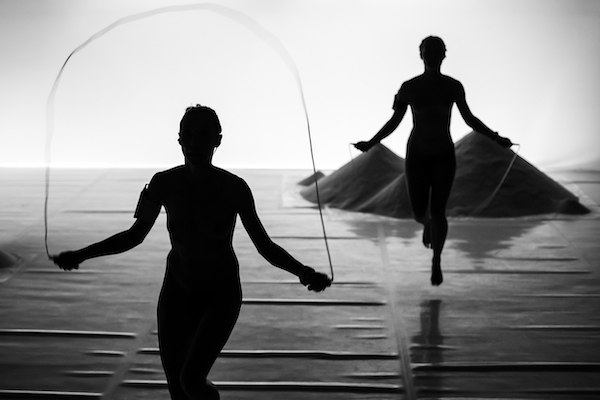
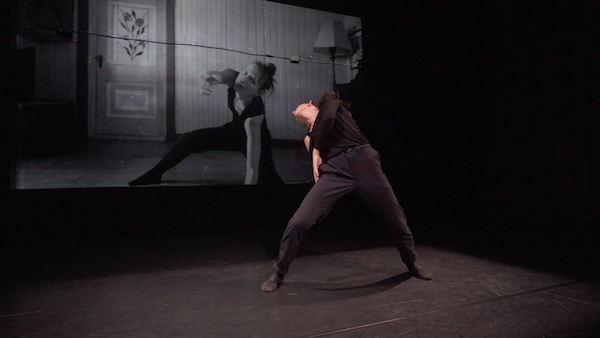
Body Line of Thought (BLOT) examines “our microbiome as a collection of organisms in perpetual transformation.” (photo by Ionut Rusu)
Vanessa Goodman (Action at a Distance) and Simona Deaconescu (Tangja Collective) explore aspects of our humanity in their dance and art. Their collaborative Body Line of Thought (BLOT) is a four-video installation that “aims to strip the body of social meanings and rethink it as an interconnected system.”
BLOT runs Nov. 24-28, 1-4 p.m., at KW Studios as part of the Dance Centre’s 13th biennial Dance in Vancouver.
“In BLOT, we are interested in examining our microbiome as a collection of organisms in perpetual transformation,” explained Goodman. “The human body contains trillions of microorganisms, that outnumber human cells by 10 to one. Each person’s bacterial composition acts as an ersatz fingerprint: when two people touch, they exchange parts of this identity. With each point of contact we essentially ‘infect’ each other with bacteria. We incorporate these themes of communication and contamination on a physical level. We are interested in the banality and the danger of such exchanges.
“One of the main focuses of BLOT is centred around bacteria being an agent of infection and salt becoming a cleaning and restructuring force in our bodies,” she continued. “We are not scientists, but we are fascinated by how these basic elements of our biological makeup can drastically inform our mental and physical health. Both salt and bacteria transform organic material, and we are drawn to transformation within our work. We are interested in applying these relationships to our art practice, and this has allowed us to create a new space to explore conceptually and physically.”
Without salt, “senses are dulled, muscles can’t fire, and nerves cease to function,” Goodman said. “In BLOT, salt acts as a conductor for our creativity. We explore salt as a staging material and incorporate many of its tactile qualities across various mediums, providing a textural through-line between visuals, sound and movement. We try to reframe the banality of sweat, a ubiquitous element of every dance, as a thematic focus instead of a mere byproduct.”
As part of their research, Goodman and Deaconescu went to Portugal, where they were in residence with Bio-Friction at Cultivamos Cultura. There, said Goodman, “we learned how to cultivate our own bacteria in agar dishes and studied this information and imagery to build BLOT.
“Our work in dance and art aims to speak not only about widely discussed issues but also about the unseen life that shapes our body and connects it with the outside world,” she said. “We seek reciprocity in our practice, parallel to that of a healthy immune system: to become stronger, one must first be vulnerable and exposed.” (BLOT includes nudity.)
BLOT was presented as a three-video installation at Left on Main last year, via 20 personal Zoom performances. Its creators, Goodman and Deaconescu (who is also a filmmaker), connected when they were both choreographers at Springboard Danse Montréal in 2019.
“During this intensive working period, we realized how many artistic interests we share,” said Goodman. “We both use a deconstructed vernacular that flirts with pop culture and is mediated by the lens of conceptual and physical landscapes. We are interested in looking at the body as a biological technology that can be altered by its environment, which is especially relevant today.”
Dance in Vancouver features many ticketed and free events at various locations. This year’s festival was co-curated by Australia-based Angela Conquet with Michelle Olson and Starr Muranko of Vancouver’s Raven Spirit Dance. Some performances, films and events will also be available online. For tickets and information, visit thedancecentre.ca/event/dance-in-vancouver-2021.
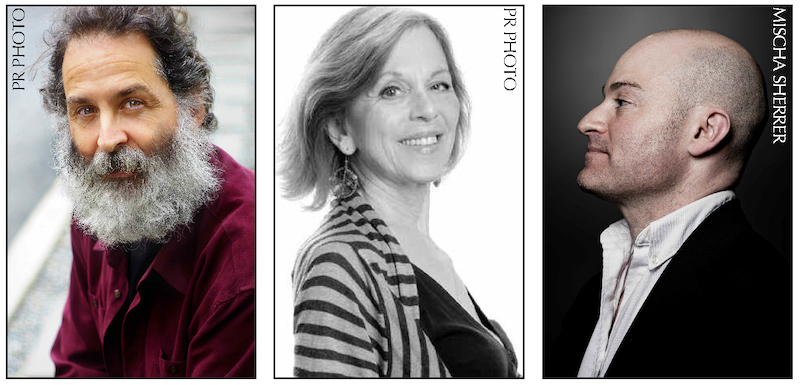
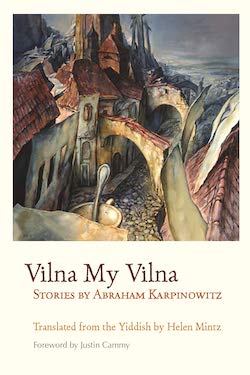
Stephen Aberle, Nicola Lipman and Geoff Berner will perform stories from Vilna My Vilna: Stories by Abraham Karpinowitz, as translated by Helen Mintz, as part of Western Gold Theatre’s Virtual Gold series.
Vilna My Vilna: Stories by Abraham Karpinowitz (Syracuse University Press, 2016) is a collection of 13 short stories and two brief memoirs by Abraham Karpinowitz (1913-2004), translated from Yiddish into English by local storyteller Helen Mintz.
Thanks to Mintz, “more of us can now visit Karpinowitz’s Vilna – a city full of colourful characters, both real and not, and share in a small part of their lives.” (jewishindependent.ca/vilna-the-place-its-people) And, thanks to Western Gold Theatre, even more people will be able to visit Karpinowitz’s Vilna this Chanukah.
When Vilna My Vilna was published, actor Stephen Aberle both helped present the book and interviewed Mintz at the JCC Jewish Book Festival.
“As part of the presentation, Helen and I read excerpts from several of the stories. I was struck immediately by how engaging and naturally theatrical these stories and characters were, and I’ve been thinking ever since that a dramatic rendition would be a great thing,” Aberle told the Independent. “Then, earlier this year, Tanja Dixon-Warren, Western Gold Theatre’s artistic director, approached me with the idea of curating one of their Virtual Gold series around Chanukah time. I immediately thought of Vilna My Vilna as the perfect material for such a project, pitched it to Tanja, and she loved the idea, as did Helen. So, I set about to recruit my luminously wonderful co-presenters, Geoff Berner and Nicola Lipman, to be part of it all.
“When Helen and I first began talking about some kind of performance of these stories, we thought of Geoff and it just clicked perfectly. His ‘klezmer-punk’ material and presentation and his beautiful selection and rendition of Yiddish songs provide exactly the flavour to suit these rather gritty stories,” said Aberle. “And I had got to know Nicola through working together on the development of a wonderful new play by Manami Hara, Courage Now (coming soon to a theatre near you – but that’s another story) about Chiune Sugihara, the Japanese diplomat who helped thousands of Polish and Lithuanian Jews escape the Nazis.”
Lipman was “another perfect fit,” said Aberle. “And here we are!”
Western Gold Theatre will release individual video recordings of the selected stories, one at a time, throughout Chanukah, said Aberle, “and Geoff will frame each of them with some of his stirringly beautiful Yiddish music – an intro and an ‘extro,’ if you like – thematically linked to the content of the story. I won’t say a lot more except to add that, when Geoff and I were talking about which songs to do where, what connections to make and so forth, I think we both found it haunting and moving. Chills.”
Deciding which of the short stories to include in the production wasn’t easy.
“I have pages and pages of notes about the stories, characters, settings, arc of the narrative and so forth,” said Aberle. “In the end, I felt like a lot of my choosing was helped along by the format: we’ll be recording ourselves reading over Zoom, so we need to keep things fairly simple, with not too many characters and not too much complex action. I chose stories where the scenes tend to involve one or two characters at a time, so the performers can dig in and work off each other.
“I also tried to choose a variety of themes and moods. The stories are written against the backdrop of the writer’s awareness of what was to come: the Nazi annihilation of Vilna’s Jewish community. We have to be true to that bleak awareness; at the same time, there’s a lot of joy and humour. I tried to make choices to honour the depth and balance Karpinowitz brings to his work.”
Of the stories to be presented, the production’s press release highlights “Vilna Without Vilna,” describing it: “A Vilna native (a pickpocket in his youth, now grown up and respectable) comes back to visit his home city and finds that not a trace of what he remembers remains.”
In “The Folklorist,” a “researcher into Yiddish folklore finds himself professionally drawn to the Vilna fish market – and personally drawn to one particularly expressive fishwife.” And “Chana-Merka the Fishwife” picks up this story, “continuing the adventures of the Vilna fishwife and the school of Yiddish Institute scholars who swim after her.”
Finally, “Tall Tamara” recounts how a “Vilna prostitute and her friend find their way out of the brothel and into very different lives.”
The performances will all be online.
“Theatres are just starting to re-reopen up to in-person performances, but, for this project, we’re sticking to video presentations,” said Aberle, thanking Dixon-Warren and Western Gold “for their vision in creating the Virtual Gold series.”
“When the pandemic shut things down,” he said, “they decided they weren’t going to let it stop their work. They also decided it was important to provide opportunities to artists from a diverse spectrum of communities. And to make all the presentations free! That all takes courage and generosity of spirit.”
For those who watch the Virtual Gold series, Aberle said, “I think I can pretty much guarantee there will be laughs; there may be a few tears. It’s an honour to help share these works so more people can get to know them.”
The stories from Vilna My Vilna will be posted throughout the week of Chanukah, Nov. 28-Dec. 6, at westerngoldtheatre.org/virtual-gold. The full name of the series is Look! Listen! and Learn! Virtual Gold, and the Learn! segment will feature a video interview with Mintz about Vilna, Karpinowitz and being a translator, which will be posted on the Virtual Gold page, as well as on Western Gold Theatre’s YouTube page.
Jewish Museum and Archives of British Columbia releases its new publication Looking Back, Moving Forward after its AGM on Nov. 16.
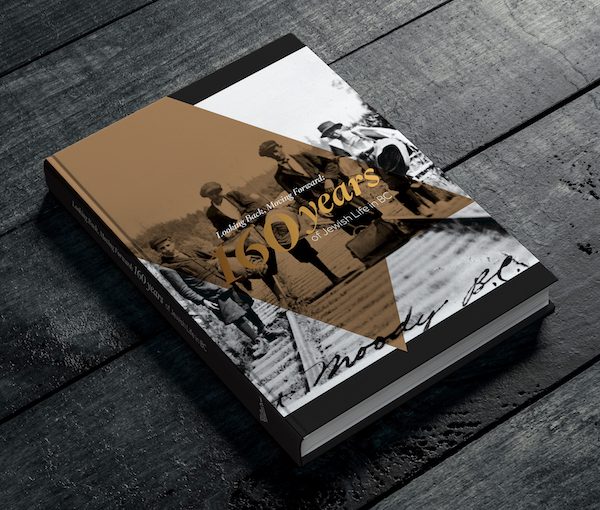
The Nov. 16 annual general meeting of the Jewish Museum and Archives of British Columbia (JMABC) is the culmination of the museum’s 50th anniversary year of celebrations. The special occasion will not only feature Dr. Morton Weinfeld, Chair in Ethnic Canadian Studies at McGill University and author of numerous books on Canadian Jewry, but also the release of the new JMABC publication Looking Back, Moving Forward: 160 Years of Jewish Life in BC.
Taking place at Congregation Beth Israel, the 6 p.m. AGM will be followed by a reception at 7 p.m. and the keynote address. Weinfeld’s most recent publication is a revised and updated version of his book Like Everybody Else but Different: The Paradoxical Success of Canadian Jewry. His virtual presentation will highlight the unveiling of the JMABC’s Looking Back, Moving Forward.
Local historian Cyril Leonoff, who passed away in 2016, established what has become the JMABC with a group of volunteers in 1970. In his research on the B.C. Jewish community, he combed ship manifests and discovered that the first Jews to arrive in the province came to participate in the Gold Rush, in 1858.
The museum’s new book is a testament to the variety and tenacity of Jewish life all over British Columbia. The publication comprises interviews, archival research and community contributions from more than 200 B.C. Jewish community members and it includes more than 400 photos.
Organized into four sections, the book begins with a collection of essays on the history of Jewish life in various regions of the province. This section is followed by short descriptions of historic, modern and new Jewish agencies and organizations that serve(d) the social, cultural, political and religious interests of the Jewish community. Short biographies of notable B.C. Jewish figures from all areas of public and communal life make up the third part of the book. And, finally, a family-sponsored section gives some personal descriptions of a variety of families within the community.
A central mission of the JMABC is to raise awareness of the importance of everyday artifacts to the overall picture of Jewish history in British Columbia. Photos of a family barbecue or a trip to the beach, flyers, letters and other such memorabilia personalize history. Over the years, the museum has created exhibits, films, books and other research material, making its archives as accessible to the public as possible.
The JMABC is hoping to ride the wave of enthusiasm and support from the past year of 50th anniversary activities, as it continues its role as both keepers and disseminators of history within the community and as ambassadors of the Jewish community to broader B.C. society.
Copies of Looking Back, Moving Forward: 160 Years of Jewish Life in BC are now on sale through the JMABC website at a 10% discounted price up until Nov. 16. After the AGM, the price will increase to $50 in general and to $100 for the limited edition hardcover version.
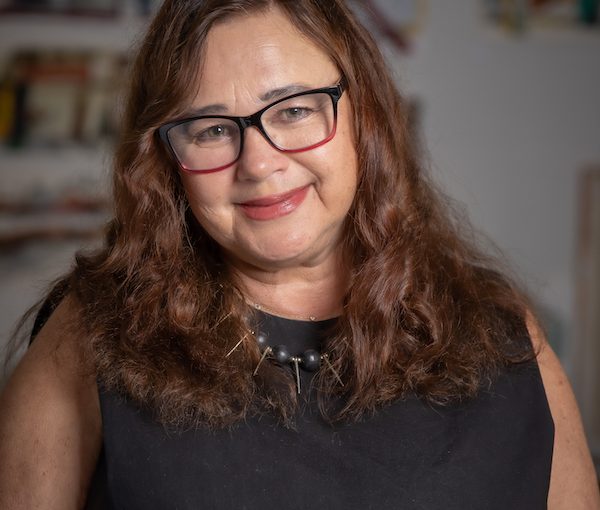
Esther Rausenberg, Eastside Arts Society’s artistic and executive director. (photo by Adam P.W. Smith)
The Eastside Arts Society welcomes art enthusiasts to celebrate the 25th anniversary of the Eastside Culture Crawl Visual Art, Design & Craft Festival in-person and online over two consecutive weekends, Nov. 12-14 (preview by appointment) and Nov. 18-21. The event’s landmark edition will offer arts patrons an enhanced opportunity to fully customize their experience and visit the studios of 400+ artists.
“As we look back on the past 25 years of the Eastside Culture Crawl, we are incredibly proud of the strong, resilient and inspiring visual arts community we have helped to support,” said Esther Rausenberg, artistic and executive director of the Eastside Arts Society, who is a member of the Jewish community.
“Through our annual Culture Crawl celebration,” she said, “we have not only boosted the careers and livelihoods of countless artists who enrich our city through creative vitality, but we have provided an essential outlet for the public to experience artistic expression and creative connection. The 25th annual Culture Crawl presents a special opportunity to acknowledge, pay tribute to and showcase the extraordinary talents and accomplishments of the visual arts community, while looking forward to an even brighter future ahead with the development of the Eastside Arts District.”
To maximize the Crawl experience and open accessibility for all patrons in Metro Vancouver and beyond, the Eastside Arts Society has created further improvements to its digital presence, including a newly designed and user-friendly website, an artist livestream schedule, appointment booking software and increased access to artists through 360° virtual studio tours.
For those visitors who wish to attend in-person, the Culture Crawl features two options. Based on overwhelmingly positive feedback from 2020, when studio appointment bookings were created for the first time, this year’s event will once again provide a preview weekend Nov. 12-14, reserved for appointments only, cultivating an intimate, interactive experience for both artists and guests. For those Culture Crawl enthusiasts wishing for a more traditional event experience, open studios will return for the event’s main weekend Nov. 18-21.
The Eastside Culture Crawl presents unparalleled access to visual artists practising a variety of different art forms, including painting, sculpture, pottery, photography, jewelry, glass art, furniture, and more. Visit culturecrawl.ca for all the festival details.
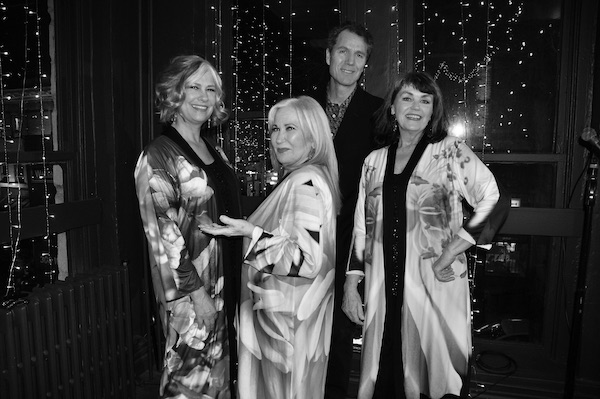
The Hot Mammas – left to right, Mary Ella Young, Julie Brown and Georgina Arntzen – with Tom Arntzen. (photo by Dee Lippingwell)
The Hot Mammas – Mary Ella Young, Julie Brown and Georgina Arntzen – with Tom Arntzen perform a Remembrance Day Revue on Nov. 10 and 11 at the Corner Stone Bistro in North Vancouver. With careers spanning decades, they have done it all, from folk to jazz, radio to musical theatre, Vancouver to New York; these women know how to work a room. Long-time friends Arntzen, Brown (who is a member of the Jewish community) and Young formed the Hot Mammas in 2004 and they entertain audiences with the kinds of stories and harmonies that can only come from such a friendship. For reservations, call 604-990-3602 or visit thehotmammas.com.
Mini poems that rhyme and colourful illustrations combine for a family-filled, fun-filled and food-filled holiday book for younger revelers. Hanukkah, Here I Come! (Grosset & Dunlap) by writer D.J. Steinberg and illustrator Sara Palacios is an energetic account that touches upon all the many things a kid might look forward to on Chanukah.
Starting with the setting up of the candles and the stacking of the presents, the meal prep also begins. The children help out their parents.
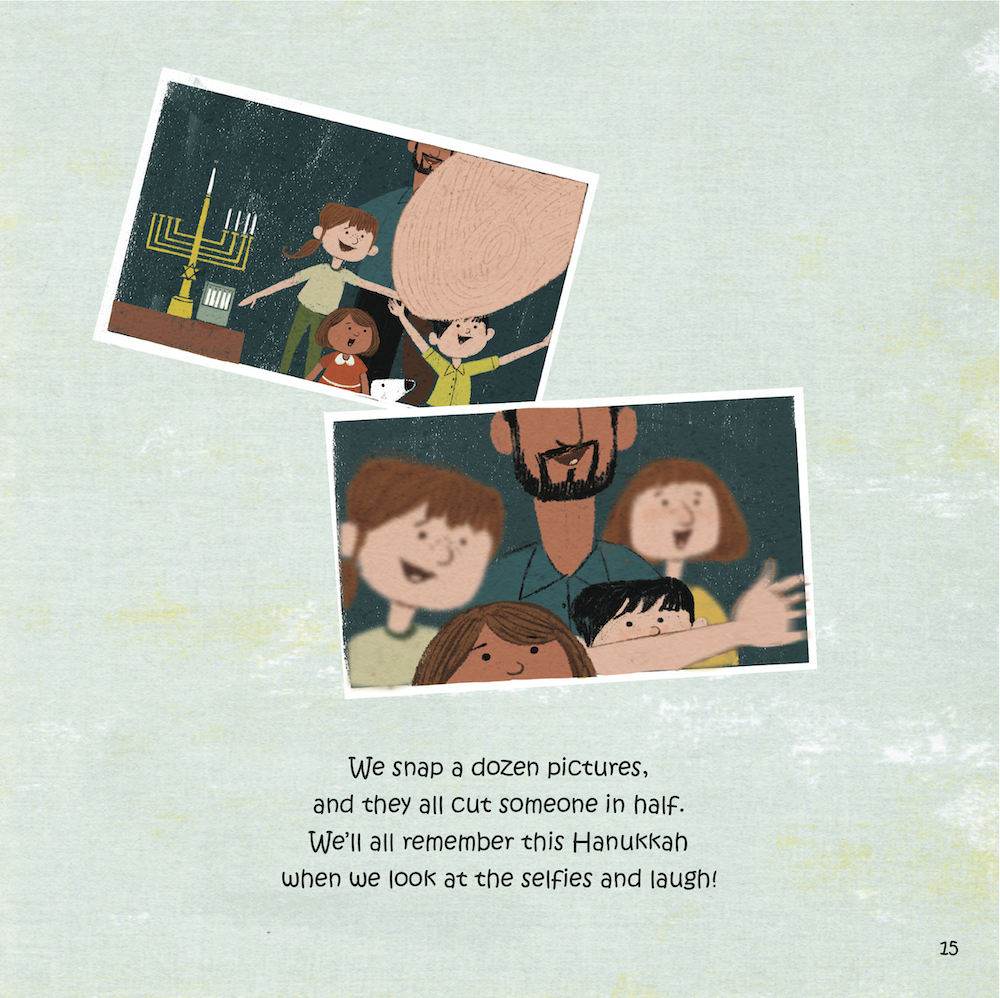
We briefly learn about the brave Judah Maccabee, “Macca-BAM! Macca-BOOM!” and how he and his brothers made history and the Jews took back their Temple. We light the candles, sharing in the joy with the neighbours across the street, who can be seen from their apartment windows. First gifts are unwrapped and selfies are taken – these illustrations are particularly delightful, as we see and read: “Click! That one cut off my sister.
“Click! Where’s my mother’s head?
“Click! That one’s dark and blurry.
“Click! That’s Mom’s finger instead.”
A page from Hanukkah, Here I Come! (Grosset & Dunlap) by writer D.J. Steinberg and illustrator Sara Palacios.
There is chocolate gelt, a lesson on how to play dreidel and a visit to Bubbe and Grandpa’s (implying a mixed family perhaps, that the grandfather is not Zayde). Latkes and apple sauce – or are you on Team Sour Cream, instead? – follow. The happy noise of the family celebrating together mounts and dinner is served, with a warning that your jelly doughnut dessert might just explode all over your face.
The last night of Chanukah arrives all too soon.
Editor’s Note: Unfortunately, because of supply chain issues, the publication of Hanukkah, Here I Come! has been postponed to fall 2022.
Live performances – that you can see in person – are, thankfully, a thing again. At least, for now. And this year’s Chutzpah! Festival, Nov. 4-24, features many shows that people will be able to attend, most of which will also be streamed digitally.
For the two artists the Jewish Independent interviewed this week about the festival, the upcoming performances hold special meaning.
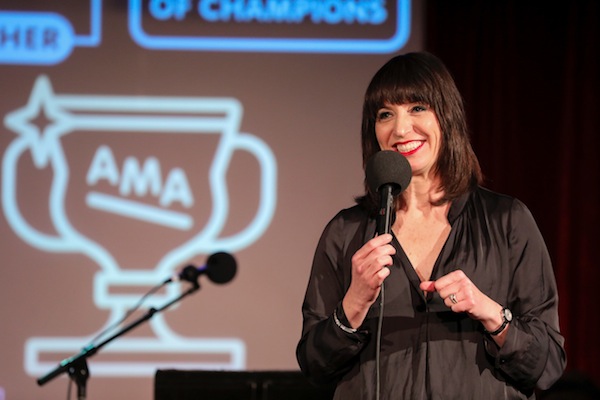
“I am so looking forward to coming back to Canada,” said New York-based comedian and storyteller Ophira Eisenberg, who was born in Calgary. “And Vancouver at that! Where it all started.” Eisenberg performs Nov. 7 at the Rothstein Theatre.
Shay Kuebler/Radical System Art’s Momentum of Isolation sees its world première at the theatre Nov. 13 and 14. The dance company returns to Chutzpah! as resident artists. The Rothstein Theatre and Chutzpah! “have been critical to the growth of Radical System Art and my work as an individual artist,” Kuebler told the Independent, describing the theatre as “the cradle that supported us” during “our infancy as an organization.”
“When I stepped back into the theatre,” Kuebler said, “it was like being back in a close friend’s home. It feels right. There’s a groove and comfort there. This has enabled us to create with as much momentum as possible, both as a company and collective of artists.”
Stepping back into a theatre has been an emotional experience for many artists.
“This spring in New York, I performed numerous times outside,” said Eisenberg. “All of the situations were a little different and, a couple of times, the address of the show was a large tree in a park! It wasn’t ideal and definitely was challenging, but people really wanted to laugh and take in some live entertainment, so it was uplifting.
“My first real performance inside at a comedy club was in early May, when New York opened small performance venues,” she said. “The audience was distanced and masked, and I think they laughed louder and harder than an audience of 3,000 – or maybe my ears weren’t used to hearing live indoor laughter and it sounded explosive. Either way, it almost brought me to tears, and I know I’m not the only one that felt that way.”
Eisenberg comes to Vancouver soon after the final episode of National Public Radio’s comedy trivia show Ask Me Another, which she hosted for nine years, interviewing and joking with numerous famous folk, including Sir Patrick Stewart, Awkwafina, Ethan Hawke and Julia Stiles, among many others.
“After interviewing hundreds of celebrities, authors, musicians,” said Eisenberg, “one thing that stands out to me is that, whenever we talked about a project that meant a lot to an artist, they mentioned that what made that project so successful was the supportive environment – and the fact that they worked with people who allowed experimentation and even failure. That ended up bringing out their best work. I think about that a lot when it comes to creating a space for artists to truly succeed.”
Eisenberg has headlined and performed at countless festivals and appeared on numerous comedy networks and programs. She has her own comedy special, called Inside Joke, and her first book, Screw Everyone: Sleeping My Way to Monogamy (Seal Press), was optioned for a feature film. She is a regular host and storyteller with the Moth, an organization that has become a radio show and podcast, in addition to putting on live events and other activities.
As for what she would still like to accomplish in her career, Eisenberg said, “I’m working on another podcast that I hope is also long-running! But I have so many things I’d like to do. Maybe too many things! On the docket are writing another book, and I’d love to write for TV. Performing live is my first love, so I’m looking forward to a safer world where that can happen more often.”
Eisenberg’s journey to success began at a young age.
“I truly believe I was drawn to New York as a child from watching Sesame Street!,” she said. “I went to McGill for university, where I got a bachelor’s in anthropology and theatre, then moved to Vancouver for a couple of years, where I tried standup for the first time.
“I was honestly too scared to move to New York,” she admitted, “so I moved to Toronto and spent five years performing and starting to understand my craft. Then, one day, I thought, ‘I need to move to New York now while I can still happily live with a futon and milk crate furniture.’ Two years after moving here, I discovered the Moth…. I love writing jokes, but I was working on other material that just did not fit into the standup mold. I found an outlet of expression at the Moth and in this short form storytelling, and I continue to pursue both.”
When asked to describe her connection to Judaism and/or Jewish community or culture, Eisenberg said, “I have a joke in my act that goes something like this: ‘I was raised Jewish in Calgary, Alberta, or so I thought because when I moved to New York I wondered, “maybe I was raised Protestant?” Everyone in New York is more Jewish than I am. My Puerto Rican neighbour knows more about Judaism than I do.’
“That is just a joke but living in New York is definitely the first time I felt surrounded by pervasive cultural Judaism. My father was the principal of the Hebrew school in Calgary but left that job the year I was born, so I went to public school. We still practised at home and went to synagogue during the High Holidays. As an adult, I’ve definitely been able to find my community here in Brooklyn, which is very wonderful and embracing.”
Exploring isolation
In 2018, before the pandemic sent us all into relative isolation, the United Kingdom appointed its – and, apparently, the world’s – first minister of loneliness, to address the problem as a public health issue.
“Right away, the title of ‘minister of loneliness’ grabbed me,” Shay Kuebler told the Independent. “There’s something very simple about it and it almost feels like a caricature, yet, when you think of someone whose entire work/career is to disrupt loneliness, it becomes deeply serious. When you read about isolation and loneliness, the gravity of this position becomes even more clear.”
The United Kingdom’s action was a catalyst for Kuebler, who noted, “You can now find multiple countries that have ministers of loneliness.”
The work Momentum of Isolation “speaks to a number of ideas around isolation and loneliness,” he said. “By doing so, I hope to open up greater conversations around the topic and maybe have audiences start their own exploration of the topic.”
Sarah Hutton performs in Shay Kuebler/ Radical System Art’s Momentum of Isolation. (screenshot)
Momentum of Isolation explores the theme both through physical isolation and social isolation, explained Kuebler. “These two points are explored through a number of different scenes, which make the show episodic in its structure, with some through-lines and arcs for characters moving all the way through.”
The work has turned out to be even more relevant than Kuebler initially thought it.
“Honestly, this show took on an evolution that I could have never projected,” he said. “The timing of our first full-company research period coincided with the closures and lockdowns across 2020. I knew that this project was important, and being forced into an online/isolated form of research was profound, to say the least.
“This isolated online research, which enabled one-on-one time with each of the company artists, created a well of material,” he said. “It was a format that was completely new, but something I found extremely valuable. While working with each artist one on one, I was simultaneously writing and composing music for the work. This not only led to a lot of new scenes and ideas, but it also distilled what was most relevant and necessary to say.
“For me, this piece was both a rediscovery and a reinforcement of what I hold most valuable. It has brought me back to how and why I want to create. I am grateful for this.”
For those unfamiliar with Radical System Art and dance in general, Kuebler added, “I know when we hear ‘dance’ and, especially, ‘contemporary dance,’ a lot of people can feel hesitant. I want readers and audiences to see this show as more of a ‘contemporary theatre experience.’ It brings together technology, design and multiple art forms around a very relevant – and timely – theme. It is something being made now, through many different artists and their many unique experiences…. With a collaborative approach to connecting with our audiences, we hope to create something new, relevant and accessible.”
For Chutzpah! tickets and the full lineup, visit chutzpahfestival.com or call 604-257-5145.
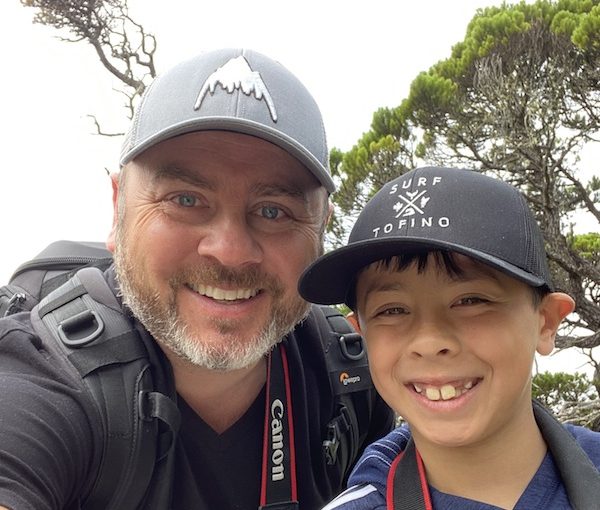
Micah Groberman with his son, Evan. (photo by Micah Groberman)
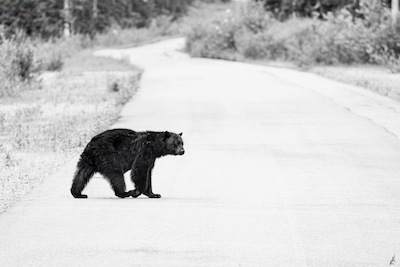
The current photography exhibit at the Zack Gallery, Discoveries: A New Way Forward, allows visitors a peek into the wilderness of British Columbia. A bird serenades the sunset. A bear crosses a road. A coyote glares into the camera. Even a Whistler bridge seems to lead to an adventure in the forests and mountains of our province. The photographer, Micah Groberman, talked to the Independent about his art and how the pandemic set him on his new creative course.
“Before the pandemic, I had a business with a partner, Ivan Solomon. We did many different things, but mostly we designed wall murals for children’s stores, hospitals and private clinics,” said Groberman. “After the pandemic hit, we couldn’t do it anymore, couldn’t stay inside the enclosed spaces for the long time it takes to create a large mural. Many places closed. School was canceled. I had to stay at home and take care of my sons.”
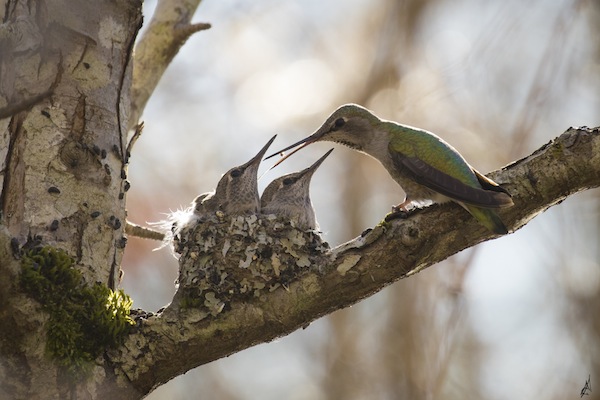
Micah Groberman’s photo of a hummingbird feeding her babies was featured on CBC.
For Groberman, instructing his elementary school sons from a set curriculum was frustrating. “I’m not good at math,” he joked. So he found something else to do with his boys. He shared his passion for nature with them. They went for walks in local parks. And they took photographs.
“I started taking photos when I was about 9,” Groberman recalled. “It was with a simple camera, the point-and-shoot kind. I enjoyed it and did it for a long time, simply for myself and my family. During COVID, my photography took a more serious turn. I wanted to do it well. I wanted to learn. I watched videos on YouTube. You can find all sorts of useful tips online. I got myself some professional gear, a large camera. And I took photos. Many, many photos. I learned by doing.”
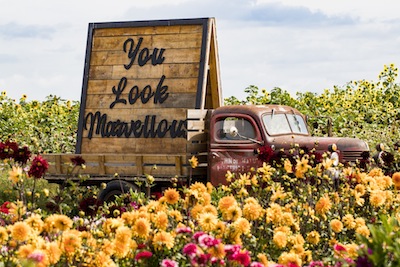
Groberman classifies his images into three categories: landscape, wildlife (which includes all his animal and bird shots) and fine art. The last category is the most inclusive. It overlaps with landscape and boasts some unusual shots, like a PNE ride from a rare angle or an old pickup surrounded by flowers that displays an uplifting message in its cargo bed.
Micah Groberman took this photograph last year at the Richmond Sunflower Festival.
“I took it last year at the Richmond Sunflower Festival,” Groberman explained. “The organizers put the old truck among the flowers, and I thought it looked interesting.”
Many of his images, especially of wildlife, are fascinating because he has sought them out. In addition to artistic skill and adequate hardware, nature photography requires a great deal of perseverance and patience. Groberman has both.
“The bear that crosses the road – I took this picture from my car,” he said. “We were in Whistler, driving around, looking for bears. It took us three hours, until one walked out of the woods.”
Another of his amazing wildlife shots is a coyote on a piece of driftwood. “I noticed him hiding in the bushes on the other side of a stream in Richmond. I followed him for about five minutes, with only glimpses, until he came out and stared at me. I took the shot, but I was glad there was water between us.”
While taking his own photos, Groberman tried to share his knowledge with his sons. “My younger son wasn’t that interested,” he said, “but my older son, Evan, took to photography. I taught him, and he inspired me. Many of my photos in this show I took when I was with him. I think teaching him made me a better photographer.”
Groberman hadn’t ever exhibited his photos prior to the pandemic. He had never even thought about doing so. “It was just a hobby,” he said. “But, in 2020, I participated in a group show at the Zack. A couple of my son Evan’s photos were also on display. That’s how I first met Hope [Forstenzer], the gallery director.”
It took a few hours of searching before Micah Groberman came across this bear and took its picture.
According to Groberman, the current show was supposed to be a double feature, including a sculptor as well. “But the sculptor didn’t happen,” he said, “so it became my solo photography show. There are 37 images in the show: 30 are mine, seven are Evan’s. We have a show together.”
The name of the show – Discovery – came from the experiences shared between father and son. “Our walks together were bonding,” said Groberman. “We discovered things together. Evan discovered new skills. I discovered a new way to move forward and I discovered teaching. That’s where the name of the show came from.”
Groberman hopes that his wall mural business will recover once the pandemic ends, but he also sees several new avenues for his creativity.
“I want to do more with my photography,” he said. “I’m exploring different options, trying to establish myself locally. I went to stores to offer them prints of my photos and postcards. I rented a bunch of my prints to a movie set. I entered local contests. One of my photos – a mama hummingbird feeding her babies – was featured on CBC. Another – a photo of a heron – won the Richmond banner contest last year in the nature category. You will see my heron on the streetlights in Richmond. I have an Instagram account. I’m just starting with photography, but I want to see where I can end up.”
Discover opened on Oct 4 and runs until Nov. 7. Learn more about Groberman’s work at micahgphotography.com.
Olga Livshinis a Vancouver freelance writer. She can be reached at olgagodim@gmail.com.
Haley K. Turner has made a parody of her own Chanukah song, in an effort to get Adam Sandler’s attention.
On Nov. 3, local singer-songwriter Haley K. Turner is releasing what might be the only original Chanukah song set for release this year, and one of only a few in the last 25 years. Inspired by a recent plea from Adam Sandler for “someone out there” to write a new Chanukah song, Turner did just that.
In the tradition of nostalgic, sentimental classics such as “Have Yourself a Merry Little Christmas,” “Intangible Things (A Hanukkah Song)” features a string orchestra with lyrics that were completed early this year, on the very last snow day of last winter.
Since Sandler asked for the song, Turner decided he should know about it. In an attempt to garner his support, she wrestled an alligator in a Happy Gilmore parody video, which can be seen on YouTube; created a tutorial on “How to Get in Touch with Adam Sandler”; and recorded a parody of her own new song, “Intangible Things.”
The videos showcase Turner’s spirited side, one that may not have been recognizable from the vulnerable storytelling displayed on her debut LP in from the dark, which was released early 2020. (See jewishindependent.ca/find-comfort-in-music.) It was recorded at Monarch Studios with Juno-nominated producer and musician Tom Dobrzanski (Said the Whale, the Zolas). Her 2011 EP, Ready or Not, was produced by Ben Kaplan (Mother Mother, Five Alarm Funk).
It may take a miracle to get Sandler’s attention but, as Chanukah shows us, miracles do happen.
To hear “Intangible Things” once it’s released, as well as its parody and the Happy Gilmore video, visit facebook.com/haleykmusic.
Alley Theatre, in partnership with Good Night Out Vancouver, presents the world première of a multi-perspective, docu-theatre dance creation entitled #whatnow, Oct. 28-Nov. 7, at the Russian Hall, as part of the Downtown Eastside Heart of the City Festival.
After collecting hours of audio interviews from people of different genders, sexual orientations, cultures, ages and abilities, real-life stories and reflections around the #metoo movement come to life through the mediums of headphone verbatim (explained below) and dance.
Marisa Emma Smith (photo from Alley Theatre)
“This piece is both a celebration of survival and a call for action,” explained co-director and sexual assault survivor Marisa Emma Smith. “What surprised me the most about interviewing people is their natural humour and poeticism. We couldn’t have written better lines to describe the things they went through or committed. I am so honoured to have met them all.”
Co-director and choreographer of #whatnow is Amber Barton, who has been a featured performer at the Chutzpah! Festival.
“We’re living in a time of increased awareness and social justice,” said Barton. “For me, that means it’s important to keep our conversations, such as the ones around the #metoo movement, alive. #whatnow is a unique performance experience that helps us to continue these conversations. I feel so privileged to be part of this production and to be trusted with the stories that have been shared with us.”
Amber Barton (photo from Alley Theatre)
#whatnow includes testimonials from survivors of harassment, misconduct and assault, as well as stories from those who took accountability for their harms. Throughout the piece, Barton has crafted ensemble movement that articulates tone, environment and viewpoints. The work also uses the format “headphone verbatim,” where edited audio interviews are played through headphones to actors on stage and the actors mimic and repeat what they hear, in real time. Every cough, stutter and hesitation is reproduced, and the actors never “memorize the lines.”
#whatnow features performances by Sabrina Symington, Yvonne Wallace, Patrick Dodd, Emily Grace Brook and Siobhan Sloane-Seale. Running time is approximately 80 minutes, with professionally facilitated conversations afterward. There are a few gender-specific performances, to allow for an honest and supported environment for audiences to respond to the performance with other people of the gender they identify as most. As well, there is ASL interpretation at the Nov. 7 show.
Tickets start at $15 and $2 from every ticket goes to Pacific Association of First Nations Women. The Oct. 28 preview is two-for-one. Visit alleytheatre.ca.