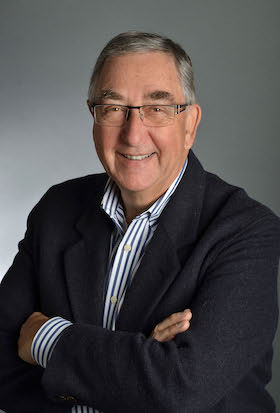
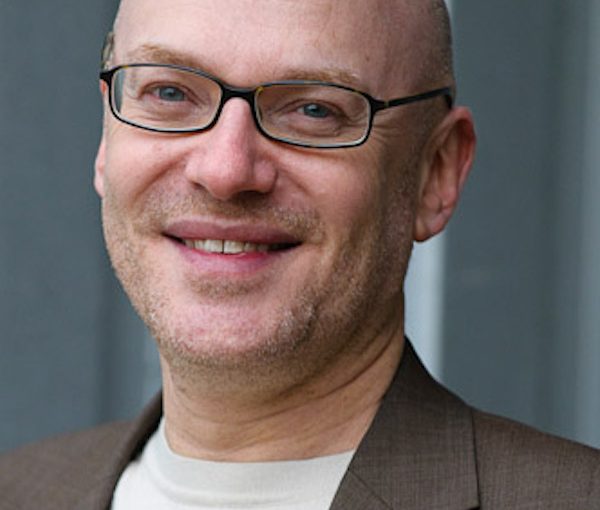
Rachel Rose, left, and Ami Sands Brodoff take part in the Cherie Smith JCC Jewish Book Festival on Feb. 8.
None of us knows what lies ahead. We might think we do, but a lack of awareness one moment can have tragic impacts, mental or physical illness can overtake us, and our actions and reactions can hurt ourselves and others, whether harm is intended or not. Control is a fiction. And two recently published short story collections that will be featured at the Cherie Smith JCC Jewish Book Festival on Feb. 8 explore that fact with tales that should make most of us feel grateful for the relative boringness of our lives.
Poet Rachel Rose’s debut novel, The Octopus Has Three Hearts, presents a series of unconventional characters in life-challenging situations difficult to imagine oneself in and yet portraying familiar emotions. The characters in Ami Sands Brodoff’s The Sleep of Apples will be easier for many readers to recognize in themselves, but they are also a diverse group of people for whom living is more of a task than a pleasure. In both collections, instances of uncomplicated joy, love and connection are rare. Nevertheless, they leave one feeling melancholically appreciative of the incomparable value of life, and acutely mindful of its fragile nature.
Rose’s stories are explicitly linked by the animals with whom her people interact, from dogs to rats to pigs to parrots and others, including, of course, an octopus. The title story centres around a polyamorous relationship, the narrator husband, his wife (who is a biologist at an aquarium) and one of his wife’s partners trying to find an octopus who’s escaped their tank under the biologist’s watch. The animal’s attributes – intelligence, fluidity, ambiguity, etc. – have obvious symbolic meaning not only within this particular chapter but the collection as a whole; similarly with the other animals that figure into Rose’s narratives.
The Octopus Has Three Hearts was longlisted for the Scotiabank Giller Prize, and Rose is no stranger to awards and recognition for her writing. She is the poet laureate emerita of Vancouver for good reason. She writes with succinct and oft-times detailed brutality, with touches of dark humour, and with much insight into humanity. Elements of her characters – whether they be ex-cons, cheating spouses, or people who just made a terrible mistake – are within all of us to some degree and our world would probably be a better place if we confronted these aspects of ourselves, instead of burying them or pretending they don’t exist.
Similar themes appear in The Sleep of Apples, a more overtly Jewish compilation. Rather than animals linking the chapters, the people are related or connected in some way to one another. Miri’s Bubbe Zelda dies in the first story and, right away, loss, guilt, love, identity, tradition – throughout the book, no matter the characters’ gender, sexuality, age, upbringing, relationship and friendship choices, career path, they must deal with these and other basic elements of existence. Death is always present. But so, too, is the will to live, to forgive, and to care for oneself and for others.
It is interesting to think of the creative process and how people come up with stories that are out of the ordinary yet resonate. Some of the language and situations in these short stories will shock and discomfort readers. Many of the characters will not resemble people most of us regularly encounter. But, ideally, if we’re willing, they will open our minds in a way that will help us navigate the real world more thoughtfully and with more compassion.
The Cherie Smith JCC Jewish Book Festival is online only this year. For the full lineup of authors, visit jccgv.com/jewish-book-festival.
Robert Silverman is one of the musicians featured in Under the Radar, by David Eisenstadt. (photo from Robert Silverman)
***
David Eisenstadt (photo from tcgpr)
Under the Radar: 30 Notable Canadian Jewish Musicians, which I wrote with Alan L. Simons (editor), takes an historical approach, covering musicians of most genres and genders, some alive and others having passed on, all skilled, but excelling somewhat out of sight. This is the first in a three-part series of excerpts from the book, which was released last November, and is available in paperback and as an ebook from amazon.ca. The excerpts feature performers with B.C. roots: Robert Silverman, Ben Mink and Mike Kobluk.
***
Robert Herschel Silverman is one of Canada’s premier pianists. He was born in Montreal, Que., on May 25, 1938, to Jewish parents from the Ukraine and Romania. Globe and Mail reporter Marsha Lederman wrote, “when he was just 4, after seeing how he was drawn to classical music programs on the radio, he was signed up (by his parents) for piano lessons. By his second lesson, Silverman could identify notes by ear. He could read sheet music before he could read words. But even as he continued with his lessons through high school and university, he never considered a career in piano.”
At 6, Silverman played his first recital. His debut at 14 was with the Montreal Symphony Orchestra. At 23, he planned to become an engineer but decided to be a classical pianist. Lederman reported Silverman saying, “It was really, really late. It’s not the way to do it.”
He earned undergrad arts and music degrees in the 1960s from Sir George Williams (now Concordia) University. He studied with Dorothy Morton (the daughter of Silverman’s childhood piano teacher) at McGill University, and with Cecile Genhart at the Eastman School of Music, Rochester, N.Y. He also earned a Canada Council grant to enrol at the Vienna Academy of Music.
Silverman won the top piano prize at the Jeunesses Musicales Canada national competition, playing twice at Expo ’67. His Allied Arts piano competition success earned a recital debut in Chicago’s Orchestra Hall in 1970. He made his New York Lincoln Centre debut before he turned 40, in 1978, where the New York Timesdescribed him as “a polished and thoroughly finished technician and an extremely articulate [virtuoso].”
Silverman performed with global and Canadian orchestras conducted by John Eliot Gardiner, Neeme Jarvi, Kiril Kondrashin, Zdenek Macal, Seiji Ozawa and Gerard Schwarz.
In his 30s, he was an artist-in-residence at Nazareth College in Rochester, N.Y.; he also taught at the University of California in Santa Barbara from 1969 to 1970, and the University of Wisconsin-Milwaukee 1970-73. He moved to Vancouver to join the University of British Columbia as professor of music (piano) in 1973. He was the director of UBC’s music school 1991-95, retiring as professor emeritus of music in 2003. Celebrating his 30-year tenure, Silverman received an honorary doctorate in 2004.
Working with Adrienne Cohen, the former music program director at Toronto’s Koffler Centre of the Arts, Silverman, in 2002, was the artist-in-residence.
“My relationship was informal with no written contract. I received an honorarium for seasonal concerts. I appreciated the opportunity to maintain a visible presence in Toronto’s music life and to help Adrienne enhance and enlarge classical music’s role. Although I’m not observant from a religious standpoint, I am keenly aware of my Jewish heritage and pleased to be affiliated with Koffler, whose programs were attuned to the Jewish community in its traditional sense,” he said.
“I grew up when many North American Jewish luminaries were visible – Horowitz, Rubinstein, Bernstein, Reiner, Heifetz, Menuhin and the up-and-comers, Fleisher, Graffman and Rabin. My musicality was shaped by their warm manner of phrasing and attention to tonal beauty, qualities I hold dear and continue to strive towards.”
He returned to Montreal in 2008 to initiate the Dorothy Morton Visiting Artist series at McGill University’s Schulich School of Music, performing there on its 10th anniversary. He and his wife also endowed a biannual Robert and Ellen Silverman Piano Concerto Competition.
His discography numbers 30-plus CDs and 12 LPs. He received an Order of Canada in 2013.
As a Vancouver-based retiree and a Steinway artist, Silverman devotes himself full-time to recordings and concerts and is heard often on the CBC and Radio-Canada networks.
Vancouver counselor and comic David Granirer has been standing up for mental health, literally, for nearly two decades. His brainchild, Stand Up for Mental Health, is a program that has helped hundreds of people on the road towards addressing and recovering from all sorts of psychological disorders by taking to the stage and performing comedy before live audiences.
The concept came to Granirer after observing his students during a stand-up comedy clinic he taught at Langara College in the early 2000s. While the course had nothing to do with mental health, Granirer noticed that some students experienced psychological benefits by the end of the semester.
“So, in 2004, I thought, why not put this in a package for people who wanted to do comedy but also wanted that life-changing experience? And, since I work in mental health and have a mental illness, this was the natural place to start,” said Granirer, who, in addition to advocating for destigmatizing mental illness, speaks openly about his own experience with depression.
“I’ve had students overcome long-standing depressions and phobias, not to mention increasing their confidence and self-esteem. There’s something incredibly empowering about telling a roomful of people exactly who you are and having them laugh and cheer,” he added.
The idea, which was seeded in Vancouver’s Oakridge neighbourhood, has blossomed to a program that Granirer has run in 50 cities throughout Canada, the United States and Australia – in partnership with mental health organizations in each area.
Granirer has trained nearly 700 comics since Stand Up for Mental Health’s inception. In that time, there have been more than 500 shows for a range of audiences, including mental health organizations, government departments, corporations, universities, correctional facilities and the military. He even created a show for the United States Secret Service in Washington, D.C., in May 2021.
In Vancouver, the Stand Up for Mental Health course is six months long. Classes start by teaching participants how to write stand-up routines; then they spend the next part of the classes working on their acts. Each week, participants write some jokes and bring them in to try in front of the class. Most of the acts are about their mental health experiences.
Classmates do a lot brainstorming together to hone the routines. At the halfway point, each student does a five-minute set. Afterwards, the prospective comics develop a completely new set for their graduation show at the end of the program.
In terms of therapeutic benefits, Granirer said doing comedy builds a comic’s confidence and self-esteem, enabling many to tackle other challenges in their lives successfully. It also helps get rid of the shame many feel about having a mental illness.
“People transform their past trauma into great comedy material,” he said. “In therapy we call that a cognitive shift. All the bad things they’ve been through now make a great act. Instead of feeling ashamed, they now feel proud of what they’ve been able to survive.”
Granirer emphasized that, while much can be explored in the process, the humour has to be clean, and there are taboo elements, such as homophobia, racism and antisemitism, which are off limits.
When the pandemic started last year, Granirer shifted to online classes and shows on Zoom. In 2021, Stand Up for Mental Health has done about 25 virtual shows for organizations across North America. Recently, live classes have resumed.
“The pandemic has also got in the way of my traveling to other cities where I’ve trained groups,” Granirer said. “I just finished training a group in Culpeper, Va., and had to emcee the show virtually instead of in person.”
Granirer has been the recipient of numerous accolades over the years. Among the honours decorating his mantel are an Award of Excellence from the National Council for Behavioural Health, a Life Unlimited Award presented by the Depression Bipolar Support Alliance, a Rotary Shine On Award in Australia for special achievement in mental health, and a Meritorious Service Medal from the Governor General of Canada.
His work for Stand Up for Mental Health has been featured in media throughout the world, including, of course, the Jewish Independent, and also in The Passionate Eye documentary Cracking Up. Granirer is the author of the book The Happy Neurotic: How Fear and Angst Can Lead to Happiness and Success.
The new year promises a busy start for Stand Up for Mental Health. On Jan. 12, Granirer and his team of comics are organizing “an evening of stigma busting comedy” called Speaking of Normal. The Zoom event will be hosted by TSN personality Michael Landsberg. To attend, visit wellnessinstitute.org/speakingofnormal.
The next Stand Up for Mental Health Vancouver class starts on Jan. 25 and is currently recruiting students. Classes are Tuesdays from 10:45 a.m. to 1:45 p.m. More information can be found at standupformentalhealth.com or by emailing Granirer at david@smhcomedysociety.org.
As far as being able to participate, Granirer stressed, “there are no prerequisites, no auditions, and no one needs to have any comedy experience. All they need is a desire to do stand-up comedy.”
He strongly encouraged his fellow Jewish community members to take part.
Sam Margolishas written for the Globe and Mail, the National Post, UPI and MSNBC.
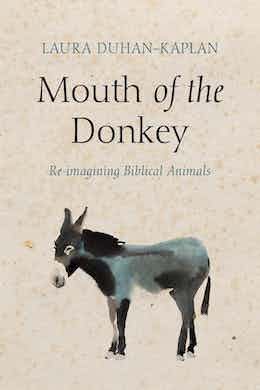
In her new book, Rabbi Dr. Laura Duhan Kaplan explores lessons for humans from the animal world.
Good things come in small packages. A thin volume by Vancouver rabbi, philosopher and academic Laura Duhan Kaplan packs ancient and modern wisdom into a delightful parcel.
Duhan Kaplan is director of inter-religious studies and professor of Jewish studies at Vancouver School of Theology, professor emerita of philosophy at University of North Carolina at Charlotte and rabbi emerita of Vancouver’s Or Shalom Synagogue. Her book Mouth of the Donkey: Re-imagining Biblical Animals was released this year. To her resumé, you might add a sort of Dr. Doolittle role, as she returns frequently to her ability to “talk” to the animals.
“I did a little research into communication,” she writes. “Observe a creature’s form of life, discern its form of communication.… I didn’t look specifically for sound, gesture or expressions of feeling. Instead, I just watched animals interact. And, bit by bit, I began to learn their languages. Since then, I’ve conversed with cats by looking at things and then back at the cat. I’ve given information to wasps and hornets by making gestures. Spoken to crows with vocal clicks and clacks arranged in sentences. (Since I have a limited crow vocabulary, it’s a string of nonsense words, but they give me credit for trying.) And, oddest of all, I’ve befriended flies through telepathy. After all, sight, sound, thought and movement are all wavelengths on which communication happens. Different creatures favour different wavelengths. A good neighbour pays attention and meets others halfway.”
(Disclosure: In the book’s acknowledgements, Duhan Kaplan notes that I critiqued some of the earliest iterations of a couple of chapters.)
In the book, Duhan Kaplan explains that she uses four kabbalistic levels of analysis: peshat, plain literal meaning; derash, exposition of recurring ethical themes; remez, hints to allegorical meanings; and sod, secret allusions to God’s true nature.
She considers both the depictions of humans as sheep in God’s “flock,” and the intertwining of the lives of the ancient Israelites with their own flocks – “Take your sheep and cattle and go!” God tells the Israelites in Exodus.
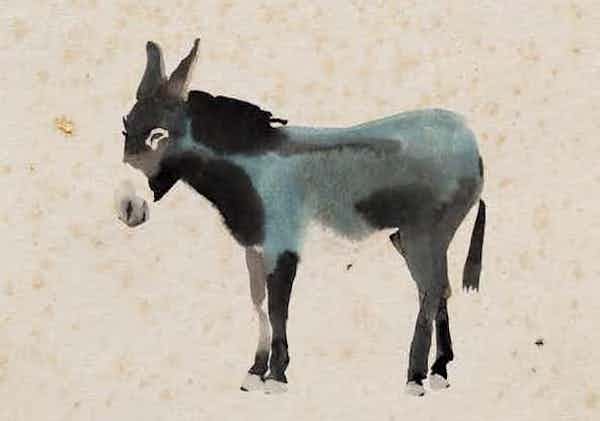
She contemplates the multiple times where the ancient literature depicts a donkey as a spiritual guide. She weaves in personal stories, such as visit to a donkey refuge here in British Columbia.
“Equines communicate well through touch. So, with my hand scratching his neck, we had a wordless conversation.” This segues into the Bible’s “most famous donkey,” that of Balaam, whose interaction with an angel sends Balaam on, so to speak, a different path.
Biblical writers, both Jewish and Christian, she writes, associate donkeys with “hope, divine guidance and messianic time.”
The blurry line between humans and other animals is a recurring theme, as is the transfiguration of one sort of creature into another. In the Book of Numbers, when Moses sends 12 scouts to tour the land of Canaan, they come back with stories of wonder and terror. Vineyards produce clusters of grapes so large that two people are needed to carry them but the farmers are gigantic – “Next to them, we feel like grasshoppers.” But, as the story unfolds, a short 40 years later, the Canaanites come to see the Israelites not as grasshoppers but as a powerful plague of locusts: “They will lick up everything around us!” declares the king.
Isaiah’s oracle about the wolf and the lamb living in peace is seen by many as a fable of human coexistence. Lambs, on the other hand, can represent defeated nations. But Duhan Kaplan flips power dynamics, noting that, in Isaiah’s oracle, the lambs control the land and exhibit a model for coexistence: “The lambs are peaceful; they govern without a policy of revenge. Graciously and with mercy, they allow the wolves to sojourn as guests.”
The book takes a surprising turn to the immediate present with a discussion of Indigenous-settler peace and friendship treaties and how they may apply to the reconciliation process our country is currently undergoing.
“The treaties are an expression, I might say, of people committed to an ethic like the one Isaiah describes,” writes Duhan Kaplan. “Like the wolf and the lamb, they resist conquest and revenge. They welcome one another as fellow residents. Like the lion and the ox, who share a food source, they rise to the opportunity for peace. And, like the bear and the cow, they understand that the relationship must be renewed in every generation.”
Inspired by Story and Song – this was the topic of the JSA Snider Foundation Virtual Empowerment Series session held on Dec. 2, in partnership with the Louis Brier Home and Hospital.
Jewish Seniors Alliance co-president Gyda Chud welcomed the 45 Zoom participants, as well as the 35 Louis Brier residents, who joined to hear Shanie Levin’s stories and Myrna Rabinowitz’s singing.
Rabinowitz opened with a Chanukah song in Yiddish, “Drei Zich Dreidele” (“Spin Yourself Dreidel”), which was followed by Levin reading Sholem Aleichem’s Hanukkah Gelt (Hanukkah Money). In this story, Motl and his brother take part in the beloved customs of a favourite holiday: the lighting of the chanukiyah, eating potato latkes, playing dreidel, and the gift of gelt.
In the course of the program, Rabinowitz sang songs in Hebrew, Yiddish and Judeo-Spanish. She sang “Oh Hanukkah,” a song in Judeo-Spanish about the holiday’s eight candles, as well as more personal songs, including one she wrote on the occasion of her grandson’s birth and one she wrote for her father. She offered the audience a treat by singing the classic and sentimental Yiddish song by the Barry sisters from the 1950s, “Wie Nemt Men a Bissele Mazel?” (“Where Can You Get a Little Luck?”).
Levin chose the story by Abraham Karpinowitz titled Jewish Money, from the book Vilna My Vilna, which is a volume of his work that was translated into English by local storyteller Helen Mintz. Karpinowitz was known for his detailed and vivid descriptions of the city of Vilna and the odd characters who lived there.
The Spice Box is an anthology of Canadian Jewish writers and Levin read an illuminating story written in 1968 by Larry Zolf, who was a CBC personality and writer for the program This Hour Has Seven Days. The story, Boil Me No Melting Pot, Dream Me No Dreams, deals with the difference between the American and Canadian immigrant experiences.
Preposterous Papa, the final story read by Levin, was an excerpt from a book by Lewis Meyer. Meyer’s father grew up in a small town in Oklahoma, which had very few Jewish families. Unable to commute to the synagogue in the larger city, his father bought a house and converted it into a chapel, offering a place for the few Jewish families in nearby towns to socialize and pray on High Holidays.
Rabinowitz ended the program with an upbeat song in Yiddish, the title of which translates as “We Are All Brothers and Sisters.”
Nathalie Jacobs of the Louis Brier thanked the performers and expressed her wish to partner again with JSA in the future.
Tamara Frankelis a member of the board of Jewish Seniors Alliance and of the editorial committee of Senior Line magazine. She is also a board member of the Jewish Community Centre of Greater Vancouver.
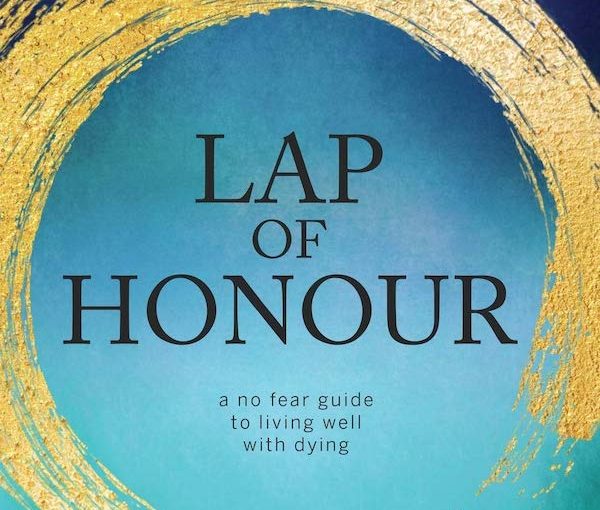
Lap of Honour: A No Fear Guide to Living Well with Dying by Jewish community member Gaby Eirew and Dr. Pippa Hawley is not a new book – it was self-published in 2019 – but its subject matter is timeless. And, after almost two years of the pandemic, many of us have perhaps contemplated the fragility of our existence more than we otherwise would have. While the book talks about what we can do to live well with dying once we are diagnosed with a terminal illness, it’s probably better to read it before that happens, if we have the opportunity, as we’ll have other things to contend with at that point.
Being prepared for something generally reduces our anxiety about that something, no matter what it is – even death.
“When you have been diagnosed with an illness (or someone close to you has) you enter a rather unusual time,” write Eirew and Hawley. “Life’s finishing line might be drawing nearer, but you are still very much alive. This is a time of huge opportunity for warmth, connection and honesty. There are unknowns and inevitably there will be fears, yet once you have a sense of what to expect, fears can be much more manageable, and the personal growth often described by people in this situation can be maximized. There may be difficult conversations ahead, but if these are tackled with honesty and kindness, they can be uplifting.”
Eirew is a counselor and educator, and she created the Recordmenow app, which they recommend in the book as a way to leave messages for your loved ones – you record answers to questions that were derived from interviews of 100 people under the age of 16 who had lost a parent; questions the kids wished their parent had answered for them.
Hawley, a clinical professor and division head at the University of British Columbia, is a pioneer in palliative care, having founded several programs and models of care. She was the founder, for example, of the Bucket List Festival, which was a workshop for people facing end-of-life issues to meet others who were going through similar experiences and has been adapted to other scenarios.
The title of the book comes from the “finishing line” metaphor: “Some runners stop at the finish line. Others take their time, grab a flag, cheer with the crowd and feel the love back. They do a lap of honour, recognizing everything that brought them to this moment, all the events in their life and all the people who are key to them.”
The book has 16 chapters, some written by Hawley, some by Eirew. They touch upon numerous subjects, starting with the process of being diagnosed and receiving a prognosis, or a “best guess as to what will happen to an average person with your condition.” Despite its inherent uncertainty, you might want this prediction because it gives you an idea of what you might want to prioritize.
There are chapters on facing the unknown; on how to tell other people, including children, that you’re ill; on deciding on home, hospital or hospice care; on caring for the person caring for you; on health insurance and the costs that you might face; on celebrating your life; on accessing support services and groups; and more. In the chapter on what you should take into account if you decide to take that trip of a lifetime, to travel with an illness, Hawley highlights “a recurring theme in this book: let people help you.”
While the bulk of the work will still be up to you to do, Lap of Honour discusses almost everything, it seems, that you – and those who love you – will be feeling if you find yourself in this position. And it offers ways for you to “live your life to the very end … in the way that feels right for you.”
The 37th annual Cherie Smith JCC Jewish Book Festival takes place Feb. 6-10 at both the Jewish Community Centre of Greater Vancouver and online, with authors joining from across Canada, the United States, Israel, Australia and Great Britain.
“We look forward to welcoming our live audiences to the joyful experience of a shared literary event,” said festival director Dana Camil Hewitt. “The Jewish Book Festival strives to reflect and showcase recent literature that revels in the lively and pivotal ideas stemming from the modern world and, in the process, expose our city and community to meaningful and captivating conversations about the written word in every shape and form.
“And, while the nucleus of our festival is Jewish-themed, our speakers, events and audience happily represent a diversity of experiences and cultures that defy narrow categorization. We are attuned to timely and universal themes and we thrive on the interdisciplinary, always inviting visual arts and performance art into our events.”
Opening the festival are American novelist and journalist Dara Horn, with her book People Love Dead Jews: Reports from a Haunted Present, and British comedian and writer David Baddiel, with his book Jews Don’t Count. On the closing night, Daniel Sokatch, an expert who understands both sides of the Israeli-Palestianian conflict, will present his book Can We Talk About Israel? A Guide for the Curious, Confused and Conflicted.
Winner of the Canadian Jewish Literary Award for fiction Gary Barwin joins the festival with Nothing the Same, Everything Haunted: The Ballad of Motl the Cowboy, together with U.S. author Jai Chakrabarti, who brings A Play for the End of the World.
Short stories will be celebrated in an event with Vancouver’s Rachel Rose and her collection The Octopus Has Three Hearts, long-listed for the Scotiabank Giller Prize, together with Montreal’s Ami Sands Brodoff presenting her intricately linked stories in The Sleep of Apples. From Toronto, novelist and cultural critic Hal Niedzviecki discusses his latest novel, The Lost Expert.
Stories of artists in the Second World War era are presented by two U.S. writers: Meg Waite Clayton (The Postmistress of Paris) and painter/writer Michaela Carter (Leonora in the Morning Light). History also has an important place in the work of Leah Garrett, who presents X-Troop: The Secret Jewish Commandos of World War II (who were the inspiration for Quentin Tarantino’s Inglourious Basterds), and Menachem Kaiser, whose Plunder: A Memoir of Family Property and Nazi Treasure won the Canadian Jewish Literary Award for non-fiction.
The annual Book Clubs event features Australian author Heather Morris, with her novel Three Sisters, the last in the Tattooist of Auschwitz trilogy.
Among the B.C. authors represented are Isa Milman, with her memoir Afterlight: In Search of Poetry, History and Home, and Rachel Mines, with her translation of Jonah Rosenfeld’s The Rivals and Other Stories. An epilogue event (i.e. after the festival run) moderated by Yosef Wosk features Robert Krell and his memoir Sounds from Silence and Alan Twigg’s Out Of Hiding: Holocaust Literature of British Columbia.
Regular updates can be found at jccgv.com/jewish-book-festival, where the digital program guide will be available after Dec. 28.
Actor Catherine O’Hara in a still from the four-minute video All of Us Shine by Jewish community member Hart Snider. (See jewishindependent.ca/revisiting-shop-class-misery.) For the 12th year, the NFB brought together acclaimed filmmakers to create short cinematic tributes to Canadian performing arts legends, as the Governor General’s Performing Arts Awards honoured laureates with two televised specials last month, one on CBC and one on Radio-Canada. All the short films are now available to watch (for free) at nfb.ca.
Also released early last month, marking Transgender Awareness Week, was the feature-length documentary Beauty by Christina Willings (jewishindependent.ca/liked-beauty-not-wall). It and more than 40 other related short and feature-length documentary and animated films can be accessed at nfb.ca/channels/lgbtq2.
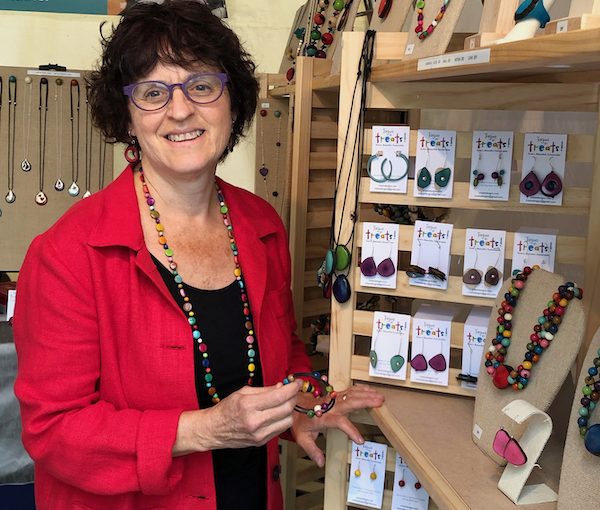
Ande Axelrod has developed a partnership with artisans in the village of Sosote, Ecuador, as her source for tagua beads. (photo from Zack Gallery)
The current show at the Zack Gallery, Affordable, opened on Nov. 17. It delivers on its name’s promise. Every item on display is less than $250 and thus in the realm of affordability for many people, not just art connoisseurs.
“That’s what I wanted for the Zack Gallery from the beginning,” said gallery director Hope Forstenzer. “I wanted to deepen the involvement of the JCC community in the gallery, wanted the art within people’s reach.”
Accordingly, this show looks more like a holiday craft fair than a high art exhibition.
“I don’t believe in the separation of art versus craft,” said Forstenzer. “For me, craft is another word for art, but art that is functional and affordable, designed for enhancing your life and your home rather than a wall of a museum. I hope we can make such a show an annual event.”
To achieve the artisan market feel, Forstenzer invited 10 artists in different media to participate. “They are all local B.C. artists,” she said. “Some Jewish, some not. I wanted to cater to different tastes, to represent different artistic fields. I wanted the show to be fun.”
Ceramics by Hitomi McKenzie.
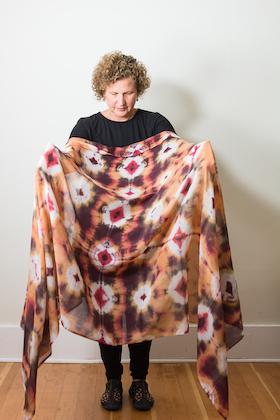
The atmosphere of the show is jazzy and welcoming. The giclée prints of well-known Vancouver artist Linda Frimer glow with greens and blues. The glass and jewelry twinkle. The ceramics by Hitomi McKenzie stand proud and bright. Mariana Frochtengarten’s colourful shawls in Shibori patterns add a touch of elegance.
Frochtengarten teaches textile art at the Jewish Community Centre of Greater Vancouver. “This is a great opportunity for me to show the community my personal work,” she said. “My work is based on the principles of Shibori – a Japanese manual tie-dye technique. I combine the ancient Japanese tradition with a contemporary approach.”
She works with natural fibres, mostly cotton and linen, and has been working as a textile artist for more than 25 years. “My way into textile art was a bit accidental,” she told the Independent. “I was born in Brazil. When I was in high school, I took a batik class for a hobby, but I fell in love with it.”
After graduating from high school, she studied at Fine Arts and Education University in Brazil and later completed her master’s in fine arts (textiles) at Nova Scotia College of Art and Design, in Halifax. “For 17 years, I worked with batik,” she said. “I had a business in Brazil and sold my works in stores, galleries, shows and fairs. I also experimented with some Shibori. I slowly moved on to my own form and interpretation of Japanese Shibori after moving to Canada in 2006. I love the elements of surprise involved in the process of Shibori and I am fascinated by the idea of creating different designs by blocking areas of the fabric before dyeing it.”
Another artist who works with an unusual material and technique is Ande Axelrod. Her company, Treats Designs, produces whimsical and sophisticated tagua jewelry: necklaces, earrings, pendants, and bracelets. Axelrod is very enthusiastic about her artistic creations. “Tagua is known as ‘vegetable ivory,’” she explained. “The tagua palms are native to the rainforests of Ecuador and other South American countries. The nuts grow and harden inside their seedpods. Some tagua nuts can grow up to six centimetres. Once the seedpods are ripe, they’re picked, and the seeds are dried in the sun, peeled and polished.”
The creamy white substance of the nuts is incredibly hard, similar to elephant ivory, hence the name. According to Wikipedia, a mature tagua palm can produce up to 20 pounds of vegetable ivory a year.
“Tagua nuts have been used as a substitute for ivory since the early 20th century,” Axelrod said. “The local masters carve the nuts into a variety of beads and buttons and dye them using bright natural colours.”
Mariana Frochtengarten shows of one of her colourful Shibori shawls.
She is thrilled to use tagua nuts as the base for her jewelry. “I worked as a graphic designer for more than 25 years. In 2011, a friend and I took some jewelry making classes and I explored a variety of media and techniques. The next year, I discovered tagua while traveling in South America. I was dazzled by the colours, and I loved how light and comfortable the pieces were. You could wear a bigger statement necklace or a pair of earrings and not have a sore neck or headache at the end of the day.”
The sustainability and eco-friendliness of tagua sealed the deal for her. “I wanted to save elephants and I was truly inspired by the vast creative potential of this versatile natural material. It also provides an economic incentive for the local communities to protect the rainforests,” she said.
Since then, Axelrod has developed a partnership with artisans in the village of Sosote, Ecuador, as her source for tagua beads. “Before COVID, I’d made annual visits to Ecuador each February. It gave me the opportunity to work with tagua throughout the process, from seed to bead. Of course, like everyone else, I’ve had to improvise these past two years. Zoom, WhatsApp, FedEx and Western Union have enabled me to stay in touch with my South American partners and get tagua here for me to create my jewelry.”
While Shibori scarves and tagua jewelry may more easily be thought of as unique artwork in the Vancouver context than photography perhaps, Michael Shevloff proves that he is an unquestionable master of the camera, producing his own singular creations. His images, both in colour and in black and white, are statements of his love for British Columbia: its forests, its mountains, its waterways, its streets.
“I do predominantly nature photography,” he said. “However, I also shoot street photography, portraits, and many other genres, both digital and film.”
For this show, Shevloff offers framed and matted photos and photo coasters. “In the past, I also produced books of my photos, collages, cushions and more. I even put one of my images on my phone cover. The choices are many, and there are online firms, as well as local places, that specialize in putting images on almost any surface.”
He has been taking photographs since he was a teenager. “That was a long time ago,” he joked. “I have albums filled with photographs from places I have worked and traveled throughout the years.”
For Shevloff, photography has always been a hobby, while he worked in information technology. It remains a hobby in his retirement, although he obviously has more time now to immerse in his artistic endeavours.
“Tropical Vancouver,” by Michael Shevloff.
“I have taken classes with professional photographers to hone my craft. And I belong to two photo clubs in Vancouver,” he said. “Vancouver PhotoClub is a well-organized group with monthly meetings and outings. I enjoy being a part of that club because they have assignments, which gives me a challenge and focus each month. They also organize exhibits, which gives me an opportunity to show my work.”
He belongs to the West End Photographic Society, as well. “That one is dedicated to film work and darkroom processing,” he explained. “They also organize exhibits. I enjoy the challenge of working with film and working with prints.”
The 10 artists of this show incorporate different art forms, different artistic philosophies, different ethnic roots and different price ranges. But one fact unites them all – every piece of art in the gallery for the next month is affordable.
The exhibit continues until Dec. 31.
Olga Livshinis a Vancouver freelance writer. She can be reached at olgagodim@gmail.com.
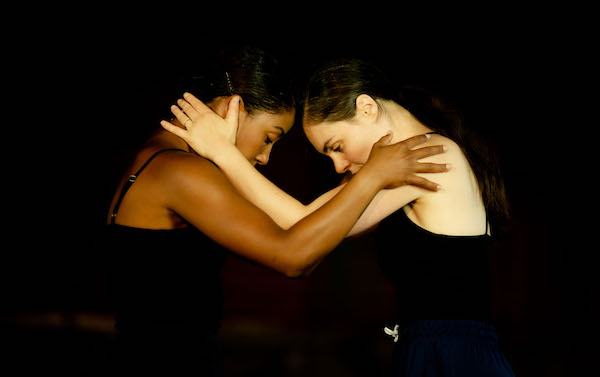
Livona Ellis, left, and Rebecca Margolick, right, perform together Dec. 17 and 18 at Scotiabank Dance Centre. (photo by Faviola Perez)
Next weekend, choreographers and dancers Livona Ellis and Rebecca Margolick will première their first collaboration, a duet called Fortress. The Dec. 17 and 18 performances at the Scotiabank Dance Centre also feature four solo works.
Ellis performs Unmoved, “a response to the idea of overcoming the limitations we place on ourselves,” and Margolick’s solo Bunker draws “on themes of memory and the shared history of previous generations of women.” The other two solo pieces were revived last season specifically for them: Peter Bingham’s Woman Walking (away) (1997), danced by Ellis, and Allen Kaeja’s Trace Elements (2000), performed by Margolick. (See jewishindependent.ca/albert-solos-reimagined.)
Both dancers have had the chance to perform for live audiences recently and both have been touring – New York-based Margolick internationally with her own work and locally based Ellis with Ballet BC, for audiences in Ottawa and Montreal.
“From these past two years of experiencing how quickly it can be taken away and experiencing how deeply I miss it when it’s gone, performing has a renewed sense of urgency and importance for me,” Margolick told the Independent. “I’m so excited to perform for a live audience here in Vancouver, especially because last year, when we were about to do this show for a live audience, on the day of the show, we had to switch to livestream only. A lot of energy has been built in this show over the past three years, and I’m looking forward to being able to share it live.”
While Margolick and Ellis have known each other for a long time, Fortress is their first duet together.
“Livona has always been one of the best dancers and performers I know. We trained at Arts Umbrella together all through high school, but, since then, we hadn’t danced together, until now. So much of collaboration happens outside of the studio and so, in a way, I feel like through our friendship and conversations over the past number of years, the work and ideas were already starting to form and it felt natural to transition to a studio together.
“At the time we decided to work together, I had been creating a solo titled Harbour, which was about my grandmother and my relationship to her both in life and death. One day, Livona and I had a conversation about it and she began talking about her grandmother. I was moved by this, and this conversation naturally spiraled into how we’ve started to see our mothers and grandmothers differently; how we see their influence on us; our desires to become mothers one day, being in our 30s now; how dance has changed for us, etc. The conversation was vibrant and honest and there’s a lot of history and love between us and I just asked if she wanted to create together, and she said yes.”
Ellis added, “One of the silver linings about the pandemic is that we both found ourselves in Vancouver at the same time…. I have always admired Rebecca’s work from afar but we’ve never been in the same place long enough to even begin to think about a collaboration. She was working on Harbour and we started speaking about our family and our grandmothers. This sparked the inspiration for Fortress. We were both doing a lot of reflecting during our various lockdowns and quarantines and found we were thinking a lot about who we are as artists and as women. How does our matriarchal lineage affect who we are today?
“We both feel like we are in a moment of change or transformation,” Ellis continued. “We can feel our experience settling in and grounding us in a way that allows us to move forward into the next chapter of our careers. This felt like the perfect jumping off point to create a duet.”
The pair started creating that work this past August 2021, with a residency hosted by the B.C. Movement Arts Society, rehearsing at the Athletic Hall in Sointula. “We are now working with composer Ivan Shopov from Bulgaria to develop the music, and Mimi Abrahams to develop the lighting,” said Margolick.
For Margolick, while both Bunker and Trace Elements haven’t seen any changes choreographically, “as time goes on, and as I evolve, they naturally do as well.”
“Especially for Trace Elements,” she explained, “it’s been a journey since I began working on it with Allen Kaeja. I started to learn more about Jewish history and specifically Jewish leftist and Jewish resistance history, both in the U.S. and Europe. Specifically, in Trace Elements, there is a spirit of resistance and remembrance in the work, countering the text we hear out loud, text of German propaganda and generational indifference to the history of the Holocaust. In that, I think about resistance fighters, countering the narrative that Jews went quietly towards death – they didn’t. That is a history we’re not often told of, and it’s been a part of my Jewish education to learn that history. The work is really spiritual for me and every time I perform it, I feel the spirit of those who fought and those who keep fighting and inspire me to as well.
“More recently,” she said, “I’ve been learning about Jewish women activists and fighters, especially women like Hannah Senesh, Faye Schulman, Bella Abzug, Emma Goldman, Anna Sokolow and others. I can’t really explain into words how this knowledge affects my performance, but I feel it, and it gives me a sense of grounding and inspiration.”
Margolick highlighted the Jewish Women’s Archive and Judy Batalion’s book The Light of Days: The Untold Story of Women Resistance Fighters in Hitler’s Ghettos as resources.
Bunker is also steeped in research. While she premièred the full-length version of the piece (titled Bunker + Vault, which runs 35 minutes) a few weeks ago in San José, Costa Rica, the December performances will include only the first 10 minutes of the work.
“A part of my research for this piece included looking through the archives of the Clara de Hirsch Home for Working Girls at the 92nd Street Y from the late-1800s to mid-1900s,” said Margolick. “The Clara de Hirsch Home was a place where young, poor, mostly Jewish immigrant women were housed and supported with educational resources as they found jobs and worked towards being able to support themselves. These archives were records kept by the staff, with observations and notes about the women who resided there. These observations gave me a window into the lives of the women who lived there, ranging from extreme hardship, repression, mental health issues, Jewish culture, camaraderie, acts of extreme kindness and on and on. Some of these women informed the movements, and spirit of resilience and care in the work.”
Fortress + Four Solos is presented by the Dance Centre and B.C. Movement Arts Dec. 17, 8 p.m., and Dec. 18, 1 p.m. and 8 p.m. For tickets, visit thedancecentre.ca.