Get $5 off Ahed’s Knee admission at VIFF

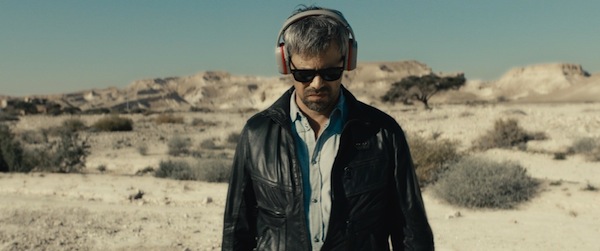
A still from Ahed’s Knee, which screens at Vancity Theatre March 25, 26 and 28. The movie – which won the Jury Prize at last year’s Cannes Film Festival – is about a celebrated Israeli filmmaker named Y, who arrives in a remote desert village to present one of his films at a local library. Struggling to cope with the recent news of his mother’s terminal illness, he is pushed into a spiral of rage when the host of the screening, a government employee, asks him to sign a form placing restrictions on what he can say at the film’s Q&A. Told over the course of one day, the film depicts Y as he battles against the loss of freedom in his country and the fear of losing his mother.

For $5 off the ticket price, use the promotional code VIFFKNEE22 at goviff.org/aheds-knee.

– Courtesy Vancouver International Film Festival

A rediscovered novella

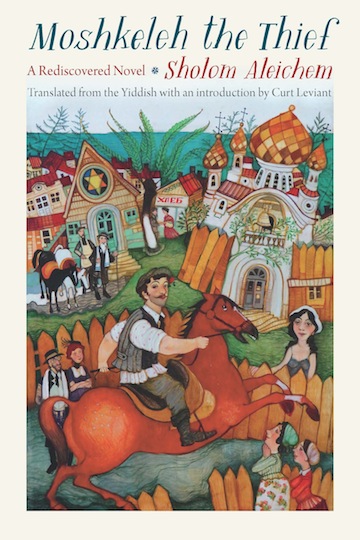
Moshkeleh Ganev, a forgotten novella by Sholom Aleichem, was recently resurrected from obscurity by gifted translator Curt Leviant.

image - Moshkeleh the Thief book cover

Missing from the standard edition of Sholom Aleichem’s collected works, which was published after his death, Leviant came across a brief citation of the story in a Yiddish literary quarterly published in Israel, while doing research on another project at the Hebrew University library. Leviant went on to translate it into English and Moshkeleh the Thief was published in 2021 by University of Nebraska Press.

The story stands out as a lively and endearing picture of shtetl life in Russia’s Pale of Settlement. Sholom Aleichem himself wrote in 1903 that the work celebrated a phase in his career when he had, he said, “really begun to write,” and was not merely “fooling around.”

I read Moshkeleh at a rapid clip as soon as it was mailed to me by Leviant, unable to stop due to the inescapably arresting character of the narrative. Sholom Aleichem has the ability to keep readers riveted to his stories, as though we are living in the community he is describing. His narratives are always very much alive in this sense.

Tsireleh, the attractive daughter of Chaim Chosid, a wine-cellar manager (a marginalized role for many Jews of that time, whose sights were set on more prestigious occupations), was, for me, a pivotal character in the tale for several reasons.

Unlike Chava in Tevye the Dairyman, Tsireleh was another variation on the Sholom Aleichem theme of a daughter whose involvement with non-Jews (Chvedka) posed a challenge to a sense of Jewish identity. The nine Tevye stories were authored over several years, starting in 1894. Moshkeleh was first serialized in a Warsaw Yiddish paper in 1903, when five of the Tevye stories had already been published; the remaining four were published after 1904. So, thematic strands interwoven in the lives of characters like Chava and Tsireleh that were important to the author may have overlapped. For example, Tsireleh comes close to the same threat to tradition in her relationship with Maxim Tchubinski, a non-Jew, and her elopement with him to a Christian monastery, but is whisked away by Moshkeleh at the 11th hour.

It is tempting to think that, despite Tsireleh’s nascent feminism, she was a pushover for any man who declared his love for her in passionate terms, as did both Maxim and Moshkeleh. But one can also see her elopement with the latter – even though he is a horse thief fated for deportation – as an enduring commitment to the faith of the family she left behind in her drive toward independence. Far from being overly impressionable in matters of the heart, there remained a silent commitment to the Jewish faith, unlike Tevye’s Chava.

Also unlike Chava, Tsireleh was a contrarian from the get-go, who longed for a different life than the one she felt she was saddled with as Chaim Chosid’s daughter. She had earlier rebelled against the yet-to-be role of subservient wife, becoming pregnant and going on to appropriate the domesticity envisioned for her sisters, not to mention all the young women in the shtetl. Her own metaphor was not becoming a clucking hen who sits on her eggs until they hatch, only to repeat the process several times over. She rebelled against the idea of marrying at too young an age to experience the world in a different way, and rebelled against the thought of having to marry a suitable man from a respectable family. She promised herself she would build her life differently. Eloping with a non-Jew like Maxim Tchubinski on a Pesach night was a dramatic example of why, unlike other characters in the novel, she wasn’t cut from an ordinary mold.

Yet her elopement with Moshkeleh does show an enduring commitment to her Jewish faith. Perhaps Tsireleh was for Sholom Aleichem a character representing themes he wrestled with when it came to communities in which opportunities for assimilation were an ever-present temptation – or threat.

David Begelman, PhD, is a psychologist in New Milford, Conn.

The excitement of holidays

As meaningful and fun as most of the Jewish holidays are, there’s a lot of running around, cleaning, cooking and other preparation that generally goes into them. Three recently published children’s books – two about Passover and one on Shabbat – capture the joys of the holidays, and the craziness that can sometimes precede them.

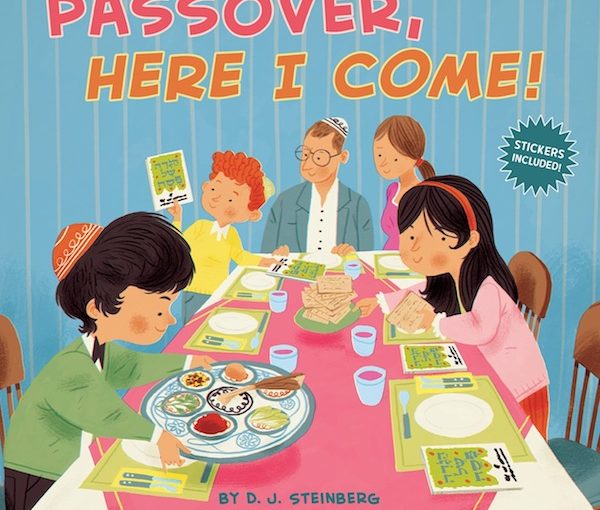
Passover, Here I Come!, written by D.J. Steinberg and illustrated by Emanuel Wiemans was put out this year by Grosset & Dunlap. It’s a compilation of short poems, all related to Passover, from “Scrub-A-Dub-Dub!” preparations to “Bye-bye, Bread!” and “Hello, Matzoh!” it goes through pretty much every aspect, including the Passover story, what’s for dinner and the search for the afikomen.

“Made by Me!” is about making up the seder plate, and all the plate’s items and their symbols are noted alongside the illustration. For the poem “Our Magic Table,” the drawings and words again combine to wonderful effect. We see the tables from set-up to guest-filled, and the typesetting, leaving gaps between the letters forming the words “g r o w s   a n d    g  r  o  w  s,” communicate the truly magic nature of a Pesach table that does seem to fit an enormous number of people, when we’re lucky to have many friends and family join in our celebrations.

Steinberg’s verse and Wiemans’ drawings work well together, simultaneously entertaining and teaching. The basics of Passover are all covered in Passover, Here I Come! which even includes a recipe for Mom’s Matzoh Brei after the four-line poem “World’s Best Breakfast.”

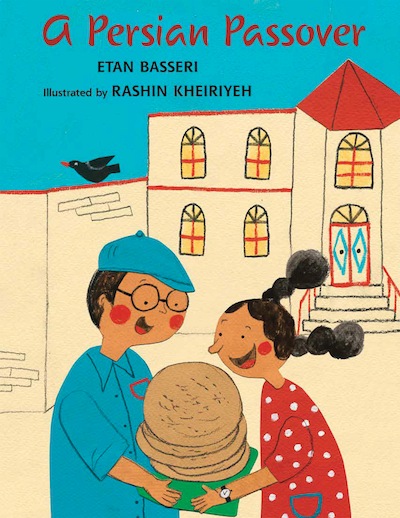
A Persian Passover (Kalaniot Books) by Etan Basseri with illustrations by Rashin Kheiriyeh, also contains a recipe – for hallaq, which is Persian-style charoset. In addition, the end of the book features a brief description of Passover and what goes on the seder plate, a glossary of Persian and Hebrew words used in the story, and a couple of paragraphs on Jews in Persia, known today as Iran, though, notes Basseri, “the culture and main language of this region is still called ‘Persian.’”

image - A Persian Passover book cover

Set in Iran in the 1950s, A Persian Passover follows siblings Ezra and Roza, who are helping their family get ready for the holiday. Everyone is put to work and Roza is finally old to enough to accompany older brother Ezra to the synagogue, where families bring their own flour “to be mixed, rolled and baked into soft, delicious matzah.” Though older, Ezra is not necessarily wiser and he’s still a kid, with energy to burn. Not having learned from an earlier collision with a neighbour – as he ran a lap around the house, being timed by Roza – Ezra once again asks Roza to measure how fast he can run to the next street corner, freshly baked matzah in hand.

“But he didn’t see the rut in the road up ahead. ‘Oof!’ yelped Ezra as he tripped and fell. Splat! went the bag of matzah as it dropped into a puddle.

“‘The matzah!’ they exclaimed together.

“‘That was all the matzah we had for the week. Now it’s gone. What will we tell Mama and Baba?’ asked Roza.” (The glossary notes that baba means dad in Persian.)

Ezra and Roza set out to find replacement matzah before the seder starts, and we meet more of the neighbourhood folk. Hopefully, it won’t be too much of a spoiler to know that the kids succeed – not only receiving kindness, but also showing kindness to others along the way.

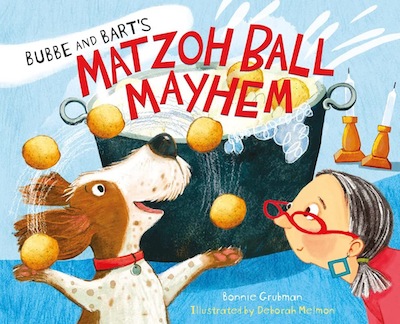
The last book that recently came out has to do with matzah, but not with Passover, which is why it’s included in this brief roundup even though it’s about Shabbat. Good for year-round reading, Bubbe and Bart’s Matzoh Ball Mayhem, written by Bonnie Grubman and illustrated by Deborah Melmon, was published by Seattle’s Intergalactic Afikoman last November. Created by two dog lovers, it begins, “This is Bubbe’s story. Believe me that it’s true. Her puppy loved each Friday night like Jewish puppies do.

image - Bubbe and Bart’s Matzoh Ball Mayhem book cover

“When Bubbe made her matzoh balls, Bart was at her feet, waiting for a ball to fall, and not some doggie treat.”

While Bart’s begging doesn’t achieve the desired result, he does get to eat all the matzah balls he’s able to catch. Bubbling away in the pot on the stove, the matzah balls grow so large that they blow off the lid and zoom all over the room. Not to be held back by “a better lid, and some very sticky tape,” the balls continue to fly. And we get to count them as they do. (Another spoiler alert: Bart gets to eat an awful lot of matzah.)

Eventually, with a little magic, calmness is restored and dog and house are cleaned up in time for Shabbat dinner with the family.

Bubbe and Bart’s Matzoh Ball Mayhem ends with a couple of paragraphs about Shabbat, “a very special day of the week,” and a short glossary.

A roadmap to remembering

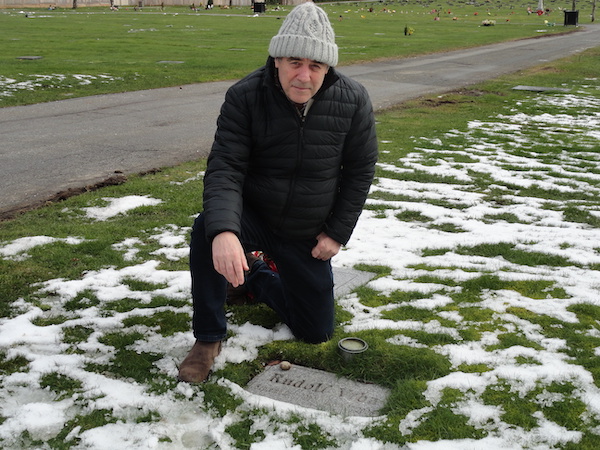
Alan Twigg, author of Out of Hiding: Holocaust Literature of British Columbia, at the gravesite of Rudolf “Rudi” Vrba, who died in 2006. (photo from JCC Jewish Book Festival)

Fittingly for a man who has dedicated his life’s work to the written word, Alan Twigg has compiled a fascinating bibliography. Out of Hiding: Holocaust Literature of British Columbia is one of two books to be launched in a JCC Jewish Book Festival epilogue event on April 5. The other is Sounds from Silence: Reflections of a Child Holocaust Survivor, Psychiatrist and Teacher by Dr. Robert Krell, to whom Twigg’s book is dedicated.
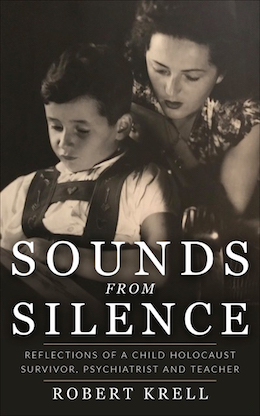
image - Sounds from Silence book cover“More than anyone in Canada, Robert Krell has continuously carried the torches of healing, investigation and discourse about the Shoah since the 1970s to counteract ever-encroaching racism, denial and wilful ignorance,” writes Twigg, whose book is also dedicated to the late publisher and editor Ronald Hatch, who died last November. Hatch and his wife Veronica co-managed Ronsdale Press, which published Out of Hiding.

Among other things, Twigg is the founder of the BC BookWorld newspaper, The Ormsby Review (now called The British Columbia Review), the ABCBookWorld reference site, the Literary Map of BC and the Indigenous Literary Map of BC, as well as many of the province’s literary prizes. He has published 20 books and made seven literary documentaries.

Twigg wrote Out of Hiding with the help of many, including, notably, Yosef Wosk, who wrote the book’s afterword, in which Wosk discusses various kinds of hiding – from one’s mission, from persecution, in dreams, in silence, from truth. Wosk notes that the perpetrators of the Holocaust also tried to hide: “The Nazis engaged in fraud, deception and secrecy on a massive scale,” he writes.

“The secrecy was complete and, to a large extent, effective,” he adds. “The very monstrosity of the crime made it unbelieveable. In fact, the Nazis speculated that the unimaginability of their Aktionen would work in their favour.” But this expectation “was frustrated by the Allied victory. [What remained of] Nazi archives were opened, contemporary Jewish documents were discovered, and facts were ferreted out by courts and scholars. Moreover, by 1942, the Free World had gradually learned the truth, albeit not always complete and precise.”

Wosk concludes, “There is much to remember and even more to know as the Holocaust comes out of hiding.”

And this is one of the reasons Twigg compiled this collection.

“I am not a Jew. I am not a German. I simply believe it is the responsibility of everyone on the planet to know more than just a little about the Holocaust,” begins Twigg in the foreword. “It is our collective responsibility to teach our children – with details – about why the Shoah is unique among the many genocides.”

He points out: “No other political regime has ever systematically murdered at least 1.5 million babies and children.”

As well: “Never before or after has a modern, industrial state mobilized all of its resources to systematically commit murder at least six million times in about eight years (from Kristallnacht in 1938 to 1945) and no other government has established a separate killing ground to murder approximately 50,000 women (at Ravensbruck, north of Berlin).

“No other regime has so thoroughly and consistently degraded its victims,” writes Twigg. “Estimates vary but the United States Holocaust Memorial Museum claims Germans created 980 concentration camps, 30,000 slave labour camps, 1,150 Jewish ghettos, 1,000 prisoner-of-war camps and 500 brothels where women were sex slaves.” And yet, Holocaust education surveys have shown that most people would struggle to name one or two camps, other than perhaps Auschwitz.

Twigg believes that, “if the most-heinous, most-planned and most extensive genocide can be deep-sixed by mankind, all genocides thereafter can be shrugged off as natural – as inevitable as forest fires, plagues, droughts, locusts or tidal waves.” If that happens, he argues, then genocide becomes “someone else’s problem.” As for something the magnitude of the Holocaust, he writes, “Most certainly it can happen again.”
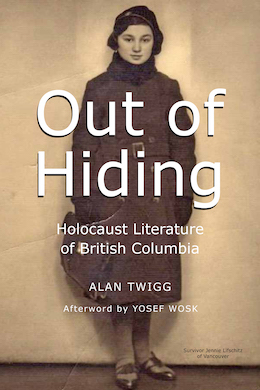
image - Out of Hiding book coverOut of Hiding is an intensely personal project for Twigg. He describes the book as “a roadmap back to places and experiences that must never be forgotten, offering a wide range of perspectives from the Holocaust-related books of British Columbian authors.” In total, he covers some 160 books in four sections. Some authors have written, edited or otherwise helped bring into being more than one memoir, novel, report or study; some of the people discussed are the subjects of the publications, rather than the writer.

Part One features relatively long expositions on Rudolf Vrba, Robert (Robbie) Waisman and Krell.

Twigg considers Vrba – who lived in Vancouver for the last few decades of his life – the “most important author of British Columbia.”

Writes Twigg in Out of Hiding, “Historian Ruth Linn estimates there were about 500-700 attempts to escape from Auschwitz-Birkenau, and most failed. Some 75 of these attempts were made by Jews; only five Jews made it successfully to freedom. The most significant of these five was Rudolf ‘Rudi’ Vrba, the main author of the most authoritative report on the true nature of the concentration camps, co-authored with co-escapee Alfred Wetzler.”

The Vrba-Wetzler Report, dated April 25, 1944, “finally revealed to the Allies the true nature and extent of the Holocaust.”

Twigg provides a biography of Vrba and some of what he learned from him as a friend. He also shares that Vrba, who died in 2006, was buried in a “seldom-visited cemetery, known to few people, where there is only a simple headstone.”

The April 5 event will include a video of Wosk chanting a Jewish blessing for Vrba at the graveside – something that apparently has not been done before.

Both Waisman and Krell are discussed in as much depth as Vrba, from their brief childhoods before the Holocaust through to recent history, sharing some of their writings and accomplishments, giving readers a sense of who they are and why their contributions are so vital.

Part Two offers shorter personal summaries on dozens of authors and publications. This section includes Lillian Boraks-Nemetz, Claudia Cornwall, Peter Hay, David Lester, Robert Mermelstein, Heather Pringle, Peter Suedfeld, Mark Zuehlke and many others. It features survivors of the Holocaust, as well as researchers, educators, journalists, graphic artists and editors who have studied the Holocaust, members of the Second or Third Generation, and a few non-Jews.

Part Three features an eclectic mix of 26 writers/artists, including Olga Campbell, Esi Edugyan, Jean Gerber, Rabbi Marvin Hier, Nikolaus Martin, Isa Milman, Norman Ravvin, Colin Upton and others.

Part Four:  One Doctor, Two Rabbis comprises three essays. The first is on Dr. Tom Perry, who served with the U.S. Army Medical Corps in the Second World War, and “took a series of rarely seen photos that his widow Claire Perry donated to the Vancouver Holocaust Education Centre in 1994 along with a five-page letter he wrote to her from ‘somewhere in Germany,’ describing his feelings and impressions of Buchenwald.” The letter is included in this section – and it is a powerful testament, though words don’t capture the horror as much as do his photographs.

The second essay, “Lulek’s Story,” flows from a well-known photo taken by Tim Gidal on July 17, 1945, in a refugee compound near Haifa – front and centre is Israel Meir “Lulek” Lau, holding a Buchenwald banner. Rabbi Meir Lau, who became Ashkenazi chief rabbi of Israel, was the youngest survivor of Buchenwald and his story is moving and inspirational.

Wosk’s afterword rounds out the collection with his thought-provoking reflections on hiding.

“Soon all witnesses will be gone,” concludes Twigg in his author’s statement. “The Holocaust must not be relegated to being merely the psychic preserve of Jews and Germans.”

The double-book launch event is presented with the Vancouver Holocaust Education Centre and takes place at the Rothstein Theatre. Admission is free but registration via jccgv.com/jewish-book-festival/events or at eventbrite.ca is required. To read a discussion of Krell’s Sounds from Silence, visit jewishindependent.ca/a-child-survivor-reflects.

Peace hopes still alive

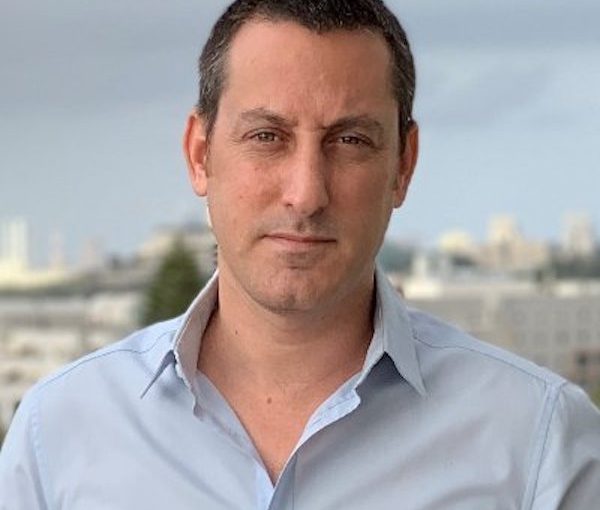
Barak Ravid (photo from Twitter)

An end to the Israeli-Palestinian conflict may be nowhere in sight, but the Israeli-Arab conflict may be coming to an end, says a leading Israeli diplomatic journalist.

Barak Ravid spoke virtually Feb. 20 in a presentation organized by the Jewish National Fund of Canada. Ravid, who reports for Axios from Israel, was formerly with Ha’aretz, where he worked for a decade as diplomatic correspondent and columnist, and is also a familiar face on Israeli TV. He was interviewed by Cynthia Ramsay, publisher and editor of the Jewish Independent.

Ravid spoke about his new book, Trump’s Peace: The Abraham Accords and the Reshaping of the Middle East, which is currently available only in Hebrew but should be out in English this summer.

Ravid acknowledges that Trump is a controversial figure and that the book’s title has received some pushback. “Peace is not the first thing that comes to mind when you say the word Trump,” he said. “I chose that name because it happens to be true.”

The author maintains that the Abraham Accords and the expanding normalization between Israel and Arab states would not have occurred under any other president.

“At the end of the day, Trump’s policies in the region closed down the trust gap that was open between the U.S. and the Israeli government … a gap that was opened during Obama’s term in office,” he said. “Whether it was warranted or not doesn’t matter. The gap was there. Trump’s policies in the region, mainly on Iran, closed down the gap and brought Israel and the Arab countries closer together.”

Trump’s decision to appoint his son-in-law, Jared Kushner, to deal with peace in the Middle East was key, according to Ravid. In interviews with Israelis and Arabs for his book, Ravid found that both sides viewed the appointment as proof of how central this issue was for Trump and served as an assurance that, when they spoke to Kushner, they were speaking to the president.

The ultimate reason the Abraham Accords were cinched, said Ravid, is that Trump did what he always claimed as his strength – he made deals. In return for normalizing relations with Israel, each party to the accords got something they wanted.

“For the United Arab Emirates, it was the arms sales, the sales of the F-35 fighter jets,” he said. “For Bahrain, it was an upgraded trade deal [with the United States]. For Sudan, it was removing them from the [U.S.] state department’s terrorism list. For Morocco, it was the U.S. recognition of Moroccan sovereignty over the Western Sahara…. Without those tangibles, those countries would not necessarily agree to take those steps.”

Ravid contends that Trump is not the only leader who deserves credit – Binyamin Netanyahu, who was Israeli prime minister at the time, was pivotal to the success. Ironically, he noted, the decision by most Arab politicians in Israel to reject the accords led Mansour Abbas to break away from the Joint (Arab) List and form a new party, Ra’am, whose participation in the new coalition government ultimately brought Netanyahu’s reign to an end.

“For the first time in history, an Arab party is a part of the coalition in Israel,” Ravid said. “In a strange way, the Abraham Accords enabled this change in Israel where Jews in Israel feel more comfortable towards Arabs and Arabs feel more comfortable joining the coalition and, therefore, Netanyahu’s biggest foreign policy achievement created the political conditions to get him out of office.”

It has long been an assumption that peace between Israel and Arab states would come only after a resolution of the Palestinian issue. When Netanyahu earlier tried to bypass the Palestinians and make friends in the neighbourhood, he was publicly shunned, said Ravid. But he kept plugging away behind the scenes, building relations in the region.

“It’s hard to go from zero to 100 in one step,” said Ravid. “You need to get to a situation where you narrow this gap and Netanyahu managed to take Israel and the Arab world from zero to, let’s say, 70. So, when the decision for the Abraham Accords came, the Arab countries didn’t have to go zero to 100, they needed to go 70 to 100.”

A third crucial contributor – who Ravid said deserves perhaps the most credit and who wants the least recognition – is the Crown Prince of Abu Dhabi, Sheikh Mohamed bin Zayed, the de facto leader of the United Arab Emirates. Bin Zayed has been trying to modernize his nation and he saw normalization with Israel as advantageous to his project. At the time, Netanyahu was threatening to annex about 30% of the West Bank into Israel. According to Ravid, bin Zayed saw a way to manoeuvre.

“He decided to be the most vocal opponent of annexation,” Ravid said. Bin Zayed told the Trump White House that, if Netanyahu dropped the annexation initiative, he would be ready to sign a peace deal with Israel.

For the White House, the annexation issue was a huge headache, said Ravid, and bin Zayed’s offer solved that problem while delivering a generational diplomatic breakthrough at the same time.

The big question is, what’s next? What about Saudi Arabia?

“That’s the crown jewel,” Ravid said. U.S. President Joe Biden sent his national security adviser, Jake Sullivan, to Riyadh and received a list of demands from Crown Prince Mohammed bin Salman Al Saud. All the demands were on the United States, not Israel, including that the Saudi monarch be invited to the White House.

Bin Salman has been an international pariah since the Washington Post commentator and Saudi dissident Jamal Khashoggi was murdered and dismembered in the Saudi consulate in Istanbul in 2017. The U.S. Central Intelligence Agency concluded that bin Salman ordered Khashoggi’s killing.

“Biden will have to take a very hard decision if he wants to move ahead with the Abraham Accords,” said Ravid, walking the fine line between rewarding a foreign leader who American intelligence has dubbed a murderer of a journalist and seeking to advance peace in the Middle East. But, if it works, the dominos will almost certainly fall into place, said Ravid.

“If Saudi comes in, then Indonesia comes in, then Kuwait comes in, then Oman comes in, then Muslim countries in Africa join, Pakistan,” he said. “It’s literally the end of the Arab-Israeli conflict – while the Israeli-Palestinian conflict will continue, obviously.”

In this regard, Ravid said, “The Palestinians decided to boycott the Trump administration in December 2017 after Trump announced he is recognizing Jerusalem as the capital of Israel and moving the embassy there. While I can understand Palestinian frustration and anger, and it makes complete sense to protest, the decision to boycott Trump until his last day in office, I think, was counterproductive to their goals, and didn’t get them anything in the end.”

On the flip side, Ravid argued, Netanyahu’s annexation of a big chunk of the West Bank would have put another nail in the coffin of the two-state solution.

“I think the Abraham Accords, even though the Palestinians won’t admit it, saved the two-state solution, at least for now,” said Ravid. “Some people think it’s gone already, but if you think the two-state solution is still alive, the reason it’s still alive is that the UAE normalized relations with Israel and stopped Netanyahu from annexing the West Bank.”

Bernice Carmeli, president of JNF Canada Pacific Region, opened the event, and Michael Sachs, executive director of JNF Pacific Region, closed it. Lance Davis, chief executive officer of JNF Canada thanked Ravid.

A best home for Jews?

Despite its flaws, most Canadians are proud to call this country home. And most of us would leave it at that, and not delve too much into why we feel that way. But a recently published book asks 20 scholars to consider the question, “Has there ever been a better home for the Jews than Canada?” The result is a compelling read that raises many more questions than answers.

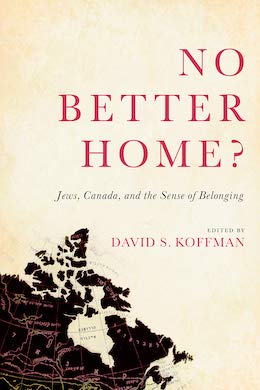
No Better Home? Jews, Canada and the Sense of Belonging, edited by David S. Koffman of York University, was published by University of Toronto Press last year. While many of us may not rush to pick up an academic publication, for fear of its denseness and potential incomprehensibility for laypeople, this one is surprisingly readable. Not every essay will be of as much interest, as the book is Eastern Canada-centric, but many of its ideas will help us in determining for ourselves what we mean when we say Canada is one of the best places in the world to live. And some of its discussion will prod humility – for example, the reality that many immigrants to Canada would rather have been able to stay where they were, but had to flee persecution, war or other circumstances, is a sobering reminder. As is the fact that the situation in Canada has not always been good for Jews or other minorities.

An exact measurement of “best” is elusive and subjective, of course. As editor Koffman notes in his introduction, “Canada may now very well be the safest, most socially welcoming, economically secure, and possibly most religiously tolerant home for the Jews than any other diaspora country, past or present. Jews in Canada today enjoy (1) high rates of voluntary religious participation at all denominational in-points; (2) relatively low rates of nonviolent forms of antisemitism; (3) high degrees of Jewish literacy; (4) the capacity to exercise political power unfettered by antisemitism; (5) institutional completeness for Jewish communal needs; (6) thoroughgoing social acceptance; (7) significant cultural production; (8) public recognition; (9) comparatively low intermarriage rates; and (10) economic opportunities unrestricted by their Jewishness.”

image - No Better Home? book coverThat said, the matter is not so easily determined, as the other contributors to the volume delve into Canada’s past, into other countries that offer good homes for Jews, into the accessibility and affordability of Jewish education, into Canada as a point of arrival for Holocaust survivors, into Yiddish not only as a language but as a link to family, heritage or tradition, and into many other topics.

The situation in Ukraine makes Jeffrey Veidlinger’s essay particularly interesting for anyone wanting to know more about that country and the influence of its history and its emigrants on Canada. For instance, Canada’s multiculturalism policy was a concept introduced in the 1960s by Ukrainian Canadians, “who, in turn, adapted it from the notion of ‘national autonomy’ that Jews had introduced to early 20th-century Ukraine, where Jews were conscious of securing rights as a minority group within a largely binational (Russian and Ukrainian) state,” writes Veidlinger, who is at the University of Michigan. “Ironically, when multiculturalism made it to Canada in its new form, it was met with skepticism and even outright rejection by the organized Canadian Jewish community.” Some of that rejection had to do with this vision of multiculturalism being “premised on a common Christianity,” he says. As well, the Jewish community had learned to navigate between the so-called “two founding races” (French and English powers) and there was concern that diffusion of power would make it harder to do so.

More than one writer touches on the French-English dichotomy, as well as where Indigenous peoples fit in those narratives. In his essay, Koffman considers the question, “What have Jewish-Indigenous peoples’ interactions looked like? How might we think about Jews’ home in Canada refracted through the prism of the interactions between the placed and the displaced?”

The only local contributor to No Better Home is Richard Menkis, a professor at the University of British Columbia. The way in which his essay on museums fits into the collection is encapsulated in the two questions he poses: “What kind of home would it be if the narrative of the Jewish community were not considered ‘Canadian’ and included in the national experiences depicted in state-sponsored exhibitions? And the corollary question is: How comfortable are Jews, in this home, telling their stories, including the stories of the marginalized (the poor) and the ostracized (the criminals)?”

Menkis looks at three exhibits on Canadian Jewry – Journey Into Our Heritage (1970s), A Coat of Many Colours (late 1980s) and narratives at the Canadian Museum of Immigration at Pier 21 in Halifax since it opened in 1999. He concludes that, in the two exhibits, as groundbreaking as they were, Canadian Jews were comfortable only in sharing their achievements and contributions (ie. worth) to Canadian society at large. These exhibits omitted people and activities that could be more controversial, such as Jews involved in the union movement or in radical politics.

At the Canadian Museum of Immigration, the historical summations eventually became more nuanced about Canada’s immigrant communities, and recognized them as having “enriched the cultural mosaic.” This is a grand improvement from the attitude in 1945 of the Historic Sites and Monuments Board of Canada when it was asked to recognize the country’s first synagogue. Menkis begins his essay with this point, citing a member of the board, who said “he was not particularly interested in the commemoration of Jewish activities.” The board member had a similarly dismissive response to the suggestion “that there be a commemorative marker for 400 African Canadians who lived on Vancouver Island before 1858,” notes Menkis.

Every contributor to No Better Home? offers a different perspective. One that seems sadly true is that of Jack Kugelmass of the University of Florida. “My point,” he writes, “is that good places for Jews have a lot to do with robust economies, with stable governments and a consensus in which difference is at least tolerated and immigrants welcomed because they’re good for business.” He recommends: “Enjoy the good times while they last. Nothing is forever. Right now is certainly Canada’s time, as it is for Canada’s Jews.”

Bunny at Cultch

Emma Slipp co-stars in Bunny. (photo by Emily Cooper)

Emma Slipp co-stars in Bunny, written by Jewish-Canadian playwright Hannah Moscovitch, and presented by the Search Party in the Cultch’s Vancity Culture Lab March 17-27.

In Bunny, Sorrel – a young woman raised by unconventional parents – tries to reconcile her love of Victorian literature, her intellectual Marxist-feminist upbringing, and her burgeoning sexuality. From high school, through college and into adulthood, Sorrel’s story reveals a woman who feels the weight of societal expectations, wants to make the “good” and “right” choice, while simultaneously embracing her own sexual nature.

Bunny premièred in 2016 at the Stratford Festival, and garnered rave reviews for its bold and honest portrayal of female sexuality. With this upcoming run, the Search Party presents the play for the first time in Western Canada. A relatively new theatre company, their 2019 production of Florian Zeller’s The Father won six Jessie Awards. Mindy Parfitt, artistic director of the Search Party, directs this Vancouver première, which features Slipp, Ghazal Azarbad, Kayvon Khoshkam, Jay Hindle, Nathan Kay, Pamela Carolina Martinez and Liam Stewart-Kanigan.

– Courtesy the Cultch


Ominous Sounds premières

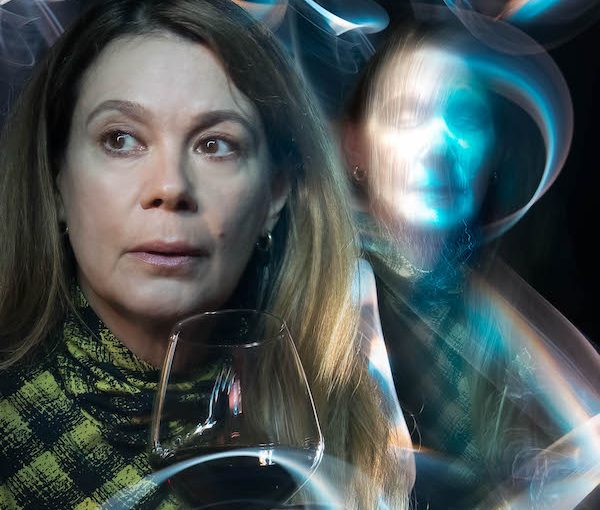
Kerry Sandomirsky co-stars in Ominous Sounds at the River Crossing by Jason Sherman, which has its world première at Performance Works March 6-13. (photo by David Cooper)

Who is permitted to tell stories? This is the main theme of Ominous Sounds at the River Crossing; or, Another F–king Dinner Party Play, playwright Jason Sherman told the Independent.

The world première of Ominous Sounds takes place March 6-13 at Performance Works on Granville Island. Not only is Sherman a member of the Jewish community, but so are cast members Alex Poch-Goldin and Kerry Sandomirsky and lighting designer Itai Erdal. The production is being staged by Touchstone Theatre, whose artistic director is Roy Surette.

Ominous Sounds is described as “a provocative and darkly comedic piece of metatheatre that dives into hot-button issues including the ethics of representation, climate responsibility, and social power in a reality marked by colossal cultural shifts and blurring meanings.”

“In exploring the central theme,” said Sherman, “characters in the play reject a number of storytelling approaches, old and new, notably the dinner party play, of which there are many fine examples, to be sure, but which one of our characters is desperate to escape from. The play keeps returning to various versions of a dinner party play, interspersing it with attempts at other forms of storytelling, before finding a synthesis in a new story.”

photo - Playwright Jason Sherman
Playwright Jason Sherman (PR photo)

The launching point of Ominous Sounds was a planned follow-up to Sherman’s play Patience, which Surette directed some 20 years ago. Patience is “a contemporary retelling of the story of Job; the new play was to pick up with news of the death of the earlier piece’s main character,” said Sherman. “But I found myself balking at returning to the earlier story – for reasons of both form and content – and instead incorporated some of its elements into what would become Ominous Sounds.”

Erdal described some of the considerations in lighting a play like Ominous Sounds. “In a naturalistic play,” he said, “the lighting usually wants to be invisible; it should move the story forward and set the mood and the tone for the scene but it should do all that without pulling any attention to itself…. In an abstract play, the lighting doesn’t have to be justified – it can be part of the architecture and the dramaturgy of the piece. This play is about making theatre, so it moves between the two approaches – sometimes the lighting is invisible and sometimes it can be very dramatic and noticeable.

“We have a brilliant projection designer,” he added, “and many of the locations will be done with video projection, so I will have to … work closely with the projection designer to determine which scenes will be done with lighting only and which scenes with lighting and projections. We are still very early in the process so a lot of those decisions are still being made.”

When Poch-Goldin spoke with the Independent, there had been only three days of Zoom rehearsals.

“It was a bit exhausting using that format, but very enlightening,” he said. “The writer, Jason, was part of our rehearsals and he was able to clarify things for us, which was very helpful.

“I hope people will come see the show now that things are opening up. While COVID is hovering in the background, I have to be optimistic. I want to share this play with people. I want to work with other actors without masks on and I want a sense of normalcy to prevail. I’m not nervous about having restrictions loosen and a full theatre appreciate the work.”

Sandomirsky echoed this last sentiment. “We have all been inside now for two years, many of us living on a diet of Netflix and Skip the Dishes,” she said. “This play does what theatre does best – engages in the cultural conversation of the moment in a provocative, entertaining way. It’s an opportunity to see theatre that you will keep discussing post-show. It’s an opportunity to leave your bubble and safely let a group of experienced actors delight and enrage you. You don’t need to go to New York. You can hear a script that has intelligence, humour and heart right here, on Granville Island.”

Both Poch-Goldin and Sandomirsky play more than one character.

Among Sandomirsky’s roles, she said, “is a 50-something actor trying to navigate the minefield of what stories she is and is not allowed to tell. Is her voice still relevant?”

“We start as numbered entities and then we start to play other characters in little plays along the way, but always return back to our numbered entity,” explained Poch-Goldin. “My character starts vulnerable and becomes quite strident and outspoken, longing for the good old days, when theatre was something he understood. As for the other characters I play, Peter is a bit of a wisecracking dad who is trying to be a better person and facing a lot of struggles. I also play the character of Ruben, who is someone who has passed away and comes back in a flashback to talk about his struggles, and to learn to accept himself and his failings. I love all the characters, they’re profound and reflect many things I feel about the changes in society.”

Poch-Goldin has been busy since the pandemic began. He moved to Winnipeg two years ago and has been doing a lot of TV and film, he said. For example, the première of the series The Porter started on CBC Feb. 21, and Poch-Goldin is in five of the eight episodes.

“I also just finished writing a new play called The Trial of William Shakespeare,” he said. “After three years of development, we’re finally starting to share the script after several workshops. I also have a play called The Great Shadow, about the first film studio in Canada in 1919. It’s going to première this summer at 4th Line Theatre, which is an outdoor theatre in Millbrook, Ont.”

For her part, Sandomirsky continued to teach acting for film and television at Langara’s Studio 58.

“I gathered a group of friends and directed A Midsummer Night’s Dream on Galiano Island in a field,” she said. “It was an opportunity to have experienced Bard on the Beach actors mix with local islanders and create a bit of magic on a few warm August nights.”

As well, she, her son Ben (who is in Los Angeles shooting The Mysterious Benedict Society) and her mom (who lives in Saskatchewan) “started doing nightly themed Zoom sessions to amuse ourselves and stay in contact. We’d choose a theme and then give ourselves half an hour to whump up costumes and props using only what we had at hand.” They shared photos with friends and “began to take thematic requests and covered everything from Bergman to Batman to Brueghel.”

Next for her is the play Courage Now at Firehall Theatre.  Written by Manami Hara, it’s a piece about Japanese consul Chiune Sugihara, who helped thousands of Lithuanian Jews flee Europe. “The director, Jane Heyman, is herself a descendant of a family saved by Sugihara’s actions,” said Sandomirsky.

For tickets to Ominous Sounds, visit ticketscene.ca/series/926.

Diverse and innovative films

A still from Amanda Kinsey’s documentary Jews of the Wild West, a series of vignettes that shines a light on a noteworthy and usually overlooked history.

The Wild West, Jews in Germany and a surprisingly vivacious Israeli seniors home feature among the diverse films at the Vancouver Jewish Film Festival this year.

Somehow, we tend not to associate Jews with the legends that have built up around the development of the American West, a serious oversight that is in the crosshairs of filmmaker Amanda Kinsey’s documentary Jews of the Wild West.

The mythology of the Wild West is perhaps as much an invention of Hollywood as of history, so it is notable that the 1903 film The Great Train Robbery, which introduced the genre of the cinematic Western, featured Gilbert “Broncho Billy” Anderson – né Max Aronson.

The myth of the West was no less inspiring to Jews than to other Americans and dreamers from around the world. Perhaps one of the most famous names in the lore was Wyatt Earp. The film introduces us to Josephine Marcus, who fled her family in San Francisco to become an actress and ended up being Earp’s wife. Earp himself is buried along with the Marcus family in a Jewish cemetery.

The gold rush drew Jewish peddlers and merchants to the West Coast in the late 19th century including, most famously, Levi Strauss, who left the Lower East Side and, via Panama, arrived in San Francisco. His brothers sent dry goods from New York and Levi sold them up and down the coast. When Jacob Davis, a tailor, was asked by a woman to construct pants that her husband wouldn’t burst out of, he imagined adding rivets. He took the idea to Strauss and the rest is American clothing history. As one historian notes, it was a Jew who invented “the most American of garments.”

The rapid industrialization in the mining sector is where the Guggenheim family got its start and so, while the name is now most associated with Fifth Avenue, the finest address in New York City, their start was in the gritty West of the 19th century.

We meet Ray Frank, the first woman said to have preached from a bimah. Called the “golden girl rabbi,” she was not ordained, but was apparently a phenomenon that drew crowds to her sermons.

Many people will know that Golda (Mabovitch/Meyerson) Meir spent formative years as an immigrant from Russia in Milwaukee and then Denver. This footnote to her history is often considered curious and interesting, but in this film it integrates the Jewish experience of the 20th century and its roots in the American West with the development of the Jewish state – the opening up of another frontier, one might say.

The Hebrew Immigrant Aid Society, seeing the poverty in the Lower East Side, actively encouraged migration to the West. The film introduces families who have worked the land for generations, some of whom have maintained their Jewish identity and at least one of whom was raised Methodist. But, it suggests, the thriving Jewish community of Denver owes much to the failed farmers of the West who made their way to the nearest metropolis to salvage their livelihoods.

The documentary is really a series of vignettes and at times the shift from one story to another is confusing but, as a whole, Jews of the Wild West successfully shines a light on a noteworthy and usually overlooked history.

* * *

The festival features two German films that complement each other in interesting ways.

In Masel Tov Cocktail, a short (about 30 minutes) film, high schooler Dima (Alexander Wertmann) welcomes viewers into his life just as he is suspended for a week as a result of punching a classmate in the face during an altercation in the washroom. The “victim,” Tobi (Mateo Wansing Lorrio), had taunted the Jewish Dima, graphically play-acting a victim in a gas chamber, a performance enhanced by the austere, sterile setting of the restroom’s porcelain-tiled walls. So begins an interplay of victim and perpetrator that is just one of several provocative themes weaving through this powerful short.

Dima’s family, it turns out, heralds from the former Soviet Union, like 90% of Jews in today’s Germany. After the fall of the Soviet Union and the reunification of Germany, the German government actively encouraged migration of Jews to revitalize Jewish life in the country. This fact, like other statistics and tidbits, is flashed across the screen.

Juxtapositions pack a punch, including Dima’s switching between a baseball cap and a kippa, perhaps reflecting his complex identities, as well as the schism in the identities of post-Holocaust Jews more broadly in a society that struggles to assimilate the idea of contemporary, living Jews in the context of the blood-soaked soil of their state. A shift from colour to black-and-white also evokes the stark break between the present and the past.

But the present and the past are themselves in conflict as Dima recounts how other Germans react when they learn he is Jewish. Why does he only meet Germans whose grandparents weren’t Nazis, he wonders. Statistic: a survey indicates that 29% of Germans think their ancestors helped Jews during the Holocaust, while the screen text helpfully informs us the number was more like 0.1%.

Dima’s teacher, who can’t utter the word Jew and struggles to get the word Shoah out of her mouth, wants Dima to share his family’s Holocaust story with the class. The film’s implication is that Dima’s family was largely spared the trauma of the Holocaust, but he decides to play along because, “There’s no business like Shoah business.”

Dima’s grandfather is taken in by the AfD, the neo-fascist Alternative for Germany party, convinced that their pro-Israel and anti-Muslim rhetoric means that they are defenders of the Jewish people. In a moment that confounds the AfD campaigner (and causes the viewer to reflect), Dima drags his grandfather away from the campaigner while yelling: “Don’t let foreigners take away your antisemitism.”

The film is kooky, funny and light, while also serious, dark and thoughtful throughout.

That description applies to the similarly named feature film Love and Mazel Tov, which features Anne, a non-Jewish bookstore owner who has Munich’s largest selection of Jewish titles and who herself is more than a little obsessed with all things Jewish – including potential romantic partners.

“Some are into fat. Some are into thin. Anne is into Jews,” a friend explains. This turns out to be more than a romantic or erotic attraction, perhaps a disordered response to national and family histories.

Thinking she has found not only a Jewish boyfriend but a doctor at that, Anna (Verena Altenberger) courts Daniel (Maxim Mehmet), who in typical cinematic fashion lets her believe what she wants to believe until the inevitable mix-up explodes in a farcical emotional explosion – though not before an excruciating family dinner.

Parts of the film exist on a spectrum between cringey and hilarious. The film features (at least) two fake Jews who don this identity for extremely different reasons, inviting reflections on passing, appropriation and the fine line between veneration and fetishization.

Both of these films use humour to excavate deeply troubling concepts of identity and addressing horrors of the past. They approach these challenging themes in truly innovative and entertaining ways.

* * *

Understated comedy is key to the success of Greener Pastures, an Israeli film in which Dov, a retired postal worker, has lost his home after a “pension fiasco” involving the privatization of the postal service.

He is a curmudgeonly old square when it comes to marijuana, which the government has decided should be available to anyone 75 and over, but he sees a moneymaking opportunity. Dov (Shlomo Bar-Aba) enlists a network of seniors to order medicinal cannabis and mail it to him so he can distribute it to his “connection,” who shops it around to younger consumers. This “kosher kush,” guaranteed “Grade A government-approved stuff” sold in tahini bottles, brings Dov into conflict with a two-bit drug kingpin in a wheelchair and, of course, a snooping police officer.

There is romance and suspense in this madcap caper, but there is also the theme of elder empowerment, along with the laughs.

The Vancouver Jewish Film Festival runs online only March 3-13. For the full festival lineup and tickets, visit vjff.org.

Tree poses quandary

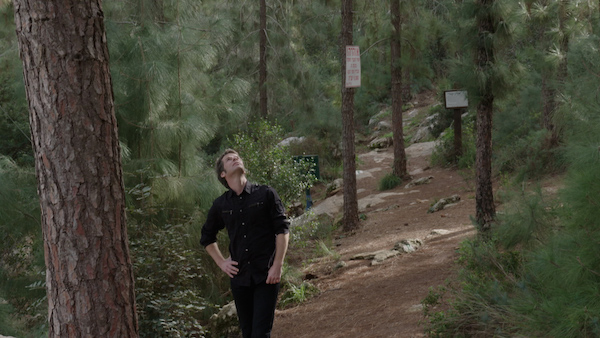
Jason Sherman wanders through an Israeli pine forest in search of his tree. (photo by John Minh Tran)

My Tree, a film by Jason Sherman on his moral dilemma over having had a tree planted in his name in a Jewish National Fund forest, screens at the Salt Spring Film Festival March 6, 7 p.m.

Sherman grew up in a Jewish home in Toronto. “Like my brothers before me, I had a bar mitzvah…. On that day of my becoming a man – at the age of 13 – I was given a number of presents,” writes Sherman in his director’s statement. “There were books of Jewish learning and culture; there was money; and there was a tree. Or rather, there was a certificate telling me that a tree had been planted in my name in Israel.”

He forgot about the certificate until about 40 years later, on his first trip to Israel.

“As I wandered the tourist sites, traipsing around religious Jerusalem, secular Tel Aviv and mystical Masada … I felt the pull of kinship and familiarity,” he writes. “But I also felt a kind of disconnect, wondering if my feelings for the place were genuine or imposed. I got to wondering what my real connection was to the land. It was then that I remembered the tree.”

After much research and metaphorical digging, he determines that the likeliest location of his tree is a conservation area called Canada Park.

“Here, I learn a disturbing new fact about my tree: it’s part of a massive forest that’s covering up the remains of an Arab village that was destroyed in 1967, its thousands of inhabitants sent on the road, never permitted to return.

“I also learn that this covering up of depopulated Arab villages is part of a pattern that stretches back to 1948, during the war that established Israeli statehood. These revelations lead me to ask a number of painful questions with people back in Canada. Did my parents know about the village beneath the forest when they donated a tree for me there? What is my responsibility for that tree?”

Sherman, who is an award-winning playwright, says his aim is not journalistic. “This is not a muckraking, finger-pointing documentary about the dark history of Israel’s tree planting program but rather a personal story … that asks its audience to confront uncomfortable historical truths, and to decide for themselves how to respond to those truths.

For tickets to My Tree, visit artspring.ca/event/salt-spring-film-festival-my-tree. For more about the film festival, which runs March 1-6, go to saltspringfilmfestival.com.

– Courtesy Salt Spring Film Festival