Celebrating Israel together

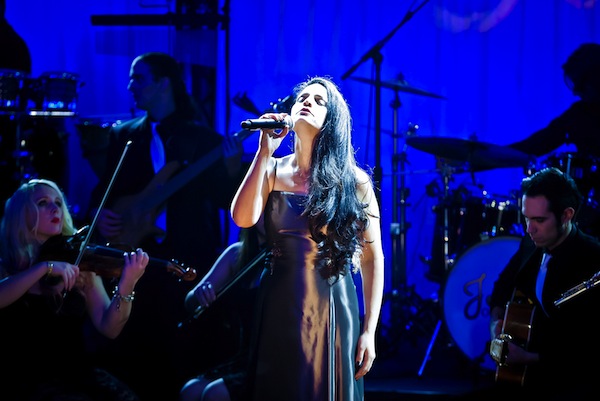
Israel’s Gilat Rapaport and the InJoy Band headline this year’s Yom Ha’atzmaut celebration on May 4 at the Vogue Theatre. (photo from injoyprod.com)

This year’s Yom Ha’atzmaut celebration on May 4 at the Vogue Theatre, headlined by Israel’s Gilat Rapaport and the InJoy Band, marks 20 years since the first large-scale community-wide event to celebrate Israel’s Independence Day was organized by the Jewish Federation of Greater Vancouver.

“Growing up in Vancouver, the community had occasional large Yom Ha’atzmaut events with Israeli performers and I have wonderful memories of attending them,” said Stephen Gaerber, who co-chaired that first major gathering. “I was incredibly impressed by a large event held to celebrate Israel’s 50th in 1998 at the Orpheum [which was chaired by Judy Mandleman]. It was 2001, the Second Intifada was raging, Camp David had resulted in failure and Israel was, as usual, being disparaged in the press. My friend, Rick Schreiber, had become the chair of the Federation’s Israel department, and I told him that I thought the community should be having large-scale events every year to celebrate Yom Ha’atzmaut and all that is wonderful about Israel. His response was, ‘OK, you chair it.’ That’s how I became chair for the 2002 Yom Ha’atzmaut celebration, first co-chairing with my wife, Shari, and then, starting in 2003, with my brother Allen.”

Of course, local groups celebrated Israel’s birthday in various ways prior to 2002, notably the now-defunct Canadian Zionist Federation (CZF). Bernard Pinsky was CZF chair in the late 1980s.

“In the 1980s,” said Pinsky, “CZF brought in big names from Israel for a Yom Ha’atzmaut concert, including top artists like Nomi Shemer, Chava Alberstein, and Haparvarim. The concert was held at the JCC and wasn’t always right on Yom Ha’atzmaut, it was when the artists were available. The venue meant that we could only sell about 400 tickets, and CZF did a lot of fundraising to cover costs.”

Geoffrey Druker, who still leads the community’s annual Yom Hazikaron (Israel’s Memorial Day) ceremony, said he was recruited by Pinsky to become involved in CZF and it was from Pinsky that Druker took over the role of local CZF chair in the early 1990s.

“We ran most Israel-related community programs,” said Druker, including Yom Ha’atzmaut, Yom Hazikaron, Walk with Israel (which took place on Jerusalem Day), the student public-speaking contest and other programs. When CZF closed nationally, Druker said he gathered past local leaders of the group to decide “whether to become an independent local organization or join Federation.”

The choice was to join the Israel desk at Federation, and Druker continued to chair many of the events, with most of the Yom Ha’atzmaut activities being held at the Jewish Community Centre of Greater Vancouver, he said.

“Federation didn’t have the funds for a large Yom Ha’atzmaut, and we couldn’t risk having a large celebration … while keeping the event tickets affordable to all,” said Druker. “So we ran smaller celebrations and with less-known artists.”

Affordability remained key when Federation, led by a committee put together by Stephen and Shari Gaerber, took over the event.

“Our goal wasn’t to just make it a concert, but a real community celebration,” said Stephen Gaerber. “We kept ticket prices very low so that everyone could afford to attend – and if they couldn’t afford even that, we made free tickets available through JFS [Jewish Family Services]. We invited all Jewish organizations in the city to add their names as Community Partners, and dozens did. We had children from Hebrew Academy, Talmud Torah and RJDS performing in addition to Israeli singer Danny Maseng.
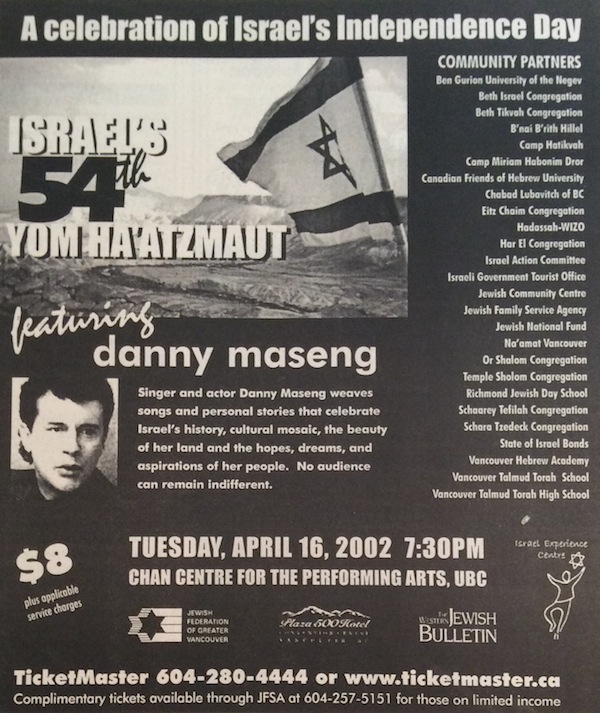
image - The ad promoting the 2002 Yom Ha’atzmaut celebration
The ad promoting the 2002 Yom Ha’atzmaut celebration.

“We were given no budget (other than staff time) for the event from the Federation and I didn’t want one. I was determined that the Federation not take anything away from what they were allocating to local community agencies in order to make this event happen. We believed that the community would support the event and we were right. We raised the funds from generous donors, rented the Chan Centre and signed a contract with the performer. We put tickets on sale and we sold out all 1,200 seats very quickly. The event itself is a bit of a blur, but my most vivid memory is the joy people expressed to us at its conclusion.”

With that success behind them, the goal was to involve even more individuals and organizations in the celebrations.

“For years,” said Gaerber, “Jonathan and Heather Berkowitz wrote a piece for young community members to perform and we were fortunate to have Wendy Bross Stuart direct them. We later added the JCC’s children’s Israeli dance troupes to the program, sometimes joined with dancers from our partnership region in the Upper Galilee.

“Pam Wolfman took over chairing the event in 2014 and continued to tweak things to make sure everything is new and fresh and even better each year, including involving the entire community in the community song,” he said. “What hasn’t changed is the support from the community. To this day, other than staff time, the Federation has not had to give any funding at all towards putting on the event. The group of donors has grown over the years and that allows the event to continue to stay true to our initial vision – tickets are still affordable and many are available at no cost to those who need them – and the events continue to sell out.”

The annual celebration brings Israeli performers – from veteran musicians to up-and-coming singers and musical groups – to Vancouver on Yom Ha’atzmaut.

“For many,” said Gaerber, “it was their first time performing outside of Israel on Yom Ha’atzmaut, as they hesitate to leave the country for this important day. Without exception, they have all expressed how incredibly meaningful it was for them to experience the warmth of our community and its love for Israel. A number of our performers who would not have otherwise considered coming to Vancouver for Yom Ha’atzmaut have only done so because they have heard from other performers about their experience and our Jewish community.

“Despite our Jewish community’s relatively small size,” he said, “we have been told by Israeli diplomats that Vancouver’s Yom Ha’atzmaut celebration, always occurring actually on erev Yom Ha’atzmaut, is one of the largest celebrations of its kind taking place on that day outside of Israel.”

For tickets to this year’s event and a sneak peak at the program guide, go to jewishvancouver.com/yh2022.
Beckow’s music will live on

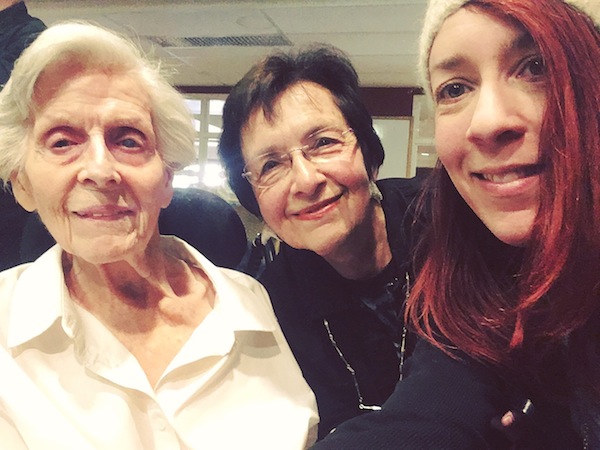
Joan Beckow, left, Wendy Bross Stuart, centre, and Jessica Stuart, during a visit a few years ago. (photo from Jessica Stuart)

Acknowledging that the music world is “a fickle one in which skill, talent and ingenuity do not necessarily result in widespread acknowledgement or musical reach,” Jessica Stuart said Joan Beckow’s “music deserves to be heard. It deserves to be performed and played for many generations to come, and it is more than good enough to stand next to the work of Leonard Bernstein or Stephen Sondheim.”

Stuart and her mother, Wendy Bross Stuart – accomplished musicians in their own right – are co-directors of the Joan Beckow Project. Stuart is also project manager and producer of the project. Arts administrator Rosie Callaghan handles many of the behind-the-scenes details.

Beckow passed away on Jan. 13, 2021, at age 88. She was a close family friend of the Stuarts, and she and Bross Stuart collaborated professionally for more than 40 years. Jessica Stuart grew up surrounded by Beckow’s music, both because her mother and Beckow had worked together and because Stuart has performed a large body of Beckow’s work. The seeds of the Joan Beckow Project were planted in 2015, when Stuart discovered that none of Beckow’s music was available online and almost none of her choral or musical theatre music had ever been professionally recorded or transcribed. Beckow gave Stuart her blessing for the project.

Beckow started her career with a music degree from the University of California at Los Angeles. At UCLA, she composed six original musicals for the theatre department, where she collaborated with her friend, Carol Burnett. Beckow was resident composer and music director for the Stumptown Players, out of San Francisco, and, when she graduated, she started composing for Holiday Theatre L.A.

Eventually, Beckow found her way to Vancouver, where she worked with many theatres as a composer and music director, including the Playhouse, Carousel and Belfry theatres, as well as with the Shaw Festival. With Bross Stuart, she composed several musicals and, in 2002, It’s All in the Song, a summary of Beckow’s work, premièred at the Chutzpah! Festival.

photo - Joan Beckow, right, with Carol Burnett, in 1958
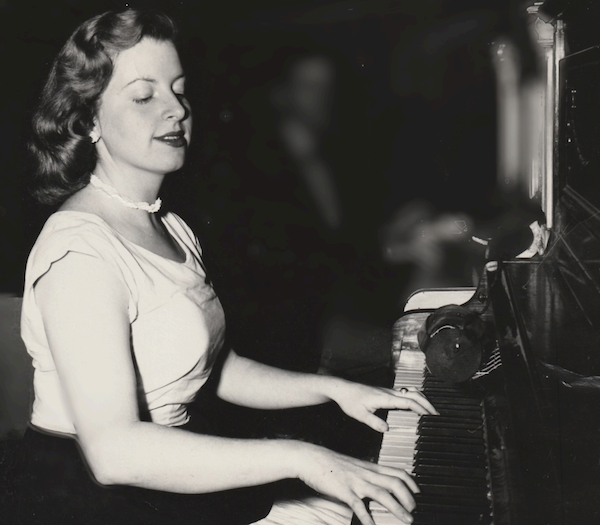
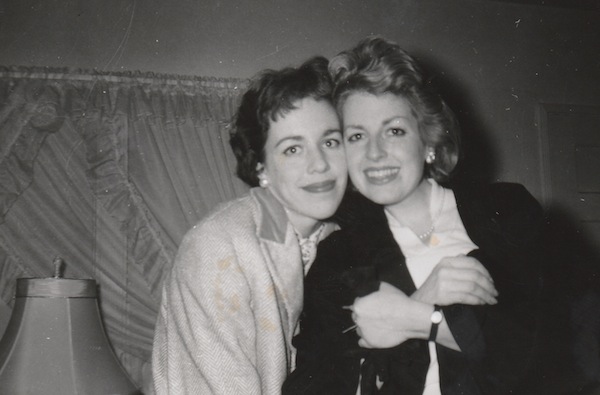
Joan Beckow, right, with Carol Burnett, in 1958. (photo from Jessica Stuart)

Beckow’s resumé also includes a degree in music therapy from Capilano College, where she was faculty for 10 years. And, over a 25-year period, she wrote original material for the Jewish Community Centre of Greater Vancouver’s Gotta Sing! Gotta Dance! theatre program for youth.

“Part of the reason I think it’s so important to record Joan’s work for the first time, is that, although her pieces have a natural beauty and intuitive sound, on paper (literally, the musical scores), her pieces look very complicated,” Stuart told the Independent. “Many of her songs cycle through multiple musical keys and several time signatures in one piece and I strongly believe that, if we want choral directors, vocalists and instrumentalists to choose this music to perform, they need the chance to listen and fall in love with it first.”

Beckow wrote hundreds of compositions, and Stuart and her mother started talking about song selection long before the project officially started.

“How does one sum up a composer’s career in one album? Well, we decided that we couldn’t, so we made it a double disc,” said Stuart. “One disc will focus on Joan’s musical theatre material, and the other will focus on her classical and sacred music, including many pieces set to text from the Jewish liturgy. There will be 22 pieces in total.”

Also part of the project is a 25-minute documentary, directed by Stuart’s father, Ron Stuart, in collaboration with editor Carlos Coronado.

“We applied to the Canada Council for the Arts, to the Concept to Realization program, in which we were able to define the scope of our project activities to include more than just an album recording,” said Jessica Stuart. “We wanted to tell the story of Joan’s life, culminating in the present-day recording of her debut album, albeit posthumous.”

In addition to the Canada Council support, the project has received support from the Ontario Arts Council and from Beckow’s son, David Beckow. But such undertakings are expensive. This one involves 30 musicians, and recording sessions in both Vancouver, where Bross Stuart lives, and Toronto, where Stuart is based.

“Even with the arts councils’ generous contributions, this massive undertaking still requires more financial support and, with some of this music having waited 70 years to be recorded for the first time, cutting corners is not an option we’re willing to consider,” writes Stuart on the Indiegogo fundraiser page.

As part of the project, Beckow’s songs have been “lush[ed] out.”

“Joan wrote most of her pieces for piano and voices, and the piano accompaniment always felt very orchestral, so adding strings, woodwinds and percussion felt completely natural and somehow brought even more emotional levity to the pieces,” explained Stuart. “The arrangements were done by Wendy and I, separately, but then requiring approval from each other before signing off. We agreed that these arrangements needed to keep a focus on Joan’s actual writing, instead of letting our imaginations run too wild, and we stuck to that. The results are quite wonderful!”

photo - Joan Beckow, in the late 1950s
Joan Beckow, in the late 1950s. (photo from Jessica Stuart)

As for the vocal contributors to the project, Stuart said, “The main consideration here was about getting the right voices for the right pieces. Wendy hired the personnel involved in the musical theatre portion of the album, which took place in Vancouver at Bryan Adam’s recording studio, the Warehouse.

“When I first conceived of this project,” she said, “I recognized that Joan’s classical and sacred music somehow had a kinship with jazz in terms of harmony, so I was eager to get the material into the hands of some of my favourite jazz musicians and improvisers based in Toronto. When choosing the personnel in Toronto, I went for both classical and jazz musicians, and even arranged a few pieces with sections earmarked for improvised solos. As suspected, not only did the music lend itself exceptionally well to improvisation, but Joan’s music had the Toronto jazz scene completely enamoured, and kind of in a tizzy, which was a real pleasure to watch.”

One of Stuart’s longtime favourite Beckow pieces is “Dwelling Places.”

“Joan once told me that she never wanted a harmony to simply exist as an ornament to a melody – that a harmony should be able to stand alone even if the melody were removed,” explained Stuart. “That, to me, is a profound idea, and I’ve always admired the myriad moving lines Joan was able to work into one piece concurrently within the accompaniment and vocal parts of her work. These lines lead you emotionally from one place to another, seamlessly, and all of sudden you have goosebumps and don’t even know why.

“Also, whether Joan was setting her own lyrics, or else poetry by Dorothy Parker, or else Jewish liturgical text, like ‘Dwelling Places,’ to music, she had an incredible gift for being able to mirror spoken cadence and intonation within her melodies.”

Stuart continued, “A new favourite of mine, though, discovered through the process of working on the Joan Beckow Legacy Project, is what I refer to as her ‘instant Christmas classic,’ called ‘A Christmas Wish.’ This is a song that stands up next to ‘Chestnuts Roasting on an Open Fire (The Christmas Song),’ and you can’t help but to imagine Bing Crosby or Frank Sinatra’s voice all over it. And I’m sure we’re all aware of the long-standing tradition of Jewish songwriters creating the best Christmas music, so it’s time we added a female composer’s take to the mix!”

For anyone wanting to know more about the Joan Beckow Legacy Project, there are regular posts on Facebook and Instagram. To contribute to the project via Indiegogo and watch a short video about it, visit igg.me/at/joanbeckowlegacy. There is a six-level range of incentives for donors, from a personal social media shoutout for a $25 gift, to a personal thank you in the liner notes of the album – and all the goodies of the prior levels – for a $1,000 contribution.

Sculpting emotion with glass

Some of Tara Pawson’s Human Beams. (photo from Tara Pawson)

Tara Pawson’s fascination with glass began when she was in high school.

“My dad was a welder,” she said. “He would bring home some metal pieces, and I would fabricate some garden art in our garage. Then, I got a birthday present – a weeklong class of glass-blowing – and I knew that was what I wanted to do with my life. Before that class, I was planning to go to a culinary school after graduation. After it, nothing else but glass.”

Pawson’s solo show, Human Beams, opened on March 22 at the Zack Gallery.

“Glass is a fascinating medium,” Pawson told the Independent. “It combines all the elements: air, fire, wood, metal, water. It is labour-intensive and demanding, and the results are beautiful and fragile. There is a contradiction there.”

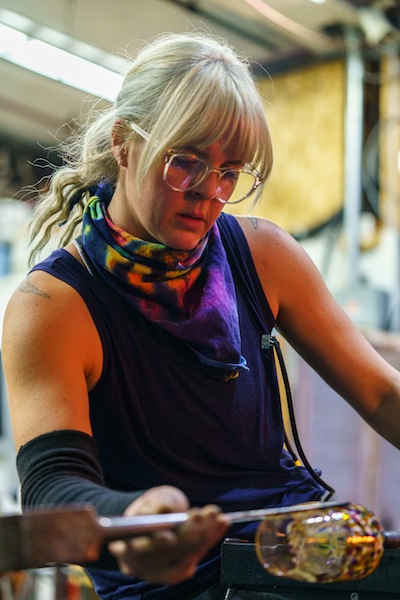
photo - Glass artist Tara Pawson at work
Glass artist Tara Pawson at work. (photo from Tara Pawson)

Pawson enjoys the process of glass-blowing – despite its inherent danger. “It’s like a game to me,” she said. “I’m not afraid of getting hurt. I have been once or twice, but I love doing it all the same…. When a piece is finished, I always want to do it again, in a different way.”

She loves the functionality of glass, its accessibility to everyone in the forms of glassware or candelabras. “I’m not drawn to huge installations. I want to make art for the people,” she said, “for their homes and their hearts.”

Pawson doesn’t have a classical art education, but she has taken many workshops in a wide variety of glass-blowing techniques over the years. “I apprenticed and I learned,” she said.

At 21, she found a job with Robert Held Art Glass.

“The company created giftware and home decor,” she said. “I learned a great deal there. It was a full-time job, and I did everything: glass-blowing, sales, cleaning. I stayed with them for about eight years. During the week, I worked for the company, but on the weekends, they allowed me to use their glass-blowing equipment, and I started making things for myself.”

Then she moved to a company that created glass light fixtures. “There, I learned to work with a different type of glass, different styles, different process,” she said.

About six years ago, Pawson decided to become an independent glass artist. “After my youngest son was born, it was time,” she said. “I wanted to make my own hours and [have] no commute to work, so I could spend more time with my family.”

For the equipment, she joined Terminal City Glass Coop and rents time when it suits her schedule. She makes some unique artworks.

“I make glass gifts and I make memorial pieces that are very popular,” she said. “Those memorial keepsakes are small glass baubles – hearts or orbs or coins – which incorporate tiny amounts of cremains within the glass matrix. The result is a treasured heirloom. I can make them for several family members, so they will always have a keepsake to remember their loved ones. People love them. One client of mine said she always wanted to travel with her father. After he died, she took the glass marble with his ashes on her travels, so he was with her everywhere. This way, she had no problems with customs – an urn with his ashes might be much harder to pass through customs.”

Pawson’s giftware includes vases and glasses, paperweights and funky little “monsters,” candleholders and Christmas ornaments. She sells her glass in several stores in British Columbia, Alberta and Ontario, as well as online, through her website and her Etsy shop. She is also an active participant in many seasonal markets. Recently, she created a new collection of glass beams, which are included in her current show at the Zack.

“My mother passed away shortly before the COVID lockdown started,” Pawson explained. “I was dealing with my grief and I felt alone in the pandemic. Everything was closed. So I started working on these glass pieces. They helped me process my grief. I thought, maybe I could share it, help others. I never had an art show before. I started asking around how to go about it, whom to approach. I know Hope [Forstenzer] through the Terminal City Glass Coop. I asked for her advice, and she said: ‘Why don’t you apply at the JCC? We have a gallery there.’ I did. This is my first show.”

The show at the Zack, where Forstenzer is director, displays three distinct lines: Human Beams glassware, Thought Towers sculptures and Pearls of Light wall decorations. The Human Beams series works are tall cylindrical glasses of different colours, decorated with mandalas.

“The cylinders start as dark shadowy forms and flow into the bright beams of light,” Pawson said. “They reflect the timeline of the dark days, when the trauma begins, and grow organically towards the light days, when you find peace.”

She explained the symbolism of a mandala, which “represents the universe in Hinduism and Buddhism,” she said. “Their circular design without beginnings or ends is a symbol of a spiritual journey. They illustrate the events, memories and thoughts we have when the emotion of grief consumes us. Some days are darker than others, but, with time, work and support, we learn to ride those waves…. I hand-carved every mandala on every glass. It took me about four hours for each mandala. I think I’m done with them for awhile.”

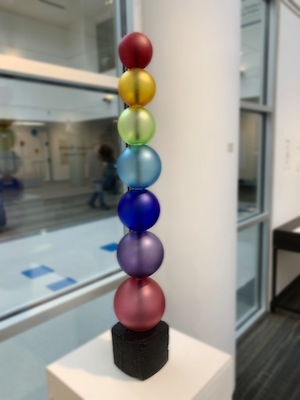
photo - One of Tara Pawson’s Thought Towers
One of Tara Pawson’s Thought Towers. (photo from Tara Pawson)

The Thought Towers are sculptural compositions, orbs of various sizes and colours growing like a tree out of each other. The lighter, bigger orbs echo lighter emotions, like hope or joy, but they are always interspaced with small dark orbs of desperation, guilt or anger. “The Thought Towers convey a spectrum of emotions,” said Pawson. “As we deal with grief, we have good days and bad days. Anything could trigger a crippling emotional response – a song, an image, a TV episode. But we have to remember that good days always follow the bad ones.”

And then, there are the Pearls, each one hand-formed, each a complex and beautiful glass tablet. “Each one is a person or an event we encounter in our daily lives,” Pawson said. “Pearls of Light, or Baily’s Beads, are a phenomenon seen during a sun eclipse. These spots of light encircle the moon. They resemble a string of luminous beads, visible immediately before and after a total eclipse. They are the people around us, our family and friends.”

Pawson’s exhibit is on display until April 28. For more information about her and her work, visit her website, tarapawson.com.

Olga Livshin is a Vancouver freelance writer. She can be reached at olgagodim@gmail.com.

Opening of hearts

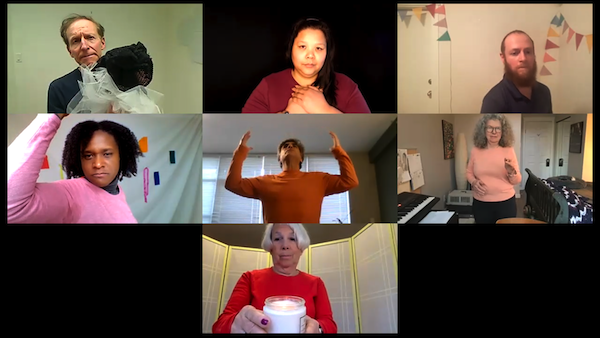
In this Vancouver Playback Theatre screenshot are, top row, left to right, Peter Abrams, Diandra Lee and Laen Hershler; middle row from left, Ingrid Broussillon, Joel Bronstein and Louise Lemieux; and Carol Ann Fried.

If you want to see tikkun olam in action, see the next performance of Vancouver Playback Theatre (VPT). For the last 23 years, the ensemble has been retelling audience participants’ life stories with sensitivity and compassion.

At VPT’s March 6 show, brightly coloured scarves, banners, dance, piano music and improvisation “played back” individual audience experiences of and the accompanying emotions caused by antisemitic events and other forms of discrimination.

“We really want audience members to feel seen, understood, and learn from the playback experience,” VPT’s Peter Abrams told the Jewish Independent.

Fellow Jewish community and troupe member Joel Bronstein added, “Our work takes audience members out of their heads and into their hearts … when people share their feelings and life experiences in a safe and supportive environment, there is a collective opening of our hearts, even when it is light and funny.”

Playback Theatre was created in New York 47 years ago with the intention of returning theatre to its storytelling and community-building roots. With troupes now established worldwide, Playback Theatre directly engages participants in sharing experiences and ideas related to themes of importance to them individually, and as groups, organizations and communities.

Abrams, Bronstein and Carol Ann Fried, who is also a member of the Jewish community, have all been part of the ensemble for more than two decades. Fried’s most memorable audience story involved a father talking about the love he had for his son.

“As he was speaking,” she said, “I wanted to sing a song about his love. I knew there was a Cat Stevens song called ‘Father and Son’ but I couldn’t remember the words or the melody. The only song I could think of was ‘You are the Wind Beneath My Wings,’ and I sang a few lines.”

After the show, the father told Fried that he had made a video of his son when his son was younger and the sound track was “You are the Wind Beneath My Wings.”

“That’s the magic of Playback,” said Fried. “It’s Hashem in action.”

Abrams remembers a story about a woman who found herself attracted to two men who were both interested in her, and she was wondering what to do about her pleasant dilemma.

“In the playback, myself and another male actor represented the two suitors in an old-fashioned duel that was a slow-motion dance, also using fabrics,” said Abrams. “We ended in a draw, appealing to the teller [audience participant] to decide. The teller and the audience loved it, and the teller realized she didn’t need to rush any decision, and decided just to enjoy the experience.”

There seems to be no limit as to what can be expressed in performances with VPT and what insights can be gained.

Fried said she has particularly enjoyed playing “non-literal parts.” For example, she has played a table at which two people fell in love, she has played the feelings of love and has even played internal organs. She said she has learned to trust that her creativity will emerge when invited.

Bronstein remembers when he had to play back a story about a violent character. “Although I symbolically represented the violence, when the story was finished my body was shaking intensely,” he said.

It’s not surprising that VPT works with organizations that help others, such as the Kitsilano-Fairview Mental Health team and Oxfam Canada.

“When we do a workshop for an organization or a community group, we often start with a short performance on an issue, and follow this with breakout groups where participants can dialogue on what they’ve learned and where to go from here on the issue,” Abrams said. “The groups we work with are focused on progressive social issues, so we contribute to forward movement on these issues through our workshops.”

VPT offers a variety of services, including public and conference performances, workplace conflict resolution workshops, peace-building in schools, community engagement projects, and Playback skills training, in person (when possible) and virtually (via Zoom).

Fried said she has learned a lot about the human condition through working with culturally diverse audiences. “Although our lives, cultures, religions and life experiences are different, we all value and care about the same things,” she said. “We all have the same variety of feelings. I feel connected on an internal level with each teller.”

When they aren’t together storytelling, Fried runs her own company and is a keynote speaker, workshop leader and coach; Bronstein is the executive director of Little Mountain Neighbourhood House; and Abrams runs his own organizational development consulting business.

The other members of the ensemble are Diandra Lee, Laen Hershler, Ingrid Brousillon, Louise Lemieux, Laurie Damer and Matthew Spears.

The troupe’s website is vancouverplaybacktheatre.com. Their next online public performance will be on June 26 in honour of World Refugee Day, which is June 20.

Cassandra Freeman writes stories with the support and love of her husband, Irwin Levin.

Bar mitzvah reveals tensions

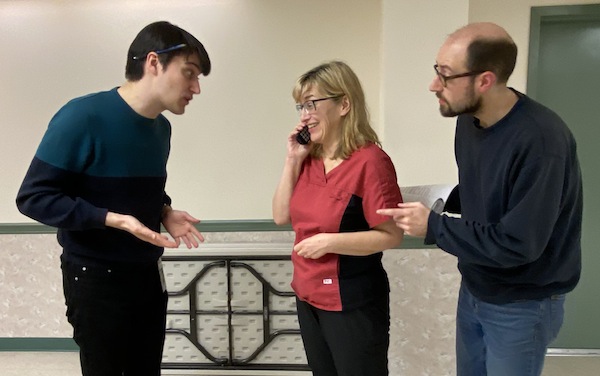
Nicholas Guerriero, left, Lorene Cammiade and Rudy Smith rehearse a scene from Bema Productions’ staging of Men Overboard, which will be at Emanu-El Synagogue’s Black Box Theatre May 5-15. Guerriero plays Jay Silver, a Buddhist monk and the youngest son of Zaida Ernie, Cammiade portrays Eva Fuzesi, the bar mitzvah tutor from Hungary, and Smith plays Doug Silver, Ernie’s middle son and a psychotherapist. (photo from Bema Productions)

Next month, Victoria’s Bema Productions mounts the first full production of Men Overboard.

Winner of the Long Beach Playhouse New Play Contest and a finalist for the Woodward-Newman New Play Award, Men Overboard was written by Rich Orloff. After well-received readings and workshops in New York, Philadelphia, Long Beach and Dayton, the play comes to Victoria, where the première will be directed by Kevin McKendrick.

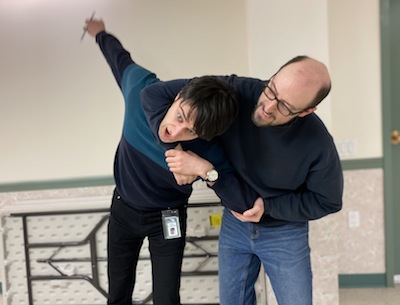
photo - Things get rough in Men Overboard: Rudy Smith puts a (fake) stranglehold on Nicholas Guerriero
Things get rough in Men Overboard: Rudy Smith puts a (fake) stranglehold on Nicholas Guerriero. (photo from Bema Productions)

The play focuses on a bar mitzvah for a boy, Abraham, who doubts he’s ready to become a man. The event brings together Abraham’s politician father and the father’s two brothers, a therapist and a Buddhist monk. Add their fading but forceful father and Abraham’s bar mitzvah tutor, a woman who loves Abraham and possibly one of his uncles, and it’s easy to see that Abraham is torn between obedience and defiance of his father. Tensions grow, affecting everyone in the family, until anger becomes abuse and it becomes clear that the family’s status quo is no longer an option. Men Overboard asks “What makes a man?” as it explores the responsibility each of us has to protect the souls of those we love.

The Bema production stars Lorene Cammiade, Nicholas Guerriero, Asa O’Connor-Jaeckel, Evan Roberts, Alf Small and Rudy Smith. It is produced by Alan Segal and takes place May 5-15 at Congregation Emanu-El Synagogue’s Black Box Theatre, 1461 Blanshard St. For tickets ($25) and showtimes, visit eventbrite.ca/e/295008758137. 

– Courtesy Bema Productions

Take a comedy break

Left to right, Ori Laizerouvich, Israel Atias, Daniel Gad and Omer Perelman Striks co-star in The New Black. (photo from ChaiFlicks)

I have to improve either my Hebrew comprehension or my English speedreading skills before April 12. The second season of The New Black premières that day on ChaiFlicks and it’d be great if I could understand more of what was going on – even with my limited capacity, the first season was an absolute blast.

Also recently premièring on the streaming service ChaiFlicks, which carries all sorts of Israeli films and TV shows, was the second season of Checkout, an Israeli comedy in the tradition of American sitcoms Superstore, The Office and Parks and Recreation. It has some seriously funny moments, though a couple of the characters may grate on folks, as some of the characters on the aforementioned American shows did.

Superstore takes viewers into an Israel that most Jews will recognize, but that will be less familiar to those whose only experience of Israel is via the news. The show is set in a small supermarket, Issachar’s Bounty, in a small town, Yavne. The store’s patrons are regulars, and one in particular, fanny-packed customer Amnon, who has a complaint or gets into a confrontation every time he comes in to shop, is particularly annoying, as often is his main sparring partner, the brash cashier Kochava. But the other characters – notably Shira, the store manager who idolizes and sees herself as an up-and-coming Steve Jobs – offer enough less-in-your-face humour that the show is well worth watching if you like reality-show-type comedies. As in the other shows of this genre, there is a camera crew making a documentary about the store, so the characters not only interact with one another, but express their views in interview snippets with the film crew.

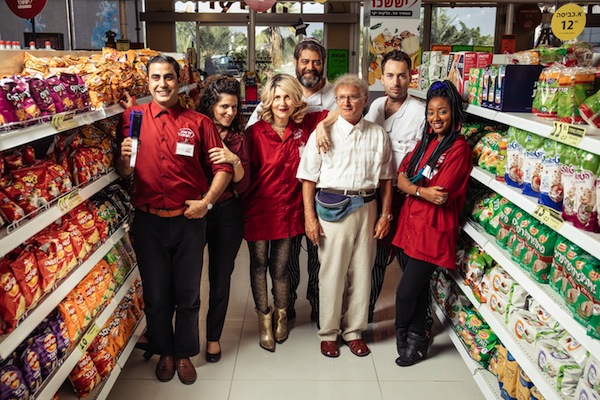
photo - The cast of Checkout, left to right: Amir Shurush, Noa Koler, Keren Mor, Yaniv Swissa, Dov Navon, Daniel Styupin and Aviva Nagosa
The cast of Checkout, left to right: Amir Shurush, Noa Koler, Keren Mor, Yaniv Swissa, Dov Navon, Daniel Styupin and Aviva Nagosa. (photo from ChaiFlicks)

In the guise of humour, many a true observation is made in Superstore, which touches upon social inequality, terrorism, racism, homophobia and many other issues. Viewers can choose to just laugh at the goings-on depicted or they can take more away from the show. The same can be said of The New Black, which has some uncomfortable moments – for example, are we supposed to laugh when one of the yeshivah students is appalled when his matchmaker sets him up with a woman who uses a wheelchair? I don’t think so. I think we’re supposed to be appalled at his behaviour, behaviour that one can easily imagine of many self-absorbed 20-something guys who fancy themselves a prize despite all evidence to the contrary.

That the four yeshivah boys at the centre of The New Black seem like regular college-age men is why the show has broad appeal. That is does, while also being packed with somewhat-high-level (to non-Orthodox Jews) talmudic discussions, is a notable achievement. It is easy to see why the show was nominated for eight Israeli Television Academy Awards. It is smart, engaging, fast-paced and has a fantastic soundtrack. While non-Jews will have to watch it with a semi-knowledgeable Jewish friend and non-Hebrew-speaking Jews will occasionally have to press pause to take in the subtitles fully, The New Black has legs … and Borsalinos aplenty.

For access to these two comedies, and many other programs, visit chaiflicks.com.

Trying to fix broken wings

Not fitting in. Being misunderstood and miscategorized. These are recurring themes in Flying Camel: Essays on Identity by Women of North African and Middle Eastern Jewish Heritage, edited by Loolwa Khazzoom, a Seattle writer, musician, activist and occasional contributor to the Independent.

image - Flying Camel book coverThe book was first released in the 1990s and was recently re-released.

“I wish I could say that this book is no longer as revolutionary, cutting-edge, or as needed as it was when I began compiling it in 1992, but, unfortunately, that is not the case,” writes Khazzoom, the daughter of an Iraqi Jew, in the new introduction. “Even though there have been changes – shifts in consciousness, language, and even representation – Mizrahi and Sephardi women remain overall excluded, in theory and practice, from spaces for women, Jews, Middle Easterners, people of colour, LGBTQI folk, and even Mizrahim and Sephardim. In addition, so many of the presumably inclusive conversations about us seem basic and superficial, with an undertone of it being a really big deal that these conversations exist at all.”

Khazzoom’s struggle to fit in led her to Seattle, in large part because it is home to one of the largest Sephardi communities in the United States. But even in that milieu she found herself an outsider.

“In June 2014, however, on the first sh’bath [Sabbath] after driving my U-Haul up the coast from Northern California, I was appalled by a sermon so sexist – where women were equated with ‘meat’ – that I walked out of the Sephardi synagogue, just 15 minutes after arriving,” she writes.

“I have been a hybrid all my life, forever caught between two or more worlds,” writes Caroline Smadja in her contribution to the collection. It is a state of being that is shared by many of the writers.

Yael Arami, born in Petah Tikvah to parents from Yemen, speaks of others’ perceptions of her.

“In Germany, I have had to avoid certain areas, fearing local skinheads’ reaction to my skin colour. In France, I have been verbally ridiculed and insulted for being yet another ignorant North African who does not know French,” she writes. “In California, people’s best intentions have resulted in a number of social blunders: When I left a tip in a San Francisco café, I got a courteous ‘gracias’ from the politically correct Anglo waiter. After a predominantly African-American gospel group sang at a Marin County synagogue, several members of the congregation approached me, to express their admiration for our wonderful gospel performance! It seems that wherever I go in white-majority countries, I am, in accordance with local stereotypes, seen as the generic woman of colour – Algerian in France, African-American or Puerto Rican in California.”

Rachel Wahba, an Iraqi-Egyptian Jew, calls out politically correct hypocrisy.

“Sometimes, when I bring up the oppression of Jews in Arab countries, progressive Jews get strangely uncomfortable – as if recognizing the Jewish experience under Islam would make someone racist and anti-Arab,” she writes. “During my mother’s cancer support group intake, I listened as my mother told her story of living in Baghdad and surviving the Farhud. She ended with an ironic ‘I survived the Arabs to get cancer?’ The Jewish oncology nurse was shocked that my mother was so ‘blunt.’

“Should we revise our history? Leave out the details of our oppression under Islam? Pretend my mother never saw the Shiite merchants in Karballah wash their hands after doing business with her father, because he was a ‘dirty Jew?’”

The book’s title comes from an essay by Lital Levy, “How the Camel Found Its Wings” and an Israeli film of the same name.

The metaphor involves the repair of a broken statue of a flying camel, which actually stood at the entrance to the international fairgrounds in Tel Aviv in the 1930s. In the film, the two wings of the camel become stand-ins for a dichotomy that mostly excludes Mizrahi/Sephardi Jews and yet still casts them in a negative light.

“By the end of the screening, the camel had found two new wings, and I got to thinking,” writes Levy. “I started putting my own pieces together – making my own flying camel out of the remnants of the past, borrowing missing pieces from the present, and using my imagination and willpower to try to make it all stick together. The pieces of my own American childhood, the histories that preceded it in Israel and in Iraq, and the challenges I see before me in my work are the various fragments I have been remembering and re-membering into an integral whole. I do not yet know its shape – camel, dromedary, llama, yak – but I do not care, as long as it will fly.”

Dutch family’s secrets

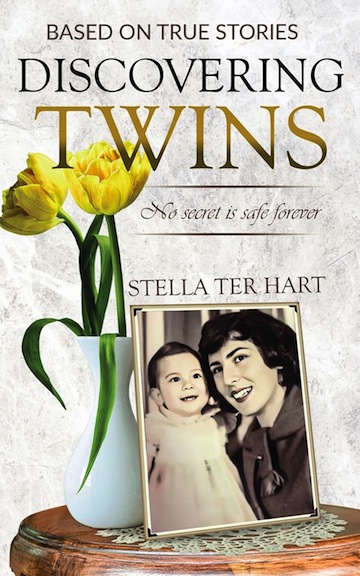
“Twins run in the family, you know,” Stella ter Hart’s mother, Sophia, said to her nonchalantly when Stella was pregnant with her first child. That this was news to Stella is a first sign that there was a great deal about her family she did not know. In fact, she wasn’t aware she had much family at all.

image - Discovering Twins book coverThus begins Stella ter Hart’s book Discovering Twins: A Journey into Lives.

As a high school graduation gift, Stella and her mother made the trip from Estevan, Sask., to Holland. There, she meets an endless web of confusingly related kin – almost all on her father’s side. A visit to the home of family on her mother’s side raises questions in the teenager’s mind.

“‘Oom Jacob and Tante Becca are Jewish,’ I stated rather than questioned, ‘no one other than Jewish people are named Jacob and Rebecca.’

“And, in a style completely out of character for her, almost resignedly, my mother replied, ‘Yes, they are.’

“There was no further clarification of her answer, no offering up of a tidbit of a childhood memory, as might be expected when revealing so vast a thing as religiously specific relatives for the first time.

“‘So, if Oom Jacob is your first cousin, and he has the same last name as your mother’s maiden name, then he is the son of your mother’s brother,’ my new skill of dissecting family relationships now sharply honed, I added, ‘so your mother must have been Jewish, too.’

“In a split second, she came back at me, her voice strident with an unexpected, insistent, and lashing response, ‘NO! My mother was NOT Jewish. According to the Germans, she was Italian because she married an Italian.’”

Whether that logic ever truly convinced her mother, Sophia, it did not sit well with ter Hart. After her mother’s death, ter Hart began a genealogical quest. Slowly and excruciatingly, she pieces together the tragic fates of almost the entire maternal line.

“Our extended circle of family, formerly numbering over 1,200, was reduced to the less than 20 who returned, or were known to have survived, creating a psychological tsunami shock-wave impacting existing and future generations,” writes ter Hart.

The book recreates ter Hart’s prewar extended family, flashing back from postwar comfort in Canada. She captures what must have been a dawning realization among Dutch Jews in the earliest months of what became the Holocaust, as relatives who were relocated to the east inexplicably never wrote back.

“How many ‘workers’ did this totalitarian German regime require for its slave labour force? Where was the food to feed them all going to come from and the rooms to house them all? Supplies were already hitting dangerous lows in the cities, and rationing was strictly enforced.

“The unsettling sentiment echoing throughout the community for months raised its voice again. What in heaven’s name would the Germans do with grandparents and babies? This didn’t seem like a necessary part of war. This was something else.”

As ter Hart’s research expands, numbers and dates leap off the page.

“The ages and dates are, each time, an emotional shock. The eye at first does not even see, let alone accept, the horrific truths the numbers expose. Mothers with all their young children around them all killed at the same time, or an elderly couple, obviously arrested and deported together, also murdered together. The gruesomeness and cruelty of it all is staggering and overwhelming,” she writes.

On Sept. 30, 1942, 103 family members were murdered at Auschwitz, the youngest 15 years old, the oldest 54. On June 11, 1943, 64 family members were gassed at Sobibor, aged 2 to 68.

The author seeks to build suspense, but her discoveries are, generally, no surprise to those with knowledge of the history. The emphasis on twins – across generations, the family seems to have an occurrence of twins about twice the average – gives the reader an anxious sense that, at some point, some family members are going to fall into the hands of the monstrous Dr. Josef Mengele.

“Not wanting to know, but needing to know, I researched the lists of Mengele Twins, now publicly available. None of our family were on that list, as most had been deported and killed before Mengele began his murderous experimentations. Small comfort,” she writes.

The narrative at the beginning of the book devolves near the end into something of a genealogist’s notebook, with records, short biographies and charts. Generally, the book hangs together, though an editor’s hand could have been firmer, to avoid easily avoidable clangers like misspelling Anne Frank’s name.

Snapshot of Jewish life

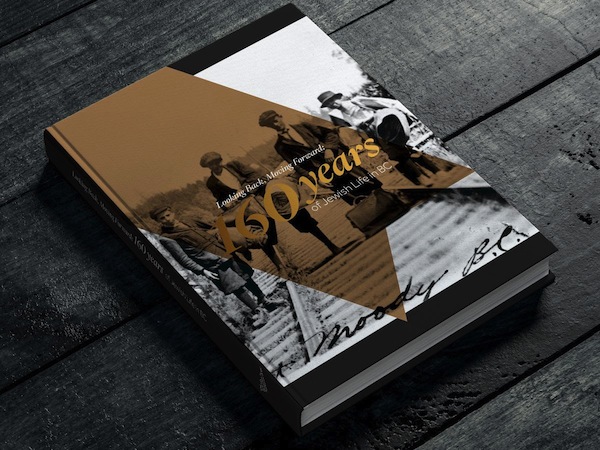
Looking Back, Moving Forward is available for purchase from the Jewish Museum and Archives of British Columbia. (photo from JMABC)

The first thing many readers will do upon opening the Jewish Museum and Archives of British Columbia’s Looking Back, Moving Forward: 160 Years of Jewish Life in BC is try and find their friends’ writeups and those of the organizations with which they volunteer or work. That is, if they didn’t submit their own writeup for the publication. If they did send in their bio or one for their family, then that’s the first page to find.

Even people who grew up in the province and have a multigenerational presence here will find novel tidbits in this 284-page hardcover (or soft) coffee table book. Published to celebrate the museum’s 50th anniversary last year, it is appropriately dedicated to Irene Dodek (1930-2019) and Cyril E. Leonoff (1925-2016). Leonoff was founding president of the Jewish Historical Society of British Columbia, which was established in January 1971. Dodek, also a founder of the museum and archives, “helped define its direction early on and conducted more than a hundred oral history interviews with members of our community.” More about Dodek and Leonoff can be found in the first pages of the book, before the greetings from Prime Minister Justin Trudeau and Premier John Horgan.

In her president’s message, Carol Herbert writes, “Our stories are fascinating, and demonstrate the evolution over time of our communities, from a few small clusters of Ashkenazi Jews from Eastern Europe in late 19th century to present-day diverse Jewish communities, comprised of individuals who originated from across the world; Sephardic, Mizrahi and Ashkenazi; secular and religious; leaders, activists and advocates for Jewish and general community causes.”

Both Herbert and the book’s editor, Michael Schwartz, director of community engagement for the JMABC, acknowledge that this publication is a partial snapshot of the community. They both encourage readers who haven’t done so yet “to share your memories of where we’ve been, celebrate with us where we are, and join us in envisioning where we might be headed,” writes Schwartz.

A chapter on the history of the JMABC begins the book proper. It is followed by brief regional histories – Victoria, Vancouver, Kootenay/Boundary, Okanagan, Prince George, Sunshine Coast, Central Vancouver Island and Whistler. The chapter on organizations is divided into those that work in advocacy and activism; religious observance; education; youth groups and camps; seniors; arts, culture and leisure; Zionism; Holocaust education; and anchor organizations. That last one, by the way, is where you’ll find the Jewish Independent (pages 126 and 127).

The Notables chapter is sorted chronologically: pioneers (1886-1945), postwar (1945-1970), modern (1970-2000), contemporary (2000-2010) and emerging (2010-present). Within each section, people are listed alphabetically by surname, as are the entries in the Family Album chapter. Rounding out the publication is a list of donors and an index.

Looking Back, Moving Forward offers a broad overview of many of the major players in the B.C. Jewish community over the 160 years since Jews first arrived here. It focuses on accomplishments and takes readers right up to 2021. It is easy reading, and no one need worry that any dirty laundry is aired. Given the celebratory nature of the book, none of the submitters (including the JI) talk about the challenges they’ve faced or controversies, and neither do any of the introductions to the various sections.

Some history is given only passing mention, such as what community fundraising structures were in place prior to the Jewish Federation of Greater Vancouver’s emergence in 1987, for example, but the book isn’t meant to be a comprehensive historical tome. Rather, it’s a fun, page-flipping community yearbook of sorts, which will hopefully motivate people to both learn more about the community and contribute their stories to its archival record.

Looking Back, Moving Forward is available in hardcover ($100) and softcover ($50). To place an order, contact the museum offices at 604-257-5199 or info@jewishmuseum.ca. Shipping is available across Canada for a fee of $20 per book.

Gallery’s new guides

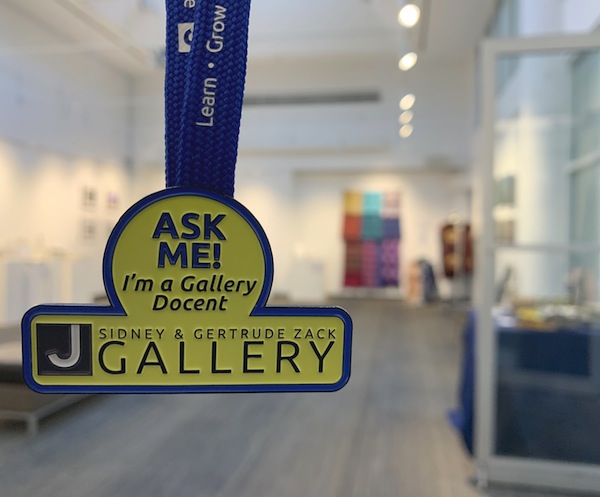
New docent program at the Zack gets underway. (photo from Zack Gallery)

Sidney and Gertrude Zack Gallery director Hope Forstenzer recently instituted a new docent program, to train guides for the art gallery.

“I came up with the idea of creating a group of volunteer docents for the gallery right after I got here, which means right before the pandemic,” Forstenzer told the Independent.

Unfortunately, the pandemic made it impossible to implement the idea at that time, and the initiative only became reality in the past few months.

“My job as the gallery director is only half-time,” Forstenzer said. “Even when I’m working, I’m frequently in meetings or visiting studios or doing other work that takes me away from engaging the people in the gallery. I created the docent program to make sure the gallery was staffed with friendly and available faces, with people who knew about the shows, could make sales, and could answer questions.”

Initially, about a dozen people responded to her invitation to become volunteer docents at the Zack. “Some dropped out for various reasons as we were getting underway,” she said. “Others have come along since.

Currently, we have six docents on our active roster.”

Before the docents could perform their assigned duties, they needed a certain amount of training on the gallery rules and procedures.

“The docents each attended two training sessions, both lasting about an hour,” said Forstenzer. “Sometimes, we’d do the whole training in one session, but it varied. The second training shift was usually about our sales system, which isn’t difficult, but isn’t something most of the docents have seen or used before. In the first training session, I explained what their responsibilities were, we discussed scheduling, and I’d either show them how to use our sales system or invite them back to learn it on a different day…. Then they did a shift with me in the gallery as backup. Then they were ready to go.”

The first docent started at the Zack last October. “Some of them have taken breaks due to the Omicron,” said Forstenzer, “but others have stayed throughout.”

She has lots of plans for her volunteer docents. “The primary purpose of having the docents in the gallery right now is to have a knowledgeable and friendly presence that welcomes visitors,” she said. “They can also make sales. As the restrictions due to COVID lift (hopefully), the docents will also help me run events in the gallery, both for kids and for adult groups. Eventually, I hope they’ll be able to run some of these events themselves. We might even schedule some docent-led viewings of shows.”

At the moment, most docents do one shift a week, each shift three or four hours long, but Forstenzer is flexible about that. “Some do two shifts a week. Some split their shifts and go for a swim or a workout in the middle and then come back. It is up to them, and I create a schedule based on their availability and the gallery’s needs.”

She added that all the docents take their volunteering seriously. “If someone can’t make their shift, they let me know,” she said. “If I can cover it, I will. If not, the gallery won’t have a docent that day.”

The docents vary widely in age and experience. Some are students. Others are retirees or people participating in various community centre programs. Gail Bloom shared with the Independent a bit about herself and why she became a docent at the gallery.

Bloom worked as a city planner in San Francisco. “I studied city planning in college and then worked as a practising planner,” she said. “I love cities and was interested in public utilities. My chief role for over a dozen years was sorting out public financing of major infrastructure projects in San Francisco.  It was very satisfying to see the fruition of that work across the city.”

She retired about 20 years ago. “My home is still in the Bay Area. I live there with my husband, and my son’s family also live nearby, but, last fall, I came to Vancouver for an extended winter visit with my daughter – she lives here and teaches at Emily Carr.”

Bloom, who turns 70 this month, has been volunteering in many fields since her retirement. “I lead the Board of Children’s Book Project and presently serve on a regional public health agency at the Marin/Sonoma Mosquito and Vector Control District,” she said. “I have also enjoyed working on state, local and federal election campaigns, mentoring youths, and helping with the major fundraising event for the Oakland Museum of California.”

She has always been interested in art. “I love cities, as I said, and the museums are a big part of that – especially art museums. In the last couple months, I visited the Vancouver Art Gallery and a small community gallery at the Deep Cove Cultural Centre. There is a show at the VAG now that I’d recommend – Emily Carr and Edith Heath. Heath was a local San Francisco ceramic artist; she started her iconic tile and pottery company out of her little apartment in San Francisco in the ’40s.”

Of course, when she visited the Jewish Community Centre of Greater Vancouver for the first time, the Zack Gallery attracted her. “As I’m interested in the arts personally and enjoy art museums, their new docent program seemed like a good fit,” she said. “And my family were thrilled that I found the gallery and something meaningful to do with my time. Now, I’m at the gallery every week. My docent days are Mondays.”

Besides volunteering, Bloom takes advantage of several other programs the JCC offers. “The aquatics program is pretty great,” she said. “I also attended several sessions of the book fair last month, and I just started watching VJFF [Vancouver Jewish Film Festival]. I’m fortunate to have time to participate in them all.”

Olga Livshin is a Vancouver freelance writer. She can be reached at olgagodim@gmail.com.