Celebrating Leonard Cohen

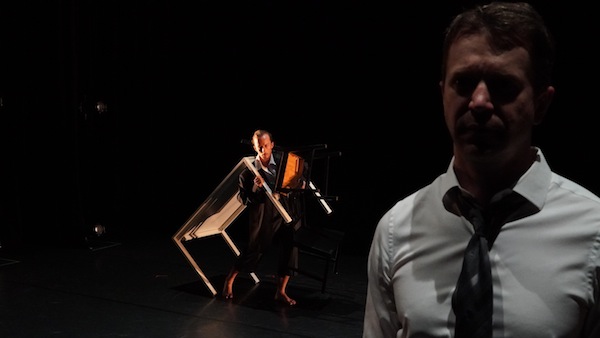
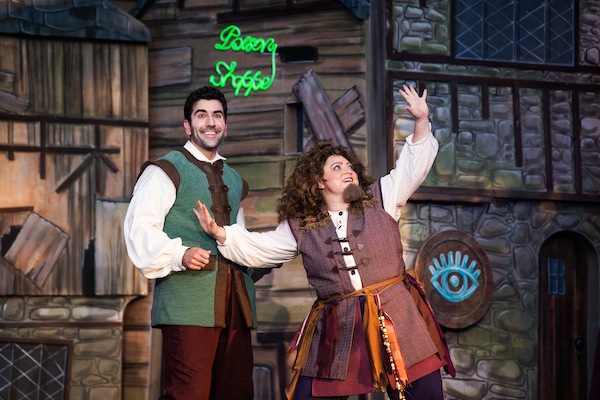
Take This Waltz performers Ted Littlemore, left, and Daniel Okulitch. (photo by Victoria Bell)

Take This Waltz world premières at Rothstein Theatre Sept. 10-11.

“The concert as a whole tells a story, and each song finds its place within that story,” Idan Cohen told the Independent about Take This Waltz, which sees its world première as a Chutzpah! Plus event Sept. 10-11 at the Rothstein Theatre.

Cohen is the artistic director of Ne. Sans Opera and Dance, so it might seem odd that he’s staging a show celebrating the music of Leonard Cohen. But he’s a fan of the Canadian icon, who died in 2016, and this production piqued his interest.

“I’ve admired Cohen’s lyrics and music for years,” said Cohen, who is not related to the singer-songwriter. “So, when Daniel Okulitch, one of Canada’s most appreciated operatic baritones reached out to me to directly to produce Take This Waltz, I immediately said yes. Daniel’s vision was to look at Cohen’s music through the classical tradition of the Song Cycles (Lieds). I thought that it was a really interesting way to look at Cohen’s music through a fresh, exciting lens.”

Okulitch contacted Cohen after having created a successful online concert that included some of Leonard Cohen’s work, as well as that of other singer-songwriters, which took place via Pacific Opera Victoria in winter 2020. Okulitch wanted to add dance to the concert.

“I knew that, if I was to take this on, I would want to focus on Cohen’s body of work and say something meaningful about the times we live in,” said Idan Cohen. “Ne. Sans’ mandate is to follow the operatic tradition in the full sense of it – to create work that integrates all the classical arts of theatre, music, dance, set and costume design. It is challenging to do in this economy, but I strongly believe in this type of offering.

“It took us some time to fundraise so that we can present this work as I believe it should be presented,” he noted. “We have an ensemble of cello, violin and accordion, with stunning arrangements by Adrian Dolan, and Daniel’s voice is so rich and sensitive, that it speaks straight to the heart. Amir Ofek is designing the set, Itai Erdal creating the light design and Christine Reimer the costumes. Alongside Daniel is the dancer/musician Ted Littlemore, with whom I’ve been collaborating for almost five years, who’s such a wonderful artist. I am truly blessed, and I hope that we’ll not just do justice to Cohen’s legacy, but help audiences experience it in a different, new way.”

About that legacy, Cohen added, “I had coffee with the wonderful Vancouver-based composer Rodney Sharman the other day, to discuss a future project that we’re working on, and Rodney said something that I found to be really relevant to Take This Waltz. He said that he thinks that my body of work is a variation of two core elements: love and death. And I thought to myself, that’s life, right? Cohen got it. His wisdom is so profound that it sometimes seems as if he knew the secrets of the human soul. I think it’s because he was brutally honest, a thing that we don’t see a lot in our contemporary culture. There’s so much pain and often bitterness and anger in his work, that are then composed in such generosity and love. What a beautiful combination. My work is to honour that.”

About his collaborators on Take This Waltz, Cohen said the production started at Pacific Opera Victoria, “as an intimate, beautiful concert of various music that included just a few of Cohen’s songs, and Vancouver Opera decided to support its development and creation. Jessica Gutteridge, a wonderful human and the artistic director of Chutzpah!, has given us a very generous creative residency at the Norman and Annette Rothstein Theatre in Vancouver’s JCC [to further develop the work]. It’s all live, no film or projections. I felt that Cohen’s work needs to be honest and direct. Having said that, there are quite a few surprises in the show – you’ll just have to come and see!”

Take This Waltz is being presented with Pacific Opera Victoria and Vancouver Opera, and Chutzpah!’s live music programming is supported by a grant from AmplifyBC. The Sept. 10-11 shows are also being supported by the Bierbrier family, in memory of Len Bierbrier, who was a dear friend of Chutzpah! board chair Lloyd Baron, said Gutteridge. Bierbrier was also a friend of Leonard Cohen, she said.

While most people cannot claim that level of connection to the legendary musician, many people do feel connected to him in some way. When asked to confirm that, indeed, he was not related to the singer-songwriter, Idan Cohen said, “We are all related, aren’t we? I first heard Cohen’s music through my dad and, in many ways, always felt that he is a father figure to me. So many of us feel that way about him and his music and poetry. I love him like family. Does that count?”

For tickets to Take This Waltz, visit chutzpahfestival.com.

Flamenco dance, music

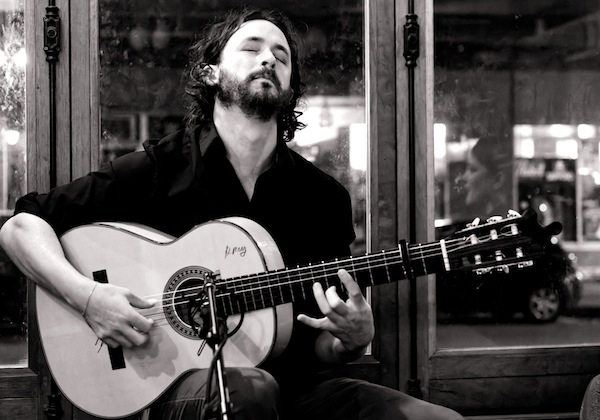
Henry Garf (photo by Herve Lebley)

Montreal guitarist and member of the Jewish community Henry Garf takes part in this year’s Vancouver International Flamenco Festival. Presented by Flamenco Rosario, the festival features live performances, with both ticketed and free events.

Garf performs at the Waterfront Theatre Sept. 23, as part of Kara Miranda’s company. Sombras/Shadows is a live music and dance presentation with projections reflecting personal experience both visually and thematically. Shadows are explored as interplay between light and dark, through the lens of Swiss psychiatrist Carl Jung’s theories of the Shadow Self. A parallel search is for intangible shadows of the past, Miranda’s ancestral roots, living in the shadow of the flamenco greats that came before and the masters that reign today and finally accepting and actualizing her shadow side.

Garf also teaches a master class at the Scotiabank Dance Centre Sept. 24, with Alvaro Echanove, called Theory and Practice: Exploring the Skills of Improvisation, Dynamics and Active Listening through Palmas. Palmas is a style of handclapping that accompanies flamenco dance.

Other master classes take place Sept. 17 and 18, with Mucha Muchacha, and on Sept. 24, with Albert Hernandez. Other ticketed shows include Mucha Muchacha at the Rothstein Theatre Sept. 16. Their eponymous show started as theoretical and practical research about women artists from the “Generation of the 27th,” known as Las Sinsombrero, and evolved into a contemporary dance project focused on the ideas of empowerment, determination, voice, participation, freedom and cooperation. The performance is developed from force-driven movement, effort, celebration and physical exhaustion. They put “at risk” traditional Spanish dance’s corporeality in a confrontation with contemporary dancing.

The two other shows at the Waterfront Theatre are Anastassiia Alexander on Sept. 22, performing The Machination of Memories Suppressed, based on the poem “Maquina de Olvido,” which Alexander wrote, and the performance contains elements of spoken word with dance; and Flamenco Rosario on Sept. 24, with Nuevo III, a collection of new choreographies by Ballet Nacional de España choreographer Albert Hernandez, Granada’s Sara Jimenez and Rosario Ancer.

On the afternoons of Sept. 3 and 4, free performances take place on the Picnic Pavilion stage at Granville Island. The Saturday features Mozaico Flamenco, A.J. Simmons and company, Bonnie Stewart, Jhoely Triana, and Michelle Harding and Calle Verde. Performers on the Sunday are Mozaico Flamenco, Kara Wiebe, Harding and Verde, Linda Hayes, and Stewart. There is also a free 20-minute workshop on Sept. 4 for children at noon, and a 30-minute one for adults at 12:20 p.m.

For registration, tickets and more information, visit vancouverflamencofestival.org.

– Courtesy Vancouver International Flamenco Festival

Immersive art experience

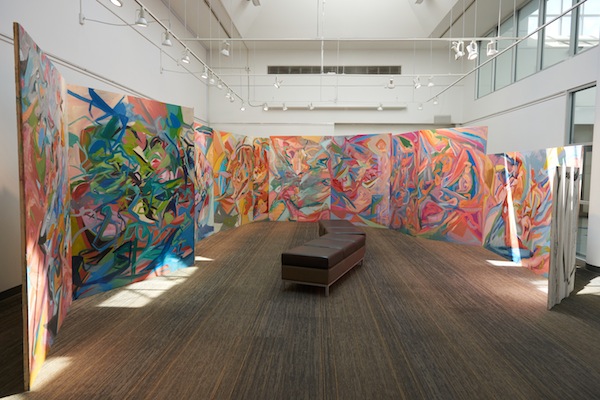
Marty Katzoff’s The Light Within the Shell was created specifically for the Zack Gallery. (photo by Lauren Zbarsky)

The Light Within the Shell exhibit opened at the Zack Gallery on July 4. There is a sign beside the door: “This space is meant to be explored. Wander, sit, experience, enjoy.” The show was created specifically for the gallery.

Created by artist Marty Katzoff, it doesn’t involve traditional paintings hanging on the walls. Instead, it looks like a huge folding screen comprised of a dozen panels. They encircle the room, leaving only a narrow passageway along the walls. Each panel has a colourful abstract painting on its inside surface and a black and white image on its outside. A few small copper sculptures scattered outside the enclosed space complete the installation. Viewers are invited to sit down and meditate on the benches inside the vibrant shell of the exhibit or wander along the outer passageway.

Born in Rhode Island, Katzoff grew up playing sports. “I didn’t do much art until my teenage years,” he told the Independent. “I was going through difficult times in high school. My friend was an artist. She introduced me to the arts. I started making collages and found it therapeutic.”

He never completed high school and worked a variety of jobs. “For the next 10 years, I worked in construction, in restaurants,” he recalled. “And, all that time, I made art. I taught myself to paint. Then I went back to school and completed my BA at Bard College in New York.”

For years, Katzoff worked as an artist in New York, created large murals in indoor and outdoor spaces. He graduated from the University of British Columbia’s master of fine arts program in 2021.

photo - Artist Marty Katzoff at work
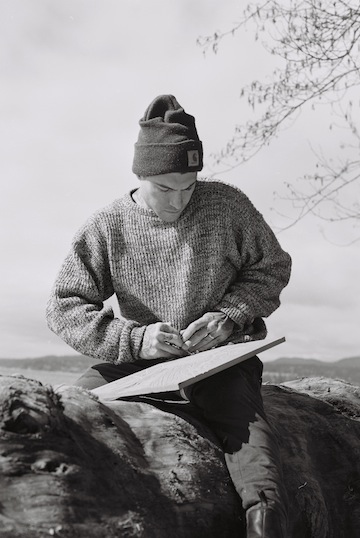
Artist Marty Katzoff at work. (photo by Lauren Zbarsky)

His artistic education vaguely coincided with his newly found fascination with kabbalah, specifically the Tanya, which he has been studying for the past few years. “Before, I had separate ideas about art and spirituality. Now, I’m exploring how Jewish learning is connected to my art, how mythology and tradition transform my spiritual life into my paintings,” he said.

As a child, Katzoff went to a Jewish day school, but kabbalah offered him a different perspective. “I started with a book by Gershom Sholem. Before, I always painted with music in the background. This project is the first I’ve ever done without listening to music. I listened to kabbalah lectures online while I painted. I wanted to discover what I could create while listening to something complex and different … [by the late] Rabbi Yehoshua B. Gordon.”

The idea for the current installation came to him when he was finishing his graduate program at UBC. “One of our family friends lives in Vancouver,” Katzoff explained. “She is Jewish and she told me about the Zack Gallery. I submitted the proposal, and it was accepted. I wanted to create an installation specifically for the gallery, an interactive space, a visualization of light. This show took me 11 months to complete.”

Katzoff sees this exhibit as an amalgam of dreams, painting, architecture, Jewish learning and personal symbolism. Vancouver artist Rosamunde Bordos’s essay about the show, which is available in the gallery, expresses her visual composition in words.

Katzoff’s media, the plywood panels, are all recycled materials. “I have a friend who works in art shipping,” he said. “They ship large pieces in plywood crates. That was where the panels came from. Some of them have holes, so customs could look inside the crates to see the art. I painted around the holes. It was like a collaboration with someone else.”

The size of the panels, some of them taller than a person, left him undaunted. “I always liked to work on a large scale,” he said. “That’s why I did murals in New York.”

His oil paints are also recycled. “I use lots of recycled materials in my art,” he said. “My grandmother was an artist. She gave me her entire collection of pigments for the oil paints I use. I’ll probably work with her paints for the next decade.”

In addition to painting, Katzoff also works as a printmaker. Currently, he teaches printmaking at UBC as a sessional instructor. “For me, printmaking provides the connection with literature, with storytelling and history,” he said. “My brain seems to process that connection better while I’m drawing and etching. My drawings are illustrations, while my painting remains more like a therapeutic activity.”

His abstract copper sculptures, several of which are included in the exhibit, grew organically out of his printmaking. “I make my sculptures reusing the copperplates from my prints,” he said. “I have lots of copper plates. Copper was an important part of Judaism and, after I use the plates for prints, I want to share the metal, recycle it. I make sculptures from it. I also make bracelets and amulets. You can see the remains of the etching if you look closely.”

To learn more, check out martinkatzoff.com. The Light Within the Shell is on display until Aug. 22.

Olga Livshin is a Vancouver freelance writer. She can be reached at olgagodim@gmail.com.

Welcome back, TUTS!

Much of the humour in Something Rotten! comes from Nostradamus (Jyla Robinson), right, leading Nick (Kamyar Pazandeh) astray with incorrect visions of the future. (photo by Emily Cooper)

Theatre Under the Stars is a fun, relaxing way to ease yourself back into theatre after the COVID hiatus. Its two productions, Something Rotten! and We Will Rock You, are happy fare that alternate nights through Aug. 27, outdoors at Stanley Park’s Malkin Bowl.

The Independent saw Something Rotten! on opening night, hoping to see Jewish community member Daniel Cardoso, who plays Jewish moneylender Shylock in the TUTS productions. However, it was understudy Simon Abraham who took on the role of the moneylender that night. He and the entire cast put on a great show.

In this comedy, set in 1595, Shakespeare is monopolizing the theatre industry and playwright siblings Nick and Nigel Bottom are trying to write a hit. They face several challenges, including being in debt to Shylock, who is willing to forgive that debt if they permit him to produce their new production. However, they initially refuse because he and they could be put to death, as Jews at the time were permitted few professions, one of which was moneylender.

Something Rotten! takes on – in very light manner – antisemitism, the treatment of the poor and the place of women in Shakespeare’s time. It also takes on these issues as they are depicted in Shakespeare’s plays and poetry.

“Shylock has been a very interesting character to explore and I extremely grateful to our director, Rachel Peake, for giving me the chance to do so,” Cardoso told the Independent in an interview before the show opened. “In researching for this part, I certainly took a cursory look at Merchant of Venice, but only so I could have an idea of who Shakespeare’s Shylock is. Because of how much Something Rotten! subverts the audience’s expectations of these well-known Shakespearean characters, there are only a few similarities between what I’m doing and what we see in Merchant of Venice. I don’t think that antisemitism is a central theme of this show, but we certainly get a view of it through Shylock.

“I also dove into what antisemitism looked like during the time of the Renaissance,” he continued, noting that Jews were “expelled from England in the late 13th century and only officially allowed to return in the mid-17th. However, it does appear that there were indeed Jewish people living in England during Shakespeare’s time and that some even fled to England from Spain and Portugal, due to the Inquisition.”

Cardoso sees parallels between Shakespeare’s time and today’s undocumented immigrants in both Canada and the United States and the refugee crises around the world. “In trying to find a way into the Shylock ofSomething Rotten!,” he said, “I found myself drawing on these modern-day examples, as well as trying to imagine what it must have been like for Jewish people in the time of the Renaissance or various other points in history. I found that, given my own connection to the community, this hit quite close to home for me. At the end of the day, he’s a smart guy who works hard and, despite the obstacles in front of him, he is able to be an equal and a friend to many of the characters in the show.”

Not such a smart guy is Nick Bottom (Kamyar Pazandeh) who, in trying to skip the hard work and best Shakespeare (Daniel Curalli), seeks out a soothsayer, Nostradamus (Jyla Robinson), who tells him that musicals are the popular theatre of the future. Nick sinks the last pennies he and his wife Bea (Katie-Rose Connors) have into a musical production with a reluctant Nigel (Vicente Sandoval), who has Shakespeare’s talent but lives in his brother’s shadow. It is only after Nigel meets Portia (Cassandra Consiglio), the daughter of Puritans, that he becomes to his own self true.

The homage to and satire of both musicals and Shakespeare makes for a lot of laughs and reference guessing – is that line or musical snippet from Annie, Evita, Rent, A Chorus Line, or more than a dozen other shows? Standout songs are “God, I Hate Shakespeare,” with the Bottom brothers’ differing views of their main competitor; “The Black Death,” a cheery ditty about the plague, the Bottoms’ first musical attempt; “Will Power,” Shakespeare enjoying his rockstar status, amid fawning, crying, screaming, fainting fans; and “Make an Omelette,” the title song of the Bottoms’ new musical. Foreseeing Omelette instead of Hamlet as Shakespeare’s best-ever play is only one of the soothsayer’s many slightly incorrect visions.

“It’s been a privilege to get to work on Something Rotten!” said Cardoso, who has been in four other TUTS productions. “It’s an extremely funny show and, if you’re a fan of either musical theatre or Shakespeare, then you’ll have a fun time at this show. And, if you like both, even better!”

For tickets to either of this season’s productions, visit tuts.ca.

Play tackles Israeli/Palestinian conflict

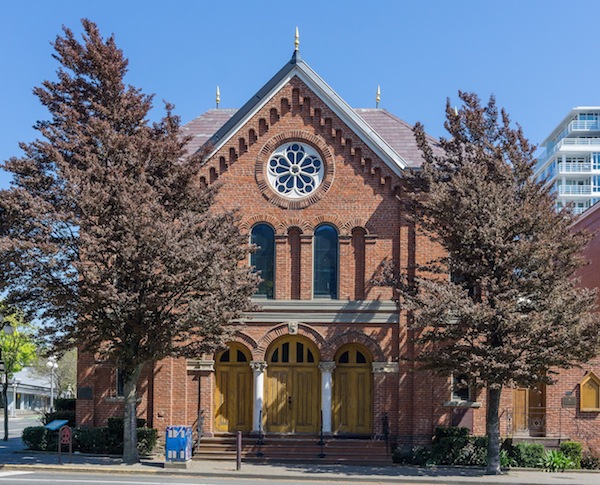
Congregation Emanu-El Synagogue (photo from Bema Productions)

Bema Productions, directed by Zelda Dean, is bringing the play Peace Talks to the Victoria Fringe Festival, Aug. 25-Sept. 4. Performances will take place at Congregation Emanu-El Synagogue’s Black Box Theatre, 1461 Blanshard St., pictured above.

Written and performed by Izzy Salant and Ryan Dunn, this run will be a world première of the work that saw a virtual staged reading in early 2021. Since that time, the playwrights continued to develop their play and raise the necessary funds to meet their goal of touring the show to university and college campuses in both Canada and the United States.

Peace Talks addresses the Israeli/Palestinian conflict. Noam watches helplessly as his best friend Andrew dies in an explosion right in front of him in a hookah bar in Israel. Noam believes he was responsible. After the catastrophe, Andrew’s bereaved American brother James sets out on a revenge plot against Israel and against Noam, as he also believes Noam is responsible for Andrew’s death. He puts his plan into action, actively sabotaging Israeli advocacy and promoting anti-Zionism to anyone who will listen, ultimately attempting to attain his true goal: to kill Noam.

James and Noam find themselves in a bitter internal and external struggle with Israel, Zionism, death, human rights, and Andrew’s memory. As they clash, they both discover some harsh realities of the Israeli/Palestinian conflict and that it is a world that isn’t as clear-cut as they thought.

For tickets to Peace Talks, visit victoriafringe.com.

– Courtesy Bema Productions

An afternoon of music

Mexican-Canadian singer Gustavo Herrera helped finish off the 2021/22 season of the Jewish Seniors Alliance Snider Foundation Empowerment Series. The classically trained operatic tenor, who has a powerful and melodic voice, entertained the audience with a mixture of classical and popular songs.

A Summer Afternoon of Music, the final event of this year’s Empowerment Series, was co-sponsored by JSA, the Kehila Society and Congregation Beth Tikvah. It took place in the synagogue’s sanctuary on June 27 and began with a catered BBQ lunch for the approximately 55 seniors who attended the event in-person. The program was also available via Zoom, making the total audience about 70 people. Herrera’s 94-year-old mother and his sister were among those who joined the concert virtually.

Toby Rubin, coordinator of the Kehila Society, welcomed everyone and introduced the guest. Herrera sang many songs, including “Somewhere,” “Could I Have This Dance,” “Granada,” “O Sole Mio,” “La Donna è Mobile,” “My Way” and “Only You.” He encouraged everyone to join in and to clap to some of the songs.

He pointed out that, although “My Way” is generally associated with Frank Sinatra, it was written by Canadian Paul Anka. A member of the audience requested “Hallelujah,” which Herrera sang in Spanish. Another request was “Boléro.” For the finale, Herrera asked everyone to join him in ending with “Hava Nagila.”

Gyda Chud, co-president of JSA, thanked Herrera, saying that the concert had been very uplifting and that his mother must be very proud.

Shanie Levin is program coordinator for Jewish Seniors Alliance and on the editorial board of Senior Linemagazine.

A composer for the Queen

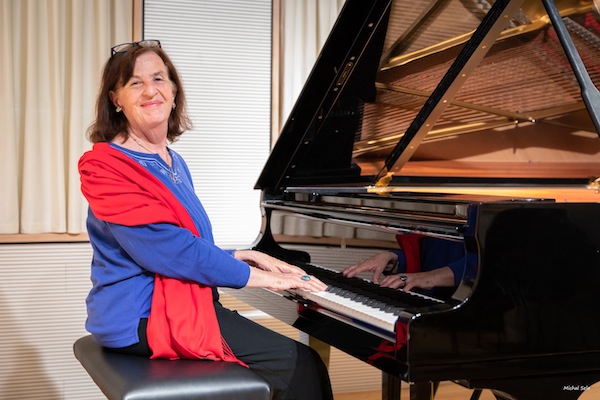
British-Israeli composer Loretta Kay Feld. (photo by Michal Sela)

Loretta Kay Feld was asked by someone close to Queen Elizabeth II to compose three tributes, which, said Kay Feld, “were gifted to Her Majesty to honour her 70 years on the throne, a life filled with grace, fortitude and dedication to her country.”

One work is a personal song, called “The Queen’s Soliloquy,” that premièred last February. The second is “A Symphonic Medley of Music for Her Majesty’s Platinum Jubilee,” which includes four instrumental segments – from “Soliloquy,” the pieces “We Never Felt So Glorious” and “The Lord Chamberlain’s Processional March and Song,” and the third tribute Kay Feld composed for the Queen, which premièred last month, called “70 Years a Queen.”

Kay Feld was born in London and trained in music composition and drama at the Royal College and Guildhall School of Music. She toured with plays and musicals in the West End of London and has published several books. She is a prolific, award-winning composer, lyricist and author, who now lives in Ra’anana, Israel. She made aliyah 11 years ago and is in her final year of a master’s at the Jerusalem Academy of Music and Dance.

“I wanted to come here [Israel] since I was a child in Hebrew school but life has a way of changing your plans,” she said. “I got married and lived in America. I gave concerts all over New York, from 1973 into the ’80s.”

Kay Feld wrote for a children’s television network and composed music in many genres. She has written about 900 songs and musical compositions. One of those is the song “Hymn for Israel.”

“I wrote it after the Yom Kippur War [in 1973] and I received letters from Moshe Dayan and Menachem Begin thanking me. The ‘Shabbat Song’ I wrote is also on YouTube and is sung in communities all over the world. ‘I’m Going to Keep America Singing,’” she said, “was performed at the inaugurations of presidents Obama and Biden, played by the Marine band.”

Making aliyah was one dream come true. Composing for the Queen was another.

When Kay Feld was 19, she performed for the royal family at the Variety Club for Great Britain at Victoria Palace and, after the show, was escorted to the box where the royals were seated. She remembers speaking with Princess Margaret and shaking hands with Queen Elizabeth II.

The opening lyrics of “The Queen’s Soliloquy” are: “You may ask me what I’m thinking on my Platinum Jubilee / And of all these celebrations, what they really mean to me / Well, my mind keeps drifting backwards, to a life yet unforeseen / Trembling at my coronation, unprepared to become a queen.”

“If we make it to threescore and 10,” said Kay Feld, “we’re considered by Judaism to be filled with wisdom, and the Queen is definitely filled with wisdom. They say the Queen learned five languages when she was young, and one of them was Hebrew.”

Kay Feld said she was offered a singer from the Royal National Opera House for “The Queen’s Soliloquy” but instead chose classical and contemporary singer Shlomit Leah Kovalski, who was born in Jerusalem to parents who made aliyah – her father from Montreal, her mother from New York.

Jamie Clarkston Collins and Eli Schurder of SoundSuiteStudio in Jerusalem do post-production of Kay Feld’s music and the videos are directed and edited by Jason Figgis.

Describing her creative process, Kay Feld said, “I compose when I’m out walking along the sea or in nature, and I think about what I’m composing and usually it just comes to me as if from the air. I write all the music in my head and the lyrics usually come at the same time and I go home and write out the manuscript.”

For her third royal tribute, “70 Years a Queen,” Kay Feld said, “I tried to write a song that I felt everybody throughout the world would be able to sing if they desired to. The melody is simple and the lyrics memorable with a tinge of humour.” Such lyrics as “… 70 years a queen / Four children in between / The Grandmama of future kings / Elizabeth, our Queen.”

The music is accompanied by the singing of renowned baritone Noah Brieger, who, Kay Feld said, “Has an outstanding voice with a great tone. He sang the lyrics with meaning and emotion.”

Brieger, like Kovalski, was born in Israel. He graduated from the Jerusalem Academy of Music and continued his training in the United States. An award-winning performer, he has sung in dozens of productions at the Israeli Opera, including lead roles in Don Pasquale (Donizetti), La Cenerentola (Rossini), La Bohème(Puccini), Romeo et Juliette (Gounod), Schitz (Rechter) and more. He also has performed in Germany, the United States, France, Italy and China.

Kay Feld is excited about a new project she has been working on for a number of years – 1897, The Musical. There are 27 original songs and the choreography is by her daughter, Dorothy Eisdorfer.

“The story is about the degrading things they did in Victorian times, but I want to tell the story with dignity,” said Kay Feld. “It expresses the desires of two women, one in the lower and one in the higher class.”

Her plan is to hire an all Israeli cast and crew, “to showcase all the wonderful talent we have here in Israel,” she said. “I’d like to find enough funding so I can pay all the performers fairly.”

She wants to film the musical and livestream it globally “for all the world to see. It will be a most splendid performance.”

For someone whose music has been performed for presidents and queens, Kay Feld remains humble. “I just believe everyone has a gift,” she said. “And if one can use the gift to make the world a better place, that’s what matters.”

Toby Klein Greenwald is an award-winning journalist, educational theatre director, teacher and the editor-in-chief of wholefamily.com. Anyone interested in supporting 1897, The Musical can write to Loretta Kay Feld at lorettakayfeld@gmail.com.

Different horror, same hell

As soon as they got into power, German Nazis began to make life hell for German-Jewish men – partly to promote their sadistically comic-book ideal of “Aryan” masculine supremacy, and partly out of a desire to plunder valuables and property. And also, it must be said, out of simple criminal/pathological malice.

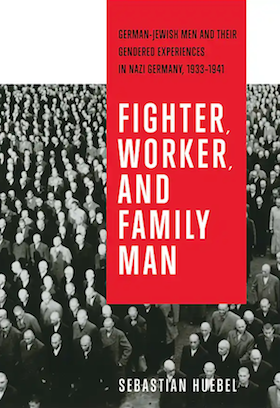
image - Fighter, Worker and Family Man book coverFighter, Worker and Family Man: German-Jewish Men and Their Gendered Experiences in Nazi Germany, 1933-1941 (University of Toronto Press, 2022) is a thoroughly researched book. In it, Sebastian Huebel – a sessional instructor in the history department at University of the Fraser Valley – depicts various strategies used by the Nazis to isolate and degrade German-Jewish men in the years prior to the concentration camps. His metaphor for this program of debasement and humiliation is “emasculation,” and the word identifies the book’s focus: how the Jewish-German (heterosexual) male was shamed by the dispossession of any masculine identity as “fighters, workers or family men” – the traditional markers of masculinity in Europe in those days.

Gender is a rare focus in Holocaust literature and, when the topic of gender arises there, it is almost always about women, and written by feminist scholars, as Huebel notes.

But men’s victimization, as Huebel demonstrates, also deserves scrutiny. During the 1930s, the overwhelming percentage of camp internees were male (“cheats,” “traitors,” “greedy bankers,” “race defilers,” “manipulators of international capitalism,” etc.): in other words, women did not fit the Nazi stereotype of the gendered male Jewish fifth-column “enemy.”

The Jewish male “enemy” was uniformly forced out of work, his business expropriated; he was excluded from the military, and his military service in the First World War ignored. In public, he was ridiculed, he was caricatured in propaganda and openly derided – all, as mentioned, to further the absurd Nazi fantasy of the “Aryan” übermensch. For what reason? Simply to “justify the need for protecting Germany from within” by inventing a supposed internal threat – to this day, a tried-and-true strategy practised by would-be and extant dictators.

(It’s worth noting that Huebel does not address the perceived threat emanating from the predominance of Jewish men in the German Communist and Social Democratic parties, in labour unions, and among other dissidents.)

In private, the Jewish father/husband paradigm crumbled under the weight of Nazi deprecation. With no work, no “bread being won,” the only way the Jewish father/husband could show his worth to the family was to arrange for emigration. But, as Holocaust historians have amply shown, by the time it was clear to the German Jews that the Nazis were not going to go away, the “free world” had closed its doors to them. (Canada’s famous response to the question of how many Jewish refugees should be admitted was “None is too many!”)

On a more positive note, Huebel notes that the at-home father model led to increased bonding – unusual for the time – between father and family, and Huebel offers lots of documentary evidence of signs of love and affection between the unemployed father and his children. As well, fathers frequently became at-home teachers to their expelled children – more evidence of “a new presence at home” that led to a reaffirmation of men’s role as father/mentor-educators.

On the streets, as Nazi violence against men increased, men were often coated with tar, made to walk barefoot over broken glass, made to stand for attention for long hours in bitter cold, and forced to open their mouths for Nazis to spit in. As a result, women were more and more often required to go out in public for menial chores.

The gender-specific treatment of men in the camps has not, Huebel says, been examined as closely as has been the treatment of women. To illustrate his point, he stresses how forced labour demanded of men, particularly in brickworks and quarries, led to disfigured bodies, “violated psyches” and premature death. Those who survived returned home like ghosts, permanently traumatized both physically and mentally, tortured by nightmares and often considering (and committing) suicide.

At no point in his book does Huebel denigrate the experiences of Jewish women under Nazism: “different horrors, same hell,” as Myra Goldenberg and Amy Shapiro said in the title of their excellent 2013 book.

Huebel’s oft-stated intention is to draw attention to the specific way men were abused, from beard-pulling to climbing up and down rock quarries until death. Jewish males were, as mentioned, typically regarded by Nazis as the “greater threat,” and were victimized accordingly.

Overall, Huebel shares the hope, in his conclusion, that a study of the erosion of Jewish male masculinity under Nazism can “sharpen our understanding of contemporary issues related to gender.”

This is a daunting objective, if not fulfilled, at least boldly addressed in this groundbreaking book.

Graham Forst, PhD, taught literature and philosophy at Capilano University until his retirement and now teaches in the continuing education department at Simon Fraser University. From 1975 to 2010, he co-chaired the symposium committee of the Vancouver Holocaust Education Centre.

Dreamy Midsummer’s Night

The company of Bard on Beach’s production of Midsummer Night’s Dream. (photo by Tim Matheson)

The thespian delights of Shakespeare set against the glorious backdrop of mountains, sea and sky have been missed. But now, after a COVID-induced two-year hiatus, Bard on the Beach at Vanier Park is back with a bang, based on the audience buzz on opening night.

The comedy A Midsummer Night’s Dream, a perennial crowd pleaser, will occupy the BMO Mainstage all season. Harlem Duet, a tale of Black life spanning three periods in American history, runs until mid-July on the smaller Howard Family Stage, with Romeo and Juliet taking over that stage in August through to September.

This is the seventh time Bard has produced A Midsummer Night’s Dream, and this rendition has “hit” written all over it. It is one cheeky dream.

Set against the backdrop of the upcoming marriage of Athenian Duke Theseus (Ian Butcher) to foreign Queen Hippolyta (Melissa Oei), three stories weave their way through a mélange of mistaken identities, unrequited love, feuding fairy royalty and would-be actors, riotously intersecting in the enchanted wood outside of Athens.

Four young lovers, Hermia (Heidi Damayo), Lysander (Olivia Hutt), Helena (Emily Dallas) and Demetrius (Christopher Allen) dash through the woods in a mad, “looking for love romp” replete with a WWE-worthy cat fight and zingy insults.

Meanwhile, in the sylvan wonderland, Fairy King Oberon (Billy Marchenski) and his queen, Titania (Kate Besworth), are in the midst of a custody battle. Oberon sends his trusty servant, the mischievous Puck (Sarah Roa), to exact revenge on his queen with a potion meant to make her fall in love with the first thing she sees when she awakes.

Finally, we meet a troupe of bumbling tradesmen who seek refuge in the forest to rehearse Pyramus and Thisbe, the play they have written in honour of the duke’s pending nuptials. It is during this rehearsal, that one of them, Bottom (Carly Street), morphs into an ass, both literally and figuratively, and becomes the love interest of Titania.

In a nod to diversity and gender fluidity, director Scott Bellis (who knows this play from top to bottom, having performed in five of Bard’s previous Midsummer productions) has cast lovers Hermia and Lysander as a lesbian couple, while two of the tradesmen, Bottom and Snug (Jewish community member Advah Soudack), are played as females.

Bellis has also incorporated some interesting staging devices. Oberon arrives on stage on stilts, towering over his subjects. Bottom makes numerous asides to the audience and takes forays up the aisles. And the Mechanicals characters, at one point, move in a shuffling turntable motion around the stage.

Street steals the show as Bottom, the know-it-all of the working class group. Although given the lead of Pyramus, she wants to play all of the parts, thinking she can act better than the others. In her quest to prove this, she gives whole new meaning to the concept of emoting. It generally works and the audience loves it, although she often upstages her castmates.

Roa provides a refreshing spin on her impish character and Soudack, although in a minor role, is hilarious as the timid lion in Pyramus and Thisbe, as is Flute (Munish Sharma) as Thisbe, the reluctant object of Pyramus’s affection. Many of the actors are making their Bard debut and it is good to see new blood in the Vancouver theatre scene.

Jewish community members are prominent behind the scenes in this production. Amir Ofek’s set, backed by two leaded glass windows framing the view of the North Shore, easily transitions from the staid royal Athenian court to the warehouse of the tradesmen to the whimsy of the Oberon realm. Mishelle Cuttler, as sound designer/composer, provides original music that complements Tara Cheyenne Friedenberg’s ethereal choreography, as performed by students from the Simon Fraser University School of Contemporary Dance. You don’t usually get to see Shakespeare with so many dance elements, which adds an interesting layer to the mix.

Christine Reimer’s costumes are a delight – earth-toned, tailored day suits and cloche hats for the women, a white bejeweled gown for Titania, frothy candy-coloured tutus for the fairies and silky evening frocks for the final scene. Gerald King’s lighting – the greens, the purples, the reds – all work in harmony with the sun as it sets behind the stage.

To escape into the Bard’s fantasy world and enjoy the dream, visit bardonthebeach.org.

Tova Kornfeld is a Vancouver freelance writer and lawyer.

A story of two families

Marsha Lederman’s Kiss the Red Stairs begins in 1919, when her father was born, on erev Yom Kippur. (photo by Ben Nelms)

In the last couple of decades, researchers have identified traits that affect many children of Holocaust survivors. There remains much left to uncover, including how much is epigenetic – that is, whether and how the genes of people like survivors, who have undergone extreme trauma, work differently than other people’s – and how much might be a result of the parenting styles of people who, in many instances, were ripped from their own parents in the most brutal circumstances. The old issue of nature versus nurture, in other words.

While psychologists and scientists try to unravel those mysteries, a genre of second generation memoirs is exploring the deeply personal experiences of being raised by survivors of the Shoah. A page-turning, sometimes shocking and nakedly vulnerable volume has recently added much to the growing library.

Vancouver journalist Marsha Lederman, Western arts correspondent for the Globe and Mail, has written Kiss the Red Stairs: The Holocaust, Once Removed. The book begins in 1919, when Jacob Meier Lederman was born on erev Yom Kippur. The auspicious timing of the birth of this baby, who would grow to become Marsha Lederman’s father, portended great things.

“[T]his was an occasion, an omen – a very good one, the hugest of deals,” she writes. “This person was special, he was going to be something, do something very important with his life.”

Indeed, he did. He survived the Holocaust – the only person in his immediate family to do so and one of only 10% of the Polish Jews alive in 1939 who survived to 1945.

Marsha Lederman’s mother was also a survivor, and one who participated in Steven Spielberg’s Shoah Foundation testimony project, video-recording her Holocaust experiences. This recording would become a touchstone because, despite the journalist daughter’s career asking questions of strangers, there were many unanswered questions in the family. This was due in part to the harrowing, abrupt response to a childish inquiry about the absence of grandparents, an early lesson that unexpected answers can have catastrophic emotional impacts.

Well into adulthood, Lederman decided to visit her mother during a snowbird retreat in Florida. But instead of sitting across the kitchen table learning about her mother’s darkest moments, she was instead living one of her own – delivering her mother’s eulogy. She had waited a day too long to fly south.
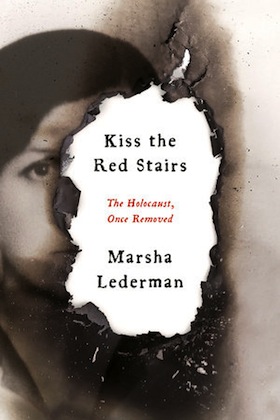
image - Kiss the Red Stairs book coverLederman’s book is the story of a family – two families, really. A family that in some ways never came together quite right, the author’s birth family with its silences about the past, and another that fell apart, that of her marriage. Kiss the Red Stairs, in fact, is a sort of applied case study in second generation (shorthanded “2G”) neuroses, as they distort the author’s reactions and coping mechanisms in a time of personal crisis.

As her marriage collapses, Lederman recognizes, on the one hand, that her responses may not be commensurate with actual events but are exacerbated by a lifetime of fears around loss and abandonment. On another hand, the undeniable anguish of her marital breakdown evokes an added burden of guilt, her own trauma juxtaposed with her parents’ experiences. Given what their mothers and fathers endured, do children of survivors have a right to feel the pain that other people seem to validly experience?

Lederman acknowledges that she was always ready for everything to fall to pieces. She inherited – or developed – an existential pessimism and a catastrophizing worldview: “The glass wasn’t just half-empty; it was half-full of poison,” she writes. “Or Zyklon B.”

The history that has formed Lederman’s identity was not imprinted on her at home only. It was in the zeitgeist of her coming-of-age as a young Canadian Jew in the 1970s and ’80s.

“The slogan ‘Never Again’ was drilled into us, implying – to me, anyway – that there was always the potential for an again, for another catastrophe. What would we do when the Nazis came back and came for us, like they came for our parents?

“This happened to us. This could happen to us again. I was one of the us. On some level I believed, from a very young age, that this could happen to me. I understood the need to be on guard, that we weren’t really safe. We needed to be on alert. Have a plan.”

For whatever were their good intentions, the organizers of a youth trip to Israel reinforced Lederman’s anxieties. Intending to instil in the participants the need for one solitary Jewish state in the world, they reminded their young charges that, in the absence of Israel, Jews would have nowhere to go should the need arise, “if the world once again turned on – or turned its back on – the Jews.”

She doesn’t disagree with the premise. “But the exercise scared the hell out of me. Don’t be so comfortable in that Canada you think of as home; you never know what could happen.”

That awareness of the unimaginable human capability for inhumanity had imprinted on her to the extent that everyday life became a gauntlet of inevitable disaster, misery the preordained endpoint of any happiness. When her marriage broke down, her reaction was extreme, “As if divorce, for instance, were some kind of death camp.”

Having consciously tried to eradicate (second-hand) Holocaust memory from its constant intrusion into her mind, Lederman finally faces the core question of her life, and of the book: “Could I possibly be a victim of the Holocaust, once removed?”

Now a mother, her obsessive worry has a new object, not only in terms of the world into which that child was born, but the potential for epigenetic inheritance. Will the baggage of the past be passed along to another descendant of survivors?

At the same time, Lederman is careful not to ascribe her challenges to the overburdened couple who raised her.

“I am not comfortable blaming what happened to my parents – and, in effect, blaming them – for my little problems. It feels self-indulgent, unfair and actually untrue,” she writes. What they accomplished after the war was almost as miraculous as their survival during it. “The fact that after such tragedy my parents were able to build new lives – purchase and set up a home, go to night school to learn English, buy a business, raise children – seems astonishing to me, as I contemplate it all as an adult. How on earth did they manage to do it, manage to be so normal?”

She quotes Elie Wiesel who, in 1984, told children of Holocaust survivors: “That your parents were not seized by an irrepressible anger … remains a source of astonishment to me. Had they set fire to the entire planet, it would not have surprised anyone.”

Elsewhere in Lederman’s book, Wiesel appears again, seemingly underscoring the legitimacy of second generation complexes by noting that it was they, not their parents, who were the ultimate target of Hitler’s plan.

“You were the enemy’s obsessions,” Wiesel told the children of survivors. “In murdering living Jews, he wished to prevent you from being born.”

Lederman confronts the reader with things she has learned from research, rather than from firsthand experience or from stories her parents shared (because they didn’t). The Holocaust experiences of her parents may be the impetus for her lifelong sense of danger, she seems to suggest, but the larger history of that era should be a warning shot for all humans – because it was humans who perpetrated everything that happened to her parents and to the millions of others of the Nazis’ victims.

In one of several graphic segments, she demands that the reader ponder how ordinary people could throw babies in the air and practise a merciless form of skeet shooting.

There are other psychological conundrums in the book. Reading her father’s journal of a trip back to Europe, Lederman confronts what reads like a cognitive rupture: her father’s love for and comparatively happy memories of Germany.

Rather than remain in Nazi-occupied Poland, young Jacob audaciously crossed into the belly of the beast, into Germany, posing as a Polish peasant boy, and got work as a farmhand, surviving until the end of the war. As a result, he took a perversely positive view. In a travel diary entry, he wrote, “I had a wonderful exciting day and my motto stands again forever: I will never forget you Germany and the peace and security I found here among these fields, meadows and trees in those murderous inhuman times of the year 1942.”

Of all the happenstances in the book – some life-altering and, in several instances, life-saving – there is a particularly poignant one that happened on her father’s trip back to his hometown. On that trip, her father found out that his parents had left a letter for him before they had been evacuated from the ghetto and shortly thereafter murdered.

“A Polish woman who lived there at the time, or moved in after the liquidation – I’m not sure which – had come into possession of that letter. There were photos in this packet and some other family keepsakes,” she writes. “The woman said she had held onto these items for a long time, but after so many years without word, she lost all hope that my father had survived; she figured nobody from the family had. She threw the packet away.

“What was that like for him – to learn that his parents had left him something: a declaration of their love, a wish for his future, some unknown secret, an explanation of what was happening to them? And to learn that those things once touched and left for him by his parents – a written document, photographs, who knows what else – proof that his parents had existed, evidence of their love – had survived, only to be discarded?”

On her own ventures to the blood-soaked continent, Lederman is reminded that the past has not passed. She sees antisemitic graffiti on abandoned synagogues, Polish youths giving obscene gestures to participants during the March of the Living. Lederman and four family members are paying tribute at a Holocaust memorial while a group of boys nearby chant something in Polish, something menacing that included one term she recognized: “Auschwitz-Birkenau.”

“It didn’t sound like they were expressing their condolences,” she writes.

After a lifetime of mostly solitary rumination and fears, Lederman has several epiphanies during the World Federation of Child Survivors of the Holocaust annual conference, held in 2019 in Vancouver. Here, she finds others who share her view that “the other shoe is always about to drop and the world is not safe”; “being plagued with obsessive doubt”; “a heightened ability – one might call it a curse – to observe and engage others”; “A constant expectation that someone is going to get you.”

There, she finds she is not alone.

“I had found my people,” she writes.