Folk festival returns to park

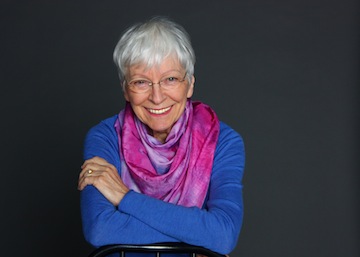
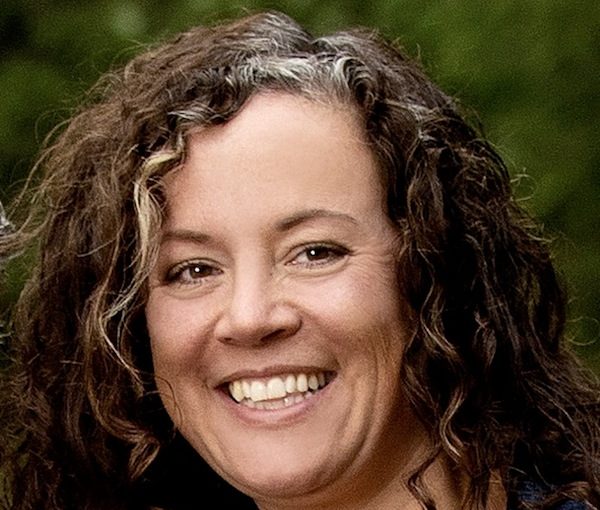
Michelle Demers Shaevitz, artistic director of Mission Folk Music Festival, which runs July 22-24. (photo from Mission Folk Music Festival)

“Mission Folk Music Festival is a wonderful combination of the familiar and the magical,” artistic director Michelle Demers Shaevitz told the Jewish Independent of how the festival has thrived for 35 years. “We’ve had the great privilege of presenting interesting and engaging music and art in a stunning setting. Imagine this creativity set among the trees, overlooking the river. We are very lucky.”

The annual festival takes place in Fraser River Heritage Park in Mission. This year, it runs over the weekend of July 22-24.

Demers Shaevitz’s history with the Mission Folk Music Festival goes back to 1991, the year she graduated from high school.

“I started by handing out volunteer tags, graduated to driving performers, moved into performer services and, from there on, to assisting our founder, Francis Xavier, with general management. When he departed in 2016, the board asked me to step into this role as the festival’s second artistic director. Adjacent to all of this, I spent 10 years working in student affairs for Simon Fraser University and the University of the Fraser Valley, as well as moving to Seattle, getting married, and having a kid.”

She credits the festival for that move and her marriage. People come to Mission from Seattle every year to volunteer and Demers Shaevitz said she has made many friends as a result.

“I was headed down there to stay with some of them and see a festival band, the Duhks, from Winnipeg,” she said. “These friends own a wine shop, West Seattle Cellars, and the night after the show, I met my future husband in the Riesling section. I’m so lucky for this festival for giving me the life I have.”

And part of that life is the Jewish community into which she married. She described herself as blessed to have it. “From the start of our relationship, Ben and I decided to incorporate Jewish traditions and holidays into our relationship,” she said. “We’re involved in the JCC here and our son attended Jewish day school for preschool and pre-K. We are members of Kol HaNeshamah in West Seattle and our son has just started Hebrew classes. I am grateful for the acceptance I’ve found in the community, as well as their amazing willingness to share knowledge, traditions and culture with me.”

In addition to the Mission Folk Music Festival, Demers Shaevitz works with Festival du Bois in Maillardville, an historic francophone neighbourhood in Coquitlam, and the Subdued Stringband Jamboree in Bellingham, Wash. She has also volunteered and served as a board member with Northwest Folklife in Seattle.

“I am lucky to have a supportive partner and a good internet connection,” she said of working remotely, notably on the folk festival. “The pandemic really demonstrated the capacity to produce and manage an event from outside of Mission. I’m generally up to Mission two to three times a month, which increases as we get closer to the festival.”

The organizing process for the music festival – which involves more than 300 volunteers – revolves around storytelling.

“If I can focus on the artistic side, I start with a story or an idea that I would like to explore,” she explained. “This year, I am digging into the idea of homecoming. I focus on artists who tell a great story through their music. Artists who are grounded in a culture and/or tradition. Artists who represent a diverse window through which to experience the world around us. It’s important to me that we highlight and celebrate diverse voices and communities. I take this responsibility very seriously.”

Another responsibility she and the festival as a whole take seriously is reconciliation – the event takes place in a park where a residential school once stood.

“We have planned our festival to respectfully acknowledge the footprint of the original site,” said Demers Shaevitz. “We are deepening relationships with the local Sto:lo community as we remain committed to the principles of the Truth and Reconciliation Commission. We continue to work towards a deeper understanding of what role we can play in the healing of this space.

“We recognize the privilege we have in presenting music and dance on these grounds and will continue to work with affected communities to prioritize their experiences,” she added.

“It’s a thrill for us to return in person to Fraser River Heritage Park for our 35th anniversary festival,” said Demers Shaevitz in the press release. “I’m excited to welcome folks back to the park to share some amazing global music with them. This year’s lineup offers festival-goers everything from singer-songwriter folk to Celtic, blues, bluegrass and soul to the uniquely amazing nu-folk of Estonia’s Puuluup, the electrifying sound of Chile’s Golosa La Orquesta and, for our Saturday night main stage final act, the dynamic Québécois zydeco of Le Winston Band…. From the heart of B.C.’s Rockies, Shred Kelly will help kick off the festival Friday night, and a true Canadian treasure, William Prince, will close the show on Sunday. And in between – there’s an incredible range of tunes to enjoy.”

Leading the festival through the worst of COVID had its challenges, but also its silver linings.

“I am so grateful to have been able to work with a talented bunch of dedicated folks to produce our two online festivals,” said Demers Shaevitz. “The highlight of this for me was all the ways in which people demonstrated their willingness to support us in any way that they could. The resilience of the artists, the community to continue was so heartening. It truly fed my heart and soul. I think that I’ve continued to draw upon that resilience to get through this return to music, this return to ‘live.’”

In addition to the concerts, the three-day live event includes music workshops, Wee Folks programming “so kids and their families can enjoy listening to the music while they play,” food and artisan markets and a licensed bistro on site. For evening, day or weekend passes, including an option to camp at the site, visit missionfolkmusicfestival.ca.
Good reads, good talks

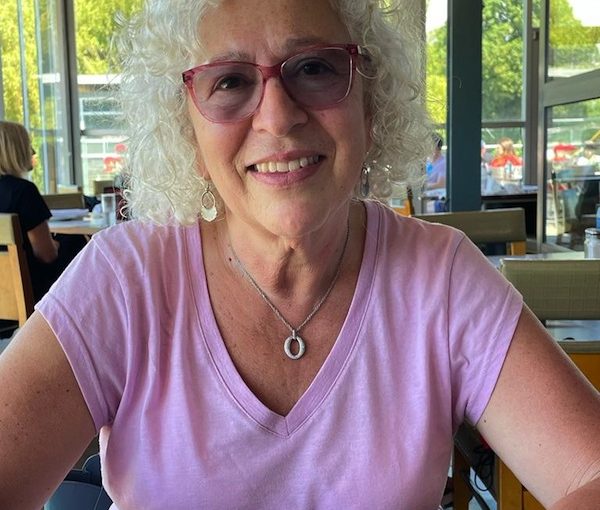
Helen Pinsky still chairs Waldman Library’s Jewish Book Club, which she started in 2015 when she was librarian there. (photo from Helen Pinsky)

Helen Pinsky founded the Waldman Library’s Jewish Book Club in 2015, when she was the librarian there. She has since retired from the position but stays on as the book club chair.

“We started it as a drop-in,” Pinsky told the Independent. “Always once a month, on a last Thursday. People drifted in gradually. Some were library volunteers who wanted to discuss their recent reads. Others were readers who wanted to talk about books. Waldman had book clubs before, on and off for years, but this one has lasted the longest.”

She defined the club’s goal: to foster the love and understanding of books written by Jewish authors or featuring Jewish content. “We try to select books that are entertaining, interesting to many readers. Mostly we read fiction,” she said. “Rarely, we try non-fiction books, but unless they are memoirs, not many people are eager to read or discuss them. We even attempted a separate non-fiction club, but it didn’t work.”

The books selected come from different sources. “I’m a librarian. I listen to what people want to read,” said Pinsky. “Sometimes, I select the books myself. Other times, the library staff might make a suggestion, or the group would vote on the title or author.”

The books that club members have read so far are divided between English-language writers and translated novels. “There are so many outstanding Israeli writers,” said Pinsky. “Our chosen books are not always new. Some of them were published a number of years ago. Often, they are not easy reads.”

But new or old, easy or sophisticated, they are always books with brilliant writing and complex ideas – “great literature exploring universal themes,” she said.

Generally, the club reads mainstream fiction. “We often read historical literature,” Pinsky said. “Not so much about the Holocaust and wars, but stories about Jewish life in other centuries and other countries. Some of our most captivating recent novels talked about the post-Holocaust decades, about the survivors rebuilding their lives.”

To find books for the club, Pinsky regularly scours the Jewish Book Council website. She reads reviews on Goodreads and Amazon. She seeks recommendations from the National Council of Jewish Women.

“We always choose books with multiple copies at the Waldman, as well as at the VPL [Vancouver Public Library] and the Richmond library, so people are not forced to buy them. Occasionally, the book was donated. Then it makes a round on a goodwill system, so every member of the club can read it. We usually announce the titles three or four months in advance, to give people time to read the books.”

The club’s facilitator from the beginning, Pinsky tries to make every meeting interesting in a different way. “I do my research about every book. Usually, in the beginning of a meeting, I would do a bio sketch of the author. Then, before we open a discussion, I would list the main points of the story, maybe a quote or two from the reviews to demonstrate something that caught other readers’ interest,” she explained. “Then we go around the table. Everyone who wants to speak raises their hands. I would ask questions to nudge the conversation. Who is your favourite character? Why? What lesson did you learn from the story? Some people enjoy talking at the meetings. Others keep quiet; they come to listen. I keep a list of speakers, but if someone new, who rarely participates, raises their hands, I bump them to the top of the list.”

In her experience as the club moderator, people are interested in different aspects. “Some read for the plot,” she said. “Others are fascinated by character development or emotional issues. Still others pay the most attention to the quality of writing.”

She said that, occasionally, even if you don’t like a book, it could provide a valuable insight. “We once read a book about Alzheimer’s. I didn’t want to read it,” she admitted. “It seemed too close to my private life. I had a personal experience with this dreadful disease. My mother had Alzheimer’s for years. It was very hard. But the book was written in a remote way that allowed me to maintain emotional distance. Otherwise, I probably couldn’t have read it.”

She shared her opinions about that book with the club, and the discussion was lively. It also veered from that particular book into more personal territory, as everyone had a story to tell.

Besides discussing books, sometimes the club has the privilege of meeting the authors. “If the author is local, I would invite them to speak to us,” Pinsky said. “Often, we tie our book selection to the Jewish Book Festival and organize the club nights to coincide with the author’s public appearances.”

According to Pinsky, the number of participants in the club fluctuates from month to month. Some people come for several months and then stop for various reasons. Some realize they are not interested, while others are devastated to leave the club but have no choice. Sometimes, more than 20 people attend the meetings, but the optimal number is around 10 or 12, said Pinsky.

“As we meet in the daytime, most of our members are retired,” she said. “Although we have younger participants if they are students or have flexible working hours, or if they are library staff. Some of the members are writers themselves. Newcomers to Canada also occasionally join the club to read and discuss Canadian Jewish authors.”

Pinsky stressed that COVID changed the book club atmosphere a lot, as it changed everything else. “During the pandemic,” she said, “we couldn’t meet in person, of course. We had our meetings on Zoom for almost two years. Only the last few months, we resumed out meetings in-person, and some longtime members are still not comfortable meeting face-to-face. New people come in. We might institute some changes to reinvigorate the club.”

The July selection of the club is The Last Rose of Shanghai by Weina Dai Randel, published last year. Everyone is welcome. Send a message to library@jccgv.bc.ca if you’d like to join the discussion.

Olga Livshin is a Vancouver freelance writer. She can be reached at olgagodim@gmail.com.

Broca’s latest mosaics

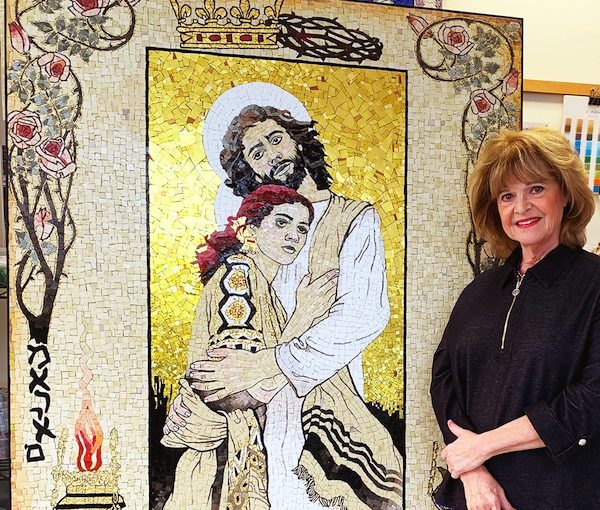
Lilian Broca stands with “Mary Magdalene, The Sacred Union,” which is one of seven panels comprising her current exhibit, Mary Magdalene Resurrected. (photo from Lilian Broca)

Lilian Broca’s artistic canon includes four series on biblical women. The latest, Mary Magdalene Resurrected, is at Il Museo at the Italian Cultural Centre until Aug. 15.

“Each series is an interpretation of a different concern,” Broca told the Independent. “Lilith is the rebel signifying hope for human courage and gender equality. Queen Esther, also courageous and wise, her story addressing the theme of sacrifice and self-empowerment, is actively involved in politics; in her time, known as an almost exclusive masculine realm. Judith, a warrior at heart who single-handedly saves her town from total annihilation, speaks of female effectiveness in the military world – a masculine tradition that she breaks, proving women don’t necessarily excel only in the domestic sphere.

“Unlike Esther and Judith, both actively involved in the masculine domain, Mariam [Mary] is a much more complex figure,” said Broca. “Her story has been greatly redacted in the first couple of centuries CE, leaving us various versions, which offer divergent perspectives of her importance and placement in the life of Yeshua Ben Yosef [Jesus]. One of the concerns in this series is about women’s place, or lack thereof, in institutions – which even in our 21st century – are restrictively based on gender.”

While it may seem odd that Mary Magdalene is included in Broca’s body of work, she reminded the Independent that Mary was “also Jewish until she died, as Christianity did not appear as such until the Edict of Milan in 313 CE and, universally, only at the Council of Nicea in 325 CE.”

A painter for many years, Broca’s Lilith series was created and exhibited in that medium, while Esther, Judith and Mariam are portrayed in mosaics.

“In 2000, I attended The Creation of the World in Jewish and Christian Art with Discussion on Illuminated Manuscripts at the Vancouver Public Library with speakers/presenters Bezalel Narkiss and Dr. Aliza Cohen-Mushlin, both of Israel,” explained Broca. “There, I saw a slide show Bezalel presented on ancient synagogues in the Levant. The Dura Europos in Syria had a beautiful fresco illustrating the Queen Esther story. I was mesmerized and, once home, I started to do some serious research on the Esther stories (more than one version)…. It was during the research that I found out that the palace in which Esther lived with her Persian king, Hashayarshah/Xerxes, had floors ‘encrusted with rubies and porphyry in pleasing designs.’ These were mosaics and, for me, a good omen. I knew I should return to creating mosaics one day, something I experimented with as a student (at 19) but stopped soon after. So, I decided to create the whole Esther series in mosaic glass.”

More than 10 years ago, Broca’s interest in Mary Magdalene was piqued by something she read on the discovery in the 1940s of the Gnostic Gospels, but various circumstances delayed further study, including a visit to her studio by Dr. Adolfo Roitman, curator of the Dead Sea Scrolls, who was in town to give a lecture. He loved the Esther series and suggested she do one on Judith, which she did.

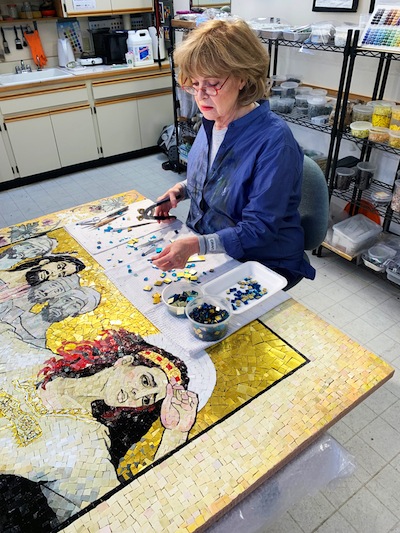
Only in 2016 did Broca return her attention to Mariam. Over eight months, she read dozens of books and essays, and drew and painted the cartoons (drawings for mosaics) for the series now on display. In making the panels, Broca had the help of Adeline Benhammouda, who used to work for Mosaika Studio in Montreal. When Broca was diagnosed with cancer, she asked the studio to make the last two mosaics in the series.

“In the meantime,” said Broca, “the pandemic slowed down activities in all institutions, especially art galleries, and I didn’t know what would happen to my future exhibition.”

The pandemic also temporarily reduced the supply of N95 masks that protected Broca – who suffered a lung infection after her radiation treatment was complete – from the silica dust that results from grinding the glass mosaic tesserae.

One of Broca’s projects as a Shadbolt Independent Scholar at Simon Fraser University was to write a letter describing her activities during the self-isolation months of COVID. All the scholars’ letters were published and Broca’s can be found at the bcreview.ca/2021/02/14/broca-pandemic-magdalene. It is addressed to Mariam and, in it, Broca explains why she chose large (79-by-48-inch) panels for this series.

“In the past, women artists, their works and their stories were mostly associated with the intimate and the small, as though they dared not take up valuable space and time,” she wrote. “As you know from my past art works, I resent that timid notion. My heroines insist and demand the space and importance that long ago was offered to masculine achievements in the military, politics and commerce.

“And, finally, Mariam, after reading so many diverse accusations, betrayals, and the vilification you were subjected to over the centuries, I have decided to express the existence of disparate accounts of your story with text in each mosaic panel, hence the illuminated manuscript composition and unifying motif. Each panel displays three to four lines in an ancient language spoken during your time on earth.”

The languages featured are Aramaic, Hebrew, Ancient Greek, Armenian, Latin, Amharic and Coptic. Broca chose to make seven panels because seven “is a sacred number in the Jewish tradition.”

“Symbolism plays an important part in my artworks and this series is no exception,” Broca told the Independent. “Each drawing includes symbols that are meaningful in both Judaic and Christian traditions. Whether they are flowers, fruit, boats, pottery or textile patterns, these symbols speak of the distant past, yet most of them are recognizable today. Just like an illuminated manuscript page, I sought to illuminate what lies hidden or repressed through the symbols on the borders of each ‘page.’ Hopefully, through them, new ideas can be brought to life.”

photo - Lilian Broca working on the panel “Mary Magdalene, Defiled and Defamed.” Her exhibit, Mary Magdalene Resurrected, is at Il Museo until Aug. 15
Lilian Broca working on the panel “Mary Magdalene, Defiled and Defamed.” Her exhibit, Mary Magdalene Resurrected, is at Il Museo until Aug. 15. (photo from Lilian Broca)

While the Esther and Judith stories have a beginning and an end, Broca said, “Mariam unfortunately is a figure that appears suddenly in Yeshua’s (arguably) 33rd year and disappears right after the Crucifixion that same year. The Gnostic Gospels and other historical documentation that refer to her following the crucifixion are interwoven with legend and myth, none of which is accepted by academics. I chose scenes from all sources, scenes that I felt relayed best her high social status during Yeshua’s life, the love and closeness the two shared, her marginalization once Yeshua died and there was no one to protect her against the ill will and jealousy of the Apostles, the relationship with Mary the Virgin and, finally, my personal vision of a balanced religion, any religion.”

For the series, Broca studied the history of the Jews in the first-century BCE to first-century CE period. “I loved all that research,” said Broca. “I learned so much about Judaism in the process. It was reassuring to read Yeshua’s Jewish parables and to realize that he was very, very concerned with the lack of faith he found in the small beit hamidrash(es) they had in those days and, of course, in the temple. The political situation at that time was extremely complex and the ‘ruling class’ of Sadducees and Pharisees kept the masses in poverty while most of them aligned themselves with the Romans and became wealthier than they had ever dreamed. Yeshua never planned on starting a new religion; on the contrary, he wanted a return to the old ways. My understanding is that the 12 disciples were responsible for all the changes that ensued after Yeshua’s death.”

During the drawing stage of the series, Broca said she consulted two academics – Dr. Mary Ann Beavis and Margaret Starbird – about “‘how far can I push the envelope?’ before I get reprimanded by Christians for profanity or blasphemy.” For instance, wondered Broca, is it OK to portray Jesus washing Mary Magdelene’s feet?

“Each time I heard their answers,” said Broca, “I weighed them carefully, because, after all, I do retain an artistic licence for expressing my own perspective in art. But, at the same time, as a Jewish woman (not a Jewish artist) who embarks on a sensitive subject, I had to make sure I respect the Christian beliefs. I would not appreciate a Christian person making art that endorses what I consider derogatory Jewish images or symbolism.”

At the exhibit’s opening, Broca said, “I am not a theologian nor a religious person and my point of view remains, as always, a feminist one.”

She noted, “Mary Magdalene lived in a strict patriarchal society when women had few rights and freedoms, yet she left her sanctuary, her home and family, in order to follow a single man, without a job or an income, without a fixed address, a man traveling with an entourage of 12 other men spreading the word of God.”

She said, “For 20 centuries, Yeshua, or Jesus, has been both a bridge and a barrier between the Jewish and the Christian faiths. Although I find Jesus equally fascinating, this body of work here, is not about him. It is strictly about his favourite and beloved disciple, Mary the Magdalene.”

The documentary Mary Magdalene in Conversation with Lilian Broca is in post-production. The film, for which Broca wrote the script, is fully subsidized by the Canada Council for the Arts. It follows the journal Broca started in early 2016, when she embarked on her research.

“My hope is that the Mary Magdalene series will open new avenues to perceive the hugely influential relationship between Yeshua and Mariam … as well as considering what happened to that relationship in the hands of the male founders of Christianity,” said Broca. “In addition, I hope that, through my Mariam mosaics, viewers will be profoundly motivated to reexamine this whole critical episode of human history.”

In a 2020 article, Italian Cultural Centre director and curator Angela Clarke spoke in this context about Broca’s body of work as a whole, noting: “Through her mosaics, Broca looks to glass shards as a means to remind viewers that the traditional paradigms associated with traditional institutions and power dynamics can be broken through and reconstructed into a world that is more healing.”

For more on Broca, visit lilianbroca.com. For more on the exhibit, visit italianculturalcentre.ca.

Picturing connections

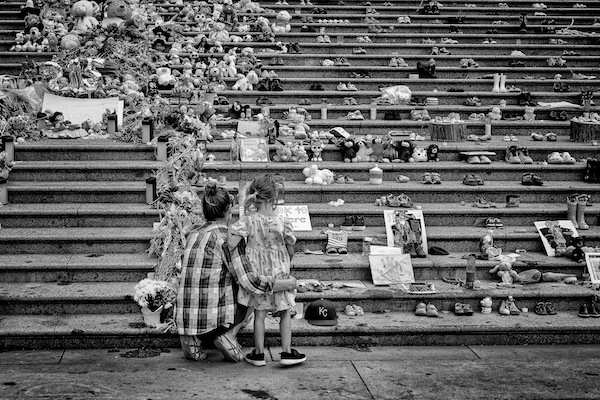
“Remembrance” by Michael Shevloff. Part of PhotoClub Vancouver’s Connections exhibit at Zack Gallery until June 27.

Whenever a photographer – amateur or experienced – snaps a picture, they establish a connection between themself and their subject. They shout to the world that this image at this time and in this place is an important occurrence and should be preserved and treasured.

The PhotoClub Vancouver group show, Connections, opened June 2 at the Zack Gallery. People and birds, industrial cityscapes and soothing nature shots, close-ups and panoramas – every image in the exhibit tells a story about the world and the photographer’s place in it.

The club was officially established in 1998. Its friendly, non-competitive environment for photographers of all skill levels encourages members to develop their technical and artistic abilities through various activities, including peer critique, field trips, workshops and seminars. And, of course, exhibitions like Connections, which allow members to share their art beyond the group.

Some of the photographers took the Connections theme literally, like Ivor Levin’s “Roped In.” The orange ropes in the image are taut and sure, but the objects they hold together are left outside the frame. Only the connection itself is important to the artist.

A similar approach characterizes Lynn Copeland’s “Cranes and Planes.” The image’s graphic simplicity is almost abstract, as the harsh lines of the industrial cityscape, viewed on the background of the distant sky, induces the sense of a steel labyrinth where any uninitiated human would be lost.

Barb Kaiser’s “Hanging Around” also includes ropes as the connecting medium, but the feeling it inspires is vastly different. A window washer hangs in his harness in the foreground, doing his job. Behind him, a skyscraper-studded panorama of North Vancouver is visible in all its urban majesty. We are all connected, the image seems to say, in every window of every building.

Unlike the stark, sharp-angled industrial imagery, logical and attractive on a cerebral level, the pictures reflecting nature flaunt softer lines. They appeal to our emotions. For example, Terry Beaupre’s “Canada Geese Flying Off Together” depicts two geese. Their dark silhouettes soaring together on the background of a pink sunset evoke ideas of love and companionship. “I couldn’t have asked them to pose more perfectly for me,” Beaupre says in her artist’s statement, although she admits that she painted the dramatic colours of the sunset later on, to enhance the picture.

photo - Terry Beaupre’s “Canada Geese Flying Off Together”
Terry Beaupre’s “Canada Geese Flying Off Together.”

The grace of a couple in love is also implied in another bird picture – Levin’s “Peck.” The two doves in the image are sharing a kiss. Or maybe they are sharing a bug to eat. Whatever they are sharing, their affection for each other is unmistakable and heartwarming.

The charm of the loving doves is absent in Drago Tutnjevic’s “Bus Stop.” The four people standing in line to board a bus are strangers. Their estrangement is made even more obvious by the fact that three of them are absorbed in their phones. The one not on the phone looks straight ahead, thinking her own thoughts. No doubt, each of the passengers has multiple connections – their friends, family and others – but here, at this bus stop, nothing connects them except the expectation of the bus itself. The photo reflects the complex networks that link us all, as well as the separateness of every person in our huge technology-permeated world.

In contrast, a simple path in the park, portrayed in John Konovsky’s “Onward No Matter What,” reminds us of the mysteries of childhood adventures and the romantic wandering of our youth.

Another image reminiscent of the joy of childhood is David Beaver’s “Balloon Man.” Even in black and white, the man holding bunches of balloons in both hands brings to mind birthday parties and vacation frolicking. The photo is part of the club’s Henry Ballon B&W Challenge.

photo - "Line S" by Ivor Levin
“Line S” by Ivor Levin.

An entire wall of the gallery is reserved for the black and white photographs, by different photographers, all parts of the challenge, which was started in 2015 in memory of the late Henry Ballon. Ballon was an avid monochrome photographer and advocated photography with minimum retouching by any software. Club members honour Ballon by creating their own art using his principles. The photos demonstrate how deep the artists can reach, even if their expression palette is limited to the gradations of black and white.

But the most visceral and poignant image in this exhibition is “Remembrance” by Michael Shevloff. A mother crouches beside her young daughter in front of a staircase. Their backs are to the viewer. They face the stairs together, just like everyone who looks at this photograph. And on the stairs reside memories. Toys. Shoes. Hats. Books. No people. What does this young mother tell her child? Who were the owners of the objects on this staircase? What happened to them? Where? When? The photograph raises many questions, and all of them remain unanswered – unless the artist decides to answer them, which Shevloff did.

“The photo was taken at the Vancouver Art Gallery, where there was an outdoor installation commemorating the discovery of the unmarked graves found at a residential school recently. It affected many people and brought a dark period of history to light. Flags were lowered across Canada for many months.

“I took the photo on July 1st of 2021. Normally on Canada Day, there are parades and many people celebrating our history. However, last year, with the pandemic and the dark events I mentioned above, it seemed like no one was celebrating our national day.

“In the photo a woman is talking to her child. In my mind, I tried to imagine how she would be explaining the memorial and the events surrounding it to her daughter. Just as the memory of the dead children is elicited by the installation, the mother and child are also photographed from behind and also remain nameless in time.”

Connections is on display until June 27. For more information, check out photoclubvancouver.com.

Olga Livshin is a Vancouver freelance writer. She can be reached at olgagodim@gmail.com.

Explorations of identity

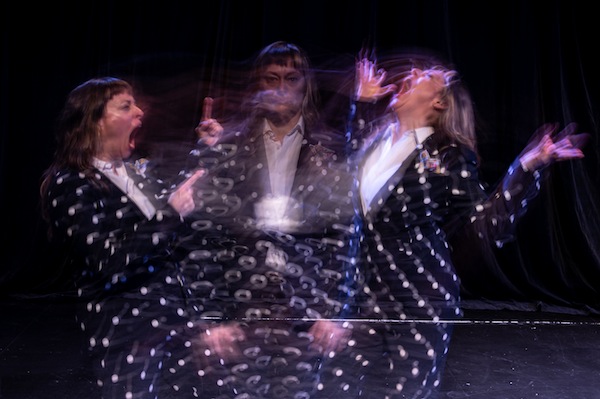
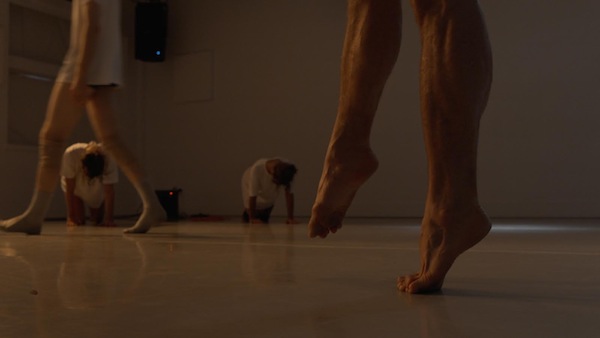
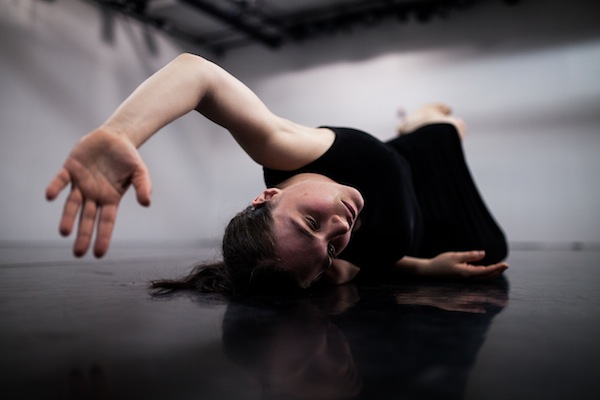
Jewish artists participating in Dancing on the Edge July 7-16 include Tara Cheyenne Friedenberg in Pants. (photo by Wendy D Photography)

Several Jewish community artists are part of the 34th annual Dancing on the Edge lineup, which includes more than 30 productions July 7-16.

Tara Cheyenne Friedenberg will share part of a new solo called Pants, which is a work-in-progress. Tasha Faye Evans will perform in the première of Raven Spirit Dance’s Confluence and Vanessa Goodman’s Core/Us will see its local debut. Rebecca Margolick will bring the now-complete solo Bunker + Vault to the festival, whose home base is the Firehall Arts Centre.

Of Pants, Cheyenne Friedenberg said, “The full-length show will premiere at the Firehall in the ’23/24 season and centres around my experience as a ‘mostly’ female-identifying person who has been questioning the gender binary in private and in my art practice all my life. The younger generation, including my child, is inspiring the challenging of the gender binary in ways my generation never had the language for. Pants uses personal narrative comedy/stand-up and dance to trace how gender stereotypes and expectations affect a life, an identity, and how poking holes in all of it can bring healing and catharsis.”

She noted, “The piece is being created with consultation, interviews and collaboration from a variety of artists working outside the gender binary.”

Cheyenne Friedenberg created Pants in collaboration with choreographer Kate Franklin, theatre artist Cameron Mackenzie (ZeeZee Theatre) and dramaturge Joanna Garfinkel (who is also a member of the Jewish community).

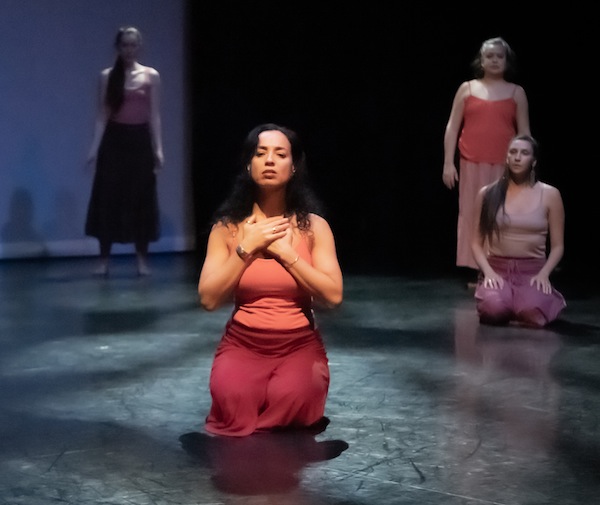
Evans is a theatre and dance artist, writer and festival producer, with Coast Salish, Welsh, and European Jewish heritage. She described Raven Spirit Dance’s Confluence as “a beautiful weaving of Indigenous women from across these lands. The piece is about the things we carry as women, how we hold each other and how the land holds all of us.

“The piece,” she said, “was shared two years ago at the Talking Stick Festival and, days later, we all went into lockdown and our worlds changed.”

photo - Tasha Faye Evans in Raven Spirit Dance’s Confluence
Tasha Faye Evans in Raven Spirit Dance’s Confluence. (photo by Erik Zennström)

When theatres began to reopen, Confluence was the first piece that brought Raven Spirit together again – they performed an excerpt of it at Dancing on the Edge. “This year,” said Evans, “we are delighted to be brought together again, premièring the work and being able to take a deep breath together as life continues to unfold in these unprecedented times.”

Goodman’s Core/Us is a new group work that she has been in the process of creating on and off since the fall of 2019. During the piece, which runs about 70 minutes, Goodman said “four dancers transverse our perception of how we hear movement and see sound, with mesmerizing results. The live movement and sound score sculpt an ever-evolving atmosphere that builds gravity for the body. Patiently shifting states and layers of momentum define this piece, marked by its immersive world-building. The work asks for both tenderness and strength from the performing artists.”

photo - Vanessa Goodman’s Core/Us
Vanessa Goodman’s Core/Us. (photo by David Cooper)

Core/Us will be performed by Anya Saugstad, Eowynn Enquist, Ted Littlemore and Adrian de Leeuw with lighting by James Proudfoot. Shion Skye Carter and Sarah Formosa have also been a part of the creative process, said Goodman.

The group has worked closely with artist Brady Marks on the piece. “Her incredible knowledge of sonic composition has made a deep impact on our process together,” said Goodman. “We are looking forward to sharing the work in Seattle with On the Boards and Velocity just before DOTE, then we are excited to première it here in July.”

photo - Rebecca Margolick in Bunker + Vault
Rebecca Margolick in Bunker + Vault(photo by Maxx Berkowitz)

Margolick has performed the first 10 minutes of the solo Bunker + Vault in Vancouver previously and said she is excited to be bringing the full show to DOTE.

“It’s now a finished 35-minute solo,” she said. “I showed 20 minutes in Montreal, and I showed the full piece in Carcassonne, France, and in San José, Costa Rica, once in November 2021 and just recently in May 2022.

“The work is very much based on personal experience,” she continued. “In it, there is a lot of imagery steeped in memory, women, mothers, womb and resilience. Some inspiration and imagery in the solo came from reading through the archives at the 92nd St Y in New York City detailing the lives of immigrant Jewish women, from 1890 to 1950, residing at the Clara de Hirsch Home for Working Girls, and where and how my experience has overlapped with theirs.”

Dancing on the Edge takes place at Firehall Arts Centre, Scotiabank Dance Centre and various other locations. It also features online performances, as well as dance films and discussions. Tickets are pay-what-you-wish from $15 to $35, and offsite outdoor performances are free. For tickets and more information, visit dancingontheedge.org.

Ancient-modern music

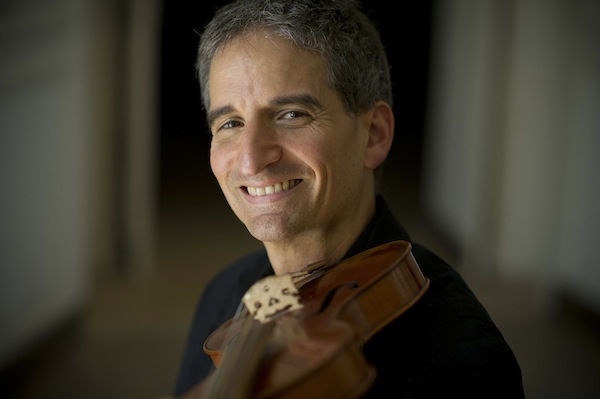
Artist-in-residence David Greenberg has multiple performances at this year’s Vancouver Bach Festival: Scottish Baroque and Other Traditions. (photo by J.B. Millot)

Violinist David Greenberg teaches a course called Cape Breton-Baroque Integration, which is “devoted to creating living moments on the violin through the art of ‘keeping it swirly.’” He keeps it swirly by a range of techniques, but the intangible part derives from his love of Baroque and Cape Breton music.

Greenberg is co-artist-in-residence at Early Music Vancouver this year along with David McGuinness, and the pair will play in a few performances as part of this summer’s Vancouver Bach Festival: Scottish Baroque and Other Traditions, which takes place July 26 to Aug. 6 at various venues in Vancouver.

Early Music Vancouver’s artists-in-residence program started last summer, with Cree-Métis Two-Spirit baritone Jonathon Adams. The program was initiated by EMV artistic and executive director Suzie LeBlanc “to honour Canada’s diverse heritages while at the same time exploring the convergences between ‘world music’ and early music.” Greenberg came to be an artist-in-residence through his connection to LeBlanc, who is an interdisciplinary artist – he has performed with her many times over the years.

“Many of those collaborations involved a degree of integration between folk and Baroque music,” Greenberg told the Independent. “Often, those collaborations included David McGuinness, who is also a close friend and colleague from Glasgow, a scholar of 18th-century Scottish music, a brilliant musician on various keyboard instruments and the founder and director of Concerto Caledonia.

“David and I have worked together for over 20 years,” said Greenberg, “mostly on projects that involve some degree of Baroque-traditional stylistic integration. Suzie asked David and me to be co-artists-in-residence for the 2022 festival since this year’s theme is the integration of Baroque and Scottish traditional music.

“Over the two-week festival … David and I will perform solo, chamber and orchestral concerts. We will also coach young musicians and perform with BOMP (Baroque Orchestra Mentorship Program) as part of our activities.”

Greenberg was born in Washington, D.C., and grew up in Maryland. He lived in Canada for 30 years, but is currently living in Corvallis, Ore.

A graduate of Indiana University’s Early Music Institute, he has performed, taught and recorded in multiple places around the world, but mainly in North America and Western Europe. In addition to LeBlanc, he has performed with more than a dozen groups and performers, and been a guest soloist and/or director with several orchestras. Between these collaborations and his own ensemble Puirt a Baroque (pronounced poorsht-a-baroque, and meaning tunes from the Baroque), he has recorded more than 80 CDs. As well, he is a composer and arranger, and he co-authored Traditional Celtic Violin Music of Cape Breton: The DunGreen Collection with Kate Dunlay.

“I started playing at age 4, dabbled in both classical music and traditional folk fiddle as a kid, went to conservatory and got depressed, switched over to Early Music performance, which suited my temperament better, and joined Tafelmusik (Toronto-based Baroque orchestra) for a decade in the ’90s,” said Greenberg.

“Alongside my Baroque playing, I dove into learning the Cape Breton fiddle style, started a few bands, worked with many colleagues around the world…. The combination of the Baroque and Cape Breton musical languages is where my sense of 18th-century Scottish violin music comes from. Italian and Scottish composers are connected by way of some Italians living and working in Scotland in the 18th century, resulting in an inevitable mixing of the styles, though to what degree is a matter of opinion.”

He said the fun thing about the Baroque and Cape Breton styles “is how their esthetic hierarchies are totally different. So that means they work as effective comic relief for each other! Cape Breton music is basically the continued, naturally evolving, living tradition of 18th-century Scottish Highland fiddling. A strange fact is that Baroque music was popular in Scotland about 50 years beyond when it died out in continental Europe. That means that the Scottish traditional music and Scottish Baroque music coexisted side-by-side in 18th-century Scotland, including many examples of music that lie somewhere between the two styles.”

Greenberg plays a Baroque-style violin made in 2000 by Masa Inokuchi in Toronto. He said, “Cape Breton music is played on a modern fiddle these days, but it works on a Baroque fiddle within the appropriate context.”

And as for a little more context on Greenberg and his musical range, he shared, “My mom has always loved singing Yiddish songs and accompanying herself on the piano. I enjoy backing her up on fiddle when I visit her.”

For tickets go to the Vancouver Bach Festival, visit earlymusic.bc.ca.

After COVID – Showtime!

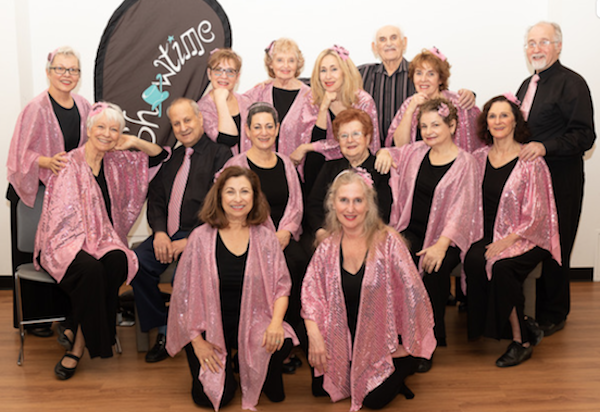
Back row, left to right: Jocelyne Hallé, Debbie Cossever, Nassa Selwyn, Susan Goldstein, Arnold Selwyn, Karon Shear and Marshall Berger. Middle row, left to right: Beryl Israel, Maurice Moses, Daniella Givon, Muriel Morris, Dawn Hurwitz and Rona Black. In front: Sara Bernstein, left, and Tamar Glaser. (photo by Jocelyne Hallé)

Shortly after she arrived in Vancouver from South Africa, in 2002, Beryl Israel founded Showtime, a seniors’ singing and dancing group. In the decades since, Showtime participants have performed 230 concerts. After a hiatus forced by the global pandemic, Showtimers are back to rehearsals, hoping to have their first public performance in September or October.

“It’s old-time, happy favourites, from the movies and from Broadway shows,” Israel said of the Showtime repertoire.

For most of the group’s history, rehearsals took place at the Jewish Community Centre of Greater Vancouver, but, as rehearsals return, they will be meeting at Kerrisdale Community Centre. Concerts are performed wherever they can bring happiness and good memories – community centres, church groups and Jewish venues like the Richmond Kehila Seniors, the Louis Brier Home and Hospital and the Weinberg Residence.

From the start, 20 years ago, the group – which usually consists of about 16 performers, many of whom are Jewish – has done a concert every three or four weeks. That came to an abrupt halt with the arrival of COVID. Now, as the group plans the first post-pandemic activity, Showtimers are reflecting on what the group – and Israel in particular – has meant to them. In a series of testimonials collected by participant Karon Shear, members spoke of the impact of their participation in general and of their friendship with Israel. The testimonials were compiled “behind my back!” Israel noted, and were shared in Senior Line, the publication of the Jewish Seniors Alliance of Greater Vancouver.

Muriel Morris, who has just retired as the group’s pianist, said the Showtime experience was important at a pivotal time in her life.

“Beryl came into my life shortly after Ben, my husband, died,” said the musician. “Meeting her was so fortunate for me. Showtime filled a great void in my life, as pianist of the group, giving pleasure to all our audiences and giving myself a true feeling of well-being and fulfilment.”

With Morris’s departure, the group will sing to music recorded by North Shore musician Bob York.

photo - Beryl Israel founded Showtime shortly after she arrived in Vancouver from South Africa, in 2002
Beryl Israel founded Showtime shortly after she arrived in Vancouver from South Africa, in 2002. (photo by Jennifer Friezen)

“We’re very privileged and lucky that he’s done this for us,” Israel said.

While Showtime includes a cadre of singers and dancers, Israel alone fills many roles.

“I’m the everything,” she said with a laugh. “I’m the director, producer, choreographer, I make the costumes, I do the arrangements, I do the bookings. I ended up doing it all.”

Most of the performers are north of 70.

“I don’t know what’s happened with the 60-to-70 age group,” she said. “They sort of disappeared.”

A number of the most active participants are in their 90s – and maybe singing and dancing keeps them young.

“It’s very rewarding, both for participants and for the audience,” Israel said, a theme reflected in the many testimonials collected by Shear.

“I love the costumes, the rehearsals, being on the stage, singing and dancing and entertaining folks,” said singer Debbie Cossever. “Beryl gave me the opportunity to use my talents bringing joy to the lives of seniors. I have been with her troupe for 17 years

because I love it! I am so proud I am a Showtimer.”

“Beryl has enhanced my life and my dreams have been fulfilled,” said singer and dancer Sara Bernstein. “It has been an honour over the 17 years being part of Showtime. I witnessed how people sprung up from wheelchairs in elation of the dance, costumes and musical joy Beryl produced. I shall never forget seeing stroke victims joyfully tapping a finger or toe in unrestrained elation. Caregivers and staff mentioned that the residual energy of the shows carried on for days.”

“Although my stage presence in acting and singing goes back over 75 years,” Arnold Selwyn added, “the last 16 years, performing with Beryl’s Showtime group, has given me, without a doubt, the most satisfaction and pleasure. Her professionalism, choice of content and skill of program arranging, makes each show run smoothly and [be] enjoyable for the varied audiences. It is a joy to work with her and watching her dance is a delight.”

“Thank you for giving me the opportunity to do a mitzvah (again and again) while I do some of the things I love most – singing and dancing,” said Daniella Givon. “It is a pleasure to bring light and colour, music and movement to those who are wheelchair-bound, who cannot live on their own and who need special care. Every time I see our audience smile, nod their head, clap their hands and sing with us, I know this mitzvah counts.”

Song in My Heart delights

Spring forum? What spring? Heavy rain and cold weather welcomed Jewish Senior Alliance’s spring forum that took place at the Peretz Centre for Secular Jewish Culture May 15. But the forum’s title, With a Song in My Heart, was more than fitting and filled the audience with warmth and, I would add to it, “And a Smile on My Face.”

The first hybrid program of JSA attracted 40 people attending in-person, as well as another 40 people by streaming links. Gyda Chud, co-president of JSA, welcomed the audience and reminded them of the work JSA does in outreach, advocacy and, especially, peer support.

The program featured Wendy Bross Stuart, ethnomusicologist, music director, composer and piano accompanist, and was dedicated to the memory of two musicians of exceptional talent: Claire Klein Osipov z”l and Joan Beckow z”l. Bross Stuart said she was pleased to have been able to engage three superb singers for the performance – Erin Aberle-Palm, Kat Palmer and Chris Adams, who delighted the audience with not only their beautiful voices but also with their charming stage presence.

The program started with the beautiful title song, “With a Song in My Heart,” which is a show tune from the 1929 Rodgers and Hart musical Spring is Here.

Bross Stuart spoke about the Joan Beckow Legacy Project, started by Bross Stuart’s daughter, musician and composer Jessica Stuart, which spotlights works of the brilliant, prolific and totally under-celebrated composer, who died in January 2021. Beckow had been Michael Bublé’s vocal coach, as well as Carol Burnett’s music director. She wrote “Pretending” to capture the sense of wonder provided by “Somewhere Over the Rainbow.” Burnett learned it in a day and it became part of their production.

The forum performance included the Hebrew song “Tov L’Hodot,” as well as George Gershwin’s “Someone to Watch Over Me,” which was most famously sung by Ella Fitzgerald. It continued with my all-time favourite Yiddish song, “Oyfn Pripetshik,” which made me think of my mother, followed by “Rozhinkes mit Mandlen,” which prompted many in the audience to sing along.

“Guided by the Stars” was a conversation between husband (Captain Cook) and wife, who pleaded him to be careful upon his forthcoming voyage. Alas, Captain Cook’s life came to a fatal end on that last journey.

While almost all of us are familiar with the song “Somewhere Over the Rainbow,” how many of us know that it was written by sons of Jewish immigrants from Eastern Europe, who escaped the pogroms to “a land they only imagined in their dreams”? Edgar Yispel (Yip) and Harold Alan wrote the song for The Wizard of Oz, which came out on New Year’s Day 1939, less than two months after Kristallnacht. The music is deeply embedded in the Jewish experience, and the lyrics become more about Jewish survival than wizards.

A medley from Fiddler on the Roof further entertained listeners, followed by Beckow’s “On the Other Side of Nowhere.” Her son, David Beckow, selected his mother’s lyrics to inscribe on her gravestone: “When this life is over, we will meet somehow, on the other side of nowhere, on the far side of now.”

The performance ended with a singalong of “Tum Balalaika” and an encore of “Dona Dona.”

Shanie Levin thanked the performers and spoke of the importance of remembering and honouring Beckow and Klein Osipov.

The next JSA event takes place on June 27, 1 p.m., at Congregation Beth Tikvah, and features tenor Gustavo Herrera. The hybrid event is co-sponsored by Kehila Society and the synagogue; if attending the lunch portion, the cost is $12. Register by June 24 with Toby Rubin, trubin@kehilasociety.org, or via jsalliance.org.

Tamara Frankel is a member of the board of Jewish Seniors Alliance and of the editorial committee of Senior Line magazine.

Poetry-art book launch and exhibit

Suzy Birstein’s “Ladies-not-Waiting: Harlequin Zsa Zsa.” (photo from  ParkerArtSalon)

Suzy Birstein’s “Ladies-not-Waiting: Harlequin Zsa Zsa,” made of fired ceramic with glazes and lusters, is featured in the book the poetry project: where poetry expands upon a visual idea, published by ParkerArtSalon. The artwork is accompanied by a poem it inspired, written by Majka Pauchly: “I’m not home décor / I shift on the shelf, and plot / To make my next move.”

Beedie Luminaries students were invited to participate in the project by submitting a work of poetry, inspired by a selection of art provided by the ParkerArtSalon artists. The book launch and an exhibit of the poems with the corresponding artwork by the artists – who also include Miriam Aroeste – takes place at Gallery George June 1-July 3, Wednesday-Sunday, noon-5 p.m., with the official opening weekend June 4-5, 2-4 p.m., with artists in attendance. Visit parkerartsalon.com for details.

– Courtesy ParkerArtSalon

Battling over-diagnosis

Dr. Shoshana Levin Fox’s An Autism Casebook for Parents and Practitioners: The Child Behind the Symptomswill hold you spellbound. Section I is titled “Children.” These first eight chapters are the stories of Jack, Sasha, Annie and others (all the children’s names used are pseudonyms) – children who came into the Feuerstein Institute after having been diagnosed as autistic. They exited with new hope, not only for themselves, but for their parents, who needed their own emotional propping up.

Levin Fox is a psychologist and play therapist who has worked with children for more than 30 years. In addition to lecturing and giving workshops in North America, Israel and Europe, she worked for 25 years in the Feuerstein Institute of Jerusalem, founded by the late Sorbonne-educated Prof. Reuven Feuerstein.

Levin Fox lived for nearly 20 years in Canada. She completed a master’s at Simon Fraser University and a doctorate in counseling psychology at the University of British Columbia. She worked for many years as a counselor in the Special Services to Children and Families program of the Association of Neighbourhood Houses of British Columbia. Levin Fox was awarded a Social Sciences and Humanities Research Council of Canada post-doctoral fellowship, which enabled her to do research and practical work in the field of autism at the Feuerstein Institute. Coincidentally, for many years, Hadassah-WIZO Canada were prime funders of the institute’s programs related to autism.

image - An Autism Casebook for Parents and Practitioners book coverI recommend the book, not just for the moving stories of the children who were saved from what proved to be inaccurate assessments, and not only for the intriguing descriptions of the practices of the Feuerstein Institute, which Levin Fox combined with the DIRFloortime method. This book should be read for its critical message to parents who have received an autism diagnosis – or one of learning disabilities, ADHD, or other emotional, cognitive or developmental challenges – for their son or daughter: Believe in your child. Talk to your child. Keep looking till you find her the best and most appropriate help and hope. Don’t let the “experts” get you down, because a true expert will find the formula to lift you – and your child – up.

The idea of plasticity of the brain, writes Levin Fox, entered mainstream medicine several generations after Feuerstein had intuited and created materials and methods based on that reality. Levin Fox decries the fact that “the diagnosis of autism is used as a sacrosanct truism…. I have found that the term ‘autism,’ as it appears commonly in the field, in actuality is being used to describe children who suffer from a vast range of communication difficulties, from extreme shyness to psychotic conditions and just about everything in between.”

The children whose stories are recounted in this book all made significant progress. Levin Fox writes, “Not every child began to speak fluently, to learn at a normative level and to play happily with friends…. However, it can be safely and honestly stated that, inspired and mentored by the professor, my colleagues and I made a huge difference in the lives of hundreds of children originally thought to be autistic.” She sees them, as a team, as having saved many lives.

Feuerstein sought to find a child’s latent strengths, and what he called “islets of normalcy.” Levin Fox explains that “islets of normalcy” include, among other elements, eye contact, human relationships, symbolic play, curiosity, humour and more.” She emphasizes that helping parents understand their children’s challenges, and not to be fearful and depressed about them, is part of the battle.

In Part II, “Theoretical Groundings,” Levin Fox gives the intense and thorough theoretical background to the success stories, which are plentiful. Six more case studies are interwoven in the text to help bring the theory alive.

This section also describes the roots of Feuerstein’s methods. He began by working with orphan children who had been traumatized after the Second World War, decided there were flaws in the standard diagnostic tests and, rather than focusing on performance, he focused on the child’s ability to develop learning processes.

“Current studies on brain plasticity … scientifically substantiates what [Feuerstein] proposed two generations ago – that brain cells are modifiable and respond to the stimuli of the environment,” writes Levin Fox.

One of my favourite stories is in Chapter 15, where Levin Fox talks about Ben, whom she first met when he was 5 years old. The end of the chapter, with the sub-heading, “Ben’s Epilogue,” describes a chance meeting between Levin Fox and Ben’s parents, many years later, at an airport. “Dr. Shoshana!” they called out, and his mother pulled out her cellphone. “The happy faces of Ben and his wife, holding their newborn son, smiled back at me,” writes Levin Fox. “For Ben, the paradigm-shift had indeed been life-saving.”

I found other words to describe the journeys and miracles of the children portrayed in this book: life-affirming.

And hope.

Toby Klein Greenwald is an award-winning journalist, educational theatre director, teacher and the editor-in-chief of wholefamily.com. A longer version of this article appears at jewishlink.news/features/47241-the-child-behind-the-diagnosis and elsewhere online.