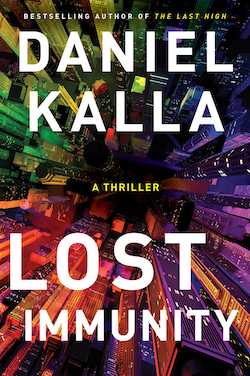
There’s something comforting about reading a thriller writer whose novels you’ve enjoyed in the past. You know exactly what to expect, and yet the pages almost turn themselves. Given, however, that we’ve been living through a real pandemic for almost two years now, it might feel “too close to home” to pick up a Daniel Kalla – who writes about mysterious diseases that run rampant, plagues that resurface, surging deaths from opioids and other such things – but, somehow, he makes it fun rather than depressing. His latest, Lost Immunity (Simon & Schuster), is a great read.
It helps that Kalla is a real medical doctor. An emergency room physician here in Vancouver, he knows that of which he speaks and can relate complicated information without sounding didactic. And there’s always what to explain in his books. In Lost Immunity, the lessons are particularly relevant, about how a bacteria spreads, the challenges of contact tracing and containment, the benefits and side effects of vaccines, the concept of herd immunity, etc., etc. But he does all this while being completely entertaining. Readers of Lost Immunity will have an idea of what Dr. Bonnie Henry and her team have been going through these last many months – minus (I hope) the human killer element.
Lost Immunity features a smart and likeable protagonist in Lisa Dyer, Seattle’s new chief public health officer. In a community health forum about a law mandating immunization for middle-school girls and boys with the latest HPV vaccine, Dyer takes on the doubters – members of “the ‘vaccine hesitancy’ community” – calmly and compassionately, with science always as her guide. Within this community are her own sister and father, so she’s had much practice.
As exhausting and frustrating as the forum is, Dyer’s job gets more challenging even before the Q&A is over – “her phone buzzes on the lectern. She can’t help but glance down at the health advisory from her office that pops up on the screen. ‘Four dead from meningitis. All attended the same local Bible camp.’”
The campers are children and teenagers, and the death rate rises quickly. (I admit to having skimmed the parts about dying kids, as they added a little too much realism for me.) Dyer and her colleagues must try to contain the outbreak – of the same strain of bacteria that caused 35 deaths in short order in Iceland six months earlier, and for which an American pharmaceutical firm is doing final-phase trials on a promising vaccine. Dyer pressures the company into releasing the vaccine early – as the mortality rate in Iceland was 46% – and goes ahead with a vaccination campaign. At first, it seems to be working, but then some severe and fatal apparent side effects bring everything to a halt. But is it really the vaccine that’s responsible? Even if you can probably guess the answer, Dyer’s journey to get there is full of twists, as well as fascinating exchanges on all aspects of the vaccination issue.
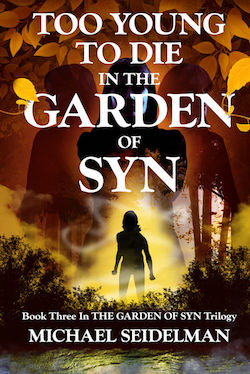
After a three-year wait, local writer Michael Seidelman’s Garden of Syn trilogy comes to a fast-paced, satisfying conclusion.
We first met our protagonist, Synthia Wade, in No One Dies in the Garden of Syn, which was released in 2016. (All of the books are published by Chewed Pencil Press.) A teenager when we encounter her, she is being parented by her aunt, as her parents went missing when she was 5 years old. In Book 1, due to circumstances beyond her control, Syn falls into another universe – one in which she can breathe easily, her cystic fibrosis nonexistent. But all is not healthy in the garden, as this other place is called, and Syn must rise to many challenges and challengers to set things right.
There are multiple universes in this trilogy, each with their own Syn, and, in at least one of them, Syn has a sister, Beth. The second book, Everyone Dies in the Garden of Syn, which came out in 2018, focuses on Syn’s efforts to rescue Beth, who has been kidnapped. Unfortunately, because of Syn’s actions, the healing powers of the garden disappear, hence, the name of this part of the story. Syn must take particular care, given her CF.
Many people die in the second book. So, at the beginning of the third book, feeling responsible and guilty for the tragedies, Syn doesn’t want to return to the garden. However, a determined friend-turned-enemy forces Syn to finish what she started. In the conclusion to the series, Too Young to Die in the Garden of Syn, Syn must fight to save the garden and its inhabitants, at the risk of her own life.
The plot that runs through the trilogy is complex. Characters thought dead turn out not to be, characters that seem like allies turn out not to be and vice versa, and, given the multiverses, there are numerous versions of key personnel. As well, the story tackles many ethical issues, mainly involving medical research and experimentation. The novels also illustrate that who the hero of a story is depends on who’s telling the story – the bad guys in Seidelman’s fictional worlds don’t think they’re in the wrong; in fact, they have good reason to feel aggrieved and betrayed.
The action doesn’t lose momentum in this third book and Syn and her allies must race and jump around universes, fight and think for their lives – and the lives of many others. Though I was both hoping and fearing Seidelman would wrap things up more darkly, I think he made the right choice for his young adult audience.
Too Young to Die in the Garden of Syn was worth the wait.
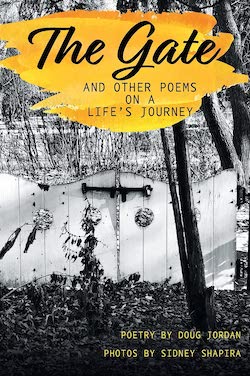
For anyone who has thought about publishing their own story, poems, photos, artwork – really, anything they have created – The Gate and Other Poems on a Life’s Journey (FriesenPress) should be an inspiration to just do it already.
This book of poetry by Winnipeggers Doug Jordan, with editing and photography by my cousin Sidney Shapira, is a wonderful example of what we are capable of creating when we stop thinking about maybe doing something and act. It also affirms the benefits that can be reaped by working with someone on an endeavour, not only for encouragement but for holding ourselves accountable to whatever vision we may have, and bringing it out of our heads and into being.
In Shapira’s introduction, he acknowledges that Jordan’s target audience for this collection is his family, friends – in particular, friends who had also lived on the Shilo army base, near Brandon, Man., as kids – and former students. While this is probably the audience who will most revel in this publication, there are poems that will speak to everyone, about love, work, grief and other universal themes. They date from 1965 through to 2021.
Shapira has thoughtfully chosen photos of his that would complement various poems – all in black-and-white, to match the sombre mood of Jordan’s writings. The collection doesn’t leave readers in a sombre mood, however, perhaps because of the rhyming, which may not suit everyone’s tastes. Jordan explains his choice in a note at the end of the book:
“I enjoy poetry that rhymes and has rhythm,” he writes. “It is easier to read. Most poets prefer a form of free verse and their message is completely lost to many of their readers as they try to uncomplicate the poet’s words. This is when, as a teacher, we often hear ‘I hate poetry.’ No wonder. They can’t understand it, and don’t get me going on Shakespeare and others of that ilk.
“I say, if you are a poet and have a message or a story to tell, try do so in its most understandable terms.”
But don’t confuse rhythmic with simplistic. As Shapira notes, “Doug’s poems never meet his own standards after one draft; for example, ‘The Streets of Copenhagen’ took 10 years to achieve ‘finished’ status.”
The Gate truly represents a journey – one to which all of us can relate.
Say hello to Leah, the daughter of a man who disappears when she is a baby and a mother who dies in a car crash when she is 6 years old. She is placed in the care of her Jewish aunt during the week, and her three eccentric Jarvis uncles on the weekends – Rudy, Gus and Malcolm. This excerpt is a flashback – she is now a junior lawyer, working on the deportation of a war criminal, and Nate is a fellow junior in the firm.
***
You have no idea where he is? said the social worker. I don’t believe it for a minute, said her tone.
No idea, said Rudy. I’m sure he would be here if he knew.
In fact, he was not at all sure of this. The youngest brother, the father – witty and weak and self-absorbed. And a man who was afraid, desperately afraid of – what? Of being ordinary. Of leading a rye-and-ginger life. Chasing anything that might save him from this, like a distracted dog. A fugitive from the everyday, the commonplace, always searching for a way out.
He’ll turn up soon, said Rudy.
He is far from sure of this either.
The aunt was the formal placement – the mother’s half-sister, 19 years older than her, almost another generation. But a woman whose kidneys were starting to fail, scarred organs slowly breaking down.
I can’t handle her full-time, she said miserably, exhausted by the disease.
The social worker knew enough – too much – about the foster home system to send the child into its labyrinths. So this arrangement would have to work – the aunt during the week, the uncles on the weekend. She did what could be done, the things that were possible. A session on child-rearing, simple advice, checklists on clothing, food, sleeping. The child was the only one who read the lists, though, or tried to – her small finger tracing out the letters she knew until the papers were stained and dog-eared. Hoping that somewhere in there were the clues she needed, the answers to what had happened, how her life had jackknifed so wildly. But she also passed along anything she understood to Gus.
A taciturn man, something that suited them both. He used words sparingly, as if he had only a limited supply, and was storing them for some future use. Instead, he preferred silence, or a range of silences: dusty silences, steep silences, warm silences.
A clam, said the social worker to her supervisor. But soon he became used to the child winding around his legs, and developed a clumsy affection for her. Not a man who was a good bet in other ways, though – someone with serial bankruptcies, an instinct for failure.
Raised by your uncles? Nate says in the same tone someone might say: raised by wolves? His voice is dark, slightly hoarse. He is intrigued by this odd household, intrigued as only someone with two card-carrying parents can be.
I raised her, says her aunt. They looked after her.
Anna Rubin. Puffy-faced, her skin floury, her dark eyes circled with shadows. Persistent in her own way, determined that the girl would know something of this other life, that she would have some sense of its latitudes and longitudes.
No such thing as half-Jewish. Don’t let me hear you say that. If your mother is Jewish, you’re Jewish. Halachah. Those are the rules.
Those are the rules, echoed the girl, curled under the woman’s arm.
But her aunt had more to say, much more. A personal mission, built around tzimmes and the ten plagues.
The plague of locusts. The plague of frogs. The plague of water turning into blood.
The girl held up a hand, raising her small fingers.
Only three, she said.
She was a literal child.
A selection of the best, said her aunt.
Behind the scenes, though, her kidneys were silently abandoning their functions, the toxins in her system slowly building. Soon – too soon – it was the uncles during the week, the aunt on the weekend.
Not even a Jewish disease, said her aunt disgustedly, her skin yellow.
No need to tell that social worker, she added.
What do you do when you’re there? Malcolm said once, not so much interested in the girl as the aunt, any possibilities for money.
The child hesitated.
We eat brisket, she said after a minute, the only thing that came into her mind. She had no words for this briny, tender woman, for her kitchen, her houseplants, vines running along mantels, trailing down shelves. For the moth orchids everywhere – windowsills, bookcases – leaning over pots, their grey air roots twisting around them.
Malcolm looked at her uncomprehendingly. The idea that the girl was half-Jewish, the idea of Jewishness itself was so foreign, so baffling to him – to all three of them – that they ignored it. They had an unspoken agreement to treat it as if it were an awkward genetic problem, something that was better left unmentioned. And after awhile, she understood that she was not to talk to them about it, that this was something she had – she was – with her aunt.
Is it only for girls? she said to her, early on. Being Jewish?
Who told you that? Full of men. Look at Moses. Look at Einstein. Look at Marvin next door.
Marvin – thinning hair, mild, someone who yawns a lot. Ida’s husband, content to drift in her slipstream. Neighbours.
She’s not the brightest, but she has a good heart. And he shovels my walk in the winter.
And Moses? Einstein? Other neighbours?
Big shots, said her aunt.
That night: Men can be Jewish, too, she said to Gus, putting her to bed.
He said nothing in an agreeable way.
Look at Moses. Look at Marvin.
More nothing.
She sighed, the world-weary sigh of a six-year-old.
Those are the rules.
* * *
Half-Jewish. This is unsound genetically as well, she discovers later in biology classes, not a matter of chromosomal halves. Instead, she has a mix of genetic variations, extending in all directions. If some of them mark her as a carrier of Tay-Sachs disease, Bloom syndrome and an inability to drink milk, one non-Jewish parent will make no difference. This is a mess of a genome.
* * *
A week after the motion. Nate is sitting on the arm of one of her office chairs, cracking pumpkin seeds in his teeth. Lime, chili, salt – I roasted them myself.
You’re distracting me, she says, although the truth is that she was already distracted. The stay motion has been stalking her thoughts, intruding everywhere. She is waiting for the decision, although this is a wholly pointless exercise – it could be issued tomorrow, next week, or even next month, especially if the judge decides to write extensive reasons, not at all improbable. Still, she feels suspended in the web of this case, in part because she is still possessed by the idea that if they lose, it will be her fault.
Unlikely, says Nate. Although not impossible.
Or that she will be blamed anyway, whether it is her fault or not.
Not quite so unlikely, Nate admits. Give me your hand.
She stretches out her palm, and he leans over and shakes some pumpkin seeds into it.
She studies them absently, and then puts them in her mouth.
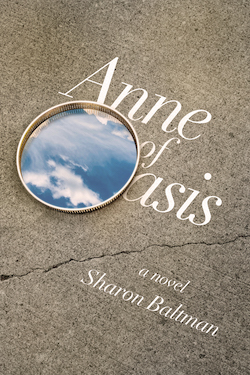
In Anne of Oasis, drawing on my many years as a physician psychotherapist, I tell the detailed, fictional story of what goes on in the therapy room when an eccentric, 70-year-old is obsessed with changing her life – or ending it. Anne bumbles through what she views as mysterious rituals with the therapist, explores secrets, re-jigs behaviours and, five years later, finds bliss. Here is the final chapter.
***
Chapter 26: June 2008
For two years, Doug heard sporadically from his mother and continued his requests for pearls. She made it clear to him and his brother she wasn’t coming out to Kelowna anymore. They occasionally visited her in Toronto, or in Golden, where she was staying with Eleanor for longer and longer periods of time.
When he received the phone call from a Toronto hospital, Doug asked if she’d fallen and busted her hip. They said it was more than that. They had found her unconscious on the street in Toronto with no ID, except for a piece of paper with Doug’s number on it as her next of kin. They admitted her as an Unknown Person and she was failing fast. If he wanted to see her alive, he had better come quickly.
He didn’t know what to do. He had promised to be there if she needed him for assistance in dying peacefully, but this was different. Yet how could he leave her to die on her own?
“She’s still your mother,” his wife offered.
He flew out as soon as he could. He arrived at the Toronto General Hospital, where Admitting confirmed there was no patient by the name of Anne Bishop. But a woman had been admitted as an Unknown Person. Doug wandered the halls searching for his mother.
“She was moved to a different floor.”
“She’s in ICU.”
“She’s not in ICU.”
Finally, he stepped into the Cardiac ICU and in the corner he saw a pile of breathing bones. Tube in mouth, IV in arm, sas-sas-sas of a respirator. Unknown Person at the foot of the bed.
“Is this her?” he asked the nurse at the desk.
“She was found with only this slip of paper on her.”
“That’s my name and number.”
“She apparently suffered a sudden, massive heart attack on the street.”
As Doug approached the bed, he recognized the bony lumps on her hands, the chewed-up fingernails, the crepe skin. It was definitely Mum. He gasped. His eyes filled, the lump in his throat tightened. He turned and rushed to the nursing station.
“Please, can the tubes be removed? She didn’t want heroics.”
“We barely know her name. We can’t follow any directives without proper ID and signed papers detailing her wishes.”
He took off uptown to retrieve the Dying With Dignity papers his mother had been talking about for years.
Stepping into his mother’s house, it felt haunted, full of yesterday’s glory. Dust everywhere. Her clothes neatly stashed, but neglect inhabited the place. He walked from room to room, observing photos everywhere – on window ledges, on kitchen counters, on the bedside table. Pictures of Jesse and Catherine and Doug and Bruce and Pam and Sue in every combination. Sitting next to each image was a shiny rock or pebble. He picked up each clear Plexiglass frame and stared. He was shocked to see how she surrounded herself with family. He began to sob.
He found the papers in the second drawer of his grandmother’s mahogany desk, exactly where his mother had said they’d be. Everything was perfectly organized and signed. He grabbed the requisite forms, glanced around at the family photos and returned to the hospital. They removed the tubes.
He returned to the house for a few hours’ sleep and arrived back at the hospital next morning, to find she had again sprouted pipes. The staff explained that overnight she had taken a turn for the worse and they tried to save her.
Angrily showing them the papers again, he repeated her wish to die quietly, and they removed the tubes a second time. He wrapped Mum in her favourite turquoise velour blanket he had brought from her home, took her in his arms and held her exactly as she held him as a sick boy on the farm. He noticed a flicker of a smile cross her face, then she took her last breath.
Just then, Eleanor appeared.
Through their tears, Doug and Eleanor awkwardly made their way to her house together. They expected to start planning how to say goodbye to Anne. But she beat them to it. She had detailed her every wish. They simply had to fulfil them.
“You know what?” Doug asked. “She knew what she was doing all those years ago around Dying With Dignity. We thought she was nuts, but it’s sure helping us now.”
“She was utterly determined in every aspect of her life,” Eleanor replied.
“What do you think we should do with the rocks? My brother thinks we should pitch them.”
“She schlepped them home from every spot she ever visited. Each and every one was special to her,” Eleanor sighed.
“I think we should leave some at the cemetery.”
Because Doug knew Mum hated missing appointments, he searched in her handwritten, dog-eared address book for Dr. C’s number.
“I’m so sorry,” Dr. C responded when he told her the news.
“It’s odd speaking to you in person after hearing about you for so long,” Doug said. “I’m happy to hear your voice. I need to tell you how important you were to my mother. Thank you for helping her.
“She was still difficult to deal with, but she seemed a lot happier. I also want to thank you for all the pearls of wisdom I received second-hand. Mum loved sharing them and they have been extremely helpful in my life.”
“We will all miss her.”
“As per her wishes, we are having a funeral service tomorrow afternoon at 2 p.m. at the Mount Pleasant Cemetery. We would be honoured if you would come.”
“Thank you. It would be a privilege. I’ll see you there.”
Tuesday afternoon, at 2 p.m., under a blistering sun, Doug, Eleanor and Dr. C, along with a handful of grey-haired men and women, gathered as they lowered the casket into the ground. Doug pulled out a heavy purple velvet Crown Royal bag and spoke.
“When I called Dr. C to notify her of Mum’s death, I asked what we could do with the stones Mum collected on her travels. She informed me that according to Jewish tradition, leaving a stone on a loved one’s grave signifies you have been to visit. Because of Mum’s lifelong appreciation of all things Jewish, placing stones on her grave would be a mitzvah, or a blessed act of kindness.
“I am honoured to ask each of you to dig into this bag, which held my marbles as a kid, to take out a pebble and place it on Mum’s final resting place.”
Tears rolled down his face. Doug held the bag open. Eleanor, Dr. C and the others lined up. One by one they removed a rock and placed it on the earth as it was shovelled onto the casket.
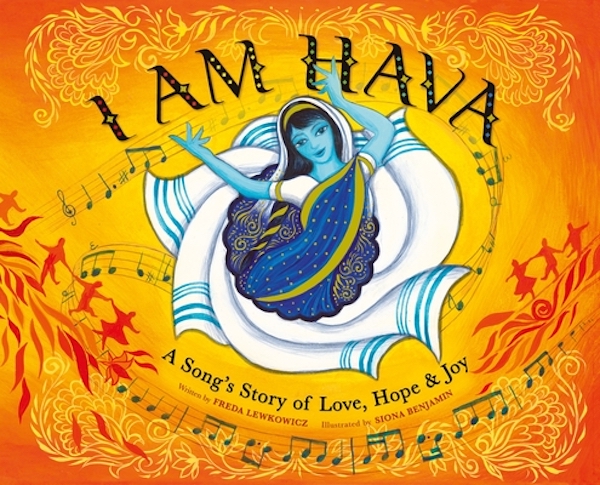
Among Intergalactic Afikoman’s newest picture books is I Am Hava: A Song’s Story of Love, Hope & Joy, written by Freda Lekowicz and illustrated by Siona Benjamin. It tells the story of the song “Hava Nagila,” from its birth as a niggun (melody without words) in Ukraine, to Jerusalem, to when it received its name and lyrics (though exactly from whom is still a mystery), and its journey around the world to popularity well beyond the Jewish community.
Hava Nagila means “Come and Rejoice,” explains the book, and this story – told by the song herself, personified as a blue-skinned Indian-Jewish girl in a sari – is full of movement and colour. It boldly celebrates the diversity of the Jewish people and our culture.
“For me, Hava’s story is a story of universality and multiculturalism,” Benjamin, who grew up as a Bene Israel Jew in India, writes at the end of the book. “Universality is always born from the specifics. The specifics for me are my Jewishness, my Indianness and my Americanness.
“Many blue-skinned characters populate my paintings,” she continues. “Hava is blue because blue is the colour of the sky and the ocean. Blue is the colour of the globe. Blue is also such a Jewish colour. It’s in the tallit. It’s in the tzitzit. It’s in the Israeli flag.”
Montreal-born Lekowicz also connects personally with the story. She shares that her parents, after the Holocaust, were in a displaced persons camp in Germany. “Like other Holocaust survivors,” she writes, “they were broken and in mourning. Yet the joyful sounds of Hava Nagila sometimes echoed in the camp. ‘Let us celebrate,’ it urged. The song symbolized hope and resilience.”
This lovely and imaginative book does joyous justice to this well-known song.
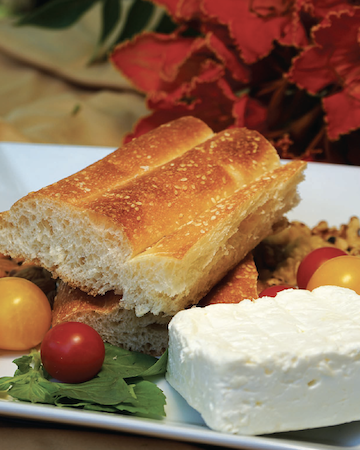
While my Barbari bread (above) looked nothing like the photo from the book (below), as my dough was too wet to allow for the requisite creation of vertical ridges, it tasted really good nonetheless. (photo by Cynthia Ramsay)
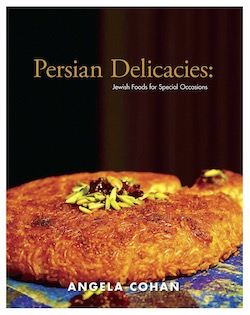
I was very excited to try out Persian Delicacies: Jewish Foods for Special Occasions by Angela Cohan. Living on the North Shore, I have met several people whose heritage is Iranian, though not Jewish, and I’ve eaten Persian food, but never made it. The idea that I could make my own “delicacies” was enticing.
Cohan is a Los Angeles-based writer and editor, so it’s no wonder that her cookbook reads well and looks fabulous. The layout is pretty and logical. The colour photos are beautiful. This is a great gift for a seasoned cook, or a cook that’s willing to have a few misadventures and so-so meals before they get the hang of things.
Barbara bread as it’s supposed to look. (photo from Persian Delicacies)
In the preface, Cohan, who moved to the United States with her family in 1979, writes, “I was inspired to compile the specialty recipes of my mother, my late grandmothers, and other family members and friends in this cookbook. This book is as much theirs as it is mine. It is a tribute to my heritage as a Persian woman as well as an evolution of recipes since living and cooking in the United States for the past three decades.”
I remember watching my grandmother cooking. She seemed to randomly toss in this, shake in that. It appeared to the uneducated eye that measurements were not measured at all. I get the feeling that this is somewhat the case with this cookbook. Guesstimates in many cases rather than meticulously precise cups, teaspoons, etc. And the assumption that one knows how long to knead dough, for example.
The recipes I tried – dolmeh (stuffed peppers), Barbari bread and sesame brittle – seemed easy enough. I chose them because I was on a deadline and had all the ingredients at hand. I will continue to explore this cookbook, as my first foray was promising but not that successful, in part because, instead of adapting the measures, I decided to follow the instructions come what may. So, even though I knew that my pepper stuffing was too bland, my dough was too sticky and my brittle too bendy, I made them as per the recipes. Everything was edible but nothing was delicious. Next time, I will use, respectively, another pinch of salt or another clove of garlic, more flour (or less water) and less honey. I can’t wait to try my hand at making kuku seeb zamini(potato frittata), tahdig (crispy rice), turmeric chicken, lavash bread and more.
Each recipe in Persian Delicacies comes with a brief description, either of what it is, from where or whom it came, and other useful tidbits. At the end of the book, there is some information on special occasions, with the examples of Norouz, the start of the Persian New Year, and Shabbat, and traditions associated with them, in particular as they relate to foods. A glossary of many of the ingredients and their health benefits is an interesting component.
DOLMEH (serves 3)
3 or 4 bell peppers 1/4 cup olive oil 1 cup diced yellow onion 1/2 cup scallions, chopped 2 cloves garlic, peeled and finely chopped or minced 1 cup quinoa, cooked 1/2 cup fresh dill, finely chopped 1/2 cup fresh tarragon or parsley, finely chopped 1 tsp ground cinnamon (optional) salt and pepper to taste
Preheat the oven to 350°F.
Cut the top of the bell peppers and remove the seeds and veins.
Heat the oil in a skillet or a saucepan. Add the onions, scallions, and garlic and cook until soft, about four minutes.
Add the quinoa, dill and tarragon and season with salt and pepper. Remove from heat.
Spoon the quinoa mixture into the peppers. Place the stuffed peppers on a baking tray or baking dish and bake for 45 minutes. Add salt and pepper to taste. Top with chopped parsley and cinnamon (optional).
BARBARI BREAD (serves 4)
1 1/2 cups warm water 1/2 tsp active dry yeast 3 cups all-purpose flour plus 1 tbsp additional flour 1 tsp salt 3 tbsp water 1/4 cup sesame seeds
Add the yeast to the warm water, stir, and set aside.
In a large bowl, combine the flour and salt. Add the yeast mixture. Knead the dough on a flat surface.
Place the dough in a bowl and cover with plastic wrap. Let it rise for an hour.
Preheat the oven to 325°F.
In a small saucepan, stir one tablespoon flour and three tablespoons water over a medium-low heat.
Uncover the risen dough, cut into four pieces, and roll out in an oval shape using a rolling pin.
Place the dough on a cookie sheet. Using your finger or a small knife, create vertical ridges on the dough. Brush with the flour and water mixture. Sprinkle with sesame seeds.
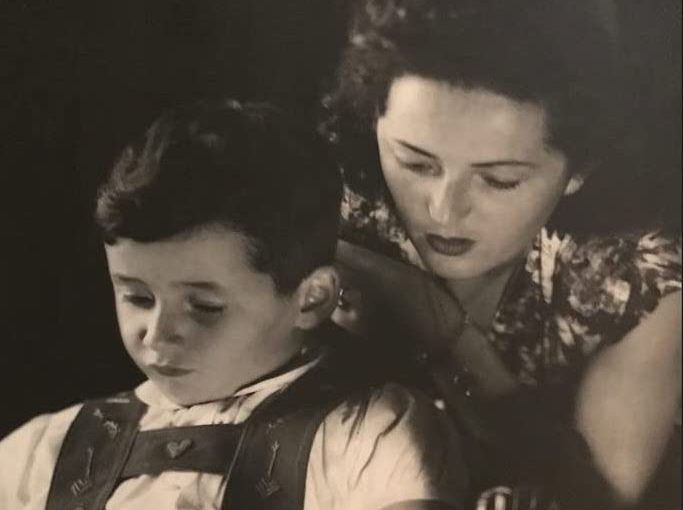
Dr. Robert Krell, child survivor, psychiatrist, community leader and founding president of the Vancouver Holocaust Education Centre, is probably known to most readers. But few people, perhaps even those closest to him, know him as well as they will after reading his extraordinarily vulnerable new memoir.
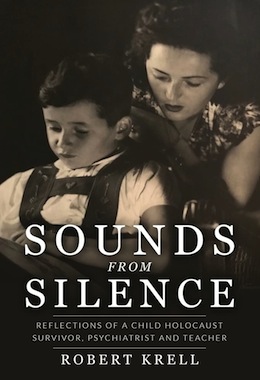
Krell acknowledges that he has held much back from the public and his closest family and friends. But, at 80, he has decided to open up in a book called Sounds from Silence: Reflections of a Child Holocaust Survivor, Psychiatrist and Teacher (Amsterdam Publishers).
Krell begins by talking about the duality of his life – the hidden child who, as an adult, tried to remain hidden versus the public figure whose career and community activities have placed him at the fore of various fields; the sadness at his core versus the upbeat visage he presents to the world.
“I have allowed family members and friends to see my inherent optimism and love of life. I live with few regrets,” he writes. “Blessed with a fascinating career, lasting friendships and an incredible family, I have kept at a distance my profound sadness, chronic fears, devastating shame, incapacitating shyness, and nightmares and preoccupations shaped by my earliest experiences and forged in an atmosphere of potential annihilation.”
Krell was 2 years old when his Dutch Jewish parents placed him in hiding with the Munnik family, who he would come to view as his actual parents. He was reunited at age 5 with his birth parents, Emmy and Leo Krell – a miracle on many fronts given the small proportion of Dutch Jews to survive to 1945.
“After liberation, life became very complicated,” he writes. He had been treated well by his rescuing family, unlike some Jewish children, “but strangely, even those ‘good’ circumstances exacted a psychological toll that never quite healed. After all, my relatively ‘benign’ circumstances were still completely off the scales of what is normal, including separation from my parents, shattering of security, and vague awareness of persecution that contributes to the feeling of shame experienced by a child as having done something wrong to cause the situation. Years later, as a child psychiatrist, I would see this phenomenon in children who, faced with parental separation, assumed responsibility.”
His parents also survived in hiding and his mother in particular never stopped mourning the complete loss of both sides of their extended families.
“I was raised by psychologically wounded parents, no less so than if they had been in the camps,” says Krell. “For three years, they lived in fear of being caught, and that fear exacted a psychological toll that one cannot underestimate.”
Trying to recreate a life, they considered making aliyah to the new state of Israel, but their business before the war had been furs and the climate in Canada was more conducive to that specialty. They came to Vancouver in 1951.
Like many survivors, the Krells found new “family” at Schara Tzedeck Synagogue. Despite many survivors bearing a “burning rage against G-d,” the shul was a second home. His father refused to open a prayer book. And yet, years later, when he was in a position to be philanthropic, he spoke with Rabbi Mordechai Feuerstein and donated $30,000 to buy prayer books for the High Holy Days so that congregants wouldn’t have to carry them to and from synagogue on those days.
“Why would a man who no longer prayed purchase prayer books?” asks Krell. “The rabbi characterized Dad as ‘a man of faithful disbelief.’”
Habonim, the labour Zionist youth movement, was a major stabilizing force for young Robbie. He would attend weekend events, summer at Camp Miriam and do normal Canadian teenage things like matinees at the Stanley Theatre on Granville.
A late-in-life baby, his brother Ronnie, was born in 1956, and his mother’s disordered parenting shifted from the first born to the younger.
“Her subsequent attention to Ronnie grew so intense that even my 16-year-old self realized that he fulfilled her need to replay the years in which I had been lost to her. That need virtually enslaved my younger brother and freed me.”
While building a career as a clinical psychiatrist, professor and academic administrator, Krell and wife Marilyn were raising three daughters.
“I can barely believe that my survival as a young boy has led to the rebirth of an entire Jewish family that now includes nine gorgeous grandchildren,” he writes. “My good fortune scares me. Our world looks so dangerous, and the future of life – Jewish life – remains so precarious. But day-to-day, we are a close family, and every day brings much joy – so far.”
Krell was a leader in Canadian Jewish Congress regionally and nationally. In Vancouver, he became immersed in Holocaust remembrance and education. Kristallnacht commemorative lectures and other Holocaust remembrance events were often begun under the auspices of CJC.
With theologian William Nicholls and English literature teacher Graham Forst, Krell launched what has become a decades-long annual symposium for high school students on the Holocaust.
He was also among the first people anywhere to begin video recording the testimonies of Holocaust survivors.
Krell was also pivotal in the organizing of a succession of world conventions: first, for Holocaust survivors and, later, for “child survivors,” a term he acknowledges was not in use until the 1980s. Hidden children were not viewed as Holocaust victims in the way that survivors of the camps or partisan fighters were. Krell is among a small number of people who helped usher in a reconsideration of the wartime experiences of these children.
In 1984, he gathered 18 survivors and children of survivors in his living room and committed to creating a Holocaust education centre in Vancouver. But some of the older attendees remembered an as-yet unfulfilled promise to create a permanent local memorial to the Shoah, so the group decided to keep that commitment first.
“The memorial was unveiled on Yom Hashoah, April 26, 1987, in the presence of 1,300 members of the community,” notes Krell. “The survivors now had a metzeivah, a ‘burial site,’ albeit symbolic, to visit and to grieve.”
In 1994, the Vancouver Holocaust Education Centre opened, with Krell as founding president.
One time, when he was on the national board of CJC, the organization considered ending their efforts to bring (by then aging) war criminals to justice.
“I argued for continuing the effort,” says Krell. “My measure of success was different. I told my colleagues that it was not only about successful prosecution but also their knowing that, one day, they might hear a knock on the door. The sleep of Nazis should be no less disturbed than that of Holocaust survivors.”
Throughout the book, Krell recalls brushes with history and the figures who make it.
On a trip to Israel as a young adult, he was able to get a seat at the Eichmann trial, thanks to an aunt who had married into the family of Gideon Hausner, the prosecutor of the case. On the same trip, Krell went to Sde Boker and ran into David Ben-Gurion.
A few years later, Krell volunteered to serve in the 1967 war as a doctor fresh out of his internship but, given the chronology of the Six Day War, by the time he got to Europe, the conflict was over.
Two years after that, on another trip to Israel, his plane was hijacked by the Popular Front for the Liberation of Palestine.
Krell was able to attend the ceremony when his family-in-hiding – Albert and Violette Munnik and their daughter Nora – were inducted by Yad Vashem as Righteous Among the Nations (posthumously for Albert).
Krell’s book evokes an array of emotions. The psychiatrist’s self-assessment provides a sometimes startling look inside.
“I kept my rage suppressed, not repressed,” he writes. “It was not unconscious. I knew that it was there. I felt in danger from it and feared losing control. I played, studied and worked hard, surrounded by good friends.”
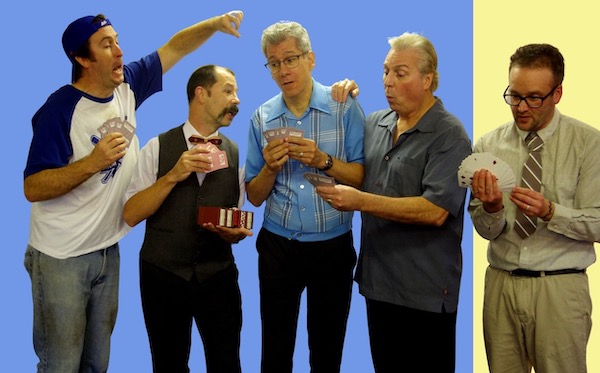
Left to right: Rob Stover, Kimball Finigan, Adam Abrams, Michael S. Weir and Adrian Maxwell in Metro Theatre Vancouver’s The Odd Couple. (photo by Tracy-Lynn Chernaske)
Neil Simon’s famous comedy The Odd Couple opened Oct. 30 on the Metro Theatre Vancouver stage. It runs until Nov. 14.
We meet divorced sportswriter Oscar Madison (played by Rob Stover) as his buddies arrive for their weekly poker game. One of the friends welcomed into Oscar’s messy abode is news writer Felix Unger (played by Adrian Maxwell), who is also divorced, but exists on the opposite end of the neat-and-tidy spectrum. The fact that the men are opposites in so many ways does not prevent Oscar from inviting Felix – who is so depressed it worries Oscar – to move in. Of course, they drive each other nuts.
Jewish community member Adam Abrams plays Roy, a regular at Oscar’s Friday night poker games, in the Metro Theatre production, which is directed by Catherine Morrison.
Abrams has been a part of the local theatre scene for more than 20 years, including many musical theatre productions. “I also played Richard in North Van Community Players’ The Trouble With Richard,” he told the Independent. “A personal favourite was portraying Abraham Goldstein, builder of the Sylvia Hotel, in Kol Halev Performance Society’s Two Views from the Sylvia, back in 2017. That was my last time on the stage, and it’s so great to be back, as part of the return of live theatre, after such a long and trying time for all of us.”
He said that, in real life, he is more like Felix than Oscar.
“My wife Christine will vouch for that – and would readily admit to being much more of an Oscar!” said Abrams. “When Felix is fussing over his London broil dinner or imploring Oscar’s guests to use a coaster, I very much see myself, the chef of the family and the one who is always keeping things tidy. After years of sharing a home, Christine and I have negotiated a much more successful arrangement than anything seen in the play. But our relative household peace has depended on us both accepting each other’s style to some degree.”
As for the character he plays in the show, Abrams said, “I like Roy, though he is somewhat crankier and more blunt than I’d be. He’s a voice of reason for Oscar, imploring him to do what’s right – stop gambling, and pay his debts. No surprise, as he’s Oscar’s accountant!
“My favourite scene in the show is the date with the Pigeon sisters, Oscar’s upstairs neighbours,” added Abrams. “The conflicting attitudes to divorce – a mere inconvenience to the sisters, pure heartache to Felix – and how he both derails Oscar’s hopes for the evening and endears himself to the sisters, is a delight. And, while it’s hilarious, there’s an undercurrent of true emotion that I find touching even as I’m laughing, which I do every time I see it!”
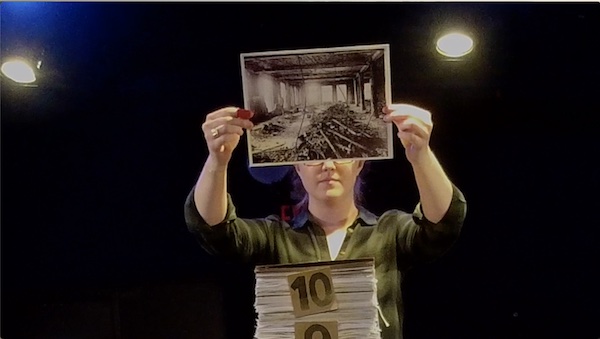
Surplus Production Unit’s Briony Merritt. (photo by Alex McLean)
No matter how well we document history, it matters little unless people are aware of it. Two very different productions at this year’s Chutzpah! Festival, which began this week, were born of personal discoveries of documents from the past – in one case, a trial transcript; in the other, Yiddish compositions. The artists’ unique interpretations help ensure that important aspects of our culture are not forgotten.
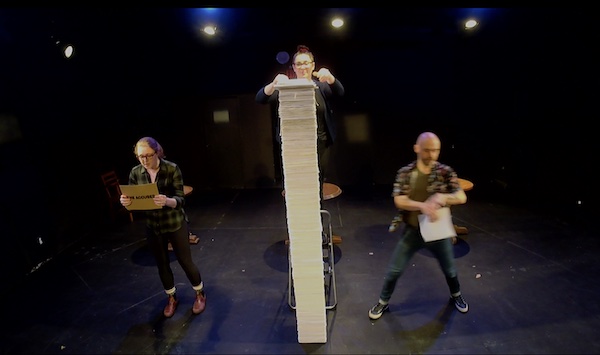
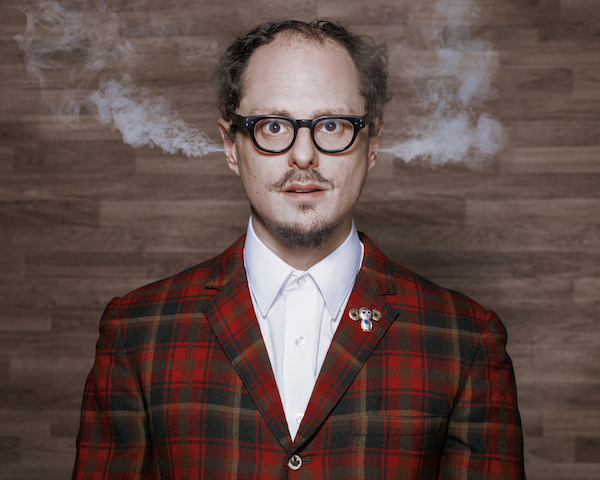
Halifax-based Surplus Production Unit, under the direction of Alex McLean, performs A Timed Speed-Read of the Triangle Shirtwaist Factory Fire Trial Transcript on Nov. 21 and 22 at the Jewish Community Centre of Greater Vancouver, in the Wosk Auditorium. Montreal’s Josh “Socalled” Dolgin performs music from his album Di Frosh with a local quartet at the JCC’s Rothstein Theatre Nov. 19 in a concert that will also be livestreamed.
“I had never heard of the Triangle Shirtwaist fire until 2010, when I was doing research for an MA in Toronto,” McLean told the Independent. “I was totally fascinated by the case and got especially swept up in the extensive trial transcript.”
Triangle Shirtwaist Company owners Max Blanck and Isaac Harris were put on trial for manslaughter after a fire at their factory on March 25, 1911, killed 146 people – mostly women and girls – in part because one of the exit doors was locked.
“I think the gender politics were what initially stood out to me – it was an all-male jury, the case hinged on the discrediting of female witnesses, and it was all taking place at a time when women weren’t able to vote in either Canada or the United States. I also knew that this was a time when the labour movement was massive globally and that the Ladies Garment Workers Union had waged its major strike just a couple years earlier. The way that this all reads as subtext in the trial transcript was fascinating to me. I knew that I wanted to work with the material somehow, but wasn’t sure how.”
In 2011, during the 100th anniversary year of the fire, McLean saw an interview with Charles Kernaghan, director of the Institute for Global Labour and Human Rights, who mentioned the Hameen factory fire in Dhaka, Bangladesh. “And then there was the Tazreen factory fire in 2012 and then the collapse of the Rana Plaza building in Dhaka in 2013,” said McLean. “It all made the record of what happened in New York in 1911 hauntingly relevant.
“Somewhere around this time,” he said, “I got a small grant to create a verbatim script from the transcript. I started work on it but it felt lifeless, like a bad ‘historical drama.’ So, I gathered a few actors who I knew and trusted and who were interested in the material. We started playing around with ways to approach the material that felt honest and the current production grew from there.”
McLean believes “it is endlessly worthwhile to think about the hidden costs in our global economy and the conditions under which so many of the products we consume are created.” At the same time, he added, “I was very aware that my life – like those of my colleagues – was radically different from the lives of the people in the trial transcript. None of us are immigrants, none of us are Jewish or Italian (as were almost all of the Triangle victims). As middle-class Canadians in the 21st century, I felt that we had to acknowledge the gulf between us and those New York factory workers in 1911. We had to build this distance into the structure of the show, and so this idea emerged that we would actually sit the trial transcript on the stage and the performance would be a group of people engaging with this historical record, rather than trying to represent it realistically. This felt like the only way we could approach the material respectfully.”
Briony Merritt, left, Kathryn McCormack and Richie Wilcox bring A Timed Speed-Read of the Triangle Shirtwaist Factory Fire Trial Transcript to the Chutzpah! Festival Nov. 21-22. (photo by Alex McLean)
Throughout the trial, said McLean, “witnesses, especially women, were treated with palpable disrespect. Max Steuer, the lawyer defending the factory owners, repeatedly tried to cast suspicion on witness testimony. This came to a head in his cross-examination of Kate Alterman, the ‘star witness’ for the prosecution. Knowing that Alterman’s English wasn’t great, Steuer had her repeat her testimony multiple times to make it appear rehearsed. This ultimately worked for him.
“There’s also a fascinating class dynamic at play: Steuer and his clients, Isaac Harris and Max Blanck, were themselves Jewish immigrants who had worked their way up in New York’s garment district. While at times they appear callous towards the victims and survivors, there is also this sense that they come from the same place. The prosecutor, on the other hand, comes across as much more of a patrician and, at times, this results in condescension. To him, the victims are helpless little girls, while the defence tries to portray them as streetwise conspirators plotting their revenge. Their actual messy humanity gets lost in the crossfire.”
Justice was not served by the trial, nor other legal measures, but there were positive changes that resulted from the tragedy.
“Part of what the case revealed was that workplace safety regulations at the time had no teeth, so the silver lining was that a host of new laws were introduced,” explained McLean. “Frances Perkins, the first woman to serve in a U.S. cabinet, actually witnessed the Triangle Shirtwaist fire and described it as a pivotal moment in her life. She became secretary of labour under FDR [Franklin D. Roosevelt] and was a major player in ushering in the New Deal.”
In terms of lessons learned, however, “we seem doomed to continually forget the inequality that animates our world,” he said. “Going to work under dangerous conditions seems like a reasonable choice to many people in impoverished conditions. As long as those conditions exist, workplace tragedies are likely to occur.”
He added, “There’s a fascinating historian of the Triangle Shirtwaist fire, Michael Hirsch, who argues that it’s a mistake focusing anger and blame on the factory owners. He uncovered the names of several bodies that were unidentified in 1911, and he makes a yearly pilgrimage to the victims’ graves…. To me, Harris and Blanck do appear negligent, but acknowledging systemic imbalances is also important. Economic inequality has proven a difficult problem to solve, but that doesn’t give us the right to forget about it. My sense is that we need a new New Deal today.”
A love of Yiddish music
Josh Dolgin has many artistic interests and musical styles – from composing to photography to puppeteering, from hip-hop to musicals to Yiddish music. As different as they may be, Dolgin said, “all the passions stem from an attraction to ‘realness,’ to things that just deeply move me, spark inspiration, speak to my soul.”
For him, the 2018 album Di Frosh “was a kind of return to a pure, more ‘traditional’ Yiddish music, even though it’s a project of ‘new’ music. I had experimented with using Jewish music sounds in contemporary ways,” he explained, “sampling, mixing, collaborating and fusing to create hip-hop, rap and funky pop music. In so doing, I became rather immersed in the form – in klezmer, in Yiddish folk, art, theatre music, cantorial sounds from the synagogue and Chassidic music – by collecting old records looking for sources. Listening to all that music, I eventually fell in love with the source material … I wanted to play and sing it! I eventually started learning the songs as a pianist, as an accordionist and singer. I wanted to just perform that music, without mixing it, without adding beats, just to play and sing it as is.
Josh “Socalled” Dolgin performs Yiddish music from his album Di Frosh with a local quartet Nov. 19 in a concert that will also be livestreamed. (photo from Chutzpah! Festival)
“In the meantime, I started getting into four-part harmony singing and collecting choral arrangements, then directing choirs at synagogues and music camps. That love of harmony mixed with my love of singing Yiddish songs and I thought, hmm, it would be cool to present this repertoire in an almost classic style, maintaining all that beautiful real harmony from arrangements from the ‘time.’ Some friends and I created new arrangements based on old sources – all the arrangements are ‘new,’ this repertoire for string quartet never existed before, so it’s ‘new’ music, but it’s more traditional than my fusion/pop experiments.”
Dolgin went to Hebrew school and was raised Jewishly. But, while he “adored” the “holidays and rituals and foods and songs,” he said, “I never was very inspired by the religious aspect of my cultural history, or the establishment ritual practice. When I started to find old records of Yiddish music looking for samples to make hip-hop music, I had stumbled on a part of my cultural identity that I could take pride in, that spoke to me, something I had never been exposed to with the more ‘mainstream,’ ‘modern,’ ‘reform’ version of Judaism I had experienced as a child.”
Musically, he started piano lessons at a young age and “was bribed and forced to keep at it, until I finally was allowed to study ‘jazz,’ i.e., not classical music. Then I got into the ‘rap music’ of my peers, and wanted to participate in that, to make a current music from today. I started looking into studio production techniques, sampling, using drum machines and computers to sequence and combine sounds and compose. Finding the Yiddish sounds and repertoire gave me a voice in hip-hop culture.”
Dolgin has always been one to seek out things that were “off the beaten path” and “a bit more hidden.”
“That led me as a teenager, in the days before the internet, to develop a real love of Brazilian music and funk, by digging and exploring,” he said. “The digging required to find sounds to sample in hip-hop led me unearth … a whole universe of Yiddish music and culture. I never heard Yiddish growing up! I had no idea! It was so fun to discover these treasures of my own cultural history, these sounds, modes, rhythms, poems and songs that were developed by my Eastern European ancestors. I dug around and really got into trying to find as much as I could, and that was more fun for me than having a whole repertoire handed to me on a silver platter.”
Dolgin chose his favourite songs for Di Frosh, ones “that weren’t the same top five Yiddish ‘chestnuts’ that everyone has already sung. Even though it’s not at all a well-known repertoire, there are a few songs that keep coming up, and they’ve been sung and presented enough, thank you very much. I wanted cool, rare repertoire. These could be things I heard from old records, or things I found as piano and choral arrangements on paper that could be brought to life in new arrangements.
“I thought it would be nice to have a range of repertoire from the various sub-genres of Yiddish music, from theatre music, from folk song, from Chassidic song, from postwar things, Holocaust songs, and even some ‘originals’ from contemporary Yiddish writers. Those ‘high concept’ factors were at the back of my mind when putting the program together, but it was mostly just a very subjective process of picking my favourite songs, the songs that blow my mind lyrically, harmonically or melodically.”
He went through another selection process when he was asked by a bass player from Vienna to do some Yiddish songs with a big band. Dolgin said he picked “out a whole new repertoire of more Yiddish songs I was interested in presenting, sent charts and recordings to them and they created arrangements for an actual 19-piece big band! I showed up in Salzburg and, after one rehearsal, performed with them to a sold-out jazz festival audience – it was magical! We have since done the show several times, including this summer with the Toronto Jazz Orchestra for the Ashkenaz Festival.”
They were about to travel with the show in Germany and Austria when COVID struck; the plan is now for a spring tour. During the lockdowns, said Dolgin, “I did manage to write quite a few more arrangements of Yiddish songs for string quartet, so hopefully a Frosh 2 is possible.”
The best part of this project, he said, has been “meeting new string quartets around the world and bringing this new repertoire to them, and then bringing the music to new audiences who may not be too familiar with these songs, with these sounds.
“After recording the music to make the Di Frosh record, with the amazing Kaiser Quartett based in Hamburg,” said Dolgin, “I’ve since presented this music all around the world with ‘local’ quartets: in Vienna, in London, in Venice, New York, Toronto, Montreal, Boston, Paris…. I’m very excited to be in Vancouver and meet Elyse Jacobson and the musicians she will put together for this program.
The Chutzpah! Festival opened Nov. 4 and runs until Nov. 24. For tickets and the full lineup, visit chutzpahfestival.com or call 604-257-5145.

 It helps that Kalla is a real medical doctor. An emergency room physician here in Vancouver, he knows that of which he speaks and can relate complicated information without sounding didactic. And there’s always what to explain in his books. In Lost Immunity, the lessons are particularly relevant, about how a bacteria spreads, the challenges of contact tracing and containment, the benefits and side effects of vaccines, the concept of herd immunity, etc., etc. But he does all this while being completely entertaining. Readers of Lost Immunity will have an idea of what Dr. Bonnie Henry and her team have been going through these last many months – minus (I hope) the human killer element.