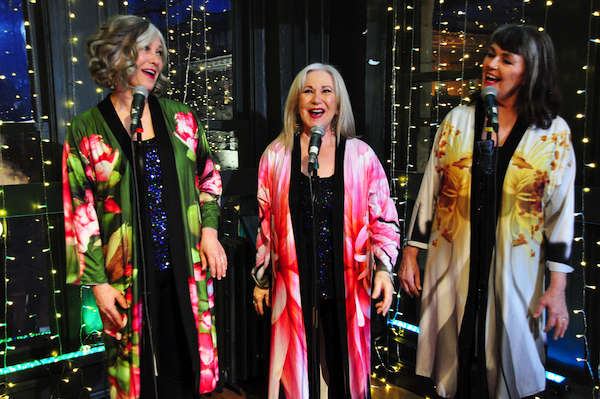
A lifelong love of performing

Left to right, the Hot Mammas are Mary Ella Young, Julie Brown, Georgina Arntzen. (photo by Dee Lippingwell)

The Hot Mammas are busy this holiday season – and year round. With three albums to their credit, they perform at venues ranging from jazz clubs to shopping malls. Readers can next see them at Robson Square Skating Rink on Dec. 15, and then at Water Street Café Dec. 18.

One of the holiday songs the group performs is “Mamma Julie’s Hanukkah Song,” so dubbed by Georgina Arntzen and Mary Ella Young because the third member of the Hot Mammas, Julie Brown, wrote it, and “too many songs are called ‘The Hanukkah Song’ or ‘Festival of Lights.’” (A video of it can be found via facebook.com/thehotmammas.)

Brown’s Jewish heritage is Ashkenazi. “My maternal grandfather, who I’m named after (Julius Cohen), was a rabbi,” she told the Independent. “My father always followed our traditions. My mother was a phenomenal cook and it’s because of her I’m able to make latkes, matzo balls, knishes, chicken soup, etc. When she didn’t want me to understand something she and her sisters were talking about over the phone, she’d suddenly switch from English to Yiddish. That’s where and how I picked up some fun expressions, which I use to this day.”

Born and raised in Montreal, Brown said she has been performing music since she could walk.

“My older, late, great brother Martin Overland was the founding member of the Canadian folk group the Raftsmen,” she said. “Your readers may recall the song ‘Something to Sing About,’ which was one of their hits. Martin had perfect pitch and the voice of an angel. He was also a terrific guitarist and accordionist. Eleven years my senior, we would sing together in harmony when I was a very young child. I still recall performing ‘Buttons and Bows’ in front of a roomful of relatives and friends.

“When the opportunity arose as a 10-year-old to actually sing on camera, I jumped at the chance. The Montreal kids show was called Small Fry Frolics and there I was with my cousin Shirley singing the Everly Brothers’ ‘Bye Bye Love’! At 15, I joined a rock band, while singing lead as Carmen in high school.

“The singing/performing didn’t stop at teacher’s college either,” she added. “McGill’s Macdonald College offered a two-year teaching diploma program at the time and, much to my delight, also had yearly talent shows.”

During her teaching days, Brown brought her ukulele to class. “The kids were as crazy about the Beatles as I was and we sang our buttinsky’s off to start the day,” she said.

While at university, Brown performed in stage plays and film. She recalled working on a movie directed by John Huston, which featured Sophia Loren – “and I was fortunate enough to garner a wee speaking role when Ms. Loren walked over to a table of background performers of which I was one, and asked me a question. I wasn’t supposed to answer her as a silent on-camera person but spontaneously blurted out a comment because I didn’t want to be rude. (Out of my peripheral vision, I noticed John Huston smacking his forehead.) And that was how I got my first ACTRA permit! Even after moving out to Vancouver and doing radio full time, I still continued to audition for film, TV and did a lot of voice work. In fact, I was the Telus voice for nearly 15 years – ‘We’re sorry, the number you have dialed is not in order. Please hang up and try your call again. Thank you, from Telus.’ That was me and one of 40 or so prompts I did for them.”

Brown left Montreal after the Front de libération du Québec “raised its ugly head in Quebec” and the Parti Québécois was in power.

“My child came home in tears from school with a notice that all English-speaking children had to be educated in French the following year,” she explained. “French didn’t come easy to my son but it was more than that. We lived in Canada, or so I thought. Stop signs had Nazi slogans scrawled across them. Shop windows in the English and Jewish communities were smashed and vandalized. An elderly Jewish woman who couldn’t speak French and wanted to order flowers for a friend was disgustingly treated over the phone because she was trying to place her order in English. The clerk hung up on her.

“As a teaching friend once said to me, if you say, ‘ich bin a Yid,’ you get it from both sides. I still don’t think the rest of Canada realized just how dangerous and revolting that regime was. Well, I did…. We came out to Vancouver for a visit and, with tears in his eyes, my son asked if we could move. And we did just that in 1978.”

Within a week, Brown got a job as a news broadcaster at CFMI, the sister station to CKNW.

“Not long after that, the program director allowed me to develop an interview show as well. I had been doing interviews at the Montreal radio station, along with news, so this was a huge relief to me. I love people and am a naturally curious person, so interviewing was, and still is, a good fit.  My radio career blossomed here in Vancouver. Eventually, I co-wrote, co-produced and co-hosted Vancouver at Noon on KISS-FM for 11 years.”

In her more than two decades as a broadcaster, Brown interviewed hundreds of people, including Bob Hope, Paul Newman, Shirley MacLaine, Johnny Depp, Leonard Cohen, Eartha Kitt, Sarah McLachlan, Neil Diamond, Buffy Sainte-Marie, François Truffaut, Jackie Collins, Jim Byrnes, Rick Hansen and Dee Lippingwell.

For Brown, singing in choirs has always fed her soul, and it was in one of those choirs she met Arntzen and in another that they met Young. The Hot Mammas have been together now for 11 years.

“They are both family to me – my sisters,” said Brown. “All three of us love performing because we give to our audiences and they give back. Something magical and marvelous happens, no matter where we are or how many or how few people are in that audience. Synergy. Energy. Love. Music heals. It is the ‘universal language.’

“We sing songs we love. That’s how we choose our repertoire. Jazz, pop, rock ’n’ roll, folk, show tunes, you name it. We don’t just cover groups. We also write originals. In fact, one of our tunes is called ‘The Hot Mammas’ Song,’ and it’s quite amusing – all about being mothers who love their kids but have ‘traded in their aprons for a microphone.’”

For more, visit thehotmammas.com.
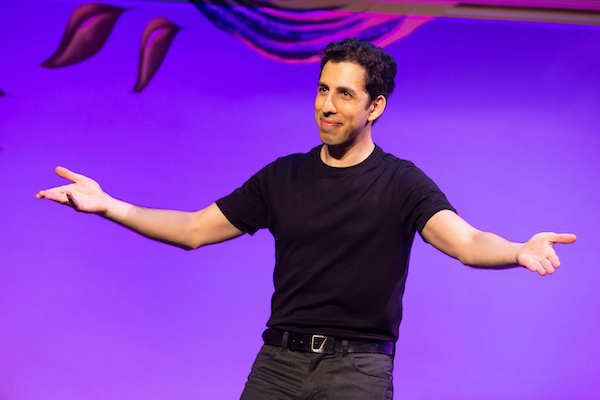
Vitaly Beckman at the Anvil

Vitaly Beckman will bring some of his best illusions yet to his Dec. 22 performance. (photo from eveningofwonders.com)

“I have been working very hard on some new illusions that I consider to be some of my best work yet,” Vitaly Beckman told the Independent. “I created a lot of my illusions during

no-show periods, a few of which I plan to include in the upcoming show.”

Vitaly: An Evening of Wonders returns to the stage on Dec. 22 at the Anvil Centre in New Westminster. While it is Beckman’s first live in-person performance in Canada since the pandemic started, he already has performed in theatres in the United States.

“It is certainly exciting to start doing live shows again – both performers and audiences could feel the void of live theatre during the past two years,” he said. “Life is really not the same without theatre.”

But there have been some benefits from the enforced hiatus.

“It is really helpful for the creative process to be able to focus on just one goal, and not be distracted by anything else for a period of time,” acknowledged Beckman. “So the lockdowns were helpful in that regard, as I managed to finish some really great illusions – one involves a sculpted bust, another involves an oil painting that comes to life and another, a matchbox. The latter I created while visiting my family in Israel. Actually, I’ve created a lot of my illusions in the past while vacationing there – it seems that the sunny place boosts my creativity.”

In addition to creating new material, Beckman has been busy in other ways, as well.

“It was certainly a long period to go without doing a single live show,” he said, “but I did a lot of magic for virtual performances and recorded an illusion for Penn & Teller’s Fool Us show, with a second appearance there.” (In that appearance, Beckman once again managed to fool the master illusionists.)

About returning to the stage, he said, “I was wondering if I would be ‘out of shape’ when performing again, however, from recent shows in the U.S., it was like riding a bike. I really enjoyed going back on stage and especially seeing how the audience left the theatre feeling uplifted and full of joy.”

For tickets to see Beckman on Dec. 22, at 7:30 p.m., click here.

Photographing the rebellious

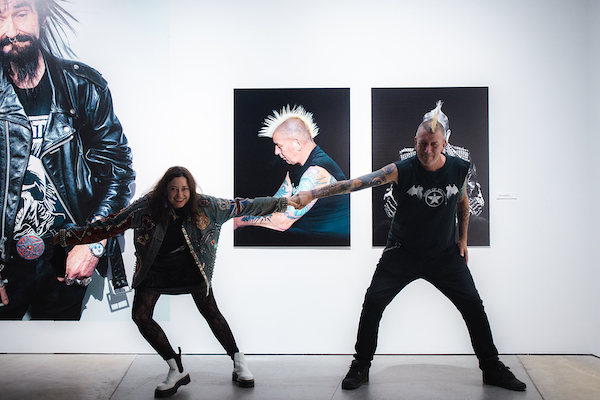
Photographer Dina Goldstein and Myles Peterson, one of her model-collaborators, at Goldstein’s OG Punk exhibit, which is at the Polygon Gallery until Jan. 2. (photo by Dina Goldstein)

Walking past the Polygon Gallery in North Vancouver, it is hard not to be drawn to the photographs adorning the walls. The powerful portraits of self-described original – OG – punks were taken by Jewish community member Dina Goldstein, whose work is known for its thought-provoking social commentary.

The exhibit OG Punk is on display at the gallery until Jan. 2. Curated by Helga Pakassar, it comprises portraits of major figures from the punk rock scene in Vancouver and Victoria, which were taken by Goldstein over the past year. It is accompanied by an audio guide written by author Michael Turner.

Turner notes, “Goldstein gave her model-collaborators little instruction on what to bring to their shoot, apart from their ‘leathers.’ As for poses, these too were left to the model-collaborators, though it should be noted that the poses chosen for display, as portraits, were decided by Goldstein and exhibition curator Helga Pakasaar.”

“I met some of my model-collaborators by chance around my neighbourhood,” Goldstein told the Independent. “They are artists, musicians and punk devotees; most of them over 50, in punk regalia, hairdos, piercings and tattoos. I was excited by their stories and memories of their time as punks during the late ’70s, ’80s and into the ’90s. There was a vibrant punk scene in Vancouver and Victoria, with local bands, like DOA, incorporating activism and social commentary into their music.

“I have always been attracted to individualism – those who openly express themselves, are unconventional and live an authentic existence,” she said. “Some of the punks were ailing and not well. Some key figures had already passed. Most recently, the iconic Chi Pig, who passed a couple of years ago. I felt an urgency to document this generation of local punks. The project evolved into a series when I was able to collect a good amount of participants.”

Among the participants featured are Murray “The Cretin” Acton, Myles Peterson and wendythirteen. Goldstein sent out questionnaires to better understand the participants. Turner discusses some of the responses to the questions – such as “Has punk changed much since the 1980s?” and “Is punk here to stay?” – in the audio guide, the script of which can be found at mtwebsit.blogspot.com/2021/11/og-punk-2.html.

Though none of the model-collaborators to date are Jewish, Goldstein noted that she “will be continuing to photograph more people for this series in January.”

As for what punk means to her, Goldstein said, “I have always been rebellious. I am non-conventional and have a DIY mentality. My photography requires critical thinking and is a form of activism. My art has been described as satirical, irreverent and subversive.

“As one of my model-collaborators Lisa Jak said and I totally agree: ‘Anywhere and anytime that there is oppression, ignorance, intolerance and f–king stupidity – some punk will be there to question and fight it!’”

Head to Metro for Panto

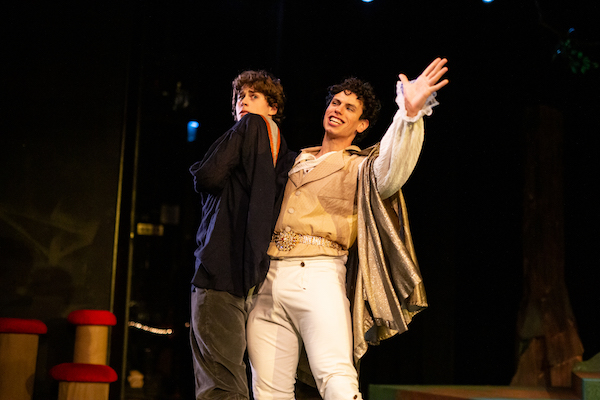
Lucas Gregory, left, and Daniel Cardoso, in Metro Theatre’s Snow White: The Panto, which runs until Jan. 3. (photo by Nicol Spinola)

“A lot of musical theatre is inherently silly and fun but it still doesn’t reach the level of a holiday panto,” said Daniel Cardoso, who plays the Prince in Metro Theatre’s Snow White: The Panto. An annual treat for more than 35 years, this year’s panto, which runs until Jan. 3, has added significance.

“The past year and a bit has been challenging, not only for the arts community, but for everyone,” said Cardoso. “I got to go to an opening night of a show last week and part of me had forgotten the energy of getting to be in an audience and the joy that it brings to people to get to go to live theatre. I hope that we can do something similar with the panto and that we can act as another step in a return to normalcy.”

“I love being back with the theatre community after so much time away,” said fellow Jewish community member Kat Palmer, who is stage manager of the production. “I think most of the team feels this way. So often actors would be finished working their scenes but would choose to stay a little longer to watch and support their fellow cast members rehearse. There is this sense of returning to what was and that’s been quite moving.”

Things aren’t completely back to normal, of course, as COVID is still is concern.

Metro Theatre requires proof of vaccination, said Palmer. “Usually, pantos have lots of kids and an ensemble – our show has a much smaller cast with no children,” she said. “Everyone – cast, crew and staff – is fully vaccinated. We have taken our inspiration from film sets and have rapid COVID tests on hand. Usually, kids in the audience get to come up on stage – we can’t do that this year. Luckily, there are still lots of opportunities to participate by booing and cheering our demon and good fairy.”

For Palmer, Snow White was “always a favourite growing up – I think mostly because she had black hair like me. But the traditional story is a little dated. Erik Gow, our writer, has done a great job breathing new life into this script. In our version, Snow White is spunky, independent and doesn’t need a prince. She takes charge of her own destiny.”

That said, the prince is still an important part of the story, and it was Palmer who suggested Cardoso try out for the role.

“I’ve known about the Metro Theatre since I was in university and have often gone to see shows there, but the panto this year is the first time I’ve gotten to work there,” he said. “I came to Snow White when Kat Palmer … reached out and asked me to audition for it. I hadn’t initially planned on it but it was an opportunity to work with Chris and Kat and Suzanne again, so I’m glad I did.”

Chris Adams is the director of the production, while Suzanne Ouellette is the choreographer.

Cardoso is a graduate of the musical theatre program at Capilano University and has been working in theatre around Vancouver since 2011. “I was also lucky enough to work on Disney Cruise Line for a few years,” he said. “In 2016, I went back to school to become a registered massage therapist and have been doing that in addition to theatre since 2018.”

While not raised attending shul, Cardoso said his mother and her family are Jewish, “so it is definitely a part of me that I am proud of and something that I think I will always want to learn more about and explore. I know it sounds cliché, especially for a theatre performer, but getting to do a production of Fiddler on the Roof (Gateway, 2012) was a special experience for me in that I got to play in that story and feel like I belonged there instead of just pretending like it.”

For tickets to see Cardoso as the Prince that Snow White (played by Scotia Browner) may or may not need to help her, visit metrotheatre.com. The panto promises to be a “zany and uproariously funny family pantomime,” but that’s not the only reason to check it out.

“The theatre community is hurting right now. We are trying to stay afloat,” said Palmer. “After almost two years of silence, we need your laughter – we need your applause. Please come out and support local theatre.”

Space beyond time

Sky Lilah’s new exhibition, Quantum Sky, is at Art @Bentall this month. Quantum Sky is an exploration of consciousness and what that means to the artist. This self-study is done using various mindfulness techniques, then interpreted through visual art. One dominant theme is the use of chakras, with 21 separate works, three per chakra, dedicated specifically to interpreting the meanings held within. As such, the exhibition is an exploration of an aspect of themselves through her art and letting others into that process, with the intention of creating a space beyond time.

“A lot of it is just trusting the process, which is I guess why I paint in the first place, which I find funny because I’m so organized in life. And when it comes to artwork, I find I just need to start and figure it out as I go, as opposed to planning it all and then starting,” said Lilah.

– Courtesy Art @Bentall

Lively driftwood sculptures

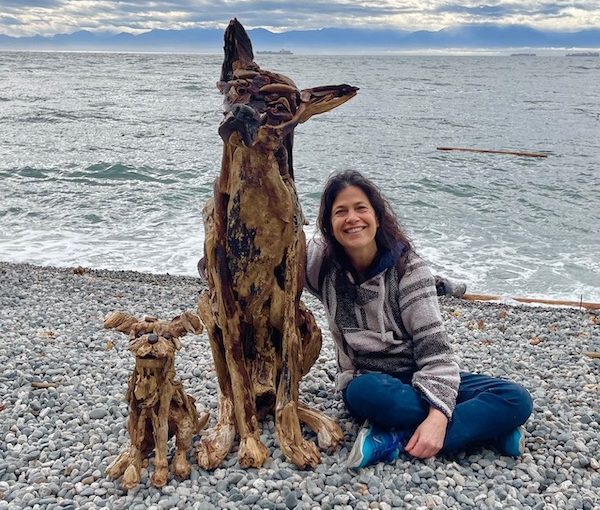
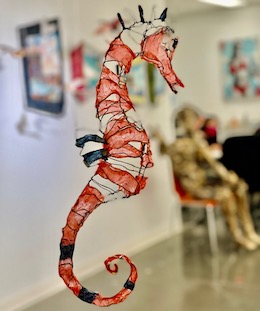
Victoria artist Tanya Bub’s current exhibit at the Art @ Bentall Gallery features life-size works of animals that occupy land, sea and air. (photo from Tanya Bub)

“Working with driftwood has given me a great appreciation of the power and beauty of nature. The shape and colour of every stick of driftwood hints at its history. Maybe a root had to bend around a rock while it was growing, maybe sand and water smoothed its edges over a period of many years. Then,” said artist Tanya Bub, “I combine all of these diverse natural sculptures to create an animal or person that looks alive because it borrows from the evident life forces that shaped the wood. There is something almost magical about extending the life of once-living wood by turning it into art. I’ll keep making driftwood sculptures as long as I am able.”

Victoria-based Bub currently has a solo exhibition on display at the Art @ Bentall Gallery. Called Mind Games, Defying the Art Space, the exhibit – which runs to the end of the month – features life-size works of animals that occupy air, land and sea.

In addition to the Art @ Bentall show, Bub has two separate outdoor installations of her sculptures. A large driftwood cat can be found at Kits beach (at the corner of Whyte and Arbutus) and a driftwood “giant” lives between Wreck and Oasis beaches (at the corner of N.W. Marine and Agronomy).

photo - Tanya Bub's solo exhibit - Mind Games, Defying the Art Space - the runs to the end of the month
Tanya Bub’s solo exhibit – Mind Games, Defying the Art Space – the runs to the end of the month. (photo from Tanya Bub)

Bub studied oil painting and ceramics at Emily Carr University of Art + Design, and did figurative work based on life drawings. She has a degree in fine arts from Emily Carr, as well as a degree in the philosophy of science from McGill University in Montreal. She worked as a computer programmer for a couple of decades and had her own website development company. The finding of a piece of driftwood during a walk on the beach was a game changer. Since 2019, she has been making her sculptures depicting various creatures, including the occasional human.

“I came to Victoria in 2003 with my husband and daughter to be near my mom,” Bub told the Independent. “I wanted a second child and realized I needed family and community nearby to raise a family with grace. I passionately loved art as a kid but shelved it as a young adult to pursue a more practical career in programming. Now that my kids are all grown up, I’m allowing myself a second childhood and spend about 12 hours a day creating art with absolute abandon!”

photo - One of the many creatures sculpted by Tanya Bub, whose works on on display display at the Art @ Bentall Gallery
One of the many creatures sculpted by Tanya Bub, whose works on on display display at the Art @ Bentall Gallery. (photo from Tanya Bub)

Also on Bub’s CV are two physics books that she co-authored with her father. While perhaps not immediately evoking any connection with her artwork, Bub explained, “Both the relativity and quantum mechanics books begin with a simple premise and extend from there with small logical steps, building complexity bit by bit, to tell the tale of the universe. My sculptures also all begin simply, by combining one piece of wood with a second. Then another is added and another, eventually resulting in a complex unified form made up of a thousand different pieces, that tell a unified story.”

And part of Bub’s story is her Jewish heritage.

“I’ve always identified strongly with Judaism, which for me is more of an approach to life rather than strictly religious beliefs,” she said. “My grandfather, Percy, was the embodiment of Jewishness. He had an irrepressible curiosity and an almost childlike joyfulness, which allowed him to marvel at and appreciate the simplest things. That, combined with a deep respect for intellectual pursuits and, above all, the high value placed on family, was at the core of hisJudaism. These ideals inform my approach to art, physics, family and life in general.”

To see more of Bub’s artwork, follow her on Instagram @victoriadrifter or visit her website, tanyabub.myportfolio.com.

Discussing Jewishness

Maxine Lee Ewaschuk, in a still from the documentary Periphery, which premièred last month at the Prosserman Jewish Community Centre in North York, and is available to view online.

On Oct. 28, the Prosserman Jewish Community Centre in North York hosted a hybrid launch for Periphery, a newly produced documentary film and photo exhibit that explores the lives of multiracial and multiethnic Jews within the Greater Toronto Area.

The 27-minute film features interviews with several individuals who might be considered as existing on the fringes of a homogenous, stereotypical notion of the Jewish world – a world that, in reality, is multifaceted and ever-evolving.

“What Periphery does for us is bring together a diverse view of our community,” said Andrew Levy, one of the event’s organizers.

From the outset, the film asks, “What makes a Jew? What do you have to know to be a Jew?” Implicit in those questions is another question, how can the Jewish community extend its tent to include those who might feel left out of the broader mishpachah, family? Notably, those whose parents are not both Jewish.

“There becomes a question of, can I say I am Jewish? When can I say I am Jewish? Is it ever OK for me to say I am Jewish before I complete my conversion, even if I am functioning very Jewishly in my day-to-day life. Sometimes, I say I am a Jew-in-progress,” shared dancer Maxine Lee Ewaschuk.

“Maybe I don’t know everything about what it is to be Jewish, but I am fiercely, proudly Jewish. It’s my experience and my experience is valid,” said actor Nobu Adilman, whose heritage is Jewish and Japanese.

“I knew my Indian grandparents super well, but I never knew where my Jewish grandparents came from,” said author Devyani Saltzman, who recounted a trip to Russia with her father to look into the roots of the paternal side of her family.

Saltzman also remembered an observation she had as a child of looking at other classmates who came from solely Hindu or Jewish families and thinking, non-judgmentally, “that must be really nice to know one’s place and space so clearly.”

In the cases of both Adilman and Saltzman, their parents married out of a love that transcended religious, cultural and geographic barriers.

“My father put a lot of his energy into my mother’s culture. He didn’t talk a lot about his upbringing. He was proudly Jewish, but he didn’t want to impose it on us,” Adilman said.

Adilman, too, related a kinship he has with other Jewish people who have gone through the same sorts of questioning that he has.

Ariella Daniels, Daniel Sourani and Sarah Aklilu each spoke of connections to places far removed from the GTA.

Daniels, who descends from Bene Israel Jews of India, explained that, for her, being a Jew represents several layers of identity – cultural, religious and national – and that the perspective she has of the world comes through being Jewish.

Sourani, who identifies as a gay, Iraqi Jew, focused on the importance of family – and the gatherings around Shabbat, holidays and lifecycle events – to his Jewish experience.

Aklilu, meanwhile, sees herself as Jewish, Ethiopian and Canadian.  She told of the many times her Jewish identity has been called into question and, as a result, she has questioned who she is. Ultimately, she asserted, “I know I am Jewish and I feel that I don’t need to explain to people that I am.”

Tema Smith, a Jewish community professional and daughter of a Black father and Jewish mother, outlined the odd experiences she has had because people often assume she has two European Jewish parents.

“People say things that they would never say if a Black person were in the room. I feel completely unseen in those moments,” Smith said. “I feel trapped in these weird moments of having to swallow what just happened.”

For Asha, a Black and Jewish woman, her connection to Judaism is one that she described as developing and expanding. “I think, if you look Black, like I do, then you go through life as a Black person,” she said. “I don’t know if you have to choose internally, but it is chosen for you in the wider world. So, people don’t look at me and think I am Jewish.  I don’t think that’s ever going to happen. If it did, it would be weird.”

While the experiences in Jewish spaces of those interviewed were frequently frustrating and alienating, it was also pointed out in the documentary that there are positive aspects to having a multiracial background. There is richness and happiness in belonging to different cultures and this, in itself, can be invigorating.

The screening was followed by a conversation with director Sara Yacobi-Harris, cinematographer Marcus Armstrong and film participants. Periphery was produced by No Silence on Race, an organization that seeks to establish racial equity and inclusivity within Jewish spaces in Canada, in partnership with the Ontario Jewish Archives. To view the film, visit virtualjcc.com/watch/periphery.

Sam Margolis has written for the Globe and Mail, the National Post, UPI and MSNBC.

London’s Ghetto Songs

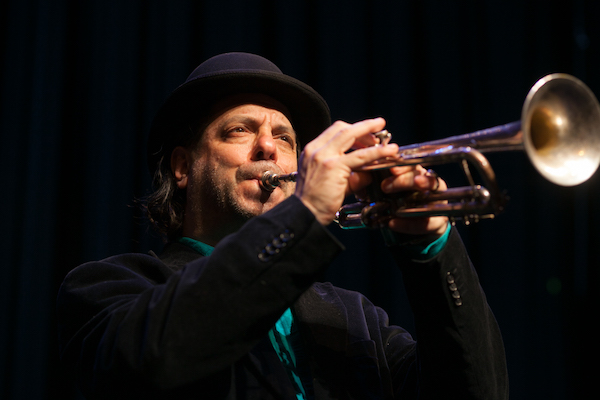
Frank London recently released a new album, Ghetto Songs (Venice and Beyond). (photo by Chuck Fishman)

Trumpeter and composer Frank London, an unwavering presence in numerous musical genres for more than four decades, released a new album, Ghetto Songs (Venice and Beyond), on Felmay Records earlier this year. The project incorporates music from around the world and delves into the history of “ghetto music.”

Coming out this past April – to coincide with the anniversary of the Warsaw Ghetto Uprising in 1943 – the concept for Ghetto Songs began in 2016, when the Grammy Award-winning London found himself in Venice on a residency with Beit Venezia, a foundation that aims to promote Jewish thought and culture, and serve as a bridge between people of all cultures and religions.

“It all started with my being invited by Dr. Shaul Bassi and Beit Venezia to go to Venice and conceive a special way to commemorate the 500th anniversary of the opening of the Venice Ghetto, the first segregated urban area to be called a ghetto,” London told the Independent. “The particularity of the Venice Ghetto and the universality of ghettos themselves inspired Ghetto Songs.”

The Jewish ghetto in Venice was situated in the polluted grounds of an ancient copper foundry, or geto. By the early 20th century, the term ghetto came to signify the crowded urban quarters of any minority group.

As London sees it, ghettos are historically complex phenomena. They offer both freedom and restriction, protection and imperilment. By isolating specific groups from the outside world, they become cultural “petri dishes” in which the ghettoized group’s culture can thrive.

Ghetto Songs celebrates the music and poetry that emerges from and about the world’s many ghettos. The playlist for the new release includes 17th-century music and poetry from the Venice ghetto (works from Salomone Rossi, Benedetto Marcello and Sara Copia Sullam); a piyyut (Jewish liturgical poem) from a mellah, a Moroccan Jewish quarter; kwela, street music from South Africa’s townships; and works by Cantor Gershon Sirota, who lived and died in the Warsaw Ghetto. There is also version the 1972 hit by the band War, “The World is a Ghetto.”

When it came to selecting what pieces would be the best fit for an album covering ghetto music encompassing five centuries and numerous locations, London recounted, “This is my favourite part of the process! I do the deep dive: tons of research into music from the world’s ghettos throughout history, across time and place. I pick out songs that I love, but that also tell a story, that inform each other, that complement each other, and that work together as a unified whole despite their incredible differences.”

London has assembled an array of talent for the release. Among the vocalists are tenor Karim Sulayman, Cantor Svetlana “Sveta” Kundish, Yaakov “Yanky” Lemmer (considered one of the best in the new generation of chazzans) and singer/guitarist Brandon Ross. They are joined by drummers Kenny Wollesen and Zeno De Rossi, cellists Francesca Ter-Berg and Marika Hughes, bassists Greg Cohen and Gregg August, and multi-instrumentalist Ilya Shneyveys.

“What might have been seen as challenging – getting the right musicians who can play such a diverse, variegated set of musics, styles, genres, etc., was really no problem. I am blessed to know and work with some of the world’s finest musicians and, with them, there were really no big challenges,” said London. “I have worked with each of these fantastic musicians in different projects and situations – mine, theirs, and as side musicians for others – over my 40-year career.”

To summarize London’s career in the space of an article, let alone a paragraph of two, is not an easy task. Among the artists he has worked with are Itzhak Perlman, Allen Ginsberg, LL Cool J, Mel Tormé, Iggy Pop, John Cale and Jane Siberry. He is a member of the Klezmatics and Hasidic New Wave, as well as leader of the Frank London’s Klezmer Brass All Stars and the Glass House Orchestra, a band that plays Austro-Hungarian Jewish music. London has made 30 solo recordings, is featured on more than 400 CDs and is the recipient of the Hungarian Order of Merit.

The veteran musician is working on several projects at present. These include Ich Bin Eine Hexe, a dance/theatre spectacle about pioneering performance artist Valeska Gert; “Rube G (Music for Brass Trio and Percussion,” a dance score for choreographer and filmmaker Jody Oberfelder; ESN: Songs from the Kitchen, a cooking and music video with Lorin Sklamberg and Sarah Gordon; Salomé: Woman of Valor, a CD with poet Adeena Karasick (jewishindependent.ca/salome-cd-launched); and Transliminal Rites, a CD of improvised music with Eyal Maoz and Guy Barash, who, together with London, make up the EFG Trio.

Sam Margolis has written for the Globe and Mail, the National Post, UPI and MSNBC.

Walking through our history

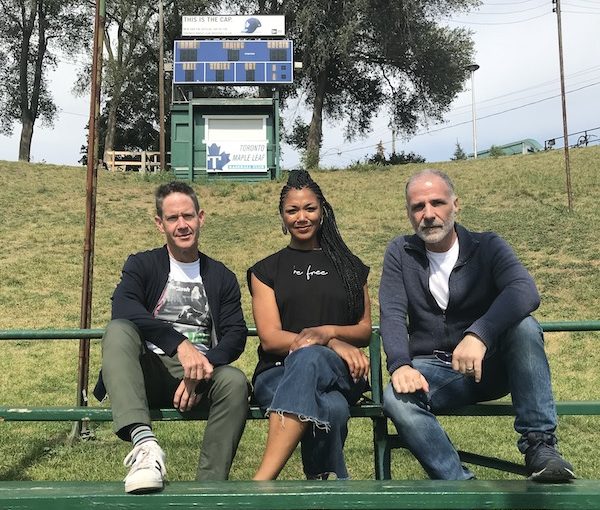
Left to right: Drew Carnwath, Measha Brueggergosman and Sam Rosenthal are the main creatives behind the podcast The Christie Pits Riot. (photo by John Ebata)

On Aug. 16, 1933, Toronto experienced what is viewed as one of the worst race riots in Canadian history. Earlier this fall, the Hogtown Collective, an immersive theatre company, released a four-part podcast that recreates the events of that summer evening 88 years ago.

The eponymously named podcast, The Christie Pits Riot, is seen through the eyes of its 12-year-old protagonist, Joey Rosenbaum. Created by Sam Rosenthal and Drew Cranwath of Hogtown Collective and set amid the circumstances of the Great Depression, Hitler’s rise to power in Germany and escalating ethnic unrest within Toronto, the series also contains an interactive walking tour through the neighbourhood where the riot took place.

The centre of the conflict is a baseball diamond in Christie Pits Park. Tensions began festering during a playoff between two local teams, the Harbord Playground, consisting mostly of Jewish and Italian players, and St. Peter’s, a club sponsored by a local church. Fights erupted and a full-on riot ensued. There were many injuries, but no fatalities.

The mass brawl, which lasted six hours, started after the final out of the second game of a quarterfinal pitting Harbord against St. Peter’s. Two nights earlier, at the first game, a swastika had been displayed by some fans. In the weeks before these games, troubles in Toronto had been brewing more broadly between some Jewish residents and antisemitic groups, primarily those calling themselves the Swastika Club.

A number of Jewish boys and young men who had heard about the swastika incident at the first game rushed to destroy the swastika unfurled at the end of the second. Supporters of both sides, including the Italians, who supported the Jews, joined in the melee.

In the podcast, narrated by Rosenthal, the listener gets a snapshot of life in the city at the time and follows Joey through his day – running errands for his father’s drugstore – along Bloor Street, near the ballpark.

“We wanted the audience to be able to access this story through an emotional, not just historical, perspective,” Rosenthal told the Independent. “Making our hero a young boy allowed us to show the world from his perspective.

“Exploring the deeper issue of systemic racism and antisemitic behaviour can be challenging,” he added. “Our young hero doesn’t understand hatred the way an adult might, so his character provides a means of asking questions about antisemitic racism. We also wanted a way to keep things rooted in the present simultaneously, so as to be able to draw clear parallels to the same problems and issues” that still exist.

The first three instalments take the audience through Depression-era Toronto, with the final episode coming to a head at the fateful game. When the riot breaks out in the story, we find Joey trying to get his friend Rachel home. They are helped along the way by Nala – voiced by Juno Award-winning soprano Measha Brueggergosman – who encourages Joey to stand up for what he believes.

In addition to providing her vocal talent, Brueggergosman was the podcast’s musical supervisor.

In releasing a theatrical production during the pandemic, the creators spotted a chance to provide audiences with a safe and tangible way to experience where the riot happened via the walking tour.

“To look out at Christie Pits Park and imagine what it would be like being in the middle of 1,000-plus people fighting is a terrifying thought, and so it makes the story land in a more visceral way if one can actually be there while listening in,” Rosenthal said. “Since my grandfather owned a store at the corner of Bloor and Manning, the walking tour is a perfect addition to share some of my family history within the broader scope of this chapter from Toronto’s history.”

Several scenes in the story are situated in the drugstore operated by Rosenthal’s grandfather from the early 1920s until the late 1950s.  Rosenthal’s father, Joseph, grew up in the neighbourhood and worked there. Joseph was born after the riot, and knew about it from his own father.

“My dad shared many stories of being a young boy in a deeply divided antisemitic Toronto,” said Rosenthal. “When he told me there were once signs posted at the Balmy Beach Club that said, ‘No Jews or Dogs,’ and that there were Swastika Clubs in the 1930s, I felt compelled to tell this story. My father and his friends were often brutalized or threatened whilst walking home from school. I wonder how many Toronto residents know this about our city’s past, and why it seems still entrenched in our present.”

Rosenthal’s hope for the production is that younger listeners not only learn that the riot was a dark chapter in Canadian history, but see it as a way to honour previous generations who paved the way for the diverse culture that Toronto is celebrated for today.

The Christie Pits Riot is available online from multiple providers. The Anchor app can be used by anyone interested in taking the guided walking tour through the Toronto neighbourhood where the riot transpired – the app can be found at hogtownexperience.com.

Sam Margolis has written for the Globe and Mail, the National Post, UPI and MSNBC.

The quirky stories of Israel

The images posted at facebook.com/sipurisraeli highlight the diverse stories and people covered on the Israel Story podcast, which is in its sixth season.

The podcast Israel Story started its sixth season in September. The show, which offers a long-form journalism approach to quirky stories of the people and events in Israel that do not often appear in the headlines, has been called the Israeli version of This American Life by none other than Ira Glass, the host of the National Public Radio hit.

Started in 2011 and originally intended for family and friends, Israel Story has grown to attract thousands of listeners. It is one of the most popular Jewish podcasts in the world.

The Independent recently caught up with Zev Levi, managing producer of the podcast, for some behind-the-scenes insight on the behind-the-scenes show about Israel – and to ask him what’s in store for upcoming episodes.

“The rest of this season is packed with moving stories about identity, healing, looking back, and looking forward. We’ll hear about the everyday lives changed forever by a national tragedy, the space project that lifted hopes around the world, an unlikely pro sports team, a soldier’s unexpected journey to tabletop gaming, and an internet scam that made people’s blood boil,” Levi revealed.

Already featured in episodes this season have been the story of a day in which all nine of the show’s producers spent from early morning to evening interviewing various and sundry characters at the historic Jerusalem International YMCA; an effort to save a 2,000-year-old mikvah; and a look at the life of Bung-Ja Ziporah Kim Rothkopf, the woman who opened the Seoul House restaurant in Jerusalem and started KOKO, a Korean kosher food brand.

image - from facebook.com/sipurisraeliEver since its beginning, the show has covered the stories of a wide range of groups living in Israel: Jews, Muslims and Christians; Israelis and Palestinians; Ashkenazim and Sephardim; Russians, Bedouin and Ethiopians; Filipino foreign workers and Eritrean refugees; Orthodox and secular; political hawks and doves.

And, not surprisingly, according to Levi, there is an endless source of material for future shows based on Israel, a land of storytellers. Levi said that ideas for topics are supplied by listeners and others, who send in potential stories. The team of producers is also encouraged to chase narratives they think should be told. He said the team prides itself on investing the time and energy to “find the perfect stories that shine a spotlight on what it’s like to be here. We look for the everyday lives that bring listeners to Israeli streets and fill their lungs with Israeli air.”

He added, “We see our show as a platform to display the complexities and depth of living in this amazing part of the world. And there are always unique subcultures and norms and clashes to explore. We live in an area where there are so many different ways to define yourself – religion, culture, politics, race, language – and there are endless permutations of the intersections and clashes between them. The story of how people make themselves is something anyone around the world can relate to and connect with.”

image - from facebook.com/sipurisraeliLevi elaborated on the process the team undertakes to determine what stories will be aired. Most episodes run roughly an hour or more with some bonus segments added.

“To paraphrase [Albert] Einstein, a story should be told as succinctly as possible, but no more succinctly than that,” said Levi. “While pitching a story, we generally have an idea of how long it will take to tell it, but, during the production process, there are countless examples of a story being way more complex than first thought, and needing more time. And countless examples of a story being much more simple, and being trimmed down, or even killed completely.”

The team would prefer to curate several stories that speak to different angles of a single theme, or to restrict themselves to three 20-minute stories in each episode, said Levi. However, they feel such an approach would not do justice to the stories themselves.

“When it comes to holding interest, our first defence is our own team,” he said. “We each dedicate time to analyzing when a story loses its engagement, and what we (as listeners) would need to avoid that. Several producers will often weigh in on drafts to make sure the best, most-engaging version of a story is what makes it to listeners. But all our stories are about people. People struggling to be authentic. People struggling to heal. People struggling to achieve. And we can all relate to that.”

Israel Story was founded by Dr. Mishy Harman, who serves as the podcast’s host and chief executive officer. The show can be heard on Apple Podcasts, Spotify and Stitcher, among other streaming services.

Sam Margolis has written for the Globe and Mail, the National Post, UPI and MSNBC.