Comedy tour now on

Left to right, comedians Andrew Packer, Jacob Balshin and Che Durena are currently on the JNT Comedy Tour, which takes them to small towns around Alberta and British Columbia until Sept. 6. (photo from David Cyr Photography / JNT Comedy Tour)

The JNT Comedy Tour, known for presenting the “highest” level of comedy in Canada from coast to coast, returned for their fourth edition Aug. 18. Featuring stand-up comedians Andrew Packer, Che Durena and Jacob Balshin, the tour comprises live shows in 19 communities across Alberta and British Columbia, and runs until Sept. 6.

Packer is an international headlining comedian and creator of JNT Comedy; his credits include performances at JFL42 (Just for Laughs), JFL Northwest and Edinburgh International Fringe Festival. Durena came runner up in SiriusXM’s Next Top Comic and he has headlined shows at JFL42 and appeared on JFL All Access on Comedy Central. Balshin, who is a member of the Jewish community, was named Toronto’s Best Upcoming Comedian at the I Heart Jokes Awards in 2018, and was nominated for Breakout Comic of the Year in 2020; his comedy has been featured on SiriusXM and CBC’s LOL.

The trio brings the tour into British Columbia Sept. 1, to Kimberley, with actor Sarah Stupar joining them. They then head to Creston Sept. 2 and Crawford Bay Sept. 3, before returning to Alberta for the tour’s last show.

If you happen to be traveling the province early next month, check out linktr.ee/jntcomedy for tickets and show times.

– Courtesy JNT Comedy Tour

Tackling the hatred head on

When white supremacists converged on Charlottesville, Va., four years ago chanting “Jews will not replace us,” it was the first encounter most of us had had with the conspiracy theory known as “the Great Replacement.”

In the pretzel logic of racists, immigration and multiculturalism are products of the Jewish imagination, with Jews perpetrating, through behind-the-curtains jiggery-pokery, what the tiny number of actual Jews in the world cannot do demographically: replace Aryan culture with alien races and cultures. The absurdity of the “theory” makes a lot more sense as one delves deeper into the trends and characteristics of antisemitism. Three wildly different but related books show that the projection of all that is wrong in society onto an empty vessel that happens to be Jewish recurs repeatedly. As ludicrous as the Great Replacement is, it dovetails magnificently with thousands of years of anti-Jewish prejudice and propaganda.

In Jews Don’t Count: How Identity Politics Failed One Particular Identity (TLS Books, 2021), author David Baddiel explores how the treatment of Jews is the exception to effectively everything today’s progressives espouse.

“It is a progressive article of faith – much heightened during the Black Lives Matter protests following the murder of George Floyd in 2020 – that those who do not experience racism need to listen, to learn, to accept and not challenge when others speak about their experiences,” he writes. “Except, it seems, when Jews do. Non-Jews, including progressive non-Jews, are still very happy to tell Jews whether or not the utterance about them was in fact racist.”

image - Jews Don’t Count book coverBaddiel discusses how racism and antisemitism are disentwined to disadvantage Jews, placing antisemitism lower on a “hierarchy of racisms” than other forms.

“Jews are stereotyped, by the racists, in all the same ways as the other minorities are – as lying, thieving, dirty, vile, stinking – but also as moneyed, privileged, powerful and secretly in control of the world,” he says. “And, if you believe, even a little bit, that Jews are moneyed, privileged, powerful and secretly in control of the world … well, you can’t put them into the sacred circle of the oppressed. Some might even say they belong in the damned circle of the oppressors.”

Baddiel confronts the canard that Jews can’t be victims of racism because they represent a religion, not a race – an audacious defining of an entire people by others who do not belong to the group, itself an example of something progressives would deign to do with no group other than Jews. By pushing antisemitism down the victimization scale, perpetrators can then accuse people who call out antisemitism as diminishing the experiences of minorities with legitimate claims to oppression.

When Baddiel called out one prominent antisemite, saying he had rarely heard so blatant a statement from someone with so large an audience, the perpetrator replied: “’Cos everyone was scared, that’s why.”

By alleging that a cabal of powerful Jews is policing the language of critics, the perpetrator, Baddiel writes, “isn’t a racist, he’s a hero, finally standing up and saying the things that need to be said even though it will bring down the wrath of this all-powerful Jewstablishment on his head.”

Similarly, when an article in the New York Times seemed like an attempt to rehabilitate the notorious antisemite Louis Farrakhan, the author replied to a critic who mooted the negative impact this could have on Jews: “Somehow, among the million concerns, you believe that yours are supposed to rise to the top.… That is called privilege.”

A recurring theme is that, unlike other minorities, Jews are not “innocent victims.” Baddiel (and the other authors mentioned here) do not explicitly say it, but it is understood that, for antisemites, Jews are not victims because, whatever the calamity, they bring it on themselves.

Another recent book, Israel: A Simple Guide to the Most Misunderstood Country on Earth by Noa Tishby (Free Press, 2021), picks up on some of Baddiel’s themes.

Tishby is an Israeli-American actor with a strong Zionist lineage. Her grandmother was a founder of the first kibbutz in Israel. Her grandfather was Israel’s first ambassador to West African countries and served on the Israeli delegation to the United Nations. Her great-grandfather was the founder of Israel’s ministry of industry and trade. Tishby served in the Israel Defence Forces entertainment troops, which she describes as, basically, “a nightly USO [United Service Organizations] tour.” She starred in an Israeli prime time soap opera – Ramat Aviv Gimmel, a sort of Israeli Melrose Place – then made the move to Hollywood.

image - Israel book coverHer book is aimed at people of her demographic – young, hip, leftist (though presumably non-Jewish) readers – and she presents, through biography and history, a tidy Zionist narrative that hits the bases. She does what pro-Israel writers rarely do: she uses emotion and personal stories, rather than dogged reliance on facts, chronology and empiricism. This is not to diminish the fact-based foundation of the book, but her first-person narrative connects the reader to the land and people of Israel in a way that cold facts do not.

Tishby provides a simple but thorough overview of regional history and the development of Israel, as well as the parallel history of the Palestinian and Arab peoples in the area. She dissects the claims of the BDS movement one by one, debunking the prevailing leftist narrative in the West. She pillories the obsession of the United Nations with anything Israeli and rebuts allegations of colonialism, apartheid, ethnic cleansing, unequal warfare and occupation quite effectively.

She recounts how, in the years after the Second World War, there were roughly 11 million refugees worldwide, 700,000 of whom were Palestinian.

“The 10,300,000 non-Palestinian refugees were funneled into UNHCR (United Nations High Commissioner for refugees, created in 1951), the UN agency dedicated to resettling and integrating refugees and/or stateless peoples,” she writes. The Palestinians got their own unique refugee agency: the UN Relief and Works Agency for Palestine Refugees in the Near East (UNRWA).

“While UNHCR is constantly working on getting the global number of refugees down, with UNRWA the numbers go up, up, up,” Tishby writes. “After the 1948 war, there were approximately 700,000 displaced people. Now UNRWA has 5.6 million ‘refugees’ registered in their books. How is that possible?”

Even Palestinians living in Gaza and the West Bank are counted as refugees by UNRWA, she notes, asking: “Can you be a refugee from Palestine when you currently live in … Palestine?”

Near the end of the book, Tishby throws some questions at the reader: “How would you handle a wannabe Sharia state 30 miles from your house? How should Israel retaliate when Hamas fires thousands of rockets into southern Israeli towns? Why haven’t the Palestinians agreed to make a final peace deal? Will the PA unite with Hamas and, if so, will Hamas denounce violence, like, ever? Why is Israel singled out? What about other countries that actually do systematically abuse human rights? Why aren’t activists focused on their freedoms of religion, speech, and assembly, which Israel grants all her citizens? Where are the boycott movements of neighbouring countries that literally kill people for their beliefs, desire for freedoms and democracy, or sexual orientation?”

Tishby’s Israel is an engaging, entertaining read and an ideal primer for newbies to the subject. For those more immersed academically or through lived experience with this topic, there is little new information, but it is largely an enjoyable read although, in an effort to be hip and approachable, she routinely employs gratuitous profanities, which might grate on some readers.

Far from these two volumes on the scale of page-turning readability is the monumental tome Anti-Judaism: The Western Tradition by David Nirenberg (W.W. Norton & Co., 2013). Published eight years ago, it had somehow escaped my eye and, when I did get my hands on it, it sat for some time on my pile. Cracking the spine was daunting because the thesis is dark and unnerving.

Nirenberg undermines the received wisdom that antisemitism is characteristic of ideological extremes in Western civilization. Instead, he depicts “anti-Judaism” as absolutely central and foundational to the very identity of Western civilization. (He differentiates “antisemitism,” which is discrimination against Jews, and “anti-Judaism,” which is perhaps a more pernicious, guileful thing, attributing “Judaism” and “Jewishness” to anything undesirable, whether the object is Jewish or not.) Applying Nirenberg’s thesis to Charlottesville is a simple way of understanding it. In the eye of the racists, immigration and multiculturalism are bad, ergo, by definition, they are “Jewish,” whether actual Jews have any hand in them or not.

image - Anti-Judaism book coverNirenberg provides a sadly compendious recital of civilizations for whom “Jews,” “Jewishness” and “Judaism” were used as a prism through (and against) which non-Jews defined their own identities.

“Why did so many diverse cultures – even many cultures with no Jews living among them – think so much about Judaism? What work did thinking about Judaism do for them in their efforts to make sense of their world?” he asks.

In Christianity, Jews are viewed as “materialist” and earthly, which is juxtaposed with Christians’ self-image as being concerned with the spiritual and the divine. In a theology where things terrestrial are equated with all things evil, the corollary is predictable.

Nirenberg quotes Jean-Paul Sartre, who said: “if the Jew did not exist, the antisemite would invent him.” The subtext of Nirenberg’s book, one could say, is that both things are true: the Jew does exist and the antisemite invented him. There are, in effect, two different “Jews”: real Jews and the image antisemites have created and refined for millennia.

It is this latter imaginary “Jew” that has been used not only to torment generations of actual Jews, but also to contrive the self-identities of civilizations. Nirenberg includes both Christianity and Islam under the rubric of Western civilization when he writes: “anti-Judaism should not be understood as some archaic or irrational closet in the vast edifices of Western thought. It was rather one of the basic tools with which that edifice was constructed.”

Since Christianity and Islam were both founded as supercessionary religions to Judaism, juxtaposing that theological parentage with an antipathy to the descendants of the parent religion creates a cognitive dissonance that Nirenberg describes as the “truth of Jewish scripture and the falsity of the Jews.”

Somehow, adherents of both religions have intrepidly managed to accommodate the dissonance.

“The simultaneous inclusion and exclusion of Judaism became for Islam – as it had been for Christianity – a structuring principle of the world, one through which Islamic truth was explored, discovered and articulated,” he writes. Jews were “both necessary and noxious, prophetic and pernicious.”

The religious bigotry permeates Western civilization, not just its religion, he argues. Nirenberg discusses how Marx employed typical Christian perceptions of Jews as materialistic to fit his atheistic ideology. He also analyzes how it influenced the Enlightenment and the French Revolution. For example, while the Declaration of the Rights of Man and of the Citizen, the great document of the French Revolution, does not mention Jews or Judaism, “it was famously presented and represented to the people – in a painting and in print – as two new tablets of law, replacing those handed Moses on Mount Sinai.” Never mind Christianity and Islam, when it came time for what was probably the most progressive, liberal society yet in modern history to define itself, the revolutionaries took Jewish imagery and firmly demarcated themselves as “not that.”

What is striking when immersing oneself in volumes about antisemitism is the stark certainty of today’s “critics of Israel” that they are untainted with antisemitic bias. They apparently have given little, if any, thought or effort to learn the history of antisemitism and its myriad permutations.

While Nirenberg speaks very little about Israel, he packs a powerful punch when, after hundreds of dense pages excruciatingly dissecting how civilizations for thousands of years have understood their identities and their most significant beliefs in direct opposition to Judaism, he declares: “We live in an age in which millions of people are exposed daily to some variant of the argument that the challenges of the world they live in are best explained in terms of ‘Israel.’”

Coincidence? It doesn’t seem so to those have studied the history and malleability of anti-Jewish ideas.

Teaching community’s kids

Congregation Beth Israel, children in costume, 1965. (photo from JMABC L.09778)

image - The Scribe book cover
The 2020/21 education-themed issue of The Scribe will be launched on Aug. 26.

The launch of the Jewish Museum and Archives of British Columbia’s latest edition of The Scribe will be held virtually on Aug. 26, at 7 p.m.  This year’s book features stories, photos and some almost-forgotten details about Jewish education in British Columbia. Join the Zoom to hear from local leaders in Jewish education both past and present who will give context to this significant subject.

Anne Andrew, past principal of Temple Sholom Hebrew School, and Emily Greenberg, current head of school at Vancouver Talmud Torah, will lead the discussion. Andrew will focus on her long involvement with the Jewish education scene in Vancouver and Greenberg will share her perspectives on where Jewish education is headed. Considering the impact teachers, educational institutions and curricula have on the continuity and cohesion of a community, both this panel discussion and this issue of The Scribe speak to important issues.

photo - Story time, conducted by Gamliel Aharon, Beth Hamidrash B’nai Jacob, 1976
Story time, conducted by Gamliel Aharon, Beth Hamidrash B’nai Jacob, 1976. (photo from JMABC L.00155)

The 2020/21 Scribe features information from the community archives about Jewish education around the province, spanning some 100 years. In addition, there are oral history excerpts from dozens of community members about various programs that have been offered over those years. Even in the very early days of the Jewish community in British Columbia, no matter where Jews settled in the province, there were all kinds of arrangements for the transmission of Jewish knowledge, culture and identity.

Zoom attendees will hear about iconic educators who instilled a love of Judaism and community spirit. Those who attended Jewish school here will take a trip down memory lane, being reintroduced to teachers from their past.

For more information or to register for the free online book launch event or to get your own copy of The Scribe, visit jewishmuseum.ca/publications/the-scribe or call the museum office at 604-257-5199.

– Courtesy Jewish Museum and Archives of British Columbia

Festival features local doc

Left to right: Lydia Okello, Shana Myara and Joanne Tsung. (photo from VQFF)

The 2021 Vancouver Queer Film Festival, which runs until Aug. 22, includes the screening of local feature documentary Well Rounded, directed by Jewish community member Shana Myara.

image - a still from the film Well Rounded
A still from the film Well Rounded.

Well Rounded brings fat queers to the front, with interviews from artists to health professionals. Directed by Myara, it features stories from Mi’kmaw comedian and broadcaster Candy Palmater, multidisciplinary performer Ivory and local queers including style icon Lydia Okello and comedian Joanne Tsung. The documentary balances the personal impacts of fatphobia with scientific facts from Dr. Janet Tomiyama, a psychologist working specifically with the causes and impacts of weight stigma, along with socio-political context provided by historian Dr. Jenny Ellison.

Myara is an award-winning writer. She is a curator, recovered festival director, and community arts programmer who has cultivated arts and dialogue for social change for more than 20 years. Well Rounded is her first feature length film. As part of the film festival, it is available for a limited release from Aug. 19 to 21, and includes a post-screening Q&A with the director and cast members.

The full 2021 VQFF program is available online at queerfilmfestival.ca.

– Courtesy Vancouver Queer Film Festival

Coveted Wife at Fringe Fest

Megan Phillips, left, and Hayley Sullivan in A Coveted Wife of East Van, part of the Vancouver Fringe Festival, which runs Sept. 9-19. (photo by Marn Norwich)

An all-star Jewish team consisting of poet Marn Norwich, director Ariel Martz-Oberlander, jazz musician Itamar Erez and actress Hayley Sullivan join forces to produce A Coveted Wife of East Van, the post-pandemic dating musical that you didn’t know you needed at this year’s Vancouver Fringe Festival. Light and fun, this show is the cathartic release we’ve all been jonesing for after months of pandemic isolation and, if you’re single, forced celibacy.

A Coveted Wife of East Van tells the story of Samantha Cohen as she navigates friendship, men and dating apps while making some very bad decisions along the way. Featuring both original music by Erez and familiar melodies from shows like Fiddler on the Roof, the story is set in Commercial Drive’s Café Deux Soleils. Samatha goes on a date with an East Van hippie, don’t forget the crystals; a mansplainer, need we say more; a pimp; and a murderer, who brings her ex’s head as an offering on their date. Just before things go horribly wrong, Samantha is saved by her best friend in this story about friendship, online dating and the search to find “the one.”

Norwich, an independent journalist for the CBC and Georgia Straight, and Erez, nominee for 2020 Instrumental Artist of the Year award, are joined by award-winning director Martz-Oberlander and Sullivan, as well as producer of the Or Festival Olivia Etey; Best of Fringe Award-winning actor Megan Phillips; winner of best comedy at the 2020 Florence Film Awards actor Mostafa Shaker; and set designer Michael Duggan, who has 30-plus years in the industry and has worked on more than 25 film productions.

A Coveted Wife of East Van opens Sept. 11, 3:30 p.m., and closes Sept. 19, 4:30 p.m., with several shows in between. The Fringe Festival runs Sept 9-19. For the full schedule, visit vancouverfringe.com.

– Courtesy Claudia Nobauer


More than a guide for work

Vancouver-based consultant Zena Simces’ You Can Make a Difference: A Guide to Being a Great Consultant(Tellwell Talent, 2020) is an informative, concise and useful primer for anyone considering this career path – or, really, anyone who works with diverse individuals or groups.

photo - Zena Simces shares lessons from her experiences in You Can Make a Difference: A Guide to Being a Great Consultant
Zena Simces shares lessons from her experiences in You Can Make a Difference: A Guide to Being a Great Consultant.

Based on knowledge gleaned from 30-plus years of experience working with a wide range of clients, as well as other research, You Can Make a Difference is what its title says, a guide to being an effective consultant. But it also is kind of a guide for how to be a good person and interact well with others. As Simces notes in the chapter on “Upholding Ethical Standards”: “My parents (who were in the grocery business) shaped me as a person and as a consultant. Their motto was to treat people the way I want to be treated.”

Perhaps now, in the context of ethics and family, I should mention that Simces is a longtime family friend. While I don’t think that this fact has influenced my opinions, it is interesting that, more than once in her book – starting with the first chapter – Simces discusses the need for consultants to be aware of things like unconscious bias and to try and mitigate their impacts.

“Knowing your strengths and weaknesses is important,” she writes. “We all struggle with self-awareness, but effective consultants recognize their biases and how to address them. They are natural self-starters and strive for excellence in all that they do, so they are aware of their blind spots and work to improve in areas they are weak.”

The book is full of practical advice like this – not earth-shattering insights but valuable information, collected into one easy-to-read volume of about 100 pages.

You Can Make a Difference is divided into two main parts. The first section takes readers through how to become a consultant, including consideration of whether that’s really the right career path for them. The second section highlights the main skills needed to do the job well. The four-page selected bibliography offers a start for readers who want to dive into the topic more deeply.

The two-and-a-half-page foreword begins with an example from Simces’ career – an instance when things did not go as planned, at least initially.

“While I have learned much from my successes, ‘failures’ like this one offer me the opportunity to learn and grow, which is essential,” she writes. “Being a successful consultant does not only involve substantive knowledge and technical skills, but also ‘soft skills,’ such as relationship-building, listening, communication and leadership. This combination allows a consultant to more efficiently and thoroughly achieve his or her clients’ goals.”

As she notes, these abilities, in reality, are “too important to be called ‘soft’ skills and have become the essence of what is required to be a great consultant. In fact, the Business Council of Canada’s Skills Survey (2018), which is based on responses from 95 of Canada’s largest companies, lists soft skills such as collaboration, communication, problem-solving, analytical capabilities and resiliency as top priorities for entry-level hires. Companies also valued these soft skills for mid-level employees.”

image - You Can Make a Difference book coverThis is another example of why Simces’ book also would be of interest to people who aren’t necessarily wanting to become a consultant. And that she starts her book with sharing how she learned from a misstep illustrates another of her points that would be beneficial to anyone, not just consultants – that it’s OK to “show some vulnerability. In fact, it takes courage to show vulnerability, and it takes strength to redirect to find a better solution. This can contribute to greater confidence between you and your client.” Or any relationship.

Unlike other books of this kind, Simces doesn’t give multiple examples or long stories to help drive home or explain a point. She gives one – and short ones at that – and moves on, which I appreciated. She trusts readers’ intelligence and doesn’t fill pages with unnecessary or ego-inflating narratives. Each chapter ends with a summary of the ideas therein and, in the second section, each chapter also includes a list of key tips covered. While this may seem like overkill, I found it helpful, especially when wanting to quickly find the details about something I only semi-recalled reading. I could see the tips or summaries making the book an accessible reference tool to have on your shelf or computer desktop long after having read it.

Whether or not You Can Make a Difference translates into your being able to make a difference in the world as a consultant, I can’t say, but it gives anyone considering this career path a solid framework for trying to do so. And its lessons and observations are applicable beyond the work setting. We could all use a gentle reminder on how to build trust in relationships, to have the courage to admit what we don’t know, to be flexible and open to change, and other such life, never mind consulting, skills.

Heavy summer reads

I recently read two works of fiction by former Winnipeggers. I mention that because, when I think of Winnipeg, where I grew up, I think of the Prairies, I think of wide open spaces. Yet both of these novels portray the bleaker side of life, with characters who can’t get beyond their limitations.

Having read and enjoyed Sidura Ludwig’s first novel some 15 years ago – Holding My Breath (Key Porter Books, 2007) – I looked forward to You Are Not What We Expected (House of Anansi Press Inc., 2020). Set in the Toronto suburb of Thornhill – a heavily Jewish neighbourhood – where Ludwig now lives, the loosely linked stories about the Levine family are wonderfully written, which is not surprising. But they are dark and, at times, brutal. Ludwig’s economical use of language can feel almost like a literal knife in the side or a punch in the gut, when a story switches from a relatively light moment – there is humour in these tales – to a tragic one.

image - You Are Not What We Expected book coverLudwig is a skilled observer of human nature and she creates characters in You Are Not What We Expectedwith whom readers will both empathize and even root for, but also get frustrated with. The first chapter jumps right in and sets the tone with senior citizen Isaac, back from Los Angeles to help his sister out. His fist-waving, shouting and no-spoiler-here reaction to a school’s placing of the Israeli flag below Canada’s on their flagpole is both hilarious, valiant and pathetic. His vitriolic and stubborn behaviours will cause him more than one trouble.

Other characters in the book are similarly limited – as we all are – by their own personal issues, the action or inaction of others, and simple twists of fate. You Are Not What We Expected is well worth reading but maybe not on vacation.

image - The Renter book coverMichael Tregebov’s The Renter: A Novel (New Star Books, 2021) is similarly well-written and also not a light holiday read, which is what I was kind of expecting. Tregebov, who now lives near Barcelona, takes a nostalgic look at Winnipeg Beach, but certainly not the cottage life that I experienced in the area as a kid.

The back cover promises romance in the summer of 1968; rich girl, poor boy, the stuff of rom-coms. But the poor boy in question is a cynical (with good reason) drug dealer who pretty much desires and courts the rich girl because of her wealth, not because he truly likes her at all.

I know there is a lot to appreciate in The Renter and there are many people who would love it – for example, Winnipeg filmmaker Guy Maddin, who, on the book’s cover, calls it “Absolutely brilliant!” – but I can’t honestly count myself among them.

Communicating with visuals

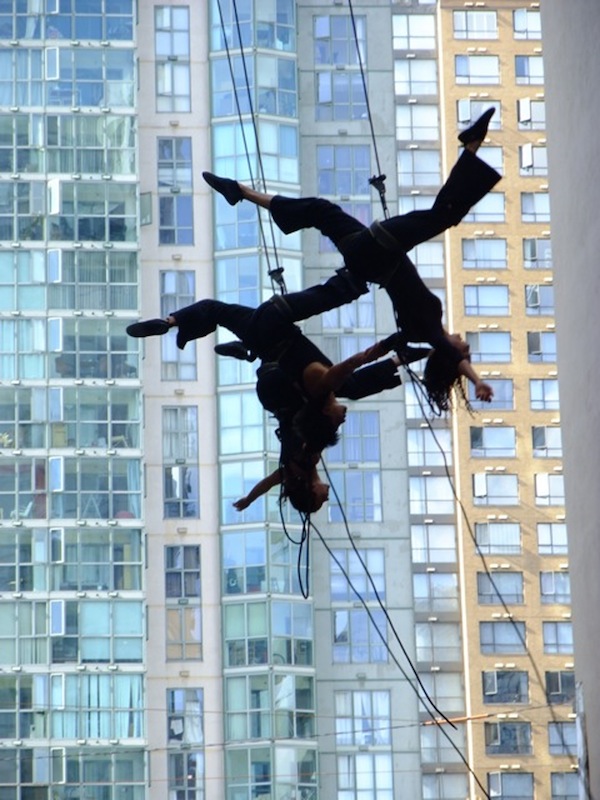
“Hanging Out” by Derry Lubell.

Derry Lubell’s photography captures the motion of dance, the ephemeral magic of the art form that generally only exists at the moment of performance. Unless, of course, it is recorded by a talented photographer.

Lubell’s solo exhibition The Body Speaks: Dance • Movement • Emotion opened on July 2 at the Zack Gallery. The official opening on July 8 was in person, as the long months of COVID restrictions started to ease. The gallery’s latest email to its patrons joyously states: “Appointments are no longer needed to see the show in person. Come on in!”

photo - “The Dichotomy” by Derry Lubell
“The Dichotomy” by Derry Lubell.

When you do go in, you’re surrounded by dance and dancers, their beautiful faces, and their astounding bodies. The gallery is a quiet place, but you can almost hear the music floating in the air, while the graceful ballerinas leap and pirouette around you. Most images are black and white or rendered in muted colours. “I think you can see the lines better in black and white,” said Lubell in an interview with the Independent. “The colour is often distracting, and I don’t want that. I don’t like fussy. I want clean shots.”

Lubell has been an artistic photographer for about five years. “Before that, I had a career as a psychotherapist. I had a family to raise,” she mused. “I always had a small camera with me, since I was young, to photograph my family or places I visited, but it was casual, like memory shots. After I retired, I started thinking: what else do I want to do? I always enjoyed talking to people, understanding their emotions. I wanted to do something similar but without the responsibility. Photography allows that. Using photography, I can still communicate with people, discern their emotions, reach their hearts, but on a visual level, without words.”

photo - Derry Lubell
Derry Lubell (photo from Derry Lubell)

The former psychotherapist reinvented herself as a photographer, and it led her on a long road of self-exploration, especially because the technology had progressed so much. “I had to learn computers,” she said. “I work harder now than before I retired. Shooting. Editing my pictures. Studying. Taking classes. Looking at other photographers’ images to see what works and what doesn’t. I put up my pictures on my website and Instagram, so others can see me, too.”

The dancing series is her latest, and it came about almost by accident. “I always enjoyed working with people who are comfortable with their bodies,” she said. “Even as a psychotherapist, I paid attention not only to words but to body language. Many people speak with their bodies. Dancers are the best at that.”

Her admiration of dancers prompted her a few years ago to enrol in dance lessons. “It was incredible,” she remembered. “The instructor was wonderful. I asked her: could I take your photograph? She agreed. After that, I photographed her and some of her students, and some other dancers.”

Lubell prefers taking pictures in people’s natural milieu. Some of the photos in the exhibit she took during rehearsals in the dancers’ studio spaces around the city. For others, she arranged meetings with the dancers outside, in urban surroundings, parks or the beach.

“Each session is an hour or two hours long. Each one is a collaboration between a photographer and a dancer,” she explained. “Together, we choose a location. I would ask her to bring half of her dancing wardrobe, and we try different costumes to see what works for the camera. I often select the background, and then the dancer would start dancing, and I would walk around and take shots. I might suggest a position or a prop, like ‘play against that log’ or ‘turn this way,’ but they are the performers. They like to perform. It is up to me to capture the perfect moment.”

One of those moments resulted in a unique picture. Only the legs of the dancer are showing. One wears a point shoe, posing like a coquette on a staircase. The other is still wearing a stiletto. The photo, titled “The Dichotomy,” emphasizes the dual nature of the subject: a woman and a dancer.

“It was sold before the show started,” Lubell said. “I brought pictures to the gallery to hang on the walls. Everything was still on the floor, in boxes. I left the gallery for a few minutes. When I came back, Hope [Forstenzer, the gallery director] said: ‘You know, this one just sold.’ Before it was even displayed.”

photo - “Form in Flight” by Derry Lubell
“Form in Flight” by Derry Lubell.

Another interesting image, “Form in Flight,” is of a young dancer in street clothing jumping in front of a brick wall. Lubell took the photo in Chinatown. “It is one of the oldest walls in the city,” she said. “I walked around Chinatown with that dancer. She is a student, but she loves dancing. When I saw that wall bordering a parking lot, I asked her to dance against it.” The dancer’s flight in the image is airy and joyful.

Several pictures display more than one dancer. One of those photos, called “Hanging Out,” is imbued with humour: one dancer is hanging from a wall with her hands, while the other is hanging upside down by her feet. “They are best friends,” Lubell said. “They met years ago as gymnasts. One does stunts for the movies now – she is the one who is upside down. I asked them to dance against the wall, and they started playing together, having fun. That mutual pose was a surprise to me.”

Lubell considers her dancers as partners in her art. “They have the right of veto. It doesn’t happen often, but sometimes they would say: ‘Don’t use this picture, my leg is in the wrong position.’ And I won’t. I honour their requests. After all, they honour me by allowing me to shoot their photos.”

The Body Speaks is on display until Aug. 16. For more information, visit the photographer’s website, derrylubell.com.

Olga Livshin is a Vancouver freelance writer. She can be reached at olgagodim@gmail.com.

Future of Film Showcase starts July 9

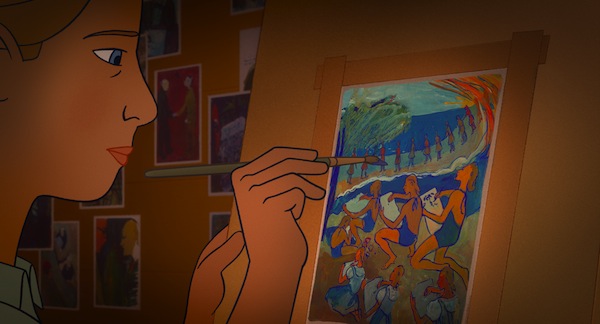
A still from Max Shoham’s animated film Sophie and Jacob.

The Future of Film Showcase, an annual short film festival and professional development conference dedicated to fostering the future of emerging Canadian filmmakers, features 11 shorts from Canada’s most promising new voices aged 40 and younger. This year’s slate includes Toronto Jewish community member Max Shoham’s animated film Sophie and Jacob, based on the true story of his great-grandparents, who find love while fleeing Nazi-occupied Romania in 1939. Shoham is a graduate of Etobicoke School of the Arts, where he majored in film, and is currently at Concordia University studying film animation.

The Future of Film Showcase takes place July 9 to 22, with films available to stream for free on the CBC Gem streaming service.

– Courtesy Future of Film Showcase

Libby Yu plays music for soul

Libby Yu performed A Concert for the Soul on June 28, hosted by Jewish Seniors Alliance and the Kehila Society of Richmond. (screenshot)

On June 28, Jewish Seniors Alliance and the Kehila Society of Richmond presented classical pianist Libby Yu in performance via Zoom. A Concert for the Soul was the last session of the 2020-21 JSA Snider Foundation Empowerment Series.

Toby Rubin, coordinator of Kehila Society, welcomed everyone to the concert and introduced Yu, who was born and grew up in Richmond. An accomplished performer, collaborator, teacher and adjudicator, Yu has graced international stages and has appeared as soloist with major symphony orchestras. She brings her passion for music to audiences of all ages and venues. She is an artist for the Health Arts Society’s Concerts in Care, which allows her to share her music in residential care homes and hospitals. Rubin encouraged us all to watch Yu’s fingers as they moved on the keyboard.

Yu greeted everyone from her home, saying how much she enjoys performing for JSA and Kehila and that she looks forward to playing for us in person in the future. She told us that she would be playing Ludwig van Beethoven, Franz Schubert and Frédéric Chopin.

The first piece was Beethoven’s Moonlight in three movements. The first was slow, the second light and happy, while the third was dramatic with many runs and chords.

The next piece was Schubert’s Impromptu, 4th Opus in A Flat Major. This piece is full of cascades, arpeggios, with a beautiful melody. It is in the ABA format, where the third movement returns to the melody of the first.

This was followed by two of Chopin’s Etudes, the first in F minor and the second his well-known revolutionary étude that reflects his turmoil over the instability of his native Poland.

Yu ended her performance with a Chopin Ballade, in G minor. The main theme is a quiet, still melody that builds in virtuosity and then flourishes to huge dramatic chords. The coda is fast and exciting.

It is indeed a pleasure to watch Yu in her intensity and concentration. After her performance, she thanked us and said she hoped the music brought us all joy.

Gyda Chud, co-president of JSA, thanked Yu for the program. She reminded everyone that, in the past, events with Kehila have included lunch and, hopefully, we will all be able to enjoy both lunch and a performance in person soon.

Chud again thanked Yu, saying the concert was not only an inspiration for the soul, but also for the heart and mind.

The Empowerment Series will continue with the theme “Be Inspired” for the 2021-22 season.

Shanie Levin is program coordinator for Jewish Seniors Alliance and on the editorial board of Senior Line magazine.