Skip to content
  • Home
  • Subscribe / donate
  • Events calendar
  • News
    • Local
    • National
    • Israel
    • World
    • עניין בחדשות
      A roundup of news in Canada and further afield, in Hebrew.
  • Opinion
    • From the JI
    • Op-Ed
  • Arts & Culture
    • Performing Arts
    • Music
    • Books
    • Visual Arts
    • TV & Film
  • Life
    • Celebrating the Holidays
    • Travel
    • The Daily Snooze
      Cartoons by Jacob Samuel
    • Mystery Photo
      Help the JI and JMABC fill in the gaps in our archives.
  • Community Links
    • Organizations, Etc.
    • Other News Sources & Blogs
    • Business Directory
  • FAQ
  • JI Chai Celebration
  • JI@88! video

Recent Posts

  • Zionism wins big in Vegas
  • Different but connected
  • Survival not passive
  • Musical celebration of Israel
  • Shoppe celebrates 25 years
  • Human “book” event
  • Reclaiming Jewish stories
  • Bema presents Perseverance
  • CSS honours Bellas z”l
  • Sheba Promise here May 7
  • Reflections from Be’eri
  • New law a desecration
  • Resilient joy in tough times
  • Rescue dog brings joy
  • Art chosen for new museum
  • Reminder of hope, resilience
  • The national food of Israel?
  • Story of Israel’s north
  • Sheltering in train stations
  • Teach critical thinking
  • Learning to bridge divides
  • Supporting Iranian community
  • Art dismantles systems
  • Beth Tikvah celebrates 50th
  • What is Jewish music?
  • Celebrate joy of music
  • Women share experiences 
  • Raising funds for Survivors
  • Call for digital literacy
  • The hidden hand of hate
  • Tarot as spiritual ritual
  • Students create fancy meal
  • Encouraging young voices
  • Rose’s Angels delivers
  • Living life to its fullest
  • Drawing on his roots

Archives

Follow @JewishIndie
image - The CJN - Visit Us Banner - 300x600 - 101625

Author: Olga Livshin

Monsters at the Zack

Monsters at the Zack

Claudia Segovia’s creations are colorful, whimsical monsters. (photo from Claudia Segovia)

It took Claudia Segovia a long time to find her niche. “I always liked art,” she said in an interview with the Jewish Independent, “but I’ve been primarily a dancer, drawing on the sideline. When I got pregnant 17 years ago, I couldn’t dance, so I started drawing much more. I also always liked sewing, so I experimented with textile art, tried different techniques: finger puppets, smaller pictures, drawings, collages, sewn little monsters. Nothing seemed to fit, until I began painting. I have only been painting for a few years but I know that’s my direction, that’s what I want to do.”

Segovia’s solo show, Intuitive Mythology, opened at the Zack Gallery on Aug. 17. It is awash with colorful, whimsical monsters. Painted as large pictures or crafted as fabric dolls, the artist’s monsters are full of contradictions. They are childish and philosophical, ugly and charming, spout big ideas or cavort like spoiled brats.
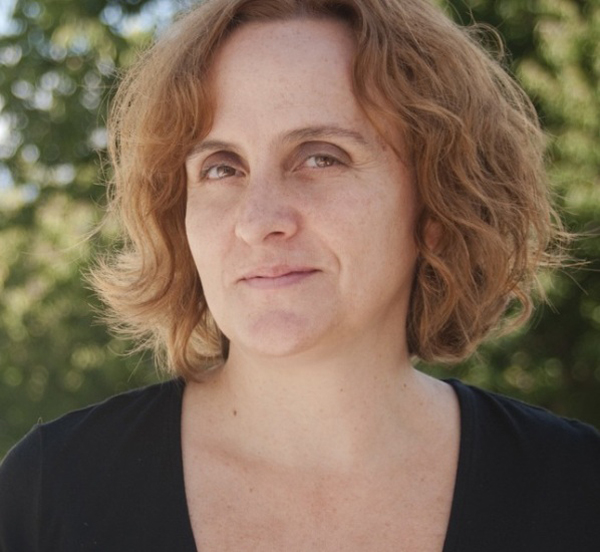
photo - Claudia Segovia
Claudia Segovia (photo from the artist)

“I don’t decide what I paint,” Segovia said. “First, I let my intuition flow and play with colors and figures on canvas for the background. Then, when it’s done, I try to see what shapes are there, what creature emerges from within. Once the creature is realized, I work to fulfil its life. Only then, I try to understand its meaning. For me, it is the most important part. Sometimes I see my siblings there, sometimes a timepiece, sometimes a totem pole. It is as amazing to me as it is to the viewers. Each piece is a surprise. What does this creature mean? What words come up? What questions does it answer?”

For this show, Segovia doubled each of her painted monsters as a hand-made fabric doll. “After I finished the painting, I worked on a 3D textile sculpture. I try to match the fabrics to the texture and colors of the painting. I display my sewn creatures in front of the paintings, as if they are coming out of the canvases, into life.”

Each of her monsters has a story to tell, if only the viewers would listen. All of them are unique, sweet and tart fruits of Segovia’s imagination.

“I have a passion for little monsters, the ones that are funny and different. I don’t like realistic art,” she admitted. “Sometimes, I write words on my monsters. My intuition guides me.… I’m inspired by the Mexican folk art, especially Alebrije – painted wooden sculpture from Oaxaca. I visited the town once, when I was younger, and talked to the artists. I do similar things with my monsters. It’s not on purpose, it just happened.”

Segovia started selling her little sewn beasties long before she started painting them. “My son was about five,” she recalled. “I wasn’t painting yet but I was making the fabric creatures. I emailed all my friends and they emailed their friends and, eventually, a couple of gift shops expressed interest. Now, three stores in B.C. carry my monsters and my smaller pictures and collages. One is on Granville Island, one on Main and one in Victoria.”

She feels excited when someone buys her art – and it’s not about the money. “People buy it because they love my piece so much they want to take it home,” she explained. “It feels wonderful.”

Unfortunately, like many artists, Segovia can’t make a living with her art. “It helps,” she said, laughing, “but to pay the bills, I teach. I teach art and I teach dancing. I love teaching.”

“I don’t teach computers anymore. Now, I only teach what I love: dancing and art. And I concentrate on my painting.”

Before she immigrated to Canada from Mexico, Segovia taught computers. Her educational background includes training in computers, as well as in art and dancing. “I did it in Canada, too, for a few years,” she noted, “before the high-tech crash in 2001. Then, when no job in the computer industry was available, I started teaching dance and art, choreographed a few pieces. I don’t teach computers anymore. Now, I only teach what I love: dancing and art. And I concentrate on my painting.”

As with her own work, in her art lessons, Segovia lets intuition take the reins. “I’m interested in the creative process, not the technique,” she said. “When I come to a school to teach, my lessons depend on the supplies. Scraps of fabrics? We’ll make aprons. Snippets of paper and old magazines? We’ll make collages. I look at what they have and think, What can we make of it?… My favorite art student’s age is from 6 to 9. Such kids engage easily. I think that must be my real age inside, too, about 8 years old.”

Segovia is a respected teacher in Vancouver, teaching art and dancing at Arts Umbrella, the Jewish Community Centre of Greater Vancouver and the Shadbolt Centre for the Arts. For more information about her, visit claudiasegoviaart.blogspot.com. Intuitive Mythology runs until Aug 31.

Olga Livshin is a Vancouver freelance writer. She can be reached at [email protected].
Format ImagePosted on August 22, 2014August 21, 2014Author Olga LivshinCategories Visual ArtsTags Claudia Segovia, Intuitive Mythology, Zack Gallery
Dorrance headlines Vancouver tap festival

Dorrance headlines Vancouver tap festival

Dorrance Dance will perform at the Rothstein Theatre on Aug. 30. (photo from Vancouver International Tap Festival)

“It would be like a jazz festival presenting Oscar Peterson,” said Sas Selfjord, executive director of the Vancouver International Tap Festival. She is so proud that tap dancer Michelle Dorrance is headlining her festival that she compared Dorrance to the great Canadian jazz musician. “Michelle Dorrance is the ‘it’ girl,” she said of the artist who takes the stage Saturday, Aug. 30, at the Norman and Annette Rothstein Theatre.

The dance festival is now in its 15th season and it’s time to celebrate. A weekend of professional performance and a fundraising gala are on the schedule that runs Aug. 28 to 31.

With this, the festival’s 15th edition, Selfjord said, the Vancouver International Tap Festival “is one of the top two or three in the world. With that reputation,” she said, “we can attract any artist we want. That’s a very egocentric statement, but it’s true. People want to be part of the Vancouver festival, so that is the legacy.”

Selfjord said anyone who has ever enjoyed tap, even in old movies, will appreciate the festival’s artists. “Fred Astaire, Ginger Rogers, Gene Kelley, the Nicholas Brothers, these are people we revere in the highest regard,” she said. “Their work is a subset and that work is always carried through in everything that a tap dance artist does, except we give our own relevance to it … there could be a little bit more hip hop, there could be some breakdancing, there could be, you know, innovative combinations that no one has ever heard.”

In addition to Dorrance Dance on Aug. 30, the festival features two other professional performances, on Aug. 29, also at the Rothstein. First is LOVE.Be.Best.Free, choreographed by Danny Nielsen with an all-male cast. Selfjord remembers encountering Nielsen years ago. “I remember he was at our very first festival and what was he, 14? He’s now an internationally revered artist.”

photo - Travis Knight
Travis Knight (photo from Vancouver International Tap Festival)

Second on the Aug. 29 ticket is Lisa La Touche’s Hold On, the debut of a work commissioned specifically for this festival. “Lisa was here from the get-go,” said Selfjord. “Now she’s in New York and she’s revered.” Hold On has an all-Canadian cast of dancers.

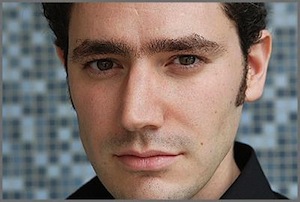
Selfjord is also proud of Travis Knight, one of the performers in Hold On. Knight has been a tap consultant with Cirque du Soleil and performed at the opening ceremonies of the 2010 Olympics. He has toured with the Australian show Tap Dogs. Knight “is one of Canada’s top artists,” said Selfjord, “and I remember he came to our first festival. He took a Greyhound bus and came out on a scholarship from Montreal. He is one of Canada’s amazing, talented, generous artists.”

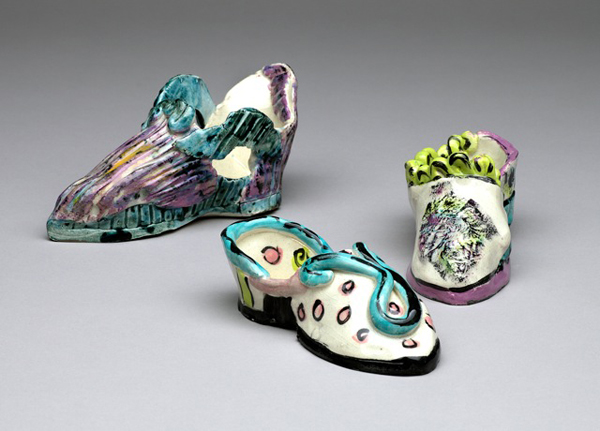
The gala fundraising and awards event, which takes place Aug. 28 at the Holiday Inn Downtown Vancouver, benefits from the sculpting talent of local ceramics artist Suzy Birstein. The local artist – who once chose dancing class over Hebrew school – was commissioned to design the awards to be presented. Birstein, who dances with the society during the year, was given the task of coming up with fancy ceramic shoes to honor some of those who have made the society great. “They pretty much gave me carte blanche as to what I wanted to do,” said Birstein. “So, I’m making shoes, like miniature shoes, not just like tap shoes. They’re just kind of in my style,” she said, referring to her own internationally known approach to sculpture.

photo - Three of the 15 individually crafted awards – created by Suzy Birstein – that will be given out at the Aug. 28 gala event
Three of the 15 individually crafted awards – created by Suzy Birstein – that will be given out at the Aug. 28 gala event. (photo from Suzy Birstein)

Each of the clay shoes will bear a special feature. “They’ll all have something that looks like a tap on the bottom of them,” she said.

Rounding out the weekend is Tap It Out on Aug. 31, where, according to the schedule, “everyone in Vancouver is invited to experience the tap phenomena themselves … when more than 100 dancers take to Granville Street,” and a performance by four youth ensembles that night at the Rothstein Theatre.

The festival idea began in the late 1990s when Selfjord took a trip to Minneapolis on behalf of others in the Vancouver tap world “to see what we could do to help build community and engage the community at large, and we thought a festival” might be the idea.

In Minneapolis, she encountered “two of tap’s greatest legends,” the Nicholas Brothers. To some, they are the greatest tap dancers who ever lived. Born in 1914 and 1921, the two became famous as children and opened at the Cotton Club in 1932. They made films throughout the 1930s and ’40s that showed off the prowess of the dancing team, which combined tap with ballet and acrobatics.

Meeting the brothers, said Selfjord, “turned me right on my head. I thought, how am I sitting having a brandy with the Nicholas Brothers and talking to them and engaging them? I was just so motivated by having access to artists of that calibre, that just set the stage to come home and to do the festival, so we did.”

For tickets and more information, visit vantapdance.com.

Michael Groberman is a Vancouver freelance writer.

Format ImagePosted on August 22, 2014August 22, 2014Author Michael GrobermanCategories Performing ArtsTags Danny Nielsen, Lisa La Touche, Michelle Dorrance, Sas Selfjord, Suzy Birstein, Travis Knight, Vancouver International Tap Festival
Elan Mastai taps family history for F Word

Elan Mastai taps family history for F Word

Zoe Kazan and Daniel Radcliffe on the red carpet in New York City. (photo from facebook.com/thewhatifmovie/photos_stream)

When Elan Mastai’s father said hello to a pretty stranger in a Jerusalem café some four decades ago, it was the only English word he knew.

She was born in Chicago and grew up in Vancouver, and had lived in London the previous few years before trekking to Israel to explore her Jewish heritage and teach English, of all things.

It worked out pretty well for both of them. They relocated to Vancouver, got married and started a family. Now, their 39-year-old son has channeled their youthful bravado into his screenplay for What If, a warm and refreshingly grounded romantic comedy that opens in as-of-yet-unspecifed Canadian cities Aug. 22 with its original title, The F Word (F as in friend).

“The idea of moving to a country where I didn’t speak the language, different legal system, different everything, and having to start my life from scratch, it’s almost impossible for me to imagine doing that,” Mastai said in an interview. “But that’s what my father did. And he did it for love. That is a big part of the kind of things I like to write. I think in my DNA are the things that people do for love. And that’s all over this movie.”

The film imagines just-dumped Daniel Radcliffe meeting Zoe Kazan at a party, only to learn that she’s in a serious, long-term relationship. Say, there’s no reason they can’t be friends, right? It just requires a little honesty on his part and a lot of clarity on her part.

If only things were that simple, well, there’d be no movie. The film has great fun poking and prodding the central characters until one of them takes a leap of faith – and a transatlantic flight – that results in nothing I can reveal here.

photo - Screenwriter Elan Mastai
Screenwriter Elan Mastai (photo from thefinaltake.com)

“I love the romantic comedy, but it can sometimes be a bit of a debased genre because it’s a very phony genre at times,” Mastai said on the phone from Toronto, where he lives with his wife and children. “The ones I love – and they’re the ones that most people love – have something real and relatable to say about human interaction.”

Mastai’s childhood was happily marked by a Shabbat dinner every Friday night, where his large family would convene and debate the issues of the day. Everyone had strong ideas of right and wrong, but there was plenty of grey to debate, as well.

“In my personal heritage, I had all the different versions of the Jewish experience in the 20th and 21st century,” Mastai explained. “Whether it’s American Jews, European Jewry, Sephardic, the beginning of Israel, it was all literally sitting around my dinner table when I was growing up.”

Notably, the travails his grandparents had survived did not mitigate their sense of humor. “To me, the sensibility at the core of the film is very Jewish in terms of that legacy of Jewish humor, whether it’s Billy Wilder or Woody Allen or Nora Ephron or Charlie Kaufman or William Goldman,” Mastai said. “Wit and humor as a tool to defuse awkwardness and tension, and that prizing of intelligence, and the prizing of ethical behavior – these are things that were part of my Jewish upbringing, and I tried to bring those to the characters.”

We may think that a successful screenwriter, more than anything, must have a fabulous imagination. Mastai’s triumphantly demonstrates in What If/The F Word that heart and intelligence are sufficient to engage an audience in the romantic travails of a couple of ordinary people.

“All the way through it, I wanted to write what I thought of as an ethical romantic comedy,”

Mastai confided. “A comedy where people aren’t making these crazy, cockamamie schemes or twisting the truth or hiding things from each other. Everybody’s trying to do the right thing. That feels very Jewish to me because of how I was raised, that you can try to do the right thing, try to make ethical decisions, and still make a total mess of your life. Because that’s the way life is.”

Michael Fox is a San Francisco film critic and journalist.

Format ImagePosted on August 22, 2014August 27, 2014Author Michael FoxCategories TV & FilmTags Daniel Radcliffe, Elan Mastai, The F Word, What If, Zoe Kazan
Tunnels pose serious threat

Tunnels pose serious threat

Weapons recovered from a Hamas tunnel. (photo from IDF/FLICKR)

“One hundred Israeli schoolchildren killed in Hamas attack.” Israelis say this would have been just one of many similar headlines announcing untold loss of civilian life had Operation Protective Edge not been launched last month. The goal of the operation was to silence the seemingly endless barrages of Gaza rockets aimed at Israeli cities and towns, and to detect and destroy the vast network of underground tunnels dug beneath Gaza and into Israel by the Islamist Hamas terror organization.

As details of the tunnel system became public, Israelis were at once fascinated and infuriated to learn specifics of the intricate Trojan-horse-like network lurking beneath their communities; an engineering feat so potentially lethal that the national discussion is rife with unsubstantiated worries about terrorist plans for the execution of “an Israeli 9/11.”

Frequently heard were comments like, “Surely the high-tech nation should have the ability to detect tunnels!” while others ask how such an elaborate feat of engineering and construction could have proceeded right under the noses of the military in a security-savvy country with vast counter-terrorism experience.

In October 2013, Israeli army intelligence located entrances to one such tunnel just a couple of hundred metres from the entrance to Kibbutz Ein Hashlosha, a collective community in southern Israel near the border with Gaza.

On a tour of that network, standing at ground level, one can see the tunnel split in the middle, its branches extending deep into the earth, with one entrance/exit nearly a mile away – through Israeli territory and into the Gaza Strip – and the other a mere 600 metres (almost 2,000 feet) to the right: exiting into Israeli territory.

Moving closer required man- oeuvring through a steep downward 46-foot trek, assisted by the steadying hand of an IDF officer to navigate the distance from the surface to the underground passageway itself. Crawling through the deceptively small opening and out of the desert’s summer heat into the coolness of the subterranean concrete-encased structure, it was surprising to find myself standing upright, able to see far enough to sense the vast distance it covers. Though visibility was limited by the dearth of ambient light, helped only slightly by the lighting unit attached to our camera, the immense dimension of the tunnel was perceptible, the elaborate nature of the structure striking. From the sophisticated construction to the array of cables, conduits, finished ceilings, communication lines and pulley systems, it made sense that each tunnel was estimated to have required several years and millions of dollars to build – mostly by hand, with jackhammers and shovels.

Also discovered in many of the recently destroyed tunnels was a variety of weapons, army uniforms, motorcycles, chloroform and handcuffs: macabre “kidnapping kits.”

Read more at themedialine.org.

Format ImagePosted on August 22, 2014August 27, 2014Author Felice Friedson TMLCategories IsraelTags Hamas, IDF, Israel, Israel Defence Forces, terrorism, tunnels

IDF’s minority soldiers

Fact: There are 200 Christian Arab Israelis serving in the Israel Defence Forces (IDF). Fact: There are 200 Muslim Arab Israelis serving in the IDF. Fact: There are 1,400 Bedouin serving in the IDF. Fact: There are 4,000 Druze serving in the IDF. Fact: There are 100 Circassians serving in the IDF.

Why don’t journalists write about them? Perhaps because most might find it hard to believe that these 5,900 view their citizenship to mean they have a role to play in defending their country. How do these minority members of the IDF come to the decision to serve their country?

A recent meeting with parents of minority soldiers in the IDF presented some context. The visit was organized by MediaCentral, an independent Jerusalem-based nongovernmental organization that provides support services for journalists based in or visiting Israel, the Palestinian Authority and the region.

photo - Anett Haskia
Anett Haskia (photo by Barry A. Kaplan)

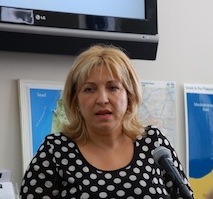
Anett Haskia is an attractive, fashionably dressed blond with long, manicured fingernails. She is an Israeli Muslim Arab and outspoken. Growing up, she said, “It was not acceptable for our kids to join the army. Everyone [who wanted to join the army was] considered to be a traitor, but I didn’t see it as [being] a traitor. I saw it as taking responsibility like every other citizen.”

Twenty-two years ago, after a divorce, she and her three children moved to a kibbutz and she went to enrol them in a Jewish school, the first time that school had been approached to enrol an Arab child. He was accepted in three days.

As her children grew up, her older son decided to volunteer to serve in the IDF infantry; her daughter volunteered to serve in an education unit and became one of the first Arab Israeli women to serve in the IDF. Haskia’s youngest son is part of the Golani Brigade (an infantry brigade) currently serving in Gaza.

“The aim was not to integrate into Israeli society,” she said. “They [already] are Israeli. They want to live in the present and future as Israelis. They never suffered from being Arab and they never hid their heritage.” Haskia said she didn’t tell them to join the IDF, rather, it was a choice the children made as individuals.

photo - Yusuf Jahja
Yusuf Jahja (photo by Barry A. Kaplan)

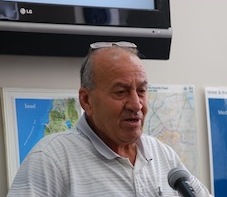
Speaking to reporters, Yusuf Jahja said proudly, “I am a Muslim Arab citizen of the state of Israel.” A blue-collar worker most of his life, Jahja comes from an Arab village up north and has six sons and two daughters. His was the first family from his village to send their children to the Israeli army.

Three of the sons went to serve in the IDF together – two served in combat units and one in border patrol. In 2004, one of the sons was killed in an explosion in Gaza. The family’s home community initially boycotted the funeral. Today, two of Jahja’s sons are still serving their country.

Sybil Kaplan is a journalist, foreign correspondent, lecturer, food writer and book reviewer who lives in Jerusalem. She also does the restaurant features for janglo.net and leads weekly Shuk Walks in English in Jerusalem’s Jewish food market.

Posted on August 22, 2014August 21, 2014Author Sybil KaplanCategories IsraelTags Anett Haskia, IDF, Israel Defence Forces, Yusuf Jahja
Aliyah even in hard times

Aliyah even in hard times

The Babani family at New York’s JFK airport, moments before they boarded the plane to Israel. (photo by Shahar Azran via Nefesh b’Nefesh)

Despite tensions surrounding the war in Gaza, 338 new olim (immigrants) from the United States and Canada departed on an aliyah charter flight to Israel on Aug. 11. The special flight is a joint venture of Nefesh b’Nefesh, the Ministry of Aliyah and Immigrant Absorption, and Keren Kayemeth Le’Israel, in cooperation with the Jewish Agency for Israel, JNF-USA and Tzofim Garin Tzabar.

Among the olim are Nir Babani and Luz Arroyave with their daughter Antonia from Vancouver. “We’re going to miss our family and the peaceful environment of Vancouver. We’ll miss the quality life there,” said Arroyave.

The large group of olim includes 37 families with 107 children. The passenger list also includes 65 olim moving to the Galilee and the Negev as part of the Nefesh b’Nefesh and Keren Kayemeth L’Israel Go North and Go South programs. Altogether, the olim will be settling in every part of Israel, from Ma’alot in the north to Eilat in the south. Included in the group of olim are 109 young men and women who will be serving in the Israel Defence Forces.

The olim hail from 27 states and three Canadian provinces, from Arizona to Quebec, and range in age from a six-week-old baby to a 93-year-old great-grandparent in a family of four generations making aliyah together.

“I find it profoundly inspiring that we have a 747 jumbo jet filled to capacity with people from the North American Jewish community making aliyah, especially at such a challenging time,” said co-founder and executive director of Nefesh b’Nefesh Rabbi Yehoshua Fass. “To see that Jews everywhere, young and old, religious and secular, are determined to fulfil the dream of helping to build the Jewish state is truly amazing.”

This summer, 2,000 olim are expected to have made aliyah with Nefesh b’Nefesh on eight different flights. Since the beginning of the year, about 1,600 olim have made aliyah with the organization. Since 2002, Nefesh b’Nefesh has brought nearly 40,000 olim to Israel from the United States, Canada and England.

Format ImagePosted on August 22, 2014August 27, 2014Author Nefesh b’NefeshCategories IsraelTags aliyah, Luz Arroyave, Nefesh b’Nefesh, Nir Babani, Yehoshua Fass

Our Israel connections – the need to tell our stories

The Six Day War may have been history’s most illustrative example of the limitations of a weekly newspaper. Reviewing this newspaper’s archives from 1967 shows one week’s paper filled with ominous foreboding and the next issue, triumphal jubilation.

Every year, we take a short publishing break in the usually quiet news period that is the summer doldrums. Unlike in 1967, though, we now have a spiffy new website that has allowed readers to follow some local events and commentary from abroad during these especially tumultuous few weeks.

The news has not been pleasant. Israel has somewhat successfully stanched some of the infrastructure of the Gazan terrorist regime. The cost has been tragic and the worldwide reverberations deeply disturbing.

“Victory” is difficult to discern. In the biggest picture, victory for all civilians would be peace in the region, but even the most optimistic among us see that as a long way off – the stated objective of Hamas remains the destruction of Israel. For Israel, victory has historically meant a few months or a couple of years of relative peace. By beating back the immediate threat (whether the combined Arab armies in 1948-49, 1967 and 1973, or the PLO in the 1970s and ’80s, and the assorted terrorist entities since), Israel has managed to buy a few periods of comparative peace. And, as a result of Operation Protective Edge, Israel has undermined the strength of Hamas and so that may result in a period of relative peace for Israelis and Palestinians.

There has been another battle: the battle of words around the world. It’s not all words, of course – some of the battle has been violent, with anti-Jewish attacks in Europe and elsewhere – but the discourse about Israel globally, even when largely non-violent, has been unprecedentedly grotesque and incendiary. The United Nations, reinforcing its long failure to live up to the promise of its founding charter, has made a mockery of justice and peace by condemning only Israel. Armchair commentators have declared themselves military authorities to parse Israeli actions. Cartoonists have exhumed Nazi-era imagery to employ against Israel. Street rallies around the world, while accusing Israel of bloodlust, have themselves turned into bloody and violent displays of hatred.

Even some of the more thoughtful contributors to the “debate” have exhibited assumptions that seem to rely on old familiar stereotypes. And people who have never uttered a word of concern in the past nine years while the repressive Hamas regime has tightened its grip on the people in Gaza suddenly, when Israel becomes involved, declare, “I don’t support Hamas. I support the people of Gaza.” Would that they actually did.

In Canada, things are somewhat brighter. All major federal political parties have rightly stood with Israel in its fight against terrorism. (The exception being the Green Party of Canada, but then, it isn’t “major.”) We have a fairly balanced media that has generally not succumbed to the extremism or misrepresentation we have seen in Europe. Still, Canadian opponents of Israel purvey the idea that they can denounce Israel in the most horrible terms without that level of rhetoric having an impact on Jewish Canadians or our country’s multicultural harmony.

Explaining why this type of anti-Israel action affects us as Canadian Jews is not simple. Most Diaspora Jews have a deep and passionate connection with Israel. In part, this has to do with the Holocaust. The Holocaust did not happen because of Hitler and Nazism. It happened, at least in the magnitude it did, because there was not a country on the planet (save the Dominican Republic) that was willing to welcome the imperiled Jews of Europe. The need for Israel as a nation where Jews control the immigration policy is not due to the Holocaust per se, but the world’s nonchalance toward it.

More than this, after the magnitude of the Holocaust became known to the survivors and to the entire world, the unfathomable disaster might reasonably have sunk the Jewish people into a collective depression of hopelessness and fatalism. Instead, the rebirth of the Jewish homeland in Eretz Israel allowed a people seeking some light from a catastrophic darkness to find hope and optimism. Those Jews who made aliyah – and, to no small extent, those who remained in the Diaspora – threw themselves into building the state of Israel, a task that has proven successful beyond any dreams and allowed an optimistic future to salve the horrors of the immediate past.

When street mobs, politicians, UN resolutions, cartoonists and Facebook authorities heap loathing on Israel, despite all their feeble assurances that it is Israel, not Jews, they target, the words and the hatred behind them hurt. There are other historical, cultural, familial and political reasons why Jewish Canadians and others in the Diaspora feel deeply a part of Israel. It might help our neighbors understand us if we told our personal and collective stories better.

***

The JI’s Pat Johnson spoke with David Berner about the Israel-Hamas conflict, global antisemitism and other issues on Aug. 7 2014:


Posted on August 22, 2014September 3, 2014Author The Editorial BoardCategories From the JITags Diaspora, Hamas, Holocaust, Israel, Palestinians

Playing to win

I’m home when my phone buzzes with a text from my son. Playing for the school basketball team in a city an hour away, his five words carry disappointment, sadness. “I’m just a benchwarmer, mom.”

I’m not one of those parents who cheers on sports games from the sidelines. Perhaps I’m still scarred from high school athletics, when my best friend and I were consistently the last members picked for any team during PE classes, a painful memory to this day. It sounds callous but, for me, sports has never held even a glimmer of interest, not even when my own children are playing.

But something changed when I learned my son had spent most of that game on the bench, watching instead of playing. What upset me was the injustice of his exclusion. He’d attended practices dutifully and loved being part of the team – until that game. “I’m not a bad player,” he insisted. “I don’t know why they didn’t give me a turn.”

The indignation of having been left out hung around the house like a damp cloud for a few days. I felt hurt on his behalf, compelled to try and make things right. So, I did what most writer-parents would do – I penned a letter to the principal. It wasn’t fair, I declared. I was under the impression that in team sports everyone gets a turn. How could the coach exclude certain players and justify that exclusion by the team’s victory? Wasn’t the victory hollow when only the best players had performed?

We don’t guarantee that every player will get to play, the principal responded. Sure, they can get a place on the team, but it’s the coach’s decision about who plays the games – and we play to win.

A friend explained it in a gentler way to me a few days later. In elementary school, the games are all about playing fair, giving everyone a turn and learning to be a good sport. Not so in high school, where the emphasis shifts to winning. “The weaker players sit on the bench so the team can have its best shot at victory,” she said. “That’s just the way it is, regardless which sport we’re talking about.”

I was astonished, but enlightened, too. As parents, we want desperately to defend our kids from insult, bruised egos and perceived injustice. Their hurt becomes our hurt, and we feel compelled, angered even, to speak out on their behalf.

But sitting on the bench might offer some important life lessons. The humility to admit you’re not the strongest player. The insight that you need to work harder to be chosen for the next game. The understanding that, as unifying as the word “team” appears to be, it’s composed of members who are not equally competent: you either shine, or are outshone.

It’s going to be the same scenario at every job interview a few years down the line. The strongest candidates will be selected while the rest will warm the bench on the sidelines until they improve their game.

So, maybe warming a bench a few times is a crucial part of the game, in that it deftly illustrates the distance between where you are and where you want to be. It’s what you do with that knowledge that makes all the difference, on the basketball court and off.

Lauren Kramer, an award-winning writer and editor, lives in Richmond, B.C. To read her work online, visit laurenkramer.net.

Posted on August 22, 2014August 21, 2014Author Lauren KramerCategories Op-EdTags school sports
Bard celebrates 25th

Bard celebrates 25th

Bard on the Beach’s A Midsummer Night’s Dream is one cheeky dream. (photo by David Blue)

Summer in Vancouver brings the sun and, with it, things like beach time and bike rides, barbecues and picnics. It also brings the magic of Shakespeare’s Elizabethan world under the red-and-white tents of Bard on the Beach at Vanier Park.

This year marks the 25th anniversary of Bard. And, true to form, it serves up an interesting mix: re-mountings of two previous hits, A Midsummer Night’s Dream and The Tempest, under the big tent, with the lesser-known Cymbeline and the non-Shakespearean Equivocation on the newly minted Howard Family Stage at the Douglas Campbell Studio Theatre. This week, the JI reviews Dream and Cymbeline.

You can never really go wrong with presenting one of the Bard’s most beloved comedies and this year’s production of Dream is no exception, as director Dean Paul Gibson ramps up the frenzy to produce what can only be described as a very raunchy, in-your-face romp. This is one cheeky dream.

There are four story lines to follow: the wedding preparations of the duke of Athens to Hippolyta; the “looking for love” riotous journey through the fairy-studded woods of the four young star-crossed lovers; the feud of the fairy royals, Oberon and Tatiana; and, finally, the play within a play (Pyramus and Thisbe) presented by the local tradesmen in honor of the duke’s wedding and acted out under its own little red-and-white tent.

Kyle Rideout as Puck, the mischievous servant of Oberon, and Scott Bellis, as Bottom, the bucktoothed, red-nosed, nerdy know-it-all of the working class, stand out in the reprisal of their 2006 roles in this large ensemble cast. Naomi Wright breathes new life into the role of Tatiana while Ian Butcher is a very sexy Oberon. Chirag Naik, Daniel Doheny, Claire Hesselgrave and Sereana Malani beautifully play the young lovers Lysander, Demetrius, Hermia and Helena. It is refreshing to see these up-and-coming thespians make their mark on the Vancouver stage (watch them in the future!), but it is veterans Bernard Cuffling, Allan Morgan, Andrew McNee, Allan Zinyk, Haig Sutherland and Bellis (who does double duty as a lovesick ass – the animal, not the human kind) who are the hits of the show with their take on Pyramus and Thisbe. The prolonged death scene played by Sutherland and Bellis will have you in stitches, although there is a raised eyebrow moment thrown in for good measure – keep your eyes peeled.

The visuals make this production pop, from the set to the props to the costumes. Set designer Kevin McAllister has created his own dream with a large seashell-like shape framing the ocean and mountain vista that is Bard’s trademark. Umbrellas play a pivotal role in the opening scene with Tatiana’s oversized umbrella bed providing the focal point. Mara Gottler’s costumes are sartorial delights to behold, punk meets Goth meets Victorian era meets contemporary with a plethora of tutus, corsets, bustles, sheer skirts and some very interesting footwear. Then, there is the music by husband-wife sound design team Alessandro Juliani and Meg Roe, which hits the spot with the likes of “Why Do Fools Fall in Love,” “At Last My Love Has Come Along” and “I Put a Spell on You,” tunes synchronized perfectly with the action. Tara Cheyenne Friedenberg brings it all together with bespoke choreography for the doo-wapping fairy chorus.

photo - From left to right, Shawn Macdonald, Anton Lipovetsky and Benjamin Elliott in Cymbeline
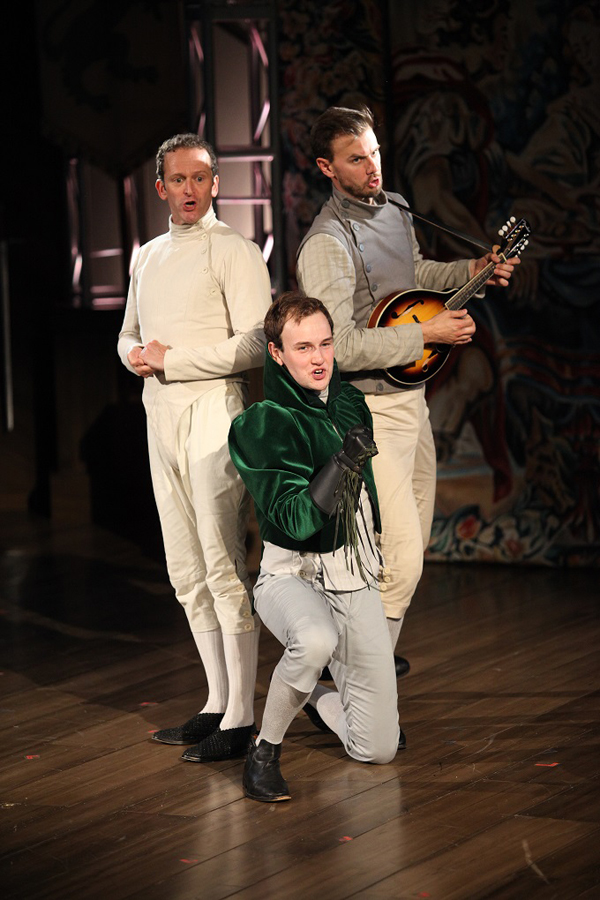
From left to right, Shawn Macdonald, Anton Lipovetsky and Benjamin Elliott in Cymbeline. (photo by David Blue)

Shakespeare wrote Cymbeline in his twilight years. It is an eclectic retrospective of his repertoire, including the allegedly unfaithful wife and villain in Othello, the sleeping potion from Romeo and Juliet, the murder plots from Hamlet and Macbeth, the heroine disguised as a boy of As You Like It, the bloody beheading in Titus Andronicus, the missing brothers of A Comedy of Errors, the list goes on. Perhaps Will thought putting these all together would be fun, but his creation is a jumbled goulash with a dizzying array of plotlines that have more twists and turns than any rollercoaster ride. This may well be why the play is so rarely produced. That being said, director Anita Rochon’s production – which she characterizes as a “tragedy gone right” – is very entertaining and hits the right balance between gravitas and farce.

Seven actors play 18 roles with all the costume changes taking place in view of the audience. Clad in beige fencing outfits, the actors signal character changes by the addition of colorful pieces to their neutral palettes – a red sash here, a green doublet or muffler there.

The story starts with the girl-meets-boy scenario. That is, royal girl (Imogen, played beautifully by the only female member of the cast, Rachel Cairns) meets plebian boy (Posthumous, played by Anton Lipovetsky) and secretly marries him. Father (King Cymbeline, played by Gerry Mackay) frowns on the relationship and banishes the boy. Meanwhile, his second wife, the wicked Queen (Shawn Macdonald) plots to have her son, the scheming Cloten (also played by Lipovetsky), marry Imogen and then poison both the girl and her father so that Cloten can become king. The speed picks up with the runaway bridegroom, a wager to test the fidelity of the chaste Imogen, disguises, a sleeping beauty, a battle, a beheading, mistaken identities and long-lost brothers. Without giving away the ending, the good news is that, measure for measure, in this production, despite much ado, all’s well that ends well.

Lipovetsky is definitely the stand out in this show as he juggles his three roles – the third being Arviragus, one of the brothers – seamlessly morphing from one character to the next. He even manages to have two of his characters on stage at the same time. Bob Frazer plays the snakelike seducer, Iachimo, who literally slithers out of a chest of drawers to do his dastardly deed. Anousha Alamian has a small but dialogue-heavy role as the long-suffering servant of Posthumous, and Benjamin Elliott also plays various smaller parts, including one of the brothers and he gets the juicy beheading bit, but his main role is as sound designer and composer of the original music played by various cast members on banjo, accordion, mandolin and drum.

Pam Johnson’s set is stark and sleek, with many pieces doing double and triple duty – a chest becomes a table, a bed, a desk. Locations are identified by flag standards, blue for England and red for Italy. Gottler’s austere costumes, in contrast to her fanciful creations in Dream, complement the simple setting, and Cheyenne Friedenberg and fight director Nicholas Harrison conspire to present some very fancy footwork.

The bottom line is that you can’t go wrong with any of Bard’s offerings for its silver anniversary year. See one or two or all, but see at least one. The festival runs to Sept. 20. For more information and tickets, visit bardonthebeach.org or call the box office at 604-739-0559.

Tova Kornfeld is a Vancouver freelance writer and lawyer.

Format ImagePosted on August 22, 2014August 21, 2014Author Tova KornfeldCategories Performing ArtsTags A Midsummer Night's Dream, Bard on the Beach, Cymbeline, Equivocation, Shakespeare, The Tempest
An overdue unveiling

An overdue unveiling

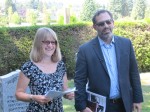
Sarah Haniford’s granddaughter, Alice Campbell, with Schara Tzedeck Synagogue Rabbi Andrew Rosenblatt at the unveiling of Sarah’s headstone. (photo from Jewish Cemetery at Mountain View Restoration Project)

“You live as long as you are remembered.”
– Russian Proverb

Fifty people gathered together on Aug. 3 to remember and honor the life of Sarah Goldberg-Haniford at the Jewish Cemetery at Mountain View. As Alice Campbell, Sarah’s granddaughter, said in her opening remarks to the family and friends there for the unveiling of the headstone, “a bridge to the past is a pathway to the future.”

Campbell shared some of the highlights of her grandmother’s life, which began with her birth in 1878 in Glasgow, subsequent marriage in 1890 to Louis Haniford (Ljeb Hanoft) from Poland, journey to Winnipeg in 1902, then to a farm near Hanna, Alta., in 1907.

photo - Sarah Goldberg-Haniford’s headstone
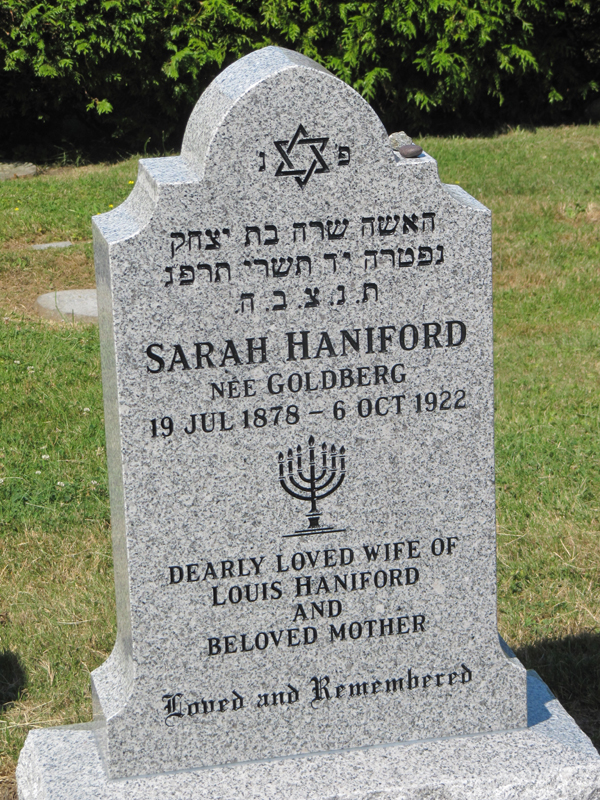
Sarah Goldberg-Haniford’s headstone. (photo from Jewish Cemetery at Mountain View Restoration Project)

Life was very hard for Sarah and Louis, with the harsh climate and work on the farm, to which they were far from accustomed, having been in the watch-making business up until the move. In 1922, Sarah, who had by then given birth to nine children, was in very poor health, and Louis, not knowing what else to do to help her, sent her to St. Paul’s Hospital in Vancouver. Unfortunately, her health deteriorated and she passed away here, all alone, on Oct. 6, 1922.

As Jewish custom dictated, Sarah was buried in the Jewish Cemetery at Mountain View. After her death, according to Sarah’s wishes, Louis moved his family of the seven surviving children away from the farm, to the town of Hanna. With Sarah’s passing, Judaism disappeared from the Haniford family until October 2012, 90 years later, when Campbell discovered through genealogical research that Sarah was buried at Mountain View Cemetery. Beryl and Christi Cooke, Sarah’s granddaughter who lives in Kelowna and great-granddaughter who lives in Vancouver, went to the cemetery for the first time.

The timing couldn’t have been more perfect. Shirley Barnett had just embarked on her project to restore the Jewish Cemetery at Mountain View and their paths collided. In October 2013, along with 146 other unmarked burials, Sarah’s life and death were recognized, with the placing of a temporary marker as the first step in restoring the Jewish cemetery to its former significance in the community. With this mitzvah, the plan to place a permanent monument was born.

Among those attending the Aug. 3 ceremony were 25 family members, including grandchildren and great-grandchildren, none of whom had ever known Sarah – and many of whom had not seen each other in at least 15 years. Rabbi Andrew Rosenblatt and Rev. Joseph Marciano, along with members of the Vancouver Jewish community, were witness to the unveiling of Sarah’s headstone. Sarah brought everyone together and, in doing so, helped rekindle her family’s connections to each other and to Judaism.

Format ImagePosted on August 22, 2014August 21, 2014Author Jewish Cemetery at Mountain View Restoration ProjectCategories LocalTags Alice Campbell, Andrew Rosenblatt, Jewish Cemetery at Mountain View, Joseph Marciano, Sarah Goldberg-Haniford, Shirley Barnett, unveiling

Posts pagination

Previous page Page 1 … Page 633 Page 634 Page 635 … Page 663 Next page
Proudly powered by WordPress