In British Columbia, this summer has been among the finest in living memory. Yet, for Jewish British Columbians and for all those watching events around the world right now, the summer has brought a very dark cloud.
It has not only been the terrible violence between Israel and Gaza, but violence elsewhere in the Middle East that is claiming exponentially more lives and causing horrific hardship and inhumanity.
The advance of the so-called Islamic caliphate from Iraq into parts of Syria opens the potential for additional Western military involvement in the region. The horrors that are taking place under the extremist ISIS dictatorship are almost beyond human imagination. In Syria, meanwhile, the death toll from the now two-year-old civil war has reached 190,000.
Despite all this, global attention remains focused on Israel. At the United Nations, Israel is singled out for condemnation, while Hamas is given a pass. Marches in the streets around the world declare Israel a pariah. Violence against Jews and attacks on Jewish institutions worldwide are legitimately striking fear that a generation or more of Diaspora Jews have never experienced.
There really is no silver lining. But, if there were, perhaps it would be that several fictions have been debunked.
Time was, even Zionists accepted the position that “anti-Zionism does not equal antisemitism.” This has been almost a required disclaimer at the beginning of any conversation on the subject for at least the last 15 years. This needs to be revised, however, to recognize that anti-Zionism at least sometimes equals antisemitism. As we have seen in recent weeks, there are those in the anti-Zionist movement who are motivated by anti-Jewish animus, and then there are those who refuse to condemn them. When it comes down to it, the moral difference between the two groups is minimal.
There is also the position that, by definition, anti-Zionism should legitimately be considered a form of antisemitism. After all, Zionism is simply the national representation of the Jewish people. If one is opposed to that, especially while supporting self-determination for every other national identity in the world, it must stem from some intellectual or emotional process that views Jews differently from other people.
There are certainly reasons why a conflict in a place that is holy to several religions should draw an outsized interest from people around the world. Yet, when the global reaction is so extraordinarily imbalanced, something is clearly beyond reason.
We know what motivates at least a significant part of the anti-Israel movement. More words have been spilled on this subject in the past two months than perhaps ever in human history, given the ability of everybody to broadcast their positions via social media. We have been able to see in greater detail the narrative subscribed to by many of Israel’s critics, from well-known commentators to elected officials to ordinary Facebook friends. Overwhelmingly, it is a simple one: Israel is just plain evil and, because its legitimacy and right to exist are explicitly or implicitly denied, its right to defend itself is likewise repudiated.
These are not words that generally come out of the mouths of anti-Israel activists, because they are not palatable to those who would otherwise consider themselves progressive, well-intentioned people. But push has come to shove and, all over the internet and in face-to-face conversations – yes, those still take place sometimes – we have been able to learn more about what a lot of “ordinary” people think about Israel. It has been painful. The conversations have been difficult. Many of us have lost friends.
But it is always better to know than to proceed in ignorance. We have a new understanding of what we are up against. We also have discovered many new friends, and new ways of engaging with those who don’t share our views.
Others in our community have no doubt had similar experiences. Many of us have felt challenged to present our positions with clear heads and hearts, and we invite all readers to contribute to the discussion by sharing their suggestions for continuing this dialogue constructively.
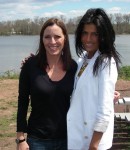
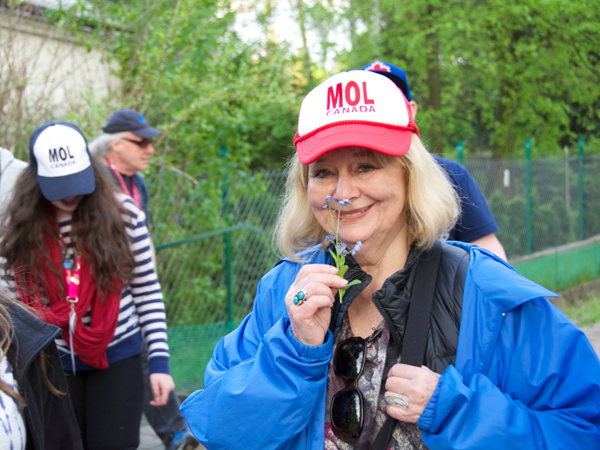
Cecilia Peck, left, and Linor Abargil in Princeton, N.J. (photo by Motty Reif)
Former Israeli beauty queen and international cover girl Linor Abargil is a sharply intelligent woman with a cause: survivors of rape. Empathetic yet unsentimental, highly visible but also private, Abargil is a uniquely complicated individual.
Those who have been directly or indirectly affected by rape will have a visceral, positive reaction to Abargil’s story, as depicted in the feature-length documentary Brave Miss World, which is now streaming on Netflix. While Cecilia Peck’s film suffers from a meandering structure, Abargil’s toughness and tenacity provide a steady source of inspiration.
Shortly after she was anointed Miss Israel in 1998, the 18-year-old Abargil went to Milan for some modeling jobs. Preparing to leave Italy and return home a few months later, she was raped by an Israeli travel agent who’d been recommended by her modeling agency.
Abargil escaped with her life by promising the assailant that she would never tell anyone, but quickly reported the crime to Italian and Israeli authorities. When he returned to Israel, he was arrested, tried, convicted and sentenced. (The film marshals allegations that the perpetrator – an Egyptian Christian married to an Israeli woman – was a serial rapist and an ongoing danger to society.)
The film picks up Abargil’s saga many years later, after she’s begun a website (now based at bravemissworld.com/speak-out/share-your-story) for rape survivors to confide their experiences, as well as the ongoing effects of their trauma.
Brave Miss World follows the peripatetic Netanya native from Tel Aviv to Cleveland, Johannesburg, New York, Princeton, UC Santa Barbara and Beverly Hills, where she meets with rape survivors and speaks at charity luncheons. Supplying solace and strength as needed, Abargil offers in-person proof that it’s possible to heal from a sexual attack and lead a satisfying life of unapologetic self-expression.
It’s not always a smooth ride, of course, particularly when Abargil’s rapist is up for parole and she has to confront past events and ongoing fears. Her determination, along with her belief that the failure to prosecute more rapists is an injustice that contributes to the ongoing suffering of survivors, is truly inspiring.
Abargil is a strong-willed, self-confident woman, and it’s always interesting watching her interact with strangers. But the documentary lacks her courage, tiptoeing around anything that might make her less sympathetic and saddling her with dull voice-over narration devoid of the bite of her personality. The omission of any discussion of how young women are objectified in advertising and fashion photography is an especially curious oversight given both Abargil’s extensive career as a model and her outspoken nature.
Brave Miss World was shot over a period of time that encompasses Abargil’s enrolment in law school as well as her abrupt transition from secular to religious Jew, which flummoxes her ever-loyal parents and may unsettle some viewers.
Ultimately, Brave Miss World does a clumsy job of blending a character study with a social-issue documentary. It’s soft-centred, unlike its subject, and largely content to proffer good intentions and a parade of hugs instead of exploring the tangle of issues surrounding rape.
Abargil, however, is a pretty remarkable person who never stops pushing herself beyond the familiar and comfortable. She’s well worth getting to know.
Michael Fox is a San Francisco film critic and journalist.
Members of the Gitxaala Nation at the 2014 Qatuwas Festival. (photo by Kris Krug)
Vancouver, Erev Tisha b’Av (Aug. 4): As Jews across North America are preparing themselves for the sombre, mournful fast commemorating the destruction of the holy temples in Jerusalem, Jews in Israel and across much of the world have already begun fasting. We fast to mark the calamities that befell our people on the ninth of Av throughout history, and to acknowledge that we are still living in exile, awaiting the building of the third Beit Hamikdash.
For a moment, imagine that we are in Yerushalayim while the Temple stands and hearing news of a siege of the city. Food is growing scarce and we realize that the walls will soon be breached, and destruction leveled upon us and upon our holiest of places. Invasion, murder and desecration are almost certain. If we survive, we will almost certainly be forced into exile, and our city would be burned along with the centre of life for all Jews, the Holy Temple.
As I sit, I reflect upon our history, my history. I reflect upon 2,000 years of exile, upon the Holocaust, upon the war in Gaza. I wonder what may come tomorrow. Exactly three weeks earlier, I was away from the city, visiting my mother on Denny Island, B.C. I went there to spend time with her, to go fishing with my stepfather and to eat Mom’s cooking. I hadn’t planned on meeting people from other nations that have faced destruction, assimilation and exile also, or to learn from their resolve.
Waglisla, Heiltsuk territory, three weeks earlier (July 15): I stand in the grass under the blazing sun, straw hat on, squinting at the dancers. They wear traditional garb: robes, cedar hats, blankets and paint; they sing. Today is the 17th of Tammuz and I haven’t eaten since the night before. I am at the 2014 Qatuwas Festival, an annual gathering of the First Nations of North America’s West Coast – from Alaska to Oregon, where the nations have traveled by glwa (gil-wah, an ocean-going canoe), some for more than 30 days to reach their destination. Qatuwas, the Heiltsuk word for “people gathering together,” has its roots in 1985 in Waglisla (Bella Bella), when a group of local residents built a glwa to paddle 500 kilometres to Vancouver for Expo ’86. They now make a journey each year to a different nation to build connections, morale, identity and community. Nearly 30 years after Qatuwas began, there are hundreds gathered on the grass field in Heiltsuk territory.
My mother moved to Denny Island about two years ago and I’ve taken the 10-minute ferry to Bella Bella to see Qatuwas for myself. I sit in the shade with Jessica Brown, a beaming, bright young woman from Heiltsuk Nation, who is part of the host committee for Qatuwas. She smiles while she speaks about the festival:
“It’s pretty amazing. Last summer, we left Bella Bella and paddled for 32 days on the water, and stopped at every first nation – for a day in the life of each nation. You can be there for a funeral, or you can be there for a lahal tournament or a powwow. It’s a journey of healing, drug and alcohol free, and it’s supposed to be about resurgence, revitalization.
“Young people on the canoe say that the water is a healing process, from the effects of colonization, continuing and ongoing.”
As I contemplate my physical hunger, my fatigue, I feel connected to my spiritual hunger, our collective desire as Jews to return to the Holy Land, a holy time. At least some of my emotions are shared by the nations celebrating at the Qatuwas Festival. Like us, they have suffered innumerable losses. Spirit, though, as it is with knowledge, faith and hope, can never be taken away from one person by another. They can only be given up.
I leave Qatuwas in peace. The days are long here on the central coast in summer, but the sun is slowly burning towards the horizon. Spirits are high on the ferry back to Denny Island.
Vancouver, Erev Tisha b’Av (Aug. 4): The hour of the fast is nearly upon us. Soon I will get into my car and drive to shul to sit and pray on the floor like in a house of mourning, and mark the beginning of the fast of Tisha b’Av. I have a flash from three weeks prior, when I asked Jessica about the land we stood on at Qatuwas.
“We’re not treaty people,” she said, “and that means that we’ve never given up access to our land. We basically consider ourselves the Heiltsuk Nation, a sovereign nation.”
“Am I in Canada?” I asked with an intrigued grin.
“No, you’re in Heiltsuk territory.”
As Jews across Israel and the Diaspora prepare to mourn on Tisha b’Av, I’m inspired by the strength of our people and by that of the First Peoples of Canada.
Despite the destruction, chaos, hatred and exile, we still hope to be free peoples in our own land. For us, the land of Zion, Yerushalayim. Am Yisroel chai.
Benjamin Grobermanis a born and raised Vancouverite. He is a freelance writer, and is pursuing a bachelor of education degree, with aspirations to teach in a Jewish high school. He is a resident of Vancouver’s Moishe House.
The holy month of Elul has begun, the sixth month in the Hebrew calendar. There is a rabbinic allusion that the month was named from the initial letters of “Ani le dodi v’dodi li” (“I am my beloved’s and my beloved is mine”), describing the relationship between G-d and His people. In the Aggadah, we read that Elul has special significance because of Moses’ 40-day stay on Mount Sinai (Exodus 34:28), which was calculated to have begun on the first of Elul and ended on the 10th of Tishrei (Yom Kippur).
Every weekday morning, the shofar is sounded and Psalm 27 recited. Sephardim have already begun saying Selichot, but Ashkenazim recite this only in the last days of the month. The word selichah means forgiveness – it is a plea for forgiveness for sins and, as we approach the time when we know that we will be judged, we practise a kind of spiritual stocktaking. We look inward, trying to assess what happened to last year’s dreams/goals, asking pardon for wrongs committed and hoping, with repentance, charity and prayers, to be written into the Book of Life for another year.
Rav Nachman of Bratslav expressed it beautifully: “Every word of your prayer is like a rose which you pick from its bush. You continue until you have formed a bouquet of blessings, until you have pleated a wreath of glory for the Lord.”
Prayer takes on special meaning in Elul, as we move toward Rosh Hashanah, which celebrates the birth of the world. Then, we will recite the special prayer called Unetenah Tokef (“Let us proclaim the sacred power of this day…”) when we are reminded of our mortality. The translation for part of it reads: “Humanity’s origin is dust, and dust is our end. Each of us is a shattered pot, grass that must wither, a flower that will fade, a shadow moving on, a cloud passing by, a particle of dust on the wind, a dream soon forgotten…. But You are the Ruler, the everlasting G-d.” Legend has it that this prayer was written some 10 centuries ago by Rabbi Amnon of Mainz. Ordered to convert to Christianity by the local bishop, Rabbi Amnon refused. His limbs were amputated and, as his mutilated body lay before the ark as he was dying, he said these words, which are also part of the Yom Kippur liturgy.
When mystics pray, they believe there is an ascent of the soul to upper worlds. Prayers of thanksgiving and praise are deemed worthier than petitionary prayers (when we are asking for things), because they are selfless. Some people believe that the highest form of worship is silence. The Bible tells us that Abraham was the first to utter a true prayer – for his fellow man.
In these times, when we are at war, agonizing over our losses and the many families who have lost loved ones, we in Israel need to have faith more than ever. We pray for all Jews to have a good, safe year. We share a common destiny – Jews in Israel and abroad – and it is this shared destiny that binds us together, no matter how different our ethnic and cultural boundaries may be.
I memorized the following poem when I was a schoolgirl. I never knew the author, and doubt that he was Jewish, but I think it is appropriate now and all the year: “I shall pass through this world but once / Any good therefore that I can do / Or any kindness I can show / To any human being / Let me do it now / Let me not defer it or neglect it / For I shall not pass this way again.”
Dvora Waysmanis the author of 13 books, which are available through Amazon, or from the author at [email protected]. Her website is dvorawaysman.com.
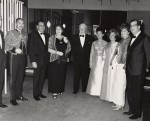
Group in evening dress, State of Israel Bonds, Vancouver, B.C., 1960. (photo from JWB fonds; JMABC L.14505)
If you know someone in this photo, please help the JI fill the gaps of its predecessor’s (the Jewish Western Bulletin’s) collection at the Jewish Museum and Archives of B.C. by contacting [email protected].
Some of the violence in the Middle East has inflamed tensions closer to home. Online, there is a recent interview conducted by the University of British Columbia with its resident expert Prof. Robert Daum, who offered his thoughts on navigating these frictions. Daum is a faculty associate with the Institute for Gender, Race, Sexuality and Social Justice, a faculty member of Green College, project lead in UBC Transcultural Leaders, a Reconciliation ambassador for Reconciliation Canada and a dialogue associate at Simon Fraser University’s Centre for Dialogue.
UBC: How do conflicts afar, like the Israel-Gaza situation, spark local tensions?
RD: Sadly, some conflicts push people into rigid positions rooted in insufficiently rigorous, self-critical and nuanced analysis. Simplistic narratives about historical and contemporary events resulting in loss of life raise tensions. Inadequate media coverage heightens tensions, and people tend to gather in narrowly circumscribed assemblies of like-minded thinkers. Conflicts such as these are teachable moments, but learning and teaching require an attitude of openness to authentic inquiry on the part of everyone.
Imagine what we can do in addressing any number of complex conflicts and challenges if we can cultivate a culture of evidence-based, authentic inquiry and dialogue. I have seen this approach in action in my work with UBC’s Transcultural Leaders 2014 Conversation Series, SFU’s Centre for Dialogue and Reconciliation Canada.
UBC: Have you been surprised by the tensions arising locally and across Canada?
RD: No. In the context of genuine human suffering, we encounter hateful slogans, racist images, one-sided narratives, vicious social media comments and self-righteous oversimplifications. This does not honor the dead. Inflammatory rhetoric gets most of the headlines. Research shows that anxiety and clear thinking tend not to be compatible. Our discourse has to be as levelheaded, sober and reasonable as possible. People need to feel that they can learn in an environment of safety, civility and mutual respect. I consider myself to be a principled pragmatist. It is precisely when we feel angriest about world events that we need to take a deep breath. Imagine if the Supreme Court had to reach decisions under fire. If we cannot learn how to share narrative space – that is, how to reconcile competing, deeply held, national narratives, in a way that does not require the annihilation or complete negation of the other’s position – then how can we expect geographical space to be shared at one of the most fraught intersections of regional and global politics?
I have participated in forums on antisemitism, Islamophobia, homophobia, the Indian residential schools and many other issues. Two years ago, I co-sponsored with the Vancity Office of Community Engagement a three-hour public forum downtown on Islamophobia, featuring a critical media analyst, three Muslim speakers from very diverse backgrounds and perspectives, and three equally diverse non-Muslim speakers, including myself. A mixed audience of more than 250 listened to stories of prejudice experienced and prejudice confronted. It was a thoughtful, nuanced and multi-layered conversation over the course of three hours. And we were just getting started.
UBC: What are some healthy ways in which people can deal with tensions that may arise between themselves and others?
RD: Seek to engage in a dialogue, rather than a debate. Ask genuine questions: “What did you mean by that? What are you trying to say? Have you considered different perspectives on this? Have you tried to understand why others hold positions different than yours? On what can we agree? Is there another way to understand the phenomenon, whereby our positions might be reconciled, even partially?” Try building on ideas and making connections between ideas. Don’t reduce multi-faceted conflicts to a single variable such as religion or oil, for example.
Politics, history and ethics are not reducible to simple equations. Complex questions can rarely be reduced to the logic of black and white, right and wrong. I may see the world very differently than you, but that does not necessarily make you (or me) wrong. Of course, moral assessment matters, and I believe that some behaviors, like the intentional murder of civilian non-combatants as prohibited in the Geneva Conventions, are abhorrent. But, as any first-year law student knows, such an assertion is the beginning, not the end of the inquiry. If such matters were simple enough to be reduced to trial by megaphone, we would not need faculties of law or courts, let alone courses in ethics, history, politics, religion, gender, media or much else.
What began as a last-minute visit to one of the most solemn places in history has grown into a nationwide campaign supported by many distinguished people and groups, including the Canadian and Polish ambassadors and the Centre for Israel and Jewish Affairs. Canadians Remember is a grassroots campaign relying on the goodwill of average Canadians to spread the word of the need for preservation and restoration at Auschwitz-Birkenau in Poland. The former German Nazi concentration camp – where more than 1.1 million Jews, Roma, Sinti, Poles, Russians and other Europeans were systematically killed during the Second World War – is reaching out for support of its Perpetual Fund.
“Since visiting Auschwitz, we’ve learned that a remarkable number of connections to the camp exist in Canada,” said campaign director Rob Carter. “Many Canadian success stories began with the small number of people who survived the Holocaust.”
Canadians Remember logo (CNW Group/Seed Communications Inc.)
Funds raised by Canadians Remember will be presented to the Auschwitz-Birkenau Foundation in 2015 to commemorate the 70th anniversary of the camp’s liberation. The foundation’s director, Piotr Cywinski, endorses the Canadian campaign and has pledged to install permanent recognition at Auschwitz, listing Canadians as a “Pillar of Remembrance” if the campaign can raise one million euro. All net funds raised go to the foundation’s Perpetual Fund, created in 2009 to enable the redevelopment of the museum and the preservation of the historic facility. In 2012, Canada’s federal government donated $400,000 to the fund. The Canadians Remember team hopes to raise $2.5 million, a figure in line with donations pledged by other countries, including Germany, France, Great Britain and the United States.
Each year, many more than one million visitors from around the world arrive at Auschwitz-Birkenau to view the museum and memorial. The remains of the concentration camp stand today as a cemetery and as evidence of the horrors of which humanity is capable. The site is also a warning to future generations about the realities of the Holocaust, genocide and prejudice.
In addition to Auschwitz survivors like George Brady (widely known from Hana’s Suitcase, the story of his sister), the campaign’s early supporters include Canada’s Ambassador to Poland Alexandra Bugailiskis and Polish Ambassador to Canada Marcin Bosacki. “We believe that Canadians of all walks of life will recognize the importance of this initiative not only for Auschwitz, but its relevance in today’s socio-political environment,” said Bosacki.
For only $1, donors can add a photo of themselves to the website’s donor wall. By encouraging Canadian citizens – of all ages, religious affiliations and cultural backgrounds – to donate just $1 each, the Canadian public can make a gesture of remembrance and support for Holocaust education. Canadiansremember.ca provides the details of the campaign, and accepts donations via PayPal.
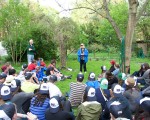
Teens on this year’s March of the Living helped Lillian Boraks-Nemetz face down haunting memories. (photo by Adele Lewin Photography)
Lillian Boraks-Nemetz, a Vancouver poet and author who was a child survivor of the Holocaust, initially declined the offer of a trip to her Polish homeland. She had been there, and written books and poems about her experiences as a child and as a returning adult. She didn’t know that an invitation to go again would lead to an emotional and psychological closure for which she had waited seven decades.
When first invited to participate in last spring’s Canadian contingent of March of the Living, Boraks-Nemetz demurred. March of the Living is a program that brings Jewish young people from around the world to the sites of Nazi atrocities in Europe and then to the Jewish homeland of Israel, marching from Auschwitz to Birkenau on Yom Hashoah, Holocaust memorial day, and traveling to Israel in time for Yom Hazikaron, Israel’s remembrance day for fallen soldiers, and Yom Ha’atzmaut, Israeli independence day. March of the Living’s teenage participants are accompanied by Holocaust survivors.
“I thought, how am I going to keep up with a bunch of 16-, 17-year-olds?” Boraks-Nemetz said in a recent interview. But she was assured that survivors are well taken care of on the trips and she was convinced to go.
“There were difficulties, but I rose to the occasion,” she said, laughing. On the extremely long day traveling from Canada to Poland, which then continued immediately with more travel and programming, Boraks-Nemetz was aided by one of the young participants. “One of the girls had chocolate that had extra caffeine in it, so she gave it to me,” she explained.
Boraks-Nemetz was accompanied by another survivor, chaperones and young people from Edmonton, Calgary, Winnipeg and Ottawa, as well as eight Jewish teens from Vancouver. In all, there were 78 people on the trip. (Young people from Ontario and Quebec made up their own contingents and traveled on different buses.)
The program was intensive. The week in Poland involved stays in Krakow and Warsaw, where they visited the Museum of Polish Jews, and they went to the extermination camps Auschwitz-Birkenau and Majdanek.
“The young people who came with us are so beautiful and so good and so well behaved and so moved by everything. You could just see how they took it all in. For them, it was a life-changing experience.”
“The young people who came with us are so beautiful and so good and so well behaved and so moved by everything,” she said. “You could just see how they took it all in. For them, it was a life-changing experience.”
In Warsaw, they also went to the orphanage that had been run by Janusz Korczak. A Polish Jew who was a respected published author, Korczak was offered multiple opportunities to save himself from the advancing Final Solution. When the Warsaw Ghetto was created, Korczak’s orphanage, its staff and nearly 200 young charges were forced to move into the ghetto. When the ghetto was liquidated, in 1942, Korczak was again offered immunity, but instead stayed with his orphaned children as they were deported to Treblinka.
In Lodz, the group visited the cemetery and the place where the second-largest Nazi-enforced Jewish ghetto had been. (More than 200,000 Jews were held in Lodz Ghetto during its existence. About 10,000 of those were alive in 1945.) There, the Canadians boarded one of the rail cars that had transported Jews to the camps.
“It was dark and there were many of us,” said Boraks-Nemetz. “It was tight. It was scary. We got the feel of it. Of course, the fear wasn’t there, but there was something foreboding about it.”
At the camps, the participants said prayers and sang mournful songs.
“There was a lot of poetry,” she said. “I brought my book Ghost Children, which was written after one of my trips there. And, whenever we went to a certain place, I would read a poem and it really got to them.”
An unexpected insight came during conversations with young Polish Jews during an arranged dinner at the hotel in Warsaw.
“They sat down, one at each table of students, so they were able to talk,” said Boraks-Nemetz. “At the end of the dinner, I saw the five or six of them standing in the lobby of the hotel, the Polish Jews, and so I went to talk to them. We went to the side and it was really interesting what they told me. They’re quite modern. They’re a little bit shy. They’re a big change from the Israeli youth,” she said, laughing.
The young Polish Jews told her that things were pretty good for them. Some go abroad – to France or elsewhere – to study, but jobs are hard to find and the standard of living isn’t great. They had a question about March of the Living.
“They said, ‘Why do you always come here looking for what’s dead?’ And I explained to them that this is an educational trip,” said Boraks-Nemetz. “But they said, ‘You know, there are some of us here, there is beauty here too, we are alive and there is a Jewish community – small, but there is a Jewish community. And I could see that that was maybe something to address.”
From Poland, the group flew El-Al to Israel.
“It’s like walking in from the shadow into light,” she said. “The Jerusalem of Gold! And we went straight to Masada off the plane.”
There, the other survivor on the trip, Max Iland, an octogenarian from Sault Ste. Marie, Ont., celebrated his bar mitzvah, a few decades late.
“The students were singing and he and I were dancing, it was really fantastic,” said Boraks-Nemetz.
The entire experience, she said, was life-altering for the participants.
“They felt that their Jewishness was strengthened, that they are a part of history,” she said. “They cherish their homes and their families after finding out what happened to Jews over there. And, above all … they were becoming witnesses to my story. That’s what one of them said. She felt she was a witness to it. I did speak to them about the legacy that we, survivors who were on our way out, are leaving them.”
Boraks-Nemetz found especially notable the connection of young Canadian Jews to those who had given their lives in defence of the Jewish state.
“What I didn’t realize was how strongly they feel about the fallen soldiers who fought for Israel,” she said. “They read poetry again to the fallen soldiers.”
When the national moment of silence came, the experience was transfixing.
“We’re standing on [Tel Aviv’s central street] Ben Yehuda and the sirens sounded and, all of a sudden, it was like everyone was made of wax figures. That was an incredible thing.”
For Boraks-Nemetz, the trip provided an unexpected closure to the darkest chapter of her life.
Lillian Boraks-Nemetz accompanied teens on this year’s March of the Living. (photo by Adele Lewin Photography)
For her, the climactic moments of the March of the Living took place in the small Polish village of Zalesie. It was here that young Lillian survived the Holocaust in hiding. After spending two years in the Warsaw Ghetto, she was smuggled out by her father before the ghetto was liquidated and its residents – more than a quarter million Jews – were sent to Treblinka and other death camps. Outside the ghetto, she was met by a Christian woman who transported her to a little white home in Zalesie, where her grandmother was in hiding, posing as the wife of the Polish man who lived there.
Boraks-Nemetz has written about that time in her poetry and in her book for young adults, The Old Brown Suitcase. As an adult, she has returned to the little house at Spokojna Street, Number 16. But this visit was different.
“These two buses went down this dusty road, and there were all these [people in] houses wondering what was going on,” she said. “Nobody bothered us. We filed out and we went into the garden. We all stood in the garden and I told them the story of hiding.”
There was one part of the story she hadn’t intended to tell, but she had developed closeness and trust with the participants accompanying her. She felt confident and compelled to share more than she ever had before, which led to an unprecedented emotional catharsis after almost seven decades.
“I told them something about the man with whom we were in hiding. He was both good and bad,” Boraks-Nemetz said. “How does a child of eight take that? That, on the one hand, he saved us, our lives, and, on the other hand, he was a drunk who could have given us away and didn’t, and, thirdly, he abused me when my grandmother wasn’t there. This is life and that’s how it was.”
In small groups of six or eight, the young people accompanied Boraks-Nemetz into the home.
“When we went into the house, I explained where I slept and where I stood by the window and watched for my parents to come, the road, the garden, the whole thing,” she said. “They were very moved, and a funny thing happened. Each time a group would come out, I would come out with them onto the little porch and they would all hug me. Every one of them. And I think what happened to me was probably, for the first time in my life, I was able to face what happened there. That was an awesome experience for me. I had been there before many times but I always blocked it out. I never faced it properly. And, this time, because of the kids … I just couldn’t believe how it opened me up, this experience with the kids.”
The ambulance being sent to Israel by the Winnipeg CMDA is the same type as the one pictured here. (photo from CMDA)
With the recent violence and tensions in Israel, Magen David Adom (MDA) is, once again, being pushed to its limits – working in a state of high alert and keeping most of its equipment in service 24 hours a day. And though tensions are high in Jewish communities outside of Israel, as well, the recent Operation Protective Edge seems to be bringing out the best in people, including additional financial support for Israel.
One such Canadian example is in Winnipeg, where people are pouring their energy into helping to send ambulances and medical equipment to Israel via Canadian Magen David Adom (CMDA). Winnipeg’s local CMDA chapter sent an ambulance to Kiryat Shmona last year. Now, it is sending its second ambulance to Israel, which will be stationed in the south.
While most of the support has come from the local Jewish community, there is growing support from Manitoba’s Christian community, who are eager to show their support for the Jewish state.
One of the leading figures in that group is Pastor John Plantz, who has been leading tours to Israel every year via his Beauty Field Tours to Israel. Plantz said he was looking for a tangible way to help Israel aside from visiting the country with his tours. He was first introduced to CMDA through materials he came across at a local Jewish community centre and, later, around 2009, through a meeting with CMDA Winnipeg member Ami Bakerman. Plantz invited Bakerman to set up a CMDA table at a local Bible conference he organizes each year.
Looking for even more ways to support Israel, Plantz recently purchased a grove of 1,000 trees, along with Beauty Field Tours group-mates John and Janice Thiessen, through the Jewish National Fund. The grove will be planted in the Yatir Forest.
“My joining the Winnipeg CMDA chapter came through an invitation from Ami [Bakerman],” said Plantz. “I was very excited about the opportunity to help this organization get ambulances for the state of Israel and to be able to help get practical resources to people in a time of need in a country that I’ve truly come to love.”
Some 25 years ago, Plantz discovered that his grandfather was Jewish. Since then, he said, “I decided to support, in practical ways, the Jewish community here, in Winnipeg, and also the state of Israel.”
Plantz sees it as “a privilege” to introduce many more Christians to CMDA at the many events he attends by handing out CMDA tzedakah boxes and other CMDA materials. Also, Plantz said, “By informing people of the need[s] in the state of Israel, it gives them the opportunity to give and help.
“I was so pleased to hear when CMDA had sent their first ambulance to Israel just over a year ago, as I was a part of that through our Bible conference, along with many others from that event.
“And now to think that another ambulance will be sent this month brings great joy to my heart and it should be celebrated by all who’ve had a part. I’d like to give the glory to the God of Abraham, Isaac and Jacob for putting it into the hearts of many to respond.”
He added, “I believe that the time to help is now, for the need is great in Israel and lives are at stake. Let’s get involved today.”
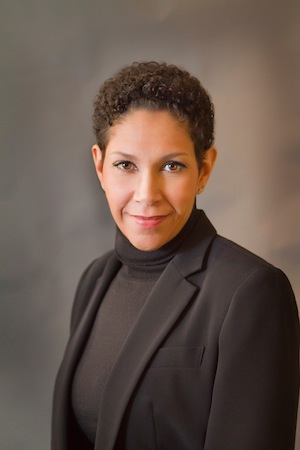
Laurelle Harris (photo from Laurelle Harris)
Another local CMDA chapter member is Laurelle Harris, a lawyer and a director of Levene Tadman Golub Law Corp.
“I’m thrilled to have been able to play a very small role in the chapter having been able to send two ambulances so far,” said Harris. “To be able to contribute to the safety and well-being of people in Israel is amazing.”
Harris joined the Winnipeg chapter of CMDA about two years ago. “The ability for MDA to provide emergency services is essential to the well-being of all those living in or visiting Israel,” she said.
“At the time, I didn’t know how long it would take to be in a position to send one ambulance. Actually sending two makes me believe that we’re on a roll and can achieve our goals in the future.
“To be able to send a second ambulance – an intensive care unit (MICA), no less – during the current conflict with Hamas makes me feel that Winnipeggers have done something tangible to make a difference right now,” she added. “Winnipeggers have, quite literally, helped MDA save lives in real time.”
According to Harris, the Winnipeg chapter’s ability to send more ambulances depends on the continued financial support of the general community in Winnipeg and throughout the province, as well as adding more volunteers with diverse skill sets and backgrounds.
“During this particularly difficult time for Israel, as she remains under attack, there are a number of ways that people can help,” said Harris. “But, most importantly, is to give to any cause that will have a direct impact on service provisions. CMDA is one such organization that will not just be of benefit in the immediate, but will also have a lasting impact in times to come. When this crisis is over, gifts given now will continue to have a lasting impact for years into the future.”
For more information or to donate to the Winnipeg chapter ambulance drive, email Winnipeg chapter treasurer Bakerman, [email protected]. You can also donate online at cmdai.org or by calling 1-800-731-2848. CMDA is a registered charity and all donations receive a tax receipt.
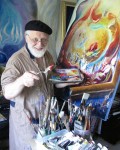
Mordechai Edel at work in the studio. (photo from the artist)
Mordechai Edel is not a stranger to grief and pain. His parents escaped Austria in 1939. His uncle spent years in the Nazi concentration camps. His father died when he was 16 years old. Edel has been aware of the darkness in the world since he was a child, but he has never succumbed to it. The art he creates is light fantastic, bursting with colors, suffused with gladness. “Bringing joy to the world,” is his artistic motto.
Edel’s solo art show at the Unitarian Church on West 49th Avenue opened on Aug. 1. The artist talked to the Independent about his life and his paintings. His involvement with the arts started in his early childhood.
“My mom baked cakes for a coffee shop in Birmingham. It was also a gallery, and the owner,
Andre Drucker, was my first art teacher. When I was about 8, I won a BBC art competition with my self-portrait. It must’ve been my bright red hair,” he joked.
Even more than painting, he said, he wanted to sing, but for a child of a working immigrant family in post-war Birmingham, it wasn’t an easy or even a realistic dream, especially after his father fell sick and young Edel had to leave school at 14 to help his mother.
“I listened to the radio when they played classical music and opera,” he said. “We also had a very good cantor in our synagogue, and I wanted to sound like him. I sang in the choir.”
He frequently bought classical opera records at the local flea market but couldn’t listen to them at home – the family didn’t own a record player. When someone at the flea market suggested playing them on his player, the music was a revelation to the boy. “I wanted to sing like Caruso,” he remembered. “I wanted to study classical music and opera.”
Instead, he followed a much more practical route and apprenticed to a hairdresser. “My uncle was an opera singer before the war. It saved his life in the Nazi camp – he sang there. After the war, he immigrated to Canada and became a hairdresser. Nobody needed an opera singer.”
Edel followed in his uncle’s footsteps. He moved to Canada in 1969, when he was 20, and worked as a hairdresser, while spending all his money on music and singing lessons. He sang in concerts. At some points in his life, he was a cantor in Victoria and a soloist for the Tel Aviv opera.
But visual art was always an intrinsic part of his life, always casting light onto the shadows. When he opened his own hairdressing salon, he played classical music there and decorated the room with his paintings. His patrons loved the ambience, and the word of mouth spread about the hairdresser artist and his paintings.
It is no wonder that one of the recurring themes in Edel’s paintings is music. The picture “Spinner of Light” looks like a tapestry of colors and notes, where fantastic creatures sway to the unearthly melodies in an imaginary landscape. Flowers dance in several of his paintings, and Chassidic bands indulge in merry klezmer tunes. “O Sole Leone” is more grounded but just as whimsical, a song of Vancouver at night, while “Transparent Emet” reminds the viewer of the spiritual theatre of life. The musicians play in the pit, but the conductor exalts above, a part of a mystical pomegranate.
Symbolism plays a huge part in Edel’s artistic vision. Combined with his colorful esthetics, it leads him the way of impressionists, where emotions get embedded in pictures, entangled with floral and abstract motifs.
“I listen to classical records when I paint. Sometimes I listen to my wife Annie playing her violin. She is my muse. She inspires me.” Married for four decades, he is as much in love with his wife now as ever, he said, and their mutual devotion helped them five years ago, when darkness struck the family.
Someone they had trusted conned them out of their life savings. After working hard for more than 40 years, the family lost everything, about half a million dollars.
“People don’t like to hear others crying,” Edel said, “but frankly, it’s played havoc with our lives. We had intended to make aliyah to Israel for the ‘last and best’ retirement years – even though artists never retire – but we had to recoil into a one-bedroom rented apartment these past few years. And yet, in order to combat our tragedy and adversity, I came up with my ‘artidote.’… So many people need to be uplifted with light and laughter.”
“I don’t dwell on darkness. I try to stay positive, although it’s a challenge to be happy in the face of darkness,”
Currently, the couple lives on a small government pension, and he paints in the living room – his studio. Like in all other areas of their life, however, his wife is his source of happiness and stability. “My wife says we go forward. And we do. I don’t dwell on darkness. I try to stay positive, although it’s a challenge to be happy in the face of darkness,” he admitted.
The current show emphasizes Edel’s drive towards the light. His paintings vibrate with joyful energy. “I wanted to reach out with my art, to show my paintings to Jews and non-Jews alike,” he said, explaining the placing of his deeply Jewish art in a Christian church.
The show runs until Aug. 31 and viewing is by appointment. On Aug. 27, at 7 p.m., there will be a guided tour by the artist and a complimentary concert. To register, call the Unitarian Church, 604-261-7204, or contact the artist, 604-875-9949.
Olga Livshinis a Vancouver freelance writer. She can be reached at [email protected].