Skip to content
  • Home
  • Subscribe / donate
  • Events calendar
  • News
    • Local
    • National
    • Israel
    • World
    • עניין בחדשות
      A roundup of news in Canada and further afield, in Hebrew.
  • Opinion
    • From the JI
    • Op-Ed
  • Arts & Culture
    • Performing Arts
    • Music
    • Books
    • Visual Arts
    • TV & Film
  • Life
    • Celebrating the Holidays
    • Travel
    • The Daily Snooze
      Cartoons by Jacob Samuel
    • Mystery Photo
      Help the JI and JMABC fill in the gaps in our archives.
  • Community Links
    • Organizations, Etc.
    • Other News Sources & Blogs
    • Business Directory
  • FAQ
  • JI Chai Celebration
  • JI@88! video

Recent Posts

  • Story of Israel’s north
  • Sheltering in train stations
  • Teach critical thinking
  • Learning to bridge divides
  • Supporting Iranian community
  • Art dismantles systems
  • Beth Tikvah celebrates 50th
  • What is Jewish music?
  • Celebrate joy of music
  • Women share experiences 
  • Raising funds for Survivors
  • Call for digital literacy
  • The hidden hand of hate
  • Tarot as spiritual ritual
  • Students create fancy meal
  • Encouraging young voices
  • Rose’s Angels delivers
  • Living life to its fullest
  • Drawing on his roots
  • Panama City welcoming
  • Pesach cleaning
  • On the wings of griffon vultures
  • Vast recipe & story collection
  • A word, please …
  • מארק קרני לא ממתין לטראמפ
  • On war and antisemitism
  • Jews shine in Canucks colours
  • Moment of opportunity
  • Shooting response
  • BC budget fails seniors
  • Ritual is what makes life holy
  • Dogs help war veterans live again
  • Remain vital and outspoken
  • An urgent play to see
  • Pop-up exhibit popular
  • An invite to join JWest

Archives

Follow @JewishIndie
image - The CJN - Visit Us Banner - 300x600 - 101625

Author: Jonathan Dick

Inspiring people to donate

Inspiring people to donate

Zeke Blumenkrans, chief executive officer of Generocksity. (photo from Zeke Blumenkrans)

Zeke Blumenkrans, a 21-year-old University of British Columbia student, is establishing a philanthropic younger generation one fundraiser at a time.

Blumenkrans is co-founder and chief executive officer of Generocksity Inc., a nonprofit that organizes concert and party fundraisers for a variety of causes, as well as educational workshops and help for young adults who are wanting to start their own philanthropic endeavor. It has held events across Canada and in Europe, and has active branches in Ontario (Kingston and Hamilton) with plans to expand to Montreal and Victoria later this year.

In operation since November 2013, Generocksity has received more media attention over the last year, as its events have become more popular and, therefore, the organization has been able to raise greater amounts for charities across the board. In January 2015, the organization was chosen as the best of the highlighted projects at UBC’s Student Leadership Conference and, in November, Blumenkrans was honored by the Association of Fundraising Professionals’ Vancouver chapter with the 2015 Giving Hearts Award for outstanding youth philanthropist.

“I was born in Buenos Aires, Argentina, and came to Vancouver with my brother and parents when I was 3 years old. Since our arrival in Vancouver, my family has been heavily involved in the Jewish community,” shared Blumenkrans about his background. “My siblings and I attended Talmud Torah for preschool and elementary school, and King David for high school…. I love discovering new music, watching documentaries and weird foreign films, outdoor rock climbing and playing any team sport I have time for, especially soccer.”

Blumenkrans noted that his passion for volunteering began at an early age, and he has been volunteering at Canuck Place Children’s Hospice for the past five years.

“Canuck Place allows me to interact with some of the most courageous and incredible children in the world, all while goofing around and helping them have fun and forget about their tough situations for awhile. It’s very easy to get tunnel vision and just focus on your career or academic pursuits, and sometimes it’s important to see the bigger picture and what’s really important in life,” he said.

Generocksity was formed after the death of his friend David, who he had met as a fellow volunteer at Canuck Place. When Blumenkrans met David, David had already been diagnosed with spinal cancer.

“One of my most memorable moments with David was when he was voicing his frustration about how he felt like he simply did not have enough time to do all the things he wanted to do in his life. He had only recently been diagnosed, so he had always thought, as most of us do, that you can always leave stuff for later and there will always be time in the future. Although he never knew it, David is the reason why I started Generocksity, so every success and achievement my team and I experience, I share with him for being my eternal inspiration.”

Blumenkrans combined the inspiration of David’s life with his own experiences. While he was a student at King David High School, Blumenkrans was positively influenced by events such as Random Acts of Chesed Week and Mitzvah Day. RAC Week was inspired by the life of alumna Gabrielle Isserow.

“I always looked up to Gabi Isserow and her incredible leadership working with my brother, Dan, on Mitzvah Day when I was in the eighth grade,” said Blumenkrans. “As a lowly eighth-grader, she was one of the only seniors who ever took the time to say hi or smile at me when I would see her in the halls. Although she was always an important leader in the school, she had a certain level of kindness and humility that I have seldom seen in my life and, although she likely never knew it, I always viewed her as a role model.

“RAC Week is one of the most beautiful examples of how one can find love and inspiration in the darkest of places,” he continued. “In Judaism, we are taught to always celebrate life and I genuinely feel that Gabi’s life will be forever celebrated through things like RAC Week and all the mitzvot done by those kids she unknowingly inspired just like me.”

While Blumenkrans is pensive about his past, he is very much looking forward to the future. He believes that the true impact of Generocksity will only be seen in the next couple of decades.

“Many of the young adults who attend our events will go on to become very successful business owners, lawyers, doctors, etc. My goal is that when their time comes to decide how much money they’d like to give to charity, they will remember the positive experiences they had associated with philanthropy and how easily they are able to integrate charitable giving into their day-to-day lives,” he said.

“I don’t want our charity parties to be an anomaly. I want it to become the norm. I want there to be so many people doing this type of thing that it’s oversaturated. I want every weekend when you go out to party or let loose with your friends, if at least part of the proceeds aren’t going to charity, people will think, ‘this is kind of messed up.’ I want it to get to that point and I think that we have proven that it can.”

When asked how he would respond to millennials who believe that they are above philanthropy, Blumenkrans said, “If you think that you are too good to attend a charity event, then you have probably been scarred by a really boring and dull charity event and/or never found an event that was benefiting a cause that really meant something to you. We are trying to redefine how people view charity – to make it something exciting, cool and really fun while still making it very meaningful and personal. I want people to not feel conflicted about dancing and letting loose with their friends while supporting a hospice or homeless shelter. I want them to see that you can help disadvantaged members of one’s community while having lots of fun!”

To learn more about Generocksity, and their future events, go to generocksity.com.

Jonathan Dick is a freelance writer living in Toronto. His writing has appeared in the Canadian Jewish News, and various other publications in Canada and the United States.


Format ImagePosted on February 12, 2016February 12, 2016Author Jonathan DickCategories LocalTags Generocksity, philanthropy, Zeke Blumenkrans
Paint away complexity

Paint away complexity

“Palestinian Roots” by Ahmad Al Abid. (photo from cjnews.com)

Anyone visiting the student centre at York University in Toronto has been confronted since 2013 with a mural that some say incites violence and makes York a less welcoming place for Jewish students. The piece features a young man, pictured from behind, wearing a keffiyah with a map that includes an undivided Israel and Palestine and holding two rocks. Below him is a bulldozer, presumably Israeli and presumably preparing to overturn a farmer’s tree.

Recently, the mural has led one philanthropist to pull his support for the university and it has been taken up as a cause by Jewish and Zionist organizations.

The mural makes a not very subtle point. Israel is an aggressor, wantonly destroying Palestinian livelihoods for no reason. Palestinians are helpless Davids in the face of this Goliath, reduced to that most primitive of weapons, the stone. Beneath the image are the words “Peace” and “Justice” in several languages.

A picture, they say, is worth a thousand words and this is probably why the mural upsets so many people. With one glance, the viewer understands the anti-Israel narrative in all its simplicity. Israel is powerful; Palestinians are weak. Israel is aggressive; Palestinians are defensive. The map on the keffiyah, which erases Israel, is understood as a statement that the Jews stole this land from indigenous Arabs, whereas the same map, if employed for Zionist ends, would elicit cries of racism and genocide. Even the symbol of violence – the stones – can somehow be perceived as tools for “peace” and “justice,” given the nature of the enemy.

Since the mural was painted, the weapon of choice for the Palestinian lone wolf – if we can call someone incited to murder by their government and official media a lone wolf – has morphed from stones to knives. Videos and infographics teach Palestinians how to stab Jews most effectively.

Never mind all that. The world has an idée fixe, an unshakeable certainty, that Jews are powerful and, therefore, the Palestinians must be victims; they cannot be perpetrators or instigators. A new poll of French people says nearly 60% blame Jews to some extent for antisemitism. Antisemitism is uniquely identified as brought about by its victims, not its perpetrators. We wouldn’t have to be antisemitic, it seems, if only you would be less Jewish. Even the secretary-general of the United Nations is standing by his statement that Palestinians stabbing Jews is simple “human nature” in response to “occupation.”

The same poll also affirmed the view of Jews as powerful – and the attitudes of the French in this regard are probably not substantively different from those of other Europeans and some North Americans, varying more by degrees than by kind perhaps. Today, that power is measured in perceived wealth and access to political and cultural elites. When Jews were historically powerless in those conventional senses, they were attributed with supernatural abilities. Antisemitism adapts magnificently as required.

The perception of Jews as powerful is not only at the root of antisemitism but doubles as an impervious shield against challenging it. Consider: if Jews are powerful, then coming to their aid is an act of siding with the powerful against the oppressed. This belief is, at root, the very essence of the anti-Israel narrative now dominating much of the West, especially on the political left.

As always, this incarnation of antisemitism is a form of scapegoating, the projection of sins onto an empty vessel. As we are now almost congenitally conditioned to do, we acknowledge that Israel is not above criticism. No country is. Yet the proportion of global attention, the level of vitriol and the hyperbolic accusations against Israel are clear to anyone with a sense of proportion that this has limited relation to Israeli policies or anything else rational. The nature of the beast is that there have always been “good” reasons to attack Jews. Today’s reason is Israel.

Israel, of course, is a very powerful state, with a massive military for a population its size. If it wasn’t, its population would be dead or dispersed. Yet this still feeds the narrative of Jewish power and Palestinian weakness. If this is a battle between rocks and bulldozers, well, then, who wouldn’t side with the folks holding the rocks? This, in the end, is what the mural at York is telling its viewers. It is, actually, a magnificent synopsis of the mindlessness of the anti-Israel narrative, which strips all context from the conflict and ignores the fact that the perpetuation of violence is mainly a product of Arab maximalism and refusal to live in peace with a Jewish state. That’s a picture that is a little more complicated to paint.

Format ImagePosted on February 12, 2016February 11, 2016Author The Editorial BoardCategories From the JITags Ahmad Al Abid, Israeli-Palestinian conflict, terrorism, York University
Importance of women

Importance of women

Nine B.C. Chabad rebbetzins were among the 3,000 women attending the annual conference of Chabad shluchos. (photo from Lubavitch BC)

The annual conference of Chabad shluchos (female emissaries) ended on Feb. 1 with an affirmation of the preeminent place of the woman in Jewish life and community. Some 3,000 women from 87 countries attended the International Conference of Shluchos at Chabad-Lubavitch headquarters in Brooklyn.

Nine Chabad rebbetzins from British Columbia participated in the five-day conference: Henia Wineberg of Vancouver, Chanie Baitelman of Richmond, Simie Schtroks of Surrey, Malkie Bitton of Downtown Vancouver, Miki Mochkin of North Vancouver, Esti Loeub of the University of British Columbia, Fraidy Hecht of Kelowna, Chanie Kaplan of Victoria and Blumie Shemtov of Nanaimo.

Each embracing multiple roles and responsibilities, the women explored relevant issues and learned from professionals and colleagues with years of experience. Among the diverse topics were raising a large family, mental health issues, events marketing, understanding troubled relationships, fundraising, inclusion, and a conference within the conference for Hebrew school and preschool directors.

Sessions were targeted to address the different demographics served by Chabad. Campus leaders, for example – there are at least 240 women serving in leadership positions on campuses in the United States and abroad – attended sessions on raising a family on campus, life on campus, psychodynamic counseling for anxiety, and Chabad House on a budget.

Organized and planned by a board of women, each a Chabad representative, the conference included a parallel track for lay leaders. “These are the pillars of our community who are true partners with us,” said a Chabad representative from Argentina who was joined this year by two members of her community.

Lectures and workshops aside, the opportunity to spend time with other like-minded women from so many disparate countries and cultures who are part of a worldwide project inspired by the Lubavitcher Rebbe, gave the participants, especially those going back to far and isolated outposts, an exhilarating sendoff.

“This was truly a larger-than-life experience that will sustain me for a long time,” said Sashi Fridman, an American who is now a Chabad representative in Moscow. “It illuminated the power of the Jewish woman to lead – drawing on the strength of our tradition – with wisdom, as it focused on women who effect real, meaningful change with courage and creativity.”

Format ImagePosted on February 12, 2016February 11, 2016Author Lubavitch BCCategories LocalTags Chabad, shluchos
Double tax for affordability

Double tax for affordability

Jerusalem from Mount of Olives. (photo by Wayne McLean via Wikimedia Commons)

For a long time, we have been seeking ways to make Jerusalem more than just the centre of the Jewish people, but also a city revived, with a young, optimistic spirit. We have succeeded in many areas, but a major issue remains: housing prices in many neighborhoods are unaffordable for young people.

With this in mind, the idea of raising the municipal tax came to be, with the goal of addressing this important issue. The first time we went to the government with a proposal to double the municipal tax on “ghost apartments” (empty apartments owned by non-residents) in Jerusalem, we were promptly shown the door: the ministers viewed this measure as potentially damaging for their friends abroad. While we share the deep connection with the very same people abroad, we insisted the move would promote our shared goals of a flourishing Jerusalem. But it is in the nature of good ideas to finally break through all obstacles and for disagreements and misunderstandings to be solved, and eventually the idea was approved.

Not everyone thinks increasing municipal taxes for non-residents is a good idea, but such disagreements are part of a legitimate dialogue between friends. However, I believe we might have lost the context of our shared goals. In my opinion, we’re looking at this all wrong. Instead of viewing the increased taxation as a penalty for homeowners, we need to think about this measure as an opportunity.

Jerusalem is in full bloom. Over the last few years, we have seen much progress in education, culture, tourism and the economy. It has bounced back from politicking, social tensions and terror attacks. Today’s Jerusalem is all about innovation, creativity and optimism. Across all sectors of society, Jerusalemites recognize the inherent value of diversity and coexistence. Jerusalem is a pilgrimage site, home to

Israel’s basketball champions (finally!), a place of wondrous architecture, sacred sites, top-notch museums and world-class restaurants. Everyone wants a part of Jerusalem – not in order to save it, but to take part in its success as a city combining tradition and innovation, religiosity and diversity.

It is this success that has made the beating heart of the Jewish world attractive for investors from the world over. Jerusalem currently has around 9,000 “ghost apartments,” including whole neighborhoods such as Kfar David or Mamilla, at the very core of the city. In the building where I lived until recently, seven out of 11 apartments were only in use for a few days each year. It is sad to see whole sections of the city empty. But it is even sadder to think of the young, dynamic population that won’t be able to afford an apartment in central Jerusalem so long as there is someone who will pay more.

Jerusalem is unlike any other city in the world. It is the fountain of ideology and innovation in the Jewish world. It is a challenge and an opportunity. It enjoys a unique, mutual bond with the Diaspora: connections formed here are of special significance to Jews both home and abroad. The cohort of young leaders being formed in Jerusalem is hard at work trying to create new paradigms.

Many owners of “ghost apartments” have invested time, energy and money in Jerusalem with the best intentions at heart, and have a great share in what has become of the city in recent years. But this phenomenon has driven housing costs to the level where it is nearly impossible for the average young Jerusalemite to buy an apartment, or even rent one at a reasonable cost. These young people will not be able to stay, and that is what gave birth to the idea of doubling municipal taxes for non-residents. Or, as I like to call it, “the pro-affordable housing tax.” This new ordinance is projected to generate around 10 million NIS annually, solely dedicated to creating affordable housing for the city’s young.

Again, this is not a penalty, but an opportunity to take part in one of the great challenges of the contemporary Jewish world – maintaining Jerusalem as a vital, tolerant and dynamic city.

Hanan Rubin is a Jerusalem city councilor and a co-founder of the political movement Wake Up Jerusalem, which focuses on quality of life issues for Jerusalem residents.

Format ImagePosted on February 12, 2016February 11, 2016Author Hanan RubinCategories IsraelTags affordable housing, Jerusalem

Where there’s a will …

Planned giving – the allocation of funds to charity in a will – is the lifeblood of many charitable organizations. But proper planning can deliver excellent financial benefits to the donor during their lifetime, too.

Aeronn Zlotnik, a financial advisor with ZLC Financial, said proper planning can ensure more money for a donor’s favorite charity and less money for Canada Revenue Agency.

“There’s a whole bunch of different vehicles we can use to make the experience much more tax efficient and better for the client,” he said. “For instance, you might be able to make a donation but then they’ll turn around and buy you an annuity so that you have some income on a go-forward basis.”

Buying an investment fund that is willed to the charity is another alternative. It could be structured so that the donor receives income tax-free. For instance, Zlotnik said, a $100,000 investment might provide $100 a month in income, which is designated return of capital, rather than new income, and is, therefore, tax-free.

“There are rules in place where you could donate securities and not have to pay for capital gains and so, effectively, you could increase your income today and make a charitable donation later and everybody wins,” he said.

The top rule of thumb, Zlotnik explained, is having a conversation with an advisor about intentions. There are other ways to decrease or eradicate taxes owed on an estate. Better still, there are ways to maximize the benefits while we’re still around to appreciate them.

Designating registered retirement savings plans or a registered retirement income fund to charity means the estate will avoid being taxed at the highest marginal tax rate of the deceased person, while at the same time generating a tax benefit for the plan’s total value. The dead have a tax advantage over the living, in that a tax credit arising from a bequest can be applied in its entirety to the estate’s tax bill, compared with a rate of 75% for a breathing taxpayer.

Transferring a life insurance policy to a charity allows the premiums to qualify for a tax benefit. Annuities, if arranged properly, can benefit the donor during life by providing interest income and a tax receipt for the donation to boot. In the end, the charity gets the principal.

The significance of planned giving to charities is crucial, according to Marcie Flom, vice-president, financial resource development for the Jewish Federation of Greater Vancouver.

“These planned gifts ensure the long-term stability and viability of not-for-profit organizations,” she said. “They provide resources that the charity can count on as a stable source of funding to carry out its mandate, its charitable work. By having a stable source of funding for their core mandate, it enables them to allocate resources to take some risks, to try new programs. It provides that stability.”

Endowed funds, which are a common product of planned giving, let an organization breathe a little easier, knowing that there will be guaranteed income at a certain level each year.

“Obviously, that’s the benefit for those agencies,” Flom said.

For the donor, in addition to the tax benefits, this approach is also a statement of philanthropic vision, which can continue even after they are gone.

“It’s a wonderful way,” said Flom, “for them to create a legacy in the community that reflects their charitable giving through their lifetime … and then, again, for the organization, it provides that long-term, stable funding that is so critical to the organization’s operations.”

Posted on February 12, 2016February 11, 2016Author Pat JohnsonCategories LocalTags Aeron Zlotnik, charity, Jewish Federation, Marcie Flom, planned giving
Better ways to invest RRSPs

Better ways to invest RRSPs

This RRSP season, you can give your portfolio a gift – the potential for better returns and reduced risk. (photo from 401kcalculator.org via Wikimedia Commons)

Many RRSP portfolios struggled in 2015 to produce returns sufficient for the goals of retirement building and wealth preservation. An over-reliance on equities, and particularly Canadian equities, left many RRSPs in negative territory and, so far in 2016, the stock market has continued to erode savings. But, this RRSP season, you can give your portfolio a gift – the potential for better returns and reduced risk.

The concept of what we call a registered retirement savings plan (RRSP) was introduced by the federal government in 1957 to encourage Canadians to save for their retirement. Although the rules have changed over the years, the basic benefits are every bit as valuable today as they were at inception: the ability to contribute pre-tax dollars and thereby reduce income for taxation, and the ability to compound gains within an RRSP while deferring taxes on the gains.

Many of us are good about setting up our RRSPs when we’re young, and dutifully contribute the maximum allowable each year. Typically, our RRSP accounts start out as just another brokerage account with an emphasis on long-only stock investing. But, by the time we reach our 40s, those RRSP dollars can start to add up. For top-earning Canadians contributing the maximum allowable, an RRSP account can hit $500,000 by middle age and keep going from there.

In addition, our risk tolerance changes as we age and our runway of remaining working years shortens. Conventional wisdom is that longer-term investment vehicles like RRSPs can take on more risk, as greater volatility over the long term often yields greater return. Unfortunately, this notion fails to anticipate how long it can take to overcome the drag of a negative year, and the fact that when a major loss occurs late in a life, there may not be enough time for wealth to catch up to needs. Consider, for instance, the unfortunate plight of anyone who had to rely on their RRSP in late 2008, before the Federal Reserve and its counterparts stepped in and refloated stock markets.

The collapse of stock markets in 2008 and 2009 prompted many to take their RRSP money out of the market and rethink their risk tolerance. The disappointment of 2015’s performance will likely reinforce that wariness of the equity markets. An RRSP that closely tracks the TSX would have been down 8.32% last year. That account will have to appreciate by 9.08% just to get back to the values at the beginning of last year. Given average return expectations of 8% per year, it will take 13 months just to recover, let alone get ahead. (And the numbers get worse if you go back further – the TSX is still below the high it reached in 2008.)

Even after our inauspicious start, 2016 may be a great year for equities, or it could be a repeat of 2015 (or worse). Either way, the safer, more reliable route to a more secure portfolio is to decrease downside volatility by employing two of the touchstones of risk mitigation: diversification and non-correlation. Both allow portfolios to absorb and offset downdraft periods, while benefiting from the correlation between return and risk (most assets with a higher-return profile also carry a higher-risk profile).

One of the greatest sources of volatility for a portfolio is the particular market or strategy it’s primarily invested in. The TSX, as an example, has historical volatility of more than 15%, which is quite high. To offset this inherent risk, it’s necessary to incorporate additional components that are both uncorrelated to the TSX and to each other.

Finding diversified, uncorrelated components is easier than you may think. There is a range of non-equity investment options available for RRSPs. Real estate, infrastructure and lower-risk funds of alternative funds can all be beneficial components of a balanced RRSP portfolio. Even the traditional RRSP component of Canadian equities can be turbocharged by replacing a long-only mandate with a long-short manager. And all of the above are available to accredited investors in bite-size pieces appropriate to an RRSP.

As with all portfolios, when constructing an RRSP portfolio, it’s important to distinguish the particular characteristics of each component so the portfolio achieves the greatest possible appreciation with the least possible risk. Real estate and infrastructure both have valued histories as long-term wealth generators with lower volatility, but they usually come with liquidity restrictions, and each is subject to cyclical trends. Funds of alternative funds can combine lower risk and reasonable liquidity while offering access to a range of investment themes far beyond the Canadian economy, an important way to break out of the limitations of living in a country that constitutes less than 3% of the world’s GDP. Long-short equity can achieve market neutrality and have great liquidity, but even some of the better Canadian funds can be highly volatile.

Your investment advisor should be able to suggest suitable choices for each component, and you can evaluate those recommendations (and come up with alternatives) by doing some internet research of your own. When assessing providers for each component, you and your advisor should consider the usual metrics such as beta, volatility, standard deviation, Sharpe Ratio and correlation to the TSX. While the names may be new to you, the concepts are easy to grasp and very useful when comparing performance over time. When it comes to choosing a fund of alternative funds, identify a manager with a proven record of nimbleness, as he or she will have to keep updating the mix of exposures to benefit from evolving market conditions.

Many pundits agree we are likely in the final innings of history’s longest equity bull market. Additional headwinds may result from bonds and credit, beginning a long overdue tightening cycle, which many are expecting will increase volatility. Now is the time for investors to rethink portfolio construction and embrace asset classes that are less influenced by the equity markets. Sophisticated investors like family offices and institutions embraced non-correlated alternatives decades ago. It’s time for the rest of us to catch up.

Ari Shiff is president and chief strategist of Inflection Management Inc. (inflectionmanagement.com), and manager of the Inflection Strategic Opportunities Fund. He has more than 20 years experience in hedge funds and can be reached at [email protected] or at 604-730-9147.

Format ImagePosted on February 12, 2016February 11, 2016Author Ari ShiffCategories NationalTags Inflection, investing, RRSP, taxes, TSX
This week’s cartoon … Feb. 12/16

This week’s cartoon … Feb. 12/16

For more cartoons, visit thedailysnooze.com.

Format ImagePosted on February 12, 2016February 11, 2016Author Jacob SamuelCategories The Daily SnoozeTags thedailysnooze.com
The business of agriculture

The business of agriculture

Arava International Centre for Agriculture Training executive director Hanni Arnon spoke to audiences across Canada as part of a Jewish National Fund nationwide tour. (photo by Rebeca Kuropatwa)

As part of a nationwide tour, with stops in Ontario, Manitoba, Alberta and British Columbia, Hanni Arnon, executive director of Arava International Centre for Agriculture Training (AICAT) of the Arava Development Co., introduced the training program to Canadian audiences.

In 1994, Arnon founded AICAT. The goal of the centre is to educate students from countries around the world on how to form successful agricultural businesses. Her cross-Canada talks – Feeding the World through Education – were organized by Jewish National Fund of Canada, its local branches and support from various other local Jewish organizations.

In her presentation in Winnipeg, Arnon shared her personal story about having been born and raised in Jerusalem. About 30 years ago, she chose to follow her dream and move with her husband, Moti, to the Arava region.

“We were looking for a life with challenges and fulfilment,” she said. “We wanted our children to grow up connected to nature and to be a part of a community that understands and appreciates the meaning of hard work, Zionism, solidarity and friendship.”

Some 900 families live in the central Arava, which is a desert. Given the harsh climate, general lack and poor quality of water, residents had little choice but to find creative solutions and overcome the daily difficulties they encountered. They have gathered more than 50 years of experience and research, with science as the foundation.

“With hard work, we made the desert bloom,” said Arnon. “We are the world leader in desert beautification and a prime example for effective water use. We have the ability to think outside the box and make the impossible possible.”

The global population is reaching more than seven billion, including 800 million people in poverty. Arnon is looking for a way to feed them by focusing on collaboration and the transfer of knowledge, which she feels will lead to empowerment and the opening of opportunities. She acknowledged that knowledge itself is not enough, that it needs to be coupled with training.

“For over 20 years,” she said, “AICAT has had the great privilege to bring every year, with the permission of the Israeli government, hundreds of students from 12 developing countries, such as Vietnam, Laos, Thailand, Nepal, Cambodia, South Sudan, Nigeria, Rwanda, Uganda, Ethiopia and Indonesia – a multitude of cultures, religions and nationalities that have participated in the unique program across borders.”

AICAT provides students with practical knowledge in everything from vegetable production to business management, marketing, research, technology and strategic thinking. The goal is for students to return home to “establish their own agriculture business and improve their farms,” said Arnon.

According to Arnon, AICAT – which has 40,000 graduates to date – teaches the most important lesson – that if you want something earnestly enough, you can make it happen. Every year, she said, she sees how, after 11 months, the students have a light in their eyes and are keen to apply the new ideas to helping their home countries.

“We give them hope and self-confidence to follow their dreams and improve their lives,” said Arnon. “They become entrepreneurs and future leaders of their countries.”

Arnon noted that not only do the students gain the knowledge and inspiration, but they go on to become goodwill ambassadors for the state of Israel. “They go home and talk about how much Israel means to them,” she said. “This is positive action on the Israeli side, which shows Israel in a different light.”

When Arnon was asked a question about cooperation with the Jordanians, she spoke about the different ways AICAT works with neighboring farmers. “Just to make sure you understand how close we are, the place where our fields end, this is the border,” she said. “It’s an open border with no fence. We have a peace agreement, so it’s a quiet border. We send our expertise to support farmers in Jordan. We are open for any collaboration with the Jordanians and would especially like cooperation with our neighbors.

“We also have a project [called] Clean Arava and we must do that together with the Jordanians, because we are so close to them. This is one of the projects we are doing together.”

Arnon explained that the Arava region is the biggest vegetable exporting area in Israel, producing more than 60% of the fresh vegetables Israel exports. The main crops are sweet peppers, tomatoes and melons, but they also grow flowers, grapes, mangos and dates. (The Arnon family owns a large date farm.)

As for the students involved in the project, Arnon noted that they pay for a one-way ticket to Israel, a medical exam and a passport. They can work while in Israel to earn their fare back home and tuition fees, while also taking home with them $2,000-$3,000 to help put into practice what they have learned.

“We see the impact on students,” said Arnon. “They are going back home as leaders, entrepreneurs, with knowledge, skills and money to start an agricultural business. Many of them, about 30%, continue on to higher education.”

The original inspiration for AICAT was the need to teach Thai workers in the 1990s about agricultural systems. Arnon, having been trained as a teacher for that work, immediately felt that a school should be created to teach the subject on an ongoing basis to as many students as possible.

AICAT presently teaches about 1,200 students per year, but Arnon is hoping to double that number with a new campus that will break ground in March.

As for funding, no government funding or support is provided, apart from providing the students with visas. It is JNF that provides support for facilities, dormitories and programs.

Ariel Karabelnicoff, director of JNF Manitoba and Saskatchewan, closed the Winnipeg event by sharing that the school has 80 students from Indonesia, an Islamic country with no diplomatic ties with Israel.

While in Winnipeg, Arnon also took time to speak to University of Manitoba students and visited the Canadian Museum of Human Rights. In Vancouver, hosted by JNF Pacific Region, she spoke at Temple Sholom, Beth Israel and Schara Tzedeck.

The talks were timed with the celebration of Tu b’Shevat and JNF’s fundraising campaign for a 6.5-kilometre park in Eilat. For more information on the campaign, email [email protected] or call 604-257-5155.

Rebeca Kuropatwa is a Winnipeg freelance writer.

Format ImagePosted on February 12, 2016February 11, 2016Author Rebeca KuropatwaCategories NationalTags agriculture, Arava, Hanni Arnon, JNF, Tu b'Shevat
A fighter for human rights

A fighter for human rights

At a Winnipeg Jets game, Judith Heumann, U.S. special advisor on international disability rights, speaks to hockey fans and draws the winning 50/50 ticket. (photo from Judith Heumann)

The journey of Judith Heumann, U.S. special advisor on international disability rights, is featured in the Canadian Museum of Human Rights’ (CMHR) exhibit Turning Points of Humanity. On Human Rights Day, Dec. 10, Heumann visited CMHR, which is located in Winnipeg, and gave a talk on the disability rights movement.

Heumann is an internationally recognized leader in the disability community and a lifelong civil rights advocate. For more than 30 years, she has worked with various organizations and governments to advance the human rights of people with disabilities.

A daughter of Holocaust survivors and the oldest sibling of three who grew up in Brooklyn, Heumann had polio in 1949, when she was 18 months old. She has used a wheelchair ever since.

“My parents were Jewish German immigrants who came over when they were teens from Germany,” Heumann told the Independent. “During the war, my parents lost both of their parents and other relatives. Being Jewish was a big part of our family life, and also addressing issues around the Holocaust was important.

“My parents didn’t speak that much directly about their experiences. I did find out later that they were doing classes at a junior high, talking about their experiences living in Germany in the ’30s.”

Heumann’s first experience with discrimination due to her disability happened when she was 5 years old. Her mother took her to school and the school principal denied her admission because she used a wheelchair. The city sent a teacher to her house for home schooling for a total of 2.5 hours per week up until halfway through Grade 4.

“In that time period, my parents were looking for opportunities for me to be able to get into school,” she said. “I finally was able to get into school when I was in the middle of the fourth grade, but it was just segregated classes for disabled kids.

“My mother learned to become an advocate over the years. Not just for me, but working with other parents, and she and my dad were very important role models for me.”

It was Heumann’s parents’ advocacy that spurred her onto her own path of advocacy work in different communities in the United States, to start, and then in countries around the world.

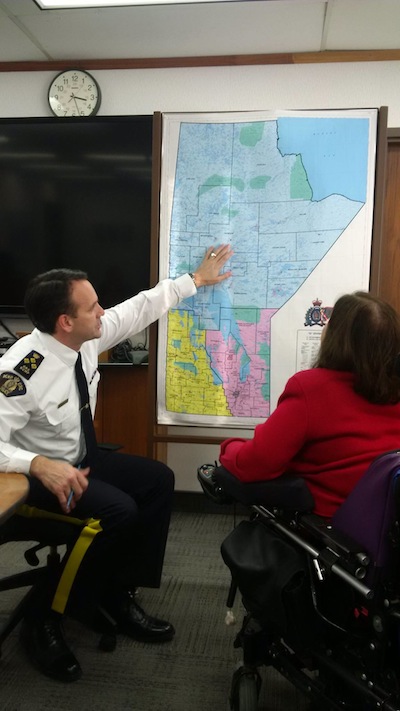
photo - Judith Heumann meets with Manitoba’s Royal Canadian Mounted Police Chief Kevin Brosseau to discuss issues around persons with disabilities and the challenges they face in traveling
Judith Heumann meets with Manitoba’s Royal Canadian Mounted Police Chief Kevin Brosseau to discuss issues around persons with disabilities and the challenges they face in traveling. (photo from Judith Heumann)

At CMHR, Heumann spoke to about 200 people about the types of human rights violations disabled people experience and the need for good and enforced laws. She encouraged Canada to look at having laws similar to the United States’ Disabilities Act.

“This is so that there could be more uniformity in the country as far as construction and non-discrimination,” Heumann explained.

She added, “I know the Trudeau administration is looking at this as a possibility and I think Manitoba and [British Columbia] are also looking at this as provinces.

“I think Canada is doing good work in the area of disability,” she said. “I know people are very hopeful that the Trudeau administration will allow Canada to be more of a player internationally than they have been in the past number of years in the area of disability.”

Heumann has had her share of experiences with the lack of construction standardization in Canada, recalling a time when she was visiting a Holiday Inn on one of her business trips. Heumann’s staff confirmed her reservation and made sure to request a roll-in shower. When she checked in, she made sure the roll-in shower request was noted on paper, yet, when she got to the room, there was no roll-in shower.

“I thought they’d mistakenly put me in the wrong room,” said Heumann. “When I called the front desk, they informed me that they didn’t have any roll-in showers. I was told that although I requested it, they don’t have one. I asked when they were planning on telling me that they don’t have one, then I called the 1-800 Holiday Inn number to express my deep concern, because Holiday Inns in the United States are accessible. It’s one of the hotels that you can make a reservation at and ask for what you need, and they will tell you if they have it or not. The woman on the phone said, ‘Oh no. That’s not possible that you couldn’t get a roll-in shower at a Holiday Inn.’ She asked where I was and I told her Canada, and she said, ‘Oh, Canada.’

“It’s not at all to say that we don’t have all kinds of problems in the United States, too, but the problem in Canada is you don’t have uniformity in your new construction or modifications.”

A similar situation happened at the hotel in which Heumann was staying in Winnipeg. The room was great, except that it had an adjoining room with a door between the two that was too narrow for her wheelchair. Heumann could not get from one room to the other without having to exit and enter through the front doors. She used this as an example during her talk at CMHR.

Also during her stay in Winnipeg, Heumann went to her first hockey game. “I really felt the spirit of people in Manitoba when I gave a very brief response to a question asked by the commentator right before I pulled the ticket for the 50/50,” said Heumann. “He asked me about the State Department and what we were doing in the area of disability. I thought, nobody is going to listen, but when I left and we were going back to the hotel at the end of the game, it was clear people were listening. Some people came over and said they liked what I’d said. I didn’t care if they liked what I said, but I was impressed that they actually listened and took the time to say something. Manitoba was a great experience.”

Rebeca Kuropatwa is a Winnipeg freelance writer.

Format ImagePosted on February 12, 2016February 11, 2016Author Rebeca KuropatwaCategories NationalTags accessibility, Holiday Inn, human rights, Judith Heumann
A groundbreaking decision?

A groundbreaking decision?

Anat Hoffman, leader of Women of the Wall, speaks with members of the media near the Western Wall on Jan. 31, reacting to the Israeli government’s passage of a new plan on egalitarian prayer rights at the Jewish holy site. (photo by Hadas Parush/Flash90 via jns.org)

The Israeli government’s passage of legislation that authorizes egalitarian prayer in a soon-to-be-created 9,700-square-foot, NIS 35 million ($8.85 million) section adjacent to the southern part of the Western Wall (Kotel) has been called groundbreaking, empowering, dramatic and unprecedented. The section could be ready in as soon as a few months or up to two years from now.

“This is a fair and creative solution,” said Prime Minister Binyamin Netanyahu after the 15-5 vote on the measure by his cabinet.

Rabbi Rick Jacobs, president of Union for Reform Judaism (URJ), said the decision would “connect world Jewry to the state of Israel.” Jerry Silverman, chief executive officer of Jewish Federations of North America (JFNA), called it a “major step forward.” Member of Knesset Merav Michaeli (Zionist Union) said the Kotel was “liberated” again; this time not by soldiers, but by women in Jewish prayer shawls.

Indeed, for 27 years, Women of the Wall pushed for women’s equality at the Kotel. Formal negotiations have been going on for almost three years. In a statement, the group said more than just an agreement has been achieved: “The vision of the new section of the Kotel is a physical and conceptual space open to all forms of Jewish prayer. Instead of splitting up the existing pie into ever more divided, smaller pieces, we are making the pie much larger.”

The new section, which will qualify for government funding, will be managed by a public council, governed by a committee headed by the chair of the Jewish Agency for Israel and comprised of representatives from the Reform and Masorti (Conservative Judaism in Israel) movements, JFNA and Women of the Wall. An administrator for the section will be appointed by the Prime Minister’s Office.

Beyond the blueprints, the ratified plan is a powerful statement about the overt impact that Diaspora Jewry and global Jewish leaders can have on Israeli decision-making.

North American Jews have traditionally served as a political lifeline for Israel, lobbying their governments on behalf of the Jewish state. Recent occurrences have shifted the relationship between the North American and Israeli Jewish communities into one of semi-equality, which includes North American Jewish leaders objectively discussing Israel’s policies rather than blindly supporting them.

Silverman called this shift evolutionary. Rabbi Gilad Kariv, executive director of the Israel Movement for Reform and Progressive Judaism, said the negotiations “prove the role that North American Jewry … can and should play in helping Israel make our country more inclusive.”

“Kudos to the unrelenting advocacy from the North American Jewish community in pushing for this,” said Rafi Rone, former vice-president of Jewish and Israel Initiatives at the Joseph and Harvey Meyerhoff Family Charitable Funds. “The dawning of a new day.”

In an interview with the Jerusalem Post, Jewish Agency chairman Natan Sharansky said that American and Israeli Jews are becoming increasingly interdependent. The U.S. needs Israel to help strengthen Jewish identity in a Diaspora community that is slowly shrinking from assimilation and intermarriage, he said. Israel, attacked daily by the international community, needs the solidarity of Jewish communities abroad, he explained.

“I am sure that the [Israeli] government must now take into account – should take into consideration – the position of world Jewry on the decisions it makes,” Hagay Elizur, senior director of Diaspora affairs for Israel’s Ministry of Public Diplomacy and Diaspora Affairs, told JNS.org.

Netanyahu might be feeling the pressure of unprecedented U.S.-Israel political tension. Last August’s Peace Index poll by the Israel Democracy Institute and Tel Aviv University showed that 48% of Israeli Jews worried that Netanyahu’s campaign against the Iran nuclear deal would damage U.S.-Israel relations.


Read more at jns.org.

For two of the many other points of view, read the articles by Rabbi Daniel Bouskila and Phyllis Chesler.

Format ImagePosted on February 12, 2016February 11, 2016Author Maayan Jaffe-Hoffman JNS.ORGCategories IsraelTags Binyamin Netanyahu, Diaspora, egalitarian prayer, Kotel, pluralism, Western Wall, Women of the Wall

Posts pagination

Previous page Page 1 … Page 528 Page 529 Page 530 … Page 661 Next page
Proudly powered by WordPress