Encouraged to be oneself

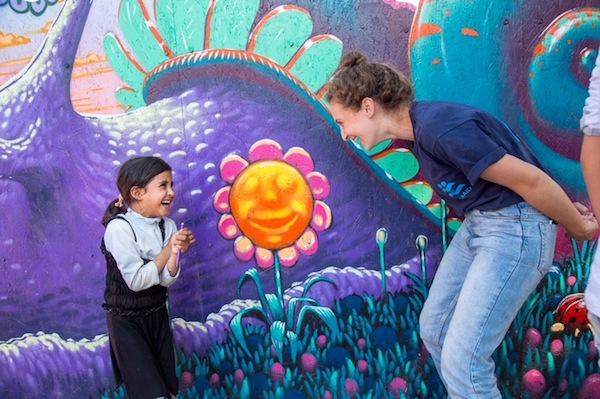
Lifelong friends can be made at summer camp. (photo from Camp Kalsman)

Fun is in all that we do,” Rabbi Ilana Mills, director of URJ Camp Kalsman, told the Independent. “Our staff creates dynamic programming that lets campers laugh and play in a way that doesn’t happen anywhere else. Where else can you spend a day with your friends and your evening doing messy night with a slip-n-slide, water balloons, shaving cream, and more?”

Summer camp is a unique experience for children and young people, for campers and counselors. While fun is at the forefront of programming, so is learning. In the case of Jewish camps, there is the added element of Shabbat observance and other elements of Judaic practise and values.

Looking at the example of Camp Kalsman, which is located north of Seattle, one can see the breadth of activities summer camp can offer. A typical day at Kalsman includes singing, pool time, prayers, and activities that range from canoeing and kayaking on the lake, to climbing the camp’s tower and/or high ropes, to farming or gardening, to painting or having a cook-out.

The camp has chugim (electives), which usually run three to four days, and campers do a project during them, said Mills. “Campers will get to rank their choice from a list of options and we do our best to give campers their choices,” she said. Chugim includes such things as pottery, embroidery, hiking, water aerobics, yoga or soccer.

And older campers have “Sababa Time,” said Mill. “Sababa Time is an hour each day where older campers get to choose their own activities from a number of creative options that changes each day. Those might include volleyball, board games, outdoor cooking, or spa days.”

The camp schedule also carves out free time for campers.

“Life is so busy and camp is as well. Free time enables campers to choose what they need on any given day,” said Mills. “Whenever we have free time, we have options for campers to choose which option best fits their needs.  Some campers need to get energy out, so they play basketball or go to the pool. Others may need down time, so they may read a book in the trees. Campers use free time to relax, recharge and have fun in a manner that best suits them. Recreation can be a time to re-create, to rejuvenate.”

photo - Kids at Camp Kalsman get ready to take a canoe out onto the lake
Kids at Camp Kalsman get ready to take a canoe out onto the lake. (photo from Camp Kalsman)

In addition to obvious practices, such as the celebration of Shabbat and group tefillah (prayer), Kalsman tries to impart Jewish values and culture throughout activities.

“We design our programs to foster a holy community through connection between campers, between campers and staff and between campers and the larger community,” said Mills. “We believe connection is important on every level, so our cabins do cabin time every night to form connections and, every week, we have all-camp programs, where campers of different ages can get to know one another. When we eat, pray and sing together, we connect to the larger community.”

Camp Kalsman ends each night in siyum, “a special closing prayer where we pray Hashkiveinu and Shema using a special tune written just for Camp Kalsman,” said Mills.

When asked what summer camps in general – and Jewish camps specifically – can give kids that schools can’t, Mills shared a quote from a 10-year-old camper, who said, “Kalsman lets me take off all the masks I have to wear at school and really be me.”

“At Kalsman, our campers know that they are valued, honoured and supported for who they are,” said Mills. “Camp enables kids to be kids, to be free, and to have fun in a way that they don’t get anywhere else. It frees them of the burdens of school and competition and allows them an outlet to be part of a great community. Kalsman campers disconnect from their devices and connect to a larger, holy community. Campers learn independence and problem solving, they learn they can make mistakes and how to manage mistakes in a safe environment. Camp is the place where kids can explore who they want to be in the world.” 

Writing in praise of neoteny

Campers being silly at Rockbrook Camp for Girls. (photo from rockbrookcamp.com)

Today, the word of the day is neoteny. It’s really a term from evolutionary biology, but it describes the retention of childlike attributes in adults. You might think of a grown-up who has a “baby face,” or is generally “cute.” When you are talking about these kinds of physical features, we tend to think it’s a good thing to have “young looking skin” or the “energy of youth,” for example. Neotenic people are usually attractive. Being neotenous is mostly considered a good thing.

But what about personality traits, attitudes or approaches to the world? What about these ways of being childlike? Think about what life is like as a child. The world is magical, full of curiosities, almost always kind and wondrous. As kids, we spend so much time being creative and playing. We feel so many more things – joy, excitement, anticipation, and the broad sensuous world around us. All of this probably makes it so easy to make friends (“Come on! Let’s play!”).

You’ve also noticed what usually happens when we grow up. We get serious, we latch on to patterns of behaviour, we get scared, we feel the need to protect what we believe, we accept responsibilities and feel pressure to perform and “be” someone in particular. As adults, we spend almost all of our time, mostly alone, working to stay organized and fighting opposing forces. We’re all too consumed by those adult things we’ve grown to accept as important, and it ain’t easy.

photo - Kids at Rockbrook Camp for Girls with soapy hair
(photo from rockbrookcamp.com)

It’s no surprise to see that being an adult overpowers those childlike traits. Sadly, to grow up often means losing touch with what we used to be, those aspects of being human we loved as kids. As adults, we have a harder time feeling what makes the world wonderful, a harder time making friends, and a much harder time playing and having fun. Of course, there are exceptions to this, but that’s the point. They are exceptions. And that’s too bad.

Let’s remember the value of being childlike even as adults.

Let’s be joyful as we’re responsible.

Let’s be curious when encountering opposing beliefs.

Let’s be friendly and playful, cooperative and excited about learning new things.

Let’s strive to foster our innate neotenous instincts.

Bringing this back to camp.… Summer camp is a place where kids can really be kids. It’s a special time when they are encouraged to play, make friends, be creative and explore the world around them. Separate from the forces of home and school (which are fundamentally about forming “adults”), camp provides a wonderful opportunity to strengthen our “kid selves.” It celebrates and fosters the neotenous traits. Camp is a joyful break from all that training, and that’s a big part of why it’s so fun.

Maybe we could say…. Camp helps you learn how to be a really great kid so that, later in life, you’ll be a really great (happy, satisfied, remarkable) adult.

Camp’s power to strengthen these “kid traits,” I suspect, will be a big part of that success. 

Jeff Carter is director of Rockbrook Camp for Girls, which is in the western part of North Carolina. For more information, visit rockbrookcamp.com.

Getting more kids into camp

The Foundation for Jewish Camp serves more than 155 Jewish summer camps, close to 80,000 campers and 11,000 counselors across North America every summer. Among its initiatives is the One Happy Camper program, which is run in partnership with Jewish federations – including in Montreal, Toronto and Calgary – foundations, PJ Library, and camps across North America. The program provides incentive grants of up to $1,000 to children attending nonprofit, Jewish overnight camp for the first time, with the intention of introducing more children to the magic of Jewish camp.

Based on the 2010 study by the FJC, Camp Works: The Long Term Impact of Jewish Overnight Camp, there is evidence that overnight Jewish camp is a proven means of building Jewish identity, community and leadership. As adults, campers are 30% more likely to donate to a Jewish federation, 37% more likely to light candles regularly on Shabbat, 45% more likely to attend synagogue at least once a month, and 55% more likely to feel emotionally attached to Israel. As well, one of three Jewish professionals (rabbis, cantors, teachers) started out as counselors at Jewish camp; one of five Jewish educators cited Jewish camp as a key experience that caused them to enter the field; and seven of 10 young Jewish leaders in their 20s and 30s attended Jewish summer camp.

North American Jewish overnight summer camps reach 77,000+ camp-aged children every summer, but this represents only 10% of eligible camp-age kids. In the FJC’s efforts to grow enrolment and increase awareness, FJC created the One Happy Camper program, thanks to the generosity of an anonymous donor. The program’s singular mission is to increase the number of children benefiting from the transformative experience of Jewish summer camp. Aimed at attracting new campers who do not have daily, immersive exposure to Judaism, the program provides financial incentives to encourage parents to choose nonprofit overnight Jewish summer camp over other summer options.

image - Communities Investing in the Future One Happy Camper at a Time report coverSince the success of the 2006 pilot, the One Happy Camper program has expanded across North America. To date, 64,000 campers have experienced Jewish overnight camp as a result of FJC’s partnership with 40 community-based organizations (federations/foundations), four national camp movements, 30 individual camps, the Harold Grinspoon Foundation’s PJ Goes to Camp program and the Jim Joseph Foundation-funded JWest program.

Of One Happy Camper grant recipients, six out of 10 would have stayed home or attended  a non-Jewish summer experience, and one out of three OHC recipients’ parents had not attended Jewish camp – FJC knows that parents who attended Jewish camp are more likely to send their own kids, so the grants are instilling a new legacy of Jewish camping for families.

Surveys show that OHC recipients enjoy their summers at camp as much as their peers, in that they say they found the experience of value and would likely recommend it. As well, they are as likely to return to camp. In fact, 82% of OHC recipients return to camp for a second summer. And their experience is infused with Jewish education, identity and connections: 97% feel that camps create an atmosphere where children are proud to be Jewish and 36% of recipients increased their participation in Jewish activities after their first summer at camp.

The majority of OHC families (63%) are not members or donors of their sponsoring organization but, as a result of the OHC grant, 78% of OHC parents feel more positive about their family’s connection to the Jewish community and 72% of OHC parents feel that they are more likely to support their sponsoring organization.

These are just some of the results found in the Foundation for Jewish Camp publication Communities Investing in the Future One Happy Camper at a Time. To read more, go to jewishcamp.org/community-partners and click on “Download ‘Communities Investing in the Future’ (PDF).” 

– Courtesy Foundation for Jewish Camp

Kelowna vigil for Israel

A vigil in solidarity with Israel took place on the Dayton Street pedestrian overpass in Kelowna on Nov. 19. (photo from vigil organizers)

About 100 people held a vigil in solidarity with Israel in Kelowna on Nov. 19, which proceeded without incident.

The two-hour gathering on the Dayton Street pedestrian overpass, which straddles Highway 97, was organized by members of the Jewish community, following a series of peaceful pro-Palestinian demonstrations since Hamas’s Oct. 7 attack on Israel. 

The organizer (who asked that their name be withheld because of security concerns) said that, in addition to community members, the participants included representatives of at least two churches, as well as Kelowna city councilor Ron Cannan, a former Conservative member of Parliament for Kelowna-Lake Country.

The vigil was encouraged by Rabbi Shmuly Hecht, director of the Okanagan Chabad Centre, who led men present in the putting on of tefillin in a display of Jewish confidence. 

The organizer said the pro-Israel public demonstration was the first of its kind in the area. The main purpose was twofold: to give the area’s small Jewish population an opportunity to unite and have its voice heard and to show other citizens that there is “another side” to the Israel-Hamas conflict not reflected by the public activities of Palestinian supporters.

One week earlier, around 300 people held a pro-Palestinian demonstration that started on the steps of the courthouse and concluded with a march. That event, which received local media coverage, was organized by the Okanagan chapter of Canadians for Peace and Justice in the Middle East, a Montreal-based anti-Israel lobby group.

The organizer said they and the other organizers decided not to alert the media to their event in order to avoid attracting any conflict with the other camp. There were no tensions, and the only show of disagreement came from a motorist driving under the overpass displaying a Palestinian flag and honking, they said.

There were a few honks of apparent approval and passersby did engage with those in the crowd, asking questions, they added.

The demonstrators carried Israeli and Canadian flags, and placards mostly reading “We stand with Israel” and “Bring them home now,” referring to the hostages taken by Hamas,  but also “Hamas (equals) ISIS” and “Rape is not resistance.”

The organizer said those supporting the Palestinians and condemning Israel are getting attention in the Okanagan because of the frequency of their protests and the media coverage. The result is people “only hear one side of the story.”

The Palestinian demonstration outside the Kelowna courthouse Nov. 12 was especially visual: an individual identifying themselves only as Haneen, a Palestinian studying locally, unfurled down the steps a computer printout listing what was said to be the names of every Palestinian civilian casualty between Oct. 7 and 26.

Kelowna is home to about 1,000 Jews, and an equal number are scattered throughout the Okanagan. At the time this article was written, the organizer said they did not feel any antisemitism in Kelowna or hostility as a result of the war and, in fact, finds a fair degree of sympathy for Israel’s position. “We haven’t removed the mezuzah from our door or things like that, like in other places. We feel quite comfortable.”

They said of the Chabad Centre, with which they are also involved: “There has been nothing there so far, but we need to be vigilant. It’s an easy place to find.”

Unlike elsewhere in British Columbia, Okanagan elected officials have generally remained neutral or understanding of Israel’s position. The area’s MPs, Tracy Gray for Kelowna-Lake Country and Dan Albas for Central Okanagan-Similkameen-Nicola are Conservatives, and have not strayed from that party’s stance supporting Israel’s right to defend itself. Right after the Hamas attack, Albas issued a clear statement “I stand with Israel” and condemned those in Canada who “celebrated these terrorist actions.”

In contrast, some 60 British Columbia politicians, at three levels of government, have signed a parliamentary e-petition sponsored by Quebec New Democrat Alexandre Boulerice calling on Prime Minister Justin Trudeau to demand an immediate ceasefire (before one happened), as well as an end to Israel’s blockade of the Gaza Strip. Over 286,000 signatures appeared on the petition by the Nov. 23 deadline. The only Okanagan official among the signatories is Penticton city councilor Isaac Gilbert.

At home, Rabbi Hecht is appreciative of the “care and assistance” the Kelowna RCMP detachment has shown to the Jewish community from the start, increasing its presence around the Chabad Centre and the Okanagan Jewish Community Centre, which houses Beth Shalom Synagogue.

Overall, he said, the Jewish community has “displayed incredible resilience and pride” as the conflict goes on.

Hecht has been urging greater public expressions of Jewishness during this time, such as putting up mezuzot and wearing kippot on the street.

“We have to shine our Jewish light right now; retreating is not an option,” he said. “We all need to be more outwardly Jewish, not less.”

The OJC did not play any role in the vigil but, in its latest newsletter, states “many members of our community” took part, that it was peaceful and received “a great response from drivers and passersby.” There is an accompanying photo.

“Everyone is praying for a swift conclusion to the war, an end to the violence in the region, and for the safe return of the hostages,” the newsletter states, continuing with the proviso: “Please note that the OJC is a social and religious community. We stand for Judaism and peace. Political events and activities of individual members are at their own discretion and are not organized by the OJC.”

OJC past president Steven Finkleman, who currently chairs several synagogue committees, told the the Jewish Independent, “We are all Jews here, and we do not want to be divisive amongst ourselves.” He emphasized that he was speaking personally and his comments do not necessarily reflect OJC policy.

“I am not on the board, so I can’t answer officially from the board’s point-of-view but only as an individual member of OJC,” Finkleman said via email. “I do know that there were several members of OJC at the event, but I’m not certain how they were made aware of the event, perhaps they are on Chabad’s emailing list.

“There is a fairly strong and active pro-Palestinian group whom I monitor, far outnumbering the group of Jews that were at the vigil. I personally think that flag-waving and asking members of the community to participate only contributes to possible division in the greater Kelowna community.

“We have had a lot of supportive emails (about 50), mainly from Christians, and have received zero negative communications. I think we have to be cautious about lowering ourselves to the level of flag waving and demonstrations that the opposition has done on a few occasions here in Kelowna.”

Finkleman, a retired pediatrician originally from Winnipeg who has lived in Kelowna 40 years, said he has had “some very gratifying contacts with Muslim students” and engaged confidentially with Palestinian supporters at the University of British Columbia campus in Kelowna and in the community,” private dialogue that he believes is more productive than public demonstrations. 

Janice Arnold is a freelance writer living in Summerland, BC.

Editor’s Note: This article was edited after publication in print and online, in response to a request for anonymity because of security concerns.

Canadian Jews’ first years

Pierre Anctil, left, and Richard Menkis with a copy of their new book, In a “Land of Hope”: Documents on the Canadian Jewish Experience, 1627-1923. (photo by Pat Johnson)

The first Jew known to have set foot in what is now Canada was Esther Brandeau, who arrived in Quebec City in 1738. Jews were forbidden from migrating to New France, but the young woman’s religion was not the only thing she was concealing. She was also dressed as a boy. 

Interrogated by authorities on arrival, Brandeau was the subject of high-level consultations before she was sent back to France the following year.

Although they are certain there were Jews in the land that would become Canada before 1738, professors Richard Menkis and Pierre Anctil say Brandeau’s case is the first documented proof of a Jewish presence here.

The historians shared Brandeau’s story at a book launch in Vancouver Nov. 21, following the annual general meeting of the Jewish Museum and Archives of British Columbia. Menkis, an associate professor in the departments of history, and classical, Near Eastern and religious studies at the University of British Columbia, and Anctil, a University of Ottawa history professor, co-edited In a “Land of Hope”: Documents on the Canadian Jewish Experience, 1627-1923.

The book spans three centuries through the lens of more than 150 documents, many of them never before published.

Menkis emphasized the efforts made to provide geographical diversity in the volume.

“If we want to appreciate the Canadian Jewish experience, we’ve got to move beyond – believe it or not – the borders of Quebec and Ontario,” he told the audience at Temple Sholom. “We have offered texts that represent the experiences from west to east. We offer an excerpt from the minute book of Congregation Emanu-El, in Victoria, recording a debate on whether to include the Freemasons in a cornerstone-naming ceremony. We have documents from the other ocean, from a controversy in Halifax, where the local SPCA argued that kosher slaughtering was cruel and that the local shochet (kosher slaughterer) was accordingly charged.”

Anctil, who is francophone, emphasized the uniqueness of the Jewish experience in Quebec and noted that shared interest between Catholics and Jews led to one of the first legislative acts of Jewish emancipation in pre-Confederation Canada. In 1832, the legislature of Lower Canada (later Quebec) passed a statute making British subjects who are Jewish equal under the law to all other British subjects in the jurisdiction.

“It’s a foundational document,” said Anctil. “It’s the first time that Canada and most British colonies allowed Jews to have political and civil rights.”

The motivation may have had less to do with Jewish rights – there were only about 150 Jews in colonial Canada at the time – than self-interest among French Catholics.

“They were Catholics living in a Protestant world and they knew that, if the Jews had more rights, the Catholics also had more rights,” Anctil said.

The Quebec education law of 1903 had lasting impacts on the province, especially for Jews and their place in the “distinct society.” 

“The Quebec government decided that Jews would be considered Protestants for the purpose of education,” said Anctil, “and [Jews] were all sent to the Protestant school board of Montreal and did not receive a Catholic or French education, which proved problematic in the decades ahead.”

Brandeau, the young Jewish woman who tried to masquerade as a non-Jewish boy, was only the first documented case of Jews coming up hard against Canada’s explicitly or implicitly racist immigration laws. The theme runs through the 400-page book.

Canadian immigration policies reflected the agricultural dominance of the Canadian economy into the 20th century and, since most European Jewish migrants were not farmers, this was an inherent, if not unwelcome from the perspective of immigration officials, bar to many Jews.

image - Land of Hope book coverThe editors address Jewish farmers in the book – those who had experience in the Old Country as well as those who, successfully or less so, took to the land after migration – but prioritize the economic experiences of Jews in peddling, retail and the garment industry.

The preference for immigrants with farming backgrounds was an implicitly, possibly even unintentionally, anti-Jewish component of Canada’s immigration approach. Other examples were less subtle. It was not so much that legislation said Jews were not permitted to migrate, but that unwritten rules, “administrative refinements” or policies that were open to interpretation could be used to block Jews from entering the country.

There had been rumours of a deliberate anti-Jewish immigration policy, and Menkis said their research found evidence that instructions had been sent to immigration officials in Europe that Jews were to be considered undesirable applicants.

In 1923, an order-in-council was passed by the federal cabinet, which said that only farmers, farmworkers and domestic women servants would be allowed to immigrate to Canada, effectively closing the door to Jews and many other communities from the Balkans and Eastern Europe.

Anctil and Menkis pointed out that Jews were far from the only group excluded under Canada’s immigration policies.

“Asians and Africans – out completely,” said Anctil. “Almost nobody got in. In 1923, we have the Chinese Immigration Act, which made it extremely difficult for financial reasons for Chinese people to migrate to Canada. So, we had a really racist immigration policy until the ’60s, ’70s. Not just Jews.”

Many of the documents included in the book were translated into English by the editors, from the original French, Yiddish or Hebrew.

“It’s very important to work in four languages,” Anctil said. “English, French, Yiddish and Hebrew – there is no way of doing Canadian Jewish history if you leave one out. All these four languages are represented in the book and serve an essential purpose of allowing the full flavour of this story to be told.”

The pair’s decade of research for In a “Land of Hope” uncovered some unexpected treasures. 

“Usually, we hear of social welfare from the minute books of established members of the community and their organizations,” said Menkis. “I was reading one of these minute books on one occasion in Toronto when a piece of paper dropped out.”

It was a desperate appeal from a woman seeking help from a Jewish women’s aid organization, specifically asking for chickens for the Passover seder.

“Please let me know if you’re going to send me the Paisez [Pesach] order and if you’re going to send me what you promised me,” read the handwritten letter. “I hope that you’re going to be kindly for my sick husband and my six little children because I just leave it to you and you should help because there is nobody to help accept [sic] you. I hope you won’t forget us and send us an answer right away. Because I could not tell you very much & That is the first time in my life that I should ask for help. But everything can happen in a lifetime. Yours […] Mrs. Green.”

The book closes in 1923 because that was a turning point in Canadian Jewish history and in the larger story of Canadian immigration. As a result of an economic depression following the First World War, nativist sentiments led to what was an effective end to large-scale immigration into Canada, itself a response to a parallel development south of the border. 

“One of the reasons it happened in Canada was that they knew the Americans were closing down [open immigration] and they didn’t want to get all those Jews that the Americans weren’t accepting,” said Menkis.

A second volume of the work, picking up from 1924, is due to be released in 2026. Anctil said the unique experiences of Jews in Quebec will be even more pronounced in that book.

“The Jews living in Quebec faced a different situation than Jews living elsewhere,” he said. “The majority of [Canadian] Jews were in Quebec until the ’60s and it’s not only the French and Catholic issue, it’s the issue that the school system was separated between Catholics and Protestants and Jews could not find a place easily in the public school system.”

Bias against Jews also has a different strain in each of Canada’s official linguistic communities, Anctil added.

“Antisemitism among the French is not the same as among the British,” he said. “The logic’s not the same and the results are not the same. Often, when you read histories of Canadian Jewry, you have the impression antisemitism is all the same, whoever is antisemitic. It’s not true. [There are a] number of subtleties and complexities in that.”

In a “Land of Hope” was released by the Champlain Society, a publisher of scholarly Canadian books. This is the first book the society has published about a community that is not French or English in its 115-year history.

“I hope at least I’ve convinced you of the value of the book, without being crassly commercial,” Menkis said at the end of the presentation, adding: “Although, I do want to say that In a ‘Land of Hope’ would make a great Hanukkah gift.” 

A 1930s immigration story

Author Norman Ravvin’s grandparents, Yehuda Yoseph and Chaya Dina Eisenstein, around the time of their engagement, in 1928. (photo from Who Gets In: An Immigration Story)

Relentless perseverance, continual pressure on select politicians and some key allies are what helped Norman Ravvin’s maternal grandfather, Yehuda Yoseph Eisenstein, finally bring his wife and two children to Canada from Poland in 1935, five years after he immigrated here. In a decade generalized as a time of “none is too many” with regards to Canada’s immigration policy towards Jews, Ravvin’s grandfather managed to get his family into the country.

In his new book, Who Gets In: An Immigration Story (University of Regina Press), Ravvin combines his novel-writing skills with his academic expertise to create an engaging memoir about his grandfather’s first years in Canada, one that is firmly situated in the larger context of what was happening at the national level at the time. An extensively researched book – with 10-and-a-half pages of sources – Ravvin’s style will make readers feel like they’ve come to know him a bit, as he allows his personality to be seen in the telling, though what is documented fact and what is conjecture or opinion is clear.

“My approach is to make nothing up. The story rides its own hard-to-believe rails,” says Ravvin on his webpage. “I present its narrative creatively, so readers relate to it on a personal level. Events and personalities from nearly a century ago remain fresh, telling and relevant to contemporary North American life.”

Ravvin does allow his imagination some space. He doesn’t know, for example, the exact reasons his grandfather left Poland, but he can surmise that rising antisemitism was one of them. Whether it was because his grandfather objected physically and publicly to a slur and became a marked man, or whether a rock was thrown into the family’s sukkah, Yehuda Yoseph Eisenstein’s response, writes Ravvin, “was to say ‘I can’t live with these people anymore.’ Or, as he would have said in Yiddish, ‘Ich ken mit zei mer nisht lebn.’ It’s good to hear some of these things in the language in which they took place. In this incident, the spoken words evoke the moment of decision with clarity and purpose.”

Eisenstein had three siblings who had already left Poland, with his younger brother Israel (Izzy) having settled in Vancouver. It was this brother who offered Eisenstein sponsorship and, while Canada was a much less welcoming place by 1930, “a single man could obtain a visa with a brother’s sponsorship.” The problem was Eisenstein had been married in 1928, without a civil licence, as he was already planning on leaving and knew that he would need to appear single to get into Canada. The illegality of the marriage and the misrepresentation of his marital status on his immigration application would cause Eisenstein much tsuris (distress) in getting his wife, Chaya Dina, and their children, Berel and Henna, to Canada as well.

image - Who Gets In book coverWho Gets In is divided into two parts. The first is about Eisenstein finding his place in the country; the second is about his efforts to bring his family over. Ravvin wants to “paint a detailed picture of the time and place, with careful attention to Western Canada,” where his grandfather went, and he does this by talking about such things as the content of school history books in the 1920s, Canada’s immigration numbers and the country’s changing demographics, the implications of government forms that asked immigrants to declare their “Nationality” and “Race or People,” how census data were being interpreted and used, the popularity of eugenics in Canada and beyond, the impacts of the Depression, and so much more.

Ravvin uses history not only to provide context for his grandfather’s experiences but also brings it into the present. Assimilability was a key consideration in assessing immigrants’ suitability in Eisenstein’s day and continues to be – current NDP leader Jagmeet Singh “was approached while campaigning and told that he should remove his turban to look more Canadian,” notes Ravvin.

Ravvin spends quite a lot of ink discussing various perceptions of what a Canadian should like and contemplating how his grandfather would have been considered. The cover of Who Gets In features a photo that was part of a newspaper article in 1910. The three men “appear as cutouts in a group of twelve ‘Types’ of ‘New-Comers’ from ‘Photographs Taken at Quebec and Halifax.’” From left to right, they are described as “Pure Russian, Jew, German.” As the landing form stripped Ravvin’s grandfather of his nationality – someone crossed out the typed letters “PO” and wrote in by hand “Hebrew” – so too is the Jew in this photograph stripped of his, observes Ravvin.

In setting the scene for Part 2 of the book – the bureaucratic fight his grandfather must undertake – Ravvin discusses the Indigenous peoples that inhabited the Prairies where his grandfather ended up. Eisenstein first went to Vancouver, where he hoped to stay and work as a shoichet (kosher butcher), but he was apparently seen as competition by Rev. N.M. Pastinsky, “who happened to be on the board of the Pacific Division of the Jewish Immigrant Aid Society (JIAS) and thus someone with whom one might not want to tangle.”

Eisenstein backtracked to Saskatchewan, living first in the farming town of Dysart and then in Hirsch. Ravvin talks about what Jewish life in rural Canada was like and some of the impacts that European settlement had on the Cree, Saulteaux and Assiniboine.

Ravvin starts the book with the story of the Komagata Maru – the chartered ship from India, full of immigrant hopefuls, mostly Sikhs, that was not allowed to land on the coast of British Columbia in 1914 and was instead forced to return to India, with disastrous results. He returns to the incident at the end of Part 1 to point out that one of the central (negative) figures in his grandfather’s life was A.L. Jolliffe, “who began his civil career in 1913 as an immigration agent in Vancouver,” playing a role in the handling of the Komagata Maru.

“By the 1930s,” writes Ravvin, “Jolliffe had ascended to the position of commissioner for the Department of Immigration in Ottawa. He is the closest thing to a bête noire in my grandfather’s story. If the much better-known doorkeeper, F.C. Blair, played any role in my grandfather’s struggle, he left no trace in any of the documents beyond a shared penchant for the use of pompous and hectoring language that appears in letters in my grandfather’s file.”

Jolliffe denies more than once Eisenstein’s applications for permission to bring his wife and children to Canada – in one instance, while expressly not recommending deportation, Jolliffe suggests that, if Eisenstein wants to be reunited with his family, he should return to Poland. Ultimately, Eisenstein is successful only because he has allies such as A.J. Paull, executive director of the JIAS, and Lillian Freiman who, married to influential merchant A.J. Freiman, had “remarkable access to the leaders of early-twentieth-century Canada.” She also did many amazing good works, including managing “Ottawa’s response to the flu epidemic in 1918 almost single-handedly.” Ravvin also positively differentiates the federal government, as led by R.B. Bennett, prime minister from 1930 to 1935, from that which succeeded it, the “none is too many” government led by William Lyon Mackenzie King as prime minister.

Eisenstein finally achieves his goal through an order-in-council – a decision made by the Privy Council, the prime minister’s cabinet – that “asserted its right to ‘waive’ determinations of an earlier order in which strict immigration regulations were brought into effect. This reflected an ability – understood to exist by those in the know – of the minister to ‘issue a permit in writing to authorize a person to enter Canada without being subject to the provisions’ of the Immigration Act, without interfering with the status of those provisions.”

The Eisenstein family was one of the lucky ones. 

A time for miracles

Hanukkah is a reminder that darkness can be transformed into light, and that miracles are possible.

With so much conflict, misery, anxiety and hopelessness in the world, we need some miracles.

There have been a few rays of hope in Israel in recent days – the release of hostages from Gaza has brought a world of relief to the families and friends of those freed and to Jews and others abroad. As a people, we will not rest until all those who have been kidnapped are returned home safely.

Even then, the war will likely continue, with the stated goal of eradicating Hamas. As catastrophic and heartbreaking as the war and the atrocities that sparked it have been, this is a single battle in a longer conflict that seems destined to go on, at least for the time being.

When we look at today’s events in the context of a larger history, it is understandable to conclude that things are not getting better, but worse. Silver linings in such a situation seem few and far between. To be honest, in this space we try to find something constructive and hopeful in every topic we confront, and it has rarely been more difficult than in the past two months.

As students of history, we can only offer this piece of hope: many times, in our individual lives, in the story of the world and in the 3,500 years of history of the Jewish people, seemingly intractable problems have been resolved in stunning and unexpected ways.

Consider three massive geopolitical examples that have happened in the living memory of most of us.

Many of us grew up under the shadow of nuclear catastrophe. Some of us may recall practising hiding under our desks in preparation for a nuclear explosion. All of us who are middle-aged or older certainly remember a world viewed as a binary of “us” (the capitalist West) and “them” (the communist East).

From the perspective of the child cowering under the desk, the idea that the defining global status quo would end not in a bang – the ultimate bang – but with the relatively peaceful dismantling of the Soviet Union and its client regimes, would have seemed unimaginable. The Cold War, which defined our worldview and, at times, threatened our very existence, ended peacefully more than 30 years ago. Just a short time before it did, nobody could have foreseen the unfolding of events.

Likewise, the end of the racist regime in South Africa and its apartheid institutions. One of the most venal systems ever imagined was ended not by bloody revolution, but by a relatively peaceful, collaborative transition to democratic majority rule.

A third example, the Irish conflict, understatedly referred to as the “Troubles,” largely ended with the successes of the Good Friday accords of 1998.

In all three of these instances, the resolution of what seemed like intractable, even existential, challenges were overcome with remarkably sudden and unanticipated events.

It should be noted as well that, in all three cases, events played out very much because of specific leaders who were involved, who took immense risks, were willing to compromise, and placed an immense amount of hope in the goodwill of their people to make their societies and, by extension, the world a better place.

We might say that we don’t see great figures on the horizon on either side of the conflict that presently consumes us with such intensity. But this is precisely the point. Vast historic changes have happened when least expected because movements and visionary individuals emerged and ushered in changes, upending the seemingly rigid status quo.

The Israeli leadership has promised that the current war will eliminate the terrorist autocrats who have run Gaza. The leadership in the West Bank is inevitably going to change before long as well, if only because the current president is aged 88.

Not incidentally, when this horrible war finally ends, Israelis will be undertaking a very serious review of recent events. It is entirely reasonable to expect significant changes at the top of both Israeli and Palestinian power structures in the very near future.

The truth is, in change there is hope. And, indeed, change is the only thing that is inevitable.

It might be also time to dig up an old chestnut from David Ben-Gurion, who said something that is relevant here not only because of the time of year – Hanukkah – but because of the time of history.

“In Israel, in order to be a realist, you must believe in miracles.” 

Growing and sharing our inner light

If we fear “advertising” our identities, we should do everything we can to maintain our inner light and self-worth in trying times. (photo from PxHere)

Years ago, my husband lost both his grandmother and his great aunt. Several years apart, he traveled to the Lower East Side in New York to attend their funerals at the same funeral home. There was a rabbi there who officiated at both funerals. This rabbi told the same story twice. Perhaps he had only the one funeral teaching, but my husband remembered it. This rabbi suggested that a famous rabbi taught that the worst of the plagues against the Egyptians was darkness. Why was darkness the worst? It was all encompassing, overwhelming, and seemingly permanent. No one knew if the sun would ever return. This rabbi used this to talk about death, but the metaphor stayed with us.

Despite our efforts to find the source for this story, we couldn’t track down its origin. While looking for it, I thought about darkness and what we can learn from it as we celebrate Hanukkah this year.

There are parallels between the Hanukkah story and our current struggles. Before Oct. 7, Israelis were distracted by potential changes to their court system and very divided politically. While that political turmoil didn’t disappear in the face of the massacre and the war, Israelis have immediately united in the aftermath to work together. Israelis I know have said that it isn’t the government that is taking care of those who are displaced, but rather nongovernmental organizations and volunteers from every corner of Israeli society. Israelis are cooking meals for soldiers, for moms managing as single parents for long periods of time, and for those who have been evacuated or made homeless by the conflict. Israelis and the Jewish people worldwide have also worked together as a people to take care of one another.

The military conflict of Hanukkah is a story of division and unity. There were Jews at this time, around 200 BCE, who had become increasingly assimilated and Hellenized. They cooperated with the Seleucid Empire. There was societal upheaval. Others were more traditional in practice and offended by the changes made by more “liberal”-minded Jews and King Antiochus. The Maccabees represented the traditional or more orthodox Jewish tradition. They rose up against King Antiochus’s pagan practices and the more assimilated Jews who had adapted to Hellenistic practice.

We know now that the Maccabees won these battles. They rededicated the Temple in Jerusalem. This is a military victory and a story around religious or national liberation. The rabbis tried to focus the religious observance on the miracle of the light (the “ner tamid,” the holy flame in the Temple that should not go out) rather than on the military situation. However, we wouldn’t have Hanukkah without these historical cultural conflicts or the Maccabees’ wars.

The historical details of this struggle are in the books of the First and Second Maccabees, which describe the Hanukkah story. While there are many references to the holiday in the Mishnah, the detailed story has been maintained through the Catholic and Orthodox churches, which kept First and Second Maccabees as part of their Old Testament. Protestants don’t include these books in their bibles. We study these texts to understand Hanukkah, but they don’t hold any official status in Jewish tradition.

This, too, has a parallel to our modern experience. While we know our traditions around Hanukkah, some of the context comes from many historical texts preserved by others. During this war against Hamas, we are being forced to defend ourselves against antisemitism, and also to defend the existence of the state of Israel. The worldwide Jewish community doesn’t have to use our personal experiences to educate others about this. The historical contexts for understanding both antisemitism and the need for the existence of the state of Israel are embedded in world history. Learning about the historical roots of Christian antisemitism in Europe or in the dhimmi law of Islamic empires is part of the greater history. Information about when the Romans conquered Israel and destroyed the second Temple can be found in multiple sources, including on the Arch of Titus in Rome. The creation of the modern state of Israel in 1948 is also part of a much broader historical context.

The rabbis chose, in creating the rules around the holiday of Hanukkah, to focus on light and miracles rather than military victories. Rabbi Lord Jonathan Sacks (z”l) wrote in “8 Short Thoughts for 8 Hanukkah Nights” about the ways in which the light is emphasized. His fifth short thought focuses on Maimonides’ teaching about how to fulfil the mitzvah of Hanukkah. Maimonides teaches that lighting candles on Hanukkah is precious and that one must sell something or borrow to fulfil this commandment. Yet, if one finds Shabbat is coming and you have only one candle? Light it for Shabbat. In this case, Maimonides teaches: “The Shabbat light takes priority because it symbolizes shalom bayit, domestic peace. And great is peace because the entire Torah was given to make peace in the world.” Sacks suggests that, “in Judaism, the greatest military victory takes second place to peace in the home.” He points out the great victory is a spiritual and not military one.

For Israel today, too, the great victory must be the notion of continuing to pray and negotiate for peace while also navigating difficult military situations.

Sacks makes several points that could be articles on their own, but the ones I felt most drawn to remain relevant. The Hanukkah candles should be lit so that people can see them outside, but if one is afraid of inviting hate, it has long been taught that it is OK to light the candles indoors, out of public view. Still, we are meant to be public about our “light” more generally and fight for it, if necessary. If we fear “advertising” our identities, we should do everything we can to maintain our inner light and self-worth in trying times.

Finally, Sacks discusses a story in the Talmud in which Rav and Shmuel, third-century rabbis, disagree over whether you can use one Hanukkah candle to light another (if you lack an extra candle, a shamash, the helper candle, that is used to light the other eight candles). Rav suggests that you may not, as this might diminish the light of the first candle. Shmuel disagrees, and halachah (Jewish law) follows Shmuel, who teaches that you can use one Hanukkah candle to light another because it helps the light grow and brings us more light. Using your light to enlighten others is the best practice.

I bumped into a rabbi I admire who lives in Winnipeg, where I live. We were each dropping off kids at a Jewish youth group activity. He wore a ball cap, as he was “off duty.” I thanked him for his contribution to a news article about the war and local protests, and he responded, “These are dark times.”

Like the plague of darkness in Egypt, we don’t know exactly how or when things will lighten. We need Hanukkah’s message and rituals to offer that light. Maybe we won’t put our Hanukkah candles on public display this year, but we can draw wisdom and comfort from our long history and rabbinic teachings. These teach us to reach deep to find the messages of hope, faith and peace from a story about a war. This time around, we need to act individually like Hanukkah candles. We can lend our inner lights to volunteer, to speak out, to support others and to kindle others’ lights during a hard time. Even during times of war and hate, we can be the light. 

Joanne Seiff has written regularly for CBC Manitoba and various Jewish publications. She is the author of three books, including From the Outside In: Jewish Post Columns 2015-2016, a collection of essays available for digital download or as a paperback from Amazon. Check her out on Instagram @yrnspinner or at joanneseiff.blogspot.com.

Contemplating the war

Prime Minister Yitzhak Rabin meets in Casablanca with PLO Chairman Yasser Arafat, 1994. (photo from flickr.com/photos/government_press_office/6324960139)

With all the darkness surrounding us since Oct 7, since the shattering of that tranquil Shabbat, have the people of Israel witnessed a miracle?

When Israel’s guard was fully down, when the south was under a vicious blitzkrieg by the monstrous Hamas, why did Hezbollah – with their 150,000 missiles pointed towards Israel – not exploit this excellent opportunity to open a second front? When Israel was existentially exposed, Hezbollah chose not to respond, at least not in any real-time, meaningful way. Complex geopolitical and military and conspiracy theories abound, attempting to explain why and why not. Pundits speculate and postulate and surmise. But maybe, just maybe, at some very esoteric level, the simplest and most logical answer, according to my close friend, a rabbi: it was a modern-day miracle. Pftt, pftt, pftt, as my great-grandmother would add.

***

The lights! Growing up, I was conditioned to shut the lights when leaving a room. I attempted to teach the same to my kids – and to my wife, although sometimes it seems she opens the lights when leaving a room. And then the missile sirens go off. Whoa! Slow it down. We have 90 seconds. Certainly time enough to shut the lights when racing to our shelter. My shouts muted by the screeching of the red alert, “Lights! Lights! Shut the lights!” I yell. To no avail, of course.

***

The day after … too soon to start thinking about it? That is where discussions about the war ultimately end up, each of us with our own theory, our own concerns, our own hopes. Once Israel achieves victory, in whatever form that takes, Gaza must then be rebuilt. But first it must be deradicalized – no more Hamas. Demilitarized – no more bombs hidden in schools, mosques and hospitals. And democratized – according to Winston Churchill, it’s the worst form of government … except for all others.

For this to succeed, Gaza should be divided into three cantons, similar to Germany, post-Second World War, each managed by a strong, Western or westward-looking country with enlightened self-interest for a stable and less radical Middle East. Maybe the United States. Maybe Britain. Maybe Germany. Maybe Egypt or Jordan. Escorted by a massive 21st-century Marshall-like plan. Maybe the Blinken Plan. Channeling the equivalent of $15 billion in 1948 purchasing power, that’s $191,569,917,012.48. OK, not that much, as the Gaza Strip is tiny compared to Germany, but enough funds to restore its economic infrastructure, to rebuild the Strip and rehabilitate its citizens, and make Gaza the Singapore of the Middle East – shipping, tourism, industry, maybe even offshore natural gas – like it could have become in 2005, when Israel fully withdrew. But then, what do I know.

***

Well before the day after, we need to take care of the Israeli hostages, including babies, children and octogenarians, both those still held in unknown condition by Hamas and other terrorists in Gaza, and those who have been returned. Interesting, but not necessarily surprising, is that neither the United Nations General Assembly nor UNICEF nor even the Red Cross demanded their unconditional release. Let alone a humanitarian visit.

As related by Liat Collins of the Jerusalem Post, Guelah Cohen – a 1980s right-wing parliamentarian, 2003 Israel Prize winner and mother of current senior Lukid lawmaker Tzachi Hanegbi – summarized this tragic situation best. Back during the First Lebanon War, when Tzachi was a combat solder, Cohen was asked what she would do if he were taken prisoner. She thoughtfully responded that, as a mother, she would be outside leading the protests to bring her son home, shouting with a megaphone outside the Prime Minister’s Office for the government to do anything and everything in its power to achieve his release. But, as a member of the government, she would be sitting quietly in the Prime Minister’s Office, advising him not to listen to the public. 

Prime Minister Yitzhak Rabin, during the controversial days of the 1993 Oslo Peace Accords process and accompanying Palestinian terror, said, “We must fight terrorism as if there’s no peace process and work for peace as if there’s no terror.” How utterly profound.

So, with the tragic circumstances of the hostages, the government must listen to the cries of the hostages’ families. But they also must lead and not be swayed by public opinion. The government must fight the war on Hamas as if there were no hostages and must, at the same time, bring all the hostages home. Alive.

***

As for economic recovery, I share a very micro, personal anecdote. About 18 months ago, we redid our condo, buying much of our furniture from BaKatzer, a wonderful and unique boutique furniture store located in a moshav (agricultural community) just outside the Gaza periphery, not too far from Ashkelon, which receives the brunt of the rockets from Gaza. While not the easiest of customers – I can be very demanding on price and service – I recently sent the owner a WhatsApp message. “Hey!” I wrote. “Hope all is well during these difficult times and hope to be back soon for more shopping.” Given my unforgiving consumerism, maybe she saw that as another threat. Alas, I can also be a very loyal consumer.

***

And there we were, my wife and I sitting around our Shabbat table with my daughter and her best friends, one with a brother who is a paratrooper and fighting in Gaza, the other an intelligence officer whose service was just extended, and still another, who was on a weekend leave from his Golani unit stationed up north. The conversation quickly moving from the trivial and benign to questioning and 

responding to issues and concerns that should be far away from them, that should not trouble the young minds of these 20-somethings, who should not deal with the complexities of miracles and hostages and day-after theories. Alas, there we were, talking of war and survival, looking hopefully to tomorrow. Am Israel chai. 

Bruce Brown is a Canadian and an Israeli. He made aliyah … a long time ago. He works in Israel’s high-tech sector by day and, in spurts, is a somewhat inspired writer by night. Brown is the winner of the 2019 AJPA Rockower Award for excellence in writing, and wrote the 1998 satire An Israeli is…. Brown reflects on life in Israel – political, social, economic and personal.

The omission of antisemitism

Many Jewish students are worried to go to campus in view of threatening and hateful messages and even open hostilities at some Canadian campuses. These are taking place within a wider context of antisemitic incidents in the wake of the eruption of the Hamas-Israel war.

The silence of some Canadian universities in addressing antisemitism, in particular when considered alongside otherwise active approaches toward equity, diversity, inclusion, decolonization (EDID) and racial justice needs to be explicitly addressed.

Legal action has recently been filed against some Canadian universities for failing to address antisemitism.

Anti-Palestinian racism, antisemitism

I’m an education scholar whose work centres on equity, diversity, inclusion, decolonization and anti-racism.

My engagement in this work has been shaped by my own background migrating to Canada from Israel 12 years ago. My graduate studies in Jewish history, with focus on Holocaust memory, made me attuned to injustice.

My migration was informed by concern my children wouldn’t be able to grow up without absorbing the racism against Palestinians that is pervasive in Israeli society. I now fear that my children, and students, will be absorbing antisemitism.

Antisemitism in society at large, on campus

Antisemitism — the prejudice, hatred, and oppression of Jews and one of the oldest forms of racism — is an ongoing concern in Canada.

There has been work at some post-secondary institutions to consider how EDID frameworks need to address antisemitism and also Islamophobia and anti-Palestinian racism both in the context of Israel and Palestinian issues and in the everyday.

But many EDID frameworks — both of specific institutions, and larger guiding frameworks — do not explicitly address these problems. For example, the Federation for the Humanities and Social Sciences’ 2021 “Charter on EDID,” which states the need for “a more resolute effort to achieve [EDID] in our disciplines [and] fields of inquiry,” mentions categories of race, ethnicity and does not name antisemitism.

Addressing covert and explicit discrimination

Because racism and discrimination are often covert in higher education institutions, EDID initiatives focus on creating systemic and institutional changes in all levels and aspects of institutions, including through policies, leadership, hiring, curriculum and student experiences. But this frame is also applied to specific discrimination cases and complaints in higher education.

Universities’ equity, diversity, inclusion and decolonization initiatives are emerging and should rightfully comprehensively respond to specific forms of racism and discrimination. For example, in 2020, work on the Scarborough Charter on Anti-Black Racism and Black Inclusion in Canadian Higher Education was launched and multiple universities have since signed it, pledging “shared recognition of the realities of anti-Black racism.”

Focus on decolonization

Inspired by the Truth and Reconciliation Commission and its 94 Calls to Action, decolonization and Indigenization of Canadian higher education plans have become central for conceiving EDID work.

For example, the second part of the Social Sciences and Humanities Research Council’s Igniting Change 2021 report, from the Advisory Committee on Equity, Diversity, Inclusion and Decolonization, focuses on “Principles, Guidelines, and Promising Practices of Decolonization.”

In Canadian universities, an EDID focus on issues of decolonization and racism is important, given histories and legacies of colonial oppression, racism, exclusion and marginalization affecting Black, Indigenous and people of colour in Canada.

Yet this focus, in specific institutional approaches to EDID, fails to address and at times downplays the history of antisemitism and its ongoing reality in Canada.

Whiteness and Jews’ ambivalent racialized status

Several factors have contributed to this. The majority of North American Jews self-identify as white. “Whitening” allowed white-passing Jews to become part of a white Christian mainstream in ambivalent ways.

This process has reduced Jewish heritage to simply a religious/faith affiliation, even while Jews remain vulnerable to pernicious white supremacist and antisemitic beliefs about Jewishness being “in the blood.”

No doubt, it is complex to identify Jews as a category under “race,” since such a categorization is reminiscent of Nazi ideology. On the other hand, if we understand race as a social construct, the absence of naming antisemitism in EDID frameworks is deeply problematic.

Tools to acknowledge antisemitism

This prevents scholars and educators from acknowledging the historical, institutional, ideological and cultural underpinnings of antisemitism.

Academics working on anti-racism issues trying to bring up antisemitism are often told this is not part of the EDID agenda.

A report by a senior adviser on antisemitism at the University of Toronto’s medical school described how instances of antisemitism were dismissed as political activism against Israel, protected under academic freedom even while this activism was rife with antisemitic dog whistles (such as seeing Jews as “controlling the media” or “owning the university.”)

This conflation points to EDID settler-colonial discourses that position Jews as white colonial forces.

This framing fails to acknowledge the historical, cultural, and spiritual ties of Jews to the land of Israel and also erases the reality that Jews both in Israel and in diasporic communities globally are not a uniform ethnic group. For example, about half of the Jewish population of Israel are “Mizrachi”, descendants of Jews from the Middle East and North Africa.

Not about shielding Israel from critique

Addressing the complexity of Jewish identities doesn’t mean justifying Israeli state politics or shielding Israel from critique.

Critiquing Israel is not antisemitism. Many Jewish and Israeli scholars have strong criticisms toward Israeli politics, just as many Jews object to the killing of civilians in Gaza, and support “free Palestine.”

CBC news video announcing the death of Canadian Israeli peace activist Vivian Silver who was killed in the Hamas attacks.

Unpacking history and current events is important for EDID work.

But portraying Jewish peoples as the embodiment of colonial oppression is an antisemitic trope that legitimizes hate and violence.

Antisemitic tones, slogans in political calls

Antisemitism was seen after Oct. 7 when some academics publicly celebrated the Hamas massacre as a form of decolonizing and liberation, while victim-blaming those murdered and kidnapped.

Colleagues shared video with me of people at University of British Columbia marching and chanting “there is only one solution: Intifada revolution.” For many Jews, this chillingly evokes the “final solution.”

In other protests, demonstrators have carried signs saying: “Keep the world clean,” portraying a trash can with a Star of David in it.

Including all experiences

The failure of EDID to address antisemitism makes Jewish students targets of microaggression and hate on campuses.

Universities must aim to create educational institutions in which all lived experiences are included.

A good way to address antisemitism would be for specific universities and the higher education sector to launch a task force. In so doing universities would also need to address hard political conversations surrounding Israel and settler colonialism. Universities have tended not to address this because of complexity, but this can no longer be avoided.

Jewish students should not be made to feel less than or illegitimate as they attend university. We have a responsibility to condemn and actively address antisemitism as part of our commitment to EDID.The Conversation

Lilach Marom, Assistant Professor, Faculty of Education, Simon Fraser University

This article is republished from The Conversation under a Creative Commons license. Read the original article.