Making meaning in diaspora

“We’re planning a family event in June.” That’s how I start nearly every contact with vendors while trying to arrange it. Sometimes, I say a “party with family and friends.” I avoid saying b’nai mitzvah. It’s just easier and safer.

One of my twins has a locker at junior high near a student who uses her body as a sign of protest. “Free Palestine” is written on her cheek. Other days, messages are emblazoned on a sweatshirt. My kid says she seems to stare at him, but I recommended he just stay away, don’t stare back, and don’t cause any kind of confrontation. “Do you know this person?” I ask him. “No,” he says, “she doesn’t know us.” What he meant is perhaps more obvious to us now – he doesn’t think she knows we are Jewish.

The transition from a bilingual Hebrew/English public elementary school to a junior high where Jewish kids are few and far between has been a big one. To my surprise, it went smoothly, but, over time, the ramifications have become clear. We knew our kids would figure out that we were, in fact, a small minority in Canadian culture. In elementary school, they would choose surprising moments to discuss Jewish things or use words in Hebrew with people at the dentist’s office or on public transportation. At first, our explanations about how people were different, with various religions and backgrounds were confusing. In their minds, they still believed everyone was Jewish.

On one hand, I loved that they didn’t have to learn to code-switch as early as I did. Code-switching is a way to describe how we switch between dialects, languages or personae in different settings. That is, a person might speak one language at home and another at work. In Jewish settings, one might use what linguists call “Jewish English,” English interspersed with Yiddish or Hebrew or other Jewish languages. At home, we might be encouraging someone to “daven at shul” with friends. We might shout “Dai, maspik!” (“Stop, enough!”) when someone misbehaves. In public, we might say “go to services” or “Behave yourself!”

Some people say that learning this kind of nuance takes maturity, but that doesn’t always ring true. I knew, by age 5 or 6 when my ethno-religious identity needed to be kept to myself. During times of extreme antisemitism, children were forced to keep this hidden, or even not told they were Jewish until old enough to manage the information. Giving my kids this extended time of safety felt like offering them a special oasis, a honeymoon that I missed.

Years ago, I worked with an editor and writer who shared with me that she had a Jewish background, although she was adamantly secular. I often felt the need to code-switch with her, as something made me feel like I was “too Jewish” for her comfort level. Since Oct.7, things have changed. She has become public in her Jewish identity, speaking out against antisemitism. Recently, she has been reading history and research for a book-length project. Today, she said, reflecting on an historic “golden age” for Jews in Polish history: “There is no safety in America now just because it’s been a golden age for my lifetime.” Yeah, I responded. I know.

Everyone copes differently. On social media and among friends, some dig into their Jewish identities. They’re consistently posting about their Jewish pride or activities and asking others to do so as well. One local friend who regularly attends synagogue told me that, if anything, this war has made her want to “do Jewish” even more, so she’s physically attending more services and gatherings than she had previously. Others decide to keep their kids home from school on days where there might be safety issues or have stopped attending anything at all connected with the Jewish community. They keep a low profile. Being loud and proud isn’t their way.

I have seen all these approaches (and many variations) from the Jewish people I know. And there are the minority Jewish viewpoints, too, on the political right and left. Those who claim more of an affinity with their progressive causes than with Jewish ones are often vocal on social media and at pro-Palestinian protests, either finding ways to disown their background or use their Judaism to explain their activism. Some particularly outspoken ones demonstrate, at least to me, that they don’t have a solid grounding in Jewish history and tradition, particularly as it relates to Israel, but instead embrace narratives around colonialism and apartheid instead.

Lately, I have been longing to ask where these “land back” Canadian Jewish activists live, if not in homes on occupied land taken from Indigenous communities. If homes here are on occupied ground, where do they believe it would be acceptable for Jews to live? I wonder how they mesh these theories with their everyday lives, or the archeological, historical and literary references to the Jewish past.

Living in grey areas of nuance is exhausting. There are so many references in Jewish texts to back this up. We have, after all, been struggling with these identity issues for millennia. We’re the ethnic group for whom the Greek word of “diaspora” was invented. Yet, this is one time where more evidence seems pointless. For those of us who feel this discord and disconnect, it’s not news. For others, who either manage to live wholly in the Jewish world or outside of it, these retellings of history aren’t useful. So many people have made their place, and it’s not in the margins of subtlety.

There’s no one response that suits. For me, I understand the value of having a rich interior and family life. The moment I’m absorbed in braiding challah and reciting the blessing blocks out some of this noise. Although I’m alone, it’s meaningful spending that small moment to send love and prayers for the hostages, the Jewish community and my family. I knit sweaters for ever-growing twins, anticipating their big birthday ahead this spring. I fall deep into intellectual arguments online, or into gazing at a pileated woodpecker whose rat-a-tat vibrates throughout the neighbourhood.

Finding one’s authentic self, the comfort zone where all the discord falls away, offers a brief respite. As we meet this complex moment in time, finding small outlets of escape can enable us to keep on going. Perhaps this is about good mental health or, as generations before us have explained, it’s nothing new. It’s about making a meaningful life in a diaspora, amid struggle. 

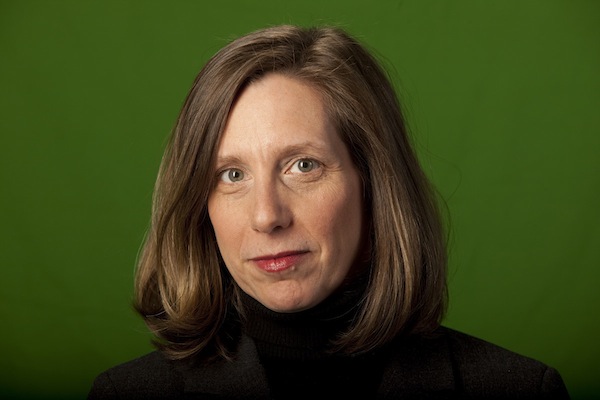
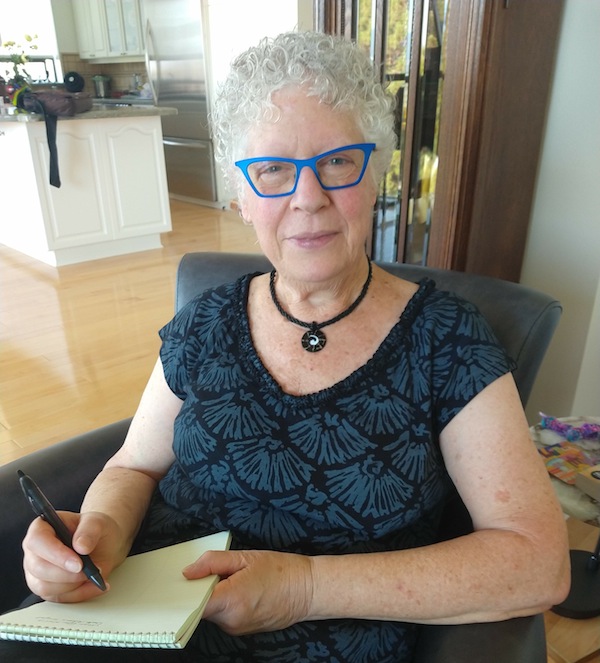
Joanne Seiff has written regularly for the Winnipeg Free Press and various Jewish publications. She is the author of three books, including From the Outside In: Jewish Post Columns 2015-2016, a collection of essays available for digital download or as a paperback from Amazon. Check her out on Instagram @yrnspinner or at joanneseiff.blogspot.com.

To heal a fractured campus

Last November, I interviewed my grandmother for an oral history project – one I had been meaning to do for a long time – about her experience surviving the Holocaust. As the grandson of two Holocaust survivors, I can affirm the reality of intergenerational trauma. Yet, as I listened to her story, I realized she was teaching me valuable, timeless lessons which the University of British Columbia community can apply on campus. That is why I am obligated to share her story – so that we avoid repeating the mistakes of the past. 

My grandmother was 13 years young when her parents and most of her family were taken away from her and deported, either to be shot on their way to Bergen-Belsen or exterminated in the gas chambers of Auschwitz. My grandmother, my safta (as I call her in Hebrew), was a little girl, orphaned, vulnerable and left all alone. She had every right to be bitter and resentful, to identify herself as a perpetual victim and to rightfully blame the Nazis for her suffering. But she did not.

She could never forgive nor forget the evil perpetrated by the Nazis. However, with this in mind, she had to move on with her life. The way she redeemed tragedy was not to define herself as the victim of the past, asking, “Who did this to me?” but rather by taking responsibility for the future, asking, “Given these circumstances, how can I help to put this situation right?”

This is the greatest eternal lesson I have learned from my grandmother and all the Holocaust survivors I have met: never internalize a victim mentality. Otherwise, you will not only become consumed with hate but also enslaved to the past. As the late chief rabbi Lord Jonathan Sacks once said, “To be free, you have to let go of hate.”

My grandmother took the negative energy and elevated it toward a higher purpose: toward marrying my grandfather, toward raising a family, toward giving back to her community. Her all-encompassing identity, attitude and purpose in life has been not based on the hate of others. Rather, her identity is based on the love of her fellow Jews, of being grateful for her heritage and everything else she had. 

“No one can make you feel inferior without your consent,” Eleanor Roosevelt once said. There was one thing from my grandmother that even the Nazis could never take away: her will to be proudly Jewish. 

UBC campus today

For my grandmother, the Hamas massacre that took place on Oct. 7, 2023, triggered painful memories from the Holocaust. “Never again,” the lesson we learned from the six million Jews murdered, has now become “ever again.”

The amount of toxic hate I have seen on my campus (and other universities as well) since Oct. 7 has been both disheartening and overwhelming. From disrespectful comments on social media posts, to provocative posters on campus demonizing the other side, to verbal and physical harassment of students, there is a small, yet vocal, minority of students who create a highly flammable atmosphere on campus. 

At UBC, I have witnessed students chanting the phrase “globalize the intifada,” a term that has historically been used in the context of the Israeli-Palestinian conflict not for “peaceful resistance,” but for terrorizing Jews with suicide bombings, shooting attacks, stabbings and other means of armed violence. I have witnessed students blacklisting other students because they do not agree with their opinions. I have witnessed students rudely spamming hateful comments (which are now taken down) on UBC’s social media page to take advantage of International Holocaust Remembrance Day to push a political message. When I hear that “hate has no place on campus,” I unfortunately continue to observe the opposite.

This is the reason why I dropped my Middle East studies minor. Every time I walked into the classroom, the negative energy was palpable. I was walking on eggshells bringing up my Jewish identity or even mentioning the word “Israel.” Every day, I had to hide my kippa under my hat so that my classmates with different viewpoints would not identify me as Jewish and publicly shame me. In short, I did not feel welcome.

At a university, a safe space should not be a place where you are protected by those with whom you agree from those with whom you disagree – that is called groupthink. Rather, a safe space should be a place where you make space for those who disagree with you so that each can listen to the other with respect.

Whether or not you agree with Israeli, Jewish, Palestinian, Arab, Muslim or any other claims, there is no justification whatsoever to scream, silence or slander those with whom you disagree. Right now, the university needs more civility and calm for all students. 

Yes, we must acknowledge that there are significant casualties on both sides of the conflict. Yes, we must acknowledge each other’s suffering. At the very least, we can all agree that every human life is sacred with equal dignity.

While we cannot control external circumstances halfway across the world from us, we can control how we respond to it. We can choose to wallow in misery and demonize the other (asking “Who did this to me?”), or we can take action to recognize each other’s suffering and elevate it to something positive (asking “Given these circumstances, how can I help to put this situation right?”).

Now, how do we do that?

Listening, not labeling

Opening yourself up to someone whose colour, culture, class or creed is different from yours can seem daunting. In an age of echo chambers, filtered media and narrowcasting, we all have a tendency to tune in to that which aligns only with our own viewpoint, while tuning out others. However, it is precisely the people not like us that make us grow. 

From clubs tabling on campus to classmates sitting next to you, there are plenty of opportunities to actively seek out diverse perspectives. We need to learn how to listen for the sake of learning, not labeling.

If one has a monopoly on the truth, then why bother listening to others? Because, as a mystical Jewish saying goes: “A full vessel cannot receive.” It is only by acquiring humility, the sense of opening ourselves up to something beyond ourselves, that we realize our own perspective is merely one finite fragment of an infinitely fractured truth. Thus, I’ve reflected on three ideas worth sharing.

First: there is no justice for any person or people without listening to the other side.

Second: true peace, in our relationships with others and toward ourselves, comes as a result of active listening.

And third: in the words of C.S. Lewis, “Humility is not thinking less of ourselves, but thinking of ourselves less.”

Listening to the other is the first step toward recognizing the “dignity of difference.”

The antidote to hate

Hate, like COVID-19, is a virus. Viruses do not distinguish between different types of people, but rather fester and grow into an infectious force that threatens us all. Historically, for example, the Nazi regime may have started with targeting Jews, but it didn’t end with Jews. Nazis also targeted Roma, Sinti, LGBTQIA+, people with disabilities and political dissidents. Hate knows no bounds. 

With this in mind, I offer three practical suggestions for what each of us can do on an everyday level to bring more hope to campus – and perhaps other places.

First, take a moment to unplug your AirPods or headphones. Just do it! Whether it’s while sitting on the bus or walking on campus, withdraw from your isolated world for five minutes and acknowledge someone you don’t know by saying hello with a genuine smile. Give them your full, undivided attention and start a friendly conversation. Humanizing starts with acknowledging the other.

Second, take a class from a perspective you have never heard from before. I am a history major. I had never considered taking an environmental history course before simply because I was not interested. But it is precisely for this reason that I am taking the course. Now, I realize how I could see my preexisting knowledge and interests from a new, oblique angle I would never have seen otherwise.  

And third, follow social media accounts of people with different viewpoints from your own. Just like our earbuds, we are constantly using our phones. Every time we open Instagram or Twitter, we are training ourselves to focus on our interests and are quick to judge other accounts as not worth our time. Instead of judgment, be curious and interact with accounts to train yourself to learn from others, not label them.  

We are first and foremost a community, of students and professors, of friends and family, of human beings with human emotions. Divided, we are more susceptible to hate. United, however, we have the potential to become force multipliers of hope over hate.   

Each one of us should ask ourselves: Are we taking actions to further fracture our world, or heal it?

If we are to heal our fractured world, we must first recognize that each and every one of us has the power and influence to turn negative energy into positive energy, just like my grandmother did. If she could continue to spread light after going through the darkest chapter in human history, how much more so can every one of us dispel the darkness of hate by becoming beacons of light in our communities at UBC and elsewhere.

It all starts with one positive thought, one friendly compliment, one good deed. 

It all starts with you. 

Eitan Feiger is a fourth-year history student and the vice-president and treasurer of the University of British Columbia’s Chabad Jewish Student Centre. This article was originally published in the Ubyssey.

Hearing from Nova survivor

Volunteers and organizers of Unity Shabbat, which this year took place on March 1. (photo from Chabad UBC)

On March 1, more than 100 Jewish students and faculty came together for a Shabbat dinner on the University of British Columbia campus. The annual event, called Unity Shabbat, was organized by Chabad Jewish Student Centre-Vancouver in partnership with Hillel BC, Israel on Campus Club, Jewish Student Association, Jewish Law Student Association and the local chapter of the AEPi fraternity. It was co-sponsored by the Jewish Federation of Greater Vancouver.

The guest speaker was Shalev Biton, a 25-year-old man from Israel who survived the Nova festival terrorist attack on Oct. 7, 2023. You could hear a pin drop as Biton told the sequence of events, which included him running from the Hamas terrorists for hours and hiding in fields and then under a building while the terrorists searched the area. The building was on the property of an Israeli Arab who subsequently saved Biton’s life – and the lives of Biton’s friends – by telling the terrorists that there was no one there.

During those hours, Biton was sure he was about to die, and repeated the Shema Yisrael prayer over and over. He told of his gratefulness to be alive and his decision to follow his passion of pursuing a career in music. Those gathered on Shabbat were inspired by his message of hope and resilience despite everything that he has been through.

photo - Left to right: Chaya and Dassie Loeub; Rabbi Chalom Loeub of Chabad UBC; Shalev Biton, a survivor of the Oct. 7 terror attacks; and Ohad Gavrieli of Hillel BC
Left to right: Chaya and Dassie Loeub; Rabbi Chalom Loeub of Chabad UBC; Shalev Biton, a survivor of the Oct. 7 terror attacks; and Ohad Gavrieli of Hillel BC. (photo from Chabad UBC)

“These past few weeks have been a very difficult time for Jewish students at UBC,” said Rabbi Chalom Loeub, co-director of Chabad Jewish Student Centre. “Unity Shabbat could not have come at a better time. It was a chance for Jewish students and faculty members to get together in a safe, inclusive atmosphere and enjoy a traditional three-course dinner. It reminds us that, despite our external differences, we are one people and we need to stick together.”

To learn more about Chabad Jewish Student Centre-Vancouver visit chabadubc.com or follow them on social media. 

Courtesy Chabad Jewish Student Centre-Vancouver

Fostering many skills

For the second year in a row, Richmond Jewish Day School hosted a STEAM-J Night for its families. The event involves an interdisciplinary approach, integrating knowledge, methods and perspectives from multiple disciplines – science, technology, engineering, arts and mathematics – all through a Jewish lens. 

As part of the STEAM-J Night, which took place Jan. 30, children in RJDS’s Early Learning Centre focused on exploring trees through art. The Early Learning Centre emphasizes a play-based philosophy and an emergent curriculum tailored to children’s interests. Inspired by Tu b’Shevat and the kids’ fascination with printmaking and tracing shapes, participants compared the lines on their hands with the lines on leaf veins. Using ink pads, each child created palm prints, observing the uniqueness of their own hands.

image - a portraitThe kindergarten and Grade 1 class explored various methods to learn Hebrew vocabulary. By combining Hebrew with art, students designed and created a game where Hebrew letters corresponded to pictures they drew. They then invited their parents and guests to participate and test their Hebrew knowledge. Additionally, the children crafted clay dioramas depicting the components of an Arctic biome. During this process, they learned about how animals adapt to changing weather and the climate.

image - artwork of a portrait whose head opens up to reveal things important to the artist
Among the many projects on Richmond Jewish Day School’s STEAM-J Night was one in which the Grade 3 and 4 class painted self-portraits with a top part that lifts up so that people can see some of the students’ favourite aspects of life. (photos from RJDS)

The Grade 3 and 4 class learned a song written by an Israeli children’s author called “All About Me” and performed a dance to go along with it. Inspired by the same song, the students painted a self-portrait with a top part that lifts up so that people can see some of their favourite aspects of life, their individuality. They then put their graphic design skills to the test and created a PowerPoint presentation about early explorers and their contributions to the world. For their final STEAM-J project, the students put on their engineering hats and created a 3D scene with animal crossings built into different cityscapes to help wildlife thrive.

The upper grades demonstrated their learnings by taking their favourite games, such as Bingo and Rummikub, and translating them into Spanish. The goal of this project was to strengthen Spanish vocabulary, interaction, creativity and group work. They also honed their graphic design and research skills by creating digital comic strips on Jewish history, focusing on a Jewish prophet or king. They learned about Newton’s Laws of Motion through a hands-on activity where they demonstrated the centre of gravity by making a balancing heart. They experimented with their completed hearts by adjusting wooden skewers and clay balls to take the hearts from a balanced to unbalanced state and back to the centre of gravity point again.

A multi-disciplinary approach to education can help bridge the gap between different subjects and build students’ confidence in an increasingly complex and technologically advanced world. By integrating insights from the STEAM fields with Jewish culture and identity, students can develop a versatile skill set that fosters critical thinking, creativity and adaptability. 

– Courtesy Richmond Jewish Day School

A successful year for Angels

Courtney Cohen with Richmond Jewish Day School students, who generously collected personal hygiene items for this year’s Rose’s Angels. (photo from Rose’s Angels)

The 11th annual Rose’s Angels event just wrapped up. This year, the initiative was able to give donations to 15 not-for-profits in Richmond that service some of the most vulnerable people in the city, including Richmond Family Place, Mamas for Mamas, Turning Point Recovery Society, JFS Grocery Program (formerly the Jewish Food Bank), Richmond Food Bank, Tikva Housing and Pathways Clubhouse.

Rose’s Angels was created in 2012 by Courtney Cohen and Lynne Fader, in memory of Cohen’s grandmothers, Rose Lewin and Babs Cohen, both of whom modeled philanthropy and instilled in Cohen the importance of giving back within her community.  Rose’s Angels is run under the umbrella of the Kehila Society of Richmond.

Among the goods donated were essential personal care items, non-perishable food, pet food, children’s arts and crafts, books and baby formula. For many of the receiving agencies, baby formula was one of the top priority items this year – Rose’s Angels was able to donate many 

baby formula cans and ready-to-feed bottles to Mamas for Mamas and the food bank, for instance.

“Being a new mom myself, I can’t imagine the feeling of not having the accessibility or means to get my baby formula,” said Cohen. “With the ever-rising cost of inflation and the toll it’s having on families and single parents, formula is becoming more of a challenge to obtain. We received this email post-event from one of our partner agencies regarding our donation of formula:  ‘I can’t tell you what it means to us and so many families!  We had another mom come in from the hospital yesterday.  They use one of the types of formula you donated, and she felt like her prayers had been answered!’ Stories like these make me so proud to carry on the Rose’s Angels legacy year after year.”

photo - For many of Rose’s Angels’ receiving agencies, baby formula was one of the top priority items this year
For many of Rose’s Angels’ receiving agencies, baby formula was one of the top priority items this year. (photo from Rose’s Angels)

The success of Rose’s Angels would not be possible without the support and dedication of donors, volunteers and community members. This year, donation letters were sent out to partner agencies, family friends and community members in January. In February, monetary and physical donations were collected, Richmond Jewish Day School hosted a hygiene items collection drive and grocery store gift cards were purchased. Earlier this month, donations were packaged and delivered with the help of volunteers to the 15 not-for-profits.

“My parents and grandparents taught me to recognize and respond to the needs of others with kindness and generosity,” said Cohen. “I hope to instil in my daughter the importance of tikkun olam (repairing the world), by focusing on one mitzvah at a time.”

If you would like to learn more about or donate to Rose’s Angels, email rosesangelsevent@gmail.com or call the Kehila Society of Richmond at 604-241-9270. 

– Courtesy Rose’s Angels

The art of creating ketubot

Mordechai Edel beside the personalized ketubah he created for A.J. and Olena Steigman; A.J. is a chess champion and Olena is a classical pianist. (photo from Mordechai Edel)

Vancouver artist Mordechai Edel is one of a handful of people in Canada who make ketubot (singular: ketubah), the standard contract for traditional Jewish marriages, which have been used for millennia.

“I was trained as an impressionist artist, from which I developed the philosophic concept of ‘impression-mystic’ art,” Edel told the Independent. “Hopefully, this contributes in a small way to ‘marrying’ wedding contracts with art and harmonizing the opposites of heaven and earth, chiaroscuro [the use of strong contrasts of dark and light], fire and water.”

While the central theme of a ketubah is constant – an obligation on the part of the groom to provide for his bride – their designs can vary immensely, and each one designed by Edel tells, in its way, a separate story. He has been creating ketubot for 40 years.

“I often incorporate a stylized menorah symbol, which reflects the potential marriage of all humanity uniting together under G-d’s joyous chuppah canopy of shalom [peace and wholeness],” he said.

A kosher ketubah requires precision and documentation, especially regarding Hebrew names, marriage location and dates. Ketubot are usually written in Aramaic, in calligraphic style, and halachic (Jewish legal) requirements allow little room for embellishment. 

“Not much fun there,” said Edel of the creative possibilities. “However, ‘the fun’ may begin with the surrounding artwork. That’s when personal requests start to kick in. I am often requested to incorporate ‘painted stories,’ illustrating romantic memories of how a couple first met.”

In the past several years, Edel has received numerous ketubah requests from local rabbis, including a “standard house model” developed with Rabbi Andrew Rosenblatt of Congregation Schara Tzedeck.

“Occasionally, some people do still enjoy elaborate weddings, which tend to generate requests for more personalized, sometimes eccentric artwork,” said Edel.

Depending on the couple’s budget, the creative detail of a personalized ketubah can vary substantially, from minimal artwork to the most elaborate designs, he said.

Edel can take several weeks to paint a personalized ketubah, although sometimes it can “just click” and he can finish one in two to three weeks. Ideally, couples planning on getting married would contact him as soon as possible, to give him as much time as possible.

Often, he said, the biggest challenge is to receive accurate place, name, date and time information. Sephardi ketubot do not permit any erasures, whereas Ashkenazi halachah (Jewish law) allows changes before the contract is signed and validated by two kosher witnesses, he explained.

Edel shared an experience that happened during a Sephardi wedding in the mid-2000s. He had painted a calla lily ketubah for a couple that had met in Acapulco, replete with a romantic sunset and a ship setting sail for Jerusalem in the background.

“Guess what? The night before the marriage, the rabbi checked the ketubah and there was one letter, ‘vov,’ missing in the Hebrew spelling of Vancouver. I was told it was invalid, it could not be rectified and was void,” Edel recalled. 

The solution, Edel found, was to physically cut out the contract part, leaving the surrounding artwork, forming a window. He then spent the entire night rewriting the document, which he then inserted, forming a two-part ketubah.

“This negative-into-positive transformation has become a trademark blessing that I now incorporate into all commissioned ketubot,” said Edel. “And, in case of a last-minute error or wine spill, all ketubot come with a duplicate backup document.”

Along the way, Edel has received some unique ketubah requests. One couple, who had encountered a skunk on their first date in Stanley Park, asked that the scene be recreated in the marriage contract. 

“I had difficulty finding a stinky model who would sit still,” Edel recalled. “That turned out to be a most scentimental ketubah.”

Another couple commissioned a grandiose, oil-on-canvas ketubah to fit over their fireplace. At the wedding ceremony, the three-foot-by-five-foot ketubah was carried into the sanctuary. The audience stood up and, according to Edel, let out an enormous communal “wow!”

Some of the more exceptional commissions Edel has seen have come from far afield. He recently completed a request that arrived “out of nowhere” from American businessman and professional chess player A.J. Steigman and his bride Olena, a classical pianist. They got married at the Western Wall (Kotel) in Israel and the ketubah features the groom (chatan) playing chess on a Vermeer-style chessboard with the bride (kalla) playing a Shostakovich concerto, all in the foreground of the Kotel.

Edel has also refurbished ketubot. In one instance, he was commissioned by the son-in-law of longstanding Schara Tzedeck members to “enhance” their original 1948 marriage certificate for their 50th anniversary. He created a ketubah “with memories of leaving the shtetl in sepia tones, transported into modern times via heaven’s kohanic [priestly] blessings, and embellished with a gorgeous bouquet of their favourite, fragrant rose flowers.”

One of Edel’s ketubot, “Le Picnique,” began as a painting commissioned by the late Joe and Rosalie Segal to be viewed by residents and staff at the Louis Brier Home and Hospital. “It later developed into a ketubah as a joyous tribute to this wonderful, caring couple,” said Edel.

Edel is grateful for the many blessings he has received in life, and gives special thanks to his wife, Annie, who helps design the ketubot.

“It is humbly interesting to note that the surname Edel means fine and noble, whereas a play on words of Mordechai suggests the French amour de chai or love of life,” Edel said. “It is this joyous love of life partnership that characterizes our ketubot and relationship between G-d, bride and groom and artist.”

For more information about Edel’s art and his ketubot, visit edelartworks.com. 

Sam Margolis has written for the Globe and Mail, the National Post, UPI and MSNBC.

JWest project update

(photo from Jewish Federation of Greater Vancouver)

The JWest project recently announced two significant milestones in its journey from vision to reality: the implementation of a new governance structure that will serve the project moving forward, and a $5 million founder-level gift from the Cristall family.

JWest represents the Jewish community’s most ambitious capital endeavour undertaken in Western Canada. It is the result of three community institutions – the Jewish Community Centre of Greater Vancouver, the Jewish Federation of Greater Vancouver and King David High School – envisioning a community hub that would be bigger and serve more people than any one institution alone.

What began as a partnership between these three founding partners has now evolved into two formal boards: the JWest Foundation and the JWest Development Corp. These bodies will provide independent expert oversight of the project and work in the long-term interests of the community as they relate to JWest.

Both boards boast key leaders from the community, who represent the three founding partner organizations, as well as members at large who bring expertise in the fields of governance, fundraising, real estate development and finance.

The JWest Foundation, a charitable organization, will provide financial oversight of the project’s costs and revenue. The JWest Development Corp. will manage the construction of the campus, including the new JCC, KDHS space and residential towers, and the ongoing maintenance of the future campus.

“Stepping into the leadership role for the JWest Foundation is a privilege,” said Bill Levine. “Our dedication to this project marks a significant step forward. Together, we’re shaping the future of our community while upholding our treasured value of building for those who come after us.”

Bringing decades of experience in fundraising, governance and strategic planning from having served on multiple boards, the JWest Foundation includes Alex Cristall, Diane Friedman, Hodie Kahn, Lana Marks Pulver, Diane Switzer and Alvin Wasserman.

On the JWest Development Corp. board, Jewish community members with significant real estate, finance and community development expertise, including Andrew Abramowich, Chris Andison, Michael Berkson, Alfonso Ergas, Phil Gertsman, Geoff Glotman, Mark Gurvis, Lana Marks Pulver and Lawrence Zimmering, will work with Vancouver real estate developer David Porte, who has taken on the role of chair.

“JWest is going to be the heart of the community and the expanding Oakridge neighbourhood, with amenities to benefit everyone across Metro Vancouver,” said Porte. “The JWest Development Corp. has been entrusted to help drive the project forward, and I am honoured to work with extraordinary leaders to bring JWest to life and ensure its success.”

The two-phase redevelopment project on 41st Avenue and Oak Street begins with a new state-of-the-art JCC that will include an expanded Vancouver Holocaust Education Centre, a new gymnasium for KDHS and a home for more than 20 not-for-profit organizations. Once complete, construction of a new King David High School will begin and include classroom spaces and an outdoor playing field. The final addition to the campus will be two towers of rental housing to serve the region.

The Cristall Family, who were early donors to the project, were pleased to see the new governance boards established. As a family, they have supported multiple capital campaigns, and understand the complexities inherent in projects of this scale.

“Jewish institutions have always been important for our community,” said Alex Cristall. “They provide a safe place to gather across generations and, in the case of JWest, a place to invite others to share in our culture and traditions. Our family sees this as our opportunity to build for our children and for the future of our city.”

JWest is grateful to the Cristall family – Lorne z’l and Sylvia Cristall, Alex, Jodi, Sydney, Tyler and Andrew Cristall, Jodi Cristall and Paul Diamond, Jackie Cristall Morris, Gary Morris, Justin and Ashley Morris – for their founder-level gift to the capital campaign. 

– Courtesy Jewish Federation of Greater Vancouver

Community milestones … Chodos, Louis Brier Home & Weinberg Residence, & Barclay

Amy Chodos, a Grade 4 student from Vancouver Talmud Torah, was chosen as the winner of ADI’s fourth annual Make the Change Challenge. (photo from ADI)

In its fourth year, ADI’s Make the Change Challenge STEM accessible design contest drew more than 254 entries from students across North America, but Vancouverite Amy Chodos secured the contest’s $1,000 grand prize by envisioning a simple application that can make the world a more accessible place for people struggling with ADHD and other neurodevelopmental disorders.

Run by ADI (adi-israel.org), Israel’s network of specialized rehabilitative care for those touched by and living with disability, to mark Jewish Disability Awareness, Acceptance and Inclusion Month (#JDAIM) in February, the contest promotes “selfless STEM” and encourages students to hack the modern world to help people with disabilities overcome the challenges that hinder their independence and inclusion.

Chodos, a fourth-grade student from Vancouver Talmud Torah, drew from her own challenges in the classroom to conceive of the Step-O-Maker, an app that uses artificial intelligence to record complex spoken instructions and then break them down into easy-to-follow checklists that can guide students through an entire process.

“As someone with ADHD, I find that starting tasks is often overwhelming, and I need help to understand where to begin. My mother teaches children with hearing loss, and I realized that an app like this could also help her students in the classroom,” explained Chodos. “I wanted to create something that could help a lot of people by making listening and understanding easier in class and making learning more fun and enjoyable.”

Instead of developing prototypes, contest entrants were asked to prepare compelling presentations that clearly explain how the original solutions they are envisioning would solve the persistent accessibility issues they choose to tackle. Chodos prepared a PowerPoint presentation that clearly explained her challenges and brought her inspired solution to life.

“Year after year, our ADI Bechinuch (ADI in Education) disability inclusion programming spotlights the inaccessibility of our world and our communal responsibility to make a change,” said Elie Klein, ADI’s director of development for the United States and Canada. “From November through February, students from our partner schools across North America become true agents of change while researching and developing original accessible design ideas in order to participate in our STEM contest, and the results are always awe-inspiring.

“We are so impressed by Amy’s poise and creativity, and the brilliant simplicity of her idea,” continued Klein. “But it’s clear to me that this exceptional young inventor always saw beyond the contest. At just 9 years old, Amy is on a mission; she genuinely wants to see this app developed so it can start to help people. This kind of leadership is what ADI Bechinuch is all about.”

More than 40 Jewish schools across North America used the ADI Bechinuch programming this year, employing the in-class activities, virtual tours and STEM contest to encourage the next generation of Jewish leaders to see the world through the eyes of others.

On Feb. 25, ADI’s panel of experts, including members of ADI’s professional staff, innovation journalists and specialists in the field of accessible design, met with the contest’s top-five finalists and their parents and teachers via Zoom to discuss the entries in greater detail. Following an uplifting discussion, the proceedings concluded with Amy Chodos being chosen as the contest winner and presented with the $1,000 prize, a gift from the Avraham and Esther Klein Young Entrepreneurs Fund.

To learn more about ADI, visit adi-israel.org.

– Courtesy ADI

* * *

Louis Brier Home and Hospital and Weinberg Residence (LBHH&WR) has officially been recognized as a 2023 Nonprofit Employer of Choice (NEOC) Award Recipient for its commitment to providing an exceptional work life experience for its employees.

“I am so proud and grateful for us to have received this recognition award, now four years in a row, from 2020 to 2023. It’s incredible how much our work culture has improved over the last four years,” said Loren Tisdelle, director of human resources in a special announcement held during the organization’s monthly Louis Brier LIFE Day. “The ‘Louis Brier LIFE’ is felt as soon as you walk into the building. Every year, we offer new and exciting programs while improving upon our current engagement initiatives. Last year, we launched Take Our Kids to Work Day and a masquerade ball, which were enormous successes. Engagement, inclusion and appreciation continue to be hallmarks of our work life at LBHH&WR.

“This is our award. Each and every employee makes LHBB&WR what it is today,” said Tisdelle. “We all come to work to make a difference, we actively engage in work life and, as a community, we make working at LBHH&WR a second-to-none employment experience.”

The LBHH&WR leadership team and its board of directors recognize the contributions and impact of its employees towards achieving the organization’s mission and vision to become a centre of excellence. It is through their hard work and dedication that the organization continues to make a positive impact on residents and families while upholding the positive reputation LBHH&WR has as a home and an employer.

More information about the NEOC Awards can be found at neoc.ca.

* * *

On April 2, just as National Autism Acceptance Month begins, Rowman & Littlefield will release the paperback edition of the multi-award-winning parenting and travel guide Traveling Different: Vacation Strategies for Parents of the Anxious, the Inflexible and the Neurodiverse by Dawn M. Barclay. 

photo - Dawn M. Barclay at a book signing
Dawn M. Barclay at a book signing for Traveling Different: Vacation Strategies for Parents of the Anxious, the Inflexible and the Neurodiverse, which will come out in paperback April 2. (photo from travelingdifferent.com)

In 2023,  the hardcover and e-book edition won the Lowell Thomas Gold Award (guidebook category) from the Society of American Travel Writers Foundation, garnered first prize in the Maxy Awards (inspirational/self-help category), was a finalist in the Best Indie Book Awards in both the travel and parenting categories, and won honourable mention in ASJA Arlene Awards for Books that Make a Difference. Traveling Different also received a starred review in August 2022 from Library Journal, who called the book “an essential read, not only for parents of autistic or otherwise neurodivergent children but for all families.”

image - Traveling Different book coverIn Traveling Different, Barclay presents travel strategies and anecdotes from a range of sources. The heart of the book outlines suggested itineraries for spectrum families as well as venues that cater to the unique special interests that are characteristic of individuals with invisible disabilities, culminating with a guide of travel agents who specialize in special needs travel and lists of organizations that advocate for special needs families. (For more on the book, see jewishindependent.ca/invest-the-time-to-prepare.)

“I’m thrilled the book will now be available in paperback, which makes it more affordable for all families,” said Barclay, who has appeared on close to 100 podcasts and interviews on video, radio and television since the book’s initial launch. Barclay prints updates on her Traveling Different website (travelingdifferent.com), as well as exclusive content on medium.com.  

– Courtesy Rowman & Littlefield

סם מזרחי לא ימשיך לבנות את פרויקט ‘האחד’ בטורונטו שנמצא בכינוס נכסים

הקבלן היהודי קנדי ממוצא איראני סם מזרחי לא ימשיך לבנות את המגדל הגבוה ביותר בקנדה הנקרא “האחד”, הממוקם בצומת הרחובות יאנג ובלור בטורונטו. הפרויקט נמצא בחובות של קרוב לשני מיליארד דולר ולכן הושט עליו הליך של כינוס נכסים מאז חודש אוקטובר אשתקד, בניהול חברת אלברז ומרשל

“האחד” שיכלול שמונים וחמש קומות (בגובה שלוש מאות עשרים ושמונה מטרים) היה לעלות כמיליארד דולר. דחיות בבניית הפרויקט שהעלויות להקמתו הוכפלו לשני מילארד דולר, וחוסר שביעות רצון מצד בעלי ההלוואות ובעיקר בנק גדול בדרום קוריאה, הביאו אותו לכינוס נכסים. כונסת הנכסים אלברז ומרשל שמונתה על ידי בית המשפט העליון של מחוז אונטריו, הודיעה כי החל מהחודש (מרץ) מזרחי והחברות שבבעלותו, לא יהיה מעורבים עוד בבניית הפרויקט

במשך שנים הופצו שמועות על הפרויקט היוקרתי הזה “האחד” שהעבודות להקמתו החלו כבר לפני כעשר שנים. יש לזכור שהוא ממוקם בצומת החשובה והיוקרתית ביותר בדאון טאון טורונטו בצמוד לשכונת יורקוויל היוקרתית. משרד האדריכלים הבריטי פוסטר ושות’ נשכר לתכנן את הבניין. רבים תהו איך בכלל יכול קבלן בסדר גודל כמו מזרחי לבנות פרוייקט כל כך גדול. אגב מזרחי השקיע כשלוש מאות מיליון דולר ברכישת מגרש עליו נבנה “האחד”. הרבה תקלות ליוו את תחילת הפרויקט כולל עיכובים בבנייה, חריגות גדולות בעלויות הבנייה, תלונות על רעש, כשלים במתן היתרי בנייה, בעיות מימון ופירוק שותפויות. במקור הפרויקט היה אמור להסתיים לפני כשנתיים, אך בפועל עד כה נבנו רק ארבעים הקומות הראשונות. מזרחי עצמו מאמין שדרושות עוד כשלוש שנים לסיום הבנייה של מגדל המגורים היוקרתי. הוא הוסיף כי כונסת הנכסים חייבת לו כחמישה מיליון דולר עבור עמלות שונות שלא שולמו עד כה. מזרחי אמר לעובדי הפרויקט באסיפת פרידה מהבניין, כי עכשיו זה יהיה קל יותר עבור הקבלן שיחליף אותו לסיים את הבנייה, לאחר כל הקשיים הרבים שבהם הוא נתקל בהם מאז תחילת העבודות. למזרחי יש מעט חרטות על מה שקרה לפרוייקט שהוא ניסה לבנות במשך שנים ללא הצלחה. לדבריו במבט לאחר הוא היה עושה את אותו הדבר

“האחד” יכלול לכלול מסעדות וחנויות מפוארות בהן חנות ענקית של “אפל” שתתפרש על פני שלוש קומות בשטח של כולל של כחמישה עשר אלף סקוור פיט. “אפל” תבעו לא מכבר את מזרחי על הדחייה בעבודות להקמת הבניין והחנות שלהם, והם דורשים ממנו שבעה מיליון דולר על הנזקים שנגרמו לחברה. הבניין יכלול ארבע קומות של חנייה תת קרקעית. חמש עשרה הקומות הראשונות במגדל מיועדות עבור מלון היאט היוקרתי. ואילו קומות המגורים שמעליו יכללו ארבע מאות ושש עשרה יחידות דיור מפוארות. ובהן ארבעה פנטהאוזים

סם מזרחי נולד בטהרן באלף תשע מאות שבעים ואחד. בשנת שבעים ושש המשפחה ביקרה במונטריאול כדי לצפות באולימפיאדה. ביקור זה הביא את המשפחה בן ששת הנפשות לעבור שנה לאחר מכן לקנדה, כאשר סם היה בן שש. מאז המשפחה גרה באזור טורונטו. בתחילה מזרחי החזיק ברשת של מכבסות. לאחר מכן הוא עבר לבנייה והקים פרוייקטים שונים בטורונטו והסביבה

מזרחי נחשב לתומך גדול של ישראל והוא אף פעיל בארגון הגג של הפדרציות היהודיות בקנדה. הוא נמנה על האחראים והפעילים של הצעדה השנתית בטורונטו עבור תמיכה בישראל. מזרחי נמנה גם על חברי הנאמנים של ארגון הידידים של המרכז ללימודי השואה סימון ויזנטל

Rally highlights women

On March 3, many stories of heroism were shared at the weekly rally for Israeli hostages, of whom 13 are women, still being held by Hamas. The gathering marked International Women’s Day, which takes place on March 8. (photo by Pat Johnson)

On Oct. 7, Amit Mann, a 22-year-old paramedic, spent six hours treating the wounded and dying in a dental clinic on Kibbutz Be’eri. 

“Six hours during which she did not stop treating the wounded, six hours during which she did not lose hope,” recounted Ruth Jankelowitz at the weekly rally for Israeli hostages March 3. “Amit Mann, a Magen David Adom paramedic, treated the wounded at Kibbutz Be’eri with her dedication and heroism with the sounds of gunfire all around her and the threatening voices of the murderers getting closer. Together with a nurse and a dentist … she tried to do everything to save everybody as she had done since she was 13, until the bullets of the vile terrorists hit her, too.”

Mann’s tragic story of heroism was one of numerous shared at the gathering Sunday, marking International Women’s Day, March 8, where speakers called for the release of all the hostages, including 13 women still being held. 

Ofra Sixto, owner of Ofra’s Kitchen restaurant, whose pro-Israel activism in recent months has attracted threats and intimidation, led a moment of silence for female victims of Oct. 7.

“The world is angry when women are being raped, abused, disrespected and brutally murdered by men – unless they are Jewish women,” she said. “Then the world is silent, complacent and, at the time, had the audacity to question the acts.

“What gets me the most is the young and old women that support Hamas, knowing what they know of how they treat women in general and our women in particular,” Sixto said. “It’s beyond me.”

Masha Kleiner, an Israeli-Canadian who co-founded NOAH, Nonviolent Opposition Against Hate, said that, for every Jew, “Oct. 7 is absolutely personal.”

“Each and every single one of us knows it could have been me who was tortured and kidnapped and killed,” she said. “I am selfishly lucky that nobody I personally know was killed or kidnapped on Oct. 7, but many of our tribe have been, so this is a personal loss for every one of us.”

Jews worldwide are grieving the loss of life, she said, but Jews lost something else that day and in the months since, she said.

“One other thing that we are all grieving in the post-Oct. 7 world is our illusions, the illusion that the world around us is safe and sane and friendly,” she said. “We grieve, and this grief can be lonely because some people that we considered friends chose to keep their distance and some of them turned their backs on us. But, while this happens, we become so much closer to the people who do have the moral clarity and the courage to stand with us.”

Mirit Murad – an Israeli who came to Vancouver two decades ago and has two nieces, Gal Klein and Ofek Elias, serving as reservists since the onset of the war – urged people to take time on International Women’s Day to honour and celebrate Israeli women, both civilians and soldiers.

“These women are demonstrating unparalleled strength, resilience, resourcefulness, bravery, intellect and protective instincts,” she said. “They embody the very essence of courage, never hesitating to leap into action or shield others from harm.”

The week’s rally took place at Jack Poole Plaza, rather than the usual location at the Vancouver Art Gallery because that space was provided to organizers of Vancouver’s International Women’s Day event.

That event’s theme was Palestinian women and featured images of “activists” including Fatima Bernawi, Ahed Tamimi and others. 

Bernawi served a decade in Israeli prisons after planting a bomb in a Jerusalem movie theatre in 1967, which was discovered before detonation. Tamimi is something of a social media star, a young woman who came to prominence as a 16-year-old when a video of her assaulting an Israeli soldier in 2017 went viral. After the Oct. 7 attacks, Tamimi wrote on social media: “We will slaughter you and you will say that what Hitler did to you was a joke, we will drink your blood and eat your skulls.”

“These women are arbiters of Palestinian resistance who advocated for the rights and freedoms of Palestinian people and are continuing to do so every day,” organizers of the Vancouver IWD event said in a statement.

“International Women’s Day belongs to everyone, everywhere,” said Daphna Kedem, organizer of the weekly vigils. “Where are you, women’s organizations? Believe Israeli women. Release our women.” 

Israeli women among the hostages still being held by Hamas

Liri Albag, soldier, 18
Noa Argamani, student, 26
Karina Ariev, soldier, 19
Agam Berger, soldier, 19
Shiri Bibas, 32, kidnapped with husband and two children
Amit Esther Buskila, fashion stylist, 28
Carmel Gat, occupational therapist, 39
Daniella Gilboa, soldier, 19
Romi Gonen, dancer, choreographer, medic, 23
Naama Levy, soldier, 19
Doron Steinbrecher, veterinary nurse, 30
Arbel Yehoud, astronomy guide, 28
Eden Yerushalmi, bartender, 24