
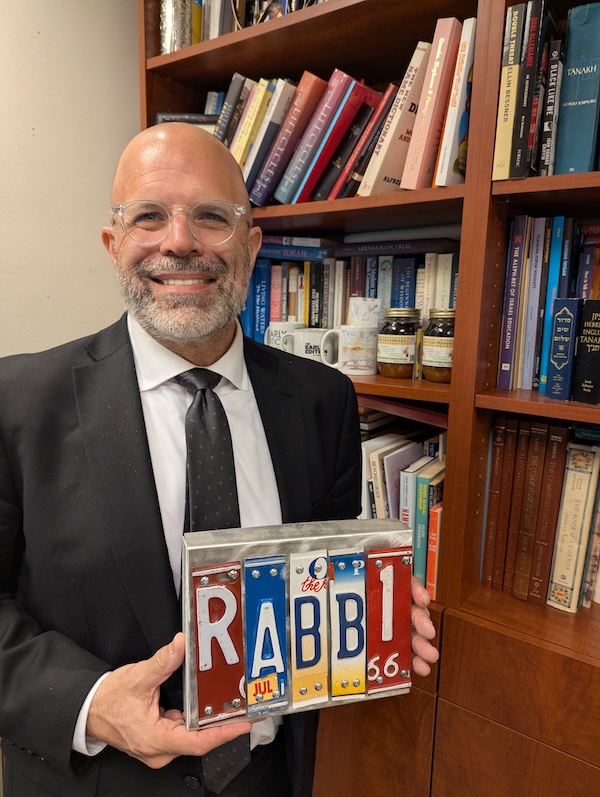

Over the weekend of May 8, Temple Sholom celebrates Rabbi Dan Moskovitz’s “bar mitzvah” year as leader of the congregation. (photo by Pat Johnson)
Rabbi Dan Moskovitz will celebrate his bar mitzvah for the third time on May 9. Marking 13 years since his arrival as senior rabbi at Vancouver’s Reform Temple Sholom, the congregation is fêting him with a 1980s-themed bar mitzvah party.
Moskovitz may experience a sense of déjà vu, since he had not one but two bar mitzvahs in 1983.
“My dad was president of the Reform congregation and vice-president of the Conservative synagogue,” the rabbi said of growing up in Foster City, in the San Francisco Bay Area. “I’m a Jewish mutt, I like to say.”
He had a Reform bar mitzvah on Friday night and a Conservative one on Saturday morning. The weekend of his Temple Sholom celebration will be similarly packed.
Friday night Shabbat services are open to the entire community, with speakers reflecting on his tenure, something that makes Moskovitz feel awkward.
“It’s weird to say, ‘Can you talk about me?’” he said. “I love showering praise on others. I truly don’t want to be the centre of attention.”
He understands, though, what the moment represents, not just for him, but for the congregation.
“I recognize that I play a significant role in people’s lives at the most important times,” he said. “That’s a privilege.”
Letting people say thank you, he added, is part of that relationship.
Moskovitz, commonly known as “Rabbi Dan,” has no similar reluctance when it comes to the menu for the Friday night Oneg, which will be stocked with his favourite desserts – Rice Krispie squares and caramel apples.
Saturday morning will belong to someone else entirely: a bar mitzvah boy whose thunder Moskovitz is not about to steal. “This is all about you,” the rabbi assured him.
The Saturday night party will be ’80s nostalgia – but tasteful, Moskovitz promised. Members of the congregation will speak, as will Rabbi Philip Bregman, Temple Sholom’s rabbi emeritus, and leaders of the broader community. Tickets are available on the shul’s website, templesholom.ca.
Sunday morning will feature a bagels-and-brunch gathering for the religious school’s 220 kids and their parents.
The festivities are in support of causes that are close to the rabbi’s heart. Funds raised will go into two endowments.
The first is a pastoral care initiative, led by Rabbi Sally Finestone, whose sole focus is seniors, including regular visits, supporting their families, even driving people to appointments. As the congregation has grown to more than 1,000 households, Finestone is able to take some of the burden off Moskovitz, Associate Rabbi Carey Brown and Cantor Shani Cohen. This program, and Finestone’s position, began through an endowment in memory of Michael Jacobson.
The second endowment, originated by Susan Mendelson and her husband, the late Jack Lutsky, supports a scholar-in-residence program, which has allowed Temple Sholom and the broader community to learn from Israeli writer and thinker Yossi Klein Halevi for the past several years.
Though Moskovitz’s visit to Vancouver before being hired was in a typical Vancouver rainstorm, he instantly felt he had found a home.
“I just fell in love with this congregation,” he told the Independent.
What stands out most, he said, is that, in Vancouver, congregants don’t simply attend services, they participate. “They own it,” he said.
It’s a contrast, he suggested, to parts of American Reform Judaism, where it can feel like congregants outsource their religion to the rabbi, drop their kids off at shul and pick them up after. “I call it drive-by Jewing,” said Moskovitz.
“Our congregation shows up. The parents don’t just drop off their kids. They come in the building. They stay for minyan,” he said.
Something else that surprised him about Vancouver is the level of collaboration among Jewish institutions, exemplified by the inter-denominational Rabbinical Association of Vancouver. It’s a model, he believes, that could reshape Jewish communal life elsewhere.
Of course, not everything has been easy. Rising antisemitism in Canada has forced him into a more public, defensive role than he ever expected. It’s not why he became a rabbi, he said, but it has become part of the job.
Thirteen years in, Moskovitz has no plans to leave.
“I never want to,” he said.
Neither, apparently, does the congregation ever want him to go. They gave him a life appointment, or to age 67: “Whichever comes first,” he said.
Aside from missing his extended family and Trader Joe’s, Moskovitz has no regrets about the move to a new city and country – the citizenship test for which, he noted, he aced, with 20 right answers out of 20.
“My parents are older now. It’s hard for them to travel,” he said. “My father-in-law is older also, so that’s hard. My kids grew up without that drop-by grandparenting, which is so special. So that’s been a trade-off.”
His family has likewise found a home at Temple Sholom, Moskovitz added. His wife, Sharon Mishler, is a true partner in the work, he said.
“When I’m in the front of the congregation leading the synagogue and services, she’s in the back of the congregation creating relationships and connecting people,” said the rabbi. “She takes brides to the mikvah. She meets with our seniors. She takes people out to lunch. She makes phone calls. She’s a great source of information for me when people tell her things that they think I should know about somebody being sick or whatever it is.”
Their son Judah, 20, studies political science and history at the University of Ottawa and works on Parliament Hill for Vancouver Granville Member of Parliament Taleeb Noormohamed. He was just selected as the co-chair of the Canadian Jewish Political Affairs Committee Fellowship.
Son Levi, 18, graduates from King David High School this spring and was accepted early to Western University’s Ivey Business School.
Daughter Estee, 14, also a student at King David, has an aptitude for science and, like her brothers, is very involved with BBYO (formerly B’nai B’rith Youth Organization), where she is vice-president of the chapter board.
“I never thought that I would be the rabbi of a synagogue that I’d want to join,” Moskovitz said. “I thought that I would always have to compromise my spirituality to serve the masses of my community.”
At Temple Sholom, he is truly at home.
“It is Judaism in the way that I like my Judaism,” he said. “It’s traditional but inclusive and egalitarian. Progressive in what I think are all the right ways in terms of trying to adapt and respond to modernity, but not watered down Judaism in the process. And it’s a loving, caring congregation.”



