

Skip to content
  • Home
  • Subscribe / donate
  • Events calendar
  • News
    • Local
    • National
    • Israel
    • World
    • עניין בחדשות
      A roundup of news in Canada and further afield, in Hebrew.
  • Opinion
    • From the JI
    • Op-Ed
  • Arts & Culture
    • Performing Arts
    • Music
    • Books
    • Visual Arts
    • TV & Film
  • Life
    • Celebrating the Holidays
    • Travel
    • The Daily Snooze
      Cartoons by Jacob Samuel
    • Mystery Photo
      Help the JI and JMABC fill in the gaps in our archives.
  • Community Links
    • Organizations, Etc.
    • Other News Sources & Blogs
    • Business Directory
  • FAQ
  • JI Chai Celebration
  • JI@88! video

Recent Posts

  • עשרים ואחת שנים בוונקובר
  • Supporting the Iranian people
  • The power of photography
  • A good place to start
  • When boundaries have shifted
  • Guitar virtuosos play
  • Different concepts of home
  • Broadway’s Jewish storylines
  • Sesame’s breadth and depth
  • Dylan Akira Adler part of JFL festival
  • Mortality learning series
  • A new strategy to brighten up BC
  • Sharing latkes and light
  • Johnson awarded for human rights work
  • Cherished tradition ensured … Silber Family Agam Menorah
  • Nothing as lovely as a tree
  • Camp welcomes new director
  • Popular family camp expands
  • A life-changing experience
  • Benefits of being a counselor
  • Camper to counselor
  • האלימות בישראל מורגשת בהרבה מגזרים
  • טראמפ עוזר דווקא לנושא הפלסטיני
  • New rabbi settles into post
  • A light for the nations
  • Killed for being Jewish 
  • The complexities of identity
  • Jews in time of trauma
  • What should governments do?
  • Annie will warm your heart
  • Best of the film fest online
  • Guitar Night at Massey
  • Partners in the telling of stories
  • Four Peretz pillars honoured
  • History as a foundation
  • Music can comfort us

Archives

Follow @JewishIndie
image - The CJN - Visit Us Banner - 300x600 - 101625

Tag: Sotheby’s

Beauty amid turbulent times

Beauty amid turbulent times

Israeli journalist Yair Cherki (photo from Facebook)

Bravo Yair Cherki, the popular, ultra-Orthodox TV news reporter. He recently came out as gay in a wonderful social media post. In part, he said: “I write these words shaking, postponing to tomorrow. For next week. For after the holidays. Maybe it’s been 10 years since I’ve been writing and erasing…. And I write not because I have the strength to write but because I have no power to stay silent. I love men. I love G-d. It is not contradictory….”

His confession continues, “I live the conflict between my secular preference and my faith all the time. Some have solved the conflict for themselves by saying that there is no G-d, while others explain that there is no homosexuality. I know both exist. And I try to reconcile this contradiction within myself in various ways. These are things between G-d and me…. This is neither a fashion nor a trend nor a political statement. It is simply me….”

An intimate and intelligent statement.

* * *

Now, if this doesn’t take “blaming the Jews” to new extremes. In my previous article in the JI (jewishindependent.ca/land-of-milk-honey) I praised the historic maritime natural gas agreement between Israel and Lebanon, enabling both countries to drill for natural gas within their own territory. I truly wished Lebanon much success in hitting a gusher and creating their own Sovereign Wealth Fund.

Hezbollah’s leader Hassan Nasrallah sees it a bit differently, warning that any delay in Lebanon’s extracting gas from its own waters will be met by a punishing attack on Israel’s adjacent gas fields. Maybe Robert Frost’s poem “Mending Wall” will assuage Nasrallah: “I let my neighbour know beyond the hill…. And set the wall between us once again…. To each the boulders that have fallen to each…. He only says, ‘Good fences make good neighbours.’”

Nasrallah went on to threaten that if the United States continues spreading chaos within Lebanon – some conspiracy theory or other –  that Israel will pay. Reminiscent of the Three Stooges slapstick routine when Curly slaps Larry for Moe slapping him.

Peace and prosperity for all, on both sides of the Fatima Gate. Otherwise known as the Good Fence!

* * *

Going once. Going twice. Do I hear $50 million? According to its website, “Sotheby’s is proud to offer … the earliest, most complete Hebrew Bible during this year’s marquee New York sales auction.”

The Codex Sassoon is more than 1,000 years old. According to Sharon Mintz, Sotheby’s senior Judaica specialist, in an interview with CNN, “this is the most important document to come to auction ever.” It’s expected to generate huge interest across the world from the wealthiest of bidders, with offers expected to reach as high as $50 million.

Other treasured documents fetching such modest amounts at auction include the Codex Leicester by Leonardo da Vinci (ostensibly his science diary) sold to Bill Gates in 1994 for about $31 million. And the first printing of the U.S. Constitution, bought by American hedge fund manager Kenneth Griffin in 2021 for about $43 million.

May 16 … save the date. And your shekels!

* * *

A few weekends ago, my wife and I drove south for the day to enjoy the year’s winter festival, Darom Adom, when the bright red poppies – a protected flower in Israel – come out in full bloom along the Gaza periphery. It’s another reason to celebrate with local handicrafts, seasonal fruit, local cheeses and wine, homemade Israeli cuisine.

Taking place not too far from Sderot, within the opened gates of local kibbutzim and moshavim (agricultural communities) and less than a kilometre from another good fence delineating the border between Israel and Gaza, the festival a testament to Israeli’s resilience – and longing for a peaceful coexistence.

Somewhat poetically, we purchased a beautifully handcrafted hamsa made by a young, local artist. This hand-shaped amulet is used for protection by both Jews and Muslims. In the Jewish faith, the five fingers of the hamsa represent the Five Books of Moses, or the Torah. The Muslim faith sees a hamsa as representing the Five Pillars of Islam (declaration of faith, prayer, alms, fasting, pilgrimage). In popular culture, the charm represents the five senses (sight, sound, smell, touch, taste).

* * *

Judicial reform. Judicial reform. Judicial reform. Sounds like Jan Brady whining about her sister getting all the attention, “Marcia. Marcia. Marcia,” from the 1970s sitcom The Brady Bunch. Judicial reform certainly has been getting all the attention lately.

Issues aside, we’ve had 10 weeks and counting of protests, with several hundred thousand Israelis protesting around the country every Saturday night against judicial reform. The protests are also aimed at the extreme, right-wing – even theocratic – makeup of the current coalition that is driving headstrong into judicial reform. And yet, the primarily secular, centre-left who comprise these thousands, waving Israeli flags and ending every protest with the singing of Hatikvah, respectfully wait until after Shabbat to begin their protests. How’s that for deep-bred regard for this Jewish tradition that crosses sociopolitical lines?

* * *

Bravo again to Yair Cherki. To come out in these turbulent, sociopolitical times for the Israeli LGBTQ+ community. With our far-right, xenophobic, theocratic and anti-LGBTQ+ government, Cherki’s post and testament to himself is nothing short of brave, beautiful and brilliant.

Bruce Brown is a Canadian and an Israeli. He made aliyah … a long time ago. He works in Israel’s high-tech sector by day and, in spurts, is a somewhat inspired writer by night. Brown is the winner of the 2019 AJPA Rockower Award for excellence in writing, and wrote the 1998 satire An Israeli is…. Brown reflects on life in Israel – political, social, economic and personal.
Format ImagePosted on March 24, 2023March 22, 2023Author Bruce BrownCategories IsraelTags Codex Sassoon, Darom Adom, Hassan Nasrallah, Hezbollah, judicial reform, LGBTQ+, politics, social commentary, Sotheby's, Yair Cherki
Haggadah from 1500s

Haggadah from 1500s

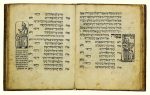
Pages from the 1500s Passover Haggadah that was recently sold to the National Library of Israel. (photo from Sotheby’s)

On the right, a man sits and prays holding a liturgical book. On the left, a rabbi is seen explaining the story of the Exodus to a child. These images were printed on the pages of a Passover Haggadah in the city of Prague in 1556.

This nearly 500-year-old Haggadah, one of only two remaining copies, is part of the Valmadonna Trust Library collection that was recently sold to the National Library of Israel, with the help of philanthropy from the Haim and Hana Salomon Fund.

photo - The line to view the Valmadonna collection outside Sotheby’s in New York, before the collection was sold to Israel’s national library
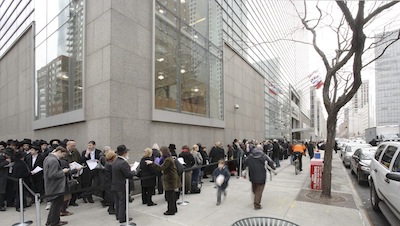
The line to view the Valmadonna collection outside Sotheby’s in New York, before the collection was sold to Israel’s national library. (photo from Sotheby’s)

“The Haggadah is the most widely published book in Jewish history,” said Sharon Mintz, senior consultant for Judaica at Sotheby’s auction house, which arranged the sale to the Israeli library. She told JNS.org that more than 3,000 editions of the Haggadah have been printed during the last several centuries – more than the Bible.

The Valmadonna collection’s 1556 Haggadah is a rare, luxury edition with Yiddish interpolations that “constitute the earliest examples of such texts,” said Marc Michael Epstein, professor of religion and visual culture and the Mattie M. Paschall (1899) and Norman Davis Chair at Vassar College in New York.

Just a few decades after Johannes Gutenberg invented the printing press around 1440, printing spread to the Jewish world, beginning in Rome and then moving throughout Italy and the Iberian Peninsula. Scholars tend to refer to the era of early printing, before 1501, as the Incunabula period.

Jews were “tremendously excited” to be able to print multiple books, Mintz explained. “They viewed it as a gift of God,” she said.

The earliest printed Haggadah was printed in Spain in 1482. Another early Haggadah dates back to roughly 1486, and was published by the Soncino family, named for the Italian town where the family ran its printing operation. These early Haggadot were not illustrated. The earliest known illustrated Haggadah was printed in Constantinople (modern Istanbul) around 1515, but only a few pages of this Haggadah remain.

Jewish printing spread to other parts of Europe in the 1500s, which also led to a growth in competition among printers.

“The cradle of Hebrew printing is, of course, Venice. But the printing of Jewish books north of the Alps began in Prague in 1512 in the circle of Gershom ben Solomon Kohen and his brother Gronem,” said Epstein, who is the author of Skies of Parchment, Seas of Ink: Jewish Illuminated Manuscripts and The Medieval Haggadah: Art, Narrative and Religious Imagination.

“Due to the humanistic patronage of the Holy Roman Emperor and a general climate of relative tolerance and free trade, Prague in the 16th century was a place of vibrant Jewish communal and cultural life, and thus – along with Venice – a crucial centre of the newly developed art and craft of Hebrew printing,” he said. “Jewish printing spread from Prague throughout Western as well as Eastern Europe, the next great centres being in the Polish communities such as Lublin.”


Read more at jns.org.

Format ImagePosted on March 31, 2017March 31, 2017Author Alina Dain Sharon JNS.ORGCategories Celebrating the HolidaysTags Haggadah, Israel, Passover, Sotheby's, Valmadonna
Proudly powered by WordPress