Chocolate chips were created when chocolate chip cookies were invented in 1937 – Ruth Graves Wakefield of the Toll House Inn in Whitman, Mass., added cut-up chunks of a semi-sweet Nestlé chocolate bar to a cookie recipe.
The cookies were a huge success, and Wakefield reached an agreement in 1939 with Nestlé to add her recipe to the chocolate bar’s packaging in exchange for a lifetime supply of chocolate. Initially, Nestlé included a small chopping tool with the chocolate bars. In 1941, Nestlé and at least one of its competitors started selling the chocolate in “chip” (or “morsel”) form.
Originally, chocolate chips were made of semi-sweet chocolate, but today there are many flavours of chips, including bittersweet, peanut butter, butterscotch, mint chocolate, white chocolate, dark chocolate, milk chocolate, and white and dark swirled chips.
Here are some of my favourite recipes.
MOM’S CHOCOLATE CHIP COOKIES 5 dozen small cookies
1/3 cup oil (Mom, z”l, used 1/2 cup shortening) 1/4 cup brown sugar 1/2 cup white sugar 1 egg 1 package chocolate chips 1/2 tsp baking soda 1/2 tsp salt (I eliminate this) 1 1/8 cups flour 1/2 cup chopped nuts 1/2 tsp vanilla
Preheat oven to 375°F. Spray cookie sheets with vegetable spray or cover with parchment paper.
Combine oil, sugars and egg in a mixing bowl or food processor.
Spoon on cookie sheets with a teaspoon or tablespoon. Bake for eight to 10 minutes. Remove from oven and let cool on a rack.
ELISHEVA’S CHOCOLATE CHIP OATMEAL COOKIES I tasted these at a Hadassah Israel meeting. They were made by one of our members and I had to have the recipe.
1 cup margarine or butter, softened (I use 3/4 cup oil) 1 1/4 cups firmly packed brown sugar 1/2 cup white sugar 2 eggs 2 tbsp milk (I use Rich’s non-dairy creamer or soy milk) 2 tsp vanilla 1 tsp baking soda 1 3/4 cups flour pinch of salt (which I don’t add) 2 cups uncooked oatmeal 1 package chocolate chips 1 cup coarsely chopped nuts (optional)
Preheat oven to 475°F. Place parchment paper on cookie sheets.
Beat margarine or butter (or oil) and sugars until creamy in a bowl. Add eggs, milk and vanilla. Beat well.
Add flour and baking soda (and salt). Mix well.
Stir in oatmeal, chocolate chips and nuts. Mix well.
Drop by rounded tablespoons onto cookie sheet. Bake for nine or 10 minutes for a chewy cookie, 12 to 13 minutes for a crispy cookie.
DIABETIC (SPLENDA) CHOCOLATE CHIP COOKIES 30 cookies
2 cups flour 1 tsp baking powder 1 tsp baking soda 1/4 tsp salt (I never add salt) 1 cup melted butter (I use 1/4 cup + 2 tbsp vegetable oil) 1 cup Splenda brown sugar blend 2 large eggs 1 tbsp vanilla extract 2 cups semi-sweet chocolate chips
Preheat oven to 375°F. Line cookie sheets with parchment paper.
Combine flour, baking powder and baking soda in a bowl. Set aside.
Mix butter (oil) and Splenda in a large bowl. Stir in eggs. Add vanilla and mix. Stir in flour mixture. Fold in chocolate chips.
Drop dough by tablespoon onto cookie sheets. Bake for 11 to 13 minutes. Allow to cool before moving to racks to cool completely.
Sybil Kaplan is a journalist, lecturer, book reviewer and food writer in Jerusalem. She created and leads the weekly English-language Shuk Walks in Machane Yehuda, she has compiled and edited nine kosher cookbooks.
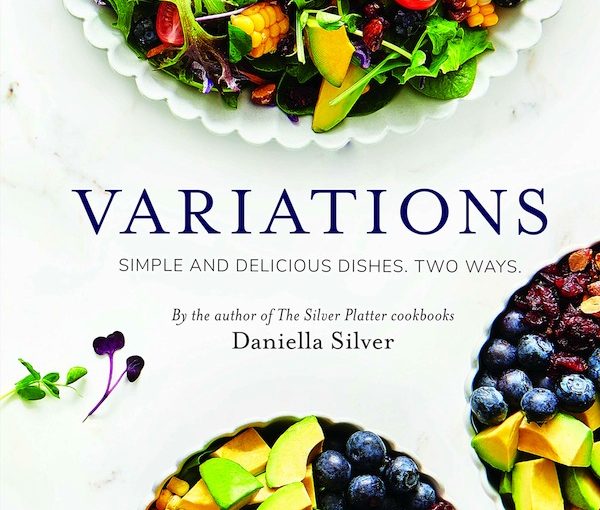
Daniella Silver, author of the Silver Platter cookbook series, has recently come out with Variations: Simple and Delicious Dishes. Two Ways (Artscroll Shaar Press).
In The Silver Platter: Simple to Spectacular, Silver offered recipes with basic ingredients, inviting readers to experiment. In The Silver Platter, Simple Elegance, she focused on recipes with a little more creative flair in presentation and attention to detail. In Variations, she shares with readers versatile recipes that can be served at least two different ways.
In the new cookbook, the basic recipe is on the left-hand page, with a note whether it is dairy, meat or pareve or any combination; if it is gluten-free, if it freezes well and the number of servings. The amounts are regular and metric. On the right-hand page is the variation. Both pages have colour photographs. In the book as a whole, there are 251 recipes and 273 photographs.
Variations’ 10 sections are appetizers (like Deli Egg Rolls and Dill Pickle Football Wings), soups (including Vegetarian Vegetable Quinoa Soup and Dinner Steak Soup), salads (such as Panko-Topped Kale Salad and Pretty Brussels Sprouts Salad), fish (French Fried Onion Salmon and No-Mayo Avocado Tuna Salad, for example), chicken (Old-Fashioned BBQ Chicken and Potato Latke Schnitzel, among others), meat (like Brisket Ends and Overnight Shabbos Corned Beef), dairy (Crustless Baby Red Potato Quiche, Baked Broccoli Tots, etc.), grain sides (such as Crispy Garlic Couscous and Fresh Orzo Salad), vegetable sides (like “Everything Bagel” Asparagus and Maple-Glazed Japanese Sweet Potatoes) and desserts (among which are Low-Fat Ginger Biscotti and Olive Oil Salted Raspberry Brownies).
There are a lot of creative ideas for experienced cooks and great new ideas for all cooks to explore. On her website (daniellasilvercooks.com), Silver says, “I wrote Variations because I felt it’s time to change things up. I want readers to get creative with the foods they prepare by understanding that a recipe can be versatile in preparation or presentation.”
As a food writer and cookbook author, I caught a couple of small but obvious technicalities. When Silver suggests a choice of two ingredients – honey or silan, soy sauce or tamari, for example – she does not mention both possibilities in her instructions for the variation.
When she suggests using a prepared pan, she is inconsistent in indicating in her instructions what preparing the pan means – vegetable spray, flour, etc. She is also inconsistent in telling the reader to preheat the oven as an initial step. Lastly, in the prime recipe, she uses numbers in the instructions; in the variations, she does not. Numbering all of the recipes would have made it easier for cooks, and I have done so below. Here are two recipes with their variations.
1 3 lb chicken, cut into eighths 4 peeled, trimmed carrots, cut in half crosswise then lengthwise 1 19 oz can chickpeas, rinsed and drained 1 cup dried fruit (raisins, apricots, prunes) 1 tsp kosher salt 1/4 tsp black pepper 2 tsp onion powder 2 tsp garlic powder 3 tbsp sweet paprika 2 tbsp extra light olive oil 3 tbsp pure maple syrup or honey
Preheat oven to 375°F. Line a large rimmed baking sheet with parchment paper.
Trim and discard excess fat from chicken. Arrange chicken, skin side up, in a single layer on prepared pan.
Scatter carrots, chickpeas and dried fruit around chicken. Sprinkle with salt and pepper, onion powder, garlic powder and paprika. Drizzle with oil or maple syrup; toss to coat.
Bake, uncovered, for 50-60 minutes, or until chicken juices run clear when pierced with a fork.
Variation: Rustic Couscous for a meatless main, omit the chicken
Cook 1 1/2 cups couscous according to package directions.
Toss carrots, chickpeas and dried fruit on prepared baking sheet with spices, oil and maple syrup or honey.
Bake, uncovered, at 375°F for 40 minutes or until golden.
Place couscous onto a large serving platter, top with roasted veggies and dried fruit.
ROSE PETAL APPLE TART pareve, gluten-free option, yields 10 servings
Dough 1 1/2 cups flour (or gluten-free flour) 1/4 cup brown sugar 1 tsp ground cinnamon 3/4 cup vegetable oil 1 1/2 tbsp vinegar
Filling 5-6 thinly sliced apples 3 tbsp brown sugar 2 tsp ground cinnamon 2 tsp fresh lemon juice
Preheat oven to 375°F. Lightly coat a 9- or 10-inch flan pan or pie plate with nonstick cooking spray.
In a large bowl, combine flour, brown sugar, cinnamon, oil and vinegar. Mix to make a soft dough.
Press dough evenly against bottom and sides of prepared pan.
In a medium bowl, combine sliced apples with brown sugar, cinnamon and lemon juice; gently mix well.
Starting at the outer edge of pan, place apple slices slightly on an angle to form a circle, making sure to overlap the apples. Repeat with additional rows, working your way toward centre.
Place additional apples in any gaps (apples should be tightly packed). Pour on any remaining liquid in apple bowl.
Bake for 45-50 minutes.
Variation: Apple Crisps
Preheat oven to 375°F.
Peel, core and cut apples into large chunks.
Place in large bowl; mix with brown sugar, cinnamon and lemon juice.
Place in individual ramekins. Bake, uncovered, for 25-30 minutes.
Serve either the principle or variation dish hot or at room temperature.
Sybil Kaplan is a journalist, lecturer, book reviewer and food writer in Jerusalem. She created and leads the weekly English-language Shuk Walks in Machane Yehuda, she has compiled and edited nine kosher cookbooks, and is the author of Witness to History: Ten Years as a Woman Journalist in Israel.
Food You Want for the Life You Crave by Nealy Fischer (Da Capo Lifelong Books, 2019) is a delight to read. Not only are there at least 128 gluten-free recipes in this kosher cookbook, but there are 107 full-colour photographs, many of the author and her family sampling the recipes and enjoying them.
“These pages are designed to help you obtain a simpler recipe for success, both in and out of the kitchen,” writes Fischer, noting “these pages are infused with craveable global recipes inspired by our life in Asia and Israel.” The author started to adhere to a gluten-free diet more than 10 years ago.
The recipes have two strategies: “nail this,” the most essential elements to master for a dish’s success, and “flip it,” tips to encourage readers to be creative and to adapt the recipe to their preferences and limitations. Fischer gives readers a 10-step guide to becoming a flexible chef; a substitution chart; pantry, fridge and freezer essentials; and useful gadgets. Chapters include all-day breakfast, breads and muffins; soups and small plates; salads and dressings; fish, poultry and meat; veggies; desserts; drinks and nibbles for friends; and condiments and pantry essentials. The book concludes with a conversion cheat sheet.
One nice idea in the formating is a list of what tools to use above the list of ingredients, which is bolded and, where applicable, divided into dry and wet ingredients and toppings. She also has my favourite element in cookbooks – numbered instructions opposite the ingredients so you don’t have to keep looking up and down. My other favourite aspect is a comment about each recipe. Here are a few of the recipes to try.
SAVOURY QUINOA BOWL 4-6 servings
1/2 cup red or white quinoa (makes 2 heaping cups cooked) 2 small Persian or Kirby cucumbers, chopped (1 1/2 cups) 2 chopped tomatoes (about 1 cup) 1 peeled, chopped avocado (about 1 cup) 1 cup arugula 1/2 cup chopped green onion (about 4) 1/2 cup chopped fresh mint 1/4 cup finely chopped shallots 3 tbsp lemon juice 4 tbsp extra-virgin olive oil salt and freshly ground black pepper to taste 6 large eggs
Start by cooking the quinoa. Mix it with one cup water in a saucepan or pot over medium low heat. Bring to a simmer and cook, covered, for 10 minutes. Check to see if it is done or needs a tad more liquid. Set aside to cool.
Toss the cucumbers, tomatoes, avocado, arugula, green onions, mint and shallots in a large bowl.
Add the cooled quinoa to the veggie bowl then season with lemon juice, olive oil, salt and pepper.
Divide the mixture between six bowls.
Fry the eggs in a lightly oiled pan over medium heat until the whites have set, or to desired doneness. Season with salt and pepper to taste, then carefully slide them on top of the quinoa bowls.
HERBED EVERYDAY BREAD 2 mini loaves or 1 large loaf
1 packet active dry yeast (2 1/4 tsp) 1/4 cup warm water 1 cup all-purpose gluten-free flour 1 cup oat flour 1/4 cup almond flour 1/4 cup flax meal 2 tsp xanthan gum (omit if already in flour) 1 1/2 tsp dried rosemary 1 tsp salt 1/4 cup extra-virgin olive oil 2 large eggs + 1 beaten for brushing 2 tbsp raw honey 1/2 tsp rice vinegar
In a large bowl, mix the yeast with the warm water; let stand until the yeast bubbles, about eight minutes.
In a separate medium bowl, whisk together gluten-free flour, oat flour, flax meal, almond flour, xanthan gum, rosemary and salt.
Stir olive oil, two eggs, honey and rice vinegar into yeast mixture. Stir dry ingredients into bowl. Mix well.
Transfer dough to parchment-lined loaf pans and let stand covered in a warm place until bread rises to double in height (about 45 minutes).
Preheat the oven to 350°F.
Brush the top with the remaining beaten egg.
Bake the bread until it is golden and set in the centre, 30 to 35 minutes for mini loaves or about 45 minutes for a larger loaf. Cool the bread completely before removing from the pans and slicing.
DATE-BAR BITES 32 to 36 squares
1 pound Medjool dates, pitted and chopped 1/4 cup maple syrup juice and zest of 1 orange 2/3 cup coarsely chopped raw walnuts or pecans 1 tsp ground cinnamon 1 tsp vanilla extract 1 3/4 cups all-purpose gluten-free flour 1 1/2 cups old-fashioned rolled oats 1 cup packed dark brown sugar 3/4 cup coconut oil at room temperature 1/2 tsp baking soda 1/8 tsp salt
In a saucepan over medium heat, combine dates with half-cup water, maple syrup and orange juice and bring to a boil.
Remove the pan from the heat and stir in the orange zest, nuts, cinnamon and vanilla. Set aside.
Preheat the oven to 350°F. Grease a 13-by-9-inch baking pan or line it with parchment paper.
In a food processor, mix together flour, rolled oats, brown sugar, coconut oil, baking soda and salt until combination is crumbly but still holds together.
Press two-thirds of the dough into the baking pan (reserve one-third for the topping).
Spread the filling evenly over the crust. Sprinkle the remaining one-third of the topping over the filling. Bake for 30 minutes or until lightly golden.
Cool completely then refrigerate until cold to make the cutting easier. Cut into one-and-a-half-inch squares.
Sybil Kaplan is a journalist, lecturer, book reviewer and food writer in Jerusalem. She created and leads the weekly English-language Shuk Walks in Machane Yehuda, she has compiled and edited nine kosher cookbooks, and is the author of Witness to History: Ten Years as a Woman Journalist in Israel.
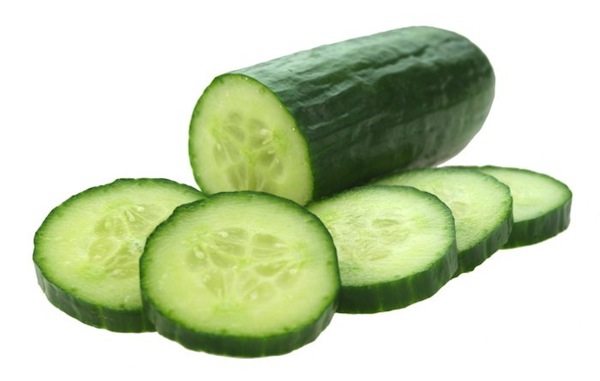
Whether you go to farmers markets or elsewhere to buy your summer produce, cucumbers are a must. In Jerusalem, we have all kinds of cucumbers year-round but my favourite in Machaneh Yehudah is one with a fuzzy, pale green skin called melafafon beladi (native, urban or indigenous to the country) or, in Arabic, fauze. Much more expensive than regular cucumbers, the taste is special, but the following recipes will taste great with regular cucumbers.
CUCUMBER SALAD BOATS This recipe came from Gourmet Magazine probably more than 30 years ago. It makes 6 servings.
2 large cucumbers, peeled and halved lengthwise 1 cup grated carrots 1 cup grated radishes 2 tbsp olive oil 2 tsp lemon juice salt and pepper to taste
In a bowl, combine grated carrots, radishes, oil, lemon juice, salt and pepper.
Scoop out some of the seeds, then place cucumbers on a plate and fill with vegetables. Wrap in plastic wrap and chill for at least one hour. To serve, cut each cucumber into thirds.
SEAWEED AND CUCUMBER SALAD 4 servings
1/2 cup washed seaweed 1/2 bunch green onions 4-6 cucumbers 2 1/2 tbsp lemon juice 1/4 tsp sesame oil 3 tbsp soy sauce or teriyaki sauce 2 tbsp sesame seeds or chopped cashew nuts (optional)
Chop seaweed and green onions in a bowl. Chop cucumbers coarsely and add to bowl.
In a jar with a lid, mix lemon juice, sesame oil, soy sauce or teriyaki sauce. Pour over salad. Sprinkle sesame seeds or cashew nuts on top before serving.
TURKISH CUCUMBER AND YOGURT SALAD This dish is often called cacik or jajik. Recipe makes 4-6 servings.
2 large cucumbers, sliced salt to taste 1 crushed garlic clove 2 tsp white vinegar 1/2 tsp chopped dill 2/3 cup yogurt 1 tbsp chopped fresh mint 2 tbsp oil
In a bowl, combine cucumber slices, salt, garlic, vinegar, dill and yogurt and blend.
Sprinkle mint and oil on top before serving.
Sybil Kaplan is a journalist, lecturer, book reviewer and food writer in Jerusalem. She created and leads the weekly English-language Shuk Walks in Machane Yehuda, she has compiled and edited nine kosher cookbooks, and is the author of Witness to History: Ten Years as a Woman Journalist in Israel.
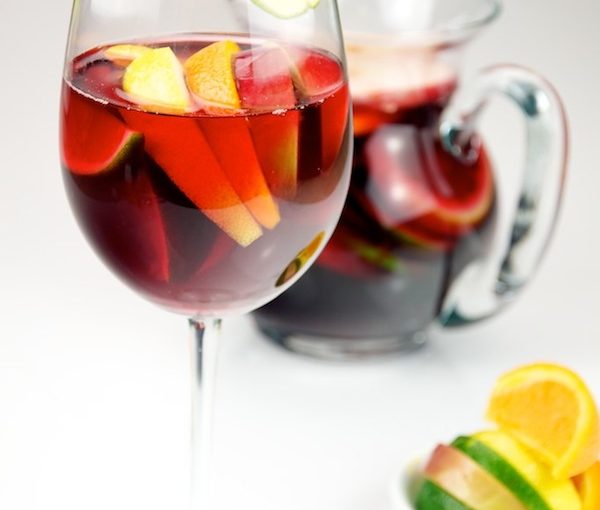
When I entertain during the summer, my favourite drink is sangria, the Spanish wine punch whose name means blood. As I walk past the wine store on Agrippas Street in Jerusalem, just before entering the shuk, I marvel at the array of wines and think what great sangria they would make.
Traditional sangria is made with red wine and fruit, a little sugar to sweeten and orange juice. A version of the drink has been around since the early Greeks and Romans, who added sugar and spices to their wines. When Spain was under Moorish Islamic rule, until 1492, sangria disappeared but then returned. When the 1964 World’s Fair was held in New York City, sangria was a popular feature at Spain’s pavilion and it became popular among Americans. Here are a few recipes to try.
TRADITIONAL SANGRIA 8 servings
3 cups red wine 1 1/2 cups lemon-lime soda 1 1/2 cups orange juice 16 slices of limes 16 slices of lemons 8 slices of oranges 1/2 cup brandy 1/4 cup sugar 2 tbsp orange liqueur 2 tbsp grenadine 2 tbsp lemon juice 2 tbsp lime juice
Place wine, lemon-lime soda and orange juice in a large pitcher.
Add lime slices, lemon slices and orange slices.
In a small bowl, combine brandy, sugar, liqueur, grenadine, lemon juice and lime juice and blend. Pour into pitcher. Add ice cubes and chill several hours before serving.
WHITE SANGRIA 6-8 servings
1 1/2 cups brandy 1 can frozen lemonade concentrate 1 thinly sliced lemon 2 cups ice cubes 2 cups dry white wine 2 cups club soda 1 cup sliced strawberries (optional) mint sprigs
Combine brandy and lemonade concentrate with lemon slices. Refrigerate one to four hours.
In a pitcher, add ice cubes, brandy mixture, wine and club soda. Add strawberries, if using. Garnish with mint sprigs.
PEACH SANGRIA 6 servings
4 cups dry white wine 1/4 cup peach-flavoured brandy peel from one large orange ice cubes 2 cups chilled club soda 1 1/2 quartered, pitted peaches
Mix wine and brandy in a large pitcher. Add orange peel and chill.
When ready to serve, add ice cubes and club soda. Place a peach quarter in each glass and pour brandied wine over each.
Sybil Kaplan is a journalist, lecturer, book reviewer and food writer in Jerusalem. She created and leads the weekly English-language Shuk Walks in Machane Yehuda, she has compiled and edited nine kosher cookbooks, and is the author of Witness to History: Ten Years as a Woman Journalist in Israel.
On the second day of Passover, we begin to count the omer (sheaves of a harvested crop). The counting concludes seven weeks later, with Shavuot (the Feast of Weeks), which has different names, but is associated with one type of food: dairy products. Hence, my sharing a few cheesecake recipes.
Song of Songs Chapter 4 reads, “honey and milk are under thy tongue,” a reference to the Torah being as nourishing as milk and as sweet as honey. Thus, on the holiday celebrating the giving of the Torah, it became traditional to eat foods with milk and honey.
Interpreters of the Tanach liked to use gematria (Jewish system of assigning numerical values to words and phrases, based on their letters). For example, Psalm 68 is read on Shavuot and, in verse 16, it reads: “A mount of G-d is the mountain of Bashan.” The Hebrew for peaks is gavnuneem, which sounds like gveeneh (cheese). One could interpret this to mean that, on Shavuot, we should eat mountains of cheese.
Another example: the values of the Hebrew letters in chalav (milk) sum to 40. Moses spent 40 days on Mount Sinai, so we eat foods with milk.
As well, there is a legend that says, until Moses descended with the Torah, kashrut was unknown so, rather than prepare the meat as per the new rules, the people ate dairy. Pragmatically, since Shavuot is a summer festival and Israel is hot, it was logical to eat light, dairy foods. Also, sheep give birth around this time, so milk and cheese are plentiful.
In the Shulchan Aruch (code of Jewish law), Rabbi Moses Isserles wrote: “It is a universal custom to eat dairy food on the first day of Shavuot.”
CRUSTLESS CHEESECAKE
1 cup cream cheese 1 1/2 cups creamed cottage cheese 1/2 cup sugar 2 eggs 1 tsp vanilla 1 cup sour cream
Preheat oven to 350°F. Spray vegetable shortening in a nine-inch round cake pan.
Mix together cream cheese, creamed cottage cheese, sugar, eggs and vanilla. Pour into pan.
Bake 35-40 minutes or until centre firm.
Remove from oven and spread with sour cream while cake is hot. Cool then refrigerate.
BLENDER CHEESECAKE
crust: 15 graham crackers 1 tbsp sugar 1/2 tsp cinnamon 1/4 cup melted margarine or 3 tbsp vegetable oil
filling: 1 envelope unflavoured gelatin 1 tbsp lemon juice grated peel of 1 lemon 1/2 cup hot water or milk 1/3 cup sugar 2 egg yolks 1 package cream cheese 1 heaping cup crushed ice 1 cup sour cream
Break five crackers into quarters, blend to crumbs. Empty into bowl. Repeat twice more.
Stir in sugar and cinnamon. Add melted margarine or oil and mix until crumbs are moist. Grease a spring form pan. Press crust against sides and chill.
Mix in blender gelatin, lemon juice, lemon peel, hot water or milk 40 seconds.
Add sugar, egg yolks and cream cheese and blend 10 seconds. Add ice and sour cream and blend 15 seconds.
Pour onto crumb crust and chill.
MY MOM’S (Z”L) SCRUMPTIOUS CHEESE CAKE
crust: 2 cups graham cracker crumbs 1/2 cup butter or margarine or 1/4 cup plus 2 tbsp oil 1/4 cup sugar dash cinnamon
Combine crushed crackers, butter, margarine or oil, sugar and cinnamon and press into spring form pan.
Bake 10 minutes.
Combine the filling’s cream cheese, eggs, sugar and vanilla with a mixer until fluffy. Pour into crust and bake 30 minutes.
Beat topping’s sour cream, sugar and vanilla. When cake is done, remove from oven and spread topping on it. Return to oven and bake 10 minutes.
Serve with cherries, crushed pineapple or strawberries on top.
Sybil Kaplanis a journalist, lecturer, book reviewer and food writer in Jerusalem. She created and leads the weekly English-language Shuk Walks in Machane Yehuda, she has compiled and edited nine kosher cookbooks, and is the author of Witness to History: Ten Years as a Woman Journalist in Israel.
In Jerusalem, as soon as Purim is over, everyone begins to get ready for Pesach. Two-and-a-half weeks ahead, macaroons are already in the stores, as well as various other products for the holiday. Here are a few desserts you can make at home, from traditional to unusual.
CLASSIC ALMOND MACAROONS Makes 20 macaroons. This recipe is adapted from an American food magazine (not sure which).
Place almonds in a pan, cover with water and bring to a boil. Boil 10 seconds. Remove one almond and see if it slips out of its skin. If not, boil a few seconds more. Spread on paper towels and pat dry once ready.
Preheat oven to 325 °F. Line a baking sheet with parchment or wax paper.
Grind almonds with 1/4 cup sugar in processor. Add egg whites and extract and blend 20 seconds. Add the 3/4 cup sugar in two batches, blending 10 seconds after each addition.
Roll one tablespoon of mixture between moistened palms into ball. Repeat until all mixture is used, spacing cookies one inch apart on the prepared cookie sheet. Flatten each to half-an-inch high. Brush each with water. Sift confectioners sugar over each. Bake for 25 minutes.
Lift one end of parchment paper and pour two tablespoons water onto cookie sheet. Lift other end and pour two tablespoons water under. Tilt to spread water. When water stops boiling, remove macaroons.
CHOCOLATE BISCOTTI 3/4 cup margarine or butter 2 1/8 cup sugar 6 eggs 2 tbsp vanilla extract 3 1/2 cups matzah flour 1 1/4 cups potato flour 3/4 cup cocoa 1 tbsp Passover baking powder 5/8 cup ground almonds 2 cups chocolate chips
Preheat oven to 375°F. Spray a cookie sheet.
In a bowl, cream margarine or butter and sugar. Add eggs and vanilla.
In another bowl, combine matzah flour, potato flour, cocoa and baking powder. Gradually add to batter.
Add nuts and chocolate chips and combine.
Form into two logs and place on cookie sheet. Bake for 30 minutes. Let cool.
Slice. Return slices to cookie sheet and bake 15 minutes.
TOFFEE MATZAH This is my favourite sweet for Pesach but this version is an Andrew Zimmern contribution from Food & Wine magazine with a few of my changes.
1 cup salted butter or margarine 5 pieces of matzah 1 cup packed brown sugar 2 cups chocolate chips 1 cup mixed chopped nuts
Preheat oven to 350°F. Line a cookie sheet with foil and spray with vegetable spray. Line with parchment paper and spray again.
Arrange a layer of matzah on the sheet.
Melt butter or margarine with brown sugar in a saucepan. Cook five minutes. Pour over matzah. Bake five to eight minutes, until bubbling.
Remove from oven and spread chocolate chips on top, letting them melt for five minutes. Sprinkle nuts on top. Let cool or refrigerate to cool. Break into pieces.
MARILYN’S CHOCOLATE BRANDIED CANDY Marilyn is a longtime friend of mine who came from the Boston area and has lived in Israel since 1949.
3 1/2 ounces bittersweet chocolate (a candy bar works fine) 1 cup raisins, soaked in cherry brandy 1 cup chopped walnuts 1 cup matzah pieces
Melt chocolate in a saucepan. Add raisins, walnuts and matzah and mix well.
Drop by tablespoon into small cupcake papers. Refrigerate.
Sybil Kaplan is a journalist, lecturer, book reviewer and food writer in Jerusalem. She created and leads the weekly English-language Shuk Walks in Machane Yehuda, she has compiled and edited nine kosher cookbooks, and is the author of Witness to History: Ten Years as a Woman Journalist in Israel.
Although summer is still in full swing, apples come into the markets here in Israel before Rosh Hashanah. I love apples; they are probably my most favourite fruit, especially in fall and winter. Here are some apple recipes for your holiday table.
BAKED APPLE RELISH I found this recipe in a women’s magazine 40 years ago but it still makes a good accompaniment for chicken or meat.
6 small baking apples, core removed, scooped out insides leaving a shell, setting the scooped out insides in a bowl 2 tbsp butter or margarine 1 cup chopped onions 1 cup chopped tomatoes 1/4 cup raisins 1 tbsp chopped fresh ginger or 1/2 tsp ground ginger 1/4 tsp dry mustard 4 tbsp red fruit preserves 4 tbsp cider vinegar 1/4 tsp crushed red pepper (optional)
1. Preheat oven to 400°F.
2. Melt butter or margarine in a large frying pan. Add onion and sauté five minutes.
3. Add chopped apples, tomato, raisins, ginger, mustard, one tablespoon preserves, one tablespoon vinegar, and red pepper, if using. Cook five minutes or until mixture starts to thicken.
4. Spoon into hollowed out apples. Arrange apples in a shallow baking pan.
5. Add remaining preserves and vinegar to frying pan and heat a few minutes. Pour over apples.
6. Bake for 30-45 minutes.
HONEY AND APPLE CAKE I found this recipe of an Israeli chef from a Bnei Brak bakery in a local newspaper. It makes two loaves.
4 eggs 3/4 cup sugar 3/4 cup oil 1 cup honey 2 1/2 cups flour 1 tsp baking powder 1 tsp baking soda 1 cup strong fruit tea 1 tsp cinnamon 1 tsp ground ginger 1/4 tsp ground cloves 2 to 3 green apples, cut into small cubes
1. Preheat the oven to 350°F. Oil two loaf pans.
2. In a mixing bowl, beat eggs and sugar for two minutes in a mixer at medium speed. Add oil then honey and mix.
3. In another bowl, mix flour, baking powder, baking soda, cinnamon, ginger and cloves.
4. Add to egg-sugar-oil-honey mixture. Mix until smooth.
5. Add tea and apples and mix.
6. Pour batter into two loaf pans. Bake for 40 minutes.
MY FAVOURITE MICROWAVE APPLE CHUTNEY I make this chutney for our favourite fish curry, but it can be used with other dishes as well. Makes two cups.
1/3 cup chopped lemon 1 chopped garlic clove 1 2/3 cups chopped apples 3/4 cup brown sugar 1/2 cup raisins 1 tbsp ground ginger dash chili powder 2/3 cup cider vinegar
1. Place all ingredients in a microwavable dish. Microwave four minutes.
Sybil Kaplan is a journalist, lecturer, book reviewer and food writer in Jerusalem. She created and leads the weekly English-language Shuk Walks in Machane Yehuda, she has compiled and edited nine kosher cookbooks, and is the author of Witness to History: Ten Years as a Woman Journalist in Israel.
Cookbook author Joan Nathan, left, with journalist Sybil Kaplan. (photo from Barry A. Kaplan)
Before I review King Solomon’s Table: A Culinary Exploration of Jewish Cooking around the World by Joan Nathan (Knopf, 2017), I have to admit, I am prejudiced. I have known Joan for around 40 years, and every cookbook she writes is great. When she was in Israel recently, she agreed to appear at my English-speaking chapter of Hadassah Israel for a fundraiser. The program included my interviewing her, and her remarks are at the end of this article, after the recipes.
In King Solomon’s Table, Joan traces, through recipes and stories, the journey of many of the dishes that Jews eat, the people she has met over the years and the places she has visited. Alice Waters, well-known chef, food activist, owner and founder of Chez Panisse Restaurant in Berkeley and cookbook author, writes in the foreword: “Joan has become the most important preservationist of Jewish food traditions, researching and honouring the rich heritage that has connected people for millennia.”
Sri Lankan Breakfast Buns are among the global fare in King Solomon’s Table. (photo from joannathan.com)
Joan’s introduction is an amazing history of the roots of Jewish food. This is followed by “The Pantry,” a discussion of spices and other items. Then there are the chapters and recipes. Every recipe has a story, and there are 171 recipes in 12 chapters. One can find recipes from Azerbaijan, Brazil, Bulgaria, Denmark, Ethiopia, France, Georgia, Germany, Hungary, India, Iraq, Israel, Italy, Kurdistan, Libya, Lithuania, Mexico, North Africa, Persia, Poland, Rhodes, Romania, Russia, Siberia, Sicily, Sri Lanka, Syria, Turkey, the United States, Uzbekistan and Yemen.
The variety is vast, from Hungarian Apple Pancakes to Sri Lankan Breakfast Buns, from French Buttery Olive Biscuits to Greek Eggplant Salad to Uzbek Noodle Soup. There are all sorts of breads, and recipes using couscous and different types of pasta. There are 15 vegetable recipes, 15 fish recipes, 10 recipes for poultry and 14 meat recipes. And, of course, there are recipes for sweets – 23 of them, including Sephardic Almond Brittle, Israeli Quince Babka and Brazilian Cashew Nut Strudel.
Scattered throughout the book are essays and, after the acknowledgments is a bibliography and index.
When Joan guest blogged for the Jewish Book Council, soon after the publication of the cookbook, she wrote: “One of the ideas that I have wrestled with throughout my career is the question of what is ‘Jewish food.’ Working on my latest cookbook, King Solomon’s Table: A Culinary Exploration of Jewish Cooking around the World, has at last answered that question for me.”
Here are a few of the recipes from this book.
SMOKY SHAKSHUKA The name shakshuka comes from an Arabic and Hebrew word meaning “all mixed up.” It is said the dish was made in North Africa, when the women were busy with a lover and then made a quick meal for their husbands; it was born in the mid-16th century. This recipe makes eight servings.
4 red bell peppers
1 (1 pound) eggplant
2 tbsp olive oil
3 lamb, beef or chicken chorizo, sliced in rounds (optional)
5 chopped garlic cloves
12 chopped tomatoes or 28-ounce can chopped tomatoes
1 tbsp smoked Spanish paprika
2 tsp salt or to taste
1/4 tsp black pepper or to taste
1 tbsp sugar or to taste
1 bunch chopped cilantro
8 large eggs
crumbled Bulgarian feta cheese
1. Preheat the oven to 450°F and line a jelly roll pan with parchment paper. Cook the peppers and eggplant, pricking them first with a fork, turning occasionally with tongs until slightly soft and blackened, about 20 minutes.
2. Heat the oil in a pot over medium heat. Add peppers and fry about three minutes then add chorizo, if using, and garlic and cook six to seven minutes, stirring occasionally. Add tomatoes and simmer, uncovered, over medium-low heat for 30 minutes, stirring occasionally.
3. When the mixture is thickened, add the smoked paprika, salt, pepper, sugar, eggplant and all but three tablespoons of the cilantro. Stir to combine, Add seasonings to taste and add a little water if the mixture is too thick.
4. With the back of a spoon, make eight shallow wells in the shakshuka. Gently crack the eggs into the wells, cover the pot and poach over medium-low heat for five to 10 minutes until egg whites are set. Serve sprinkled with remaining cilantro and, if you like, Bulgarian feta cheese.
PICKLED HERRING SPREAD (6-8 servings)
2 tbsp chopped red onion
1 tbsp almonds
1/2 Granny Smith or other tart apple, peeled and cored
1 large peeled hard-boiled egg
1 12-ounce jar marinated herring tidbits
1 tbsp fresh chopped dill
1. Pulse onion and almonds in food processor. Then add apple and egg to combine.
2. Pour off sauce and onions from marinated herring and add to food processor to chop. Place mixture in serving dish and sprinkle with dill to garnish.
LEEK AND MEAT PATTIES The original 100-year-old recipe from Macedonia was a holiday staple for Balkan Jews, which Joan tampered with a bit. This recipe makes 12 patties.
1 1/4 cup olive oil
6-8 chopped leeks
2 1/4 tsp kosher salt
1/2 tsp black pepper
2 pounds chopped lamb, beef or boiled potatoes
3 large eggs
1 tsp cinnamon
1/2 tsp allspice
1/2 cup chopped parsley
1/2 cup matzah meal
1. Preheat oven to 425°F and rub a rimmed baking sheet with oil. Toss leeks with more oil, one teaspoon salt and pepper. Spread leeks in single layer and roast, tossing frequently until golden brown and crisp at edges, about 20 minutes. Cool.
2. Chop leeks and mix with meat or boiled potatoes, eggs, cinnamon, allspice, parsley, matzah meal and salt. Form into 12 patties. Heat a frying pan with a thin film of oil. Fry the patties until golden brown on each side, making sure they cook through. If using potatoes instead of meat, add a little Parmesan cheese for extra flavour.
***
An Interview with Joan Nathan in Jerusalem, June 15, 2017
SK: How did you decide to continue in food writing after you left Israel in the 1970s?
JN: We moved to the Boston area and I met with an editor at the Boston Globe. He asked me to write about food. I also had a scholarship to the Kennedy School at Harvard to do a master’s in public administration. I also met Dov Noy, z”l, the world’s renowned Jewish folklorist, who said, I’ll help you if you decide to write a cookbook, because he knew a lot about ethnic groups.
[At some point,] I told Julia Child’s editor I wanted to write a cookbook, but my father wanted me to go to Schocken Publishers.
[Schocken published The Jewish Holiday Kitchen in 1979, An American Folklife Cookbook in 1985, The Children’s Jewish Holiday Kitchen in 1988, The Jewish Holiday Baker in 1997 and Joan Nathan’s Jewish Holiday Cookbook in 2004. Knopf published Jewish Cooking in America in 1994, The Foods of Israel Today in 2001, The New American Cooking in 2005, and Quiches, Kugels and Couscous: My Search for Jewish Cooking in France in 2010.]
SK: How long does it take you to write a cookbook?
JN: King Solomon’s Table took six years. On a trip to India, I saw a sign, “Since the time of Solomon,” and got the idea, although the [part of the title] … about my journeys everywhere was my editor’s idea.
SK: How did you acquire the recipes?
JN: I sent out to all the “tribes.”
[Joan digressed here to say that the three essentials for Jewish food are the dietary laws; that Jews went out to look, for example, for spices; and how Jews’ food is influenced by the food of the country in which they’re living.]
SK: Who does the various elements of a cookbook?
JN: I have people help me in testing and I do my research. In the process of putting together a book, professional photographs are essential today. For King Solomon’s Table, I knew where I would go in the world…. I would plan trips for 10 days and, when I returned, I got the material typed quickly. The whole book comes together with the introduction. Each of my books is like a big term paper.
Sybil Kaplanis a journalist, lecturer, book reviewer and food writer in Jerusalem. She created and leads the weekly English-language Shuk Walks in Machane Yehuda, she has compiled and edited nine kosher cookbooks, and is the author of Witness to History: Ten Years as a Woman Journalist in Israel.
Pomegranates are referred to in the Bible in many various ways. In the sensual poetry of Song of Songs, we read, “I went down into the garden of nuts … to see whether the vine budded and the pomegranates were in flower.” In another passage, the poet writes, “I would cause thee to drink of spiced wine, of the juice of my pomegranate.” Song of Songs has four additional mentions of pomegranates, and there are also references in Joel, Haggai and I Kings.
For many Jews, pomegranates are traditional for Rosh Hashanah. Some believe the dull and leathery skinned, crimson fruit may have really been the tapuach, apple, of the Garden of Eden. According to Forward “Food Maven” Matthew Goodman, the pomegranate originated in Persia and is one of the world’s oldest cultivated fruits, having been domesticated around 4000 BCE. The Egyptians imported pomegranates from the Holy Land in 1150 BCE and natural pomegranate juice, made into spiced wine, was a favourite of Hebrews living in Egypt. Pomegranate wood could also be carved into skewers on which to roast the lamb for Passover.
The word pomegranate means “grained apple.” In Hebrew, it is called rimon, which is also the word for hand grenade! In fact, the English term “hand grenade” is said to come from this and that both the town of Granada in Spain and the stone garnet come from the name and colour of the pomegranate. The juice can also be made into grenadine.
The Hebrews yearned for the pomegranates they left behind in Egypt while wandering in the desert – “And wherefore have ye made us to come up out of Egypt, to bring us in unto this evil place? It is no place of seed, or of figs, or of vines, or of pomegranates.” (Numbers 20:5) And the spies reported their findings in Canaan to Moses: “And they came unto the valley Eshkol and cut down from thence a branch with one cluster of grapes, and they bore it upon a pole between two; they took also of the pomegranates and of the figs.” (Numbers 13:23)
Pomegranates were also used on the faces of the shekel in the second century BCE. King Solomon had an orchard of pomegranates, and pomegranates of brass were part of the pillars of his great Temple in Jerusalem. Throughout the Bible, pomegranates are referred to as a symbol of fertility. As well, in the Jewish mystical tradition of kabbalah, it is said there are 613 seeds in each pomegranate, equaling the number of mitzvot commanded by God.
On the second night of Rosh Hashanah, when it is customary to eat a “new” fruit, one that celebrants have not eaten during the year, many Sephardi Jews choose the pomegranate. They recite the prayer “ken yehi ratzon, may it be thy will, O Creator, that our year be rich and replete with blessings, as the pomegranate is rich and replete with seeds.”
In modern days, a study at the Technion in Haifa a few years ago showed the power of the fruit. The cholesterol oxidation process, which creates lesions that narrow arteries and result in heart disease, was slowed by as much as 40% when subjects drank two to three ounces of pomegranate juice a day for two weeks. The juice reduced the retention of LDL, the “bad” cholesterol that aggregates and forms lesions. When subjects stopped drinking the juice, the beneficial effects lasted about a month. Other studies have shown that pomegranates fight inflammation and cancer, and slow cellular aging. Pomegranates are a good source of potassium, low in calories and low in sodium.
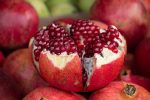
When choosing a pomegranate, look for one that is large, brightly coloured and has a shiny skin. You should store a pomegranate in a plastic bag in the refrigerator, and it can keep up to 10 weeks. To open a pomegranate, score the outside skin into four pieces, then break the fruit apart with your hands following the divisions of the membranes. Pull off the membranes then scrape the seeds into your mouth or lift them out with a spoon. Here are some recipes for those seeds.
POMEGRANATE SYRUP
6 pomegranates 1/3 cup white sugar 1/3 cup brown sugar 1 cinnamon stick 1/8 tsp nutmeg 1/8 tsp allspice
Puree seeds from pomegranates in blender or food processor and strain. Place in saucepan.
Add white sugar, brown sugar and cinnamon stick. Bring to a boil. Reduce heat and simmer about 10 minutes. Add nutmeg and allspice and cook one minute.
Remove from heat, discard cinnamon stick and strain.
BAKED APPLES IN POMEGRANATE SYRUP 6-8 servings
4 slightly tart apples 1 halved pomegranate apple juice 1/3 cup preserves of your choice 1/2 tsp cinnamon
Cut each apple into four wedges. Place in microwavable dish.
Squeeze juice from half the pomegranate into a measuring cup. Add enough apple juice to make half a cup. Add preserves and cinnamon and mix well. Pour over apples to coat them.
Cover with plastic wrap and microwave for two minutes. Stir and microwave two more minutes. Place apple wedges in serving dishes.
Remove seeds from other half of pomegranate and garnish apples.
POMEGRANATE FRUIT SOUFFLE
3 eggs 1 cup + 3 tbsp confectioners’ sugar 1 tbsp unflavoured gelatin 1/2 cup hot water 1/2 cup cold water 7 tbsp orange juice 2 1/2 tbsp lemon juice pulp and seeds of 6 pomegranates
Place yolks and sugar in a saucepan over a second saucepan filled with water (double boiler-style). Cook, stirring, until thick and creamy.
Dissolve gelatin in a bowl of hot water. Then stir in cold water.
Add orange juice, lemon juice, pomegranate pulp and seeds and mix.
Add juice mixture to egg yolk mixture.
Beat egg whites until stiff. Fold into pomegranate mixture. Pour into a soufflé dish or casserole with height built up of three to four inches with a double thickness of wax paper or aluminum foil, stapled or held in place with a paper clip.
Chill in refrigerator until set. Remove band of paper. Decorate with whipped cream.
Sybil Kaplan is a journalist, lecturer, book reviewer and food writer in Jerusalem. She created and leads the weekly English-language Shuk Walks in Machane Yehuda, she has compiled and edited nine kosher cookbooks, and is the author of Witness to History: Ten Years as a Woman Journalist in Israel.