Skip to content
  • Home
  • Subscribe / donate
  • Events calendar
  • News
    • Local
    • National
    • Israel
    • World
    • עניין בחדשות
      A roundup of news in Canada and further afield, in Hebrew.
  • Opinion
    • From the JI
    • Op-Ed
  • Arts & Culture
    • Performing Arts
    • Music
    • Books
    • Visual Arts
    • TV & Film
  • Life
    • Celebrating the Holidays
    • Travel
    • The Daily Snooze
      Cartoons by Jacob Samuel
    • Mystery Photo
      Help the JI and JMABC fill in the gaps in our archives.
  • Community Links
    • Organizations, Etc.
    • Other News Sources & Blogs
    • Business Directory
  • FAQ
  • JI Chai Celebration
  • JI@88! video

Recent Posts

  • BGU fosters startup culture
  • Photography and glass
  • Is it the end of an era?
  • Taking life a step at a time
  • Nakba exhibit biased
  • Film festival starts next week
  • Musical with heart and soul
  • Rabbi marks 13 years
  • Keeper of VTT’s history
  • Gala fêtes Infeld’s 20th
  • Building JWest together
  • Challah Mom comes to Vancouver
  • What to do about media bias
  • Education offers hope
  • Remembrance – a moral act
  • What makes us human
  • המלחמות של נתניהו וטראמפ
  • Zionism wins big in Vegas
  • Different but connected
  • Survival not passive
  • Musical celebration of Israel
  • Shoppe celebrates 25 years
  • Human “book” event
  • Reclaiming Jewish stories
  • Bema presents Perseverance
  • CSS honours Bellas z”l
  • Sheba Promise here May 7
  • Reflections from Be’eri
  • New law a desecration
  • Resilient joy in tough times
  • Rescue dog brings joy
  • Art chosen for new museum
  • Reminder of hope, resilience
  • The national food of Israel?
  • Story of Israel’s north
  • Sheltering in train stations

Archives

Follow @JewishIndie
image - The CJN - Visit Us Banner - 300x600 - 101625

Tag: Jonathan Infeld

Hundreds learn at Limmud Vancouver

Hundreds learn at Limmud Vancouver

This year’s Limmud Vancouver had about 35 percent more attendees than it did last year. (photo by Robert Albanese)

About 350 lifelong learners spent the day exploring a huge diversity of Jewish ideas at the second annual Limmud Vancouver event Feb. 1.

Limmud is a worldwide confederation of festivals of Jewish learning, entertainment, ideas and exploration. Started in the United Kingdom in 1980, Limmud is now an annual event in 80 cities. The local event last year was held at King David High School, but this year, it took place a few blocks away, at Eric Hamber, which accommodated 350 registrants, where last year’s had to be capped at 260.

“That’s about a 35 percent growth,” said Avi Dolgin, a founder and organizer of the Vancouver event. The structure changed a little as well, with 40 individual sessions, up from 36 last year, but over five blocks instead of six as was done previously.

“We had eight options per timeslot to drive people truly crazy,” said Dolgin. At breaks between sessions, participants shared take-aways from the many lectures, events, performances and panel discussions.

King David teacher Aron Rosenberg led a session called Love, Hate and the Jewish State, based on a program developed by the New Israel Fund. Participants were asked to move around the room in response to questions of core values around attitudes about Israel, Canada, citizenship, human rights, religion and other hot button topics. Participants moved left or right across the room depending on their level of agreement or disagreement with statements such as “Christmas should be a federal holiday in Canada” or “serving in the Israeli military is a Jewish value.” The room broke into smaller groups to discuss statements about Israel with which they agreed or disagreed.

In another session, comedian and inspirational speaker Adam Growe explained his mathematical formula for measuring success at tikkun olam. (The formula is: S=(hti)c*k.)

In a session on the messianic idea in Judaism, Beth Israel Rabbi Jonathan Infeld said that Judaism is “100 percent about bringing Moshiach” and added that “we have a problem with this idea.” Part of the problem, he said, is that Jews have a history with false messiahs, from Jesus and Bar Kochba to Marx and the Lubavitcher Rebbe.

As an example of how messianism – a belief in a future of perfect existence ushered in by the Messiah – permeates Judaism, Infeld said that the Passover seder, which is almost universally accepted as a metaphor for the Exodus from bondage in Egypt, is actually about redemption from this world. And the wish “next year in Jerusalem” is not so much an aspiration for the literal city in Israel, but for the place and time of the Messiah.

Dolgin took special pride in the diversity of Limmud Vancouver’s offerings. “It was a mix of some text, some history … this year we had a lot of arts and culture – Bernstein and opera and Shakespeare, Jews and Western literature,” he said. “This year, we also had workshops, group discussions about what’s your relationship with Israel and Jewish identity, traditional talmudic study chavruta-style. We had a panel talk which included a debate on the issue of Shmita, which is the seventh year in which the land and the economy is supposed to revert to the situation before.”

In future, Dolgin said, he hopes Limmud will beef up children’s programming and attract more Orthodox participants. He noted that, on forms submitted by presenters, a large proportion said they were shomer Shabbat and keep kosher.

“We look like were kind of a Renewal or Reform outfit, but a quarter or maybe as much as a third of the presenters said they observe Shabbat,” he explained.

Organizers are already priming volunteers and presenters for next year. In addition to attracting teachers who may not see themselves as teachers, Limmud is looking for volunteers in such areas as technology and publicity.

“As a young organization, we’re still easy to hijack because we have no allegiances to anybody except the people working in it,” Dolgin said. “So, if people have a vision for what Limmud could be, then they should come in and steer it in that direction and they will be met with open arms.”

Pat Johnson is a Vancouver writer and principal in PRsuasiveMedia.com.

Format ImagePosted on February 13, 2015February 13, 2015Author Pat JohnsonCategories LocalTags Adam Growe, Aron Rosenberg, Avi Dolgin, Jonathan Infeld, Limmud
Beth Israel comes home

Beth Israel comes home

The new LEED Gold-equivalent synagogue now faces 28th Avenue. (photo by Jan Lee)

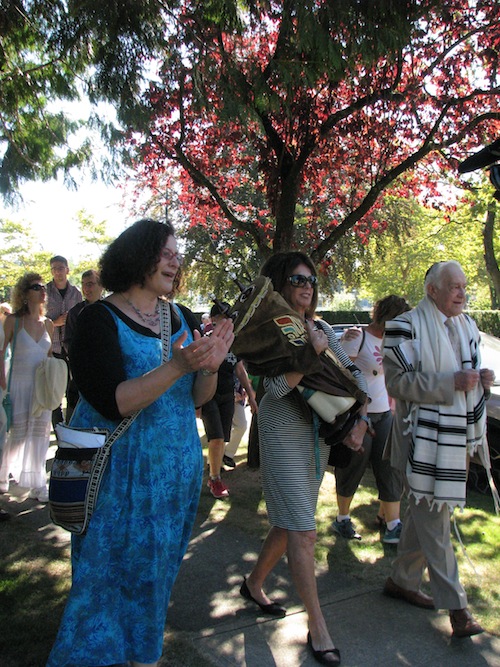
The energy was palpable last Sunday, Sept. 14, as congregants from Vancouver’s oldest Conservative synagogue gathered outside the Jewish Community Centre of Greater Vancouver. Everything was ready for the procession. The ark, which had been rolled out of its temporary home in JCCGV’s senior centre sat nearby, housing the synagogue’s three Torahs. Congregants were dressed in their best sun hats, and everyone had their walking shoes on.

photo - Baalat Tefillah Debby Fenson and congregants escort the Torah to its new home
Baalat Tefillah Debby Fenson and congregants escort the Torah to its new home. (photo by Jan Lee)

Even Vancouver’s weather was cooperating, with warm temperatures set for the unprecedented celebration. The members of Congregation Beth Israel, who had trepidatiously turned their synagogue over to architects and builders almost two years ago, were ready to return home.

A little more than a kilometre away, a new building sat in the final stages of construction, with a new address and a sweeping landscaped entrance facing the quieter side street. The makeover, which had been more than a decade in planning, was coming to fruition.

For the congregation’s 630-plus families, its upgrade represents more than the loving reconstruction of a 1940s landmark. As BI president Peter Lutsky lightheartedly said, the makeover is BI’s latest stage in “re-jew-venation,” a process that has been a part of the synagogue’s life and identity since the 1970s, when the first major retrofit took place to accommodate an aging building and a burgeoning membership. And it’s a process, said Lutsky, that has built itself upon the congregation’s belief that more than 80 years after its founding, it can still transform itself to meet new needs and new perspectives of what makes a Conservative Jewish community.

For today’s BI community, said Rabbi Jonathan Infeld, that concept is embodied by its inclusiveness; a divergence from the synagogue’s earlier image when elevators were added “as an afterthought,” where the bima towered high above the congregants and families had to decide between the responsibilities of child-minding and the desire to attend services.

photo - Cantor Lawrence Szenes-Strauss leads the community in song. (photo by Jan Lee)
Cantor Lawrence Szenes-Strauss leads the community in song. (photo by Jan Lee)

Those elements have now been factored into the synagogue’s structure. “We have a play-and-pray space right next to the sanctuary so that young families will be able to have their children playing in a room that is right next to the sanctuary,” said Infeld.

It’s a vision that keeps pace with today’s Canadian concepts of inclusiveness as well, in which mobility needs don’t restrict one’s ability to participate in community. All areas are physically accessible, including the bima, which is set low to the ground.

“This is certainly part of our consciousness: making sure everyone feels welcome and is able to enter and utilize the building is certainly important,” Infeld explained.

Getting to this point, however, has taken much more than planning. It’s taken constant fundraising, almost all of which has been raised within the BI community.

“We’ve raised over $16 million from our Beth Israel community,” much of which was done, said Lutsky, through the strength and dedication of its fundraisers, who applied themselves round the clock for years to raising the necessary capital for each stage of the reconstruction. He likened each gradual success to completing “another link in the chain” of progress.

photo - Rabbi Jonathan Infeld and Cantor Lawrence Szenes-Strauss celebrate outside the synagogue
Rabbi Jonathan Infeld and Cantor Lawrence Szenes-Strauss celebrate outside the synagogue. (photo by Adele Lewin Photography)

Lutsky credited Gary Averbach, who spearheaded the capital campaign, and Shannon Etkin, the synagogue’s executive director, for the far-sightedness that allowed the congregation to raise the funds and, at the same time, meet the opening deadline on time, with a Torah procession and a gala dinner to follow.

Later, Etkin told the Jewish Independent that the day went on without a hitch, with some 400 people at the opening, and a sold-out 500-seat dinner.

“We hope that’s a good portrayal of things to come for BI in the future and all other events we have here,” said Etkin, who added that the greatest gratification was seeing “the surprise on the faces of our members who couldn’t believe this new synagogue was actually here.”

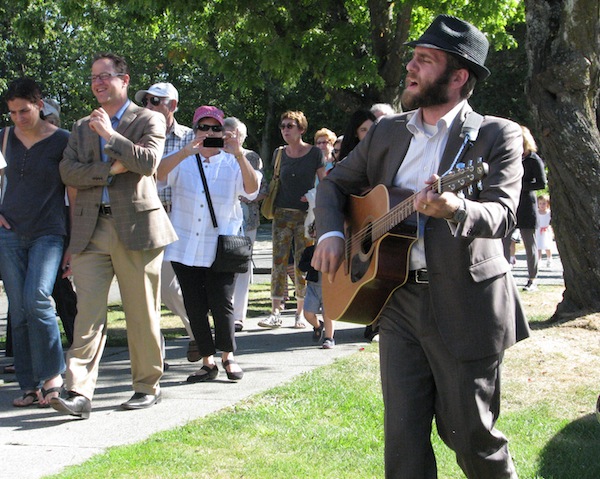
Cantor Lawrence Szenes-Strauss said that, from his perspective, the greatest takeaway from the opening was the engagement he saw on people’s faces as they accompanied the Torahs the last block and a half to the shul. Due to the distance from the JCCGV, the Torahs were accompanied to two vehicles in the JCCGV parking lot, and then escorted by car to the corner of Willow and 28th, where the community reunited and joined in song the rest of the way to the shul.

“It was fun,” he said. “People were excited. [They] were dancing all the way up there; it’s the way it ought to be.” He said he hoped the excitement that he saw would carry forth into future events as the community settled into its new surroundings.

photo - Beth Israel executive director Shannon Etkin lifts the Torah during the dedication of the new building
Beth Israel executive director Shannon Etkin lifts the Torah during the dedication of the new building. (photo by Adele Lewin Photography)

“I think what we saw there was a hint of how Simchat Torah could be, for example,” added Szenes-Strauss, who was optimistic that the move would encourage more turnout. “If we treat the chaggim, and even Shabbat, with that much anticipation, then we can boost our already high energy levels to a new point. And I think we’re going to have a natural boost now that we’re here.”

Infeld said that amid the festivities, it was important to remember the point of this reconstruction, which was to provide a home and a place for the community to come together, to celebrate, to grow, but always with the cognizance that “building is the container of the spirit” that embodies Judaism. “Ultimately, we are more concerned about the soul of the synagogue; that is why we exist,” he said. “And we are delighted to have a physical building that will facilitate all of the important and hard work we are doing, all the programming and building of community…. Ultimately, whatever the building is, wherever we are, Congregation Beth Israel is dedicated to bringing Jews closer to God, Torah and Israel. That is our primary existence, [and] we must not lose sight of this.”

Jan Lee’s articles have been published in B’nai B’rith Magazine, thedailyrabbi.com and Voices of Conservative and Masorti Judaism. She also writes on sustainable business practices for TriplePundit.com. Her blog can be found at multiculturaljew.polestarpassages.com.

Format ImagePosted on September 26, 2014September 25, 2014Author Jan LeeCategories LocalTags Congregation Beth Israel, Jonathan Infeld, Lawrence Szenes-Strauss, Shannon Etkin
JFSA Innovators Lunch raises record amount

JFSA Innovators Lunch raises record amount

David Chilton, second from the right, with Josh, Michelle and Dr. Neil Pollock. (photo by Robert Albanese Photography)

More than 650 people attended the Jewish Family Service Agency’s 10th annual Innovators Lunch on May 1. This year’s keynote speaker was Wealthy Barber author and Dragons’ Den investor David Chilton.

JFSA board chair Joel Steinberg welcomed attendees to the event, which took place at the Hyatt Regency Vancouver, and introduced Beth Israel Rabbi Jonathan Infeld to make the HaMotzi. The rabbi explained the blessing and connected it to JFSA, describing the agency as “God’s partner in sustaining the most needy in our community, working together and bringing God’s blessing down from heaven and providing it in a real way.”

In his thanks and remarks, Steinberg noted how the Innovators Lunch had grown over the years, generating “significant funds for many important programs and services provided by JFSA.” Through corporate sponsorships, ticket sales and donations, this year’s lunch raised a record amount – more than $315,000, JFSA director of development and communications Audrey Moss told the Independent Monday.

The annual video, introduced by JFSA executive director Charlotte Katzen, not only highlighted the services offered by JFSA – this year focusing on mental health counseling and outreach – but celebrated the driving force behind the Innovators event, Naomi Gropper Steiner z”l, whose “dream, vision and tireless efforts” helped launch it. As the program noted, “Naomi was a remarkable person who dedicated her exceptional talents to helping others.”

Event chair Jackie Cristall Morris echoed those sentiments in her comments and offered thanks to all those who contributed to the lunch as she invited Dr. Neil Pollock to the podium. He and his wife Michelle were this year’s event angel donors, matching dollar for dollar any new gifts or portion of increased gifts, up to $20,000. “I can see that every additional dollar that I give helps to make the life of someone in need, in our local community, a little bit better. That is why we decided to offer the matching gift opportunity for the JFSA this year,” he said. Pollock praised JFSA as “a lifeline” for many, and encouraged everyone to give outside of their comfort zone, reassuring them that it would not change their circumstances, but would help change the lives of JFSA clients.

Shay Keil of Keil Investment Group at ScotiaMcLeod, which co-sponsored the lunch with Austeville Properties, introduced Chilton, who proceeded to entertain the audience with several jokes and stories, all of which had a humorous element. He started off bemoaning Fifty Shades of Grey’s unseating of The Wealthy Barber as Canada’s all-time bestselling book. He then recounted what happened when he first returned to public speaking after a brief retirement, during which he was engaged in various projects, including homeschooling his kids for a few years.

His first tour was for CIBC, he said, speaking to the company’s high-end wealth-management clients, and it started in Victoria. It was an elderly crowd. He joked, “The average age was deceased…. I normally talk about save 10 percent and max your RRSP; these people were too old for RIFs. I didn’t know what to say.” When he finished his speech, two elderly women asked his advice on their portfolio. “‘Well,’ he said, ‘I can’t answer that here. I don’t know your risk tolerance level, your pension involved, your income needs, your age, your health, I’d have to ascertain all that before I can give you any advice.’ And the second lady cut in and said, ‘Please just give us a broad general counsel.’ And I said, ‘Well, do you mind me asking how old are you two?’ She said, ‘We’re twins … we’re 93.’ I said, ‘Oh my, I’d spend it.’”

When the laughter subsided, Chilton shared a couple of funny stories about the beginning of his career. One happened at the start of his tour for The Wealthy Barber. He was waiting at the Calgary airport for a flight and visited the bookstore. Seeing his book on display, he offered to sign some copies, only to have the clerk want to know why he would want to do that, not believing that the 25-year-old in front of her could have written it.

The entire season of Dragons Den is filmed in 21 days and, for these 21 days, the dragons must always wear the same clothing because the decision as to which pitches form each individual show are made only after all the filming is complete.

Chilton spoke of how he became involved in Dragons’ Den (“I’ve had so much fun doing the show”), how it has changed his life (he’s no longer always asked whether it’s best to pay off one’s mortgage or max one’s RRSP, but rather whether his fellow dragon, Kevin O’Leary, is really a jerk), how it attracts very passionate fans, some of whom are inspired to go into business, and a few of his favorite entrepreneurs and most profitable or surprising investments. He also shared other tidbits. He explained, for example, that the entire season is filmed in 21 days, over which they see 230 pitches. For these 21 days, the dragons must always wear the same clothing because the decision as to which pitches form each individual show are made only after all the filming is complete, and there needs to be continuity within each show.

Outside of Dragons’ Den, Chilton has invested in other businesses. Notably, he helped cookbook authors Janet and Greta Podleski – after about a year of them wooing him. He spoke with obvious fondness and admiration for the sisters, who almost went bankrupt (paying their mortgage with credit cards!) before they saw success. Their first book, Looneyspoons, spent almost two years on the national bestseller list and sold 850,000 copies in Canada alone. They have since published more cookbooks and expanded into other food-related ventures.

Chilton ended his speech with a call for perspective. Describing himself as always being in a good mood, he noted that this isn’t the case with many others. “People say that Canada’s national pastime is hockey, but I’d argue, after 25 years on the road, it’s complaining. Everywhere you go,” he said, “people whine about absolutely nothing. It is amazing to me how many people voluntarily decide to be in a bad mood about a trivial matter.”

An economist by training, Chilton said, “I believe the number one thing holding back productivity in many people’s lives is their whining and complaining, they’re always focused on something negative and it’s usually something trivial. People have lost perspective. In Canada, we have lost the ability to discern the difference between a minor inconvenience and a major problem. A long lineup at Tim Horton’s is not a major problem, but it spins people into bad moods for hours. It’s crazy. Look around the world right now and what’s happening in so many places, Ukraine obviously, but think about Syria. We’re talking about a relatively wealthy developed country disintegrating right in front of our eyes, and it’s happening everywhere in the world.”

“I’m telling you right now, if you are healthy and you live in Canada, especially if you live here [in Vancouver], it doesn’t get any better than right here and right now. You’ve got to step back and see how fortunate we are. It’s that perspective, I think, that leads to more generosity, more community involvement, all of that.”

Not only are Canadians better off relative to most other countries, but to previous centuries. “We are living such better lives than at any point in history. It’s crazy that people don’t notice that. And I’m not talking back to medieval times, I’m talking 20 and 40 years ago, one or two generations. Everything, and I repeat, everything is way better now than it was then, everything.” He gave many examples – cars, phones (which now have “more computing power than the entire Apollo 11 mission”), air travel, television, wages, home sizes and building materials, health care. “I’m telling you right now, if you are healthy and you live in Canada, especially if you live here [in Vancouver], it doesn’t get any better than right here and right now. You’ve got to step back and see how fortunate we are. It’s that perspective, I think, that leads to more generosity, more community involvement, all of that. That’s what days like this are all about.”

For more information about JFSA, call 604-257-5151 or visit jfsa.ca.

Format ImagePosted on May 9, 2014May 8, 2014Author Cynthia RamsayCategories LocalTags Audrey Moss, Charlotte Katzen, David Chilton, Dragons' Den, Greta Podleski, Jackie Cristall Morris, Janet Podleski, Jewish Family Service Agency, Jonathan Infeld, Looneyspoons, Neil Pollock, Shay Keil, The Wealthy Barber, The Wealthy Barber Returns

Posts pagination

Previous page Page 1 Page 2 Page 3
Proudly powered by WordPress