wikimedia.org: תמונה

wikimedia.org: תמונה
U.S. President Barack Obama has sent a letter to the Ayatollah Ali Khamenei requesting Iran’s support in the battle against ISIS. At a time when Israel’s relationship with the American administration is strained, the letter (which was apparently sent back in October and whose existence was recently reported by the Wall Street Journal) has sparked a great deal of reaction.
Stopping the Islamic State is and should be a global priority, but the softening of attitudes toward Iran’s regime is a concern. While there appears to be some progress in talks on Iran’s nuclear program – negotiations that are rapidly approaching a Nov. 24 deadline for an agreement – the hatred directed at Israel is as vibrant as ever. Just days ago, Khamenei tweeted an infographic titled “9 Key Questions About Elimination of Israel.”
The graphic design is better than the English grammar, but the message is unmistakable. No less than ever – and regardless of what we may read suggesting schisms in the highest reaches of the regime – the top leader is as committed as he ever was to the annihilation of Israel.
While insisting that, “of course, the elimination of Israel does not mean the massacre of Jewish people in the region,” the emphatic message is, put mildly, unwelcoming. Still, the world seems convinced that it’s a bluff. To see events at the United Nations, one would think it was Israel that was threatening to obliterate another member-state. Commentators dismiss destructive rhetoric like Khamenei’s as propaganda for domestic consumption, but most Jews, and anyone with a sense of history, take seriously threats like this at any time, but particularly in the week that we commemorate both the 76th anniversary of Kristallnacht and Remembrance Day.
Meanwhile, U.S. Secretary of State John Kerry insists any Iran overture is unrelated to the broader issues of the Middle East, as if the interconnected web of intrigues, hatreds and alliances could be unraveled from one another. And then, as if there are not enough issues in the world with which to be concerned, European states are lining up to recognize the “state of Palestine.” These legally meaningless but symbolic votes by Britain and Sweden, with more legislatures intending to follow suit, are meant to force negotiations toward a two-state solution, with an underlying assumption that Israel is to blame for the lack of progress. All the incitement to violence by Palestinian leaders and the recent upsurge in vehicular murders and stabbings of Israelis are blamed on the Israelis themselves, who must somehow deserve what they get.
Often, commentators, including Kerry recently, state that resolving the Israeli-Palestinian conflict is the lynchpin to resolving the broader conflict in the region. By obsessing about Israel, the UN, European powers and others are wasting their energies on a sideshow while the feature presentations get short shrift.
Zeruya Shalev (photo by Naomi Tokatly)
In The Remains of Love, her latest novel to be translated into English, Zeruya Shalev once again explores (and crosses) intimate emotional boundaries. In this novel, however, she also overtly explores territory that she has actively resisted – Israel, where she was born and still lives.
“In my previous works, I avoided relating to the Israeli reality in a straightforward way,” Shalev told the Independent in an email interview. “The readers could have sensed it only indirectly – through the reckless pace, the intensity and perhaps even the pessimism. In this book, however, I felt an urge to open more windows to the Israeli reality – such as the history of the kibbutz and the burning issues of human rights. Each book has its own needs. Many issues that did not fit right in the previous books with the previous protagonists found themselves fitting perfectly into this one and its characters; this is because the Israeli reality affects them in a deeper and a more profound manner. And yet, still I am wrestling with the dominance of this reality, and try not to let it take over my books – it’s enough that it controls my life.”
Shalev included a winking emoticon after this last comment, indicating that the remark should be taken with a grain of salt, or at least not as seriously as it reads. She has an engaging manner and a sense of humor, which comes through in her writing (amid the serious, emotional and provocative material) and especially in interviews (there are several available on YouTube). In addition to her talent as a writer – her novels are critically acclaimed and have garnered various awards – Shalev is a thoughtful, friendly and relaxed interviewee. She is a great choice to launch this year’s Cherie Smith JCCGV Jewish Book Festival on Nov. 22.
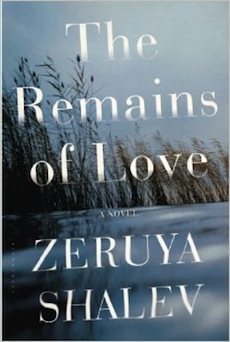 The Remains of Love (Bloomsbury, 2013) centres around a dying woman, Hemda Horovitz, and her two adult children, who each have families, foibles and problems of their own. Her favorite, Avner, is a human rights lawyer; he is questioning everything about his life, whether he has made a dent in the inequality and injustice in the world, as well as his relationship with his wife and sons. Hemda’s daughter, Dina, has devoted herself to her own daughter, Nitzan – giving her the love she never received from Hemda – but, like most teenagers, Nitzan is pulling away, so Dina looks to adopting a child to fill the void, even though her husband and daughter are against it.
The focus on three protagonists required a change in style for Shalev.
“In my previous novels, I concentrated on one protagonist, and followed her stream of consciousness in the first person, which creates immediate intimacy,” she explained. “The first person traps the readers in the inner world of the character, and even when he or she depicts other characters, they often seem like a projection of his or her own qualities. In this book, I wandered between three minds, three streams of consciousness, and the third person enables me much space and flexibility. At first, I was afraid that the third person might hurt the intimacy of the voice, but in retrospect it seems (or at least I hope) it didn’t. The first person is completely monogamous, and the third person gives you more freedom, which I and my protagonists needed for this book.”
The literal translation of the novel’s title is “the shards of life.” In the French version – and perhaps in other languages, too – chayyim is translated as “life.” However, Philip Simpson, who does a skilled job of translating the book’s content, style and emotion, chooses the word “love.”
“The French title of the book is more loyal to the original title in Hebrew (The Remains of Life) than the English one,” acknowledged Shalev. “Yet my English publisher (in the U.K. and U.S.A.) turned to me and explained that this name does not possess enough beauty and lyric in English; I therefore agreed to change it. We tried together to find a new title that would fit the themes in the book, and also be of poetic value, and this is how we got to this name. It is indeed interesting to realize how easily one can substitute the word ‘life’ for the word ‘love.’ All three protagonists of this book are indeed longing for love, all are experiencing it as a drug-of-life, each in their own unique way. Life without love seems to them tasteless, and they are all willing to go a long way to find it; not only in the footsteps of romantic love, but the love for a child, a brother, for life itself.”
Shalev’s Vancouver visit is part of a tour that begins in Houston and which also stops in Detroit, New York and Chicago.
“Unlike the dozens of tours I have done in Europe, I haven’t had many professional visits in the U.S. and Canada,” she said. “I am very much looking forward, especially to seeing Vancouver, which I heard is amazingly beautiful. As someone who has lived her entire life in a warm and desert land, I admire the cold weather, the mountains and lakes.”
Hopefully, she also likes rain.
***
The Sol & Shirley Kort Author Series will feature Zeruya Shalev in conversation with the Globe’s Marsha Lederman on Nov. 22, 7:30 p.m., in the Rothstein Theatre. Tickets ($20) are available from ticketpeak.com/jccgv or the Jewish Community Centre of Greater Vancouver, in person or by calling 604-257-5111. For the full Cherie Smith JCCGV Jewish Book Festival lineup, visit jewishbookfestival.ca.
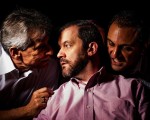
Left to right, Jerry Wasserman, James Gill and Mehdi Darvish star in United Players’ production of Facts. (photo by Doug Williams)
United Players is set to present Canadian Jewish playwright Arthur Milner’s provocative political drama Facts, loosely based on the true story of the 1992 murder of an American archeologist in the West Bank and the joint Israeli/Palestinian police investigation that followed.
The play has been produced in Ontario and the United Kingdom and was translated into Arabic for a tour of various West Bank cities in 2012. The United Players’ production marks the play’s Western Canadian première, with Jerry Wasserman as Yossi, the hot-headed Israeli detective; Mehdi Darvish as Khalid, Yossi’s Palestinian counterpart; and James Gill as Danny, the fervent settler accused of the murder. Adam Henderson helms this production as it navigates its way through some rough waters, exploring not only the Israeli-Palestinian conflict but also the religious-secular divide between Jews within Israel. The action takes place in a cramped, hot interrogation room in the West Bank and, as the story unfolds, it is revealed that the archeologist was unearthing facts that brought into question some accepted historical beliefs fundamental to Judaism.
The Jewish Independent sat down with Wasserman, Henderson and Darvish one morning before a rehearsal.
Wasserman – who is also a theatre critic and head of the theatre and film department at the University of British Columbia – described himself as an American Jew brought up by liberal Jewish thinkers. He said his research and immersion into this play angered him, but made him see the Middle East conflict in a new light. “This play really presses a lot of emotional buttons for me,” he said. “It digs down through layers into very specific details of [the] lives of people and, through this complexity, we see things more clearly.”
As to his character, Wasserman said, “Yossi’s father was a Zionist who had a dream of a state which has been compromised by the new wave of radical settlers who he sees as having a medieval way of thinking…. This has changed the state of Israel that Yossi loves. The real conflict in this story is not between Yossi and Khalid, but between Yossi and Danny.
“Because Yossi operates at a high emotional temperature, I had to find the proper rhythms and the right places to come up and go down so that I did not peak too early. There were many challenges, but it was infinitely fascinating. You don’t get too many chances to play a role like this.”
The heart of the story is the investigation, as the two detectives sift through various pieces of evidence and theories on the murder.
“I have acted in over 100 police dramas, both television and cinema, and I have to say that this, by far, is the most complex, sophisticated and confusing ones I have ever been involved in,” said Wasserman. “The research has been very detailed and the play is very accurate, re: police investigation and techniques. It is a tremendous intellectual puzzle. The evidence is circumstantial and we never find the smoking gun. The dialogue is an emotional mine field that we, as actors, all have to move through.”
Police dramas often feature a good cop/bad cop relationship. As to whether or not audiences will get to see that dynamic, Wasserman said, “Yossi tries to act the good cop but he is the bad cop by nature. He has lots of emotional buttons to press. The great thing about this play is that everyone’s buttons get pressed. Everyone has a turn to make impassioned monologues and everyone gets to lay his emotional/political cards on the table.”
Gill finds his role of Danny an interesting challenge. “While so much of his absolutist approach to his faith and his politics is antithetical to my own liberalism, nonetheless, being a Jew gives me an empathy for where his faith and politics are grounded,” he said in an email. “That gives me a starting point from which I can start to encompass the character.”
He sees the essence of the play as “the way in which these three men both conform to and transcend their stereotypes. We start with the ‘facts’ of an Israeli, a Palestinian and a settler and, on one level, each of these men is true to those simplistic profiles, but we discover that each of them is much more complicated.”
For Darvish, his involvement in the play also gave him new insights into the conflict. “I came to understand the Israeli position from an emotional perspective better as a result of working on this play,” he said, “but I also see more deeply the Palestinian position. I see the characters often acting like children throwing tantrums instead of sitting down and logically dealing with the situation. It saddens me because right now I do not see a resolution to the dilemma.”
Henderson said he enjoys working with a small cast and a modern-day setting, which contains no idiosyncrasies as to period or language. With an all-male cast, the action is testosterone driven and reflective of the politics of the Middle East, he said.
Henderson expressed surprise that more Canadians do not know about Milner, whose work he has come to appreciate more during the course of his research and preparation for this production.
“Milner has taken a very sensitive subject and effected meticulous research to create a platform to encourage serious dialogue,” he said. “His position is Socratic – he wants to encourage discussion versus making a point and this is brought home by his equivocal ending.”
Henderson acknowledged that the play is likely to be controversial but stressed that, “the key to theatre is that it is a thought experiment where we can do dangerous things with no consequences except people might have their perspectives broadened. If that is what happens in this play, then we will have accomplished something.”
He added, “As the news media move toward ‘infotainment,’ and the sound bites become faster and shallower, the longer form of theatre allows us to look a little deeper at things. For me, it is critical to protect ourselves from merely having our prejudices reinforced. Theatre was invented as a public forum, and we need to gather, to discuss, now more than ever.”
As to why Vancouverites should see the play, Henderson said, “It is an unusually well-crafted play. It is funny, witty, challenging and surprising, and you won’t find anything like it on television. Also, this is a great opportunity to dress up, go out and mingle with community and exercise the soul. Parking is easy and you come out after the show by the beautiful Jericho Beach with something new to talk about.”
Facts is at Jericho Arts Centre from Nov. 7-30. As an added feature, there will be a reading of Masada, Milner’s companion piece to Facts, after every Friday performance. Milner will be in Vancouver the week of Nov. 11 and will be attending performances during that time. For tickets and more information, visit unitedplayers.com.
Tova Kornfeld is a Vancouver freelance writer and lawyer.
Zionism promised to make the desert bloom. Of course, as they were literally making this happen, the chalutzim could not have imagined the figurative blooming that would come decades later, when Israelis would lead the world in new technologies and other economic innovations.
A new report from Credit Suisse quantifies just how successful Israel has been. And while it isn’t a surprise, in some ways, it is a symbol of astonishing achievement when taken in historical context.
The Swiss bank’s Global Wealth Report takes into account the assets, minus debt, of households and individuals, including savings, real estate and investments. By this measure, Israelis are the sixth wealthiest people in the Middle East and Asia, bested only by Australia, Singapore, Japan, New Zealand and Taiwan. With a per capita net worth between $150,000 and $175,000, Israelis are on par with, or exceed, the average European. And the wealth is distributed more evenly than it is in the United States. Not only that, but the trajectory is especially impressive for Israelis, with assets growing about 14 percent in the past year. (In Canada and the United States, the world’s wealthiest region, the average net worth of an adult is $340,000.)
The tiny country with effectively no natural resources, facing adversity and existential threat since its inception, has built a thriving economy that delivers for its citizens economic outcomes that exceed its oil-rich neighbors.
Of course, Israel’s detractors will not be impressed. Economic success is anathema to many of those who seek to boycott, divest from and sanction the Jewish state. To BDS supporters, every Israeli success is merely proof of misbegotten advantage due to exploitation or imperialism or worse.
Yet all the economic and social misery that surrounds Israel can be attributed in part back to the fatal decision nearly seven decades ago by the Arab League to have no truck nor trade with the Jews.
It is not a coincidence that the Credit Suisse report considers Canada and the United States in a single unit. Our economies are integrated enough to enjoy synergies (and yet distinct enough that the full impact of the 2008 global recession did not slam Canada as hard as it did the United States).
Were Israel as integrated into its regional economy as Canada’s is in ours, the economic miracle it represents could have spawned parallel, related success stories all around it. It still could.
A few voices in the Arab Middle East are finally speaking up to suggest that the decades-long isolation of Israel should end. Such a rapprochement would be good for Israel, to put it mildly. But it would be economically beneficial for the entire region. If economic self-interest were the defining impetus for Arab Middle East foreign policy, peace might be not so distant a dream.
An Eli Chissick-designed mirror, which will exclusively be available from SwitzerCultCreative in November. (photo from SwitzerCultCreative)
You could say Renee Switzer got her love of the furniture business from her grandfather, who arrived in Canada from Poland in 1920 and opened a second-hand furniture store in Calgary. The tradition continued when her father entered the industry, too, with a company specializing in the manufacture of antique reproductions. Switzer worked in the family business until it was sold in 2010. A year later, she launched SwitzerCultCreative, motivated by a desire to create opportunities for Canadian designers.
“I love the furniture industry and the people involved in it, and I wanted to maintain the contacts I’d developed over the years,” she told the Jewish Independent. “After I moved from Vancouver to the Sunshine Coast in 2006, I discovered there’s a tremendous amount of homegrown talent that’s hidden away and needed to be developed and promoted, so that’s what I decided to do.”
Switzer builds and maintains business relationships between furniture designers, the craftsmen who create those designs and the clients who purchase the finished product. Her focus is modern, luxurious and sustainable 21st-century designs and her emphasis is on knowing every detail about the products she represents. That includes how pieces are made and finished, what materials are used, who creates and builds those pieces and why they are environmentally sustainable.
Among the collections she promotes is the Coupland Collection by Canadian novelist Douglas Coupland, the Baumhaus Collection by Jess and Nicolas Meyer, the Barter Collection from Kenneth Torrance and the AHRPA Collection created by Umberto Asnago, an Italian furniture designer.
More recently, Switzer was also determined to find an Israeli designer whose work would fit in with the collections she already promotes. “I really believed it was important to try and do something to counteract all the anti-Israel boycotts going on right now, boycotts that are nonsense,” the Roberts Creek resident said.
In an effort to find the right fit, Switzer began reaching out to organizations in Israel, making inquiries about different designers. When she saw the work of Eli Chissick, its high quality and focus on sustainability resonated with her immediately. “His pieces are unique and made primarily from salvaged woods,” she said of the 30-something award-winning designer. “He’s interested in sustainability and, though it’s hard to reduce the carbon footprint of a designer based in Tel Aviv, we are able to do that by making his pieces in North America.”
Chissick is a designer, artist and carpenter who is passionate about environmental sustainability. His latest series of recycled art is called “Wood-Con-Fusion” and each piece within the series began its life as an off-cut on the floor of a carpentry studio, destined for the scrap heap. “Eli is able to see the potential in the most unassuming pieces of fibreboard, veneer and Formica, and nothing goes to waste as he collects and sorts these pieces and presses them into sheets, which he uses to create unique pieces of furniture,” Switzer explained.
Two of Chissick’s designs are presently being manufactured in Vancouver and will be ready in November, licensed exclusively to SwitzerCultCreative. His five-foot mirror will sell for $2,800 and Switzer is confident it will quickly find a home.
Her buyers are primarily interior designers and architects for residential and hospitality projects all over North America through sales representatives with whom she has exclusive relationships and who believe in the products she represents. With no physical showroom in Vancouver, most of Switzer’s pieces are exhibited on her website, switzercultcreative.com. Her company also sponsors an annual design competition for students, where the winner has their design built and marketed for a year by SwitzerCultCreative. “Our aim is to promote unknown talent by providing a launching point for new designers to build their own brands,” said Switzer.
Lauren Kramer, an award-winning writer and editor, lives in Richmond, B.C. To read her work online, visit laurenkramer.net.
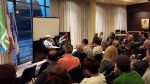
Jewish National Fund Pacific Region brought in IDF veteran Ari Zecher to speak. The talk, moderated by Geoffrey Druker, left, talked to a group at the Jewish Community Centre on Sept. 22. (photo from JNF-PR)
This Rosh Hashanah, the Vancouver Jewish community was visited by Ari Zecher, who served in the Israel Defence Forces Maglan special forces unit during Operation Protective Edge in Gaza this past summer.
Part of the Jewish National Fund’s High Holiday appeal to help build mobile bomb shelters in Israel, Zecher was invited to share his experience as a soldier and as a young Israeli during this tumultuous time. Speaking at the Jewish Community Centre of Greater Vancouver and at various synagogues, Zecher thanked the local Jewish community for its unfailing and ongoing support, and highlighted the need for young and fresh ideas to move Israel forward towards a peaceful future for future generations.
Ilan Pilo, Jerusalem emissary and executive director of JNF Pacific Region, said: “We are grateful to Ari for taking the time to interact with over 1,000 members across our community and for speaking candidly about Israel’s challenges and hopes. As in the past, this year, JNF will continue to dedicate its work to enhancing the invaluable bond between Israel and the Canadian Jewish community in general, and our Vancouver community in particular. JNF salutes everyone who has made, or will make, a donation towards the important cause of keeping children in Israel safe during such difficult and uncertain times.”
For more information on the JNF’s bomb shelter campaign, call 604-257-5155 or visit vancouver.jnf.ca.
It’s a question that defines the debate over Israel’s policies and the state’s grand strategy: do Israeli human rights organizations monitoring the occupation merely serve as a fig leaf, adding an ethical patina to what is a fundamentally immoral situation?
Four months into his new position as head of B’Tselem, having come from the Association for Civil Rights in Israel, Hagai El-Ad and I spoke by phone recently about this and other issues. [To read the JI’s interview with El-Ad, click here.]
Given that the Israeli occupation of the West Bank and Gaza was supposed to be “temporary,” El-Ad is well aware that “at some point the term loses its meaning.” So, as he took the helm of B’Tselem last May, the organization issued a position paper provocatively named 47 Years of Temporary Occupation. As El-Ad put it, B’Tselem is shifting its focus from “fighting against human rights violations under occupation to a strategy [emphasizing] that the occupation will forever violate the human rights of Palestinians.” To this end, B’Tselem is now trying to end the occupation – not just help manage it.
It’s a laudable goal. But how achievable is it?
B’Tselem is starting with some concrete steps, however limited. For one, they have recently announced that they will not cooperate with Israel Defence Forces military investigations around Operation Protective Edge. Calling it “theatre of the absurd,” El-Ad believes that the military investigation system is one intended to “always result in impunity.” And this protected military violence is a necessary “lifeline of the occupation.” Hence, the need to squelch it.
As far as the bigger picture goes, El-Ad was cautiously optimistic: probably a necessary blend for anyone in human rights work in the Israel/Palestine morass. He takes comfort from what he sees as B’Tselem’s mission being fundamentally buttressed by the very human rights discourse extant in Israel. That the concept of human rights is a “relevant currency” in Israeli politics gives the organization an important starting point by which to leverage societal consensus. Though without the clout or mandate to engage in electoral lobbying efforts, working to end the occupation must be done very much at arm’s length from the policy sphere. Still, it’s a start.
El-Ad adds that he invites others to see what they can do “in their own communities” to disrupt the idea of the occupation as “business as usual.”
OK, so most of us can agree that the occupation is an undesirable situation, but what about the argument, issued frequently by Israel’s most strident defenders, that the status quo is a security imperative? If Hamas didn’t launch rockets, the thinking goes, the war in Gaza wouldn’t have been necessary. And, if West Bank Palestinians didn’t seek to blow up Israelis, the checkpoints and night raids and (the various) separate roads could be dismantled. And we all know about the apartheid, uh, separation, ahem, security wall.
Trading off between security on one hand, and human rights and ending occupation on the other, is a false dichotomy, El-Ad explained. In Gaza, “we’ve encountered time and again the theory that using more and more force will provide the desired outcome. But that’s not really working.” When it comes to day-to-day military policing in the West Bank to ensure the safety of Israeli citizens, we all know the chicken-egg argument: the internal checkpoints would be unnecessary were there not settlements (illegal under international law) to protect, hence, B’Tselem’s claim, in its 47 Years of Temporary Occupation document, that settlements are “the heart of the matter.”
Now that the fighting in Gaza has died down, B’Tselem is reflecting on its work compiling data on casualties, monitoring international humanitarian law violations – including by Hamas – and collecting first-person testimonies, attempting to put a face to the Palestinians in Gaza. El-Ad is quick to note that the media coverage in Israel tended to be one-sided, with little coverage of the war experience for Gazans. As an antidote, B’Tselem relied heavily on social media and web coverage to get additional information disseminated, despite a hacking attempt that left their website site crippled for a few days.
After talking to El-Ad, I’m left with a strange combination of hope and cynicism. As someone who cares deeply about seeing an end to the occupation, I’m buoyed by the fact that the head of Israel’s most important human rights organization has this broader goal top of mind. At the same time, absent the apparent political will in the top echelons of the Israeli government, I can’t escape the belief that intelligent, passionate and committed Israeli change-makers like El-Ad are too often left clapping with one hand.
Mira Sucharov is an associate professor of political science at Carleton University. She blogs at Haaretz and the Jewish Daily Forward. A version of this article was originally published on haartez.com.
As a harvest festival, Sukkot is infused with thanksgiving for the bounty that Jews in Canada and, mercifully, in most of the world today, enjoy. The holiday is also an earthy affair, as we move out into our backyards (or, in some cases caused by this hot housing market, our sliver of a balcony) and into temporary shelters inspired by those used by the Israelites during the 40 years of exodus in the desert. The emphasis of the sukkah is on impermanence and inhabiting one, even if just for a meal, inspires reflection on the impermanence in our lives, including life itself.
Sukkot is immediately followed by Shemini Atzeret and Simchat Torah – and the juxtaposition is striking. On Simchat Torah, we celebrate the most permanent thing the Jewish people have experienced. On this day, we complete the annual reading of the Torah and immediately begin again, missing not a beat between the end of Devarim, Deuteronomy, and the beginning of Bereisheet, Genesis.
For a people who have known – who, indeed, have just finished a week of reenacting – historical impermanence, Simchat Torah is a reassurance that, in the face of all historical, social and technological change, at least one thing remains constant: the book that binds us in spirit and practice.
The Torah is a constant in times of change, and it is easy to take for granted that, in the long history of the Jewish people, we are living out one of the most dramatic epochs our people has ever known. For millennia, our forebears yearned for Zion, longing to celebrate next year in Jerusalem and to be a free people in our land. In our generation, this dream has come to pass.
The creation of the state of Israel has changed Jews, Judaism and Jewish practices in small and large ways. One of the most significant ways is the sense of permanence provided by a Jewish homeland. Yet, there have been times of war and terror when the dream has turned nightmarish. And there remain many in the world who would like Israel to be an impermanent way station, merely another sukkah, for the Jewish people.
Jews – in Israel and around the world – are determined that Israel should remain as permanent and enduring as the Torah. Yet, unlike the Torah, which has a definitive beginning and end, Israel’s borders are not recognized by the international community, nor is there a consensus in Israel about where precisely they should be in the event of a final status agreement for a two-state solution.
While Jews worldwide were contemplating construction of their sukkot, the United States and others were condemning Israel’s recent announcement of additional housing construction in East Jerusalem.
Such settlements do nothing to convince the world that Israel is acting in good faith vis-à-vis a two-state outcome. On the other hand, condemning construction as the primary obstacle to peace in the region is a difficult pill to swallow: there are more pressing impediments to peace on both sides of the conflict.
However, while settlements may not be the main impediment to peace, they are an attempt to build something relatively permanent in a region without clear borders. It seems a considerable waste of resources – human labor, building materials, money, time, even Israeli and Palestinian PR efforts and goodwill – to keep building, especially knowing that the area is disputed and, therefore, impermanent.
Such construction also raises the hopes and dreams of those who ultimately will live there – what happens if they are forced to move? Israel has demonstrated its willingness to uproot Jewish residents in Sinai and Gaza in exchange for the faint hope of peace.
Through history and ritual, Jews understand that most things are temporary, like settlements that eventually give way to compromise. We also understand that some things are meant to last, like Torah and like the irreversible redemption of the Jewish people to the land of Israel.
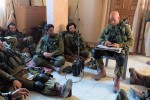
Israel Defence Forces soldiers debrief during the Israel-Hamas conflict. New Israel Fund of Canada’s president Joan Garson discussed the painful war of this past summer and the ongoing responsibility of liberal Zionists in Canada to push for Israel to be a model of democracy, pluralism and tolerance. (photo from IDF via Ashernet)
The Jewish state won’t survive without a Zionism that’s liberal and a liberalism that’s Zionist. Such was the recurrent assertion of Haaretz reporter and columnist Ari Shavit at the New Israel Fund of Canada’s (NIFC’s) annual symposium, held on Sept. 14.
Entitled The Future of Israel Starts Here and held at the Toronto Centre for the Arts, the free event drew almost 1,000 people and marked the fourth annual symposium for NIFC, an organization founded 29 years ago that describes itself as being committed to fostering the development of Israel as a Jewish and democratic state “as envisioned in her Declaration of Independence.”
The symposium was moderated by Joseph Rosen, who recently wrote an article called “The Israel taboo” in an issue of the Canadian magazine The Walrus.
The event featured Rosen interviewing Shavit via Skype, as well facilitating a lively discussion between Shavit and Akiva Eldar, chief political columnist at the online magazine Al-Monitor, who attended in person. NIFC president Joan Garson also spoke.
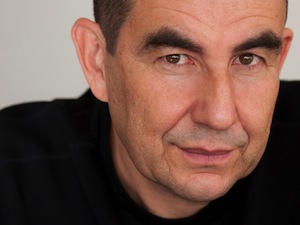
Shavit spoke passionately about how the Zionist community needs to “talk seriously and honestly about our own mistakes” and to acknowledge where the government of Israel has committed wrongs both on a moral and political level, such as with ongoing settlement building in the West Bank. He argued this must be frozen to give the Palestinians space economically and geographically and “to move toward a two-state solution.”
It’s imperative that Zionists stop treating Israel as being above criticism, he stressed. Zionists must look its sins in the face, address the arguments made on the other side of the conflict and “limit injustice to Palestinians as much as possible.”
Further, Shavit spoke about restoring Israel to its former “state of wonder,” its promise to serve as a refuge for Jews – “a home for our homeless” – and to be as just as possible.
“What happened in 1948 [when thousands of Arabs ran from or were driven from their homes and villages during the country’s founding] was in the context of the brutal history of the 1940s,” he said. “But after that, after we secured our existence at a terrible human cost for us and for them [the Palestinians], to go into the other 22 percent of the land and to try to co-opt it [through occupation and settlement building] is a huge mistake.”
But Shavit also argued that it’s unacceptable to exclusively demonize Israel for its injustices, as its critics often do, or to use the history of its founding to delegitimize it.
“Some of the world’s best democracies were founded on the terrible treatment of indigenous people. Israel can’t be singled out,” he said. “But let us remember our democratic past and try to build a future for the Palestinians.”
Garson discussed the painful war of this past summer and the ongoing responsibility of liberal Zionists in Canada to push for Israel to be a model of democracy, pluralism and tolerance.
“As liberals, we are activists,” she said. “We think it’s our job not just to sit on the sidelines, but to engage … to make Israel the country of its founders dreams…. When we see [Israeli] policies in need of change, we speak and we act.”
She added: “We must be honest with ourselves, our children and our congregations … to bring intelligence and clear thinking to Israel as we do to other issues … and to commit to telling the truth about the country to ensure there will be another generation of lovers of Israel.”
Rosen subsequently posed questions to Eldar and Shavit about whether liberal Zionism is “dead” and about the position of Israeli left-wing “peaceniks.”
Eldar, who described himself as a “radical peacenik,” argued that liberal Zionism is crucial to the future of Israel, but that it can’t coexist with the Israeli occupation of Palestinian territories.
It’s not enough to decry the settlements, he said, “we have to do something about it and call on every government in the world to do something.”
Eldar explained that he, therefore, does not buy products made in the settlements.
“If, God forbid, one of your friends was about to commit suicide, you would do everything to stop it,” he said “This [settlement expansion] is a suicidal project.”
Shavit later spoke about how many Israelis feel that Israeli “peaceniks” don’t care about them, that they’re more concerned with the well-being of the Palestinians than that of their own countrymen.
“We Israelis who advocate for peace need to love all our people, to go out and canvas and tell them why their future is connected to peace,” he said.
Eldar said the central problem is that fear seems to have become more effective than hope in addressing the Israeli-Palestinian conflict.
“We on the left are trying to sell hope,” he said. “I’m upset that people are trying to sell fear. Why not look at the glass half full? Look, for example, at how Egypt has worked with us [in the latest ceasefire negotiation between Israel and Hamas] instead of injecting more fear and saying we don’t have partners for peace in the region?”
He said that Israel needs to withdraw from the settlements, but not unilaterally. “We need to do it by making peace.”
– For more national Jewish news, visit cjnews.com.