It is the season of new beginnings: new school year, newly turning leaves and a new Jewish year. On a leisurely drive on Labour Day Monday in suburban Vancouver, bright orange pumpkins that weren’t there last time we passed had suddenly exploded into full-sized squash seemingly overnight. Summer, of course, is officially with us until Sept. 23, but, especially if your household has kids (or teachers), summer unofficially ended when the first school bell rang on Tuesday.
This is the time of year for reflecting back and looking forward. The promise and excitement of the new mixes with nostalgia and other emotions about the passage of time and memories – good or bad – of what we leave behind.
This coming Monday, we will hear from four speakers at FEDtalks, the launch of the Jewish Federation of Greater Vancouver’s annual campaign. Among them is Isaac Herzog, head of the Jewish Agency for Israel who (in last week’s Independent) acknowledged that one of the challenges our global Jewish community faces is engaging and involving young Jewish people. As students return to post-secondary campuses in British Columbia, across Canada and around the world, we can anticipate the usual challenges – some years better or worse than others – of campaigns, referenda and assorted political shenanigans that have particular impacts on Jewish students.
Understandably, young people who have grown up with connections to Judaism, Jewish peoplehood and Israel will take exception to some of the things they will face. Some will rise admirably in these encounters, as we have seen year after year, when students at Hillel, Chabad and some ad hoc Jewish and Zionist organizations have spoken out against misleading and false expressions on their campuses. Others, also understandably, will avoid such unpleasant controversies and focus on less polarized topics and activities. Those who take up the frontlines in these battles deserve our community’s support.
There are broader issues than Zionism on campus. Free expression is top of mind for many professors, students, parents and other interested parties. A particular flare-up over the summer involved the Vancouver Pride Society (VPS), which puts on the city’s largest annual event, banning the University of British Columbia and the Vancouver Public Library from participating in the Pride parade because they both provided space for presentations by speakers who are virulently vocal against the rights of transgender people. It was a rock and a hard place for many. The Pride society certainly has the right to welcome or exclude anyone they choose (although the amount of public funding and in-kind support they receive should require a degree of public accountability). But, seeing the province’s largest university and largest library system excluded from any event, for whatever reason, is upsetting. If ideas, however odious, cannot be discussed on a university campus or at a library, they cannot be openly discussed anywhere. Driving ugly ideas underground is not a solution. The answer to hate speech is anti-hate speech. And if, as critics said, the messages of the speakers were so insidious that they could lead to violence, then that was a job for the RCMP to confront, not, perhaps, the VPS.
A 2017 poll indicated that 69% of American students say that conservatives can “freely and openly” express their views on campuses, while 92% say the same about liberals. What the poll indicates, probably, is that being a conservative on campus today is more unpopular than being a liberal. Likewise, it is probably easier on most campuses to speak against Israel rather than for Israel. But does this mean an individual’s rights are being infringed? Unless there is a systematic and official injunction against the ideas someone expresses, the issue is probably not the right to speak freely and openly, but the courage and, not inconsequently, the privilege to do so.
Pro-Israel students have demonstrated courage in defending Israel against bad-faith campaigns and insinuations. In a significant number of cases, it has resulted in young adults who have become masters of community organizing and experts in responding to attacks – and, if they were not natural leaders before, they have developed skills that will advance them throughout their lives. Our instincts, as their elders, may be to shield them from the sometimes hateful ideas they will encounter. Instead, we should be supporting and encouraging them in confronting and contesting these ideas.
To all who are embarking on new adventures – and, especially at this time of year, aren’t all of us in some way? – may we be strengthened by courage, determination and the support of one another.
The Eurovision Song Contest, like the World Cup, is one of those cultural phenomena that seems to enrapture huge swaths of the world while North Americans observe it dispassionately, if at all, wondering what it’s all about.
For Jewish North Americans, the annual international songfest gained attention last year and this year for the 2018 Israeli victory by performer Netta Barzilai, a victory that comes with the privilege of hosting the next contest. So it was that the world descended on Tel Aviv last week for the 2019 edition.
Commentary on social media was polarized. Anti-Israel activists called for a boycott of the event, while Israelis and Zionists (as well as tourists who are as attuned to Israel-Palestine politics as most of us are to the nuances of Eurovision or the World Cup) posted photos of a rapturous Mediterranean seaside celebration.
Calls to boycott one of the world’s most watched cultural events because it takes place in Israel represent a continuing effort to portray Israel as a nation apart from the rest, an untouchable among countries. To make this approach make sense, Israel has to be recast to fit the narrative. Notably, there was no serious discussion of a boycott when Eurovision was hosted by Russia, an autocracy guilty of terrible crimes and oppression.
For all its bluster and online ubiquity, the boycott-Israel movement has largely been a failure on the surface. Last week, activists called for a boycott of Israeli wines and, in response, there was a run on Israeli wines at Vancouver-area liquor stores. Similar campaigns have regularly produced far more sizzle than steak, with counter buycotts negating any large impacts that the boycotts might inflict.
What the BDS movement does successfully, though, is solidify in the minds of uninformed or unengaged people the idea that the Israeli-Palestinian conflict can be blamed on one party. If peace, justice and coexistence were the real aim of the movement, they might choose to call out injustices and corruption by the Hamas and Fatah rulers in Palestine alongside wrongs perpetrated by the Israeli government and military. Indeed, boycotts need not have any actual economic success in order to succeed at planting a narrative – a fact the BDS movement has seized upon.
Meanwhile, there has been outrage from supporters of the BDS movement in response to legislative moves to block anti-Israel boycotts. The German Bundestag recently passed a resolution condemning BDS as antisemitic and calling it redolent of Nazi-era boycotts. Activists have responded with a classic goose/gander dichotomy, seemingly demanding the right to boycott while incensed that anyone might boycott them back.
As we have written in this space previously, legislative punishments for boycotting Israel, which have also been passed by many U.S. states, may come from the right philosophical place, but we’d prefer to see the basis of the movement countered intellectually, rather than with the blunt force – and unintended consequences – of these laws.
Ultimately, the message we should take from the Eurovision experience and the broader BDS movement is that misrepresentations must be met with truth, even if that seems like a Sisyphean effort. More specifically, the boycotts should be met with a forceful response that not only declares our opposition to the boycott itself. We must also loudly proclaim that the underlying assertion of unilateral Israeli guilt for this seven-decade conflict is a false premise upon which the entire BDS cause rests. Of course, Israel has responsibilities in the goal of a lasting peace, but so do Palestinians, a fact that BDS supporters and much of the world refuse to acknowledge.
Eurovision organizers tried unsuccessfully to keep politics out of the competition but they came anyway. The supposed controversies did nothing to detract from the “big show” and, in fact, could be said to have highlighted the complex entity that is Israel and its capacity to embrace diverse views.
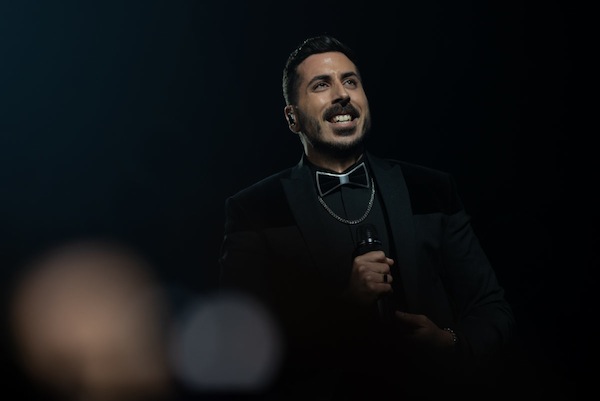
While Israel’s entrant, Kobi Marimi, didn’t fare very well – coming in 23rd of 26 entrants – he gave an emotional performance, finishing his song “Home” with tears. He later told reporters, “I don’t have words to explain how much I love this country, and how proud I am for myself and my team.” We’re pretty proud, too.
American political commentator and writer Ben Shapiro addressed more than 900 people at the Faigen Family Lecture, which was held at Congregation Schara Tzedeck on Oct. 30. (photo by Jocelyne Hallé)
More than 900 people came out to hear conservative commentator and writer Ben Shapiro give this year’s Faigen Family Lecture, which took place at Congregation Schara Tzedeck on Oct. 30.
Saul Kahn began the evening by reading the names of the 11 Jews murdered at Tree of Life synagogue in Pittsburgh a few days earlier. After a moment of silence, Vancouver Hebrew Academy head of school, Rabbi Don Pacht, recited a prayer for those who were killed. The security presence at Schara Tzedeck was notable, from every attendee being checked at the entrance to several guards within the sanctuary.
In introducing the lecture, Kahn explained, “Almost a decade ago, Dr. Morris Faigen, of blessed memory, created the Faigen Family Lecture Series in partnership with Rabbi Pacht and the Vancouver Hebrew Academy. This endeavour arose from their mutual love of Israel, a shared concern for the mindset of the modern Jew in North America and a desire to help influence the next generation.”
Kahn thanked VHA’s Teagan Horowitz and office staff, Rochelle Garfinkel and the Schara Tzedeck staff, Dr. Jeffrey Blicker, “for his instrumental role in bringing this event to fruition,” the Jewish Federation of Greater Vancouver for help with the additional security and “Gina Faigen and the Faigen family for their appreciation of how very vital it is to have a program such as this that supports an open and meaningful exchange of ideas.”
Pacht linked the lecture’s importance to Jewish tradition, noting how the word cherubs (in Hebrew) appears only twice in the Torah. In Exodus, it appears when God is explaining to Moses how the Mishkan (Tabernacle) is to be constructed: the cherubs (“angels with childlike faces”) are set above the holy ark. However, in the beginning of Genesis, when Adam and Eve are expelled from the Garden of Eden, God places cherubs to guard the entrance. “Interestingly,” said Pacht, “here the word is translated differently. It’s translated, by Rashi, as ‘angels of destruction.’” One explanation – from Rabbi Moshe Mordechai Epstein, who was head of the talmudic academy in Slabodka, Lithuania – is that, “as parents, as educators, we have a responsibility to take the next generation, to cultivate within them, the ideas and the ideals that we hold most dear. If we are successful in our endeavour, they are cherubic, they are the angels with childlike faces. Unfortunately, if we’re not successful, there’s an entire different pathway that may lay before them.”
Among the values that need to be imparted, said Pacht, are the centrality of Israel and the moral values as laid out by the Torah. Free speech and open debate, he continued, are “most dear to us.” He put them among the ideals we have “from our parents and our grandparents, and we want to see that passed on from generation to generation.”
This generational aspect was picked up on by Gina Faigen with humour in her welcoming remarks. She said she sometimes wonders, “because I’m a lot more liberal than my late father was, if he didn’t create this event in part so that, on at least one day a year, I would have to listen to somebody who shared his views. It’s definitely something I have come to appreciate more as the years go by. My father was passionate about ideas, about intelligent discourse on Israel, and he created this lecture series to ensure a space in Vancouver for a conservative and pro-Israel perspective. I know he would be really excited by tonight’s speaker, Ben Shapiro.
“For those of you who share these views, we hope to continue to provide a place for you here,” she continued. “And, for those of you who may not share all of the speaker’s views, it’s great that you’re here open-minded and part of this conversation.”
Blicker – who suggested Shapiro as a potential speaker after he and his family heard him at a Passover event in Henderson, Nev., more than three years ago – introduced Shapiro. Among other things, Shapiro is a lawyer, editor-in-chief of DailyWire.com, host of the podcast The Ben Shapiro Show, and author of seven books.
Shapiro addressed his critics right off, admitting that he does “sometimes phrase things in an intemperate fashion or spoken too hastily or out of anger or even, on occasion, over the course of a 17-year career of writing things, I’ve written stuff that I disagree with and that I think is immoral. It’s my job to hear those critiques, it’s my job to respond to those critiques in good will and in the spirit of self-betterment, and I’ve tried to do so repeatedly in different places and I look forward to doing so in the future, as well as tonight, that is my job. It’s also the job of my critics to keep an open-mind and not to mistake a political viewpoint for objective righteousness or to slanderously mislabel people like me bigoted or racist – that is unjustified, unjustifiable and hypocritical.”
Given what had happened in Pittsburgh, Shapiro decided to speak about his planned topic – the future of the state of Israel – in connection to global antisemitism. He described three general types of antisemitism.
• Right-wing antisemitism – “in this view, the presence of an independent Jewish community is a threat to national identity.”
• Left-wing antisemitism is “based on hierarchies of power.” Therefore, “when you see an imbalance in life and inequality in life, that is inherently due to inequity, so, if you see two people in a room and one guy has five bucks and one guy has one buck, that means the guy with five bucks somehow screwed the guy with one dollar. Left-wing antisemites, in terms of group politics, see the Jews as the people with five dollars. The Jews are simply too powerful and, thus, they must have participated in exploitation and egregious human rights violations.”
Shapiro offered his take on how intersectional theory would rank the groups whose “opinions should be taken most seriously because they have been most victimized by American society: LGBT folks are at the top, then it usually goes black folks, then Hispanic folks, then women, then Asians, then Jews, then, at the very bottom, white males.” In this framework, since Jews and Israel are relatively successful, they must have done something terrible, “be responsible for the ills.”
• Radical Islamic antisemitism “is the most traditional form of antisemitism – not Islamic, but religious antisemitism.” This is the belief, said Shapiro, “that the religion of Judaism itself is to blame for the problems in Western society. The history of religious antisemitism obviously, goes back thousands of years and it spans a wide variety of religions.”
Today, he said, “Islamic antisemitism has been combined with a sort of Nazi-esque racial antisemitism, which is why you see textbooks in the Palestinian Authority referring to Jews as the sons of pigs and monkeys, and it’s also been combined with a sort of intersectional antisemitism … Jews are successful because they are somehow damaging other people and, also, they happen to be a terrible religion.”
For Jews in the United States and, to a lesser extent, in Canada, Shapiro said right-wing antisemitism is probably the biggest threat, “as we saw in Pittsburgh. There has been a spate of such violence that has been consistent throughout my lifetime.” He said, “The thing that folks don’t understand if they don’t live in the Jewish community is that every single person in the Jewish community is one degree removed from some sort of tragedy of this kind.”
However, he said, for Jews worldwide, radical Islamic antisemitism is the biggest threat. “Whether it is Jews who are living under the possibility of an Iranian nuclear [regime], whether it is … Jews living under the threat of Hezbollah rockets, whether it’s Jews living under the possibility of kidnapping along the Gaza border or whether it is Jews living under the possibility of being murdered while walking the streets in France, whether it is Jews being threatened with the possibility of murder in Malmö, Sweden, whether it is Jews being threatened with murder in London. Islamic antisemitism and the rise of that antisemitism throughout Europe is deeply dangerous to Jews across the world.”
“The thing that folks don’t understand if they don’t live in the Jewish community is that every single person in the Jewish community is one degree removed from some sort of tragedy of this kind.”
There are two main perspectives on antisemitism, said Shapiro. One is that antisemitism is not another form of racism, but is unique – that it comes from a “conspiratorial mentality that the Jews are behind everything bad and, therefore, the Jews must be annihilated.” The second view is that “antisemitism is not unique, it’s not an age-old virus, it’s no different really than anti-black racism or anti-Native American racism or sexism or homophobia…. That means we have to treat the death of a Jew in Efrat at the hands of a terrorist differently than we treat the death of a Jew in Pittsburgh at the hand of a white supremacist because these two Jews scan in different areas of this intersectional pyramid,” said Shapiro. “These two Jews are not equivalent. They are not being killed for the same reasons. The Jew being killed in Pittsburgh is being killed because that Jew is a victim. The Jew being killed in Israel may or may not be being killed because of victimology. It’s possible that that Jew was being killed because of Israeli settlements or some such [reason].
“The second view, as you might imagine, I believe to be deeply troubling, counterproductive and helpful to antisemitism.”
In Shapiro’s opinion, this latter, more troubling view is mainstream on the political left in the United States and in Europe. When a Jew is murdered in certain areas of Israel, he said, “we are supposed to take into account the territorial claims of Palestinians as though that justifies the murder of a civilian who happens to be living in Efrat. We’re supposed to pretend that the dispute is merely territorial and not a symptom of a broader underlying antisemitic disease. When a Jew is murdered in Pittsburgh, then we’re allowed to talk about antisemitism.” This is why, he said, Jews can be excluded from women’s marches and antisemitism can be tolerated, if the Jews in question rank lower than the antisemite in the intersectional hierarchy.
While Israel holds a high position in the world, it is under threat from forces that we refuse to call antisemitism, he continued, citing several examples, such as the numerous votes against Israel at the United Nations. Criticism of Israel is legitimate, he said, but holding the country to a higher standard than any other nation is antisemitic, “and that has been the standard to which the world has held Israel.”
He called wanting to boycott, divest from and sanction Israel “antisemitic in the extreme…. The stated goal by many of those pressing BDS is to destroy the state of Israel…. Not a single person pushing BDS has ever condemned the Palestinian Authority for insisting on a fully judenrein state, a state completely free from every single Jew. Israel allows – and should allow – millions of Arabs to live within its borders, millions of Muslims to live within its borders, that is a good thing. Israel is a multicultural, multi-ethnic democracy. The same is not true of any of the nations facing down Israel, and yet Israel is facing down boycott, divestment and sanctions for saying that we can build an extra bathroom in East Jerusalem. No other nation would tolerate this sort of nonsense. This is targeted hatred and nothing less.”
So, what is our mission, given these realities? “Well, number one, to stand up to antisemitism wherever we see it, on left and on right,” said Shapiro, whether it is coming from our allies or our enemies. “This is not a partisan issue nor should it be. And, our other mission is also the same as it ever was, which is to spread light. What we’re watching right now in American politics and, I think, Western politics more broadly, is a fragmentation of certain eternal and true values that used to undergird a civilization. Those basic values of faith and family and those values of tolerance and openness within the bounds of recognition of certain central individual rights, that’s all fragmented. And whenever society fragments, antisemitism starts to seep through the cracks. As the Tree of Life synagogue name attests, the only way to fight back against all of this is to cling to that Tree of Life, is to cling to the Torah.”
The attack on the Tree of Life synagogue was not just an attack on Jews but on civilization, said Shapiro, “because Judaism, Jews, we stand at the heart of Western civilization…. The only proper response is the same response Jews have given throughout time: to fight back, to fight darkness with light, to fight untruth with truth and fight death with life.”
Ben Shapiro responded to 22 questions at the Faigen Family Lecture on Oct. 30. (photo by Jocelyne Hallé)
After a standing ovation for his remarks, Shapiro responded both to questions submitted in advance by event sponsors and then to questions from an open mic. In total, he responded to 22 questions, which ranged from the political to the cultural, from economics to education, tort law to religion. Several of the questioners identified themselves as being Christian, many as fans.
One of the first questions was the language Shapiro uses around transgender issues. “When I’m talking about transgenderism,” he said, “the contention of folks in the political realm is that transgenderism is not, in fact, a mental illness; that, in fact, gender identity disorder or gender dysphoria, whichever DSM [Diagnostic and Statistical Manual of Mental Disorders] you choose to use, 4 or 5, that that particular disorder is no longer a disorder, it’s actually just an expression of gender identity that has no bearing whatsoever on mental health. That’s a lie, and it’s a damaging lie. And, when a society blinds itself to the realities that gender and sex exist, it is less likely to pursue policies that alleviate the pain of a lot of folks and it’s also less likely to pursue policies that have any realities extant on the ground.”
In a few responses, Shapiro differentiated between his use of language in dealing with people one-and-one versus in the political arena or on social media, noting in particular that Twitter is meant to be a more fun space, where you don’t have to be nice. He also talked about his general wariness of government intervention and offered pretty standard conservative views on immigration, economic migration, free speech and abortion.
When asked by the mother of a 14-year-old boy who brought Shapiro’s views into their liberal household about Shapiro’s portrayal at times of the left as monolithic (and unprincipled) and whether it was “part of the game, like [you do] on Twitter?” he responded, “No, it’s political shorthand.”
However, he added, he does try to distinguish between the left and liberals. For example, “when it comes to free speech, I think the left wants to crack down on free speech and I don’t think liberals do. I think liberals are happy to have open and honest debates; they just disagree with me on the level of government necessity in public life. Listen, every individual has different political viewpoints and people self-describe in different ways … but, as a generalized worldview, if I’m hitting the target, when I say the left, 85% of the time, that’s good enough for ditch work. In politics, you’ve got to cover too much ground to break down every single constituent of a particular group. Now, is it an over-generalization? Of course. But politics operates on generalizations, so do our everyday conversations.”
Social media is instrumental in forming and reflecting the prevalent views of our society. One sign of its importance is that leaders like U.S. President Donald Trump and Israeli Prime Minister Binyamin Netanyahu communicate mainly through Twitter nowadays. And, while many of us may bemoan this fact, the demand for simplistic, polarizing and aggressive political discourse seems as strong as ever.
In our own community, differences of opinion, especially on the topic of Israel, have led to divisiveness. Many Jewish community members choose to avoid the topic altogether. But, while pausing to think before we speak and refraining from saying hurtful things are to be lauded, there are issues that require discussion if we are to ever improve them, ourselves, the community, and the world. We need to create the spaces in which these conversations can safely take place. Any steps we can take to reach that goal, even incremental ones, like holding an event that is admittedly mainstream, but allows for debate on Israel, is a positive development.
This is one reason the Jewish Independent has joined the Jewish Federation of Greater Vancouver, Centre for Israel and Jewish Affairs, Jewish Community Centre of Greater Vancouver, Ameinu, Or Shalom, Schara Tzedeck, Beth Israel and Temple Sholom in co-sponsoring Left vs. Right: The Battle for Israel’s Soul. On Oct. 23, J.J. Goldberg of the Jewish Daily Forward and Jonathan S. Tobin of JNS.org – whose visit here is part of a series that has taken them to dozens of other Jewish communities – will model how we can argue passionately about something as heated as our views on Israel while remaining not only respectful of our “opponent,” but maybe even come to like them. (Click here for event information.)
The modeling of civil discourse about contentious issues is also one of the purposes of the Faigen Family Lecture Series, which will take place on Oct. 30. Presented by Vancouver Hebrew Academy, along with several sponsors, this year’s speaker is conservative journalist and commentator Ben Shapiro, who suggests that social media is not the appropriate place to seek dialogue, noting, “you don’t look to Twitter for meaningful conversation.” (Click here for story.)
The JI sponsored the documentary The Oslo Diaries at this year’s Vancouver International Film Festival for similar reasons. (The Israel Consulate General, Toronto and Western Canada, also sponsored this film. See jewishindependent.ca/oslo-diaries-peace-possible.)
While we all know that, ultimately, the Oslo Accords failed to bring an end to the Israeli-Palestinian conflict, the film shows just how close we came to peace. One of the most important aspects of the documentary, which is based on the diaries of the Israeli and Palestinian negotiators of the accords, is the evolution of the relationship between these enemies, which they were at the time.
One of the most powerful scenes in the film is a conversation between the two chief negotiators, Uri Savir on the Israeli side and Abu Ala on the Palestinian side. Initially, they compete with regard to the history of their ancestors in Jerusalem and how far back their family ties go. However, they soon agree that they are not at these talks to make a better past but to make a better future. While the Oslo Accords failed for reasons beyond their control, the negotiators accomplished what seemed impossible – they formed an agreement – and Savir and Ala, at least, became friends.
Earlier this year, as part of the Civil Conversations Project of the podcast On Being, host and creator of the show Krista Tippet interviewed Imam Abdullah Antepli of Duke University in Durham, N.C., who also co-created and co-leads the Shalom Hartman Institute’s Muslim Leadership Initiative, and Rabbi Sarah Bassin of Temple Emmanuel in Beverly Hills, Calif. The whole conversation is fascinating but one exchange illustrates why respectful discourse on controversial topics is so difficult.
First, Tippet notes that agreement shouldn’t be the goal of such discussions, but rather understanding. She gives an example from an interview Antepli did with Israeli journalist and author Yossi Klein Halevi, where Halevi told Antepli, “I am not a dove. I am not a leftist. My positions are very mainstream, skeptical Israel.” To which Antepli replied, “And I’m not interested in marginal Jews who will agree with everything Muslims believe about Israel.”
Second, in talking about this interview and his relationship with Halevi, Antepli says there is often “a conflation of political disagreement with moral disagreement…. Yossi is like my brother. There is hardly anybody who is closer to me like him, but watch us when we talk about Israeli-Palestinian conflict…. But do I ever doubt his integrity? Do I ever doubt his moral red lines? Do I ever doubt his moral imagination?… I think many people think political disagreement translates itself as moral arguments.”
About her work creating spaces in which her community can engage on controversial issues, Bassin says, “I put out the line that the only people I don’t want in this space are people who are going to physically threaten our security. But, beyond that, I think that we want to welcome as [many] diverse voices as possible…. And it’s been hard, and some people have been challenged by it, but, ultimately, the leadership has really embraced that, because they see the need for it.”
Many of our community leaders and organizations – not just those mentioned here – also see the need, and are continuing or beginning to establish spaces for civil dialogue and debate. We owe it to ourselves and the future of our community to lend them our support – and our voice.
American political commentator Ben Shapiro will give the Faigen Family Lecture on Oct. 30. (photo by Gage Skidmore)
“We live in a world where opinions are formed, far too often, based on preconceived notions and emotion. A hallmark of the critical thinking that we impart in schools today is the ability to hear differing viewpoints and draw informed conclusions. We need to be able to engage, debate and discuss. We may ‘agree to disagree,’ but there needs to be an avenue for dialogue,” Rabbi Don Pacht, Vancouver Hebrew Academy’s head of school, told the Independent about the importance of the Faigen Family Lecture Series.
The series has featured five speakers to date: Israeli journalist Caroline Glick, American activist David Horowitz, American radio talk show host Michael Medved, British journalist Melanie Phillips and American political commentator Daniel Pipes. On Oct. 30, 7:30 p.m., at Congregation Schara Tzedeck, Ben Shapiro will join that list. The next day, he will speak to a sold-out event at the Chan Centre for Performing Arts, hosted by the University of British Columbia Free Speech Club.
Among other things, Shapiro is editor-in-chief of DailyWire.com, host of The Ben Shapiro Show and author of seven books.
“We were in touch with him almost two years ago,” said Pacht. “It took months and months to find a date that worked for him and did not conflict with other events in our community.
“He was certainly a household name when we first approached him, but it is not an exaggeration to say that he has grown considerably in his craft and has become quite the celebrity in recent years. We have already sold more tickets to this event than to any of our past lectures – including a packed house for Caroline Glick [in 2011] – and we anticipate that we will have another sell-out on our hands.”
The Faigen Family Lecture Series “began as a friendship between myself and Dr. Morris Faigen (of blessed memory). We would speak at length about politics and Israel and we often saw eye to eye on issues,” explained Pacht. “Many Jews often feel as though Israel gets a raw deal when Middle East politics are reported in the news. Dr. Faigen wanted to create a vehicle to spread a more balanced – and decidedly more pro-Israel – view.”
The process of selecting speakers was set in place by Faigen, who passed away in 2012. “His daughter, Gina [Faigen], leads a committee who meet to discuss various possibilities,” said Pacht. “The committee has a mandate – based on Dr. Faigen’s wishes and stated goals – and they will shortlist possible speakers based on these criteria.”
Pacht said the selection of Shapiro reflects the values of open debate and respectful dialogue.
“When my board chair, Glenn Bullard, and I spoke with Ben recently, we asked him directly whether he thought he was maintaining Jewish standards of respectful speech. He acknowledged it was a challenge, but he said, ‘If people want to cherry-pick something I’ve said on Twitter, all I can say is, you don’t look to Twitter for meaningful conversation.’ He hoped instead that people concerned about his tone would look at his work on many issues over many years.
“In the past,” said the rabbi, “we have had people who disagree with a point expressed by our speaker. That is your right. Our expectation is that conversations will focus on the corroboration of evidence and, as always, maintain the highest standards of menschlichkeit.”
With regards to the school’s mission, the lecture series gives VHA an opportunity “to step outside of our ‘zone’ and provide a service to the community,” said Pacht. “Obviously, our primary mission is that of Jewish education. This lecture series is a way that we can reach – and benefit – many within our community who will never see the inside of one of our classrooms.
“It fits well with our value of Israel as central to the life of every Jew and as the ancestral homeland of our people,” he added. “While our lectures are not geared towards elementary school children – we are more likely to see parents and grandparents in the audience – the message is one that is supported by the philosophy of the school.”
As for the physical future of the school, Pacht said VHA “has secured an eight-year lease with the Vancouver School Board. That gives us the security that we have been lacking for years. We know that we have room to grow in our current location.”
To support that growth, aging portables will be replaced with one large modular building. “We are currently on schedule for this renovation to be carried out in the summer of 2019,” said Pacht. “We are also thrilled to report that we are over 90% towards our fundraising goal for this project.”
Encouraged by “the generous response of our community,” he said, “We have no doubt that we will be able to make up the difference and reach our goal.”
The campaign will resume after the Jewish Federation of Greater Vancouver’s annual campaign has closed. “Meanwhile,” said Pacht, “we are moving forward with the process itself and our permit application has been submitted to the City of Vancouver.”
J.J. Goldberg, left, and Jonathan S. Tobin will participate in Left vs. Right: The Battle for Israel’s Soul on Oct. 23, 7:30 p.m., at the Jewish Community Centre of Greater Vancouver. (photos from JFGV)
On Oct. 23 at the Jewish Community Centre of Greater Vancouver, J.J. Goldberg and Jonathan S. Tobin will participate in Left vs. Right: The Battle for Israel’s Soul.
Representing the left is Goldberg, editor-at-large and senior commentator at the Jewish Daily Forward. On the right is Tobin, editor-in-chief of JNS.org and a contributing writer for National Review. The debate is one of a series that the two men are doing to model civil dialogue about contentious issues.
In a Jan. 24, 2018, article on the Goldberg-Tobin event that month at Temple Emanuel in Newton, Mass., which was organized by CJP (Combined Jewish Philanthropy) Strategic Israel Engagement’s CommUNITY Israel Dialogue initiative, Tobin is quoted as saying, “Don’t take away from this our talking points. Take away from this our ability to try to learn, to try to listen to each other. We’re both Zionists, we both love Israel. We interpret facts differently, but we think seriously about each other’s arguments.”
Of the debate they hosted, Hannah Rosenthal, chief executive officer and president of the Milwaukee Jewish Federation, said, “The program drew a large crowd and the debate was substantive and interesting. To us, the value of this program was not only that it helped us learn about the issues but also that we saw J.J. and Jonathan model civil, heartfelt and passionate debate about Israel. That kind of respectful communication over disagreements is rare and was refreshing. After the program, we posted all the audience questions online, urging people to continue the conversation.”
Tobin and Goldberg discuss many critical issues concerning the state of Israel in their two-hour debate. “Is Israel locked in a tragic dispute between two peoples claiming the same land – or a global conflict between Western democracy and Islamist terrorism?” gave Robin Wishnie, executive director of the Jewish Federation of Somerset, Hunterdon and Warren, as an example. “Is partition into two states the only way to ensure Israel’s survival – or is it the surest path to ever-increasing bloodshed and possibly even endangering Israel’s survival?”
Goldberg was the Forward’s editor in chief from 2000 to 2007. He has served as U.S. bureau chief of The Jerusalem Report and managing editor of the New York Jewish Week and his books include Jewish Power: Inside the American Jewish Establishment and Builders and Dreamers, a history of Labour Zionism in America.
Before entering journalism, Goldberg worked as an education specialist with the World Zionist Organization in Jerusalem, was a founding member and secretary-general of Kibbutz Gezer, near Tel Aviv, and was a New York City cabdriver. He has been a sharpshooter with the Israeli Border Police Civil Guard, a member of the central committee of the United Kibbutz Movement and a member of the Pulitzer Prize jury.
In addition to his roles at the Jewish News Syndicate (JNS.org) and National Review, Tobin is also a columnist for the New York Post, The Federalist, Haaretz and the New York Jewish Week. In his writing, he covers on a daily basis the American political scene, foreign policy, the U.S.-Israel relationship, Middle East diplomacy and the Jewish world.
Previously, Tobin was first executive editor and then senior online editor and chief political blogger for Commentary magazine for eight years. Prior to that, he was editor-in-chief of the Jewish Exponent in Philadelphia for 10 years and, before that, the editor of Connecticut’s Jewish Ledger. He appears regularly on television commenting on politics and foreign policy.
The Vancouver event Left vs. Right: The Battle for Israel’s Soul is co-sponsored by the Jewish Federation of Greater Vancouver, Centre for Israel and Jewish Affairs, Jewish Community Centre of Greater Vancouver, Jewish Independent, Ameinu, Or Shalom, Schara Tzedeck, Beth Israel and Temple Sholom. It takes place in the JCC’s Wosk Auditorium and starts at 7:30 p.m. There is no charge to attend but an RSVP is required to jewishvancouver.com/left-vs-right.
Last week, we published a story about a group of people gathering outside the Jewish Community Centre of Greater Vancouver to hold a Yizkor service for Palestinians who died during the March of Return actions at the Gaza-Israel border.
We are not surprised by the reaction from readers, but we are disappointed in some of it. We have been criticized for covering the event. One commenter on Facebook accused us of supporting Hamas.
We are a newspaper. The fact that a group of Jews – it doesn’t matter how many or how few – organized an event like this is newsworthy. We covered it. It is what any newspaper worth the paper it’s printed on would have done. To accuse the Independent of endorsing the event – or Hamas – because we ran a story about it demonstrates a stunning lack of understanding about the basics of journalism. When a newspaper covers a flood, it is not endorsing the river.
At least one critic suggested our approach should have been to publish a raving tirade against those saying Kaddish. Our approach, generally, is to report events in an unbiased fashion and leave the raving tirades to others.
Just one question, really, for those who didn’t like the inclusion of that story in last week’s issue: Would you rather not know what’s happening in your community?
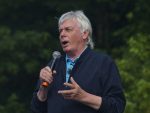
David Icke spoke in Vancouver earlier this month at the Orpheum. (photo by Tyler Merbler via cjnews.com)
David Icke – a controversial conspiracy theorist, antisemite and Holocaust denier – spoke in Vancouver at the Orpheum on Sept. 2, despite the city’s civic theatres board’s recommendation to Mayor Gregor Robertson and city council that Icke’s booking be canceled.
In a statement quoted in the Vancouver Sun, the city said that under the Charter of Rights and Freedoms, “the city is not in a position to take action intended to censor speech that is otherwise permissible under Canadian law.”
Icke is a British author and speaker known for his bizarre views. A former football player and sports broadcaster for the BBC, Icke was once also a spokesperson for the U.K. Green Party. All that changed in 1990, when, by his own account, a psychic told him that he had a special mission on earth and would soon begin receiving messages from the spirit world. The following year, he announced on primetime British television that he was “the son of godhead” (also a title of Jesus Christ’s) and predicted global natural disasters to come.
Over the next several years, Icke developed his worldview, which has been called “new age conspiracism.” He described himself as “a full-time investigator into who and what are really controlling the world.” In his 1994 book The Robots Rebellion, he answered the question by singling out Jews. But, he also argued that the really major players in world dominion were an ancient order of shapeshifting, blood-drinking reptilian humanoids called the Babylonian Brotherhood. Their goal, according to Icke, is the creation of a neo-fascist global state, known as the New World Order.
When Icke added Holocaust denial to his worldview in his 1995 book And the Truth Shall Set You Free, his publisher felt he had crossed a line. As a result, that book, and Icke’s subsequent works, were published at his own expense.
Icke combines familiar New Age philosophies with conspiracy theories about public figures being reptilian humanoids and pedophiles. He believes in reincarnation, a collective consciousness that has intentionality and the “law of attraction” (that good and bad thoughts can attract like experiences).
According to a report by Political Research Associates – an American nonprofit research group that studies white supremacist groups and militias – Icke’s ideas are “a mishmash of most of the dominant themes of contemporary neofascism, mixed in with a smattering of topics culled from the U.S. militia movement.” The same report details the support that Icke has gotten from far-right and neo-Nazi groups, including the violent U.K. group Combat 18, which was linked to bombings of minority neighbourhoods in London.
Aiden Fishman of B’nai Brith Canada described Icke’s views as “classic antisemitic ideas” and said the booking should never have been allowed. “It’s totally, totally incompatible with the city of Vancouver’s role as an open and tolerant multicultural municipality to allow Mr. Icke to speak at a city-owned facility after we’ve brought all these concerns to their attention,” Fishman told CBC News.
“You are free to be a racist in Canada, you are free to say so and tell others that they should be, too,” Micheal Vonn, policy director of the B.C. Civil Liberties Association, told the CJN. “But this is not just about Mr. Icke’s rights. Everyone who comes to see him has their Charter rights involved, as well. The government should not be in a position to prevent you from hearing what you would like to hear.”
To those who say that the talk should not have been held at a city-owned venue, Vonn said: “The city does not support this, the city is neutral with regards to the content. Can you imagine if the city could pick and choose who among the public they allowed to make use of the venue? They can’t be cherry-picking what members of the public get that benefit. The city can’t be saying this is available only to people that we like. It is, as it should be, available to all members of the public involved in lawful activity.”
To be unlawful, Icke’s speech would have to constitute criminal hate speech, which has a high burden of proof in Canada. “He would need to be intentionally and explicitly inciting harm,” said Vonn.
An admittedly unscientific Vancouver Sun poll asking whether the event should be canceled, showed that most readers supported Icke’s right to free speech, with more than 81% of respondents saying the show should go on.
Despite significant coverage of the event leading up to the talk, Icke’s lecture, which he claimed would last 10 hours, apparently failed to attract a media presence. Nor have there been any allegations of criminal hate speech.
Matthew Gindinis a freelance journalist, writer and lecturer. He writes regularly for the Forward and All That Is Interesting, and has been published in Religion Dispatches, Situate Magazine, Tikkun and elsewhere. He can be found on Medium and Twitter. A longer version of this article was originally published by CJN.
Israel’s government shut down the country’s public broadcaster last week, an act so contentious that it has the potential to bring down the government and spark fresh elections.
The Israel Broadcasting Authority was widely viewed as a dysfunctional and wasteful structure that Israeli observers from across the spectrum agreed needed reform. But the manner in which the deed was done – which involved both blatantly political motives and insensitivity to long-time employees – has turned the situation into a potential political firestorm.
The country’s press council expressed fears that media freedom in Israel is “at risk.” The country’s president, Reuven Rivlin, weighed in, saying, “Without public broadcasting, there is no democracy.… Without public broadcasting, the state of Israel isn’t the state of Israel.”
The incident inspired beastly analogies from journalists, with one saying, “They not only killed us, but they gave us a donkey’s funeral,” and another commentator declaring: “One does not close an institution the way one drives a stray dog out of the house…. One does not give an ignominious burial to what used to be the leading light of Israeli broadcasting.”
“This is a blow to the most important part of democracy – the news,” said Yitzhak Herzog, the opposition leader.
From the government side, there was little effort to deny the evidence of political interference.
“It can’t be that we’ll set up a broadcasting authority and not control it,” said Miri Regev, the Likud culture minister.
Neither does it appear to be an ad hoc effort to change the media dynamic in support of the Netanyahu government. Prime Minister Binyamin Netanyahu appointed himself communications minister and, in forming his coalition, he exacted from every party the promise to support whatever changes he introduced regarding the media.
The fact is there is still a state broadcaster in Israel. A new entity was created to replace the IBA, and some of the IBA’s staff – apparently somewhat less than half –have been hired by the new national agency that will replace the defunct broadcaster. But many of Netanyahu’s critics suspect the new channel is designed specifically to be more amenable to intervention from those with political power.
The print media in Israel has also experienced a shakeup that raises questions of political interference. American billionaire Sheldon Adelson has invested millions to produce the free daily Israel Hayom, which quickly rose to become the largest-circulation daily in the country, at least partly because it is free. Adelson is a strong supporter of Netanyahu, and the paper has been accused of being a mouthpiece for the Likud government.
Netanyahu has a relationship with the media that bears some resemblance to that of Donald Trump, the U.S. president. He picks personal quarrels with reporters with whom he disagrees and even used the term “fake news” recently in referring to CNN and the New York Times, echoing a familiar refrain from the head of the American government.
It was not only the action of shutting the IBA that has caused outrage, but the crassness with which the whole thing was handled.
The 49-year-old flagship TV news program was given one hour’s notice before its final airing, leaving on-air personalities in tears as they said their goodbyes. The program – and the channel – was slated for closure May 14 and the show was planning a farewell episode for Sunday night with nostalgic and historical clips and reflections. The sudden decision to shut it down on May 10 was seen as an unnecessary indignity.
Officials in the prime minister’s office insisted Netanyahu did not know that the abrupt end was planned and agreed that is was disrespectful.
Canada’s public broadcaster has not been above political interference – successive governments have cut funding in what is one of the most destructive forms of interference – but there has been nothing to compare with what has happened to Israel’s state broadcaster.
Israel has a reputation for a disputatious and vibrant media and public discourse. It will not be felled by one government. But recent developments are not encouraging and their impacts will be closely watched to see what effects they have on politics and society in Israel. There are also, of course, independent private media outlets in the country and, we may see – in the way that the loss of one sense results in greater acuity in another – the private broadcasters rise to keep the government effectively in check.
There should be a word for the phenomenon where an individual comes to mass public attention only when their reputations are imploding due to impolitic remarks on social media. Milo Yiannopoulos, a former editor of the far-right Breitbart news, was just cresting his 15 minutes of fame as a flamboyant right-wing provocateur when he discovered that words can still get one in hot water. Only as his credibility, such as it was, flamed out did his name become anything close to a household word.
Likewise, a Canadian figure few of our readers had probably heard of until he melted down in an online video is Gavin McInnes. A comedian, online commentator, co-founder of Vice Magazine and – here’s that term again – right-wing provocateur, McInnes is also a contributor to Ezra Levant’s Rebel Media.
On a trip to Israel with other members of the Rebel outfit, McInnes posted a lengthy spiel about his reaction to a visit to Yad Vashem, the Holocaust remembrance centre. He apparently felt the visit was an exercise in Jewish propaganda and declared that, far from making him sympathetic to Jewish history, it had the opposite effect.
The Israelis he met, he said, “assume we’re going to listen to all this s–t we get fed.… That’s having the reverse effect on me: I’m becoming antisemitic.”
He added: “I felt myself defending the super far-right Nazis just because I was sick of so much brainwashing.”
Israelis, he said, have “a whiny, paranoid fear of Nazis,” and “it’s a Jewish thing” to dwell on the past.
“This whole nation-state is talking about ‘Seventy-five years ago, my people were killed,’” McInnes said. “Always the Jews, always killing us, we are the scapegoats.… God, they’re so obsessed with the Holocaust. Yes, I know it was bad – don’t get me wrong, I’m not pro-Holocaust.”
He went on to accuse Jews of perpetrating the Holodomor, Stalin’s deliberate Ukrainian famine that killed between seven and 10 million people in the 1930s.
As McInnes was getting more than his share of attention, another Canadian was receiving a mixed reception from campus crowds in Ontario.
Jordan Peterson, a clinical psychologist and a tenured professor at the University of Toronto, gained some notoriety last fall when he posted video reflections on aspects of human rights law that he said could potentially infringe on free speech. Most notably, he refuses to use non-gendered pronouns (such as zhe, instead of he or she) in his classroom. Peterson is a critic of what he calls “compelled speech.”
Peterson is hardly as inflammatory as Yiannopoulos or McInnes. Agree or disagree, his positions are intellectually rooted and debatable, not beyond the pale of civil discourse. Yet he never really got a chance to speak at McMaster University because he was drowned out by a chanting group of students who shut down his event. That his message was one of free speech is an irony, though one apparently lost on some university students these days.
In any event, he was met with a far more amenable crowd the next day at the University of Western Ontario. According to media reports, even some who came to protest were pleasantly surprised to find themselves agreeing with Peterson once they heard what he had to say.
Regardless of what these men had to say, though, the idea that their ideas should be silenced, rather than contested, is a societal problem in itself. Things would be different if we did not have a diffuse media universe; if every individual did not have more access than ever before to express themselves; if, as some conspiracists allege, the channels of communication were truly limited to a powerful few. But they’re not.
Every Canadian can participate in the national discussion. First, we can listen, like the students at Western and unlike those at McMaster last week. Second, we can express our own views when we hear ideas that challenge ours. (We have a right to do this as vociferously as we wish, but we have a complementary responsibility to do so civilly.) Third, we can defend the right of those with whom we disagree to speak and be heard – within the limitations Canadians have broadly consented to acknowledge as appropriate to peace, order and good government.
These three steps are about as simple a description of civil discourse as can be distilled. While there is much discussion about free speech, it is valuable to bear in mind that we, as Canadians, have it. This should not be taken for granted, of course, because these freedoms were hard won and should be defended. But rights must also be exercised to be valuable.
The response to disagreeable ideas is not less speech, but more speech. Listen, express, defend. Never in history has an individual had more accessible avenues to sharing their opinions and ideas. Free speech has never been freer. Please use it for good.