Skip to content

  • Home
  • Subscribe / donate
  • Events calendar
  • News
    • Local
    • National
    • Israel
    • World
    • עניין בחדשות
      A roundup of news in Canada and further afield, in Hebrew.
  • Opinion
    • From the JI
    • Op-Ed
  • Arts & Culture
    • Performing Arts
    • Music
    • Books
    • Visual Arts
    • TV & Film
  • Life
    • Celebrating the Holidays
    • Travel
    • The Daily Snooze
      Cartoons by Jacob Samuel
    • Mystery Photo
      Help the JI and JMABC fill in the gaps in our archives.
  • Community Links
    • Organizations, Etc.
    • Other News Sources & Blogs
    • Business Directory
  • FAQ
  • JI Chai Celebration
  • JI@88! video
image - Weizmann Canada Physics Tournament 2025
image - The CJN - Visit Us Banner - 300x600 - 101625

Recent Posts

  • מדוע עזבתי את ישראל ואינני חושב לחזור ארצה
  • OJC hosts Oct. 7 memorial
  • A journey beyond self
  • Antisemitism a problem
  • Young man is missed
  • Orr action sparks complaint
  • Prison sentence for hate
  • Etgar Keret comes to Vancouver
  • New fall lecture series
  • Series explores music
  • Doc on Zapiro screens Nov. 6
  • Joy of shared existence
  • Community milestones … October 2025
  • MAID vs Jewish values
  • Cheshvan a great month, too
  • Bull, bear or bubble?
  • From the archives … a coin, etc.
  • מדוע האנטישמיות הולכת וגואה בעולם
  • New bio gives Vrba his due
  • Joy brighter than ever
  • When approaches differ
  • New leadership at the JCCV
  • Find the funny in you
  • Human rights in sports
  • Granirer returns to Carnegie
  • A last solidarity cycle
  • Grammar insight on holidays
  • Deciphering “oy”
  • From the archives … social life
  • Canada recognizes Palestine
  • Harper speaks at local event 
  • Working with “the enemy”
  • More unenforced laws?
  • CHW expands helping efforts
  • Seeking middle ground
  • Impacts of oppression

Archives

Follow @JewishIndie

Tag: discrimination

Inciting violence

On Feb. 6, Igor Sadikov, an elected student representative at McGill University, tweeted “punch a zionist today” (sic). The statement stirred some reaction, though not the universal revulsion that should greet incitement to political violence in Canada. The Student Society of McGill University (SSMU), on which Sadikov serves as an elected representative, has declined to condemn him or remove him from his position.

Instead, the brunt of vitriol appears to have been reserved for another member of the SSMU – one who is Jewish. At a public meeting where the violence-inciting statement of a councilor should have been the top agenda item, the tables turned and, instead, Jasmine Segal, a fellow councilor, who told the audience she is a Zionist, was singled out for condemnation.

The McGill Daily, a student-run newspaper that has an explicit policy of refusing to publish anything perceived as pro-Israel, has been a voice on campus emboldening voices like Sadikov’s. In writing about the SSMU meeting – under a header boldly declaring the article “News,” as opposed to commentary or opinion – the paper “reported” that “many at McGill and in the wider world are portraying it as an incitement to antisemitic violence.”

For the education of readers, the author of the piece explained: “This interpretation rests on the conflation of Zionism with Jewishness which, while widely believed, is in fact a misconception; many Jewish people do not identify with the settler-colonial ideology of Zionism or the goals and actions of the state of Israel.”

One member of the audience at the meeting said he felt personally threatened by Sadikov’s tweet, in response to which a student who identified herself as Palestinian declared that she felt unsafe because there is a self-avowed Zionist on council.

“Since SSMU has a social justice mandate,” she asked, according to the Daily account, “why does it allow Zionist councilors on council, when Zionist ideology is inherently [linked to] ethnically cleansing Palestinians?”

On a Facebook post after the meeting, Segal wrote about being targeted by the audience and abandoned by her colleagues on council.

“I was left isolated and alone to respond,” she wrote, in a statement that has been widely shared. “My fellow representatives sat in silence and permitted this malicious, prejudicial and unjustified attack to continue. Instead of rising to state that this abusive conduct would not be tolerated at this meeting and at McGill at large, I was left alone to answer prejudicial questions that should not have had such a platform. I was under attack and did the best I could to try and redirect to the issues of the meeting and … bring down the rising temperature in the room.”

The fact that most of Sadikov’s colleagues on the student society stood by him and that it has been Segal who has been made to feel like the wrongful party is not surprising. It is reflective of a general lack of compassion and listening, including among those who claim to be stewards of social justice and intercultural understanding.

Time was critics would specify that they are condemning policies of the Israeli government, not Israel’s right to exist. Now, the journalistic voice of students at McGill University just declares that the movement for Jewish self-determination has nothing at all to do with Jews, and a student considers themself “unsafe” in the mere presence of an individual who believes the Jewish people have a right to a homeland. Worst of all, even when someone literally calls for violence against fellow human beings, the overall reaction is not to condemn such incitement, but to turn against the Jew in the room.

Posted on February 17, 2017February 15, 2017Author The Editorial BoardCategories From the JITags anitsemitism, anti-Israel, anti-Zionism, discrimination, McGill, violence
Concern over incarceration

Concern over incarceration

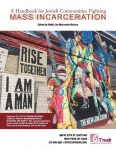
A new handbook published by T’ruah: The Rabbinic Call for Human Rights provides a resource for the Jewish community to press for change around the problem of mass incarceration in the United States.

“We are here to uphold ideas of redemption and mercy,” said T’ruah director of programs Rabbi Rachel Kahn-Troster, citing a colleague who described America’s prisons as having a “mercy deficit.”

The handbook is available for free download at truah.org/incarceration. It provides background and resources – steeped in Jewish texts and teachings – for Jewish communities to take action around these issues. Leading a network of 1,800 rabbis across North America, T’ruah aims to bring attention to an array of domestic social justice issues, as well as human rights for Israelis and Palestinians.

When it comes to mass incarceration, Canada doesn’t have the same problem, but we have similar societal ills when it comes to race, ethnicity and imprisonment – as well as problematic prison conditions themselves – that call out for redress.

The handbook initiative came out of T’ruah’s earlier work on ending solitary confinement. Over the last couple of years, Kahn-Troster has found the Jewish community to be increasingly receptive to grappling with issues around incarceration. Michelle Alexander’s book The New Jim Crow: Mass Incarceration in the Age of Colorblindness, which details the effect that mass incarceration – and the subsequent denial of civil rights for convicted felons – has had on the African American community, really opened people’s eyes, she told the Independent.

Why the term mass incarceration? Compared to other countries, the United States imprisons its population at alarmingly high rates: 698 out of every 100,000 citizens are behind bars. For comparative purposes, Canada’s per capita rate is 141 out of 100,000, according to Statistics Canada.

And then there is the problem of race. African Americans are six times more likely to be jailed than their white counterparts, yet crime rates are not necessarily different. According to American Civil Liberties Union data cited in the T’ruah report, despite equal rates of actual usage, a black person in America is 3.73 times more likely as a white person to be arrested for drug use.

In Canada, blacks are incarcerated at three times their rate in society, according to the Office of Correctional the Investigator of Canada (OCIC). And, while only four percent of the population of Canada is aboriginal, 25% of the prison population is aboriginal. Among the female prison population, fully 36% are aboriginal, and these percentages are only increasing, according to CBC News reporting from January of this year. For aboriginal adults in Canada, the incarceration rate is 10 times higher than for non-aboriginal adults, says OCIC. Maclean’s, in February, quoted criminologists describing Canadian prisons as the country’s new “residential schools.”

In addition, a report from Saskatoon and Regina, cited in the Saskatoon StarPhoenix, revealed that indigenous students are 1.6 times more likely to be stopped on the street than non-indigenous students. A Toronto Star analysis revealed that, in Toronto, blacks are three times more likely to be stopped by police than non-blacks.

As the Supreme Court of Canada has noted, “courts must take judicial notice of such matters as the history of colonialism, displacement and residential schools and how that history continues to translate into lower educational attainment, lower incomes, higher unemployment, higher rates of substance abuse and suicide and, of course, higher levels of incarceration for aboriginal peoples.”

The legacy of slavery in America looms large, and racial bias in the criminal justice system continues to haunt society. “People of color are more likely to be pulled over,” Kahn-Troster said. “The War on Drugs enables cops to search them. There’s a higher level of policing in black areas; there’s racial bias in jury selection; it’s easier to strike black people from juries; the sentencing is harsher if there’s a black perpetrator and a white victim than the other way around.”

In Canada, solitary confinement is an ongoing issue, as is overcrowding, concern over mental and physical health and rehabilitation, and an overall troubling rise in incarceration rates just as the crime rate lessens. Reporting in the Toronto Star puts the figure at a 17% increase in the federal prison population over the last decade.

With t’shuvah (repentance), cheshbon hanefesh (personal accounting), a questioning spirit and the search for social justice all core Jewish values, T’ruah’s initiative is laudable. It’s easy to look away – and harder to do the tough work of asking how we can both prevent harm to victims while improving our nation’s justice system to avoid discrimination and to shelter the most vulnerable.

Mira Sucharov is an associate professor of political science at Carleton University. She is a columnist for Canadian Jewish News and contributes to Haaretz and the Jewish Daily Forward, among other publications.

Format ImagePosted on June 24, 2016June 22, 2016Author Mira SucharovCategories NationalTags discrimination, incarceration, justice, prison, racism, T'ruah

Still hoping for equality


At Israel’s Yom Ha’atzmaut celebration marking the 67th anniversary of the state of Israel, one of the 14 individuals selected for the honor of lighting torches kicking off the celebration was Lucy Aharish, a television newscaster and actor who happens to be an Arab citizen of Israel.

Of course, “happens to be” is an obfuscation given the charged nature of life in Israel and its region. The fact that she is an Arab citizen of Israel is not at all an insignificant fact. That, certainly, was the opinion of critics from across the political spectrum when it was announced that she would be among those centre-stage at the annual Independence Day ceremony at Mount Herzl Cemetery.

Her participation in the ceremony was politicized by both left and right – by the right for reasons that can hardly be described as anything but racist and by the left for reasons that seem based on the assumption that any Arab who participates in an official Israeli ceremony is a collaborator with some sort of Zionist … whatever.

Hopefully, the critics were schooled by Aharish’s magnificent, emotional words at the ceremony. Holding back tears, Aharish said that she was lighting the torch “for all human beings, wherever they may be, who have not lost hope for peace, and for the children, full of innocence, who live on this earth…. For those who were but are no more, who fell victim to baseless hatred by those who have forgotten that we were all born in the image of one God. For Sephardim and Ashkenazim, religious and secular, Arabs and Jews, sons of this motherland that reminds us that we have no other place. For us as Israel, for the honor of mankind, and for the glory of the state of Israel.”

Aharish, the only Arab lighting a torch in the ceremony, shifted into Arabic, Israel’s other official language, saying: “For our honor as human beings, this is our country and there is no other.”

A different yet parallel development occurred at the same time, when the annual Israel Prize for poetry and literature was bestowed on Erez Biton.

The Israel Prize is widely considered the country’s highest civilian honor and the jury that selected Biton described his five collections of poetry as “an exemplary, brave, sensitive and deep grappling with the wide range of personal and collective experiences, revolving around the pain of immigration, the travails of rooting oneself in Israel, and the establishment of eastern identity as an inseparable part of the full Israeli profile.”

Biton happens to be the first Sephardi Jew to receive the award in this crucial cultural category. Again, “happens to be” is a phrase that diminishes the cultural and historical realities that make this achievement one that transcends the individual and stands in for the history of neglect felt by this significant minority in Israeli society.

These two stories, each pleasant in their way yet tinged with the deep and diverse troubles of Israeli society, carry innumerable lessons for not only Israel but countries around the world.

There are people in every country who, because of the groups to which they belong, have experienced discrimination, decreased opportunities and, well, far worse. Yet within these groups are individuals who have nevertheless achieved accomplishments that suggest there is room for a better future, one that accepts diversity, that encourages creative grappling with a society’s complexities and that respects those who are unafraid to assert their rights.

Here’s hoping that this year, and in future years, a more diverse and equal world means that “happens to be” becomes the norm, not the exception.

Posted on May 1, 2015April 29, 2015Author The Editorial BoardCategories From the JITags discrimination, equality, Erez Biton, Israel Prize, Lucy Aharish, Yom Ha'atzmaut

An extremist war on women

A small Israeli ultra-Orthodox newspaper in Israel became the target of international ridicule earlier this year after blotting out the faces of three women from a prominent photo of 40 world leaders.

Heads of state were marching through the streets of Paris to demonstrate solidarity with France, opposition to terrorism and support for freedom of expression after Islamic State sympathizers murdered journalists at the satirical magazine Charlie Hebdo and Jewish hostages at a kosher market in a Paris suburb.

HaMevaser, which serves an insular Israeli community indifferent to modernity, seems to have missed the point of the march. HaMevaser editor Binyamin Lipkin defended the altered photo, insisting a photo in the newspaper that included German Chancellor Angela Merkel, Paris Mayor Anne Hidalgo and European Union official Fedrica Mogherini would “desecrate” the memory of the 17 people who were killed.

The incident once again drew attention to the fanaticism of the ultra-religious community in Israel that demands the complete removal of all photos of women in public spaces, tight restrictions on the role of women in public life and severe limits on education for both boys and girls.

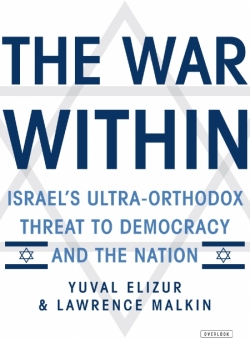
book cover - The War Within: Israel’s Ultra-Orthodox Threat to Democracy and the Nation by Yuval Elizur and Lawrence MalkinTwo books, written in a conversational style, came out recently that shine a glaring light on recent controversies sparked by the ultra-Orthodox in Israel. Reading them together provides a broad understanding of the issues.

The War Within: Israel’s Ultra-Orthodox Threat to Democracy and the Nation (Overlook Press, 2013) by journalists Yuval Elizur and Lawrence Malkin, looks at several flashpoints that, the authors say, will invariably turn into even more difficult social, economic and political problems as the ultra-Orthodox population grows.

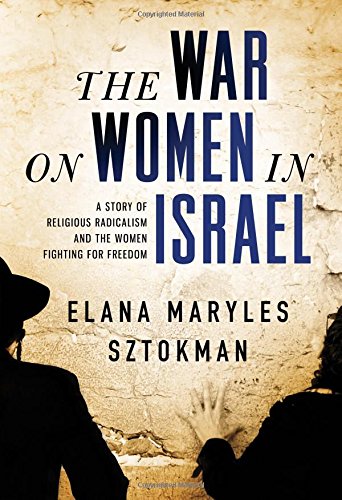
The War on Women in Israel: A Story of Religious Radicalism and the Women Fighting for Freedom (Sourcebooks Inc., 2014 ) by feminist activist Elana Maryles Sztokman, is an unrelenting assault on Israeli society for accepting blatant discrimination against women in almost every aspect of their lives. At times, the book reads like a social activist’s pamphlet demanding justice.

Israel ranks near the bottom among world democracies on the right to religious freedom. The books are reports from the frontlines in the fight for equality, and will be disturbing for those concerned about civil rights in Israel. The writers leave the impression that radical religious voices are shredding the fabric of the country.

Both books offer portraits of the ultra-Orthodox communities and a brief account of the historical context that led to the current problems. The perspective is clearly that of outsiders who have little patience for the ultra-Orthodox way of life. Nevertheless, it is difficult to ignore what they say.

Roughly 10 percent of the country and one-third of Jerusalem are ultra-Orthodox. Those numbers will likely explode within a generation, if current trends continue. The birthrate within the ultra-Orthodox community is twice the national average. As the children grow up, the impact of the ultra-Orthodox community will be felt in many different ways throughout Israeli society.

Students in ultra-Orthodox schools spend their day studying religious texts, paying scant attention to core subjects of English, math and science. Elizur and Malkin say that most students complete their formal schooling without the education or skills to work in a modern economy.

Several ultra-Orthodox schools go further, refusing to allow girls to write final exams in core subjects in order to ensure the girls do not leave school with a high school diploma.

Meanwhile, the economic life within the ultra-Orthodox community is grim and will likely degenerate even further as their numbers increase. The Taub Centre for Social Policy Research, in a report released in December, pegs the poverty rate in the ultra-Orthodox community at 66 percent in 2013, an increase from 60 percent in the previous year. The ultra-religious have the lowest participation rate in employment in the developed world.

And it’s not just a Jerusalem phenomenon. Ultra-Orthodox communities are scattered across the country. In the ultra-Orthodox community of B’nei Brak, half of all children live in families below the poverty line.

Both books provide an account of the historical roots for these circumstances. The ultra-Orthodox communities have relied almost entirely on national subsidies since the creation of the state in 1948. At that time, the rabbis argued that studying Torah and praying had ensured the survival of the Jewish people through centuries of wandering and persecution.

The founders of the state wanted to maintain the Jewish nature of the state. Religious authorities were given unqualified control over marriage and divorce. David Ben-Gurion agreed to exempt the ultra-Orthodox from military service and pay them to spend their days studying in a yeshiva. In exchange, he expected to receive their support in the Knesset.

The arrangement was a trade-off endorsed by most Israelis for more than 50 years. But demographics have shifted. In 1948, 4,000 students were studying in a yeshiva. Today, around 120,000 students study full-time and are dependent on allowances from the government. Many Israelis now are not so comfortable with the arrangement.

The trade-off has also meant that Israel does not have a constitution guaranteeing individual rights and freedoms. The ultra-Orthodox at that time refused to support a constitution, mostly to prevent shifts in the status of women, the journalists say.

The country’s founders forged practical arrangements without any long-term vision, say Elizur and Malkin. It was a colossal mistake. Successive governments have maintained the status quo, in effect placing huge barriers for those fighting for changes.

As women have asserted their right to be treated equally, religious zealots have escalated their tactics, moving from bullying and shouting to spitting, shoving and throwing rocks.

image - The War on Women in Israel: A Story of Religious Radicalism and the Women Fighting for Freedom by Elana Maryles Sztokman book coverThe ultra-Orthodox succeeded in pressuring Israeli public and private companies to ban female faces on transit ads and force women to sit at the back of the bus. Weak protection for secular values, coupled with liberal tolerance for diversity, enabled the ultra-Orthodox to push bus companies in Israel to segregate 150 bus lines across the country, Sztokman writes.

The arrests of women who sing, wear a tallit or pray at the Western Wall have been widely reported. These books provide numerous anecdotes about the confrontations on many fronts, including some outrageous instances of the struggles that some women face in obtaining a Jewish divorce from a vengeful husband. Around 10,000 women in Israel are in limbo, unable to obtain a get (a divorce decree) from the religious courts.

Elizur and Malkin also look at the government-funded rabbinic councils that operate under a minimum of oversight and with their jurisdiction only loosely defined. They assert control over everything from certifying pensions funds to ensuring that water is kosher.

Women disproportionately feel the impact of the institutions run exclusively by males. None of the judges in the religious courts are women. Until recently, even all the supervisors of the mikvehs were male.

The lack of accountability and vagueness over roles has cleared the way for the rabbinical authorities to attempt to expand their control over the lives of all Israelis. Imprecise boundaries have led to recent flare-ups over matters of division of property, child custody, alimony, child support and education. The army is struggling to find a compromise for ultra-Orthodox who are now enlisted. A battle over jurisdiction over circumcision was recently in an Israeli court.

The power of the religious authorities is on display in the most unexpected places. A produce market has separate shopping hours for men and women. Women’s voices disappear from the radio. A women’s health conference excludes accomplished women researchers and prominent women doctors from its program. Young girls cannot sing in public. Daughters are not allowed to stand by the grave of their fathers to say Kaddish.

Despite the dark portrait of the religious divide, both Sztokman and journalists Elizur and Malkin find reasons to be hopeful. Restrictions on seating on buses have been lifted on some lines; women’s faces are returning to some billboards on the street. Even the Women of the Wall can claim some victories.

Momentum is clearly on the side of the ultra-Orthodox. However, a backlash against the most extreme measures has begun to undo some excesses. The authors also find some members of the ultra-Orthodox community are working to change the system from within. Sztokman, for example, finds hope for religious pluralism in Israel from the work of an emerging alliance of Orthodox feminists and secular activists who are pushing for a more egalitarian country.

Robert Matas, a Vancouver-based writer, is a former journalist with the Globe and Mail. This review was originally published on the Isaac Waldman Jewish Public Library website and is reprinted here with permission. To reserve this book or any other, call 604-257-5181 or email [email protected]. To view the catalogue, visit jccgv.com and click on Isaac Waldman library.

Posted on March 27, 2015March 26, 2015Author Robert MatasCategories BooksTags discrimination, Elana Maryles Sztokman, Israel, Lawrence Malkin, ultra-Orthodox, women, Yuval Elizur

Posts pagination

Previous page Page 1 Page 2 Page 3
Proudly powered by WordPress