Skip to content
  • Home
  • Subscribe / donate
  • Events calendar
  • News
    • Local
    • National
    • Israel
    • World
    • עניין בחדשות
      A roundup of news in Canada and further afield, in Hebrew.
  • Opinion
    • From the JI
    • Op-Ed
  • Arts & Culture
    • Performing Arts
    • Music
    • Books
    • Visual Arts
    • TV & Film
  • Life
    • Celebrating the Holidays
    • Travel
    • The Daily Snooze
      Cartoons by Jacob Samuel
    • Mystery Photo
      Help the JI and JMABC fill in the gaps in our archives.
  • Community Links
    • Organizations, Etc.
    • Other News Sources & Blogs
    • Business Directory
  • FAQ
  • JI Chai Celebration
  • JI@88! video

Recent Posts

  • Story of Israel’s north
  • Sheltering in train stations
  • Teach critical thinking
  • Learning to bridge divides
  • Supporting Iranian community
  • Art dismantles systems
  • Beth Tikvah celebrates 50th
  • What is Jewish music?
  • Celebrate joy of music
  • Women share experiences 
  • Raising funds for Survivors
  • Call for digital literacy
  • The hidden hand of hate
  • Tarot as spiritual ritual
  • Students create fancy meal
  • Encouraging young voices
  • Rose’s Angels delivers
  • Living life to its fullest
  • Drawing on his roots
  • Panama City welcoming
  • Pesach cleaning
  • On the wings of griffon vultures
  • Vast recipe & story collection
  • A word, please …
  • מארק קרני לא ממתין לטראמפ
  • On war and antisemitism
  • Jews shine in Canucks colours
  • Moment of opportunity
  • Shooting response
  • BC budget fails seniors
  • Ritual is what makes life holy
  • Dogs help war veterans live again
  • Remain vital and outspoken
  • An urgent play to see
  • Pop-up exhibit popular
  • An invite to join JWest

Archives

Follow @JewishIndie
image - The CJN - Visit Us Banner - 300x600 - 101625

New biography of Cornelia Hahn Oberlander focuses on her work

In 1963, landscape architect Cornelia Hahn Oberlander was appalled when she saw park workers at Jericho Beach burning logs that had broken away from booms. She called up Bill Livingston, the Vancouver Park Board superintendent, and suggested placing the logs along the sandy beaches for people to sit on. Livingston thought it was a good idea.

Fifty years later, it’s often hard during the summer months to find a vacant spot along one of the logs lining Vancouver’s beaches. Changing the landscape of the city’s beaches is one of many ways in which Oberlander has contributed to making Vancouver one of the world’s most livable cities. However, despite being Canada’s preeminent landscape architect, Oberlander remains unknown to most of the people who enjoy the benefits of her work, and Susan Herrington, professor of architecture and landscape architecture at the University of British Columbia, sets out to raise Oberlander’s profile with the recently released biography Cornelia Hahn Oberlander, Making the Modern Landscape.
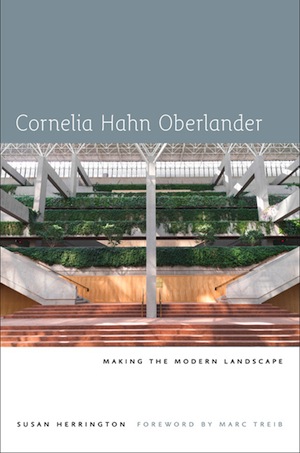
image - Cornelia Hahn Oberlander, Making the Modern Landscape book cover
Cornelia Hahn Oberlander, Making the Modern Landscape comes after several public tributes and publications about Oberlander’s achievements.

The book comes after several public tributes and publications about Oberlander’s achievements, including an extensive oral history available online at the Cultural Landscape Foundation (tclf.org) and a biography for teens called Live Every Leaf: The Life of Landscape Architect Cornelia Hahn Oberlander (2008). Oberlander has also co-authored two books: Trees in the City (1977) and Green Roof: A Design Guide and Review of Relevant Technologies (2002).

Herrington’s fascinating book goes one step further, unraveling the numerous influences throughout Oberlander’s life that shaped her professional development. Herrington places her innovative urban designs, her use of plants and her commitment to sustainability in the context of trends in landscape architecture over the past six decades. The biography is, as Herrington asserts, as much a history of modern landscape as a portrait of Oberlander’s life.

An impressive collection of photos and landscape sketches are sprinkled throughout the book to flesh out the scholarly account. The list of stunning accomplishments in a stellar career is balanced with references to some of her grand ideas that did not work out.

But the book will disappoint those looking for a popular biography with a window into her personal life; Herrington has taken an academic approach to Oberlander’s life. We become well acquainted with what the landscape architect accomplished. We are told a few delightful anecdotes about her life. But we do not learn much about her feelings or her personal relationships. If you want to get to know her in a more personal way, check out the oral history at the Cultural Landscape Foundation.

Also, the book does not pay much attention to Oberlander’s commitment to Israel and her work within the Jewish community. One of the founding members of Temple Sholom, she held a place of honor at High Holiday services for many years, reading the story of Jonah with her late husband, architect and urban planner Peter Oberlander. She designed the synagogue’s garden as well as the biblical garden at King David High School with its plants reflecting the various species and geographic regions of the Land of Israel, as described in the Torah.

Oberlander has been involved in more than 500 projects, including the design of more than 70 playgrounds. Her mother Beate Hahn was a professional horticulturalist and author of several books about gardening with children. Oberlander from an early age did drawings for her mother’s books. She has said she decided at the age of 11 that she wanted to design gardens.

Herrington includes a design of a wooded-parkland that Oberlander completed when she was 15 years old. Already at that time, Oberlander was busy in the garden, learning from firsthand experiences about the benefits of organic gardening, companion plants and attracting birds and insects to mitigate pests.

Oberlander was born in 1921 in Mulheim, Germany, a small city along the Rhine River. Herrington’s book ignores the prominence of her grandfather in Germany (a politician and professor and the University of Berlin) and the hurdles the family faced before leaving Germany in the late 1930s. The family emigrated to the United States and Oberlander in 1940 went to Smith College, a women’s college in western Massachusetts, to study architecture and landscape architecture. By coincidence, she stayed in a room across the hall from Betty Friedan, who went on to write The Feminine Mystique. However Oberlander’s contact with strong feminists did not turn her into an outspoken crusader for women’s rights.

Herrington emphasizes the significance of Oberlander as one of the first women in a male-dominated profession, but Oberlander never claimed to be a feminist. She told Herrington she never questioned whether a woman could pursue a professional career outside the home while raising her children, she just did it.

Herrington emphasizes the significance of Oberlander as one of the first women in a male-dominated profession, but Oberlander never claimed to be a feminist. She told Herrington she never questioned whether a woman could pursue a professional career outside the home while raising her children, she just did it.

Oberlander went on to Harvard in 1943. A year later, her mother, without Oberlander’s knowledge, asked the university to allow her to take a year off to work in an architectural office. Her mother thought her drafting skills were inadequate. Together, they decided she would take a year off. (The book does not tell us how that intervention affected her relationship with her mother.) Oberlander found a drafting job but was fired three months later and returned to complete her studies. She moved to Vancouver in 1953 after marrying Peter Oberlander.

Bringing together much that has been written with original research, Herrington shows how the landscape of some of Vancouver’s most familiar places (Robson Square and the Museum of Anthropology), as well as prominent national and international landmarks (the New York Times building, National Gallery in Ottawa and chanceries for embassies in Washington and Berlin) came out of Oberlander’s experiences as a child in the Weimer Republic, her exposure to seminal thinkers in school and her contact with leading figures in the profession.

Oberlander’s commitment to exhaustive research, modern design with abstract shapes and unadorned lines, and community involvement in planning were evident from the start of her career in Philadelphia. In design work for public housing, private residents and playgrounds, she saw the role of landscape architects as working for the community, not the wealthy. She shaped spaces to spark the imagination and creativity of their users. Her innovative work on playgrounds, with informal play areas and separated spaces for different age groups and activities, became a standard for progressive play areas across North America.

Even in the early 1950s, her plans reflected strong ecological values, attributes that would become her trademark in later years. Her designs integrated current strands of trees and plants as much as possible and followed the contours of the land. Years later, she set standards of excellence with her work on green roofs and green buildings.

Oberlander paid close attention to how people reacted to landscape design, what feelings were stirred by design and color, to understand how they used the space. She created areas intended to foster creativity and imagination while relating to the local context.

Herrington tracks Oberlander’s professional development as she shapes design to incorporate ideas from psychology, art and ecology. Oberlander paid close attention to how people reacted to landscape design, what feelings were stirred by design and color, to understand how they used the space. She created areas intended to foster creativity and imagination while relating to the local context.

By the mid-1970s, she had moved from playgrounds to urban landscapes that became havens for adults in densely populated areas. Herrington writes about Oberlander’s 30-year collaboration with Arthur Erickson and influences that had an impact on her high-profile projects.

Throughout it all, Herrington writes that Oberlander never lost her commitment to serve all of society. She continued to work on modest gardens for private homes, public-housing projects, playgrounds and landscapes for people with special needs. And, Oberlander has never forgotten her past. “Why would I disregard the very reasons why I joined this profession in the first place?” she told Herrington.

Media consultant Robert Matas, a former Globe and Mail journalist, still reads books. Cornelia Hahn Oberlander, Making the Modern Landscape is available at the Isaac Waldman Jewish Public Library. To reserve this book, or any other, call 604-257-5181 or email [email protected]. To view the catalogue, visit jccgv.com and click on Isaac Waldman Library.
Posted on May 2, 2014February 11, 2015Author Robert MatasCategories BooksTags Cornelia Hahn Oberlander, Susan Herrington
Visit Israel’s ancient water holes

Visit Israel’s ancient water holes

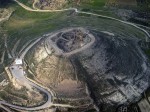
An aerial view of the acropolis of Herodium. (photo from commons.wikimedia.org)

In Israel, water scarcity has long been an issue. Even the Old Testament narrates that the Hebrews complained to Moses about the lack of fresh drinking water (Exodus 17:1-7, Numbers 20:2-13) in the arid Zin Wilderness.

Whether the answer to that particular water problem came from Divine intervention or from human ingenuity or both, the fact remains that the people who populated the ancient Land of Israel figured out sustainable solutions to their water shortages. This article focuses on three historical examples of sustainable water practice.

The first of the sustainable water system to be examined takes you forward in ancient history and north of the Zin Wilderness or Desert (Midbar Tzin, in Hebrew) to Herodium, a hilltop palace and fortress built by King Herod that stood securely at the highest peak in the Judean Desert.

Herodium was constructed more than 2,000 years ago in 23-20 BCE. Needless to say, it was crucial to have access to drinking water in this semi-arid and elevated location, and four vast underground cisterns for rainwater and spring water were carved deep into the mountain. Three of the cisterns were built in close proximity, about 80 feet below the summit. The fourth was hewn slightly above, about 16 feet from the summit. The largest cistern could hold up to 400,000 gallons of water. Access to the three lower cisterns was via the northeast side of the mountain, close to Herodium’s only flight of steps.

Water traveled a few miles from the Spring of Artas to drain into the large pool of Lower Herodium. It was carried uphill on donkeys and emptied into the lower cisterns. There were two ways to obtain water from these cisterns. One, exiting the palace-fortress with empty water skins or jars via the stairs until reaching the opening to the three lower cisterns. Water would then either be carried all the way back or, two, be transported to the opening of the higher cistern, at which point water was (ingeniously) funneled into the reservoir. A bucket attached to a man-made vertical shaft then brought this water up to the palace courtyard. This method was less labor intensive and insured the privacy of the “royals.”

As the nursery rhyme states, “some like it hot and some like it cold.” At Herodium, you had both hot and cold – and more. The Roman-style bathhouse featured a below-floor heating system in both the tepidarium (warm) and the caldarium (perhaps the precursor of the hot tub?), as well as a cold bath (frigidarium), or some kind of Roman bath/Hasmonean ritual bath hybrid, according to a Stanford professor of history.

According to David Mevorah, a curator of a Herod exhibit at the Israel Museum, by installing Roman baths, the king helped spread the importance of washing to the indigenous people of ancient Israel. Moreover, at what is called Lower Herodium (apparently the high-rent district of the day), the enormous pool (referred to by local residents today as El Hammam and measuring 70×45 metres or 230 feet) functioned as a swimming pool, a water reservoir and a small lake for boating, according to historians.

Today, Herodium is no longer a hilltop palace-fortress, but an amazing national park located just south and east of Jerusalem. For directions and hours, call the Herodian National Park at 057-776-1143 or visit parks.org.il.

***

Another (though more modern) solution to water scarcity is located just across the street from the Jerusalem Theatre at 17 Marcus St. Five large cisterns once serviced the Jesus Hilfe Asyl (what later became known as the Hansen Hospital). The Herrnhut Brothers, German Christians affiliated with the Moravian Church, donated the money to build the hospital in the late 1800s. It housed and treated people who were suffering from Hansen’s disease, a bacterial disease that was misdiagnosed as leprosy.

With the water collected, the 70 hospital patients (plus, in some cases, their healthy children) and the German Sisters of Mercy met all their water requirements, including medical needs, personal sanitation, in the kitchen and laundries, and for garden and farm maintenance.

Under the supervision of Jesus Hilfe builders, local workers constructed the cisterns, the largest of which was probably built in 1898. When full, it held 15×15 metres of water. In late December 1902, it even overflowed.

The other four cisterns were fed from rain gutters, which began on the hospital roof complex. Rain was collected from the staircase, the cistern roof and even from the road outside the compound’s high stone wall. Two cisterns were built near the laundry; one cistern was built near the southern garden while the others were situated within the main building, in the central courtyard or kitchen area.

With the advent of medicines to effectively treat Hansen’s disease, the in-patient hospital closed. Over the years, it has been an Israeli Ministry of Health outpatient facility and an early-childhood development centre. At present, it is being used as a Jerusalem municipal cultural centre. Inside the facility, you can visit an informative exhibit dealing with the history of the hospital and health care in Jerusalem. For visiting hours and tour arrangements, email [email protected] or call 054-744-6123.

***

Another ingenious water system is today located in a Ramla (or Ramle) city park. During the early Muslim period, in the early eighth century, Ramla was a strategically significant town, and served as the administrative centre of Palestine. Ramla was close to the road serving the holy city of Jerusalem and the port of Jaffa. Obviously, maintaining control of such an important location meant it had to be populated. This included providing inhabitants with a viable source of water.

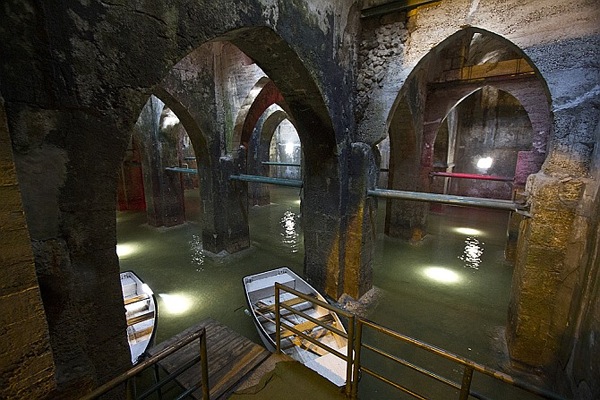
photo - Since summer of 2013, Ramla's Pool of Arches has been used for a new purpose: concerts!
Since summer of 2013, Ramla’s Pool of Arches has been used for a new purpose: concerts! (photo by Ron Peled from goramla.com)

Entering the city park, you’ll catch a glimpse of some long, rounded structures peeking up from the ground. When you descend the steep, narrow metal staircase (that now covers the original stone) leading to the pool, you take a step back in time, into the early Muslim period. This building, however, was not just any old storage unit. This elaborate reservoir, built in 789, is decorated with heavy brick, stone arches and a domed roof. Down below, you’ll find yourself facing an underground dock. It could pass for a medieval fort or a house, except that the floor is missing. In its place, the different chambers are filled with water deep enough for row boating! Altogether, the place gives you a mini-taste of Venice, Italy, except that at Ramla’s Pool of Arches, you never see the sky.

Today, we know arches make the sturdiest of structures, but this was still a novel idea back in the eighth century. Indeed, this construction proved so successful that the 400-plus-metre Pool of Arches withstood the devastation of the 1068 CE earthquake. You can see five of the original six vaults that covered the pool. Fifteen square pillars and 16 cross-shaped pillars support the vaults. Pointed arches exist between each pair of pillars. To compliment the arches, the architect designed small windows above them. These windows were likewise shaped as pointed arches. Locals drew water from 24 square openings in the ceiling.

There are various theories about the reservoir’s original source of water. Some claim it was filled only with rainwater. A more compelling assertion is that water flowed 10 kilometres from Tel Gezer via Caliph Sulayman ibn Adb al-Malik’s water conduit (in Hebrew referred to as an amah). Two points are clear: (1) it wasn’t water from any adjacent spring and (2) we are talking about a part of the world that is hot and dry for months at a time. The engineering and maintenance of this cistern was so successful that archeologists believe it was actively used for 150 years.

The site has a somewhat obscure history and goes by a variety of names, including the Pool of St. Helena and the Pool of Al-Anziya. In the early 20th cenutry, the British repaired the pool, but it was the (post-statehood) Ramla Municipality that converted it for boating.

After you visit the Pool of Arches, make note of the continuation of the city’s old subterranean water system. Ancient water cisterns are located in the White Tower’s large courtyard.

Visitors aged 2 and up can take a boat ride; life jackets are provided. For hours and directions, call 08-977-1595, 08-920-7586 or 052-851-0715. A helpful map can be found at ramla.muni.il/eng.

Deborah Rubin Fields is an Israel-based features writer. She is also the author of Take a Peek Inside: a Child’s Guide to Radiology Exams published in English, Hebrew and Arabic (take-a-peek-inside.com).

Format ImagePosted on May 2, 2014May 1, 2014Author Deborah Rubin FieldsCategories TravelTags Caliph Sulayman ibn Adb al-Malik, David Mevorah, Hansen Hospital, Herodium, Israel Museum, Jerusalem Theatre, Jesus Hilfe Asyl, Moravian Church, Pool of Arches, Roman baths, Tel Gezer, White Tower

Security after Kansas shootings

The recent deadly shooting in the parking lots of two Jewish facilities in Overland Park, Kan., exposed “glitches” in the Kansas City Jewish community’s security plan, according to the head of the local Jewish federation.

Todd Stettner, president and chief executive officer of the Jewish Federation of Greater Kansas City, said he was glad to see how competently both facilities handled the situation, quickly going on lockdown in accordance with previous training they had received.

But the Jewish Community Centre of Greater Kansas City and Village Shalom senior living centre were unable to quickly relay an emergency warning to everyone in their communities – similar to the emergency text-message and email systems used on school campuses throughout the United States.

More troubling in hindsight was the lack of a planned response for the specific attack Frazier Glenn Miller allegedly carried out on April 13 – a shooting in the two facilities’ parking lots.

“We practised for one eventuality, which was a shooter coming into the building,” said Stettner, “but this shooter didn’t come into the building. It’s always hard to plan for random kind of things, and we have to take a look and see what we can do better.”

The community will undergo an audit by U.S. Department of Homeland Security (DHS) personnel and receive input on changes they should make in security procedures. They will also receive help in developing and training to handle a wider range of emergency scenarios.

Paul Goldenberg – director of the Secure Community Network, a Jewish Federations of North America affiliate responsible for addressing security concerns in Jewish communities nationally – took part in a series of meetings between local leaders and agencies such as the FBI and Homeland Security to help answer the community’s concerns about safety and to advise on security improvements.

The 74-year-old Miller allegedly shot to death William Lewis Corporan, 69, and his 14-year-old grandson, Reat Griffin Underwood, outside the JCC. He then proceeded to nearby Village Shalom, where he allegedly killed Teresa Rose Lamanno, 53, before being arrested by police.

Read more at jns.org.

Posted on May 2, 2014May 1, 2014Author Dmitriy Shapiro JNS.ORG/WASHINGTON JEWISH WEEKCategories WorldTags Frazier Glenn Miller, Reat Griffin Underwood, Teresa Rose Lamanno, Todd Stettner, U.S. Department of Homeland Security, William Lewis Corporan

Louis Brier seeks two years of support with Eight Over Eighty

A fundraiser for the Louis Brier Home and Hospital is urging community members to make a two-year commitment so the facility can rely on sustainable funding to plan for the future.

“We are asking for people to consider making a commitment for two years so that we can tell the Louis Brier ‘we have raised this much money, we will know that it’s there for two years, you go ahead and make the plan you need to make that will take maybe two years to come to fruition and to give the maximum benefits to your residents,’” said Bernard Pinsky, co-chair of the Sustain, Maintain and Enhance campaign.

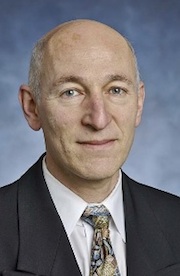
Bernard Pinksy
Bernard Pinksy (photo from Louis Brier Jewish Aged Foundation)

The last campaign raised $600,000 in each of three years, Pinsky said, and organizers hope this effort will be at least as successful, if not more. The campaign has been underway for several weeks and culminates at the end of this month. A major celebration – Eight Over Eighty – takes place May 25, when eight individuals and couples will be recognized for lifetimes of dedication to building community.

The campaign is important to the facility, Pinsky said, because the calibre of the home and hospital depends on the support of donors. The Louis Brier does not receive funding from the Jewish Federation of Greater Vancouver allocations or from United Way, Pinsky said, and the Jewish-specific components of the home’s character are not funded by government allocations.

“In order to make sure that we have the best facilities for seniors in our community the Louis Brier Aged Foundation needs to raise the money to distinguish it from other seniors facilities – many of which are very good, but they do not have the Jewish component,” he said.

Pinsky identified programs and activities such as kosher food, daily services, Shabbat services on Fridays and Saturdays, Yiddish and Hebrew classes, Jewish-themed discussion groups, films, lectures and performances as examples of the type of “extras” the fundraising supports. Louis Brier also has top-notch physiotherapy, art therapy and music therapy programs, he said. The differences made by these services are significant, he added.

“Most people in the Jewish community have had someone connected to them who has been in the Louis Brier and we also know from people who have loved ones, relatives or acquaintances in other facilities that the Louis Brier is a step above in many respects,” said Pinsky. “And we owe it to the people who established this community to give them the kind of dignity and the kind of retirement and life that they would want at this stage of their lives and it’s only us who can help because nobody else will pay for that.”

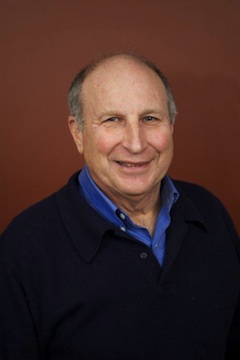
photo - Harry Lipetz
Harry Lipetz (photo from Louis Brier Jewish Aged Foundation)

Harry Lipetz, co-chair of the campaign with Pinsky, emphasized the Louis Brier’s dependence on the generosity of the community. “The Louis Brier Home and Hospital doesn’t have memberships such as synagogues [do] to draw upon,” said Lipetz, who is also president of the Louis Brier Jewish Aged Foundation. “We simply rely on the entire Jewish community.”

Lipetz said the Louis Brier’s reputation is due to the resources provided by community support. “The level of care that’s provided is probably rated the highest in British Columbia due to the additional funding that the foundation provides annually,” he said. “I am satisfied that our efforts really do bring quality of life to people, as we say, ‘adding life to years and years to life’ is something we are accomplishing.”

Lipetz asks people to take the initiative to support the campaign. “We have a limited ability to reach out to individuals,” he said. “It is a relatively large Jewish community. We would hope that individuals would come forward whether they are contacted or not to support this campaign.”

Pat Johnson is a Vancouver writer and principal in PRsuasiveMedia.com.

Posted on May 2, 2014May 3, 2014Author Pat JohnsonCategories LocalTags Bernard Pinksy, Harry Lipetz, Louis Brier Jewish Aged Foundation
Norman Tel Aviv gets makeover

Norman Tel Aviv gets makeover

The Norman Tel Aviv (all photos from the hotel)

The Norman Tel Aviv (thenorman.com), a luxurious boutique hotel, has restored two buildings on Nachmani Street, at the heart of the Tel Aviv UNESCO heritage site for historic Bauhaus architecture. The newly renovated hotel’s management are also dedicated patrons of the arts, seeking to support contemporary artistic expression in Israel. When complete, the complex will be a travel destination that houses and showcases many avant-garde cultural treasures.

image - Sigalit Landau artwork (detail)
Sigalit Landau (detail), one of the artworks on display at the Norman Tel Aviv..
image - Tsibi Geva painting
Tsibi Geva painting, also on display at the Norman.
photo - a room at the Norman Tel Aviv
A room at the Norman Tel Aviv.

“Tremendous care has been taken to restore these buildings to their original grandeur, preserving the eclectic style, Renaissance and oriental influences that characterize the edifice at #23 Nachmani, as well as the striking modernist architecture of the adjacent building at #25,” said Olivier Heuchenne, managing director of the Norman.

The hotel – whose grand opening is planned for this summer – will sport an interior design echoing the luxury and style of the grand hotels of the early 20th century, featuring top restaurants, an extraordinary collection of Israeli artwork, an elegant library bar and the Norman’s signature world-class amenities.

The art collection, comprised of more than 100 works, stands at the centre of this accomplishment, uniting design themes and creating an interactive experience for guests. Featured are works by Ilit Azoulay, Sigalit Landau, Klone, Dana Levy, Assaf Shaham and Tsibi Geva, among others, celebrating a class of leading contemporary Israeli artists whose work is exhibited worldwide.

For Tamar Dresdner, the in-house art curator and consultant tasked with selecting works for display, the opportunity to partake in the restoration is a dream come true. “I’ve been living in Tel Aviv for years,” she said in an interview. “I remember walking past these buildings when they were residential properties and then entering them when they housed offices for businesses and lawyers. I always fantasized about what could be done with the space.”

Read more at jns.org.

Format ImagePosted on May 2, 2014May 1, 2014Author Jeffrey F. Barken JNS.ORGCategories TravelTags Assaf Shaham, Dana Levy, Israeli art, Klone, lit Azoulay, Sigalit Landau, Tamar Dresdner, The Norman, Tsibi Geva

Ignite! festival is youth driven, skill building

For one week each spring, the Cultch comes alive with hundreds of local artists between the ages of 13-24 for the Ignite! Youth Festival. This is the 15th year of the event.

“The festival is a great place to discover new and emerging artists across Metro Vancouver and beyond. There’s food, laughter, dancing, dressing up, exciting acts and good times,” said Ellie O’Day of O’Day Productions, which handles publicity for the annual event. The festival “was created and run by a youth panel, working countless hours to put on an amazing festival every year, showing how important it is to have an opportunity like Ignite!,” she explained.

photo - Ellie O'Day
Ellie O’Day (photo from Ellie O’Day)

Hundreds of youth are involved in what is now Vancouver’s largest youth-driven arts festival, which includes showcases of music, dance and spoken word, the world première of three one-act plays, a visual arts exhibit and a variety of other acts. Events will be held in the Historic Theatre, Vancity Culture Lab, the Cultch lobby and the café galleries from May 2-10.

Though the festival is put on by youth, it is supported by a vast network of arts professionals to mentor the youth and help build their skills. Last year, a publicity mentorship was added to the list of mentorship opportunities. Publicity mentees get the opportunity to work with O’Day, the festival’s publicist five years running.

O’Day was brought up in a Reform Jewish family in the eastern United States and launched her career on radio in the late 1970s in Vancouver. From broadcasting, she expanded into writing, arts administration and arts advocacy, teaching music business for 21 years, and then – via her work as a publicist – helping to promote some of her favorite things: media and performing artists.

“I may have been thousands of kilometres away from my family and the customs that were part of our Jewish family life for many decades, but one of the principles that has stuck with me – particularly as I did not have children myself – is that we live on in the wisdom and knowledge we share with the coming generations,” she said. “That principle is so important to me that I would feel unfulfilled without it.”

O’Day does publicity for many shows at the Cultch, which is a complex of (now) three theatre spaces. “They have invested in this youth program,” said O’Day. “On staff, there is one youth program coordinator, currently Robert Leveroos,” who serves as guide, and also oversees a group of about 20 youth panel members who serve as the organizers of the festival.

During the weekend prior to the main festival, there is a showcase for mentored songwriters, spoken word artists and dancers. During the festival itself – which begins today – three short plays are presented in repertory. The young playwrights have been mentored by professional local playwrights; the young directors have been mentored by professional local directors.

“Last year, as a nearing-retirement publicist, I suggested we ‘mentorize’ the publicity, too,” said O’Day. “Young people may be savvy about social media, but don’t really understand how traditional media works.”

The publicity mentee helps with festival publicity. “Landon Krentz’s application indicated he was already doing some arts administration work, which meant he’d have a familiarity with the general infrastructure of arts organizations, which would add to his skill set,” said O’Day about this year’s publicity mentee.

photo - Landon Krentz
Landon Krentz (photo from Ellie O’Day)

Krentz and O’Day met a few times and split up the work, contacting artists for information, sending out media releases and following up on them.

Calling O’Day “my amazing mentor,” Krentz said he decided to join the mentorship program to improve his media relations skills and to become more involved in the industry. As the president of British Columbia Rainbow Alliance of the Deaf, Krentz has been involved with accessibility coordination, as well as with serving the deaf queer communities. A fundraiser and event coordinator for the contemporary dance community by day, Krentz is one of very few bilateral profoundly deaf people working in the arts community. “I hope to become a stronger advocate for deaf members and challenge audism in every day life,” said Krentz.

Some backstage roles, like stage management, lighting design, etc., have also been included in the mentorship program more recently. This year, promotional photography is being mentored by the Cultch’s house photographer.

“We’re not mentoring people to take over our positions next year,” O’Day explained. “The idea is to disseminate our skill sets and help mentor the next generation – who will eventually take our place(s).” The festival is all about empowerment, sharing knowledge and collaboration, she added.

There is an open application process in the fall/winter, when mentorship spots become available. In total this year, there are 18 mentorships, including three each in dance, songwriting and directing, two each in spoken word, playwriting and collaborative creation, and one each in publicity, photography, lighting design and stage management. The mentors hail from various disciplines and are all practising their art/craft in their professional lives.

Jane Heyman, a veteran director and theatre educator, is among the director mentors, as is Stephen Drover, artistic director of Rumble Theatre. A new category, collaborative creation, is mentored by Barbara Adler, who worked with spoken word mentees in the past. Among the dance mentors are Amber Funk Barton and Tara Cheyenne Friedenberg.

photo - Tara Cheyenne Friedenberg
Tara Cheyenne Friedenberg (photo by Wendy D Photography)

“This program is very unique,” Friedenberg, who is a dancer, choreographer and artistic director of Tara Cheyenne Performance, told the Independent. “It’s not a training program, but more of a lab with the amazing goal of a big performance in the fabulous Cultch. It’s an opportunity to mix with other youth committed to making art and to get guidance and support from some movers and shakers in Vancouver’s vibrant arts scene.”

O’Day added, “Each mentor’s role is going to be unique. Hopefully, they will be generous to share their knowledge and to let the mentee do a lot of the work, so they get hands-on experience.”

The Ignite! Youth Festival (igniteyouthfest.ca) runs until May 10. Tickets ($2 for youths 12-19, $6 for students/seniors, $10 for adults) are available online at tickets.thecultch.com or by calling 604-251-1363.

Rebeca Kuropatwa is a Winnipeg freelance writer.

Posted on May 2, 2014May 1, 2014Author Rebeca KuropatwaCategories Performing ArtsTags Amber Funk Barton, Barbara Adler, Cultch, Ellie O’Day, Ignite! Youth Festival, Jane Heyman, Landon Krentz, O’Day Productions, Rainbow Alliance of the Deaf, Rumble Theatre, Stephen Drover, Tara Cheyenne Friedenberg.
Winnipeg gives ambulance to Israel

Winnipeg gives ambulance to Israel

Dror Fuchs in Israel with the ambulance donated  by Winnipeg. (photo by Ariel Karabelnicoff)

In May 2013, the first Winnipeg-donated ambulance took to the streets of Israel. The vehicle was largely donated by allocations from Jewish Foundation of Manitoba fundholders responding to an ambulance fundraising drive, with additional money from members of the general community topping off donations. Another campaign for a second Winnipeg-donated ambulance is already on its way.

The Canadian Magen David Adom (CMDA) Winnipeg chapter ambulance-drive telethon was held on Nov. 24, 2013, with lead CMDA Winnipegger organizers Yolanda Papini Pollack and Sheldon Zamik, assisted by members of the CMDA Winnipeg chapter.

Growing up in Israel, Papini Pollack said she had to learn early on that it is never too early to prepare for a crisis.

“It’s rewarding to have a small role in saving the life of someone in need,” she told the Independent. “It scares me to think someone won’t get the medical treatment s/he needs due to a lack of operational ambulances.

“Magen David Adom has always been instrumental in helping save lives of Israeli residents, regardless of their ethnicity or religion. It’s an organization that unites all sectors of Israeli society.”

A filmmaker and educator, Papini Pollack created a short video clip to help convey the message of the fundraising drive and also spearheads the annual telethon.

“It was a great feeling to accomplish our goal last year, but there was also a feeling of fulfilling a duty,” she said. “This is something I had to be involved in, as I have a responsibility to the people of Israel. This is the least I can do.”

CMDA’s Winnipeg chapter wants to send more ambulances to Israel.

“It will be amazing if even one person in Israel would be able to say, ‘My life was saved thanks to an ambulance sent by people of Winnipeg.’”

“Wouldn’t it be great if Winnipeg could send an ambulance to Israel every year?” she asked. “It will be amazing if even one person in Israel would be able to say, ‘My life was saved thanks to an ambulance sent by people of Winnipeg.’

“Last year’s donors were so happy to see that 100 percent of their money was used to buy the ambulance. They were also thrilled to see a concrete photo of what their donation was able to achieve – the actual ambulance serving the people of Israel and being appreciated.”

Papini Pollack has received many messages from people in Winnipeg, expressing their thanks, as well as from people in Israel very appreciative of this lifesaving gift.

“Hearing that all the volunteers want to ride in the new Winnipeg ambulance was one of the most heart-warming things I heard all year,” she said.

The Winnipeg chapter of CMDA will continue raising awareness about the importance of MDA, while raising funds to send the second Winnipeg-sponsored ambulance to Israel.

“Our goals are very attainable,” said Papini Pollack. “We already raised a large portion of the needed money needed, with hope our community will succeed again this year.

“People wanting to get involved are welcomed to join our committee or help in other ways. We always need more volunteers and donations of any amount.”

Ariel Karabelnicoff, executive director of Canadian Associates of Ben-Gurion University of the Negev, Manitoba Region, first heard about the ambulance fundraising drive last September, having crossed paths with Papini Pollack at the Prophecy Conference, an event to which they were both invited to have a booth.

“When I heard the first ambulance was on its way, it felt amazing,” said Karabelnicoff. “I was proud of my colleagues and the people of Winnipeg. And, as I shared with other people news that the ambulance was on its way, they too were proud and impressed.”

Karabelnicoff’s current connection to MDA is through his friend’s son, Dror Fuchs, a 16-year-old who volunteers with MDA (during his free time, on weekends) in Israel.

“I heard from John Plantz, a Christian Zionist who is one of the main organizers of the Prophecy Conference in Winnipeg and who is part of the fundraising campaign for the ambulance, that he is very excited that Winnipeggers successfully sent an ambulance,” said Karabelnicoff.

“Recently, Dror sent me a photo of a brand new ambulance he was volunteering on and he mentioned it came from Winnipeg. You could probably imagine how I felt inside.”

To donate to the Winnipeg chapter ambulance drive or the Vancouver chapter ambulance drive, send a cheque to CMDA head office in Montreal (at CMDA, Suite 3155, 6900 Decarie Blvd., Montreal, QC, H3X 2TB), with mention of where you would like the money to go to, call 1-800-731-2848, or visit cmdai.org. CMDA is a registered charity and all donations will be acknowledged with a tax receipt.

Rebeca Kuropatwa is a Winnipeg freelance writer.

Format ImagePosted on May 2, 2014May 2, 2014Author Rebeca KuropatwaCategories IsraelTags Ariel Karabelnicoff, Canadian Associates of Ben-Gurion University of the Negev, CMDA, Dror Fuchs, Jewish Foundation of Manitoba, Magen David Adom, Sheldon Zamik, Yolanda Papini Pollack
Jewish sea turtle swims again

Jewish sea turtle swims again

Hofesh can swim now, thanks to a flipper made of polypropylene that is durable but flexible. (photo by Baz Ratner from Yanic Levy)

When a young green sea turtle with both his left limbs nearly severed washed up on Israel’s Mediterranean shore four years ago, the first thing on the rescuers’ minds was how they could save his life. The rescuers amputated both of the turtle’s limbs, which left him unable to swim or even keep his head above water – he was able only to stay on dry land or navigate in shallow ponds. Things changed when Shlomi Gez, a student from Hadassah Academic College in Jerusalem, happened upon the turtle rescue centre’s website.

Gez had been looking for a final project to complete his studies. “As soon as I saw the place, I was inspired, and I knew I could help solve their most acute problem, which was Hofesh,” he said.

The biggest hurdle for Hofesh – that’s the name given to the rescued sea turtle – was the loss of balance. Losing both limbs on the same side interfered with the stability needed for swimming. “A flipper enables fish to retain their balance, so I decided to adapt the idea to a sea turtle,” Gez told the Independent.

Gez’s designed a specialty flipper made of polypropylene that is durable but flexible. He attached it to Hofesh’s back with a harness – and it worked. As Gez fine-tuned the prototype, the permanent flipper was recently glued to Hofesh’s shell with a special glue designed to grow with the shell as the turtle grows.

“At first, we could only put him in a shallow-water pool because he would have drowned but, now that he has his artificial flipper, he swims completely normally,” said Yaniv Levy, director of the rescue centre.

The centre has rescued more than 500 sea turtles – green turtles, a highly endangered species, and loggerheads – since it was founded 15 years ago, and successfully returned about 70 percent of them to the sea.

Unfortunately, Hofesh cannot be set free – if his flipper ever came loose, he would drown. But as a member of a globally endangered species, Hofesh has been selected for a breeding program. “We hope his offspring will be returned to the sea,” said Levy.

Although Hofesh’s disability is visible, this does not bother his new mate, a blind green sea turtle, named Tsurit. They swim together in their shared tank at the centre. “He nibbles her neck and likes to frolic with her,” said Levy, noting green sea turtles have about the same average life span as humans, but reach sexual maturity only around the age of 30.

In 1930, the green turtle population was at around 30,000. At the time, they were called, “the Edible Sea Turtle,” hunted nearly to extinction. Today, there are fewer than 30 wild green turtles in the area.

In 1930, the green turtle population was at around 30,000. At the time, they were called, “the Edible Sea Turtle,” hunted nearly to extinction. Today, there are fewer than 30 wild green turtles in the area.

The centre runs a breeding program, which currently includes 26 green sea turtles. Its hospital treats the green turtles and the more common, but also endangered, loggerhead species, with some 15 patients in care. Like Tsurit and Hofesh, most have been injured by boats and fishing nets.

“It’s unfortunate that Hofesh will never be free,” said Levy, “but he has a good life here.”

The hope, of course, is that Tsurit and Hofesh’s union will increase the population of rare green sea turtles in the Mediterranean.

Sea turtles lay 300-500 eggs per breeding season. During a female’s lifetime, she can lay around 6,000 eggs.

The survival rate of young sea turtles is estimated as only one in every 100 hatchlings reaching sexual maturity. In the Mediterranean alone, about 1,000 turtles are injured annually.

The Israeli Sea Turtle Rescue Centre is part of the world network focused on treating injured turtles. Its aim is to create a better future for the turtles’ near-extinct populations, to raise public awareness for better life, to achieve a society that better cares for its oceans and seas and to help reestablish an environmental balance. The new dedicated rescue centre inside the existing Alexander River National Park, where the river forms an estuary flowing into the Mediterranean, will be isolated from noise and populated areas.

Another Israeli turtle story involves a groundbreaking medical device used to treat terror victims helping save the life of a Caspian turtle at the Israeli Wildlife Hospital, Ramat Gan Safari. This turtle posed a challenge for veterinarians, as its shell had too big a crack to fix the standard way (with bolts and wire). The veterinarians turned to the head of the plastic surgery unit at Hillel Yaffe Hospital in Hadera, Dr. Morris Topaz, an Israeli doctor who treats terror victims.

Topaz originally created the device to help people who lost areas of skin too far separated to sew together yet too close together to do a skin implant. It brings the two edges of existing skin closer to each other, eliminating the need for skin implants. With the special device, they glued the unique plastic device on both sides of the turtle’s fracture and connected them with a special plastic string that looks a lot like a zip tie.

Seeing his device in action on a turtle, Topaz decided to donate the idea and device to the Israeli Wildlife Hospital for future cases.

More than 2,200 injured wild animals are brought to the Israeli Wildlife Hospital annually. About 60 percent of the animals are treated, rehabilitated and returned to the wild.

Rebeca Kuropatwa is a Winnipeg freelance writer.

Format VideoPosted on May 2, 2014July 9, 2014Author Rebeca KuropatwaCategories IsraelTags Alexander River National Park, Israeli Wildlife Hospital, Morris Topaz, Ramat Gan Safari, Yaniv Levy
Moments shine in Seminar

Moments shine in Seminar

Brian Cummins, standing, with, left to right, Michael Germant, Christine Wallace, Gina Leon and Brendan Riggs. (photo by Gregory Wills Photography)

Seminar, by American playwright Theresa Rebeck, is a sex comedy with occasional insights into the life of a professional artist. However, the play feels a bit thrown together and uncertain of how seriously it wants to be taken. As a drama, it is pretty weak. As a sex comedy, it is second rate. And, as a meditation on the life of an artist, it is half-baked. Still, it has moments that work.

The recent community theatre collaboration by Island Productions with Frolicking Divas and Bar S Entertainment marked the play’s Vancouver première. The show ran for five performances at PAL Studio Theatre and closed April 20. The cast comprised local film and television actors, including a couple of Jewish community members, Gina Leon and Michael Germant.

Rebeck is a successful television writer with credits like L.A. Law, Third Watch, NYPD Blue and Smash. In 2003, she was nominated (with a co-writer) for a Pulitzer Prize. In addition, she is a noted scholar who holds a doctorate in theatre from Brandeis University. Seminar ran on Broadway for 191 performances before it closed May 6, 2012. Allan Rickman played the lead character, Leonard, a washed-up novelist who teaches young writers. It’s a huge role, a character that dominates the play and all the characters in it.

Martin Cummins played that role in the local production. Four young writers have chosen to pay $5,000 each to study with this literary giant. As the group’s teacher, Leonard is a pontificating jerk and a destructive force. He is also the source of the play’s energy. Cummins’ characterization started with over-the-top bluster and pomposity, a level that gave the character no room to become increasingly arrogant and obnoxious as the play goes on. This weakened his performance and the production.

Four students and Leonard meet weekly in Kate’s apartment for a workshop with the “Great Man.” Kate (played by Leon) is a privileged young woman who lives in a huge apartment on Manhattan’s Upper West Side. She reveals her insecurity by constantly dropping the name of the exclusive college she once attended, as if this establishes her credibility as a short story writer. She’s in love with Martin (Germant), who eventually sleeps with Izzy (Christine Wallace).

Lots of low-comedy bed-hopping occurs in a play that aspires to be about the creation of art. The sex-comedy element may indicate that the playwright was too lazy to develop more sophisticated subplots, or maybe it just shows the playwright’s conviction that stock characters in age-old situations are essential to commercial Broadway success. She is likely right in the latter.

Douglas (Brendan Riggs) is eager to receive approval from his teacher, and Izzy enjoys Leonard’s accolades for what is clearly an inferior work. She succeeds on her looks alone, and ends up in a couple of beds.

And then there is Martin, the best writer in the group and the least secure. He is afraid to show his writing to anyone. When he finally shares his work, Leonard is deeply affected and moved to make the play’s best, and best-performed, speech. He warns Martin of the miserable life that lies before him should he pursue the writing career of which he is clearly capable.

In this speech, Rebeck (through Leonard) offers a cautionary tale about how a talented writer may produce a successful novel or two, but can then expect to see his or her excellent work ignored, suffer envy of less successful writers, and end up teaching creative writing to bored students at some insignificant college. Leonard is clearly describing his own rise and fall, and Cummins rose to the occasion with this speech and we saw Leonard’s bluster combined with personal pain and disappointments. A good moment for Cummins.

For the play’s final scene, Rebeck takes a more romantic view of artists, those individuals who are compelled to create. This final dialogue, between Leonard and Martin, allowed both actors to shine. Germant provided a layered version of Martin. He shifted from an angry victim who demands his money back to an artist in search of a mentor; and Leonard challenges the young writer to work hard. The play ends on a hopeful note.

The actors, for the most part, were too dependent on the script for the establishment of their characters. They should have displayed more anxiety in anticipation of Leonard’s judgment and more distress when he destroys their dreams. The actors needed also to demonstrate why their characters stick with the loathsome Leonard, why they don’t just leave the room and quit his class. Finally, the comedy would have worked better if director Mel Tuck had guided his actors into a faster pace and a greater focus on proper timing. Snappy dialogue needs to snap.

Michael Groberman is a Vancouver freelance writer.

Posted on May 2, 2014September 18, 2014Author Michael GrobermanCategories Performing ArtsTags Bar S Entertainment, Brendan Riggs, Christine Wallace, Frolicking Divas, Gina Leon, Island Productions, Martin Cummins, Michael Germant, PAL Studio, Theresa Beck

What might the future hold now that the peace talks have failed?

This article was originally published in the Times of Israel the day before negotiations failed and the editing takes this into account. It is reprinted with permission.

As the current peace talks between Israel and the Palestinians have failed, we need to prepare for what comes next.

For some, this preparation involves preparing the public relations case for why “they” are to blame and shoring up our arguments and defence against a partial or broad boycott, divestment and sanction (BDS) campaign. It might also involve the circling of wagons around the “loyalists” and a legislative and communal campaign against the “outliers.” Who can march, when and where, who can speak, when and where, whose support is acceptable, and who is included under our “big tent,” are all going to be the subjects of ever-increasing and acrimonious debate, and some around the world might not take it as self-evident that it is “their” fault.

What happens after we accept that, for possibly the next decade, an agreement will elude us? What happens when our aspirational horizons are contracted and the status quo is all we can look forward to? Do we commence with punitive steps, such as annexing Judea and Samaria, expanding our hold on the land through settlement building and expansion, and a cessation of financial cooperation and support with the Palestinian Authority? Do these actions contribute to a stronger and greater Israel, to Israel’s vision of itself and relationship with world Jewry and the international community?

Like U.S. Secretary of State John Kerry, I, too, fear the consequences of an energized BDS movement. But, more than that, I fear the ghetto mentality and victimhood psychology to which it would give birth. As a people, we are well schooled in living in the midst of animosity and defensive responses are imprinted on our DNA. Instead of leading the Jewish people away from a Holocaust-centred narrative, Israel would be its new locus of operations.

All criticism will immediately be subsumed under the banner of antisemitism and the world will be divided between the stark categories of friend or foe, with the former an ever-shrinking category. Friends will be confined to those who do not merely support us but who agree with us and reaffirm our narrative. Our world will become smaller and our walls higher as we create with our own hands the greatest ghetto in Jewish history.

This is not the Jewish world into which I want to raise my grandchildren. This is not a Jewish world that has any chance of attracting Jews who are searching for the location of their primary identity. This is not an Israel that can lay claim to a leadership position in Jewish life and attract the loyalty of future generations. This is not an Israel that can build new bridges, whether spiritual, moral, economic or political, with the larger world and our Christian and Muslim friends.

The making of peace requires two sides. Whether we did everything in our power and whether the Palestinians did everything in theirs is a factual question and, as such, paradoxically, unresolvable, for we rarely shape our opinions on the basis of facts, and instead shape our perception of the facts on the basis of our opinions.

We need to ensure that the cessation of the current peace negotiations does not at the same time unleash an uncontrollable process and narrative that will create a broader reality alien to who we are and detrimental to who we want to be.

I am concerned with that over which we do have control – our values, principles and identity as a nation and as a people. We need to ensure that the cessation of the current peace negotiations does not at the same time unleash an uncontrollable process and narrative that will create a broader reality alien to who we are and detrimental to who we want to be.

We now awaken to a world where policy is not the barter of negotiations nor the payment offered for compromises from the other side. We awaken to a world where we have to negotiate once more with ourselves and discover what we really want and what we need to do to get there. Settlement expansion is no longer a Palestinian problem but an Israeli one; educating youth towards violence is no longer an Israeli concern but a Palestinian one.

The demands of the other have ceased to serve as the wall behind which we hide ourselves from our own values and interests. We discover that all the punitive threats of harm that we levied at each other during the negotiations, if in fact implemented, harm “us” at least to the same degree.

Together with the mobilization of our forces for the sake of public relations, we need a mobilization of our best talent and leadership to determine and implement our national policies. We need to lead and not be led.

While a unilateral withdrawal along the lines of Gaza is not prudent, a unilateral implementation of policies that serve our moral and political interests is not only prudent but critical.

Such unilateral policies, I believe, must first fortify our Jewish commitment to the equality of all humankind, to the treatment of others as we would want to be treated ourselves and to the disdain we feel in the role of occupying another people. As an expression of these commitments, we must first clarify the borders we believe are defensible and which at the same time will allow for a viable Palestinian state.

This must be followed by a cessation of all settlement expansion, let alone building beyond these lines. At the same time, this cessation must be accompanied by a gradual dismantling of those settlements that are outside our self-proclaimed borders: first, through stopping economic incentives; second, through the provision of economic incentives to move; and third, through the construction of viable housing alternatives to accommodate the inhabitants of these settlements. All this will undoubtedly take time, but now, in the days after, what we have in abundance is time.

Just as we built a massive infrastructure to support the safety of the Israeli citizens who live there, we must now invest heavily in roads, bridges and tunnels that will allow unencumbered and free passage, to the best of our ability, for Palestinian inhabitants.

As the role of occupier is prolonged, we must be ever more conscious of the effects that it has both on those who are occupied and on those who are occupying. We must engage in an ever more rigorous analysis of our military footprint in Judea and Samaria and minimize our interference in the everyday lives of the Palestinian people to pressing security concerns alone. Just as we built a massive infrastructure to support the safety of the Israeli citizens who live there, we must now invest heavily in roads, bridges and tunnels that will allow unencumbered and free passage, to the best of our ability, for Palestinian inhabitants.

As the occupier, we must realize that the cancer is not merely affecting a small group of radical settlers but us all. We must double and triple our educational programs geared toward increasing commitment and sensitivity to the equality of human beings and to their inalienable rights. We must fight any and all exhibitions of discrimination and national racism. If we are not at the present time capable of applying our values to the Palestinian people in Judea and Samaria, we can double and triple our efforts in implementing them toward our fellow Israeli Arab Palestinian citizens.

Finally, we must relearn the old Diaspora art of living with unfulfilled dreams. The success of Israel has lured us into believing that if we will it, it will become a reality. As a result, we articulate our aspirations but have difficulty holding on to them in the midst of our imperfect reality. If aspirations for peace, justice and compassion are going to continue to define Jewish identity, we must learn to talk about them, write and sing about them, dream about them, despite the pain and disappointment that accompany our inability to as yet fulfil them.

This is part of the Torah of Israel for what happens in the days after negotiations fail, a Torah that challenges us to implement our ideals to the best of our ability and which obligates us to hold on to them, regardless of the reality within which we find ourselves. This is a Torah that empowers us as a free people to shape the world in which we live, instead of merely being its victims. This is a Torah that can prepare us for all the days after.

Rabbi Dr. Donniel Hartman is president of the Shalom Hartman Institute (hartman.org.il) in Jerusalem and director of the Engaging Israel Project. He is the author of The Boundaries of Judaism.

Posted on May 2, 2014May 1, 2014Author Donniel HartmanCategories Op-EdTags John Kerry, peace process, Shalom Hartman Institute

Posts pagination

Previous page Page 1 … Page 648 Page 649 Page 650 … Page 662 Next page
Proudly powered by WordPress