Skip to content
  • Home
  • Subscribe / donate
  • Events calendar
  • News
    • Local
    • National
    • Israel
    • World
    • עניין בחדשות
      A roundup of news in Canada and further afield, in Hebrew.
  • Opinion
    • From the JI
    • Op-Ed
  • Arts & Culture
    • Performing Arts
    • Music
    • Books
    • Visual Arts
    • TV & Film
  • Life
    • Celebrating the Holidays
    • Travel
    • The Daily Snooze
      Cartoons by Jacob Samuel
    • Mystery Photo
      Help the JI and JMABC fill in the gaps in our archives.
  • Community Links
    • Organizations, Etc.
    • Other News Sources & Blogs
    • Business Directory
  • FAQ
  • JI Chai Celebration
  • JI@88! video

Recent Posts

  • Zionism wins big in Vegas
  • Different but connected
  • Survival not passive
  • Musical celebration of Israel
  • Shoppe celebrates 25 years
  • Human “book” event
  • Reclaiming Jewish stories
  • Bema presents Perseverance
  • CSS honours Bellas z”l
  • Sheba Promise here May 7
  • Reflections from Be’eri
  • New law a desecration
  • Resilient joy in tough times
  • Rescue dog brings joy
  • Art chosen for new museum
  • Reminder of hope, resilience
  • The national food of Israel?
  • Story of Israel’s north
  • Sheltering in train stations
  • Teach critical thinking
  • Learning to bridge divides
  • Supporting Iranian community
  • Art dismantles systems
  • Beth Tikvah celebrates 50th
  • What is Jewish music?
  • Celebrate joy of music
  • Women share experiences 
  • Raising funds for Survivors
  • Call for digital literacy
  • The hidden hand of hate
  • Tarot as spiritual ritual
  • Students create fancy meal
  • Encouraging young voices
  • Rose’s Angels delivers
  • Living life to its fullest
  • Drawing on his roots

Archives

Follow @JewishIndie
image - The CJN - Visit Us Banner - 300x600 - 101625

Chua and Rubenfeld attempt to explain success

Jews are the quintessential successful minority group by any economic measure. They are disproportionately represented in the top rankings in business, finance, the arts, scientific research, architecture, medicine and law.

Likewise, Mormons and new immigrants to the United States from China, Cuba, India, Lebanon, Nigeria and Iran make the A-list in several sectors of the economy. Meanwhile, black Americans and other groups are stuck in poverty with high unemployment and poor education.

Those are bold statements that many will dismiss as thoughtless stereotypes. But are the generalizations baseless?

The Triple Package: How Three Unlikely Traits Explain the Rise and Fall of Cultural Groups in America (Penguin Press, 2014) is an exploration into the murky world of these sweeping statements. Amy Chua, the “tiger mom” who gained notoriety for her harsh approach to child-rearing, teams up with her accomplished husband Jed Rubenfeld to investigate some of the reasons why some groups rise to the top of their fields, become wealthy and win awards while others seem to be stuck in a rut.

image - Triple Package book coverThey look for similarities in the lives of numerous celebrities, corporate leaders and ordinary folks, both those who have done well and those who have failed. They dissect statistics from census tracks that identify highest income and medium household net worth for different ages within several racial, cultural and religious groups. They count CEOs and CFOs, the percentage of students at Harvard and other Ivy League schools, and the winners of Nobel Prizes, as well as cultural awards such as Pulitzers and Academy Awards. They slice and dice the numbers in numerous ways and come out with specific cultural traits – a set of values and beliefs, habits and practices – that they conclude are similar among all the overachieving groups.

• Disproportionately successful groups have a deeply internalized belief in the specialness or superiority of their group, rooted in theology, history or a social hierarchy from their homeland.

• Members of the group have a feeling of insecurity and anxiety about losing whatever they have. They feel what they do is never good enough.

• Those that succeed emphasize discipline and controlling impulses. They stand up to temptation and persevere despite difficulties.

The authors conclude that people grappling with a superiority complex and deep insecurities are often consumed with resentments that push them to overachieve. The chip-on-the-shoulder attitude feeds their ambition and creates an “I’ll show them” mentality. Impulse control mixed with strong ambition yields a toughness and resilience. Members of the group who succeed found virtue in enduring hardships, deferring gratification and standing up to adversity.

There is some truth in what they write. The biographies of prominent Jewish figures often include anecdotes reflecting those traits. Although Jews are “Chosen People,” they are haunted, at least in the world of Philip Roth and Woody Allen, by insecurities stemming from unrelenting parental pressure and social scorn, real and imagined. Impulse control has been foundational to Judaism religion, with its 613 injunctions, and its countless prescriptions for a traditional Jewish way of life. It is those forces that Chua and Rubenfeld say converge to produce success.

Jewish overachievers are not the only ones. Chua and Rubenfeld find parallels with the traits of the disproportionate number of Mormons who are top executives of Fortune 500 companies, with Asian American students with the highest grades (but reportedly the lowest self-esteem of any racial group), and Cubans in Miami who have become millionaires and hold a disproportionate number of managerial and professional positions in the city, and dominate local politics. Other immigrant groups under similar pressures also do well.

But such sweeping statements set off alarms. Caustic reviews since the book was released earlier this year dismissed their conclusions as racist, faulty social science and, some may say even worse, dull prose. Reviewers attacked Chua and Rubenfeld, two Yale University law professors, for sloppy thinking and loose use of language.

Chua and Rubenfeld are accustomed to public attention, although usually of a different sort. Chua was on Time magazine’s list of the 100 most influential people in the world after the release of her book Battle Hymn of the Tiger Mother in 2011. Rubenfeld has written two international bestselling novels and two books on constitutional law.

 They challenge those who assume equality is always beneficial. They suggest that promoting self-esteem, instant gratification and excessive freedom in parenting may be counter-productive.

Clearly frustrated by the response to their new book, Chua and Rubenfeld have said their work has been misunderstood and misrepresented. They believe they have been aggressively attacked because their conclusions run counter to contemporary political correctness. They challenge those who assume equality is always beneficial. They suggest that promoting self-esteem, instant gratification and excessive freedom in parenting may be counter-productive.

They attribute the uproar over the book also to an aversion to talk about opinions about various cultural, ethnic and religious groups doing significantly better than others, views that are often expressed privately but not in a public forum.

They got that right. It’s a minefield filled with explosive emotions and ugly name-calling. However, they are right in insisting that the overheated rhetoric contributes nothing to an understanding of the subject. We should not avoid discussion of hot issues, especially those that have given rise to some of the worst atrocities in the world. Chua and Rubenfeld raise matters that should engage society in dispassionate debate.

So let’s turn the spotlight on their generalizations about cultural traits to see whether they stand up.

Chua and Rubenfeld try to inoculate their conclusions from criticism with 78 pages of notes and listing the names of 50 research assistants who worked with them. They claim statements about economic performance and cultural attitudes are backed up by empirical, historical or sociological evidence. “But when there are differences between groups, we will come out and say so,” they write.

They look at characteristics of those struggling in poverty and at a variety of explanations for their situation, such as IQ levels. They conclude that the disparities between rich and poor cannot be explained by these alternatives.

They also note the transitory nature of the accomplishments achieved through the sense of superiority, insecurities and hard work. Success wipes out insecurity and eases assimilation; equality undermines personal ambition. They conclude that traits that helped disproportionately successful groups rarely survive beyond the first two generations.

They downplay the impact of politics, social institutions and education. Personal responsibility plays virtually no role in their theories. Factors that have nothing to do with religion, culture or race, such as the lack of opportunity, discrimination and the devastating impact of economic forces, are minimized. Chua and Rubenfeld gloss over examples that do not fit their theories.

Despite their extensive references to research, the book reads as if Chua and Rubenfeld started with conclusions and then went out to find evidence to back up what they wanted to say. Focusing on cultural traits has blinded them to other influences. They downplay the impact of politics, social institutions and education. Personal responsibility plays virtually no role in their theories. Factors that have nothing to do with religion, culture or race, such as the lack of opportunity, discrimination and the devastating impact of economic forces, are minimized. Chua and Rubenfeld gloss over examples that do not fit their theories. Are they cherry-picking results and leaving out conflicting evidence? An answer to that question will be left to the experts in the field.

Anticipating probably the most controversial attack, the charge of racism, the authors write they are identifying psychological attitudes, not characteristics from birth. They acknowledge that significant differences exist within every racial, cultural and religious group. Even the subgroups they identify were not monolithic. But, they say, that did not make the culture traits less real or powerful.

They also anticipate critics who say the traits they celebrate often do not lead to happiness. They acknowledge that the attributes of success come with their own distinctive pathology that misshaped lives. Deeply insecure people were often neurotic and a sense of superiority led to arrogance and easily morphed into racism. They concede that the “triple package” might not be a recipe for happiness. Indeed, the rewards of the triple package were mostly financial. However, they posit that material success can lay the foundation for a happier life.

So, what are we left with after so many qualifications? As pop sociology, the book provides numerous provocative sparks for conversation around the Shabbat table. They identify some traits of some people who have achieved much. But many would insist their glib generalizations are just plain wrong. At times, they seem to give the strongest arguments against their own conclusions. And, even if you accept what they say, it is doubtful that many parents would want their children to follow the direction that Chua and Rubenfeld have set out.

Media consultant Robert Matas, a former Globe and Mail journalist, still reads books. The Triple Package: How Three Unlikely Traits Explain the Rise and Fall of Cultural Groups in America is available at the Isaac Waldman Jewish Public Library. To reserve this book, or any other, call 604-257-5181 or email [email protected]. To view the catalogue, visit jccgv.com and click on Isaac Waldman Library.

Posted on September 19, 2014September 18, 2014Author Robert MatasCategories BooksTags Amy Chua, Jed Rubenfeld, Tiger Mom

PhD research sparks fiction

Shirley Graetz’s She Wrote on Clay (Hadley Rille Books, 2013) is so intriguing, so mesmerizing, so unique, so well-written, I could not put it down!

image - She Wrote on Clay coverGraetz was born in Dusseldorf, Germany. She came to study at the Hebrew University of Jerusalem and never left Israel. Her master’s degree and her doctorate are in ancient Near Eastern studies, and she is a licensed tour guide and a teacher, married and mother of three young children.

She explains that, while conducting her PhD research at Ben-Gurion University in 2011, she was working on letters written by women who were naditu, monastic women who lived around 1800 BCE, about the time of Abraham, in Mesopotamia (ancient Iraq).

She had never written fiction before but, she says, “The women started to talk to me in my head. I had just given birth to my third child (the other two were 2 and 4), it was the second year of my PhD, but I sat down and wrote for three days. It was as if the story wrote itself.”

The texts were originally in cuneiform on clay tablets, in Akkadian, an ancient language. Some of these women were scribes. They lived in the equivalent of a walled compound called a gagu, but each woman had her own house or room. They all came from wealthy families, and there were different gagus in different cities. By becoming a naditu, each woman foreswore marriage and children, but her family provided her with food and clothing. However, the women had to be successful in business in order to remain financially independent.

The most prominent gagu was in Sippar, Meospotamia, a city on the banks of the Euphrates River, from which we have the most texts.

The novel revolves around 16-year-old Iltani, whose goal in life is to become a scribe. The best way to achieve this is to become a naditu and go to a gagu, which she will do in three months; her aunt and a childhood friend also live there. Her father has paid a naditu there to teach her to be a scribe. Once she enters, she will not visit her family for two years.

When she enters, there is a ceremony as she leaves her family and is welcomed by the priests, the making of temple offerings and her initiation. Her life then begins, and this forms the bulk of the book – focusing on her day-to-day life, the process of learning to be a scribe, her relationships with her aunt and friend, as well as conflicts within the gagu and her other relationships, until she is 25, already nine years in the gagu.

The surprising turns add much to the enjoyment of this read, and the meticulous details described about the home life, the clothes, the food, the customs in Sippar, are also part of the fascination of this story about what I would call “feminist women of 4,000 years ago.”

Sybil Kaplan is a foreign correspondent, lecturer, book reviewer and food writer in Jerusalem. She has compiled nine kosher cookbooks. She leads weekly walks in English in the Jewish produce market, Machaneh Yehudah, and writes the restaurant features for Janglo, the oldest, largest website in Israel for English-speakers.

Posted on September 19, 2014September 18, 2014Author Sybil KaplanCategories BooksTags gagu, Mesopotamia, naditu, Shirley Graetz

For Jews, sorry is not enough

Christianity and Judaism have many customs and symbolism in common. Naturally, as the aphorism states, the child does not stray far from the mother. We both take vows to repair our character. But, in one area, we grossly diverge: the proclamation of the new year.

photo - It’s OK to lust after your neighbor’s Jennifer Lopez-looking wife – as long as you don’t act on that desire
It’s OK to lust after your neighbor’s Jennifer Lopez-looking wife – as long as you don’t act on that desire. (photo from Stemoc via en.wikipedia.org)

To put it plainly, New Year’s Eve to your Christian friends may be an office party with wine, stolen kisses and shrill music that drowns the clarion call of the shofar. Rosh Hashanah is both private and public sober meditation, as serious as death. You can tell it’s Rosh Hashanah even without a calendar when Jewish faces go serious – when Jewish eyes are not smiling.

In both religions, we reexamine our behavior, note our lapses and vow to improve our moral balance. But, in Judaism, ceremony and symbolism take the throne. The environment is much more regal. After all, we are asking of this shofar-announced first day of the year to come – the king of days, so to speak – mercy and goodness. And, above all, life. May that lump on your leg be benign. May Bennie turn a dark corner and find through honest labor the means to feed his family. We attempt to woo good fortune with a shofar blast, the bugle call of the Jewish warrior. We give tzedakah. We fling away our sins, contemptuous of our selfish errors of the past. This is the first bright, shining day of the year to come. Repent, so that the year to come will reflect the life to come. Sweet as the honey in which we dip our challah.

If we were a bit morally careless during the previous year, we bear down hard on the 10-day interval leading to Yom Kippur. We must be as angelic as a human can be so that we are properly inscribed in the Book of Life – and please, Sir, spell my name right. It’s one “b,” not two.

Forgiveness depends not only on repentance, but also on restitution. If I burned down my neighbor’s house, I must rebuild it. “Sorry” is not enough. I must repay my debts of insult, deceit, thievery and violence. And, to be heretical for a moment (rabbis, read no further) it is vulgar, but not a sin to lust after your neighbor’s wife who looks like Jennifer Lopez. So long as you suppress your evil inclination and take no action on your devilish desire.

Deeds, deeds, Judaism is all about deeds.

Ted Roberts is a freelance writer and humorist living in Huntsville, Ala.

Posted on September 19, 2014September 18, 2014Author Ted RobertsCategories Celebrating the HolidaysTags forgiveness, Jennifer Lopez, Rosh Hashanah, Yom Kippur

Learning from tragedy

It was Aug. 9, 2001. I was in Jerusalem after 19 years absence, to attend a convention and do research on a memoir, Witness to History: Ten Years as a Woman Foreign Correspondent in Israel (still unpublished). I was staying at the Sheraton (now the Leonardo). I left the hotel to meet my good friend and personal guide, Pat (z”l). She and I were going to the Bible Lands Museum for a reunion with a mutual acquaintance. All the traffic from the hotel down King George into town was blocked. We heard there had been a terrorist attack, but decided to go on with our plans.

Later, when we returned to the hotel, national board members were waiting for us and told us to go and call our families and tell them we were OK. One by one, Hadassah women came in with stories of having been on Ben Yehudah … of hearing an explosion and ambulances. It was the Sbarro restaurant terrorist attack.

***

Dr. Zieva Dauber Konvisser is a fellow of the Institute for Social Innovation at Fielding Graduate University in California. In 2003, she was at the Israel Centre for the Treatment of Psychotrauma in Jerusalem, beginning research on the “possibility of post-traumatic growth coexisting with post-traumatic stress.” Earlier this year, her book Living Beyond Terrorism (Gefen Publishing, 2014) was published.

image - Living Beyond Terrorism coverFounding director of the centre, Prof. Danny Brom, writes in the book’s foreword that Konvisser contributes to “the study of politically motivated violence by documenting many of the challenges that confront people who experience such violence and by elucidating the many ways people find to overcome the horrors of their encounter with deadly violence. Equally, this book contributes to the development of the concept of post-traumatic growth.”

Konvisser herself explains in the preface that the focus of this book is on “resilience or recovery and post-traumatic growth.”

Konvisser is a second-generation Holocaust survivor, having lost more than 30 relatives in Vilna. During a trip to Israel in 2002, she reflected how survivors of terrorist bombings moved beyond their traumas. Subsequently, she visited Israel eight times between 2004 and 2010 to speak with such survivors.

She spoke with 24 survivors in 2004, who made up the research study sample for her doctoral dissertation, then revisited them in 2007, interviewed seven more plus 15 Arab Israelis. In 2013, she again asked them to reflect upon and describe changes in “their family, work, health and/or outlook in life since the previous interviews. The result is 36 stories as told by 48 survivors and family members with 33 incidents described.

The book is a tribute “to those who survived attacks with or without disability or loss, as well as family members of those who perished…. By telling and retelling their stories, we celebrate their lives as people – as human beings.”

Among the most amazing aspects of the book is one of the three appendices, which lists 58 organizations supporting terror survivors and families. There is also a glossary and a selected bibliography.

This is a very difficult book to read. Every story is upsetting and painful, whether one has personally experienced a terrorist attack, is related to someone or is acquainted with a victim. However, Konvisser notes 12 qualities common to these survivors, which could be “cultivate[d] to master any crisis.” These include:

• They struggle, confront and ultimately integrate painful thoughts and emotions.

• They adjust their future expectations to fit their new reality.

• They call on their inner strength, core beliefs and values.

• They are helped to move forward by strength gained from their past experiences and prior adversity.

• They are helped by spirituality or grappling with fundamental existential questions.

• They stay healthy and focus on their fitness level.

• They are creative, find the silver lining and give back, moving forward with action.

• They stay connected and seek outside resources to help them through rough times.

• They tell their stories and try to make sense of their lives.

• They are hopeful, optimistic and celebrate life.

May we all learn from their experiences.

Sybil Kaplan is a foreign correspondent, lecturer, book reviewer and food writer in Jerusalem. She has compiled nine kosher cookbooks. She leads weekly walks in English in the Jewish produce market, Machaneh Yehudah, and writes the restaurant features for Janglo, the oldest, largest website in Israel for English-speakers.

Posted on September 19, 2014September 18, 2014Author Sybil KaplanCategories BooksTags Fielding Graduate University, Institute for Social Innovation, psychotrauma, terrorism, Zieva Dauber Konvisser
Time for a personal Recharge!

Time for a personal Recharge!

Henry David Thoreau once offered this now-famous quote; “Go confidently in the direction of your dreams. Live the life you have imagined.”

I’m pretty sure we were all sold that line by one of our high school teachers on graduation day as they proudly sent us off into life’s vast wilderness.

Those teachers would no doubt be proud to know that we have ALL done exactly that! We’re all living the dream, right? Going confidently? As we imagined? Right?

I mean, it’s not as if anything has ever stopped us! Life, societal norms, expectations, responsibility, height restrictions, the law….these things don’t get in the way of going in the direction of our dreams! Nahhhhh.

I’ll spare you from hashtagging the word ‘sarcasm’ because that would be #painfullyobvious. But somehow I don’t imagine many of us have reached adulthood without feeling, in some way, like there is a dream, goal or aspiration we have left behind for one reason or another. Something that maybe just feels missing.

So what is stopping you?

Cue the 2014 Recharge Conference, Oct 26 at the JCC of Greater Vancouver!

Recharge is a one-day (full day) event that offers participants a unique opportunity to open their minds, consider the possibilities and walk away with tools to help take whatever plunge toward positive change they aspire to take. Whether it be mind, body, career, relationship or financial issues one wishes to tackle, Recharge offers a unique opportunity for that under-appreciated first step.

The day will flow with experienced speakers, special presentations, educational wisdom, and hands-on opportunities to consider how to open the right doors to go whichever direction a person might choose.

Experts on a wide range of life-changing topics will be on hand to educate and inspire while participants will have the chance to wander the conference checking out information booths feeding opportunity and ideas.

Founded by Justine Levenberg and Mike Dirks, Recharge was born last year out of a passion to help adults maximize their potential and live their ultimate life, Levenberg explained.

“The conference allows delegates to take a step back from the daily routine and devote a day to themselves to get ‘recharged,'” she said. “The goal of the conference is for delegates to leave with new ideas that have sparked an energized attitude towards their life and the empowered perspective to maximize their potential.”

What makes Recharge different than other self-help sessions? Levenberg said it’s about action, not just inspiration.

“The Recharge conference is different as delegates will leave the with an action plan to implement changes into their daily lives as soon as they walk through the door. Delegates will also have an opportunity to connect with the speakers as all presenters are local leaders in their fields.”

Highlighting a long list of speakers and topics, Recharge will conclude with a final presentation by well-known Lifestyle Designer Matt Corker.

Corker, who authored the book “Getting Over the Rainbow: my journey from self-doubt to self-love,” is also a yoga instructor, ideas retreat facilitator, relationship adviser, blogger and, of course, public speaker.

While that all  might sound well and good, the best reason to check out the Recharge conference is to see me speak and heckle me from the crowd.

Tickets and more information on Recharge can be found here.

On that note, I will leave you with this final quote from John Green:

“One day, you’re 17 and you’re planning for someday. And then quietly, without you ever noticing, someday is today. And then someday is yesterday. And this is your life.”

Mind. Blown.


Format ImagePosted on September 17, 2014Author Kyle BergerCategories It's Berger Time!Tags empower, energize, JCC, John Green, Matt Corker, Recharge, spark
From yeshivah to TV

From yeshivah to TV

Joshua Malina will help launch the Jewish Federation of Greater Vancouver’s annual campaign on Sept. 21. (photo from Joshua Malina)

The title of his talk is How to Make it in Hollywood and Remain a Mensch. From the one minute and 20 second video he made to help the Jewish Federation of Greater Vancouver promote the Sept. 21 launch of this year’s annual campaign, you can tell he knows that of which he speaks. Joshua Malina exudes menschlichkeit.

But that doesn’t mean the actor’s a pushover. Follow him on Twitter and you’ll see that he knows how to push back. He also has a wicked sense of humor, and not just in writing apparently – he has a reputation for being a prankster on set. He’s currently co-starring in the hit show Scandal, which may sound far removed from his yeshivah roots, but his character, David Rosen, has the clearest moral compass of the bunch. Not that it matters, of course, as actors, well, act, and Malina told the Jewish Independent that he “was intent on becoming an actor from about age 8 onwards. Prior to that, baseball player, Good Humor man and rabbi were all options I considered.”

As to whether his athletic or sales skills would have been up to the challenge is unclear, but anyone who has read about Malina – or watched that minute-plus video – knows that he could have easily been a rabbi.

“My parents’ decision to send me to yeshivah from first through eighth grades was a major factor in establishing my Jewish identity,” he told the Independent. “At Westchester Day School (in Mamaroneck, N.Y.), I acquired many of the skills that are helpful in living a substantive Jewish life. I studied Torah, learned about the holiday cycle, was taught to pray and to leyn, and so on. But, probably more crucially, I was taught there to consider the ethical decisions of everyday life. We were taught about tikkun olam, the concept that it’s every person’s responsibility to help repair this imperfect world.

“I’m a middle child, with a sister who’s two and a half years older than I, and a sister eight years younger,” he continued. “My family has always been extremely close, and my parents helped us all forge strong Jewish identities by raising us in a home that valued and celebrated Jewish tradition.

“Seeing how others live and observe Judaism reminds me of the resiliency and creativity of our people. It’s one of the reasons I get such pleasure from visiting different communities when I go out to speak.”

“So, I grew up in a Conservative household, attended an Orthodox shul, and spent eight years at an Orthodox day school. I ended up marrying a convert, and now my family attends a Reconstructionist synagogue, so you could say that I’m the ultimate Jewish mutt. Rather than a liability, though, I’d say that my exposure to a broad variety of Jewish experience has enhanced my own faith. Seeing how others live and observe Judaism reminds me of the resiliency and creativity of our people. It’s one of the reasons I get such pleasure from visiting different communities when I go out to speak.”

Malina now lives in Los Angeles with his wife and their two children. In addition to Scandal, his ABC biography notes that, “during his hiatus, he filmed a role in writer/director Warren Beatty’s latest Howard Hughes feature.”

Malina has had many career successes, in such television shows as The West Wing and the acclaimed but short-lived Sports Night. He has appeared in numerous other popular TV programs, as well as first-rate films, and was executive producer on Bravo’s Celebrity Poker Showdown, which “broke ratings records for the network.” But there also have been some downs since he made his professional debut in Aaron Sorkin’s A Few Good Men on Broadway.

“Ah yes, ‘professional uncertainty,’ I know it well,” he said. “I consider myself luckier than most who pursue a career in acting, but it has certainly been a rollercoaster. Work can be very hard to come by, and a job can disappear as quickly as it materialized. The emotional aspect I’m pretty good with. I don’t take rejection personally, and I understand that I may book one job for every 50 I’m considered for. Also, my self-image is not wrapped up in my success as an actor. I am much more concerned about being a good father and husband than I am in being well-known, or anything like that. That said, I do have responsibilities. I need to put food on the table and a roof over my kids’ heads. It is not always easy in this profession.”

And Malina isn’t just concerned with putting a roof over his own family’s heads.

“I try to support a variety of organizations, but I am particularly fond of groups that take their inspiration from Judaism, and do good on behalf of everybody, regardless of religious affiliation,” he said in response to a question about his charitable endeavors. “Jews are a wonderfully philanthropic community, and I like for the world to see that. Mazon – A Jewish Response to Hunger, is a nonprofit that addresses hunger issues in Israel and the U.S. They do terrific work, as does Bet Tzedek, which is a pro bono law firm in Los Angeles that takes its motivation from the Torah verse that states ‘Justice, justice you shall pursue.’

“Of course, I am also supportive of organizations that help Jews specifically, and that insure that we are a community that takes care of its own.”

One of the causes Malina supports is the Creative Community for Peace.

“We may not all share the same politics or the same opinion on the best path to peace in the Middle East,” reads the About Us explanation on the group’s website. “But we do agree that singling out Israel, the only democracy in the region, as a target of cultural boycotts while ignoring the now-recognized human rights issues of her neighbors will not further peace.

“We understand the power that our music, our films, our television shows, and all arts have. They have the power to build bridges. Foster better understanding. Encourage dialogue. And hopefully lead toward greater mutual acceptance.”

Among Creative Community for Peace’s initiatives is an anti-boycott petition, headed “Don’t Let Israel’s Detractors Politicize Art,” and the statement “Commitment to Peace and Justice.”

“The idiocy of accusing Israel – which attempts to minimize civilian casualties – of attempted genocide, while ignoring the words of Hamas’ charter, which call for the extermination of every Jew, is maddening.”

“It was a very easy decision for me to sign that statement,” he told the Independent. “It expressed grief for the loss of life among Israelis and Palestinians and, without explicitly referencing the Almodovar-Bardem-Cruz letter, it indirectly responded to its foolishness. The idiocy of accusing Israel – which attempts to minimize civilian casualties – of attempted genocide, while ignoring the words of Hamas’ charter, which call for the extermination of every Jew, is maddening. One can only come to the conclusion that those engaging in this type of false accusation are either maliciously dishonest or out of touch with reality.

“And please understand, I do not vilify everyone who is critical of Israel. I have criticisms of my own. But the vicious and intellectually dishonest nature of the double standard applied by many to the Gaza conflict requires a response. Hence, my signature on the letter.

“I have heard from many as a result of my signing the statement. The vast majority has been quite positive, some of it’s been very negative. But that’s all right. I expected it, and I can take it. I’m an actor; I have thick skin.”

Tickets for the campaign launch Sept. 21, 7:30 p.m., at Chan Centre for the Performing Arts are $40 ($18 students), with group discounts available (Anna Vander Munnik, 604-257-5109 or [email protected]). For more information and to buy tickets, visit jewishvancouver.com.

Format ImagePosted on September 12, 2014September 10, 2014Author Cynthia RamsayCategories LocalTags Creative Community for Peace, Jewish Federation of Greater Vancouver, Joshua Malina, Scandal
BGU student-built car races

BGU student-built car races

In Italy, at Ben-Gurion Racing’s pit, from left to right, BGR2014 team leader Dudy Daud, project manager Tamir Plachinsky, main sponsor of the event Giampaolo Dallara, former EU president and former Italian prime minister Romano Prodi and the rest of the BGR team. (photo from BGR)

Israel is not known for manufacturing cars, let alone race cars, but that hasn’t stopped students from Ben-Gurion University from doing just that.

At their first race this year, in Austria Aug. 17-20, the car had an oil leak in the middle of the endurance race. “The car was stopped and we were very disappointed,” said mechanical engineer Tamir Plachinsky.

At the second race, however, in Italy Aug. 29-Sept. 1, the team fared better. They finished 21st overall out of 44 teams, completing all of the events, including acceleration, skid pad, autocross and hard endurance (which was incomplete in Austria).

“The team is extremely happy to have finished the event,” said Plachinsky. “We showed again the strength of our students – that, even in a year like we had [in Israel], we managed to build the most advanced car we’ve ever built and to race it in two races.”

Plachinsky began the initiative to build the first-ever Israeli Formula SAE project in 2010. After the successful participation of the first Ben-Gurion Racing (BGR) team in 2011 in the Italian race, Plachinsky was granted a six-month apprentice opportunity at the Italian racecar manufacturer Dallara. Upon his return, he started managing the race-car project at the university.

photo - The team celebrates after the race in Italy. (photo from BGR)
The team celebrates after the race in Italy. (photo from BGR)

This year’s car is the fourth that students have designed and manufactured in the team. The aim is to redesign a new car each year for the Italian event, with a new group of students to replace the graduate students who have completed their studies.

“Each year starts with a new team and new goals, and you never know what will happen until the race,” said Plachinsky. “Think of it like a manufacturing company that forms at the beginning of the year with a new CEO … and everything [is] needed. And, at the end of the year, all the personnel retire from the company and you hire completely new staff.”

This year, Plachinsky said, “We started with new goals for the team and we knew we wouldn’t have enough time and resources to complete the car, but we still worked as hard as possible to keep to the time table and find support.”

The creation of the team occurs around September. The new team meets with the old team and learns about the current car. “We go over the good systems and the bad ones, where we need to improve and develop, and what should be left as is,” explained Plachinsky.

For 2014, the team consisted of 31 mechanical engineering students together with five students from the university’s department of management and design students from Bezalel Academy of Arts and Design in Jerusalem.

“We’re confident and believe in our ability to face any difficulty we’ll encounter,” said Plachinsky.

This year’s design concept was formed in September 2013. “They put into it their previous three years’ experience and a lot of courage to make it a better car from the 2013 model – one that put a new standard for race cars produced in Israel,” said Plachinsky.

This car, dubbed the “BGR14004,” had two unique features. The main frame is built from carbon fibre, instead of welded steel tubes, and the students designed their own gearbox.

“The carbon frame, also called ‘monocoque’ (Latin for ‘single shell’) is the first of its kind ever produced in Israel and allows for [a] lighter and stiffer chassis,” said Plachinsky. This is a feature the university students have been developing over the past two years.

“Together with the frame, we managed to design and manufacture the new gearbox,” he added. “This will enable the car to access a much better power supply, giving the driver help in reducing lap times.”

The main assembly was done in the university’s new compound, but the different parts were manufactured at various factories supporting the team. The carbon fibre frame was made at Composite Materials Ltd. in Modi’in, the gears were made at Ashot Ashkelon Industries Ltd. in Ashkelon, and the 3D-printed intake manifold was made at Aran Research & Development Ltd. in Caesaria. “But, as much as possible, we’re trying to keep the manufacturing of the parts in the Be’er Sheva area and the south of Israel,” said Plachinsky.

In competition

photo - Ben-Gurion Racing’s Formula SAE student race car at the autocross run in Austria
Ben-Gurion Racing’s Formula SAE student race car at the autocross run in Austria. (photo from BGR)

Registration for the races in Italy and Austria was in January 2014. “Once we knew we had spots at those events, all that was left to do was to build the car,” said Plachinsky. “This [was] no easy task, especially this year, because of the complicated manufacturing of the new frame and also – and maybe mainly – due to the fact that almost half the team got recruited to serve in the army. Even with these difficulties, we managed to complete the car just in time for the Austrian event, after a month of working 25 hours a day.”

Overall, Plachinsky said everyone is very happy with how the car performs. “It shows all the features we designed into it and is faster than last year’s car,” he said. “The students’ devotion to complete the car and represent the team, the university and the country in the best way possible has just been unbelievable.

“Arriving at the event with the car you’ve designed and built is an amazing feeling,” he continued. “Adding to that is the fact that the Austrian event is held at the famous Red-Bull Ring and that the Italian event, our traditional race, is always an amazing experience.”

The financial side

Getting the funding necessary for such a project is daunting – and most participating teams get 10 times the funding that BGR does, according to Plachinsky.

“We received support from the university and some companies and factories (from 2013 and continuing into 2014) but, as the design level goes up, so does the need for support,” he said. “Also, as we’re now on tour in Europe for three weeks; it’s not cheap or easy to organize and finance.”

Plachinsky and the team are approaching companies in Israel that they feel will want to collaborate with them “on a joint development basis or for marketing interest.” He said, “We want to show them how amazing this project is and that they can earn something by supporting us, having there be positive publicity, connections to the university, future employees, and so on.”

Plachinsky said of donors, “None of what we do would happen if it wasn’t for the good hearts of those people. We’ll be forever grateful.”

Looking ahead, the team’s goal is, as always, to advance into new areas and technologies. For the coming year, the plan is to participate in the Austrian and Italian events once again. This time, with a new car that will be the first electric race car made in Israel.

Although the team has not yet begun building it, the general concept is in place. “Some team members from next year’s team are here with us [in Italy], learning about the competition, the race and the car as much as possible before the current team will clear the stage for them,” said Plachinsky.

BGR is continually seeking assistance in helping them “represent Israel in the most amazing way and to educate the future engineers and automotive industry of Israel,” said Plachinsky. “And, for this, we greatly need to find further financial support.”

Rebeca Kuropatwa is a Winnipeg freelance writer.

Format ImagePosted on September 12, 2014September 10, 2014Author Rebeca KuropatwaCategories IsraelTags Ben-Gurion Racing, Ben-Gurion University, BGR, BGU, Tamir Plachinsky1 Comment on BGU student-built car races
VIFF screens humanity’s best/worst

VIFF screens humanity’s best/worst

Ilya Kabakov is the subject of Amei Wallach’s lya and Emilia Kabakov: Enter Here. (photo from VIFF)

This year’s Vancouver International Film Festival (Sept. 25-Oct. 10) will take viewers on a rollercoaster ride, if the films reviewed by the Independent this week are any indication. We went from soaring heights of imagination and freedom with Ilya and Emilia Kabakov: Enter Here to the music-filled yet poverty-ridden streets of Jakarta in Jalanan to the horrifyingly shallow depths where evil is normal in The Decent One.

“What interests me is where is the border between reality and the dream,” says artist Ilya Kabakov in Enter Here. With this film that the Jewish Independent has sponsored at VIFF, Amei Wallach follows Ilya and his wife and partner Emilia Kabakov in the months leading to a massive retrospective in Moscow in 2008. She captures the couple’s personalities: Ilya, with his mind anywhere but on earth, still traumatized by his life – and that of his mother, who led a very difficult existence – in the Soviet Union, which he escaped in 1987, and Emilia, the organizer, fearless. The exhibit marked his first return to Russia, and there is trepidation about how it will be received, and how he will handle his memories.

Kabakov’s paintings and installations are unbelievable. They inspire contemplation and awe at their scope and creativity. Most of the ones highlighted in the documentary critique what Russia would have been – and seemingly has become again – to live in: the surveillance, distrust, harshness, bureaucracy. His works are influenced by various events and people, including his mother who, at his behest, wrote a diary when she was in her 80s.

In his New York studio, Kabakov reflects on three types of losers: mankind in principle, his feelings about himself despite his self-acknowledged success, and his reaction to Russia. He describes Russia as “permanent rainy,” and speaks of life there as “two-faced,” the public front and the personal. As a non-state-sponsored artist, he created much work, but only exhibited twice in his home country. For Kabakov, for whom the museum is akin to the church, “The last haven of our history and our spirit,” this alone would have been reason to flee. For the many around the world who have glimpsed his great mind through his work, we’re very lucky he did.

***

photo - Of the 12 million people living in Indonesia’s capital city, some 7,000 earn their living as buskers, according to the film, and Jalanan follows the lives of three of them – Boni, Ho and Tuti – over a five-year period.
Of the 12 million people living in Indonesia’s capital city, some 7,000 earn their living as buskers, according to the film, and Jalanan follows the lives of three of them – Boni, Ho and Tuti – over a five-year period. (photo from VIFF)

Director Daniel Ziv obviously fell in love with the street musicians he profiles in Jalanan. Their aspirations, energy, passion, kindness, and resilience – he communicates all of it, such that you almost don’t notice it’s a documentary about poverty, development, corruption, and the treatment of women, the place of art in society, and other such weighty subject matter.

Of the 12 million people living in Indonesia’s capital city, some 7,000 earn their living as buskers, according to the film, and Jalanan follows the lives of three of them – Boni, Ho and Tuti – over a five-year period. In the face of hardship, the troubadours remain optimistic and driven to create and share their music. Nothing gets them down: Boni and his family are evicted from their 10-year “home” under a bridge, Ho gets jailed for just being on the streets and Tuti is unable to live with any of her three children.

As writes Ziv in a director’s statement, “This isn’t the type of documentary that feeds off tragedy … this is not about thousands of lives being threatened … this isn’t even about the poorest of the poor. Rather, Jalanan traces the lives of a forgotten, marginalized community that slips through society’s cracks. The dilemmas and conflicts here represent a huge segment of urban population in the developing world…. This film is meant to give them a voice, to raise awareness for their conditions and struggle.”

Ziv takes the awareness beyond the film, with a campaign to raise money to buy homes for Boni, Ho and Tuti: fundrazr.com/campaigns/dgEM6.

***

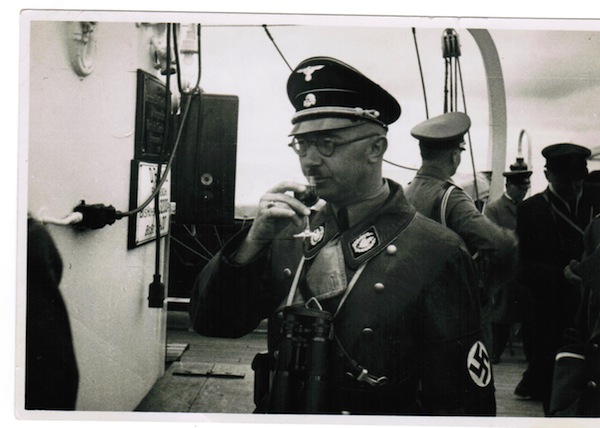
photo - Vanessa Lapa’s The Decent One is based on personal letters, documents and photographs that were found in the Himmlers’ home by U.S. soldiers in 1945
Vanessa Lapa’s The Decent One is based on personal letters, documents and photographs that were found in the Himmlers’ home by U.S. soldiers in 1945. (photo from VIFF)

And then, there is a person like Heinrich Himmler, who could write home to his family with love and affection while on a trip visiting concentration camps. Vanessa Lapa’s The Decent One is based on personal letters, documents and photographs that were found in the Himmlers’ home by U.S. soldiers in 1945, but which weren’t handed over to the military authorities. They became the property of Lapa’s father somehow, and she has used them to make this documentary.

The Decent One is very stylized. Voice actors read the letters, diary entries and documents from Himmler, his wife, daughter, mistress and others, archival footage has sound effects and/or music added, and benign-sounding excerpts from the writings are juxtaposed against brutal images. Viewers follow Himmler from a young age to his rise in the Nazi party and through much of the war. The cumulative effect is powerful. The most upsetting and scary conclusion is that understanding evil is nigh impossible.

Format ImagePosted on September 12, 2014September 10, 2014Author Cynthia RamsayCategories TV & FilmTags Amei Wallach, Daniel Ziv, Emilia Kabakov, Heinrich Himmler, Ilya Kabakov, Jalanan, Vancouver International Film Festival, Vanessa Lapa
Liqueurs add zest and spice

Liqueurs add zest and spice

Sukkah Hill Spirits’ Howard and Marni Witkin. (photo from sukkahhill.com)

There are any number of traditional Jewish holiday foods, but not nearly as many holiday-related beverages. Hands down, wine dominates. But, company has arrived. Two new – and already medal-winning – artisanal liqueurs will be a welcome addition to your table.

Los Angeles-based Sukkah Hill Spirits’ Etrog Liqueur and its Besamim Liqueur both won gold in the 2013 SIP awards: out of some 300 entries, Etrog was deemed the best fruit-based liqueur and Besamim the best herbal/botanical. Both liqueurs are kosher (including for Passover), gluten-free and made with no additives or stabilizers. Not only are they a pleasure to drink, they are aromatic as well – lemon and cloves, respectively. Take a sip of either, and a host of recipe possibilities come to mind.

When the Independent heard about Sukkah Hill liqueurs, the first question was whether we can get it in Canada.

“We will be in stores in Washington, Oregon and the Pacific Northwest in the next few months, and have a list of stores that ship listed on our website,” responded Howard Witkin. “We are adding a number of new online retailers and will update the site as we put it together.”

Witkin’s wife and business partner Marni is the creative force behind these products. He refers to her as the “Taste Mistress” – “No barrel goes to bottling unless she has tasted it and approved it,” he said.

“Marni’s been making liqueur for almost 10 years,” he explained. “She started out making it for our own home, and to share with friends. Soon, she was making dozens of bottles at the request of friends all around the community. When we were approached by a local storeowner who suggested he could sell whatever we could make, we realized that we had a product that people really enjoyed, and which could become a new business.”

The inspiration to use etrogim came from the fate many of the fruit face after Sukkot – the compost.

“Marni wanted to do more with it than allow it languish after the holiday,” said Witkin. So important during the festivities, “it seemed like a waste to let its potential just fade away. So, we started bottling it.

“Besamim is based on a twist of a traditional spice mixture from Havdalah,” he continued. “Besamim at Havdalah gives an extra lift to your soul as Shabbat wanes. We wanted to tie into those wonderful family times and warm moments. Smell has such ties into memories and experiences. I feel the warmth and closeness of Havdalah and Shabbat every time I taste our Besamim liqueur.”

Transforming something done for pleasure into something commercial can sometimes diminish its enjoyment

“Because we make everything by hand, and use the same pure and simple ingredients and processes we started with, it still feels like a fun project,” said Witkin. “Just the barrels are a lot bigger, and there are thousands of bottles to label. We’ve thoroughly enjoyed the creative process of putting together labels and art, and sharing what we are making with so many more people.”

***

Sukkah Hill Spirits’ website offers several drink ideas. In response to a request for food suggestions, Howard Witkin offered the following recipes, noting also that biscotti dipped in a glass of Besamim is delicious, as is either liqueur over ice cream or sorbet.

GRILLED TROUT WITH ETROG

Combine Etrog Liqueur, brown sugar, black pepper and tarragon vinegar. Marinate red trout fillet – skin on – for up to four hours.

Spray/brush the grill with olive oil. Cover the skin side of the fillets with a thick coating of olive oil and lay on the oiled grill. Leave in place until the top of the fish starts to become opaque. Shake a light rub of brown sugar and pepper over the trout, lightly mist with olive oil.

You should now be able to lift the fillet with a spatula from the skin and flip it over back onto the skin, which has remained on the grill. (The skin protects the trout from burning.) Drizzle the remaining marinade over the fish, sprinkle with brown sugar rub. Cook until flaky (a few extra minutes).

Variation: Drizzle soy sauce on the trout as it grills.

BESAMIM YAMS

4 large carrots
3 medium yams
3 tbsp Besamim Liqueur
Cinnamon to taste (3-6 tsp)

Preheat oven to 400°F. Arrange carrots and yams cut to size in a baking pan. Spoon liqueur over the carrots and yams and sprinkle with cinnamon. Bake for 45 minutes or until tender, stirring occasionally.

ETROG HONEY CAKE

Dry ingredients:
3 1/2 cups all-purpose flour
1 cup granulated sugar
1/2 cup brown sugar
2 tsp baking soda
2 tsp baking powder
2 tbsp ground cinnamon

Liquid ingredients:
1 cup clear honey
1 cup vegetable oil
1 cup strongly brewed black tea, cooled to room temp.
3 large eggs
1/3 cup Etrog Liqueur
1 cup plus 2 tbsp applesauce
1 tsp vanilla extract

For finishing:
honey and Etrog Liqueur (approx. 1/2 cup each)

Preheat oven to 350°F. Grease three eight-by-four-inch loaf pans.

Combine dry ingredients in large bowl. In small bowl, combine honey with oil, then add to dry ingredients and whisk in remaining liquid ingredients. Mix thoroughly.

Pour batter into prepared pans and bake for 45-55 minutes until cake springs back when lightly pressed and cake tester tests clean.

Cool the cakes in the pans for 10 minutes, then poke all over with a skewer and very slowly spoon the honey/Etrog Liqueur mix over the cakes, allowing the liquid to thoroughly saturate them. When cool, remove from the pans. Wrapping and storing the cakes for a day improves the flavor.

When ready to serve, top with confectioners’ sugar if desired.

For more about Sukkah Hill Spirits, visit sukkahhill.com.

Format ImagePosted on September 12, 2014September 10, 2014Author Cynthia RamsayCategories Celebrating the HolidaysTags besamim, etrog, Howard Witkin, liqueur, Marni Witkin, Sukkah Hill Spirits
Rose Yorsh scholarship established

Rose Yorsh scholarship established

Rose Yorsh with Kevin Land, principal of Gladstone Secondary School. (photo by Alix Bishop) 

Local community member Rose Yorsh has been honored with a scholarship in her name by friends at the University Women’s Club at Hycroft. The scholarship benefits two students at Gladstone Secondary School who are pursuing nursing studies, which was Yorsh’s profession. Yorsh has enjoyed a remarkable career and was a pioneer for women in operating room nursing.

Graduating nursing in 1944 at Misericordia Hospital in Edmonton, Alta., Yorsh received post-graduate training in operating room technique. As a Jewish woman studying in a Catholic setting in the 1940s, she faced many challenges. For example, she received top marks, but publicly was listed at the bottom of the class. After Misercordia, she went on to the New York Hospital at Cornell, where she worked in the neurosurgery operating room. As part of her post-graduate training at Johns Hopkins Hospital, she worked under noted doctors Alfred Blalock and Helen Taussig, who developed the Blalock-Taussig Shunt, a surgical procedure that has saved countless lives. She went on to head the cardiovascular and pulmonary surgery operating room at Beth Israel Hospital and, later, was asked to head the operating room at Montefiore Hospital. While back in Canada to make the decision, she met and married Dr. Ralph Yorsh in 1953.

After raising three children, Rose Yorsh returned to school and obtained a bachelor of arts in classical studies from the University of British Columbia at an age when most people are thinking about retirement – at 65. She continued to serve women’s health and education through the National Council of Women of Canada, serving as the international health chair from 1997-2000. She continues to be an inspiration to women today, and especially to the young women recipients of the Rose Yorsh Scholarship who will follow in her footsteps.

Format ImagePosted on September 12, 2014September 10, 2014Author Jordan KlingCategories LocalTags Gladstone Secondary School, Hycroft, Rose Yorsh, University Women’s Club

Posts pagination

Previous page Page 1 … Page 629 Page 630 Page 631 … Page 664 Next page
Proudly powered by WordPress