Skip to content
  • Home
  • Subscribe / donate
  • Events calendar
  • News
    • Local
    • National
    • Israel
    • World
    • עניין בחדשות
      A roundup of news in Canada and further afield, in Hebrew.
  • Opinion
    • From the JI
    • Op-Ed
  • Arts & Culture
    • Performing Arts
    • Music
    • Books
    • Visual Arts
    • TV & Film
  • Life
    • Celebrating the Holidays
    • Travel
    • The Daily Snooze
      Cartoons by Jacob Samuel
    • Mystery Photo
      Help the JI and JMABC fill in the gaps in our archives.
  • Community Links
    • Organizations, Etc.
    • Other News Sources & Blogs
    • Business Directory
  • FAQ
  • JI Chai Celebration
  • JI@88! video

Recent Posts

  • עשרים ואחת שנים להגעתי לונקובר
  • Eby touts government record
  • Keep lighting candles
  • Facing a complex situation
  • Unique interview show a hit
  • See Annie at Gateway
  • Explorations of light
  • Help with the legal aspects
  • Stories create impact
  • Different faiths gather
  • Advocating for girls’ rights
  • An oral song tradition
  • Genealogy tools and tips
  • Jew-hatred is centuries old
  • Aiding medical research
  • Connecting Jews to Judaism
  • Beacon of light in heart of city
  • Drag & Dreidel: A Queer Jewish Hanukkah Celebration
  • An emotional reunion
  • Post-tumble, lights still shine
  • Visit to cradle of Ashkenaz
  • Unique, memorable travels
  • Family memoir a work of art
  • A little holiday romance
  • The Maccabees, old and new
  • My Hanukkah miracle
  • After the rededication … a Hanukkah cartoon
  • Improving the holiday table
  • Vive la différence!
  • Fresh, healthy comfort foods
  • From the archives … Hanukkah
  • תגובתי לכתבה על ישראלים שרצו להגר לקנדה ולא קיבלו אותם עם שטיח אדום
  • Lessons in Mamdani’s win
  • West Van Story at the York
  • Words hold much power
  • Plenty of hopefulness

Archives

Follow @JewishIndie
image - The CJN - Visit Us Banner - 300x600 - 101625

The love of chocolate

The love of chocolate

Goodies from Sarina Chocolate’s kids workshop. (photo by Viva Sarah Press)

Israeli chocolatiers aren’t worried about the reported shortage of the sweet treat despite warnings by the world’s largest cocoa grinder, Barry Callebaut, that a potential chocolate shortage by 2020 is imminent.

“There will always be chocolate,” Limor Drucker of Sarina Chocolate told this reporter. “As long as there’s a demand, people will make it.”

“Originally, only kings were able to get chocolate. As long as people want it, people will grow it. I think reports of a shortage in chocolate are a marketing tool to get people to pay more,” added Jo Zander, co-founder of Holy Cacao.

photo - Chocolate spoons from Galita Chocolate
Chocolate spoons from Galita Chocolate. (photo from israel21c.org)

Visitors centres and chocolate-making workshops like Sarina have popped up around Israel as the domestic gourmet chocolate scene continues to grow. From Sweet N’ Karem in Jerusalem to Sarina Chocolate in the Sharon region, to Galita Chocolate Farm near the Kinneret to De Karina Chocolate Factory in the Golan Heights, to Hagit Lidror’s Vegan Chocolate in the Western Galilee, hands-on workshops on making pralines and other chocolate treats are popular.

Israel has a Chocolate Museum in the Upper Galilee and annual chocolate festivals.

“What’s more important for me than how many chocolatiers there are in Israel, is what kind of chocolate Israelis are eating. There’s more awareness of good quality chocolate,” Drucker said. “The level is going up. Today, people understand what makes good chocolate.”

Israeli cacao trees?

At Sarina Chocolate, the workshop begins at the hothouse. This is the only place in Israel where visitors can see cacao trees.

Drucker had worked as an English teacher before becoming a chocolatier. In 1999, her husband, Gil, who is an agriculturalist and grows oranges, was relocated for a job to Germany and they lived there for six years. During that time, she decided to take a course in chocolate-making at Barry Callebaut Academy.

She was hooked. Fine-tuning her craft came via internships and visits to chocolatiers in Europe and North America. Upon returning to Israel in 2005, she and her husband decided to “build this centre from scratch on our own land” in Ein Vered, a moshav near Netanya. After five years of bureaucracy and licensing procedures, Sarina Chocolate opened at Rosh Hashanah 2010.

The Druckers decided that cacao trees would add an educational element to their venture. On a visit to a nursery not far from their home, they met a salesman who had brought cacao seeds to Israel from Brazil “because he wanted to be able to say that he had every type of tree at his nursery.” He had tried to grow the trees in Israel with little success. The Druckers bought all six of his seedlings.

Though Israel’s weather is not ripe for these tropical trees, the Druckers created a singular hothouse replete with special air-conditioning units, sprinkler systems and drip irrigation. The six cacao trees may need pruning so as not to split open the roof of the hothouse, but their yield is zilch.

“We don’t make our own chocolate. Six trees are not enough to make chocolate,” she said. “So, why do we have this place if we don’t make chocolate? We have them to teach and show people how the process is made. We leave the cocoa fruit on the trees as long as possible for people to be able to see.”

The Druckers received a one-time grant from the Ministry of Agriculture and Rural Development of Israel when they first set up the hothouse, but today all energy and care costs are their responsibility. “It’s worth the investment because we’re the only ones in Israel with the cacao trees,” she said. “It’s special.”

Get your hands dirty

From the hothouse, visitors are taken to a square mosaic at the entrance to the centre. Here, Drucker tells the abbreviated history of chocolate from the Mayans to the Aztecs to Christopher Columbus presenting these brown beans to King Ferdinand and Queen Isabella, to Spanish explorer Hernando Cortez, who is credited with being the first to add sugar to cocoa beans, to modern-day chocolate habits.

A short film highlights the health benefits of chocolate, and shows how the beans are dried, ground and mixed into chocolate sludge before being cooled, molded and packaged.

Visitors, decked out in aprons and chef hats, are now ready to get their hands dirty.

Eating chocolate is one thing, but actually trying to mold it is a whole other experience. Squeezing the chocolate through a cornetto (funnel) is harder than it looks, as the chocolate quickly hardens.

The kids workshop includes fondue dipping, cupcake decorating and making milk-chocolate discs with outlined white-chocolate pictures, as well as three-chocolate molded lollipops. Adult workshop participants get to play with alcohol fillings, premium ingredients and chocolate-making techniques. Like the other chocolate centres throughout Israel, Sarina has workshops for families, businesses, wedding parties, bar- and bat-mitzvah events and birthday parties.

Drucker – who was born in Congo, grew up in South Africa and immigrated to Israel with her family in her late teens – conducts the workshops in both English and Hebrew.

“The centre is designed to be an experience for all the senses,” she said. When the hardened chocolates are brought out of the refrigerator and displayed on the counter, they look almost too good to eat.

Demand for quality

Whereas mass-produced, low-grade chocolate candy bars used to suffice, today Israelis demand better texture and flavors.

Most of the chocolatiers in Israel – and around the world – use ready-made industrial chocolate processed in Europe. The innovation and creativity kicks in when the imported product is formed into pralines, truffles or flavored confections.

One Israeli company, Holy Cacao, actually imports cocoa beans, grinds them and mixes its own chocolate.

“We’re proud to be Israeli chocolate. Do we do it to be the most profitable? No. We grind our own beans for quality,” said Zander.

“The demand for chocolate has always been more than the supply. The demand for our chocolate is greater outside of Israel. We sell to the health market. I’m not sure why our top sellers are 100% cocoa mass with no sugar.”

Sarina Chocolate, named for Drucker’s late mother, adds its own flavors to fine Belgian chocolate. “I love working with chocolate,” she said, confiding that she prefers working with it than eating it. She also loves the reaction her job elicits from others. “I just tell people I’m a chocolatier, and they start smiling.”

Israel21C is a nonprofit educational foundation with a mission to focus media and public attention on the 21st-century Israel that exists beyond the conflict. For more, or to donate, visit israel21c.org.
Format ImagePosted on July 10, 2015July 8, 2015Author Viva Sarah Press ISRAEL21CCategories IsraelTags chocolate, Holy Cacao, Jo Zander, Limor Drucker, Sarina
Handmade by artists

Handmade by artists

Left to right are artists Robin Adams, Jan Smith and Julie Kemble. (photo by Olga Livshin)

In common perception, the word “manufacture” is associated with industrial production and machinery, but it wasn’t always so. The word’s origins are found in manu factus, Latin for “made by hand,” and the new show at the Zack Gallery, Manufacture: From the Hand, takes visitors back to these roots.

The show presents beautiful handmade jewelry and wall hangings by 33 artists and craftspeople, members of the Vancouver Metal Arts Association (VMAA). Crafts are not a regular sight at the Zack, but gallery director Linda Lando explained, “The Vancouver Metal Arts Association has been welcomed to the Zack Gallery, as they … approach metal in a unique way. They use metal as one would use paint and canvas, so their creations bridge the gap between art and craft.”

The exhibition is eclectic in both imagery and materials, with each piece reflecting its creator’s personality. The entire show emphasizes the participants’ diversity in cultural backgrounds and artistic interests. The only common factor is metal – gold, silver, copper, brass and others – as the basis for their art.

The Independent talked to several of the featured artists. One of them, Julie Kemble, is a recently retired communications teacher from a local university, although she always enjoyed various artistic hobbies. “I started working with metal around year 2000,” she said. “I used to work with fibres. I guess I love body adornment, so it was a natural transition for me from fabrics to jewelry. They both adorn the body.” A Kemble sculpture could be used as a desk decoration or worn as a pendant. In both incarnations, they are charming.

Robin Adams has been a jeweler for more than 20 years. “I owned a jewelry shop before,” said the professional craftsman. “I sold my own jewelry there, but for a shop, you produce several copies of the same pieces. Now, everything I make is one of a kind. I’m an artist.”

Another jeweler in the show, Jana Kucera, currently manages a pub. “Art, making jewelry, is a hobby for me, but I hope it could become more,” she said. “I’ve always been an artist at heart. I graduated from the VCC [Vancouver Community College] Jewelry Art and Design program in 2005 and I enjoy making jewelry. I sell through shows like this one.” Her original copper necklaces are delightfully graceful.

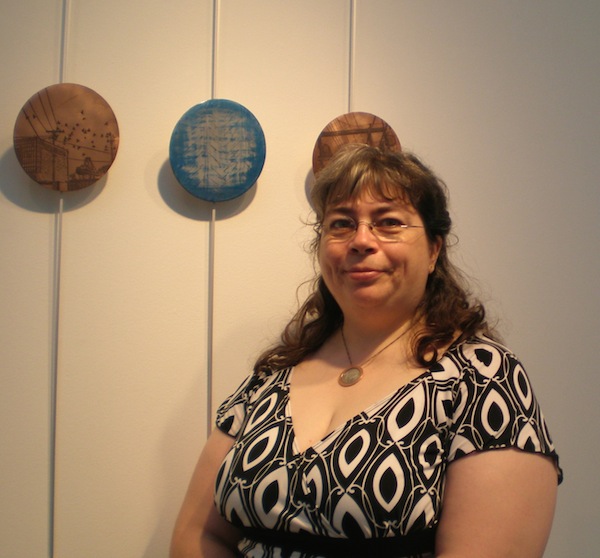
photo - One gallery wall is dedicated to Dana Reed’s series of hanging disks, which combine copper etching, enamel and photography
One gallery wall is dedicated to Dana Reed’s series of hanging disks, which combine copper etching, enamel and photography. (photo by Olga Livshin)

The exhibition showcases not only jewelry but other metal art, as well. One full gallery wall is dedicated to Dana Reed’s series of hanging disks. Each about the size of a hand, the disks combine copper etching, enamel and photography.

Reed has been working with metal for a few years. “My day job is in administration and tech support,” she said, but “I’ve always made stuff; my whole family made beautiful things.” Her brother is a metalworker, too, and although Reed doesn’t have a formal artistic education, she has been taking classes in different artistic media. “I find metal to be pleasing to work with. It stays in place,” she joked before turning serious. “I can achieve precision with metal, while enamel allows more of a free-fashion imagery.”

Among the other wall pieces in the show is a selection of life-sized garden tools, made of Damascene by Karin Jones – a decidedly unexpected item – and a small but picturesque installation called “Changing Values,” made of pennies by Peggy Logan.

Logan has been a professional artist for 30 years. Currently, she is teaching jewelry art at Langara. “I started collecting old pennies when they went out of circulation,” she said. “Before 1993, all pennies were made of copper, and I used them for this piece.” The pennies, strung together and covered with multicolored enamel, glint on the wall, defying the government’s decision to stop producing them.

Another professional artist in the show is Jan Smith, VMAA founder and past president. Her elegant enamel and silver jewelry is represented by galleries in Montreal, San Francisco and Seattle.

“I’ve been an artist for over 20 years,” she said. “It’s not easy to make a living as an artist, especially not here in B.C. I’ve often had to supplement my income by teaching art or working as an art therapist. I’m a member of the International Enamel Association. It’s a small world and we all know and talk to each other. I must tell you that other countries support their artists much better than Canada. Britain, even America, offers better conditions to artists. Their art donations are larger. I’d love to have my art better known here but, so far, collectors in the U.S. know my art better. Even the East Coast is better for artists; I have representation in Montreal but not here. Maybe it is because Vancouver is such a young city.”

Three years ago, Smith founded VMAA to improve the situation. Current VMAA president Louise Perrone told the Independent a little more about the association. “The VMAA was founded by Jan Smith in 2012. Before moving to Salt Spring Island, she lived in Seattle, where there is a thriving metal arts guild. Jan felt Vancouver needed something similar. Unlike Seattle, there are no specific jewelry galleries and no jewelry and metal BFA programs. There is no community of artistic jewelry collectors in Vancouver supporting us either. That is why we started VMAA – to give art jewelry a platform and educate the public, to build a community of jewelry and metal artists.”

Manufacture: From the Hand opened on June 25 and will continue until July 26. To see a selection of the jewelry on display, visit jccgv.com/content/metalart.

Olga Livshin is a Vancouver freelance writer. She can be reached at [email protected].

Format ImagePosted on July 3, 2015July 3, 2015Author Olga LivshinCategories Visual ArtsTags Dana Reed, Jan Smith, Jana Kucera, Linda Lando, Louise Perrone, Peggy Logan, Robin Adams, Vancouver Metal Arts Association, VMAA, Zack Gallery

Choosing the side of hope

When focusing on Israeli-Palestinian relations, as I do for a living, it’s nice to have a good news story to relay once in awhile. On June 22, the annual Victor J. Goldberg Prize for Peace in the Middle East (run by the New York-based Institute of International Education) was awarded to Yehuda Stolov and Salah Aladdin, two leaders of the Interfaith Encounter Association (IEA). To many outsiders, inter-ethnic encounter experiences seem a no-brainer when it comes to grassroots, peace-building efforts. But not everyone is so convinced, particularly the “anti-normalization” faction of the Palestine solidarity movement.

The Goldberg Prize recognizes “outstanding work being conducted jointly by two individuals, one Arab and one Israeli, working together to advance the cause of peace in the Middle East … [by] bringing people together and breaking down the barriers of hatred toward ‘the other.’” It comes with $10,000 US.

IEA brings together Israelis and West Bank Palestinians to engage with one another in an “interactive, interfaith encounter” context. The organization has run 1,900 programs over 13 years, with 4,000 individuals participating in 2014 alone. Stolov is executive director of IEA, and Aladdin has taken on various leadership roles in the organization, most recently as assistant director.

The so-called “anti-normalization” movement is amplified by elements of the Palestine solidarity movement who associate with BDS (boycott, divestment and sanctions). For example, the Palestinian Campaign for the Academic and Cultural Boycott of Israel guidelines urge that Israeli-Palestinian encounter-type initiatives be boycotted under the rubric of “anti-normalization.” The guidelines go on to suggest that “events, projects, publications, films or exhibitions that are designed to bring together Palestinians/Arabs and Israelis so they can present their respective narratives or perspectives, or to work toward reconciliation, ‘overcoming barriers,’ etc., without addressing the root causes of injustice and the requirements of justice” be boycotted.

The anti-normalization tendency may be understandable as a philosophical commitment, particularly if one believes – as those BDS activists do – that justice points to the amelioration of only one side’s lot. But even if one believes that the only justice to be served is that of the Palestinians, the anti-normalization tendency is a misguided way to hope to achieve it.

Psychologists have long shown the importance of the “contact hypothesis” for reducing intergroup prejudice. Recent studies have even shown that even “imagining a positive interaction” with an outgroup member can be just as powerful in reducing prejudice as face-to-face encounters can be. And the first step in getting Israelis to realize the power their country wields over Palestinian life and dignity is to render the Palestinian experience visible.

Stolov agrees. The only way to end the occupation, Stolov explained when I reached him by phone in Israel, is to increase the sense of human connection between Israelis and Palestinians. Aware of the anti-normalization pressures some participants may feel, participation in IEA is kept “under the radar,” press access is restricted and meeting spots are chosen so the events can appear as inconspicuous as possible.

As the lead Palestinian drafter of the 2003 Geneva initiative, which sought to lay out a two-state plan for Israeli-Palestinian peace, Ghaith al-Omari has every reason to be jaded. And having advised the Palestinian negotiating team from 1999 to 2001, al-Omari knows firsthand how little has emerged from the halting peace process. Still, he has recently declared his opposition to the anti-normalization movement in a moving essay in Fikra Forum, reprinted on the Third Narrative website (thirdnarrative.org/israel-palestine-articles/ills-of-anti-normalization), where I serve as co-director of its scholars for Israel and Palestine affiliate group. People like al-Omari and the founders of IEA and even the Goldberg peace prize visionaries realize the possibilities inherent in hope rather than cynicism. And if you have to choose among them – as it seems you do these days – I’d rather be on the side of hope.

Mira Sucharov is an associate professor of political science at Carleton University. She blogs at Haaretz and the Jewish Daily Forward. This article was originally published in the Canadian Jewish News.

Posted on July 3, 2015July 3, 2015Author Mira SucharovCategories Op-EdTags anti-normalization, BDS, Ghaith al-Omari, Goldberg Prize, Israeli-Palestinian conflict, peace, Salah Aladdin, Yehuda Stolov1 Comment on Choosing the side of hope
Montreal can be the model

Montreal can be the model

Montreal Mayor Denis Coderre at the Jan. 11, 2015, rally in Montreal in support of the victims of the Charlie Hebdo shooting. (photo by Gerry Lauzon via commons.wikimedia.org)

A hate crimes department within the city’s police force might be a good idea, Montreal Mayor Denis Coderre said following a meeting with Jewish community leaders from Quebec and France at Montreal’s city hall on June 25.

Coderre and members of his executive committee held a two-hour closed-door session to discuss what role cities can play in combating antisemitism in Montreal and globally. He underlined the frequent link between antisemitism and radicalization and its violent expression.

Unlike forces in many North American cities, the Service de Police de Montréal (SPVM) does not have a unit dedicated to investigating crimes suspected to be motivated by hatred of identifiable groups. Coderre said he will meet the SPVM to pursue the possibility.

“We have good people [in the police] who are doing a good job now, but we have to look into whether we can do things a better way and learn from best practices [elsewhere],” he said.

That was the most concrete suggestion coming out of the meeting.

The mayor’s main message after the meeting was that “we have to call a spade a spade.… Antisemitism exists, here and around the world. We have to denounce it, we have to talk about it, we have to understand that clearly something is going on and we must be there to fight it.”

The meeting was the fulfilment of a promise that Coderre had made to leaders of the French Jewish community when he visited Paris in February, shortly after the murderous terrorist attacks at the Charlie Hebdo magazine office and Hyper-Cacher kosher grocery store.

Present at the meeting, from France, were Serge Dahan, president of B’nai B’rith France, and Yonathan Arfi, vice-president of the Conseil Représentatif des Institutions Juives de France, as well as leaders of Federation CJA, the Centre for Israel and Jewish Affairs (CIJA), the Communauté Sépharade Unifiée du Québec and B’nai Brith Canada.

Julien Bauer, a Université du Québec à Montréal political science professor, and Mount Royal MP and human rights activist Irwin Cotler participated as experts on antisemitism.

Coderre hopes that Montreal and Paris can cooperate especially closely on strategies to combat antisemitism and make their cities safer.

Coderre called antisemitism “the oldest and most persistent” form of racism and warned against a tendency to “trivialize” it. He also recognized that anti-Zionism often cloaks contemporary antisemitism.

The meeting was also a followup to the June 10-11 Montreal Summit on Living Together, a gathering of 23 mayors from around the world convened by Coderre to examine how municipalities can prevent radicalism and ensure security, starting by promoting respect for diversity and harmony among the different cultural groups in their citizenry.

The City of Montreal, also in the wake of the Paris attacks, announced plans for a new centre aimed at preventing violent radicalism. So far, it consists of a telephone hotline to report information on suspected radical activity. Coderre said that the centre can play a role in preventing antisemitism. He wants to form partnerships with the schools, civil society and others in this endeavor.

Coderre said he plans to make the discussion on antisemitism an annual event, and believes that Montreal can serve as a model of how to combat racism and radicalism, while achieving “a balance between openness and vigilance.”

“The more we talk about it, the more it will have a positive effect,” he said.

CIJA Quebec vice-president Luciano Del Negro applauded Coderre’s commitment in taking on the “challenge” of combating antisemitism.

He especially appreciated that the mayor recognizes the distinctiveness of antisemitism among forms of racism, and that antisemitism is not only a phenomenon of the extreme right, but also the far left.

Similarly, Cotler applauded Coderre’s “exemplary leadership” and recognition that “municipalities not only have a role, but a responsibility, to combat antisemitism.”

– For more national Jewish news, visit cjnews.com.

Format ImagePosted on July 3, 2015July 3, 2015Author Janice Arnold CJNCategories NationalTags antisemitism, Charlie Hebdo, CIJA, Denis Coderre, Luciano Del Negro, Montreal, radicalism, terrorism

Nonsense is Trudeau’s

The Islamist group ISIS is the most technologically and media-savvy terror group ever. Their propaganda employs the highest calibre of videography and documentation. The images they capture – and successfully disseminate to the world – are among the most gruesome imaginable.

Just last week, well-produced films showed the group drowning five men in a cage and included footage of the men’s deaths captured by underwater cameras. The same video showed men being bound together at the neck by a fuse connected to explosives, like a chain of firecrackers.

On the very day that these horrendous images were leading every newscast, federal Liberal leader Justin Trudeau appeared on the CBC in an interview with veteran reporter Terry Milewski. Trudeau, who voted a few weeks ago against extending the Canadian military’s contributions to fighting ISIS, insisted that, were he to win the election this October, the Canadian military’s efforts against ISIS would end.

“If you don’t want to bomb a group as ghastly as ISIS, when would you ever support real military action?” asked Milewski.

The would-be prime minister’s reply to this legitimate and, indeed, crucial question: “Terry, that’s a nonsensical question.”

The nonsense is Trudeau’s.

It is true that Western powers cannot cure the world of every despot and dictatorship. The United States military has worn itself out and tested the dedication of military families trying. Yet there are times when action cannot be avoided.

Milewski gave Trudeau the opportunity to clarify what he was saying, to ensure that this was not another of the Liberal leader’s rookie mistakes. But, no, this was what Trudeau had come on television to say.

Whether one adheres to ethical pacifism or not, it is a coherent ideology. But this is not what Trudeau is proposing. He is not suggesting that Canada abandon its military or become a neutral state. He is saying that Canadian forces should not be deployed against ISIS. OK, then. If our admittedly limited military force is not mobilized against ISIS, what cause would we mobilize against? In what circumstances does “Never again” come into play, if not against the actions of a group such as ISIS?

It must be noted, of course, that Trudeau’s position mirrors that of New Democratic party leader Thomas Mulcair. The New Democrats also voted against extending the mission against ISIS and this position is equally flawed. But it is at least consistent with the worldview of a party that has never been burdened with the mantle of government. NDP governments at the provincial level have often risen to the occasion and discovered pragmatism when power has been thrust upon them. Should some current polls bear out and Mulcair were to become prime minister, the confluence of common sense, the magnitude of power and the need to reach out to experienced hands would almost certainly adjust their foreign policy. Perhaps we are being too generous, but Mulcair has taken a party whose foreign policy (especially vis-a-vis Israel) had become a fringe circus and brought it more in line with European parties of the left (for whatever that is worth).

Unfortunately, the Liberal case is quite different. Say what one will about the value of the Senate these days, those who served as Liberals in the upper chamber represented a cache of experience at governing that Trudeau desperately lacks. Last year, Trudeau threw them out of his caucus in a showy spectacle meant to demonstrate leadership. He is left with a caucus of 36 MPs, most of whom, in the immortal words of a former prime minister who happens to have been the current Liberal leader’s father, are “nobodies 50 feet off Parliament Hill.” It is not clear that he is seeking out or receiving rational foreign policy advice from anyone.

What makes Trudeau’s position most atrocious is that it seems to have been taken for the worst reasons. The Liberals, as is a perennial problem for opposition parties, must oppose. But foreign policy is a tricky area in which to plant a political flag. Foreign affairs should not be off limits, by any means, to criticism and differences of opinion. Yet neither should the serious issues of foreign policy be subject to knee-jerk political considerations. But this seems to be part of the explanation for Trudeau’s position.

Another likely motivating factor is that the NDP has been peeling anti-Harper votes away from the Liberals. There is a very real possibility that, if polling trajectories continue, the majority of Canadians who seek to end the Conservative government’s tenure will move en masse to the party that polls suggest is most fit to achieve that end. To stanch the flow to the NDP, Trudeau seems ready to abandon the victims of ISIS.

The irony of this entire balagan is that Trudeau’s actions will probably have precisely the opposite effect on potential Liberal voters.

Posted on July 3, 2015July 3, 2015Author The Editorial BoardCategories From the JITags Harper, ISIS, Mulcair, terrorism, Trudeau
No errors in Comedy

No errors in Comedy

Josh Epstein, left, and Andrew Cownden in Bard on the Beach’s production of The Comedy of Errors. (photo by David Blue)

It’s summer in Vancouver and with it comes sun, surf and Shakespeare – that is, Bard on the Beach under the iconic red and white tents at Vanier Park. Celebrating its 26th season, the festival serves up an interesting mix this year: A Comedy of Errors, Love’s Labor’s Lost and King Lear, from the pen of the Bard himself, and a contemporary piece, Shakespeare’s Rebel, by local author Chris Humphreys.

Opening night of Comedy of Errors on June 13 saw the always dapper artistic director Christopher Gaze welcoming the crowd under the big tent of the BMO Stage and, for the first time in the history of the festival, acknowledging that the land upon which the tents are pitched for their annual sojourn is ancestral, traditional and unceded aboriginal territory. Deborah Baker of the Squamish Nation gave greetings and performed a traditional drum song.

Comedy of Errors is one of Shakespeare’s earliest works, the shortest in his repertoire, and it contains the zaniest of his plots. It is the tale of two sets of identical twins, one aristocratic, the other, their boy servants, with the pairs separated in the aftermath of a shipwreck. The family patriarch, Egeon, has spent years looking for his lost progeny and servants. His search takes him to the town of Ephesus, where he is captured and sentenced to death (no one is supposed to come to Ephesus without permission) but receives a last-minute reprieve to look for his sons and to find money to pay the fine.

It just so happens that one of the sons and his servant ended up in Ephesus while the other two ended up in Syracuse. Both sons are named Antipholus and both their servants, Dromio – all of this sets the stage for a frenzied journey through mistaken identities, hilarious hi-jinks and the ultimate sibling reunification when the Syracuse pair show up in Ephesus.

But what a journey. Think Edward Scissorhands meets Little Shop of Horrors meets Metropolis, and you have director Scott Bellis’ (who does double duty as Egeon) fantastical steampunk version of this production. What is steampunk? A mix of sci-fi electronics and gadgets set against a pseudo-Victorian era background as stylized by authors like Jules Verne, H.G. Wells and Mary Shelley.

The production is a bit over the top with its madcap bits and bobs – a hand-eating Venus fly trap, a communal lobotomy by a mad scientist, a creature trying to escape from a boiling soup pot, a Michael Jackson-like moonwalk, a bubble-shooting gun and a flatulation moment – and its frenetic pace. It is mostly fluffy fun although if you are looking for some meaning, there are three love stories intertwined with the humor. Shakespeare purists will probably cringe in their seats. But the opening night crowd was eating it up and this unique approach should bring in younger audiences and make the Bard’s words more accessible to a wider demographic. This reviewer loved it!

The acting is solid from the ensemble cast, many of whom do double and even triple duty in various roles: Ben Elliott as one Antipholus, Jay Hindle as the other, Jeff Gladstone as the mad Dr. Pinch, Andrew McNee as the grunting cook Nell, Daniel Doheny as the chambermaid, Lilli Beaudoin as the foxy courtesan, Jewish community member Josh Epstein as the smuggler, Andrew Cownden as the goldsmith, Sereana Malani as the Ephesean Antipholus’ overbearing wife, Lindsey Angell as her nerdy sister and Anna Galvin as the abbess, who makes her first appearance on stage in stilts. But it is the pint-sized Dromios, played by Dawn Petten and Luisa Jojic, who give the standout performances of the production. In their aviator hats and goggles, they really do look like identical twins. Petten, in particular, takes her role and runs with it with impeccable comedic timing and one of the best “ad lib” lines in the play, “Call before you dig.”

What really makes this production sublime are the visuals. The set is fantastic, a wall of steam-powered widgets, sprockets and gears dominated by a one-handed clock with a mind of its own, all kept in working order by shadowy, silent engineers constantly tweaking the machinery with wrenches and hammers. The play begins with one of the engineers pushing a big red button and, all of a sudden, the empty stage becomes a mélange of color and activity as the cast appears through a smoky haze, some through the many trapdoors in the floor, some out of the bowels of the machines, some appearing to drop out of the sky – all courtesy of community member Tara Cheyenne Friedenberg’s terrific choreography.

This dreamlike mechanical dance sets the tone for the whole evening. Mara Gottler has outdone herself with the costumes – lots of leather, lace-up boots, corsets, garters, black lace and accessories like aviator goggles, gas masks and leather bat wings. Gerald King’s lighting and Malcolm Dow’s sound design are the icing on this macabre cake.

Just as the action starts with a push of a button so does it end, with the shutting down of the machinery after the final revelations. This is one production that you can just sit back and enjoy, pure and simple fun.

Comedy runs to Sept. 26. For the full Bard schedule and tickets for any of this season’s offerings, visit bardonthebeach.org or call the box office at 604-739-0559.

Tova Kornfeld is a Vancouver freelance writer and lawyer.

Format ImagePosted on July 3, 2015July 3, 2015Author Tova KornfeldCategories Performing ArtsTags Bard on the Beach, Comedy of Errors, Josh Epstein, Shakespeare
The same old stories

The same old stories

Aubrey Joy Maddock as John the Baptist, left, Andrew Cohen as Judas and Jennifer Copping as Jesus in Arts Club Theatre’s Godspell. (photo by David Cooper)

Before I attended Godspell, I was not familiar with the story or with the parables of the Gospel of Matthew, from which much of the content is taken. I did, however, know what a parable was, I knew that the play has been extraordinarily successful and I recognized the name of at least one song – “Day by Day” – so I assumed I had nothing to worry about.

I was wrong. By the end, I still didn’t get why this play has been so popular.

Godspell is essentially a series of vignettes that draw analogies between Matthew’s words and day-to-day life. It includes lessons such as, “Judge not, lest ye be judged,” “He that is without sin among you, …” the Prodigal Son, etc. Jesus relates these didactic stories to a group consisting of nine people that include a police officer, a waitress, an architect and a vamp. Judas and John the Baptist round out the cast of 12.

In each presentation of Godspell, the setting of the play, the costumes and some of the characters change. Updated scripts allow for the inclusion of cultural or geographic references that are familiar to the audience.

In the Arts Club production, the cast meet in a train station and the play unfolds as a game show where contestants participate based on the color of the shoes they’ve been given. Gospel analogies are acted out using modern story lines, including characters from Star Wars or rap songs.

To me, the play came across as a bunch of children’s shows that had been stitched together. I felt like I was back in elementary school, only instead of Smokey the Bear talking about forest fires, it’s Jesus and he wants you to avoid being stoned to death.

I found some of the skits infantile. In one case, the cast sing and talk like goats; in another scene, an audience member is pulled up to participate on stage resulting in some bad improv. And don’t get me started on the slapstick.

Godspell was an instant hit. It went from being a college student performance at Carnegie Mellon University to an experimental theatre production in Greenwich Village to being re-scored and opening off Broadway in 1971. John-Michael Tebelak originally wrote the play for his master’s thesis, having become enamored with the Gospels. Stephen Schwartz, a Carnegie Mellon alumnus was brought in to score. The award-winning Schwartz has become famous for his work in Wicked, as well as Enchanted and The Prince of Egypt. Tebelak was actually named most promising director of 1971 by the New York Drama Desk, but passed away at age 35 of a heart attack.

The show ran for five years off Broadway with an astounding 2,100 performances. The 2015 run in Vancouver is its sixth revival.

It had a particularly famous yearlong run in Toronto in 1972 with a cast that included Victor Garber, Gilda Radner (in her stage debut), Martin Short, Paul Shaffer, Eugene Levy, Andrea Martin and Dave Thomas. When I read about this production, I thought what an amazing show it must have been – staged at the Royal Alexandra Theatre, with that magnitude of talent. Maybe a show about the Bible needs a venue of biblical proportions, along with fire-and-brimstone effects that stun the audience with shock and awe. Perhaps the performance at the Arts Club was just too small.

Either way, despite my lack of interest in this particular telling of the parables, I have to tip my hat to the high calibre of quadruple-threat talent (singing, acting, dancing and, in many cases, playing an instrument) on stage. Andrew Cohen in particular stands out in his supporting role of Judas.

Godspell runs at the Arts Club Granville Island stage until Aug. 1 (artsclub.com).

Baila Lazarus is a freelance writer and media trainer in Vancouver. Her consulting work can be seen at phase2coaching.com.

Format ImagePosted on July 3, 2015July 3, 2015Author Baila LazarusCategories Performing ArtsTags Andrew Cohen, Arts Club, Godspell

Receptionist to owner

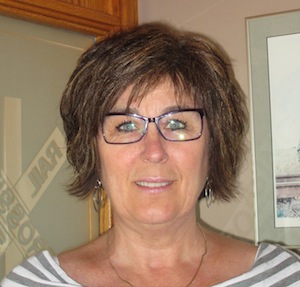
When Judy Spackman, 61, started working as a receptionist at Cando Rail Services Ltd. in Brandon 25 years ago, she felt it was a good starting place and the people were nice. Little did she know that, one day, she’d be an owner.

Born and raised in Neepawa, Man., Spackman moved to Brandon in 1987 to attend community college in the administrative accounting program. After graduating, she worked as an order operator at Richardson Greenshields for two years before coming on board with Cando.

photo - Judy Spackman
Judy Spackman (photo from Judy Spackman)

At Cando, she started out as a receptionist before moving into the accounts payable and receivables section. She later moved to the company’s offices in downtown Brandon. Today, she works for the abandonment department as their administrative assistant for trucking and rail logistics.

“Cando Rail is a railway associated company,” said Spackman. “Anything that they do has got to do with a railroad in one way or another, from tearing up abandoned tracks and building new tracks to selling components of the track.”

Seven years after she joined the company, Cando’s owner introduced Judy SpackmanJudy Spackmanan employee share ownership plan (ESOP). Unsure at first if she wanted to opt in, Spackman changed her mind when she saw the returns some of her colleagues were taking home.

“It happened in 1996,” said Spackman about the ESOP. “It was something that Gord Peters, the owner, knew about. He understood the process of employee ownership and thought it would be a good fit for Cando employees.”

Some employees went into it right away. “By year two, you could see what those people got, the share payout – putting their money into the company, they shared its profit,” she said. “That got me thinking that it was a good idea, so I started working the second year, trying to make sure I had enough matching funds to be able to participate in the program.”

In 1996, shares in Cando were worth $2.74. They are now worth more than $40.

The ESOP is set up as a retirement savings plan, wherein employees can make monthly contributions. “They helped us set something up within the company to be able to contribute to an RSP through payroll deduction,” explained Spackman.

Everybody qualifies to buy a block of shares, according to a formula based on a percentage of their T4 or total earnings. Also, employees are given a $100 bonus for every year they have been with the company. “Say they made $50,000, that’s times four percent, so they would get $2,000 of a match there,” she said. “And, for me, I’ve been with the company for 25 years, so I get $100 for every year I’ve worked. So, I get a $2,500 match…. I’d qualify for a $4,500 match.… If I bought $4,500 worth of Cando shares, they’ll match those funds and give me $4,500.

“So, now I have $9,000 worth of Cando shares…. The formula and the calculation is the fairest way to do it.

“You don’t have to do that match if you choose not to. You could only put in $2,000, then they will only match you the $2,000. If you don’t match your true potential, you don’t get that potential match. So, it gives you the initiative to make sure you put away enough to cover your match.”

Spackman’s first-year share block investment is now worth more than $25,000. She has created a spreadsheet to keep track of her shares and their growth and, as she is nearing retirement, she has made a second spreadsheet called, “Retirement.”

“Knowing the difference between RSP and non-RSP, and knowing the best way to have a mix of both and how to be diversified is key,” said Spackman. “You don’t want all eggs in one basket.

“It does make you learn a lot about finances and projections, and looking past today and into the future – doing calculations to make sure you have enough in your retirement fund.”

There is no pension offered at Cando. Instead, by creating this program, Peters gave his employees a way of creating their own pension plan.

“It’s an individual choice of how much you want to go in,” explained Spackman. “You can max everything into this and make it grow. Some are uncomfortable going in very much, [but] when they learn the system and see and do calculations, they realize the potential of growth is amazing.”

Peters’ philosophy is that employees work hard to make a company successful and that they should share in the success; shares in ownership give employees a more vested interest in the company.

“He takes great pride in people who learn the program and understand the financial and growth side of the program,” said Spackman of Peters. “I think it’s a viable program for any company and is feasible and acceptable for companies to run a program like this and be successful.”

The ESOP has helped Cando’s performance because employees who are also shareholders benefit directly when the company does well. There are “quarterly reports on how the company is doing, so we know throughout the year what’s going on and it tells us [about] new business, what’s coming up, giving us an idea of what the company is doing and how it is growing,” explained Spackman.

Every May, the projection/payout conversation starts, and the employees go back to work for another year. It’s like playing the lottery except in this case they are guaranteed to win as long as the company grows and they have some shares.

“There is a possibility that some years we may not get a payout or a big growth in the company, like this year,” said Spackman. “Worst-case scenario, it may stay the same one year. But, that’s OK, because we retain … our shares.

“You have to be in the real world. There is potential for this to go down. In 18 years, I haven’t seen it go down, but you have to keep that in mind. You have to have other investments.

“Being a Cando shareholder gives me pride, being an employee-owner. It’s an avenue for a comfortable retirement and a financial education that benefits my personal financial practices.”

Rebeca Kuropatwa is a Winnipeg freelance writer.

Posted on July 3, 2015July 3, 2015Author Rebeca KuropatwaCategories NationalTags Cando Rail, employee-share program, ESOP, Gord Peters, Judy Spackman
Parents’ silence hurts

Parents’ silence hurts

Hundreds of thousands came out to watch Toronto’s Pride Parade on June 28 despite the inclement weather. (photo by Najin Lin via facebook.com/pridetoronto)

Years ago, at a particularly low point, Chaim Silver (not his real name) was so desperate to be straight that he ingested a white powder that a naturopath had sent to him by mail, claiming it had “cured” a lesbian of her same-sex desires.

“I actually took it,” Silver laughed over the phone. “It was before anthrax, before 9/11.”

Silver is Modern Orthodox and came out to his parents when he was in his late 20s. While they’ve never explicitly rejected him, he said their approach has always been, “We can fix this.”

Over the years, they’ve oscillated between encouraging Silver to marry a woman and presuming he’ll accept a life of celibacy. “They’ve said to me, ‘You’ll just make your life about your siblings’ kids,’” said Silver, who is now in his 40s.

They’ve also suggested he try reparative therapy, a controversial practice that aims to make a homosexual person heterosexual. But, more than anything, Silver’s sexual identity is something about which his parents, plus many people at the Orthodox synagogue he attends in Toronto – most of whom, Silver believes, know about his sexuality – say nothing.

He once went away on a trip with a non-Jewish boyfriend, he noted, and nobody in his family acknowledged it.

“At synagogue, if I’m single, celibate and alone … I don’t think anyone actually cares … they’ll give me aliyot. But if I’m going to have a partner and want a life that’s celebrated, I don’t think that can happen in orthodoxy.”

On the whole, Silver said he’s grown pessimistic about the notion – touted by activists such as Rabbi Steven Greenberg, dubbed the only openly gay Orthodox rabbi in North America – that Orthodox Judaism can make space for homosexual people. “The two seem incongruous to me. [Being gay is] this innate thing that’s felt to be prohibited,” Silver said. “Not everything can be fixed in life. As you get older, you realize that some things just suck.”

Silver’s cynicism and his parents’ denial are arguably more acute because of Orthodox Judaism’s strict adherence to Torah, but anecdotal evidence shows that many Jewish parents from more liberal denominations are also uncomfortable having an LGBTQ kid and default to silence on the matter.

Justine Apple, executive director of Kulanu Toronto, a Jewish LGBTQ social and cultural group, said Jewish parents, ranging from secular to Modern Orthodox, have reached out to her, seeking counsel about their children’s sexual orientation. “People who are Orthodox tend to have a harder time dealing with this but, at the end of the day, it’s an individual process,” she said. “There are still so many parents in the community who know their kids are gay but are very secretive about it.”

Apple said when she herself first came out, her family, who have since made huge strides, didn’t want to hear about her personal life, making her feel “invisible.”

Many parents won’t ask their LGBTQ children about their romantic lives due to internalized homophobia and ignorance about what it means to be gay, she said. “A lot of parents equate being gay with what happens in the bedroom. But queer Jews, like any Jews, connect to their loved ones on multiple levels – emotional, spiritual, intellectual.”

Parents should recognize that being gay isn’t a choice and doesn’t negate that “we still have Jewish values, we’re still connected to family, community,” Apple said. “It’s important for parents to give kids support, make them feel part of family gatherings and ask them what’s happening in their personal lives.”

Apple said she reached out to several LGBTQ Jewish colleagues and friends to see if their parents would speak to the CJN about their experiences of their children coming out, but all of the parents declined. “It seems to be a sensitive topic for parents, more so than for their children,” she noted.

Maya Benaim (not her real name) came out a decade ago to her parents, who belong to a Conservative synagogue. She joked that she wishes they had taken some kind of course. “They didn’t understand it, and I wasn’t the person who could explain. It was too personal for me,” she said.

Over the years, her parents have rarely inquired about her partners and haven’t known how to act when one of her relationships ended. “I learned not to mention stuff.… I’d be going through tremendous pain from a breakup and would have to hide it from them,” she said.

Benaim, 30, said she’d be happy for her parents to seek external support – “anything that would contribute to understanding and de-stigmatizing and improve our relationship” – but she’s adamant that the onus not be on her to “hold their hands” through the process. “I’m already in pain enough from them not understanding,” she said. “I’d really appreciate if the community stepped in for that sort of thing. I think that’s what being an ally is about – doing that work so the people who are the victims of misunderstanding or hate don’t have to.”

Toronto social worker Elsia La Caria works with adolescents and young adults. She said for someone who’s come out, negative reactions from parents typically aggravate existing issues. “The person is often already struggling with feelings of not being accepted, so when the people closest to them don’t provide the right support, this can exacerbate their feelings of loneliness, sadness and feeling excluded,” she said.

Regarding parents’ silence about a child’s sexuality, she said, “this can reinforce the idea that they’re different in a bad way, that they don’t belong anywhere.”

Rabbi Michael Dolgin is senior rabbi of Toronto’s Reform Temple Sinai Congregation, where he and associate Rabbi Daniel Mikelberg officiate at same-sex weddings.

Canada’s legalization of same-sex marriage has helped affirm that “same-sex life is consistent with a focus on family, continuity and other Jewish values that I think, in the past … people assumed [LGBTQ people] were breaking with,” Dolgin said.

While parents of LGBTQ kids occasionally seek his guidance, Dolgin said young people nowadays generally seem more comfortable “being out,” and the North American Federation of Temple Youth, the youth group affiliated with the Reform movement, is widely considered a safe space for LGBTQ youth to participate without “the stress of having to choose between being Jewish and being homosexual.” The best response to a child who has come out is to love them, to listen and to work toward “an open, understanding relationship in which they can express their feelings,” he added.

Apple stressed that parents have a responsibility to educate themselves about what it means to be gay and Jewish. Kulanu’s doors are open to those seeking a safe space to discuss this, she said, but support is offered on more of an informal basis and she may refer families to Jewish Family and Child Service, and non-Jewish organizations such as PFLAG Canada and the 519, a Toronto agency that “respond[s] to the evolving needs of the LGBTQ community, from counseling services and queer parenting resources to coming out groups, trans programming and seniors support.”

“Right now, our goal is primarily to run events for the LGBTQ community and its allies,” said Apple.

Resources geared to Jewish families in this situation are only available in Canada “in pockets,” and are less abundant than in the United States, she acknowledged.

There’s a need in the community for more “open forums [for parents] to share their fears and concerns,” Apple said, adding that she sees future opportunities for Kulanu to develop a network to help parents who are struggling.

Indeed, Silver’s sense of hopelessness is tied, at least in part, to location. Toronto’s Jewish community is quite religiously conservative, unlike New York’s, where a Friday-night minyan of Orthodox LGBTQ Jews launched last year, he said.

Dating has been tough as it is – a secular Jewish partner couldn’t understand why Silver wanted to belong to a world that didn’t accept him, while a non-Jewish boyfriend wouldn’t give up Christmas – without the added problem that many in his position have left the Orthodox community or remain in hiding. “Many of us have simply disappeared,” he said, “so it’s not an issue the Orthodox community feels they have to face.”

Rabbi Noah Cheses, assistant rabbi at Shaarei Shomayim Congregation, one of Toronto’s largest Modern Orthodox shuls, said that supporting young people and their parents as the former share their sexual orientation with family and friends is an issue he cares deeply about. “But I try to take a line that distinguishes between supporting and endorsing. It’s a fine line. I can support an individual with the struggles he or she has, but I’m reluctant to endorse a lifestyle or culture that runs in opposition to a verse in the Torah, though I understand that being gay is not a choice,” he said.

Having recently moved to Toronto from Connecticut, he said he knows of several groups and online networks that support LGBTQ Orthodox people and their families there, but he isn’t aware of similar organizations in the Toronto area.

“On many different social and gender-related issues, my sense is Toronto has been not as advanced as many modern Orthodox communities in the States,” he said.

– For more national Jewish news, visit cjnews.com.

Format ImagePosted on July 3, 2015July 3, 2015Author Jodie Shupac CJNCategories NationalTags Elsia La Caria, Justine Apple, Kulanu Toronto, LGBTQ, Michael Dolgin, Noah Cheses, Shaarei Shomayim, Steven Greenberg, Temple Sinai, Toronto Pride
This week’s cartoon … July 3/15

This week’s cartoon … July 3/15

For more cartoons, visit thedailysnooze.com.

Format ImagePosted on July 3, 2015July 3, 2015Author Jacob SamuelCategories The Daily SnoozeTags dating, GoPro, thedailysnooze.com

Posts pagination

Previous page Page 1 … Page 553 Page 554 Page 555 … Page 650 Next page
Proudly powered by WordPress