The multiple-award-winning singer, songwriter, guitarist and producer is well-known to many in the Jewish community, having performed at Rothstein Theatre and in the Chutzpah! Festival a number of times, including opening for Idan Raichel last year. Her most recent CD is Hearts Up to the Sun, which has earned deserved praise. On her website, Capilano University’s Gary Cristall – who, among many other career milestones, was a co-founder of the Vancouver Folk Music Festival – describes Hearts: “Musically, it is as hot as Louisiana hot sauce and the horn arrangements sound like they might well have come from there. Babe’s voice is sounding as good or better than ever. The band is great. But the songs … wow! The songs mark a step forward. They are even better than the ones she won awards for with her last release, SideDish.”
The Jewish Independent recently interviewed Gurr about her work and its beginnings.’
JI: I understand that it wasn’t until you were in your 20s that you joined a band and set off on a musical path. How did you end up joining a band, and what type of band was it? What were you doing (or planning on doing) as a job/career at the time?
BG: I joined my first band when I was 25 and it was a jazz/pop band, which was very stupid and daring of me as I knew nothing of jazz music other than what I heard of my parents’ album collection. I was living in Victoria at the time and working as a dental assistant, which never really fit as a job for me, but when I graduated high school, my parents didn’t think music could or would ever be an option and so steered me toward something respectable like working with teeth. Nothing against teeth – we all have and need them but, ugh, not for me. I really wanted to be involved with music and so I auditioned for this jazz/pop band and, amazingly, they took me under their wing and taught me the ropes of being in a band and, on the side, the lead guitar player, Dave English, would give me lessons on how to play the jazz chords on the guitar. Later on, I also started to sing and joined various bands over the years, playing rock, jazz, folk and top 40, before I started to write my own music.
JI: What was it about music that made you so passionate about it that you wanted to create it and try to make a living at it?
BG: That is a hard thing to put a finger on. I knew from a very young age I liked music and would lay on the floor with my head near my parents’ stereo speakers listening intently to the music. But I guess the pivotal point was seeing the Beatles on The Ed Sullivan Show when I was a little girl – I just was completely wowed!
JI: You released Hearts Up to the Sun earlier this year, your fifth CD, I believe. How would you say your music/style has changed/evolved since your first recording?
BG: My music is a mash up of so many genres these days, pop, roots, blues, rock, world and a hint of jazz. I guess that is the result of the freedom one has when you are an independent artist and you have been around awhile, you just stop worrying about fitting in and create what you like, and then hope that you still have an audience for it.
JI: Do you have a specific creative process? If so, could you share how, in general, an idea becomes a song?
BG: I am fascinated by how a song will come to me – not that they are brilliant or complex but, still, it is a strange process, creativity. The music comes as a result of noodling on my guitar until I find something I like and the lyrics can be inspired by so many sources, some personal and others influenced by all that is happening around me.
JI: Could you tell me a bit about your band, how you guys got together, how long you’ve been playing together?
BG: I love the guys I play with, whether it is my three-piece or eight-piece band, they are all such talented players and so fun to work with. I have been playing with Nick Apivor, percussion/piano, for many years – I think we started to play in a duo in the late 1800s; actually, we met in our 20s. Then, I guess, violinist Tom Neville has been with me for about 10 or 12 years. The newer additions to the band are sax player Steve Hilliam, Malcolm Aiken on trumpet, Liam MacDonald on drums, Adam Popowitz on lead guitar and Darren Parris on bass.
JI: Are there any projects on which you’re currently working that you’d like to share with readers?
BG: There is a really interesting project that I will be involved with and we will be starting to workshop this summer, that puts together various dancers with a variety of musicians, but I am not able to talk about it yet – mum’s the word, for now.
JI: If there is anything else you’d like to add, please do.
BG: Another hat I like to wear is that of a record producer and I have been lucky enough to have produced a number of talented singers’ CDs along with my own. It probably is my favorite thing to do in the music business. I compare it to a painter who sits with a blank canvas with an idea and then takes that idea and expands and enhances it with colors and strokes or, in the musical sense, arrangements and various instruments and sounds. It is so exciting to hear a song come to life in the studio.
For information on Babe Gurr’s upcoming shows, visit babegurr.com.
Organizers estimate 180,000 people marched in the Tel Aviv Pride parade, June 12. (photo by Robin Perelle)
Alberto Lukacs-Böhm dabs a handful of birds onto the sunny sea-to-sky poster he’s painting for Tel Aviv Pride.
To live openly as a gay man in today’s Tel Aviv is to be free, he says. “It’s like to drink a fresh, clean water. That’s freedom.”
The 65-year-old is one of seven seniors gathered around a table at the Tel Aviv gay centre on June 11. The members of Golden Rainbow (Keshet Zahav) are chatting and painting as they finalize their plans to march together in the city’s 17th annual Pride parade the next day.
For Lukacs-Böhm, the path to freedom was somewhat complicated. Though he knew he was gay from a very young age, he married a woman in Hungary to avoid upsetting his mother, a circus illusionist who cried when he told her he’d kissed a boy at age 13.
He returned to Israel in 1988, the same year the country decriminalized homosexual sex. It was time, he says, “to take back my life in my hand.”
“From very young, everybody knows I’m a gay,” he explains, “[but] it was always complicated to be gay.”
“Is it still complicated to be gay?” I ask.
“Nooo,” he says, his face lighting up in an ear-to-ear smile.
“No whatsoever!”
“To speak about homosexuality or lesbian or transgender – it’s absolutely normal in Israel,” he says.
* * *
It’s day two of a five-day press trip to Israel, sponsored and entirely funded by the Israeli tourism ministry to show off Tel Aviv Pride to 43 journalists from around the world.
Day one began with an exuberant tour of gay Tel Aviv, led by Shai Doitsh, chair from 2012 to 2015 of the Aguda, Israel’s national LGBT task force. For the last decade, Doitsh has also been working with the tourism ministry and the municipality of Tel Aviv to market the city as a gay destination, a project he initiated in 2005, according to his LinkedIn profile.
Doitsh paints a rosy picture of Tel Aviv as one of the most accepting cities in the world, a year-round gay haven, where as much as 25 to 35 percent of the population may be gay, he claims.
Tel Aviv is a gay hub, both in Israel and throughout the region, he says, pausing repeatedly on Rothschild Boulevard and its surrounding streets to point out gay-friendly venues and the abundance of rainbow flags flying throughout the city for Pride.
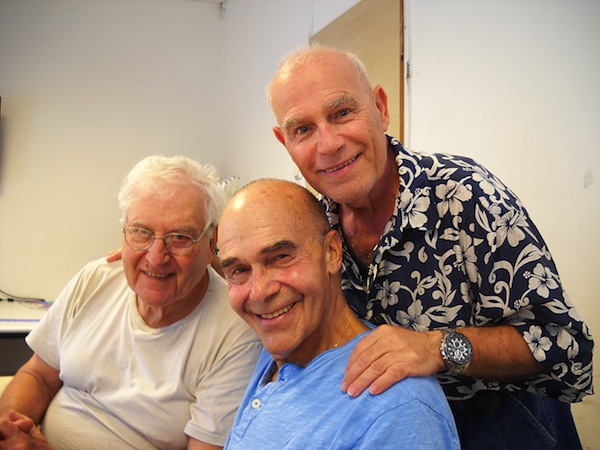
Alberto Lukacs-Böhm, right, stands behind Golden Rainbow members Nitzan Aviv and David Goldstein, centre. (photo by Robin Perelle)
He lists the many rights and benefits enjoyed by gay Tel Avivim, such as protection from workplace discrimination (introduced throughout Israel in 1992); the right to serve equally in the military (considered deeply important in a culture that requires military duty and prioritizes serving one’s country); the right to adopt your same-sex partner’s children (though surrogacy and marriage remain off-limits under the purview of ultra-Orthodox rabbis who frown on gay families); and Tel Aviv’s gay centre and Pride parade, both supported and funded by the municipality.
The gay community has a strong presence in Tel Aviv and in the city’s secular politics, Doitsh says.
“Our movement and our fight for equality is definitely the most successful in Israel” among the country’s minority groups, he says.
* * *
Doitsh may have a vested interest in trumpeting Tel Aviv’s gay appeal, but every gay, lesbian and transgender Israeli I’ve interviewed in the last few weeks has echoed his assessment. The city genuinely welcomes and supports its LGBT community, they say, or at least those members who more closely match mainstream norms.
It’s also a bubble that bears little resemblance to the rest of Israel, they all agree.
“Being in Tel Aviv is a bit like being in New York and pretending you see the entire United States,” says Moshe Zvi who, with his partner Eyal Alon, has joined the crowd gathering in Meir Park for the city’s Pride parade June 12.
“It’s a state within a state,” Alon says.
“I call it a bubble of sanity,” Zvi says.
Organizers tell us that 180,000 people are expected to gather in Meir Park to march in this year’s parade, making it the largest Pride in the Middle East and Asia.
As the marchers begin to file out towards Bograshov Street, Alon and Zvi tell me about some of the tensions that simmer beneath Israel’s seemingly gay-friendly surface.
Though Tel Aviv is a more liberal, secular city, Israel’s relatively small ultra-Orthodox Jewish community wields a disproportionate amount of political power in the national legislature due to the nature of Israel’s coalition politics, which rely on small-party support to pass most initiatives.
The ultra-Orthodox hold “almost a monopoly on power concerning marriage, cemeteries, conversion,” David Goldstein says.
Goldstein, 73, moved to Tel Aviv five years ago from San Francisco, fulfilling a lifelong dream. Now a member of the Golden Rainbow group, he says he feels much safer here than in the United States. But Tel Aviv is a bubble, he readily agrees.
It’s a secular city founded by Jewish businessmen who wanted a city of their own, he explains. Jerusalem, in contrast, is a holy city. Tel Aviv is anything but, he says, though it’s holy to the gay community and others who encourage diversity and a cosmopolitan lifestyle – anathema to the ultra-Orthodox community’s strictly religious worldview.
“They’re a very closed community,” Zvi says.
Being gay is “illogical in their way of thinking,” Goldstein says. “They would say, ‘Oh, I’m so sorry to hear that you’re this way.’”
Though he doesn’t consider the ultra-Orthodox mean-spirited in their anti-gay views – it’s “not the hatred that I find among [the] American right-wing,” he says – their steadfast repudiation of gay families makes life outside Tel Aviv less hospitable.
In one of Israel’s few headline-grabbing anti-gay hate crimes, an ultra-Orthodox man notoriously stabbed three people in the Jerusalem Pride parade in 2005, as protesters, mostly religious Jews, lined the route. Jerusalem Pride persists, I’m told, but it’s both more political and more tense than Tel Aviv’s cheerful take on the event.
It is getting easier to come out in other parts of Israel, Alon says. But it’s still easiest in Tel Aviv, where the ultra-Orthodox community is smaller, wields less power and seems more resigned to surrender the secular city to its wicked ways.
* * *
Then there are the more obvious, if less willingly broached, tensions.
Of course, Tel Aviv is a bubble, says Tal Jarus-Hakak who, with her partner Avital, was a lesbian feminist in Israel long before their nine-year legal battle successfully set a precedent allowing gays and lesbians to adopt their partners’ children.
Tel Aviv may be a cheerful, colorful, tolerant city with beautiful beaches, clubs, an increasingly well-established gay community with more and more families and businesses, and “an amazing, vibrant” gay culture, they say, but 60 kilometres away there is war, violence and poverty in many areas of Israel.
I’m sitting with the Jarus-Hakaks on the deck of their Vancouver home a few days after my return from Israel, a country they left in 2006 because, despite all their attempts to change its policies through protest and democratic means, they found the pace of change too slow and life there too traumatic, especially raising three sons.
Staying inside the bubble of Tel Aviv is “a survival mode,” Tal says. But it can get uncomfortable, too.
“Is that why you moved here?” I ask.
It’s hard to live outside the bubble – with consciousness – but it’s hard to stay inside the bubble, too, she says. Many people would call us traitors for saying this, she adds, but we’re not speaking against Israel. We’re speaking for Israel, to try to do things differently, she says.
Hadar Namir says she doesn’t want to go back to Israel either. One of Israel’s pioneering lesbian activists, Namir has been on vacation in Vancouver since April.
“I’m not wishing to go back,” she says. “I’m not comfortable with the human rights situation in Israel. That, for example, Arab-Israeli citizens are remote from being equal – and this is authorized by the government for years.”
Namir, who spent 15 years working with Israel’s Association for Civil Rights, draws me a map of the country. She places Tel Aviv on the Mediterranean coast, adds Haifa further north and Jerusalem about 45 minutes east, inland. Then she adds the occupied territories.
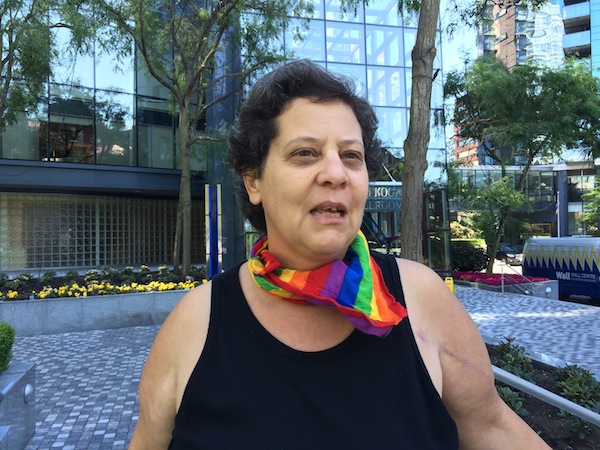
Hadar Namir says she’s uncomfortable with the human rights situation in Israel. (photo by Robin Perelle)
The map, unlike anything I saw during our ministry-sponsored tours of Tel Aviv and Jerusalem, fills with fences and checkpoints, until it’s a messy, convoluted ink-blot puzzle. She tells me stories of families divided, cut off from each other and their land or forced to take long detours to tend their olive trees, if they can tend them at all. She says there are different legal systems in the occupied territories: one for Jewish people accused of committing a crime and a different system for Arab people. She talks about inadequate government support for Arab cities, and difficulty accessing health care.
“Some gay men say, ‘let not interfere our fight for LGBT rights with other fights.’ Not me. I don’t believe it,” she says.
“I don’t want to simplify things,” she hastens to add. “It’s much more complicated” than good Israelis and Hamas terrorists. “And I do understand the desire for a Jewish state,” she says.
But different people have different narratives, she says: Independence Day for some is considered a disaster for others.
* * *
One commonly repeated narrative in Israel and around the world is that Arab communities kill gay people, further distinguishing Israel as a gay oasis.
Most of the Israelis I met in Tel Aviv hesitated when I asked them if gay Palestinians would be marching in the Pride parade.
There must be some gay Palestinians here, Zvi and Alon say, after a brief pause.
“I don’t think it’s easy being a gay Arab anywhere,” Zvi offers. “As in everything, I think life in Israel is easier than life in Palestine.”
Alon mentions a gay Palestinian party in Tel Aviv, and some gay-known coffee shops in Ramallah. But they’re discreet, he says.
Karl Walter, one of our tour guides, says there likely are Arabs participating in the parade, but quietly. They wouldn’t be able to go home, he tells me, “because the Arabs would kill them.”
Arabs “crush” gays in Gaza and in Ramallah, he asserts.
The reality, says Samira Saraya, is more complicated.
Saraya lives in Tel Aviv as an openly gay Palestinian woman. She is also an actress, an activist and a nurse who, in 2003, co-founded Aswat, a group for gay Palestinian women. She also attended the first monthly gay Palestinian parties in Tel Aviv.
“It’s complicated to live in Tel Aviv and be an Arab as well,” she tells me by phone, a week after my return from Israel. “Living in a kind of militaristic society…. On the other hand, I really love the people around me. But the moment we get into politics, it’s complicated.”
I ask her if Tel Aviv’s gay-friendly embrace extends to gay Palestinians.
“If you are willing to bargain your identity, if you are willing to be more Israeli, less Palestinian,” she says. “It depends.”
I ask if she has faced discrimination within the gay community.
“Of course,” she replies. She recalls one experience doing outreach to high school students with a mostly Jewish LGBT organization and hearing a fellow presenter say he wouldn’t date an Arab.
In the gay community, she says, “they don’t see that there is a connection between being oppressed for your sexual identity and your ethnic identity.”
As for the common refrain that Arabs kill gays, she says it’s too easy to paint Israel as democratic and gay-friendly against a backdrop of Arab homophobia. She says she enters the occupied territories as an openly gay Palestinian and no one has ever hurt her.
“I go as a lesbian to Ramallah, as well, and to Nazareth, and do not face homophobia or somebody cursing me because I’m a dyke.”
Palestinian society is “chauvinist and homophobic,” she says, but there are Palestinian people in the occupied territories living their lives as openly gay and nobody is killing them. Some of her friends are even out to their families, she adds.
Though Saraya says many Palestinians who live in Israel go to Tel Aviv Pride, it’s almost impossible for gay people from the occupied territories to get permission to attend. “Less and less people are permitted to come to Israel,” she says. “There are checkpoints and restrictions and protocols.”
* * *
I ask Namir what she thinks of the Israeli tourism ministry flying me and 42 other journalists from around the world to Tel Aviv for Pride.
Tel Aviv is a genuinely gay-friendly city, she says, and the municipality really does support the parade, the community centre and even a shelter for LGBT youth. “I do believe the credit is there,” she says. “I’m totally respectful that the minute that we decided to go out of the closet in 1993, they were opening the doors to us.” But it’s still “pinkwashing,” she says.
Tal Jarus-Hakak agrees. The ministry brought you over to show “the nice part of Israel, how tolerant we are,” she tells me.
It’s “part of their propaganda to show Israel as a gem in this area” – the only democratic country in this area, she says.
But Israel is the only democratic country in that area, Avital interjects.
“But even if that’s the case, it does not take off of Israel the responsibility for what it’s doing in the occupied territories,” Tal replies.
“There’s nothing wrong about the parade in Tel Aviv and nothing wrong about people coming to the parade,” Saraya says. “What’s wrong is trying to use the parade to cover the other violations that Israel do every day. This is pinkwashing.”
Zvi isn’t so sure. He doesn’t think showing off Pride necessarily detracts from the Palestinian situation. “I think mindfulness is in order,” he says, “but I’m glad people are coming to Tel Aviv. God knows Israel could use some good publicity. Should Tel Aviv not get this kind of feedback? I want tourists to come here.”
Walter, our guide, vehemently rejects any suggestion of pinkwashing.
“The thing to understand is that the gay parade and all that we’ve accomplished is for us,” he says, “not for tourism. It’s not for show. It’s not a PR stunt. It’s the most visible expression of freedom in the world – the only free gay community in the Middle East. People tend to forget that. We don’t.”
Gay rights in Israel have nothing to do with the Palestinian situation, he says. “If anyone uses the term pinkwashing, you immediately know that he’s a racist and a homophobe. He doesn’t have the decency to say that my foes – they did something good.”
Tourism ministries in other countries also show off their best traits to visitors, Goldstein points out.
He, too, finds the pinkwashing criticism unfair.
“I think the critics of Israel – they’re really against Israel to begin with,” he says. “People who have an axe to grind and [are] trying to besmirch Israel any way they can. So, any good points, they say they’re doing it to fool the people. I think it’s a bit antisemitic to say that.”
* * *
Back in the seniors’ room at the Tel Aviv gay centre, Lukacs-Böhm cheerfully cleans up his paints and prepares for another day in his gay paradise.
“For me, [to] be free is to drink cold, clean water when I want and how I want,” he says, with a smile.
Robin Perelleis the managing editor in Vancouver of Daily Xtra, Canada’s gay and lesbian news source. This story first ran on dailyxtra.com on July 2.
On the one hand, good news. On the other, bad. The Jewish People Policy Institute delivered its annual assessment to the Israeli cabinet a few weeks ago and it’s a mixed bag.
The annual assessment purports to be the sole “annual stocktaking of the Jewish world,” taking into account the state of affairs in Israel and the Diaspora. The Jewish People Policy Institute, which was created by the Jewish Agency, has been producing this report for 11 years now. It was presented to the cabinet by Stuart Eizenstat, a former U.S. ambassador to the European Union, and Dennis Ross, another high-level American diplomat, who served as the presidential envoy for the Middle East.
Nearly absent in the report, oddly, is any deep introspection on the crucial U.S.-Israel relationship. Among the least specific recommendations is a call for a comprehensive governmental discussion on the “complex fabric of the U.S.-Israel relationship.” It almost appears that the topic, so electric at times in the past year, is too much for the report to embrace.
The report does include, however, a specific appendix on dealing with the potential aliya of 120,000 French Jews. Yet it is nearly silent on European antisemitism, except in the context of its potential for increasing migration to Israel. Antisemitism on American college campuses receives exponentially more attention than antisemitism in Europe. It is almost as though the authors have given up on the sinking ship of European Jewry and are instead devoting their resources to bailing water from the boat of American campus activism.
The strength of the boycott, divestment and sanctions movement has clearly, and rightly, raised alarms at the highest levels. The authors say that Israel and its allies must take an offensive, not just a defensive, approach to the movement – and it states bluntly what plenty of Israel’s overseas allies and enemies have been suggesting for years. While unmasking BDS for what it is – “a movement that rejects a two-state outcome and coexistence” – Israel must also show its commitment to coexistence, Ross bluntly told the cabinet, by “aligning its settlement policy with its support for a two-state outcome. Meaning it needs to stop building outside the blocs.”
The report’s litany of troubles on the geopolitical front is long – Iran on the threshold of nuclear power, worsening security conditions on Israel’s northern and southern borders, the erosion of Israel’s international standing – but the authors see positive developments as well.
Israel is not facing a military threat from a conventional state army. Hezbollah is busy in Syria. Egypt is acting to stop arms smuggling into Gaza. Israeli relations with moderate Sunni Muslim countries are improving as they share common cause in opposition to Iran and jihadism.
As close as the report comes to unequivocal good news is in the demographic realm. Depending on the arithmetic used, the Jewish population in the world is approaching the level it was at before the Holocaust. There are 14.2 million people who identify as Jewish, in addition to one million people in the Diaspora who identify as partially Jewish and about 350,000 immigrants to Israel who are not halachically Jewish but qualify under the Law of Return. That brings the number of Jews close to the 16.5 million who were alive in 1939.
Eizenstat said, “This is a great affirmation of the Jewish people’s commitment to life and continuity but also requires new policy responses and outreach for those who have only marginal connections to Judaism and Israel.”
There are some interesting developments in the Diaspora – meaning, in this case, the United States. For the first time ever, a majority of offspring of mixed marriages in the United States are self-identifying as Jewish. The authors urge Jewish leaders and institutions to encourage the involvement of these individuals in the community.
There is also a huge swath of Americans who define themselves as “Jews of no religion” or “partially Jewish” and the report urges the development of Jewish social networks to engage these people, as well.
The face of American Jewry is changing in other ways. The “historical middle,” Jews who have strong connections to Israel and their Jewish identity but are integrated into secular society, is declining, while Orthodox and ultra-Orthodox communities in the United States are growing rapidly. It also notes that young American Jews are “becoming more, not less, pro-Israel and that growth is happening almost entirely within the politically conservative Orthodox community.”
Canadian Jewish life is experiencing many of the same forces reshaping that of the United States, no doubt. All tolled, in a world in uproar, life remains overwhelmingly comfortable for Canadians, Jewish and not – something we should never take for granted, as forces of animosity and vilification exist here, too, and Israel faces real threats. But there are other issues facing the Jewish community – internal ones. The JPPI data hint at an increasingly polarized Diaspora community, religiously and politically, but don’t offer any analysis. A job beyond its scope, perhaps, but an issue about which we should all be thinking.
Family, Israel remain at centre of Dvora Waysman’s ethical will. (photo by Ashernet, taken on Jerusalem Day 2015)
Very often wills – including ethical wills – are updated as circumstances change. I wrote my ethical will in the early 1970s, when I was still dewy-eyed about aliya and Israel was somehow more innocent, despite the wars she had endured and her ongoing fight for survival.
It was a less materialistic society back then. If you had one car per family, you were well-off; TVs, videos and microwave ovens were a rarity. In fact, not everyone had a telephone and, thank heavens, the ghastly, intrusive cellphone had not been invented.
Our four children (two sons and two daughters) were still kids. They now have all done their army service, graduated university, married and given us 18 wonderful Sabra grandchildren and 10 great-grandchildren, all still living in Israel.
While Israeli society has changed over the past four decades, many of the things I loved have endured. I still find it a great privilege to live in the beautiful city of Jerusalem – it still inspires my poems and my dreams. I still feel part of a family – even though it’s often a squabbling, divisive one. I’ve never considered leaving – to do so would be for me an amputation.
So, with these modifications, I present again my ethical will as it was first published by the World Zionist Press Service, who distributed thousands of copies and reprinted it in two anthologies, Ethical Wills and So That Your Values Live On, both edited by Jack Riemer and Nathaniel Stampfer. I have not changed it, because I can still become misty-eyed at my love affair with Israel. Perhaps today, like a marriage, the passion has somewhat abated, familiarity may have reduced the miraculous to the humdrum but, nevertheless, I am still in love!
My ethical will
As I write this, I am sitting on my Jerusalem balcony, looking through a tracery of pine trees at the view along Rehov Ruppin. I can see the Knesset, the Israel Museum and the Shrine of the Book – that architectural marvel that houses the Dead Sea Scrolls.
I am at an age where I should write a will, but the disposition of my material possessions would take just a few lines. They do not amount to much. Had we stayed in Australia, where you – my four children – were born, they would be much more. I hope you won’t blame me for this.
For now, you are Israelis, and I have different things to leave you. I hope you will understand that they are more valuable than money in the bank, stocks and bonds, and plots of land, for no one can ever take them away from you.
I am leaving you the fragrance of a Jerusalem morning – unforgettable perfume of thyme, sage and rosemary that wafts down from the Judean hills. The heartbreaking sunsets that give way to Jerusalem at night – splashes of gold on black velvet darkness. The feel of Jerusalem stone, ancient and mellow, in the buildings that surround you. The piquant taste of hummus, tehina, falafel – foods we never knew about before we came here to live.
I am leaving you an extended family – the whole house of Israel. They are your people. They will celebrate with you in joy, grieve with you in sorrow. You will argue with them, criticize them and sometimes reject them (that’s the way it is with families). But, underneath, you will be proud of them and love them. More important, when you need them, they will be there!
I am leaving you the faith of your forefathers. Here, no one will ever laugh at your beliefs, call you “Jew” as an insult. You, my sons, can wear kippot and tzitzit if you so wish; you, my daughters, can modestly cover your hair after marriage if that is what you decide. No one will ridicule you. You can be as religious or as secular as you wish, knowing it is based on your own convictions, and not because of what [non-Jews] might say. You have your heritage – written with the blood of your people through countless generations. Guard it well and cherish it – it is priceless!
I am leaving you pride. Hold your head high. This is your country, your birthright. Try to do your share to enhance its image. It may call for sacrifice, but it will be worth it. Your children, their children, and all who come after, will thank you for it.
I am leaving you memories. Some are sad – the early struggles to adapt to a new culture, a new language. But, remember, too, the triumphs – the feeling of achievement when you were accepted, when “they” became “us.” That is worth more than silver trophies and gold medals. You did it alone – you “made” it.
And so, my children, I have only one last bequest. I leave you my love and my blessing. I hope you will never again need to say, “Next year in Jerusalem.” You are already here – how rich you are!
“The Golem,” by David Aronson, 1958, encaustic on panel 57” x 64”. (all photos from David Aronson Archive via Braithwaite & Katz Communications)
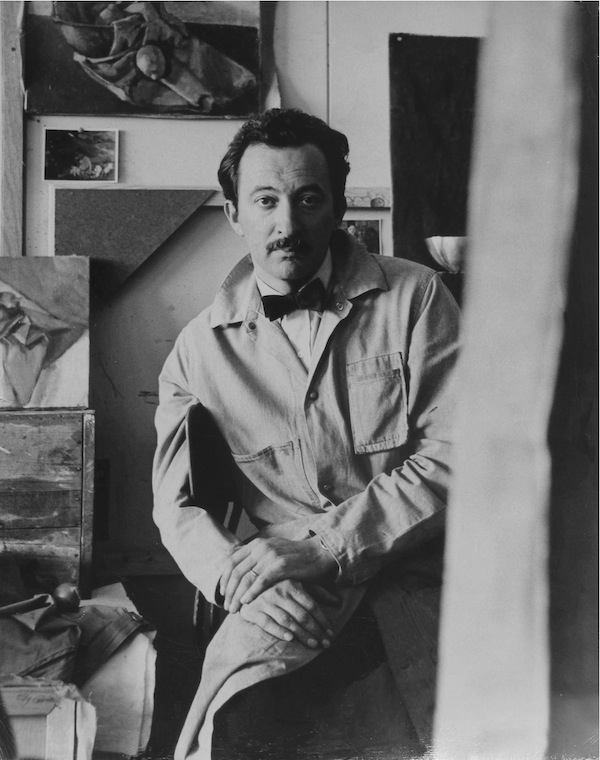
David Aronson in 1956.
American painter and sculptor David Aronson, 91, of Sudbury, Mass., passed away on July 2, 2015. He was one of the most important representatives of the Boston Expressionist movement of the 1940s, an influential force in the development of the arts in Boston for more than 60 years and professor emeritus at Boston University, where he founded the fine arts department and taught from 1955 until his retirement in 1989.
Born in Shilova, Lithuania, in 1923, Aronson immigrated to the United States at the age of 7 and lived and worked in the Boston area for his entire career. While earning his diploma at the School of the Museum of Fine Arts, Boston, Aronson studied with the innovative German-born artist Karl Zerbe.
Aronson’s reputation was quickly established and his art has been featured in numerous solo exhibitions in Boston, Chicago, Philadelphia, New York, Los Angeles and Tokyo, among others. His work is included in the permanent collections of more than 40 museums worldwide including the Museum of Fine Arts, Boston, the Metropolitan Museum of Art, the Whitney Museum of American Art, MoMA and the Art Institute of Chicago. He received both the Judges Prize and Popular Prize from the Institute of Contemporary Art, Boston in 1944 and was one of the youngest artists included in the “14 Americans” exhibition of 1946 curated by Dorothy Canning Miller of MoMA. In 1979, the Rose Art Museum of Brandeis University, the Jewish Museum and the National Academy of Design in New York all hosted retrospectives of his painting and sculpture. Later in his career, Boston University also hosted a comprehensive retrospective of his work in 2005, and the Danforth Museum featured a solo exhibition of Aronson’s work in 2009.
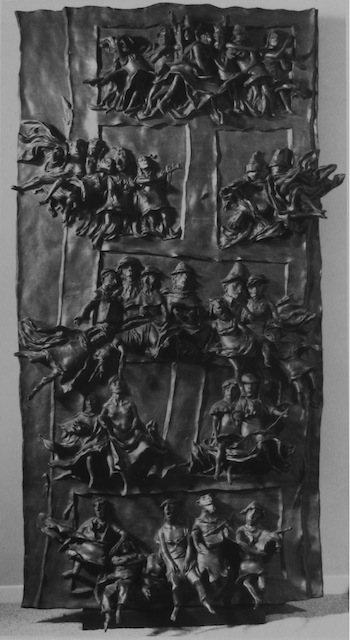
David Aronson’s “The Door David,” 1963-1969, bronze, 94” x 50.5” x 12.25”.
In addition to his exhibitions, Aronson received numerous awards and honors, including a Guggenheim Fellowship in 1960, election as Academician at the National Academy of Design, New York, Purchase Prize in 1961, 1962 and 1963 from the American Academy of Arts and Letters, New York, and honorary doctorates from both Hebrew College and Boston University.
Throughout his career, Aronson continued to experiment with new subjects and materials, frequently choosing dynamic subjects such as musicians, alchemists, magicians and mystics. He also used charcoal and pastel to exploit the power of black and white with the immediacy of drawing to convey profound human emotion in such works as “The Moonworshippers,” 1960, charcoal, 80″ x 84″ (private collection). His explorations in the 1960s also led him into sculpture, first in relief, extruding the forms from the two dimensional surface, and ultimately into major three dimensional works in bronze such as “The Door,” 1963-69, bronze, 94″ x 50″ x 12″ (collection Museum of Fine Arts, Boston).
Aronson leaves his wife of 60 years Georgiana (Nyman) Aronson, daughters Judy Webb and Abigail Zocher and son Ben Aronson, and three grandchildren (Jesse, Alex and Max) and great-granddaughter Isabella.
עומסי התנועה הכבדים במחוז אונטריו שהוא הגדול ביותר בקנדה הביאו לסלילת נתיבים מהירים באורך של למעלה מ-235 ק”מ, באוטוסטרדות המובילות לדאון טאון טורונטו. המגבלה היחידה אך המשמעותית של השימוש בנתיבים המהירים היא, שבכל רכב פרטי שנוסע בהם, חייבים לשבת לפחות שני נוסעים. בימים אלה בהם מתקיימים משחקי פאן אמריקה שנפתחו בסוף השבוע האחרון בטורונטו ויימשכו עד סוף החודש, עומסי התנועה גדולים עוד הרבה יותר, ניתן להשתמש בנתיבים המהירים בתנאי שבכל רכב ישבו לא פחות משלושה נוסעים.
נהגים רבים מבקשים להשתמש בנתיבים המהירים והאטרקטיביים, אך לא תמיד יש במכוניתם שני נוסעים נוספים. ומתברר שהם מנסים למצוא פתרונות יצירתיים ביותר לפתרון של מחסור בנוסעים. למשל להביא את הילדים מהבית שרק ישבו באוטו וישתקו והכל יהיה בסדר. נהגים אחרים בעיקר אלה שרכבם משמש לנסיעות עבודה מוכנים אפילו לשלם, למי שמוכן להצטרף לריכבם בנסיעה בנתיבים המהירים. הצורך בנוסעים נוספים בנתיבים המהירים הוליד לאחרונה תופעה חדשה של מי שמציעים את עצמם כנוסעים נלווים בנתיבים המהירים. “הנלווים” מפרסמים מודעות באתרי האינטרנט, וכצפוי דורשים תשלום. נהגים קריאטיביים במיוחד מצאו פתרון פשוט, נוח, זול וגם שקט. הם מצרפים לריכבם בובות בדמות אדם, שיושבות קשורות במושבים האחוריים. עם זאת נהגים אלה מסתכנים בקנס גבוה במידה והמשטרה תעצור אותם לבדיקה.
לדברי חוקר באוניברסיטה של טורונטו הפעלת נתיבים מהירים בכבישים עמוסים בערים גדולות בצפון אמריקה בהן למשל סן פרנסיסקו וושינגטון, הביאו את הנהגים לאמץ את המודל של ‘קאר פול’, שהוא שימוש של מספר נוסעים ברכב אחד (בהם כאלה שגם לא מכירים אחד את השני), תוך התחלקות בהוצאות הנסיעה.
באזור טורונטו למשל השימוש ‘בקאר פול’ נפוץ בעיקר במקומות העבודה, כאשר המעסיקים הם אלו שדווקא דוחפים את עובדיהם, לארגן נסיעות ברכב אחד לעבודה ובחזרה. למרות זאת בפועל עדיין רוב מוחלט של העובדים בטורונטו מעדיפים להגיע לעבודה ברכבם לבד. יש לקוות שמגמה זו תשתנה ורבים ילמדו לנסוע ברכב אחד לעבודה ולהשתתף בהוצאות נסיעה.
מכונאים קריאטיבים: חיל הים הקנדי רוכש חלקים לספינותיו הישנות באתר של ‘אי ביי’
חיל הים הקנדי עומד בפני בעייה קשה ביותר: מספר גדל והולך של כלי שייט שבצי מתיישן, והממשלה הפדרלית לא ממהרת לרכוש אוניות מלחמה חדשות, לאור העלויות הגבוהות שכרוכות בכך. באין מענה טכנאים ומכונאים של חיל הים שוקדים על תיקון ושיפוץ האוניות הישנות, שתחזוקתן הופכת להיות מטלה מורכבת ומסובכת מאוד. הדברים הגיעו עד כדי כך שלמספר אוניות לא נמצאו כלל חלקי חילוף במחסני חייל הים. ואנשי התחזוקה נאלצו לחפש מצוא פתרונות קריאטיביים עד כדי כמו חיפוש חלקי חילוף באינטרנט.
לשתי ספינות אספקה ממש “עתיקות” שנבנו לפני למעלה מארבעים וחמש שנים, וחלקים רבים שלהן כבר החלידו, לא נמצאו עוד חלקי חילוף מקוריים שיצורם כבר הופסק מזמן. שתי הספינות היו אמורות לצאת משימוש כבר לפני כשבע שנים, אך הן ממשיכות לשרת את החייל, כאמור בגלל מגבלות תקציביות קשות. כדי למנוע את השבתתן צוות התחזוקה החלו באיתור נואש חלקים חדשים במקומות שונים, ונאלצו אף להרחיב את החיפוש, על-ידי אתר המכירות הפומביות האמריקני ‘אי ביי’.
פרסום הידיעה על מצבן הרעוע של צי ספינות חיל הים מעורר ביקורת קשה מצד שתי מפלגות האופוזיציה, שמחפשות כל העת סיבות לנגוח בממשלה השמרנית בראשות סטיבן הרפר, לקראת הבחירות הכלליות שיערכו בחודש אוקטובר הקרוב.
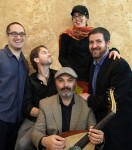
Shtreiml and Ismail Fencioglu will play at the Vancouver Folk Music Festival, as well as concerts on Vancouver and Salt Spring islands. (photo from Vancouver Folk Music Festival)
Shtreiml and Ismail Fencioglu will be right at home among the top talent that will gather at the Vancouver Folk Music Festival July 17-19. As did their previous recordings, the group’s fourth CD, Eastern Hora, received critical acclaim – it also resulted in the band’s nomination as group of the year in the 2014 Canadian Folk Music Awards.
Shtreiml is composer, pianist and harmonica player Jason Rosenblatt; trombonist Rachel Lemisch, originally from Philadelphia, who met Rosenblatt at KlezKanada (the couple dated long-distance for a few years, marrying in 2004); drummer Thierry Arsenault; bassist Joel Kerr; and composer, oud player and vocalist Ismail Fencioglu, who harkens from Istanbul.
Rosenblatt met Fencioglu a couple of years after Shtreiml was formed. The two played together at Festival du Monde Arabe in 2004.
The festival’s artistic director, Joseph Nakhlé, is “very forward-thinking, and he wanted the festival to be “more inclusive and, of course, Jewish people have had a presence in the Arab world for thousands of years, so he wanted to have a Jewish group,” Rosenblatt told the Independent in a phone interview from Montreal. While Shtreiml is not a Mizrahi or Sephardi group by any stretch, he said, Nakhlé wanted to add another element of the Middle East, “so he introduced us to Ismail, and we started this collaborative project.
“The first concert, we played all traditional tunes … traditional Jewish or traditional Turkish melodies, and we’ve just been working ever since at creating our own music. He writes music for the group, I write music for the group, and we created this hybrid sound.”
Rosenblatt attributes the success of Shtreimel to several factors. “First of all, I think when we perform live, it’s engaging in the sense that … you have the instrumentation that people don’t see very often … it’s instruments that people aren’t necessarily familiar with … so, to see someone from Turkey playing the oud and also singing in a style (microtonal), getting the notes in between the notes, I think that’s interesting.”
Another factor, and Rosenblatt said he never thought he would describe the band in this way, but “people like to see an Orthodox Jew and a Muslim playing together. He’s a secular Muslim and I don’t make a secret that I’m an Orthodox Jew, I wear kippa on stage, but I think there’s something heartwarming about it.” The two have been friends for a long time now, and they still get along really well, said Rosenblatt.
And, of course, there’s the music. “We try to stay away from cliché compositions … and, if we do play something that’s super-traditional, we try to add our own flavor, our own spin on it.”
Rosenblatt grew up in a musical family.
“Jewish music was always in the house,” he said, “but the main form of music that my parents listened to was folk and blues, early jazz, that type of thing. But we always had klezmer greats, Dave Tarras, Naftule Brandwein, somewhere in the background; Yossele Rosenblatt [no relation] from cantorial music, my grandmother sang Yiddish folk songs. But my main love of music was – I was influenced by my parents to get into – blues and early jazz.”
Rosenblatt’s dad is a doctor but he plays guitar, and he would play for the kids when Rosenblatt was growing up. His mother is a folksinger, Abigail Rosenblatt, with recordings of her own, and she has accompanied Rosenblatt’s bands on various occasions and on recordings. He has four siblings, who all played an instrument when they were growing up, but did not choose music as a profession, or at least not their main profession, as one of his brothers, Eli, who is a lawyer, has made recordings.
Rosenblatt grew up singing in synagogue, leading services; he took piano lessons. He said he picked up his first harmonica when he was 15 years old because his dad had a bunch lying around. He thought that “Oh Susannah” might have been his first tune, then his parents gave him a tape of Sonny Terry and Brownie McGhee, “an African-American duo that were big in the ’30s, and then, with the folk music revival of the 1960s, a bunch of white, Jewish people rediscovered all these amazing African-American musicians, and it kind of brought them out of retirement. While these guys were out of style for the black community, for these young Jewish people that were rediscovering blues-roots music, these guys became stars again.”
Later, when Rosenblatt started getting into the electric harmonica and Chicago blues, his parents gave him other records to inspire him, Paul Butterfield Blues Band, for example.
While he majored in economics, many of his undergraduate credits were in music, he said, and, during his subsequent MBA, he was still playing weddings and other gigs.
He headed to Israel for about five years, in the latter half of the 1990s, to work in software design. It was an educational multimedia firm, he said, “so they had these various videos and diagrams explaining certain things, historical tours, they did different projects. One of them was the genius of Edison, and Leonardo da Vinci, so they explained various inventions and each invention that was being explained was in a video and I was doing the music for those videos, and then, at night I would play [music] in bars.”
In terms of college-level music instruction, Rosenblatt said he had “one year of serious music education,” the rest was on his own and through mentors, such as Howard Levy, a well-known harmonica player.
“I studied European music at the Rimon School of Jazz [and Contemporary Music] in Israel,” he said. “Then, toward my mid 20s, I started getting into Jewish music a little more seriously, the roots of Jewish music, klezmer and cantorial music, through an organization called KlezKanada…. And I really got into listening again to klezmer greats, trying to apply the repertoire, the ornamentation, etc., to the harmonica, and also to the piano.
“Out of that experience of learning these tunes,” he continued, “I needed some sort of outlet and I formed a band called Shtreiml…. I formed it with Josh Dolgin, who’s known as Socalled … and it started off as a young group playing traditional klezmer music with somewhat untraditional instruments because I was playing harmonica, my wife was on trombone, Josh Dolgin was on accordion, and then we had bass and drums. The group kind of morphed, we played traditional repertoire, to a certain degree, until we felt we couldn’t take the repertoire much further. Then, I started writing a bunch of new material, Jewish instrumental music based on traditional modes, using traditional ornamentation and improvisation, and that’s how the band started.”
As to his compositions, Rosenblatt said, “I listen to a lot of music and I come up with ideas. I don’t just compose in the Jewish realm, I also … have a new album coming out of ragtime and jazz, and not just instrumental music but vocal music as well…. Especially with regards to the Jewish material, I saw a need for it because we were researching a lot of old klezmer tunes and we kind of got tired of always having to research and look for something old, why not create something new? We always say that we have great new music that has a reverence for the past.”
Eastern Hora follows Harmonica Galitzianer (2002), Spicy Paprikash (2004) and Fenci’s Blues (2006). Between Eastern Hora and Fenci’s Blues, Rosenblatt was working with a group called D’Harmo, “and I came out with an album with them, I was working quite a bit with them. I was doing another project, called Jump Babylon, which is a Jewish rock project. It’s difficult, we are self-managed, in other words, I manage everything…. So, to try to do projects simultaneously, especially recording projects, it’s difficult, so that’s the reason for that gap in recordings for Shtreiml because I was doing other things in between [including his continuing role as artistic director of the six-year-old annual Montreal Jewish Music Festival, which will take place in August]. But that doesn’t mean that the band was on hiatus. We were still performing and, since the new record came out, I’ve been putting a lot of emphasis on trying to book the group because it’s fun and we get along, it’s fun to tour together. I think also that the playing of the group matured quite a bit between 2006 and 2014, and I think audiences see that the compositions are little more complex and I think our stage presence is better.”
Shtreiml and Fencioglu will be doing four gigs in British Columbia. He and Lemisch are bringing the whole mishpocha with them: four kids, 7, 5, 3 and seven months. “I’m looking forward to coming to Vancouver, it’s our second time. We were there last year for a wedding…. We have what we call functional music and then we have original music, and so we’re excited to be playing our artistic project for what I know is going to be an appreciative audience because whenever we go to folk festivals, it’s always people are there because they want to hear music.”
Shtreiml and Ismail Fencioglu will be at the Vancouver Folk Music Festival July 17-19, Congregation Emanu-El in Victoria July 15, Vancouver Island Musicfest in Comox July 10-12 and Fulford Hall on Salt Spring Island July 9.
Left to right: Nathan Piasecki (Artful Dodger), E. Marie West (Nancy) and Stephen Aberle (Fagin) in Theatre Under the Stars’ production of Oliver! Aberle also plays Mr. Brownlow. (photo by Tim Matheson)
Actor Steven Aberle describes Theatre Under the Stars as “a thrilling combination of enthusiastic, amazingly talented youth and, as they say, ‘seasoned’ pros.” In this instance, Aberle – who plays both Fagin and Mr. Brownlow in TUTS’s Oliver! – counts among the seasoned pros, while fellow Jewish community member Kathryn Palmer, who plays Strawberry Seller and is in the ensemble, is one of the talented youth, though Aberle and the other seasoned pros also have plenty of that, of course. The Independent caught up with both actors by email earlier this month.
More than just luck
JI: You’re a relative newcomer to the Vancouver stage. Could you share some of your performing background?
Kathryn Palmer is Strawberry Seller / ensemble in Oliver! (photo from TUTS)
Kathryn Palmer: I have always had a deep-seated passion for music and performing. When my home life started getting rocky, my Auntie Kathryn, who was a professional opera singer, seized the opportunity to get me out of the house for a few hours a week and into her studio for voice lessons. I was hooked and completely inspired! It wasn’t long before I was accepted into the voice program at Canterbury Arts High School, taking Royal Conservatory Exams, singing in choirs, competing in music festivals across Canada and performing in as many musicals as I could.
JI: You’re a graduate of the Canadian College of Performing Arts in Victoria. Are you from Victoria? Can you share some of your personal background, including what role, if any, Judaism or Jewish culture or community has played (plays) in your life?
KP: Born and raised in Ottawa, I moved to Victoria to study at the Canadian College of Performing Arts. I was very fortunate to graduate with about two years of paid theatre work … beginner’s luck, I call it.
At school, we were always told to use what makes us different and unique. One of the things my auntie had taught me was all about Jewish folk music. Being able to sing folk songs in Yiddish and Ladino was definitely something that made me unique but also grounded me. Being Jewish doesn’t exclusively impact the work I choose to do but it definitely infuses it. When I’m doing these musicals that are set in the past, I always wonder that would my life be like a young Jewish woman during this time. I also get excited to perform in shows with a more Jewish theme, like Hodel in Fiddler on the Roof at the Gateway Theatre or Louise Philo in Girl Rabbi at Congregation Emanu-El in Victoria.
JI: What are some of your aspirations regarding a career in performance?
KP: I adore theatre. I love musical theatre. I also love working with kids. I want to go back to school within the next few years and do my ECE [early childhood education]. I’m hoping to one day move back to Ottawa and start a theatre school there. Hopefully, I can inspire children the same way my auntie inspired me.
Not just the beard
JI: You seem to have been very busy on stage in the last couple of years. Can you share with readers some of your performance highlights since the JI last spoke with you in December 2013 about Uncle Vanya?
Stephen Aberle: I have been blessed with busy-ness these past several years, yes, kein ayin hara [no evil eye]. I guess I’m at that stage in my career where, if one remains alive, willing and (unfortunate but still true in today’s theatre) male, opportunities arise. Since
Uncle Vanya, I’ve had the good fortune to perform in Snapshots: A Musical Scrapbook, with music by Stephen Schwartz (of Godspell and Wicked fame) at Studio 1398 on Granville Island last fall. That was an opportunity to work on some amazing material with a wonderful company, including director Chris McGregor and Wendy Bross Stuart as music director.
I’ve been fortunate to perform with Wendy many times, including a couple of shows together at TUTS. We’ll be doing Snapshots again this coming fall [late October, early November], at Presentation House in North Vancouver, this time to be directed by Max Reimer.
I got to be part of a workshop of Hamelin: A New Fable by Leslie Mildiner (another member of the Jewish community) for Axis Theatre, although, unfortunately, scheduling didn’t make it possible for me to be in the touring production. And, earlier this year, I was in What You’re Missing, a lovely new play by Vancouver-born playwright Tamara Micner (she’s now based in London), at the Chutzpah! Festival.
JI: What most attracts you to, and repels you about, the character of Fagin? How are you approaching the role?
SA: Well, Fagin is one of the great characters of 19th-century literature – and, in Dickens’ novel at least, one of the great antisemitic caricatures of all time. That kinda sums up both the attraction and the repulsion: the character and his motives and passions are grand, fascinating, delicious for both performers and audiences; he’s also, let’s not mince words, a brutal travesty – again, as Dickens originally conceived and presented him in the novel Oliver Twist.
I want to rise to the level of the challenges the character offers. He’s big, and I need to honor and own that and, at the same time, find the truths in the character and his situation. Lionel Bart, who was Jewish and who created the musical Oliver!, trod a careful line in dealing with Fagin. There are no explicit references in the play to Fagin’s being a Jew, but Bart wove klezmerish themes into a lot of his music. The late great Ron Moody, also Jewish, who originated the role in London and who played it in the movie, followed that line, playing into Jewish nuances in the music and in the character’s accent.
The story of Oliver Twist and of the musical Oliver! deals with some dark themes – themes that are very much still with us, here and now. Grinding poverty rubbing shoulders with enormous wealth and privilege; love, hatred, loyalty and betrayal; violence against women; criminality, justice and injustice; prejudice; legitimacy and illegitimacy and the arbitrariness of those categories. Our director, Shel Piercy, is not shying away from that darkness, and I’m interested in his approach, his color palette. There can be a tendency, sometimes, for musical comedy to be cutesy, all fun and games and sweetness and light; that’s not the intention with this production. So, I’m looking for ways to explore Fagin’s breadth and depth. He’s devious, avaricious, by turns fearful and bold, can be selfish and brutal; he’s also probably the closest thing to a parent most of his gang of little thieves have ever known. He uses them, but he also feeds them and shelters them and plays with them and teaches them the only way he knows how to make a living, which happens to be thieving.
Shel has made some intriguing casting choices. One actor – Damon Calderwood – plays both Mr. Bumble and Bill Sykes, and Shel has me playing both Fagin and Mr. Brownlow, the kind gentleman who strives to rescue Oliver from Fagin’s clutches. I get to play both the wicked and good father (or grandfather) figures, if you like. A practical consequence of that choice is that I spend a lot of time on stage, so one important goal for me as an actor will be to remain upright. It’s going to be a workout.
JI: You were Buffalo Bill in a prior TUTS season. How did you come to start auditioning with TUTS, and have there been other roles? Does performing on an outdoor stage present unique challenges?
SA: I first worked at TUTS (in those days it was called Theatre in the Park, or TITPark) in the mid-’70s as a carpenter and stagehand, and I’ve had the pleasure of performing there each decade since – in Anything Goes in ’87, as Tevye in Fiddler on the Roof in ’97 and as Buffalo Bill in Annie Get Your Gun in 2008.
I started auditioning for TUTS soon after I graduated from Studio 58, and I keep auditioning there when I’m free and I think there might be a role for me. I love it there. The people are great, a thrilling combination of enthusiastic, amazingly talented youth and, as they say, “seasoned” pros. There’s a lot of love around the place. A special smell pervades the atmosphere, although it no longer carries as much of the whiff of pigeon droppings as it had in the old days. I’ve probably been just about everywhere it’s possible for a human being to get to in that building, including all over way up in the gridwork, where I spent a great deal of my time during those summers in the ’70s.
Playing outdoors presents some curious and inspiring challenges, yes indeed. There are obvious ones, like wildlife, for example. You never know when you might be joined on the stage by a raccoon or a squirrel or a crazed moth, and every actor knows that small children and animals – even insects – are far more interesting to watch on stage than we are because they’re unselfconscious and unpredictable.
We’re playing in Vancouver in the summer and the days are long, so the first half or so of the show is hard to light – you can’t use light to draw the audience’s attention very effectively because it’s hard to compete with the sun. Shel pointed this out to us in rehearsal: “Your movement is my spotlight.” We as performers need to provide focus through our actions, positions, motions and stillnesses. We’re also quite far away from the audience, so we have to use our bodies fully. Someone in the 20th or 30th row may barely be able to make out my features, so I need to release my thoughts and emotions into my body: to smile and frown and laugh and wonder, not just from the neck up but with all of me….
JI: If there is anything else you’d like to share with readers, please do.
SA: Well, there is one other thing. It’s interesting to me that, especially in the last few years, so many of the characters I’ve played have been Jewish. Tevye in Fiddler, Jacob in Joseph … plays at the Chutzpah! Festival, now Fagin. I think I get called to audition for most of the film and TV rabbi parts that come into town.
I guess it’s the beard.
Oliver! alternates evenings with Hairspray from July 10-Aug. 22 at Malkin Bowl (tuts.ca).
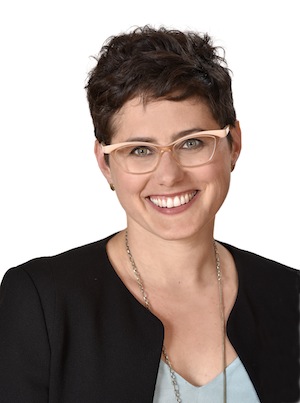
Jewish community member Mira Oreck, director of public engagement for the Broadbent Institute, has announced that she will seek the federal NDP nomination in the riding of Vancouver Granville. She spoke with the Jewish Independent about that decision. For more information, readers can visit miraoreck.ca.
JI: Why have you chosen to seek a nomination for the NDP?
Mira Oreck (photo from Mira Oreck)
MO: I am seeking the NDP nomination in Vancouver Granville because I believe in Tom Mulcair, his vision for Canada and the impressive group of leaders he has assembled to turn that vision into reality. In particular, I am compelled by his commitment to address climate change, to create affordable and accessible childcare for $15 per day and the solutions he has put forward to address the growing rate of income inequality in Canada.
JI: Why now in your career path are you seeking this nomination?
MO: I spent a number of years living in New York City and watching from afar as the direction of our country began to change. Science and evidence-based policy were being ignored. The judicial system was under attack. The core of our democracy was being challenged. I moved back to Vancouver because I could no longer watch that happen to Canada. I’m seeking the NDP nomination because I believe Canadians are ready for a change, that Mulcair is the leader with the clearest values and most ready to govern, and I want to be part of that change.
JI: Foreign policy, in particular towards Israel, is a main issue for many in the Jewish community. What are your thoughts on the Canada-Israel relationship and how would you want that to change (or not) if you were to become an NDP MP?
MO: I grew up in this riding, in the heart of the Jewish community, and a deep relationship with Israel has always been part of my world. I have visited Israel over a half-dozen times and spent a year living in Jerusalem studying at
Hebrew University. In this sense, I relate to the Jewish community’s concerns, both in terms of domestic policy issues and foreign policy, with respect to Israel in particular.
I am proud to run for a political party that supports the state of Israel and, importantly, is working towards a two-state solution. As Canadians, we were once known for listening and hearing the various sides of a conflict. I know many people on every side of this conflict – and the vast majority, even the most frustrated among them, want trust-building efforts that can lead to solutions for Israelis and Palestinians. I believe we, as Canadians, have a responsibility to be bridge-builders. I trust that the NDP under Tom Mulcair would be just that.
JI: When is the nomination vote taking place; who else is running? What would make you a better candidate for the Jewish community, or in general?
MO: The nomination meeting date has not yet been set but will likely be the final week of July. There is another candidate in the race and the vote will be among current NDP members in Vancouver Granville.
It would be an honor to serve as a member of Parliament for a riding with a large concentration of Jewish community members, many of whom I grew up with. As a former director of Canadian Jewish Congress, Pacific Region, I am acutely aware of the issues facing the community and have a track record of advocating for them. I know that, for many people in the community, issues of affordable child care, investments in public transit, an increase in the minimum wage and addressing climate change are at the core of their beliefs.
I know that members of the community are members of all political parties, and strongly support and encourage political engagement. I have been thrilled by the support I have received from members of the Jewish community who have joined the NDP to support me in this nomination race.
JI: If there is anything else you’d like to add, please do.
MO: The importance of civic and political engagement is a direct result of my family’s work within the Jewish community and my experience in USY and at summer camp. Recently, I have been inspired by a younger generation of leadership in Israel who believe in the political system making change. Watching them seek and hold office and shape their own country has shown me the importance of diving in!