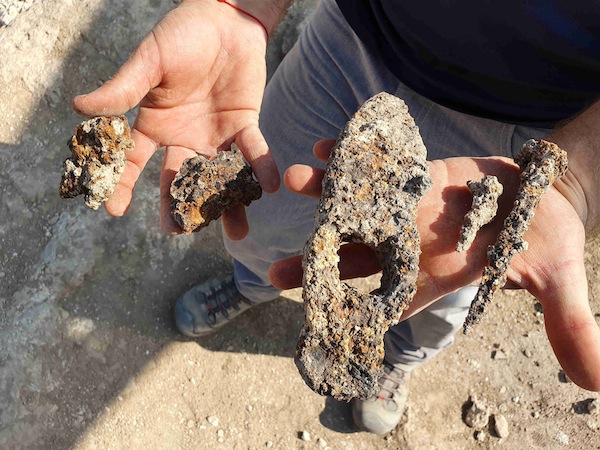
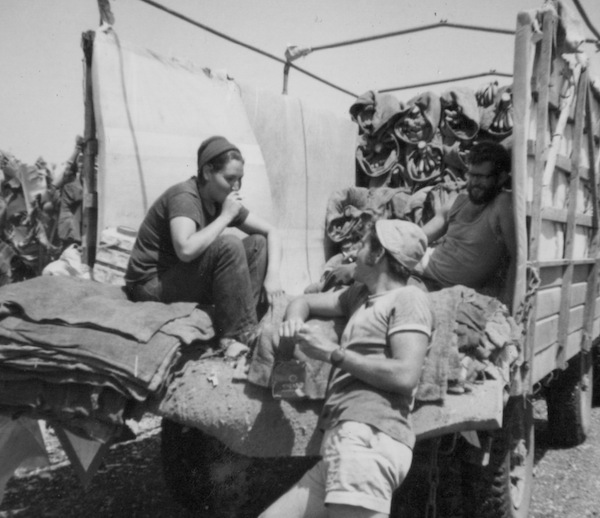
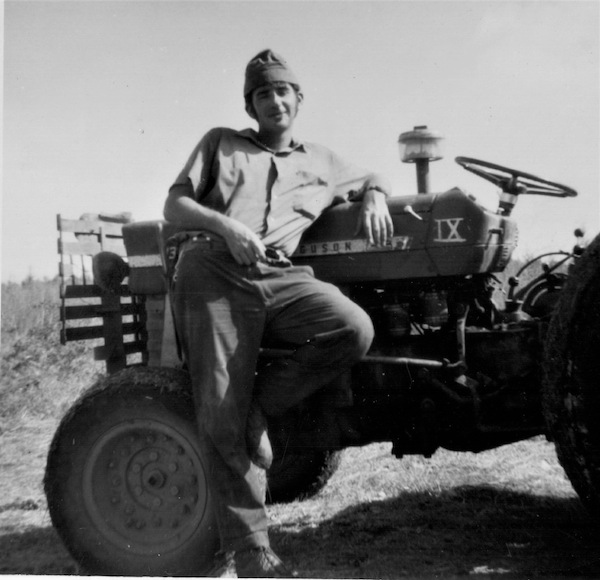
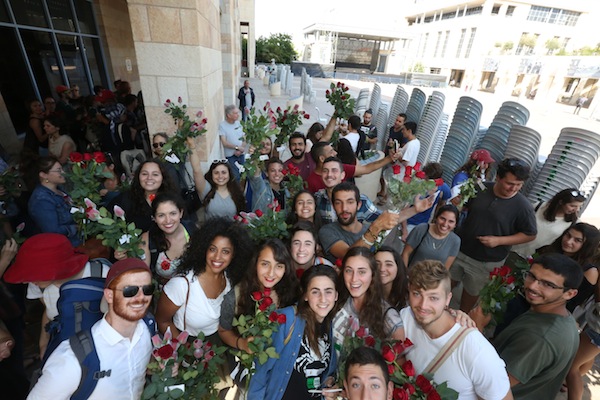
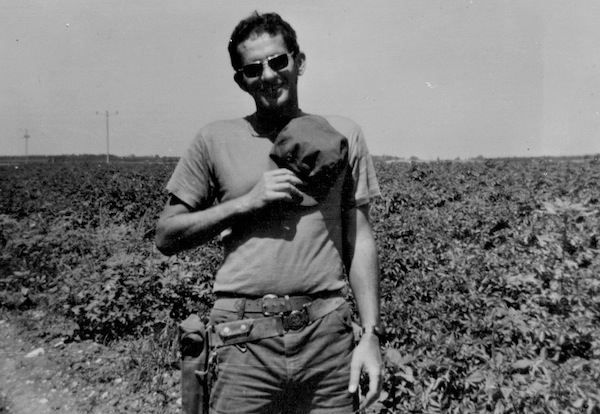
Stacking the banana bunches in the wagon required a type of superpower. (photo from Victor Neuman)
In this eight-part series, the author recounts his life in Israel around the time of the 1973 Yom Kippur War. The events and people described are real but, for reasons of privacy, the names are fictitious.
Part 6: War Comes Home
My first inkling of how fighting is done in this region of the world came in 1969, when I was working on the pipeline near Arad. Our crew was encamped at a motel and so were some Israeli soldiers. At that time, there were infiltrators crossing from Jordan into Israel and planting bombs wherever vehicles were likely to pass. Tourists like myself were warned to hitch rides while standing on the paved part of the road – never the soft shoulder. Similarly, the cars picking you up never pulled over; they simply stopped in the travel lane and waited.
The Israeli patrols were setting up ambushes in wadis in the area. When they came back to the motel to warm up, I talked with them about what they were doing.
As darkness came, the soldiers drove out to a wadi that showed signs of human activity, positioned themselves and waited. It was damn cold, they told me, especially when you had to remain still for a long time. Their jackets and leggings kept most of their bodies warm but their hands became very cold. You can’t properly operate a weapon with gloves on.
“So, what did you do to keep your hands warm?” My question got laughter in response.
“Shall we tell him?”
“Yes, who cares? Tell him.”
“Well, if you must know, we all sit around with our hands in our crotch. That’s the only way to keep them warm.”
Still the greenhorn, I asked them if they had any luck or taken any prisoners. Again, they looked at each other – in more seriousness this time.
“It’s dark and you can’t see what they have in their hands even when their hands are in the air. We just kill them all.”
I had no more questions.
Now, it was 1973 and the war had been going on for two weeks. The tide had turned. Syria had been pushed back from the Golan and Egypt had been cut off in the Sinai. To the relief of all of us on the kibbutz, Jordan’s only contribution to the war had been to send some soldiers to fight alongside the Syrians. There was no Jordanian third front in the war.
A trickle of kibbutz members – mainly the older reservists – began returning from the front lines. One of them was a good friend and a fellow banana worker named Moti.
Moti’s talent in the fields showed itself during our time of kateef (cutting, or harvesting). Moti received the bunches and quickly stacked them in the wagon, usually about eight rows high. His superpower was being able to do this in a way that the row would not collapse before the next row shored it up. I tried it once and produced a banana avalanche. It was one of those things that is funny in hindsight – at the time, we had to empty the whole wagon and start over. Time was wasted, bananas were bruised, Lev was pissed.
Moti told me he hadn’t been on the front but had heard stories from those who were. They told him that they had retaken outposts that were overrun in the first days of the war. They found Israeli soldiers tied to the four corners of their bunk with their bellies cut open. I asked him if he had seen any of this; he told me he hadn’t. They were just stories he had heard, but he believed them.
Having Moti back was like old times. Moti, Lev and I were all back in the bananas, along with a number of tourist-volunteers. We were able to properly tend the fields again and we wished to think that life was returning to normal.
Still, the war came home whenever someone else came back on furlough and brought their stories. Next to return were Tzvie and Ari – good friends who, in peacetime, worked the fields together and, in wartime, shared a tank. Just before the war, they had completed their three years of military service and were off on a tour of Europe. No one on the kibbutz could afford to do such things, so the kibbutz rewarded everyone who completed their army stint with an all-expenses paid trip to Europe. It was a once-in-a-lifetime chance to see the world before settling down and all the kibbutz kids dreamed of their time abroad.
Tzvie and Ari were two weeks into their trip when the news reached them that Israel was under attack. Ari wanted to carry on with the tour, arguing that the war would be over before they got home, but Tzvie would have none of it. He told Ari that he would go insane if he were walking around Europe while his country was at war and he became so agitated that Ari agreed to return.
One of the war stories they shared was that, on one of their forays, their tank was hit by a wire-guided missile – a portable device enabled the operator to fire the missile and control it in flight by means of a wire that played out as the missile flew on its path. The Egyptian army had many of these missiles and they took a deadly toll on Israeli tanks in the opening days of the war.
When Tzvie and Ari’s tank was hit, it was immediately disabled and the entire crew had to abandon it quickly. With the enemy nearby, they couldn’t exit from the top of the tank so they dropped the hatch at the bottom and escaped using their tank’s track-and-wheel assembly as cover. They were tripping and stumbling over anti-tank wires from an earlier battle but managed to haul their guns and a box of ammunition to a nearby hill. They were grateful to be alive but less so when they realized they had brought the wrong ammunition; it was compatible with one of the tank’s machine guns but none of the weapons they were carrying. In despair, they hunkered down and waited to be attacked. Then they began to notice how quiet it was. In fact, there was no one around but them. They came down from the hill to investigate and found that their tank had actually hit a land mine.
Ari said of the experience, “Yes, it was scary, but at least our job is driving a tank. It’s worse to be a paratrooper. There they tell you that, if your chute doesn’t open, point yourself head down toward the ground. That way they can reuse your boots.”
At this point, Ari and Tzvie smacked each other on the back and laughed their heads off. Seeing our cue, we all laughed as well.
Now I had the whole range of it. War, murderous and savage. War as slapstick.
Victor Neumanwas born in the former Soviet Union, where his family sought refuge after fleeing Poland during the Second World War. The family immigrated to Canada in 1948 and Neuman grew up in the Greater Vancouver area. He attended the University of British Columbia and obtained a BA and MA with majors in English literature and creative writing. Between 1968 and 1974, he made two trips to Israel, one of which landed him on a kibbutz at the time of the 1973 Yom Kippur war. Upon his return to Canada, he studied Survey Technology at BCIT and went on to a career of designing highways for the Province of British Columbia and the firm of Binnie Civil Engineering Consultants. When he retired, he reconnected with his roots in creative writing and began writing scripts for Vancouver Jewish Folk Choir concerts and articles for the Jewish Independent. Neuman and his wife, Tammy, live in southeast Vancouver and enjoy the company of friends, their extensive extended family and their four sons.
Patroling the kibbutz perimeter. (photo from Victor Neuman)
In this eight-part series, the author recounts his life in Israel around the time of the 1973 Yom Kippur War. The events and people described are real but, for reasons of privacy, the names are fictitious.
Part 5: Night Guard Duty on the Kibbutz
Lev, the banana boss, was in his early 30s and a miracle worker. He was back on the kibbutz and strolling toward me. He had talked the army into releasing him so he could save his banana fields. I was not surprised he had pulled it off. Lev was originally from the United States and a dedicated Zionist. He had long ago concluded that the only proper place for a Jew was in Israel and so he immigrated. Always determined in what he wanted, he bulldozed his way through kibbutz apprehensions to single-handedly create the banana crop as a major branch of our agricultural sector. And he was fearless to a fault.
“Fearless to a fault” may sound like a contradiction. It’s not. The right amount of fearlessness is courage. The wrong amount is stupidity. In my opinion, Lev was sometimes at the wrong end of that equation. Here’s an example.
Before the war, Lev was fed up with the theft from our banana fields and had no confidence that the village police from the nearby Arab town would take any action. The culprits were likely from the town and might even have been relatives of the cops. I had to agree with Lev – the only time I had seen any action from these police was when they drove up to the kibbutz to extort chickens for their next village wedding.
One day, Lev had six of us arm ourselves with clubs and do a stakeout in the banana fields. We had a German Shepherd named Ledie to help take down anyone we caught. Before long, two Arab teenagers appeared, checking for ripe bananas. They came toward where I was hiding. I jumped up but I had moved too early and they raced for their village. Only Lev, the dog and I were near enough to give chase. It was a farce. The teens were lean and fast. Lev smoked two packs a day. Our dog was never trained to be aggressive and was an older dog as well. So, it was the two teenagers way in front, me next, Lev a distant fourth and the dog in last place – tail wagging madly the whole time. I gave up and stopped, but Lev ran past me and yelled, “Come on!”
By the time we arrived at the village, the two thieves had vanished and our dog also had disappeared, likely returning to the kibbutz. I wanted to go back, too, but Lev wasn’t done and I couldn’t leave him on his own. Like a gunslinger minus the gun, he walked us right into the first building we came to. It was some kind of coffee house, full of locals sitting at tables sipping their drinks. All conversation and sipping ceased when we barged in. They all stared at us. I felt like I was in a bad Spaghetti Western. I was convinced Lev was going to get us killed.
Lev stomped around, demanding to know if anybody had seen the two boys. Heads were shaking. Not satisfied, he gave a description of what they looked like and the clothes they were wearing. Heads kept shaking. He then demanded that everybody keep an eye out for these banana thieves and report them to our kibbutz. To my astonishment, heads nodded. I think we had caught them by surprise and then Lev’s pure chutzpah had won the day. Walking out in one piece was a win for me, while Lev was angry at not catching anybody; surviving was not one of his concerns.
Now you know what I mean by “fearless to a fault.” And now, here was fearless-to-a-fault Lev walking up to me.
“Shalom, Victor. I’m back so I’ll be taking over the irrigation. I wanted to keep you on it, but Gidon says he needs you for guard duty. You better see him. And thanks for looking after the bananas. I expected half of them to be dead but they are all good. Nice job.”
High praise from Lev, who rarely expressed gratitude to anybody. The bananas were like children to him and I was the babysitter who, surprisingly, hadn’t murdered any.
Gidon told me I was to patrol the kibbutz from dusk to dawn for the next week at least. He gave me an ammunition belt, a flashlight and a first-aid kit with pressure bandages to patch up anybody I shot inappropriately. He also gave me Chauncy, the English guy. Chauncy was one of those hapless tourist volunteers who came to experience kibbutz life and was experiencing more than he bargained for. Though he wasn’t Jewish, he gamely agreed to be my assistant on patrol.
Our first patrol had a slow start. Chauncy begged me to let him hold the Uzi long enough to get his picture taken. I didn’t want to, but figured it would be better to get it out of his system. I removed the ammunition clip and handed him the Uzi. He gave me his camera and I took a half-dozen pictures of him, empty gun at the ready, looking steely-eyed and staring into the dark. I was thinking he was an idiot but then remembered the photos I had made Tamar take when I first got my weapon. She thought I was an idiot. Israelis would never think of getting this kind of snapshot, as Canadians wouldn’t think of getting their picture taken in their kitchen holding a spatula. Why record it? In this country, everybody has a spatula.
We walked the perimeter for about a week. Early evening was the best, as kibbutz members stopped to chat and the time went quickly. Adding to our duties was the requirement that we join others in checking cars that were coming up the driveway and searching them for bombs. I was particularly happy to intercept the village police who had come on another of their chicken runs. We made them get out of their car and stand around while we did a thorough, very slow check of their vehicle. The chicken-stealing cops were not nearly as annoyed as I had hoped. I was thinking we’d need to do a strip search next time.
As the night wore on, everybody went to sleep and it was just Chauncy and I walking the perimeter. As per Gidon’s instructions, we didn’t go to the dining hall to scrounge for food and thus take ourselves away from our rounds. We carried our lunches and ate under the security lights. I was always conscious of how dark it was beyond the reach of those lights and how impossible it would be to see anyone coming. On the other hand, Chauncy and I, walking directly under the lights, were highly visible from far away.
It became a nagging question in my mind as to how effective night guard duty was when Chauncy and I were always in plain view while the bad guys were always hidden. I confronted Gidon about it one day and his reply was, “When you are shot, it will alert the rest of the kibbutz.” I wished he had had a grin on his face, but he didn’t. I was just thankful he hadn’t ended with “Are we understanding?” We were not.
I never told Chauncy about that conversation but I think he detected my increased wariness. A certain morbidity came over me. In trying to come to terms with the possibility of death, I tried to control the fear by embracing the notion. I decided one night we would have our meal in the kibbutz cemetery. Chauncy was freaked but I put it to him that the dead were dead and gone. Also, I argued, the headstones made good back rests for eating in comfort. To pass the time, I read the Hebrew on some of the stones; the easiest part to grasp being the date of death and age of the departed. Many were in their 20s and had died in 1948, likely in the War of Independence. They were close to my age and Chauncy’s. It made me think of how endless the fighting was in this land. The dead of one war pondered by participants in another, with two other conflicts in between. We only had lunch in the cemetery that one time.
I never had to shoot anybody during my stint as night guard but I did come close once. Chauncy and I were in the area of the mechanical shop at around two in the morning when we heard noises coming from the shop and saw the lights were on. The kibbutz was generally very quiet at night. There was no shift work besides guard duty so everyone should have been in bed.
I told Chauncy to stay behind me as we entered the shop to investigate. For the first time in all my guard duty, I slid the thumb switch of my Uzi from safety to automatic.
Chauncy whispered, “Jesus!”
We got as close to the noise as we could and then I stepped around a corner with my Uzi leveled.
It was a kibbutz teenager named Uri. Apparently, Uri had a bout of insomnia and decided he might as well go to the shop and keep working on his project. He was trying to make a go-kart out of discarded tractor parts. Uri had almost gotten a permanent cure for his sleeplessness. I had almost shot a 15-year-old kid.
Victor Neumanwas born in the former Soviet Union, where his family sought refuge after fleeing Poland during the Second World War. The family immigrated to Canada in 1948 and Neuman grew up in the Greater Vancouver area. He attended the University of British Columbia and obtained a BA and MA with majors in English literature and creative writing. Between 1968 and 1974, he made two trips to Israel, one of which landed him on a kibbutz at the time of the 1973 Yom Kippur war. Upon his return to Canada, he studied Survey Technology at BCIT and went on to a career of designing highways for the Province of British Columbia and the firm of Binnie Civil Engineering Consultants. When he retired, he reconnected with his roots in creative writing and began writing scripts for Vancouver Jewish Folk Choir concerts and articles for the Jewish Independent. Neuman and his wife, Tammy, live in southeast Vancouver and enjoy the company of friends, their extensive extended family and their four sons.
During the Yom Kippur War, the author had to learn how to fire an Uzi and other weapons. (photo by Victor Neuman)
In this eight-part series, the author recounts his life in Israel around the time of the 1973 Yom Kippur War. The events and people described are real but, for reasons of privacy, the names are fictitious.
Part 4: Training Day
We were two or three days into the war and the news was chilling. Egypt had overrun the defences along the Suez Canal and was pouring into the Sinai. Syria had breached the outposts in the Golan and was within striking distance of Tiberias. We were in shock to think that, a scant six years after the pummeling of the Six Day War, these countries were able to go to war again.
I think the nation was in disbelief as well. Soldiers, in large numbers, had been sent home to observe Yom Kippur with their families. The government had effectively demobilized much of the Israel Defence Forces prior to the attack. The trust in Moshe Dayan and Golda Meir would never be the same.
At first, the response of the average Israeli was cocky. Tamar thought the attack was stupid. “We beat them in six days … now it will be five.” Then, as the news came in, the optimism vanished. Kibbutzniks came around to ask me if I was tuned in to the BBC. They didn’t trust the government to give them the truth of what was going on. It was wartime after all and, at such times, every involved government lies through its teeth. There was not much to listen to, though. Everything was so sudden that the international news services hadn’t caught up with what was going on.
Then Gidon came by. The next day, I was to receive weapons training along with three other volunteers who had just enough Hebrew to say “Halt! Who goes there? Who are you? Stop or I’ll shoot.” The basic wartime jabber.
I don’t recall ever being asked if I wanted to join the fight. As a candidate for kibbutz membership, it was a given that I would step up and do anything required to help. And so it was. This was now my home and these people were my family. Not doing everything I could was never a question in my mind. But, truth be told, to me the fighting seemed far away and unreal and I had no real sense of personal danger. More oblivious than brave might be the way to put it.
Next day, the four of us and Gidon met in a field behind the kibbutz. Gidon had set up a target that consisted of a plywood board on two metal rods that were banged into the ground. There was a rise behind the target to stop the bullets from straying. On a table to the side, he had weapons. There was an Uzi, a bipod sniper rifle and three Second World War relics. Gidon apologized for the older guns, saying they were there just to give us the hang of things and he expected we would have better weapons soon. But, first, he addressed us with a sombre face.
“As you know, our kibbutz is located on Wadi Ara. This valley connects the West Bank territories to the coast of Israel. The military tells me that, if Jordan enters the war and opens a third front, there is a good chance they will come right down Wadi Ara and we are the first Israeli settlement past the West Bank. If that happens, I am told, we have to hold out for six days without help from the army. They are fully occupied in the Golan and the Sinai and will not be able to help us until they have solved their problems over there. Are we understanding?”
“We are,” we all said, a little unenthusiastically. I was thinking, “Worst pep talk ever, Gidon!”
Then came the practice shooting and I learned stuff that no graduate in English literature needed to know.
When sniping with a rifle, lie flat with elbows well anchored. The right leg should be extended back in a line with your rifle and your body to absorb the shock of the recoil. Your left leg is splayed out to the left for stability. Don’t breathe, take aim and squeeze the trigger. Our accuracy was rough, then better. But my main recollection is the kick of those rifles. We were basically lying in fine dirt and, when the round went off, the force pushed our whole body two or three inches backwards. The movement after every shot caused a small cloud of dust to rise up around us and we had to wait a moment before we could see well enough to shoot again.
An Uzi has 32 rounds in its clip. The sliding switch by your thumb has three positions: safety, single shot and automatic. Gidon told us to forget about the first two positions. In battle, you had to be quick. You had to be in automatic mode and learn to shoot from the hip without aiming. The dumbest thing you could do was to hold the trigger down. Doing that would empty your clip in three seconds and the recoil would twist your arm and body up and to the right. Gidon taught us that we had to squeeze off short bursts of around three rounds, see where they hit and adjust accordingly.
Our shooting with the Uzi was fairly awful. Shooting from the hip is really tricky. There were puffs of dust halfway up the hill behind the target, in the dirt just metres in front of us, way off to the left and right of where we were trying to aim. I thought the safest place to be on that range was standing in front of the target.
I had a little better luck than the rest. High with the first burst. Low with the second. Then I adjusted again and hit the target with a burst that knocked the whole thing over.
That evening, Gidon marched us into one of the bomb shelters and gave us all our assigned Uzis. Then he showed us how to disassemble them. We had to disassemble and reassemble our Uzis over and over again until we could do it in a matter of seconds. We were feeling pretty good about ourselves until suddenly Gidon turned off the lights and we had to do the whole thing in pitch dark. A bomb shelter, of course, has no windows. So, when the lights are out, you might as well be spelunking in the world’s deepest cave. We eventually learned to do it using only our sense of touch.
Training ended and so did my date nights in the banana fields with Tamar. She was needed elsewhere and I was approved for carrying a weapon, so I was on my own for going out to the fields at night and dealing with the irrigation. A scary business. Alone in the dark, banana trees making the fields look like a jungle, shadows everywhere and the possibility of infiltrators from the West Bank. I felt like I never breathed until I was in the Willis, job done and heading back to the kibbutz. Back at the kibbutz, I signed in to prove I was still alive. Sometimes I even looked at my own signature to make sure.
When I returned to our flat at 2 a.m., Tamar would be fast asleep. In another world, my girlfriend would leap out of bed and throw her arms around me, overjoyed at my safe return. Tamar would half-waken and say, “Shalom, shalom sweetie,” then go back to sleep. And I understood. It wasn’t that she didn’t care about me. This was Israel. The Yom Kippur War was not their first rodeo.
Victor Neumanwas born in the former Soviet Union, where his family sought refuge after fleeing Poland during the Second World War. The family immigrated to Canada in 1948 and Neuman grew up in the Greater Vancouver area. He attended the University of British Columbia and obtained a BA and MA with majors in English literature and creative writing. Between 1968 and 1974, he made two trips to Israel, one of which landed him on a kibbutz at the time of the 1973 Yom Kippur war. Upon his return to Canada, he studied Survey Technology at BCIT and went on to a career of designing highways for the Province of British Columbia. When he retired, he reconnected with his roots in creative writing and began writing scripts for Vancouver Jewish Folk Choir concerts and articles for the Jewish Independent. Neuman and his wife, Tammy, live in southeast Vancouver and enjoy the company of friends, their extensive extended family and their four sons.
Tamar on a visit to Canada. (photo from Victor Neuman)
In this eight-part series, the author recounts his life in Israel around the time of the 1973 Yom Kippur War. The events and people described are real but, for reasons of privacy, the names are fictitious.
Part 3: Dating, Israeli Style
After our kibbutz commander, Gidon, had given everybody their marching orders, Tamar and I went back to her flat and started hanging black plastic on all the windows. It was late afternoon. Darkness was on its way and it was going to be our first night of wartime blackout. I didn’t bother hanging plastic in the shack I was originally assigned. Days before the war, Tamar and I had begun living together at her place. I got the girl of my dreams and a room upgrade all at the same time.
As a kibbutz volunteer from abroad, I was on the lowest rung of the accommodation ladder. All such volunteers were given a room of their own but it was in a sreef (shack), which was no more than an old wooden cabin left over from the first days of the kibbutz. These were the slap-dash shacks occupied by the kibbutz founders, intended for shelter only until the kibbutz was able to get on its feet. Once crops were sold and the money was flowing, housing was built out of concrete and tile. Who got into the new units was purely a matter of seniority. You could hold the highest position in the hierarchy (kibbutz secretary) but you’d still live in a shack until it was your turn to upgrade.
Our kibbutz had around 250 members and all the members had newer homes that were on the small side, but clean, solid and agreeable. None of them had a tub. Too much of a waste of water and space. Instead, there were narrow-stall kerosene showers for those who preferred not to use the communal hot showers down the path. Tamar had one of these. You would start a kerosene fire at the base of the water tank and go away for 20 minutes while your water heated. Then you’d come back, turn off the kerosene and enjoy your three minutes of hot water. If you wanted to push it, you could leave the kerosene burner on while you showered and squeeze a couple of more minutes out of the hot water supply. There was a down side to that, however. Though the burner was screened from the shower water, things could go wrong. During one of my showers, water got into my kerosene burner. It overflowed and I had the disconcerting experience of washing my upper end while flaming drops of kerosene landed around my feet.
The evening we were hanging the black plastic, Lev, the banana boss, came by to tell me he was being called up to the war and I would have to do everything I could to maintain irrigation on my own. The rains hadn’t come yet and the bananas wouldn’t recover if an irrigation cycle was skipped. He was going to try to get an exemption from the army on the grounds that the all-important banana crop stood in danger of being devastated in his absence, but he was not sure if it would come through. It wasn’t a cop-out. It was true. Lev was a banana guru and he was single-handedly responsible for the establishment of the kibbutz’s most important cash crop. Without him, there was nobody to be the banana whisperer and make the damn things thrive the way he did. I could do irrigation on my own but, for the rest, I always looked to Lev for direction.
Irrigation was done around the clock. With several fields to supply and only enough pressure for one field at a time, I would have to be changing taps, cleaning filters and dumping fertilizer at various times of day and night. I would have to catnap between sessions and try to be awake enough to stay on top of the schedule. I told Lev I could do it and he went away satisfied. Tamar looked at me as if I was crazy to agree but she was an Israeli, she understood. Then Lev came back and told me I could use the Willis and I was much happier. The jeep would get me to the fields a lot faster than the tractor. More time to rest. More time to sleep.
But not that night. The war was edging closer to our ordinary lives and, all night long, vehicles of all kinds were coming and going. There was the noise of a truck pulling up, the sound of boots pounding past our window, loud voices giving orders, the truck driving away, then silence. The same sequence repeated over and over again.
By morning, the kibbutz wasn’t the same place. All our trucks and buses were gone and so were all the young men and some of the young women. Why not all the young women? Because, while the Israeli army gave weapons training to both sexes, there were still some traditional attitudes toward women in war. The women all knew how to handle weapons but, somehow, when push came to shove, they never ended up on the front lines or in tanks or in planes. In war – at that point in time – their duties were confined to nursing, communications and secretarial work. Most of the young women reservists, like Tamar, remained on the kibbutz, along with the older folks. With them was a ragtag bunch of hapless tourist-volunteers wishing they had picked another time to experience life on a kibbutz. And then there was me: a volunteer worker who had become a candidate for kibbutz membership. And now we were running the show.
Gidon dropped by to talk to me.
“Are you going to the fields after dark?” he asked.
“Yes, I have to change the taps.”
“Two things then. First thing. You have to sign out when you leave and sign in when you come back. Second thing. You have no weapons training, so you have to take Tamar with you as your guard. Are we understanding?”
“We are.”
Conversations with Gidon were never anything but straight to the point and businesslike. He never had much of a sense of humour at the best of times and he now had the safety of 250 people in his hands. He felt the weight of it deeply and I wasn’t about to make his job any harder.
The next night, Tamar and I signed ourselves out and headed for the fields. I drove. She sat next to me with her Uzi resting on her lap. When I got to the irrigation pipes, I got out and, in the glare of the jeep’s headlights, I cleaned the filters, dumped sacks of fertilizer into the tanks, reset the flow timers and hopped back into the vehicle. All the while, Tamar kept her weapon at the ready and scanned the shadows of the banana trees for trouble.
There was a beautiful full moon out. A lover’s moon, just for the three of us. A guy, a gal and her Uzi. This was dating, Israeli style.
Victor Neuman was born in the former Soviet Union, where his family sought refuge after fleeing Poland during the Second World War. The family immigrated to Canada in 1948 and Neuman grew up in the Greater Vancouver area. He attended the University of British Columbia and obtained a BA and MA with majors in English literature and creative writing. Between 1968 and 1974, he made two trips to Israel, one of which landed him on a kibbutz at the time of the 1973 Yom Kippur war. Upon his return to Canada, he studied Survey Technology at BCIT and went on to a career of designing highways for the Province of British Columbia. When he retired, he reconnected with his roots in creative writing and began writing scripts for Vancouver Jewish Folk Choir concerts and articles for the Jewish Independent. Neuman and his wife, Tammy, live in southeast Vancouver and enjoy the company of friends, their extensive extended family and their four sons.
The author was in the banana fields, working on the irrigation system, when the war started. (photo from Victor Neuman)
In this eight-part series, the author recounts his life in Israel around the time of the 1973 Yom Kippur War. The events and people described are real but, for reasons of privacy, the names are fictitious.
Part 2: The War Begins
Sometimes, war begins with a whimper and not a bang. It was Oct. 6, 1973. I was back on the kibbutz that I had been on with Suzanne, except Suzanne had never returned from Paris.
I was in the banana fields, working alone on the irrigation system, when I began to feel a strangeness in the air. At first, I couldn’t put my finger on what was different. I was alone – just me and my tractor – but that was nothing new. The bananas were not ready for harvesting, so no one else was supposed to be around. The pruning of new shoots was over with and the stripping of dead leaves had been done a couple of weeks before.
Not being able to determine what was bothering me in that moment, I went back to pondering the meaning of my life. I had been to Israel on a previous trip, spent a year or so on three different kibbutzim, done archeology in the Negev at a site called Tel Beersheva, worked on construction of a chemical pipeline near Arad, gone back to Canada to get my master’s in English literature, and now I was back in Israel, at the age of 28. I still had no clue as to what I wanted to do. Go back to Canada? Teach English at the University of British Columbia? Stay in Israel? Become a member of the kibbutz?
Skewing my thought process was my relationship with a kibbutz Sabra named Tamar. By all I hold dear, Tamar was the most beautiful creature I had ever laid eyes on. When I met her, I was gob-smacked and smitten. When I found out she kept an Uzi in her flat, I was gob-smacked, smitten – and careful. She had become an officer during her two years of military service. On her bookcase, there was a photo of her looking rather sternly at her platoon. They were standing stiffly at attention while she inspected their weapons. Definitely not a gal to be trifled with.
Complicating things more was the fact that Tamar was 26 and the first child born on the kibbutz after it was founded in 1949. She was the darling of the kibbutz and, at the same time, a big concern to everybody. After all, she was already 26 and, by the standards of the day, she was on the cusp of becoming an elderly single. She had a problem common to many kibbutz youths. Who was there to get it on with? Our kibbutz, like many others, had what’s called a beit yeladim (children’s house). All babies that are weaned are taken and put in the children’s house; there, they are raised until they are of high school age. They visit with their parents frequently but, at the end of the day, they return to their communal home to sleep and live. The result is that they grow up feeling that their peers are like their brothers and sisters. Romantic feelings are hard to come by and their best chance of finding a partner is to match up with somebody from outside the kibbutz.
The kibbutzniks liked me. I worked hard. I had a university education. I always volunteered when extra work needed doing and I had applied for membership. Everybody was pulling for me and Tamar. I told my kibbutz friend Aaron that my dating Tamar was still a thing in its early stages. He was having none of it. To make his point more emphatic, he switched to English and called me by my kibbutz nickname, Kanadi. “No, no, no, Kanadi. You marry 26!” It was a romance in a goldfish bowl but I didn’t mind. She was gold to me.
When my mind returned to what was happening in the banana fields, it hit me. The constant hum of traffic on the Afula road was missing. This road was a major corridor just below our fields and it was constantly abuzz with trucks, tractors and cars. Israelis called it the “Ruler Road.” As they put it, “It is straight as any school ruler and it even has a hole in the end – Afula.” (There was never much respect for the town of Afula.) But now the road was silent. I drove the tractor to the top of a hill to get a better look and was surprised to see the road deserted. Something was going on.
Suddenly, there was a horrific racket from above. A helicopter gunship roared overhead, heading straight up the Afula road at just above treetop level. It was so close I could see the barrels of guns bristling from every port on its side. In another second, it was gone. Then, a second gunship barreled through. Same height and same direction. I started to worry.
I hopped on my tractor and booted it back to the kibbutz. Same story all along the way. No traffic on the roads. Nobody working any of the fields. Nobody walking around. Just me. As I drove into the parking lot, the roads and walkways were deserted. It was as if a mysterious virus had devastated the earth and I was the only one left. I was starting to feel like I was living in an episode of The Twilight Zone.
Then, I heard voices coming from the dining hall, so I walked in that direction. When I entered, everyone was there. The voices had dropped off and now there was only one voice dominating. It was Gidon, our designated commander.
Gidon was a recent immigrant and a South African Jew. It never surprised me that he would be in charge of our defence. Every South African immigrant I met in Israel was trained in the military. Not by Israel but by South Africa. The British won the Boer War but the Afrikaners were running the show and they were determined to never let the blacks get the upper hand. It seemed that most South Africans knew one end of a gun from the other, even the many who were disgusted with the brutality of apartheid and had left the country. So, while most Jews immigrating to Israel were novices when it came to the art of war and had to be extensively trained, the South African Jews I met had come prepared.
Gidon’s voice wasn’t the loudest I’d ever heard but, in the hush of that room, it was loud enough. Thankfully, his Hebrew was as far along as mine and I understood everything he said: “… and there will be no more swimming in the pool. The swimming pool is now our emergency drinking water supply. All tractors and vehicles are to be filled up with fuel and oil. All tractors and vehicles are to be scattered around the kibbutz and not parked in one place. The bomb shelters are no longer discothèques. The kids have to clear out all the records, strobe lights and disco stuff.
“Before the day is over, I want white lines painted on all the shelter pathways. We are blacking out the kibbutz and we have to be able to find our way to the shelters in the dark. No lights on after dark in the rooms unless there is black plastic taped to the windows. Patrols by the shomer leila [night guard] around the kibbutz perimeter are to be carried out seriously. I don’t want to hear of any guards hanging out in the kitchen having food and coffee. They can pack their lunches and eat them as they do their rounds. No, we can’t double the patrols. They’ll just end up shooting one another. That is all. We are at war. Are we understanding? Then go do your jobs.”
I looked across the room at Tamar. She looked back and her expression was serious. We were at war.
Victor Neumanwas born in the former Soviet Union, where his family sought refuge after fleeing Poland during the Second World War. The family immigrated to Canada in 1948 and Neuman grew up in the Greater Vancouver area. He attended the University of British Columbia and obtained a BA and MA with majors in English literature and creative writing. Between 1968 and 1974, he made two trips to Israel, one of which landed him on a kibbutz at the time of the 1973 Yom Kippur war. Upon his return to Canada, he studied Survey Technology at BCIT and went on to a career of designing highways for the Province of British Columbia. When he retired, he reconnected with his roots in creative writing and began writing scripts for Vancouver Jewish Folk Choir concerts and articles for the Jewish Independent. Neuman and his wife, Tammy, live in southeast Vancouver and enjoy the company of friends, their extensive extended family and their four sons.
One of Tag Meir’s annual events is Flowers of Peace. Participants hand out roses on the streets of the Old City in Jerusalem on Jerusalem Day. This year, they gave out some 2,000 flowers as a message of peace to Muslims and Christians in the city. (photo from Tag Meir)
To counter what Tag Meir head Gadi Gvaryahu described as incitement by radical settlers through Tag Mechir (Price Tagging), Tag Meir (Light Tagging) was formed.
Tag Meir, which started in 2011, is operated by members of the same segment of religious Zionistic Judaism that started price tagging (attacking Palestinian property and people) in 2009. Members of Tag Meir started visiting victims on both sides of the conflict in an effort to show solidarity and repair physical and psychological damage.
Today, Tag Meir is supported by many organizations and institutions in Israel from all segments of Jewish society – secular, Reform, Conservative, Orthodox and ultra-Orthodox Jews – coming together to stand against hate and intolerance.
Though he now lives in Rehovot, Gvaryahu still considers Jerusalem home. He is the eighth generation of his family to live there.
Gvaryahu was deeply affected by the assassination of Yitzhak Rabin and the fact that the killer had come from his segment of religious Zionism, Kippot Srugot (Knitted Kippot). He decided he had to put his passion for helping animals aside – he is a farm animal behavioural researcher by training – to find ways to mend Israeli society.
“I decided it’s about time to be more involved in public business – not politics, but more education,” said Gvaryahu. “Me and a few other families initiated a synagogue, an Orthodox synagogue in Rehovot, named after Yitzhak Rabin.”
Gvaryahu realized there was something wrong with the education system when he received a call from the head of his son’s yeshivah, demanding his son apologize for an outburst.
“Six months after Yitzhak Rabin’s assassination, a famous rabbi came to my son’s school,” recalled Gvaryahu. “He said that now, with Rabin dead, all his bad things were forgiven. And he didn’t even mention that he was murdered. He just treated him like someone who’d sinned a lot, talking to the whole synagogue, like 400 students, including the head of the synagogue … and they were all silent, except one person – my son.
“My son said, ‘How dare you say that? He just passed away! And, how dare you say that he has sins? He was killed, murdered!’ Then, he left the room, crying.”
When the rosh yeshivah called, Gvaryahu commended his son’s actions and said, “This rabbi should apologize. I’m not going to ask my son to apologize.”
Eventually, they consulted a leading rabbi who declared that Gvaryahu’s son “did a wonderful job and there’s no reason for him to apologize.”
It was at that point that Gvaryahu decided they needed to start their own school.
The first time that Israelis heard the term “Price Tag” in the context of payback was in December 2009. It was dubbed so by a small group of extreme right-wing West Bank settlers who had begun indiscriminately attacking Palestinians.
Gvaryahu explained the psychology behind it: “Something happened to us by Palestinians, by the army, by politicians, whatever … someone will pay the price. The thinking is, we don’t care that you’re innocent, we don’t care that you are Christian, Muslim…. You’re not Jewish, you’ll pay the price. We’ll burn, damage your mosque, your house, your car, your olive trees, and that’s called, ‘Price Tag,’ happening almost daily in the West Bank. Most of them, we don’t hear about. But, after a terror attack by Muslims, unfortunately, we have a bunch of them in the last two months … there’s been attacks by extreme settlers.”
While Tag Mechir destroys, Tag Meir aims to rebuild and bring light. “So, we call the people, the victims, in hospitals, villages, wherever, mosques, monasteries or churches, and we create a solidarity visit,” said Gvaryahu.
Flowers of Peace volunteers on Jerusalem Day. (photo from Tag Meir)
“Over the years, we’ve gained many, many Jewish, Christian and Muslim friends, and that’s very important. It’s important, because it’s a correct response to that crime, because they want to create terror or fear, especially among Muslims and Christians. So, those visits strengthen the relationship between Jews and Muslims and Christians. We have three Facebook pages – one in Hebrew, one in Arabic and one in English – with 35,000 followers.”
People in Israel not connected to Tag Meir have started solidarity visits by themselves, aiming to mend fences with Palestinian neighbours. “First, you know, I’m happy about Tag Meir,” Gvaryahu said about this development. “Second, that they get that this is the right way to respond to a hate crime or a price tag attack – it’s wonderful. It’s what we want to happen.
“This isn’t something that can be solved quickly. It’s education. We try to educate society, especially the Zionist society, we hope.”
This year, due to the rise in Tag Mechir attacks, Tag Meir held an education symposium on Sept. 10 at the Van Leer Jerusalem Institute, near the home of the president of Israel, Reuven Rivlin. Among the speakers were the former head of the Israeli security agency, Shin Bet, Yaakov Peri, senior rabbis from different segments of society, and the mother of one of the Jewish victims of terror, Sarah Rosenfeld.
“Her son [Malachi Moshe] was murdered and she will give her strong condemning opinion about ‘price tag,’” said Gvaryahu prior to the symposium. “When we came to visit the Rosenfeld family, she said that, if Malachi would be with us, he would join Tag Meir.
“This is very unique about Tag Meir, that we visit both settlers and victims of Tag Mechir on the Palestinian side. It’s not that pleasant an activity sometimes, but we feel it’s very important.”
One of the yearly events Tag Meir hosts is a flower giveaway called Flowers of Peace. They go out into the streets of the Old City in Jerusalem on Jerusalem Day and hand out roses. “This year, we spread 2,000 flowers all over the Old City,” said Gvaryahu. “It’s a symbolic act, sending a message of peace to Muslims and Christians in Jerusalem.”
While Gvaryahu said 40% of the people in Jerusalem are Muslim, Jerusalem Day is only celebrated by the Jewish population. He said some of the songs that are traditionally sung must irritate the Muslim population. “Unfortunately, we don’t celebrate it, in our opinion, in the right way,” he said. “We just march with Israeli flags from West Jerusalem to the Western Wall through the market. Not all the songs are horrible, but a few of them are. So, this is our response. We march with Flowers of Peace.”
The author took refuge from the perils of the streets by joining a kibbutz as a volunteer. (photo from Victor Neuman)
In this eight-part series, the author recounts his life in Israel around the time of the 1973 Yom Kippur War. The events and people described are real but, for reasons of privacy, the names are fictitious.
Before the War: Part 1
“The bomb shelters can no longer be used as discotheques.”
It was Oct. 6, 1973. Gidon, our kibbutz commander, was announcing that we were under attack and giving us our preparation instructions, including the immediate clearing out of bomb shelters for use in the event of air attack.
Syria had overrun the Golan defences and Egypt was pouring into the Sinai. I was in disbelief over the whole thing. Last year, I was writing my master’s thesis, analyzing Hawthorne’s The Scarlet Letter. Now I could be writing something more like Warfare: A Tourist’s Guide. How had my life gone so abruptly from pondering literature to pondering existence?
There’s an expression Israelis use: “I could sell you.” In other words, you are ripe for the plucking and I could easily take advantage.
When I arrived in Israel on my first trip, in 1968, I was totally pluckable. No knowledge of Hebrew. No knowledge of the country. No tour group guide to protect me. All I had was my curiosity about this country that had recently achieved a stunning victory in the Six Day War. I think that event had caught the attention of many like myself, and there was a huge influx of tourists and volunteers to visit this remarkable place.
I was bought and sold in the streets of Tel Aviv. Simply buying a prickly pear fruit was fraught with fraud.
“One-and-a-half lira please,” the street vendor told me. I paid him and started walking away. Then an Israeli stepped up to the stand.
“One-and-a-half lira please.”
This time, the buyer was having none of it. “Yes, one-and-a-half lira, but you’ll take 75 grush.” Leaving no opportunity for a response, he paid what he wanted and took the fruit. I had just paid double for the same thing.
At another time, I tried to be smarter. I needed to change my German marks into Israeli money. I was aware there was a black market for foreign currency and the street usually offered better rates than the bank. It didn’t take long to find a dealer. They can smell a tourist a mile away. One came up to me asking if I had foreign currency to change. I asked him what rate he was offering for German marks. He gave me a number that sounded pretty good and we agreed on a transaction. I handed over the Deutschmarks – he could have bolted but he was an older guy and I figured I could outrun him if I had to.
He took my money and began counting out Israeli currency. I thought there was something odd about the way he wrapped the money around one finger as he flipped the bills and counted them out to me. Later, when he was long gone, I recounted what he gave me and found I was several bills short. He had flipped the bills so that he had ended up counting the same ones twice and giving me less than we had agreed upon. In the end, I was “sold” again and had even less than I would have gotten at the bank.
You never really lose at these things because they always come with lessons. In most cases, you win some and you learn some. The only time you really lose is when misfortune befalls you and you’re sleeping through class.
I took refuge from the perils of the streets by joining a kibbutz near Haifa as a volunteer. Kibbutzim are basically communal societies where all wealth, housing and equipment are owned by the collective. Material perks like TVs or stereos are doled out on a seniority basis. No one – even those running the place – has any real power over others or more wealth than others. The top jobs are considered something to be avoided. You have all the responsibility and headaches of administering the mess without any particular rewards. In my experience, a kibbutznik generally takes the top job when it is their turn in the rotation and they simply can’t get out of it. Socialism in its purest form and no commissar overlords.
Kibbutz life was good. Nobody tried to rob me and, in return for picking grapefruit and oranges, I got accommodation, food, Hebrew lessons and free tours of the countryside. Sometimes, on my days off, I went further afield.
One of those forays was particularly memorable. My girlfriend, Suzanne, was a kibbutz volunteer from Paris and together we decided to attend Independence Day celebrations in Jerusalem. We booked a hotel room in the Arab quarter of Jerusalem’s Old City and thought about our plans for the evening. The debated options were hanging out in the room or going to the cinema to take in a movie that was a modern American take on Romeo and Juliet. Romance won the day and we left for the movie. The movie was mediocre. Things back at the hotel were less so.
Victor Neuman and his then-girlfriend, Suzanne, in Tel Aviv. (photo from Victor Neuman)
When we got back, we were met by police and the hotel manager. The manager apologized for the inconvenience but we were being moved to another room and could we please collect our luggage from the original room. The sight of our old room was amazing. It was all sparkly. The windows were gone and every horizontal surface was covered with dust. Someone had set off a bomb in the alleyway outside our room.
You might think that a bomb blast would send great shards of glass flying across the room. A blast close by doesn’t. Instead, it pulverizes the glass into a fine dust and that’s what is blown across the room. Objectively speaking, the room looked beautiful – like a fantasy bed chamber decorated in fine diamonds. In reality, we were shaken, as we carefully swept the glass from our bags and began hauling them to our new room on the opposite side of the hotel. It was nice. It had windows.
And the movie? We upgraded its rating from mediocre to fantastic.
Suzanne and I had different travel plans and, after Jerusalem, she traveled to be with friends on a kibbutz north of Hadera. I was concerned that I didn’t have enough money to fly home if the need arose. I was also learning very little Hebrew from the kibbutz we had been on and it was getting annoying needing Suzanne to translate for me wherever we went. When we parted, I headed south to find work in Arad, hoping I could make some serious money and learn Hebrew by some kind of immersion method.
The immersion was profound. I was plunked down in an environment where nobody spoke English. The Arad employment office put me on a crew building a pipeline that would take Dead Sea chemicals to a refinery in Tishlovet. The crew consisted of central European Jews, Israeli Arabs, some local Bedouins and an assortment of thieves, bastards and criminals who were probably one step ahead of an Israeli SWAT team. One of them stole my camera (a beautiful Zeiss Ikon that my father had gifted me) and an assortment of items from all of the crew. We were put up in a motel and, the day the thief quit, he still had the key to the motel room. He made the most of it.
The crew on which the author worked, building a pipeline that would take Dead Sea chemicals to a refinery in Tishlovet. (photo from Victor Neuman)
On the job, I was low man in the pecking order. I had to fetch tools when yelled at and woe to me if I didn’t understand what was being asked for. With this bunch, everybody knew only enough English to swear, and little more. I was sworn at in English, Arabic, Romanian, Hungarian, Polish and Hebrew. It was somewhat typical of what I heard in other parts of the country. Israelis have a knack for adopting the choicest insults from all the languages they encounter. Understandable when you come down to it. Spoken Hebrew was basically invented by linguistic scholars around the time the state was created. They had the difficult task of updating ancient Hebrew to cover things like helicopters and toaster ovens. They didn’t spend a lot of time thinking up swear words. Israelis had to improvise and they did a fine job of it.
The upshot was that, in two months on the pipeline, I learned more Hebrew than in a year of kibbutz Hebrew school. I was getting pretty fluent and I had a good ear for the accent. I began to find that, when I spoke, I was often being mistaken for a Sabra. And, as a bonus, I could swear like a sailor.
* * *
Living in Arad, I now had a decent amount of money rolling in from my work. I decided to take an offer from a guy I’ll call Bad Lennie. Bad Lennie was a South African Jew who had immigrated to Israel with his brother, Good Lennie. Good Lennie lived in one part of Arad with his girlfriend; Bad Lennie had his own apartment. When the two of them were in the same room, I noticed Good Lennie seemed somewhat embarrassed around his brother and often cringed when his brother rambled on about his life in South Africa. In time, I found out that he had good reason to be embarrassed.
Bad Lennie was between jobs and needed money, so he offered me a chance to share his flat if I split the rent with him. I couldn’t pass up the chance to leave behind the den of thieves that were my pipeline crew, so I moved in with Bad Lennie.
Bad Lennie had some disturbing fantasies. He had undergone some military training in his home country. He had a lot of stories to tell me about his time in the military. According to him, he was a top-notch officer in command of hundreds of blacks. His favourite story was of the day one of his men questioned his authority in front of the others. Bad Lennie calmly walked up to the offending black soldier and put a bullet in his head. After that he never had trouble with the others. He told me many stories with pretty much the same theme. The den of thieves was starting to look better to me.
Bad Lennie had a revolver. I found out about it one day when he had this huge grin on his face and told me to feel under his arm. I wanted to pass but he grabbed my hand and stuck it in his armpit.
“What do you think? It’s a gun!” What did I really think? He was wearing a holstered gun under a turtleneck sweater! Not a bad James Bond look except that his turtleneck quick draw was going to need some work. I knew he was an idiot but now I was beginning to wonder how dangerous a one.
Bad Lennie pestered me to get him a job on the pipeline so I did. He lasted three days. On the third day, he came up to me and said, “Watch this.” Then he proceeded to go up to our Arab foreman and swear a blue streak at him in English. He turned back to me with that same stupid grin on his face. “It’s OK. The bugger hasn’t a clue what I’m saying.”
I had been on the pipeline long enough to know different. Everybody in this bunch was fluent in Swearese. Bad Lennie was fired. He still seemed confused about why but he was a goner nevertheless. And his problem became my problem. Bad Lennie was getting half the rent money from me but it was not enough and he started borrowing my money. I saw no chance of getting repaid because Bad Lennie now had no job. He spent most of his time hitting on his brother for money and going to the cinema in Beersheva to watch the latest Western. After coughing up a fair amount of cash, I cut him off. Then he offered to sell me some of his coffee table books on Israel. Truth be told, they were beautiful books but I was still living out of a backpack and couldn’t see myself schlepping all that weight.
I said, “No thanks.” He looked pissed but I didn’t care.
One day, I returned from work and walked through the door of our flat. There was Bad Lennie standing kitty-corner across the room with his gun pointed straight at my head. I just froze. I felt a powerful urge to say something but nothing came to mind. Then he pulled the trigger and there was this loud “snap.”
“It’s empty,” and he was grinning again. “I’m just kidding around. I wasn’t really going to shoot you.”
The Arab foreman of the pipeline who fired Bad Lennie after Bad Lennie swore at him. (photo from Victor Neuman)
I decided then and there that I had made enough money and my Hebrew would suffice. Bad Lennie’s gun was empty but I was sure he kept bullets somewhere. It was time to get out of Dodge. On the day I decided to leave, I left the job site early and headed for the apartment. I knew Lennie wasn’t around because they were playing a new Western at the cinema. I grabbed all my things and stuffed them in my bag. There was a little room left, so I grabbed Bad Lennie’s books and stuffed them in my bag as well.
Lastly, I wrote him a note: “Hi Lennie, I’m leaving town to go to a kibbutz in the north. Take care and best of luck. P.S. I’ve changed my mind about your books. I’ll buy them after all. Just deduct what they are worth from the money you owe me and we’ll call it even. Cheers.” Then I headed for the nearest road out of Arad and started hitchhiking north. It was a bit nerve-wracking. I wasn’t sure who would show up first – my ride or Bad Lennie. I was in luck. My ride came first and I was on my way to join Suzanne.
As I mentioned, Suzanne and I had met at our previous kibbutz, near Haifa. She was Jewish and, like me, had come to Israel to check it out and become a volunteer. She was a huge fan of Leonard Cohen and, as a consequence, had a real thing for dark, brooding, handsome Canadians. All I had going for me was the Canadian thing and, happily, she settled for that. For me, the trigger was her incredibly sexy French accent. It was like listening to music.
She also spoke her mind entirely with nothing held back. Tears or laughter came at the drop of a hat and you were never in doubt about what she thought or how she felt. It was a raw honesty of emotion that took some getting used to but, once you did, it was exciting in a scary kind of way. The ride was bumpy but never ever dull. And nothing frustrated her more than people suppressing their feelings. Once, when I was being particularly uncommunicative, she booted me in the rear to try to get me past it. I don’t recall if it worked but, after that, if I felt withdrawn, I made sure I was sitting down.
Suzanne worked in the children’s house and I had a steady job in the banana fields with a guy named Lev as my boss. Banana life was good but there came a time when I worried that I was spinning my wheels. I wasn’t sure I wanted kibbutz life forever and I thought I had the beginning of a career back in Canada. I had a BA in English literature, after all. It had to mean something. I felt I needed to return to Canada and see what I could make of my life there. I was in a dark, who-am-I kind of mood. When I told Suzanne I was going home, she was angry.
“I won’t be the one left behind,” she told me.
Before I knew it, she was on a plane bound for Paris and I was sitting in the middle of a very empty room. Worse than empty. The life had gone out of it. To my surprise, I actually wept. I never realized until then how much I would miss her. Typical of me. Why not save steps? Burn the bloody bridge while you’re still standing on it.
I couldn’t bear that empty room and so, in the time I had left before going home, I joined an archeological dig in the Negev near Beersheva. The work was hot, dirty and finicky. We had to move a lot of dirt to get down to the Iron Age town we were looking for and, at that point, the work had to be much more careful. Every find was scraped, brushed clean, surveyed for location, photographed and, finally, removed to our storage room at the base of the hill.
In the summer of 1969, the author worked on an archeological dig. Here, he passes up a bucket of dirt for disposal. In the background, partially covered with a rock slab, is a Bedouin grave dating to the Middle Ages. (photo from Victor Neuman)
I was particularly proud of finding an intact Iron Age kiln, circa 700-600 BCE – basically, a three-foot-wide, clay-walled cylinder standing on its end. I carefully brushed and excavated the kiln to its base, always careful to leave the dirt in the centre as support for the walls. After three days of clearing the outside of the kiln and the floor around it, I was told it was time to take it down and go deeper. It had been photographed, measured and catalogued and now it had to be removed. Strangely, my fellow volunteers had all dropped their tools to come and watch me take a pickaxe to the kiln. Not sure what was going on, I swung the pickaxe and buried it in the centre of the kiln. There was a horrible sound of glass breaking.
“Crap!” I thought. “I’ve just destroyed some 2,600-year-old glass artifact that was situated in the middle of my kiln.” Everybody who had gathered round gasped loudly in horror. Feeling disgraced, I dejectedly began pulling out bits of glass. But there was something peculiar. The glass had a colour that was unlike any ancient glass I had ever seen. In fact, it looked a lot like.… “Alright,” I said, “Who buried the frigging beer bottle in my kiln?”
Aside from the pranks, we did a lot of good work and, by the end of the season, I was standing on the streets of ancient Beersheva where Abraham once walked.
When the dig ended for the summer, it was time to go home. My first trip to Israel was over. I returned to Canada in 1970, got an MA in English literature by May 1972 and, damn me, I still didn’t want to teach. I was no further ahead in knowing what I wanted to do. Also, I missed the kibbutz. I decided to go back to Israel later that year. My thinking was that I’d spend some quiet time there deciding about my future. I didn’t realize that I’d have to do my contemplating in the middle of a war.
Victor Neumanwas born in the former Soviet Union, where his family sought refuge after fleeing Poland during the Second World War. The family immigrated to Canada in 1948 and Neuman grew up in the Greater Vancouver area. He attended the University of British Columbia and obtained a BA and MA with majors in English literature and creative writing. Between 1968 and 1974, he made two trips to Israel, one of which landed him on a kibbutz at the time of the 1973 Yom Kippur War. Upon his return to Canada, he studied survey technology at BCIT and went on to a career of designing highways for the Province of British Columbia. When he retired, he reconnected with his roots in creative writing and began writing scripts for Vancouver Jewish Folk Choir concerts and articles for the Jewish Independent. Neuman and his wife, Tammy, live in southeast Vancouver and enjoy the company of friends, their extensive extended family and their four sons.
Patch cultivation, or box fields, in the Judean Lowlands. Image is from the 2017 article “The Origin of Terracing in the Southern Levant and Patch Cultivation/Box Fields” by Shimon Gibson and Rafael Lewis in the Journal of Landscape Ecology. (photo from Rafael Lewis)
Rosh Hashanah is upon us and that means time for a special seder with blessings over eight different fruits and vegetables. One of the chosen fruits is the pomegranate (rimon in Hebrew), most likely because the Israeli pomegranate ripens around the Jewish New Year. Over the pomegranate, we recite the following blessing: “May it be Your will, G-d and the G-d of our ancestors, that we be filled with mitzvot like a pomegranate [is filled with seeds].”
Interestingly, the pomegranate is one of the seven species mentioned in the Torah (Deuteronomy 7:12-11:25). Jerusalem has never been considered prime agricultural land, but farmers of old actually grew pomegranates and other fruits – once they had cleared the rocky hills for cultivation.
How challenging was ancient Jerusalem’s topography and climate? Jerusalem has no natural resources (including water) or fertile land. It is situated on a range of hills running north to south between the Mediterranean Sea to the west and the Jordan Rift Valley to the east. The Hills of Ephraim extend from the Jezreel Valley southward through Shechem (Nablus) and Ramallah. The Judean Hills run southward from Jerusalem through Bethlehem and Hebron down to Beersheva. The watershed runs through the heart of the range. Jerusalem is about 800 metres above sea level; the hills to the north, Shechem, 950 metres; and, to the south, Hebron, 1,000 metres.
Today, Jerusalem’s annual rainfall is about 553 millimetres, with rainfall limited to the months of November through March. Historically, however, while there were fluctuations – including two periods of severe drought – it still appears that, until the Middle Ages, Jerusalem was receiving more precipitation than it does today.
Given that less-than-compelling physical description, it is somewhat amazing that any early people stuck around to farm on Jerusalem’s hillsides. Those who stayed applied the ancient technique of terracing, which, as Haaretz’s Nir Hasson has stated, is simply “a series of steps, with the earth held back by a wall of stones to enable tilling the mountainside.”
Setting up and maintaining the terracing, however, is easier said than done. After you manually clear the rocks (a process called izuq in Hebrew), you have to haul over a layer of fertile soil. But your preparations still aren’t complete. You then have to lug back the cleared rocks to create retaining walls. The retaining walls keep the terraces from collapsing during Israel’s rainy season. Only then could you get down to planting.
Most of the farming on the terraced areas of the Judean Mountains was done without artificial irrigation. Farmers harvested pomegranates, grapes, olives and figs watered solely by rainfall.
How do we know people used terraces so long ago? Jon Seligman, an archeologist and the Israel Antiquities Authority’s director of external relations and archeological licensing, wrote his doctorate on the “rural hinterland” of Jerusalem during the Byzantine period. He concluded that, given Jerusalem’s hilly and rocky topography, there must have been terraces. In fact, in Hebrew, the word step also refers to terrace.
Other scholars have noted that, at some Judean Mountain sites, such as Mevasseret Yerushalayim, the terraces were natural features of the landscape. That the terraces were already there did not rule out all the problems, though. For instance, archeologists discovered that the soil in this area was a different colour, implying farmers had dragged in earth from other locations. When the terrace was wide enough, the farmer worked with a plow. When it was very narrow, the farmer was forced to use a hoe or mattock.
Overall, the size of the irrigated areas in the Judean Mountains was quite small. In these irrigated terraces, farmers chose to grow vegetables, rather than to cultivate orchards. The irrigated areas consisted of three parts: construction of a storage system to hold spring water, slightly raised channels to convey the spring water and level terraces.
In the valleys of the mountains, farmers occasionally had to deal with draining off excess water caused by floods or heavy rains. They did this by extending the terracing deep into the valley. Where necessary, they built drain lines. The drain lines were built at levels lower than the channels. On a needs basis, farmers constructed stone walls to divert excess water.
There is evidence that early terracing took place initially in the lower parts of hill slopes, closer to the wadi (valley or ravine which is dry except in the rainy season) beds, which were also terraced, with newer terraces later being built further up the slopes following woodland removal.
Apparently, the chief consideration in ancient and Arab settlements in the Judean Mountains was on preserving cultivatable areas. Hence, most of these settlements ended up on mountain plateaus and adjoining ridge crests.
But how did early people come to consider terracing? For more than 100 years now, some archeologists have been suggesting box fields or patch cultivation may have sparked early attempts at terracing. Box fields or patch cultivation denote the natural step-like appearance of the rocky slopes of hills, with thin layers of chalky marl interposed between limestone or dolomite strata.
Some researchers contend that these box fields were used on deforested slopes. Shimon Gibson and Rafael Lewis write in a 2017 article in the Journal of Landscape Ecology that their appearance on Jerusalem’s hilly slopes (and in other parts of ancient Israel and Jordan) were “sufficiently broad and deep enough to accommodate the root systems of one or sometimes two trees, usually olive trees. While limited in size, they constitute leveled cultivable soils on sloping rocky ground.”
Moreover, “box fields were also recorded as a phenomenon on the hill slope of Sataf, west of Jerusalem. During excavations at this site, the remains of houses and installations dating from the Chalcolithic period (4800-3500 BCE) were found adjacent to two springs of water. Due to the very steep angle of the Sataf hill slope, there can be no doubt some form of retained fields must have existed there during that period…. Indeed, an agricultural terrace from the Early Bronze I (3330-3050 BCE) was excavated at the site, and it too may have been a development of a box field.”
Terraces at Sataf in the Jerusalem Corridor. (photo from Photo Archive of JNF)
About 35 years ago, at the Sataf Spring, the Jewish National Fund began to reestablish the ancient terraced fields. The organization’s purpose was to preserve the cultural heritage of terracing and to preserve the landscape. The terraces are more or less the same size as the ancient steps. The trees found at the terraces are from the original species – basically, the biblical seven species, which includes olives, pomegranates, dates, grapes and figs.
Part of the terraces have trees, which grow from rainfall only, and part of the terraces contain organic vegetables and herbs irrigated by Sataf’s springs. Spring water travels to the vegetable plots via channels. These channels are simply opened and closed by earth and stone banking. When Jerusalem has a “wet winter,” i.e. with plenty of rain, the fields are watered solely by rain.
The terraces are maintained by a small staff headed by Gidi Bashan and a large number of volunteers. The work is all done by hand. There is no mortar used in the stone walls. Consequently, heavy rains occasionally seep in between the stones, eventually pushing out the stones. The collapsed walls must then be rebuilt, one stone at a time. In addition, there are some 55 small allotments, which allow Jerusalem residents – for a token fee – to farm in their spare time.
Terracing in the Judean Mountains has altered the flow of both the spring water and the run-off water. It has largely halted the growth of the area’s natural vegetation. It has changed the course of paths and roads.
South and west of Jerusalem, Arab villages have continued to employ terracing. Thus, according to EcoPeace Middle East (formerly known as Friends of the Earth Middle East), Battir, a village south of Jerusalem, still uses irrigated terraces, which date back 4,000 years. The terraces are the product of centuries of work. With the billion collected stones “piled one on top of another, generations have engaged in traditional farming. Spring water – stored in small pools – is channeled to the terraced fields by open canals. Today, Battir families grow olives, cabbage and eggplant just as was done in antiquity.
Terraces in any given area will look different, as it depends on what on-site raw materials are available.
From the First Temple period onward, thousands of agricultural terraces were in use around the Judean Mountains. They were destroyed and rebuilt during the Hellenistic, Roman and Byzantine periods. Farmers – including Arab families, until Israel’s War of Independence – and Jerusalem residents were able to make a living from a small number of repaired ancient Jerusalem-area terraces. While terraced farming will no longer provide enough produce to feed a large and expanding population, it is hoped that some terraces will continue to be part of Israel’s cultural heritage.
Deborah Rubin Fields is an Israel-based features writer. She is also the author of Take a Peek Inside: A Child’s Guide to Radiology Exams, published in English, Hebrew and Arabic.
A mosaic revealed during the excavation of the “Burnt Church” in Hippos. (photos by Michael Eisenberg via Ashernet)
A mosaic was revealed during the excavation of the “Burnt Church” in Hippos, which was built in the second half of the fifth or in the early sixth century CE and was probably burnt down during the Sasanian conquest in the beginning of the seventh century. According to the researchers, the descriptions in the mosaic, along with the location of the church, overlooking the Sea of Galilee, raise the connection to the “Feeding the Multitude,” the miracle performed by Jesus in the area, according to the New Testament. “There can certainly be different explanations to the descriptions of loaves and fish in the mosaic, but you cannot ignore the similarity to the description in the New Testament: for example, from the fact that the New Testament has a description of five loaves in a basket, or the two fish depicted in the apse, as we find in the mosaic,” said Dr. Michael Eisenberg, head of the excavation team in Hippos on behalf of the Institute of Archeology at the University of Haifa, along with colleague Arleta Kowalewska. The excavation of the church specifically was placed in the hands of Jessica Rentz from the United States, who has exposed its entire internal area.
During the preservation process, headed by Yana Vitkalov from the Israel Antiquities Authority, most of the mosaic area was cleaned and preserved, and most of its decorations and two inscriptions in Greek were exposed. The first one tells about the two fathers of the church, Theodoros and Petros, constructing a sanctuary for a martyr, while the second one, which is located inside a medallion at the centre of the mosaic, exposes the name of the martyr, Theodoros. An initial reading of the inscriptions was done by Dr. Gregor Staab from the University of Cologne in Germany, expedition epigraphist.
Eisenberg continues to be cautious about the interpretation of the new mosaic. “Nowadays, we tend to regard the Church of the Multiplication in Tabgha, on the northwest of the Sea of Galilee, as the location of the miracle, but with careful reading of the New Testament, it is evident that it might have taken place north of Hippos within the city’s region.”
Israeli President Reuven Rivlin talks to Rabbi Eitan Shnerb at Hadassah Medical Centre in Ein Kerem on Aug 26. On the right is Shnerb’s son, Dvir, 19, who was also seriously wounded in a bomb blast near the settlement of Dolev. The rabbi’s 17-year-old daughter Rina was killed instantly. The three were hiking when the bomb was detonated. Rina’s funeral was held in the family’s hometown of Lod on Aug. 23. The blast was the latest in a series of terrorist attacks and clashes recently in Jerusalem and the West Bank.